Heads up: some links here are affiliate links, and purchases through them support the site. As an Amazon Associate I earn from qualifying purchases.
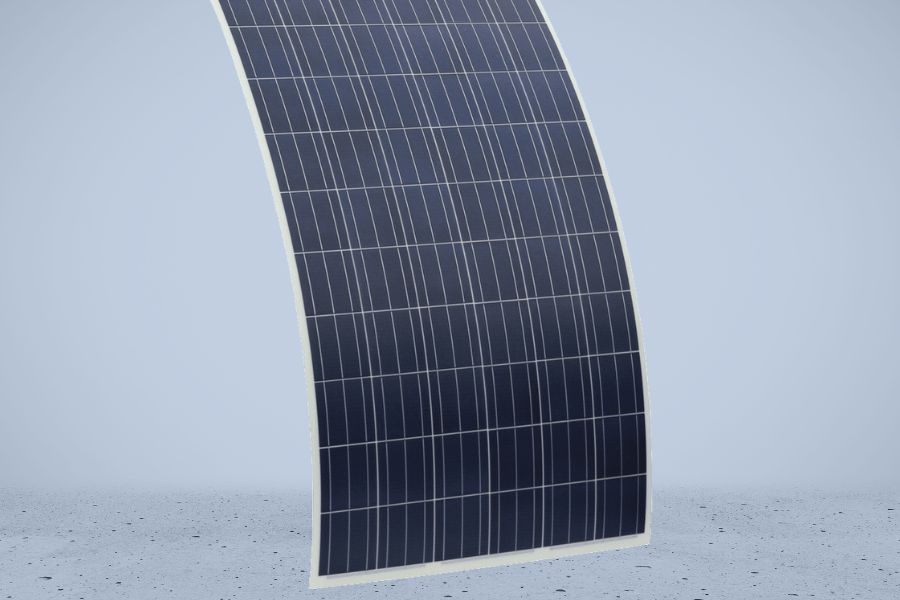
When choosing flexible solar panels, you will come across products with varying durability, ease of installation, solar cell efficiency, size, and weight. However, the power output is the most defining quality of flexible solar panels.
Not all solar cells have the same efficiency. The efficiency of flexible monocrystalline solar panels is higher than that of polycrystalline solar panels.
At the same time, thin-film solar panels offer better performance in low sunlight than the two crystalline flexible solar panels.
Size and weight also matter. If a flexible solar panel is too big or heavy, its flexibility will be less significant.
Without producing sufficient electricity, even the most flexible solar panels are only slightly better than duds. Panels that do not produce enough power to run your devices or appliances will be useless.
This is why you should place power output foremost on your scale of features.
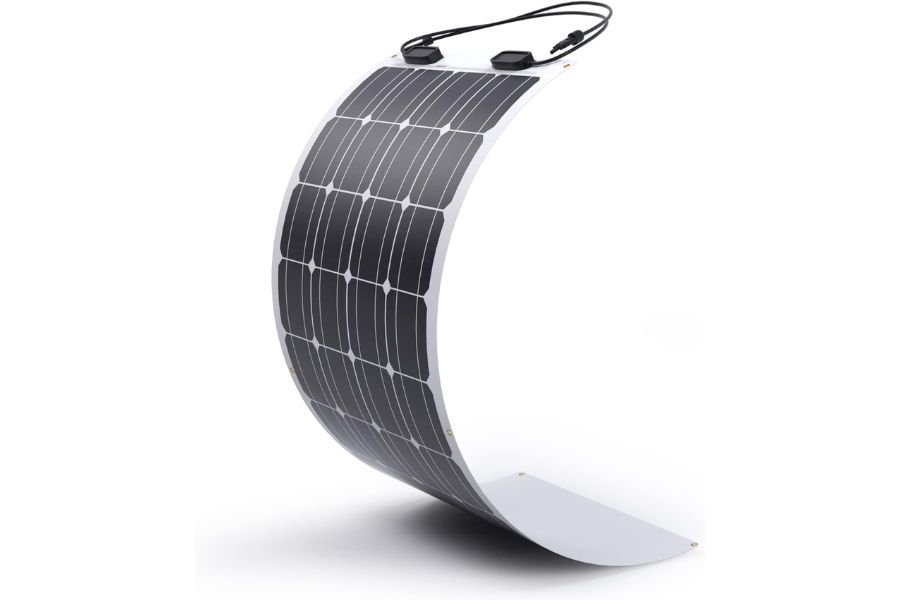
The Renogy Flexible Solar Panel impresses on all fronts. This is why we chose it as our overall best flexible panel.
This bendable solar panel offers the joint-highest power output, the joint-best durability, remarkable flexibility, high efficiency, and decent size & weight.
Our Review
Power
This flexible solar panel offers an output power of up to 100 watts – the highest output in the review. While some match this output, a few fall short by at least 50%.
This solar panel can power more than just mobile devices with a relatively high power output. You can power a radio, a small television, lamps, laptops, and other appliances with power consumption below 100 watts.
Remarkably, the junction box is rated IP 68. The only other product on our list with an ingress protection rating as high as this is the Lensun Flexible Solar Panel.
With this rating, the junction box is almost waterproof. Whether it rains or snows, you never have to worry about moisture damaging the box’s contents.
Besides its impressive level of water resistance, the Renogy Flexible Panels are the most flexible solar panels in our review. You can bend the panels through 248 degrees – none of the others come close.
Efficiency
This solar panel is about the same as the other flexible solar panels on our list regarding efficiency. It comes with monocrystalline solar cells like the rest. And, of course, these types of cells offer a higher output power per unit space than polycrystalline cells.
The rated efficiency should be in the 20-23% range – at least 4-10% higher than a polycrystalline cell can offer.
Installation
Unlike other solar panels, the installation of these panels is pretty uncomplicated. This ease of installation is partly due to the flexibility.
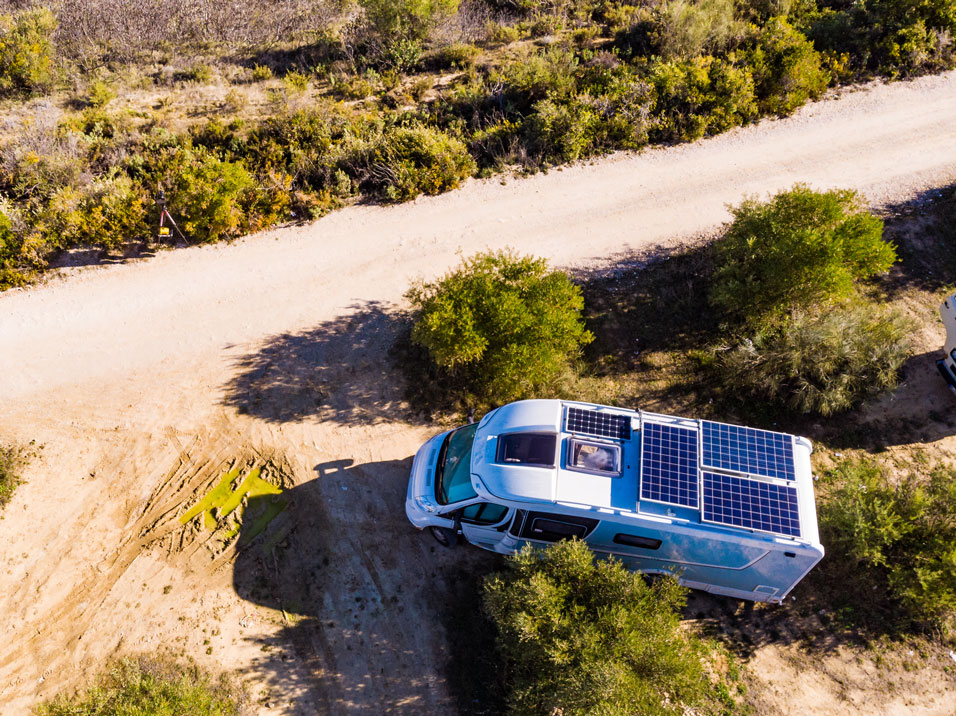
Whether you want to place this on curved or uneven surfaces or use it as your RV solar panel, it’s all straightforward.
Size and Weight
While it is the longest flexible panel in our review, it is also the thinnest. Knowing it is just about 0.08 inches thick, its high level of flexibility is not so surprising.
These bendable panels are not the lightest solar panels in our review. But it weighs just 4 pounds, which should not be hard to carry. Also, its weight is just about 25% of what traditional panels of equal size would weigh.
Pros
It offers the joint-highest power output.
Remarkable durability – offers the highest water resistance of all the reviewed flexible solar panels.
Highly efficient – more so than polycrystalline solar panels.
Bends through 248 degrees – more than any other flexible solar panel in our review.
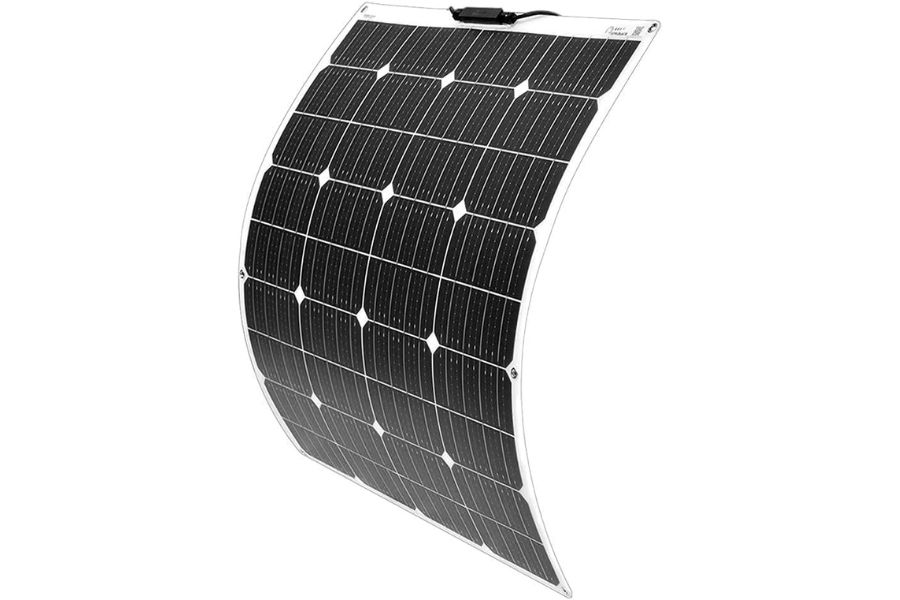
The Socentralar Flexible Solar Panels impressed on various fronts. From durability to power output and efficiency – it offers more-than-satisfactory performance on all fronts.
Our Review
Power
This solar panel offers up to 100 watts of solar power – the joint-highest of any reviewed products.
The high output power allows you to connect multiple small devices to the solar panel simultaneously. It also allows you to use devices that consume 100 watts or less.
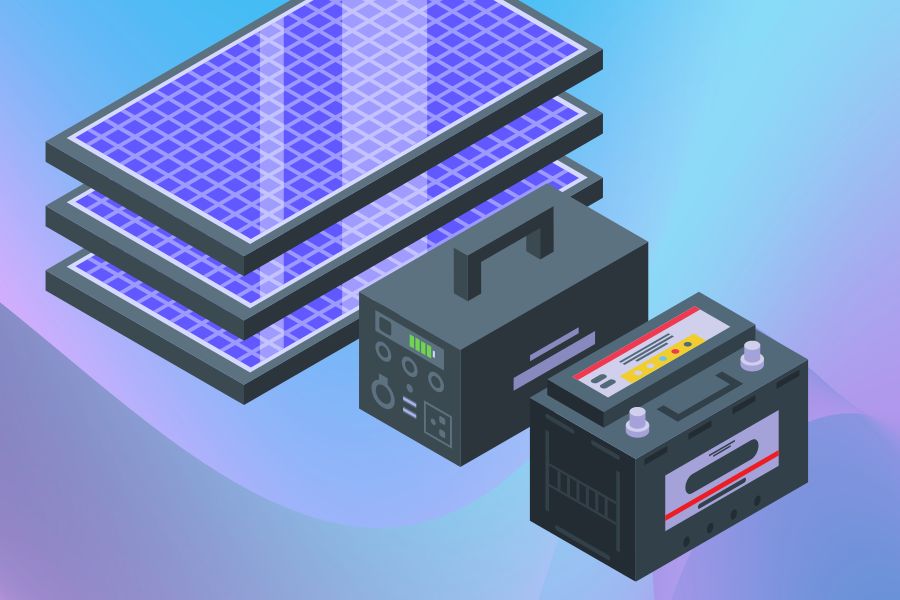
Besides directly powering devices, the panels can also charge batteries. Considering its high output power, it should charge your battery faster than other panels with lower outputs.
Durability
The junction box has an IP 67 rating. While this is still water-resistant, it is less than an IP68 rating.
Efficiency
The Socentralar runs on monocrystalline solar cells. So, its efficiency is pretty much assured.
The manufacturer states that the average conversion efficiency is 21%. Since the average conversion of polycrystalline cells is just about 13-16%, the rated efficiency of this product is pretty decent.
If you live in a region that does not get intense sunlight for a long period, you may want to consider thin-film solar panels over monocrystalline panels.
Installation
Like most solar panels that are flexible, the installation is pretty straightforward.
Unlike rigid solar panels, you can install flexible solar panels on various surfaces thanks to their flexibility.
The Socentralar is not the thinnest. But it isn’t the thickest either. So, if you are okay with something with moderate flexibility, this works fine.
As we said before, the ease of installing flexible solar panels is partly due to their flexibility. And since thicker solar panels are less flexible, they may not be the easiest to install.
This product weighs around 4.44 pounds – the heaviest of the review panels. But while it is the heaviest, its weight is not bad.
Pros
Offers the joint-highest energy output.
Its durability is impressive, especially its resistance to water.
It has an average conversion efficiency of 21%, above what you may get with a standard solar panel.
Installation is straightforward.
Cons
A longer connecting cable would have been preferable.
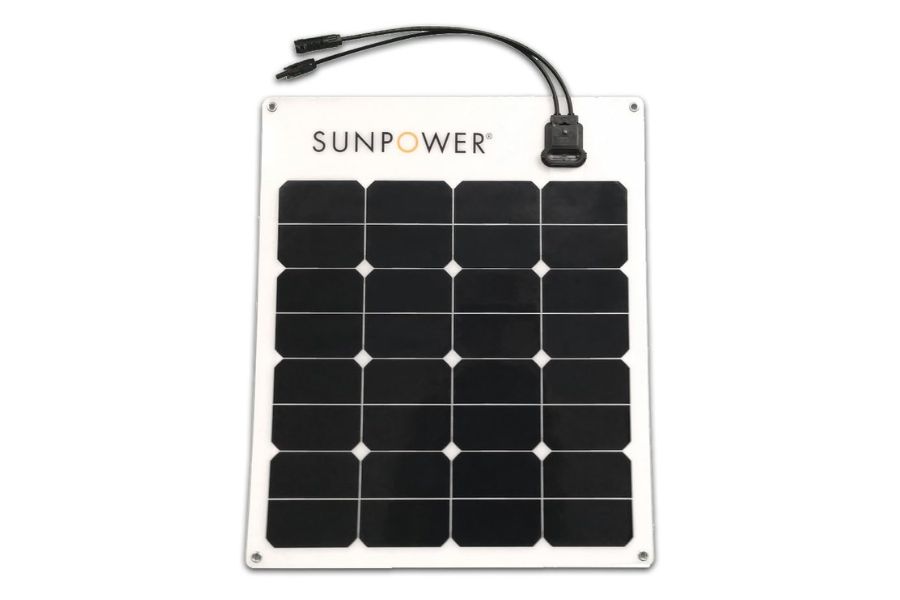
This small Sunpower solar panel offers remarkable durability, top-notch conversion efficiency, and a fair amount of power. These lightweight solar panels have the thickest dimension of the several solar panels we reviewed.
Our Review
Power
The power falls short of what you can get with some of the others. It can only match half of the power the top panels produce.
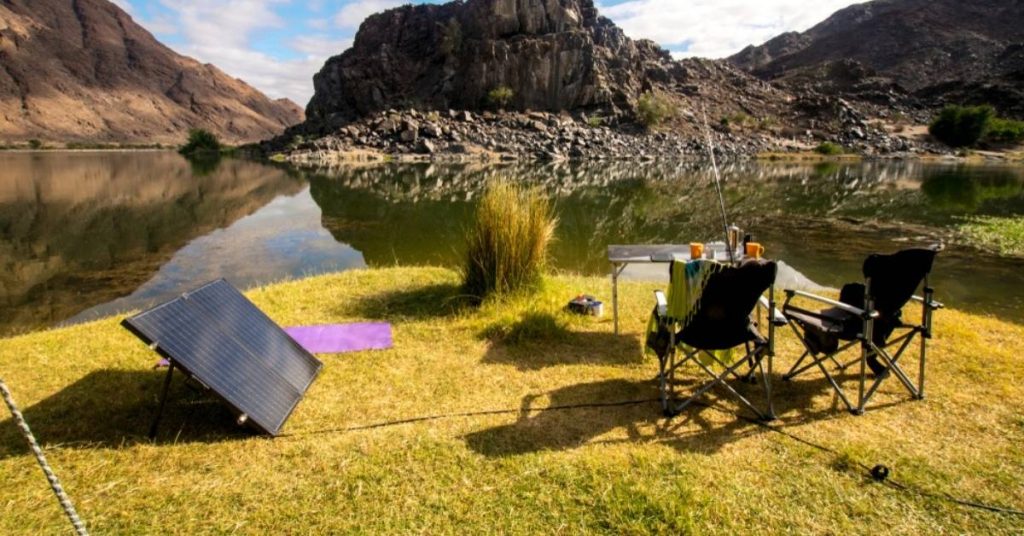
Nonetheless, it remains a good camping solar panel choice. It should power multiple mobile devices and can power larger devices whose power consumption exceeds 50 watts.
If you were to charge a battery, you should get a full charge within a relatively short period.
Durability
With an IP67 rating, we were expectant of an impressive level of water resistance, and we weren’t disappointed.
Efficiency
The SunPower uses efficient monocrystalline solar cells. It has a rated conversion efficiency of 23.5% – the second-highest amongst the reviewed products.
Going by the rated efficiency, it offers at least 7.5% to 10.5% more efficiency than polycrystalline photovoltaic cells. Then compared to the average monocrystalline solar panel, it offers around 3.5% to 8.5% more efficiency.
While monocrystalline cells are highly efficient, you may check out thin-film solar panels if you are bothered by low sunlight intensity.
Installation
As with others, installation is pretty easy. It fits pretty much anywhere you fix it, whether on a curved or flat surface.
Size and Weight
The SunPower panel weighs just 2.1 pounds, making it the second-lightest product on the list, just behind the Suner Power solar panel.
But while it is one of the lightest products we reviewed, it is the thickest. So, you may find that it is more of a semi-flexible solar panel. In other words, it is not as flexible as the others.
Pros
Produces a decent amount of solar power.
Highly water-resistant.
Has a rated conversion efficiency of 23.5% – one of the highest in the market.
Installation is pretty straightforward.
Cons
It could be thinner for more flexibility.
Longer connecting cables would have been even better.
4. Alrska 100 Watt Flexible Solar Panel 12V Monocrystalline
Credit:
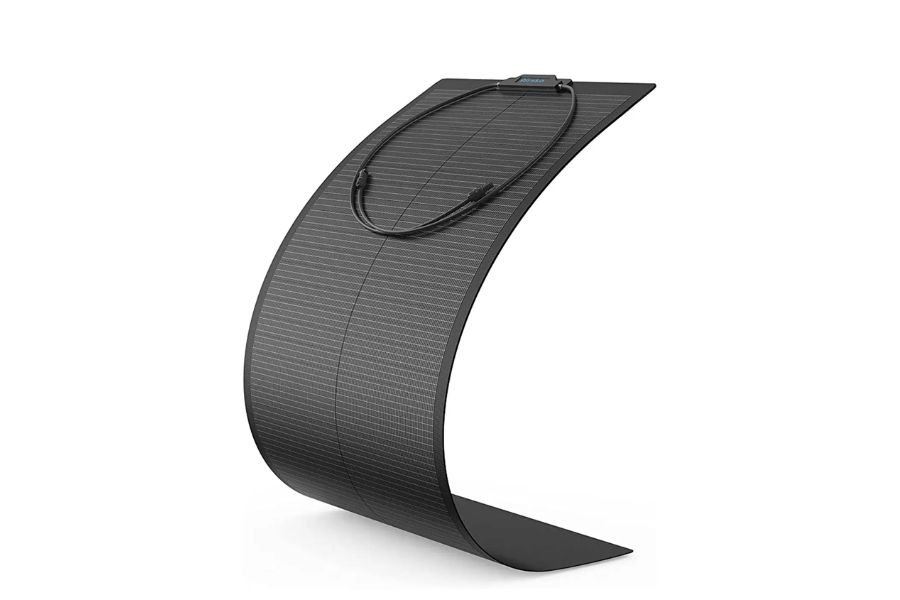
Alrska 100 Watt Flexible Solar Panel 12V Monocrystalline is one solar panel you cannot go wrong with. It ticks all the boxes, from flexibility to efficiency, durability, and power generation.
Our Review
Power
As its name has already been revealed, this flexible solar panel offers up to 100 watts of solar electricity. That output matches the highest among the products we assessed, which already tells of the quality it can offer.
With its wattage, you should be able to power multiple mobile devices simultaneously while charging a small battery pack or solar generator. So, you might want to take this along with you when going camping.
Durability
Being super flexible, this solar panel is not quite prone to damage by impact. So, you do not have to worry too much on that front. Then when it comes to protection against water ingress, it still does a great job.
We did a little test where we drizzled water all over the panel for about 10 minutes. Afterward, we tested if the panel was working fine, and it was. So, we’ll take the IP67 rating from the manufacturer.
Beyond water ingress protection, the panel features multiple circuit protections, particularly short circuit protection. More reasons why it is a very durable option.
With these features, the safety of the battery you power the panel with is pretty much assured.
Efficiency
As the name says, the Alrska 100 Watt Flexible Solar Panel 12V Monocrystalline uses monocrystalline solar cells. This means it is highly efficient – expect efficiency in the 20s (about 22% or more).
Installation
Installation is a breeze; being flexible makes this possible. The solar panel can conform to any surface you place on since it is one of the most flexible options. This removes the need to place the panel in a certain type of pot.
Size and Weight
Since it is quite flexible, you’ll expect this panel to be among the lightest on the list. But then it isn’t; it weighs around 4 pounds. Yet, a few others weigh that much. So, we wouldn’t think of the weight as a demerit.
Pros
It is very flexible.
Since it is the most flexible, it is the easiest to mount/install.
It is highly efficient.
It offers impressive power output.
Its water resistance is impressive.
Cons
Having multiple connection options would have made it even better.
5. Yuma 100W CIGS Thin-film Flexible Solar Panel with Tape (Long Version)
This CIGS solar panel stands out for its exceptional flexibility, bending up to 360 degrees where most others can’t. Beyond that bendability, it delivers solid power output and durable construction that makes it worth considering for camping or RV applications.
Our Review
Power
Looking for a backup power source or something reliable for camping trips? This thin film solar panel puts out approximately 100 watts at peak performance, enough to handle mobile devices and typical small appliances without breaking a sweat.
Charge times are respectable. A 300Wh battery or solar generator fills up in roughly 2-3 hours under moderate to strong sunlight.
Durability
Multiple circuit protection layers minimize the risk of damage to both the panel and whatever battery or generator you’ve connected. Still, proper use is your best defense against problems.
The waterproofing is thorough. Being the least rigid option in this lineup, it handles bending and flexing without complaint. Deformation during regular use isn’t something you’ll need to worry about.
Efficiency
Efficiency isn’t this panel’s strong suit. At 16% conversion, it lags behind most competitors we’ve tested.
That lower number appears to be the trade-off for the remarkable flexibility of these CIGS cells. You gain installation versatility but sacrifice some conversion performance.
Installation
A solar panel that bends 360 degrees removes most installation headaches. Mount it on curves, bends, irregular surfaces, or just about anywhere you need power.
Size and Weight
At around 4 pounds, this panel sits in the middle of the weight spectrum. Neither featherlight nor burdensome.
Given its extreme flexibility, the weight feels reasonable. You won’t struggle carrying it to your setup location.
Pros
Most flexible panel we’ve reviewed, bending up to 360 degrees
Strong 100W power output for its class
Multiple circuit protection and waterproof construction
The first impressive thing about the ALLPOWERS solar panel is its waterproof design. Another feature that impressed us was the efficiency. The power output was also massive.
Our Review
Power
The ALLPOWERS SF100 delivers a maximum output of 100W (±5%) with an open-circuit voltage of 30.6V. That means rapid charging for solar generators and batteries, compared to flexible solar panels with lower capacities.
The high output wattage means it can power relatively larger devices. You’re not limited to using it only for mobile devices and laptops.
Durability
We saw how well it resisted water ingress. Then we checked for its IP rating and were convinced about the IP68 rating. The fact that it uses ETFE material further convinced us.
Beyond water resistance, it also tolerates various regular ambient temperatures quite well.
Efficiency
This product might just be the most efficient one of the lot. Rated around 23% to 25%, none of the others come close.
Another thing: the panel is crafted with ETFE plastic, which allows high sunlight transmittance. So, we have a combination of high sunlight transmission and high solar conversion efficiency. The potential is just brilliant.
Installation
As you’d expect of a flexible solar panel, installation isn’t an issue. But with a flex of up to 260 degrees, this panel is even easier to mount than many others.
Size and Weight
We put the weight of the ALLPOWERS SF100 at around 4 pounds, pretty much the same as almost every other one. While it isn’t the most flexible, it’s close to the top.
Pros
The water resistance and overall durability are top-notch.
Its solar cell conversion efficiency is excellent.
Impressive sunlight transmittance
Flexible and very easy to mount
The power output is top-notch.
Cons
The warranty is not quite impressive.
Buyer’s Guide
Output Power
Your solar panel’s power determines how well it executes its prime purpose. If a solar panel does not produce enough solar energy to support your devices, its use will be limited.
Also, if the panel produces relatively low power, it only supports minimal loads. Then, when you try to charge a battery with it, the charging rate will be slow.
Going by the above, output wattage should be considered when buying flexible solar panels.
Solar Cell Efficiency
This feature is a bit straightforward. Solar panels with monocrystalline cells offer the highest efficiency. On average, their efficiency is about 15-20%. So, when you go shopping, keep an eye out for them.
While monocrystalline panels are great, you may want to check out thin-film panels if your region’s direct sunlight is limited.
Durability
Durability matters because flexible solar panels live outdoors, exposed to rain, UV light, wind, and temperature swings. These elements wear down materials over time, so choosing a panel built to last makes a real difference in how long your investment pays off.
A durable flexible solar panel resists deterioration and keeps producing power year after year. That translates to a longer lifespan and better value.
Water resistance is one of the most important durability factors. Look at the ingress protection (IP) rating when shopping. An IP67 rating means the panel can withstand temporary immersion in water, while an IP68 rating offers even better protection against prolonged exposure. Generally, the higher the IP code, the more weather-resistant the panel. A truly waterproof solar panel should carry at least an IP65 rating, but IP67 or IP68 is ideal for harsh conditions.
Beyond water resistance, the materials in the panel’s covering and backplane determine how well it handles heat and UV exposure. ETFE (ethylene tetrafluoroethylene) and TPT (Tedlar-polyester-Tedlar) are both excellent choices. They resist UV damage, tolerate high temperatures, and help extend the panel’s working life.
For reference, the Renogy 100W flexible panel is rated for wind loads up to 2400 Pa and snow loads up to 5400 Pa, showing how a well-built panel can handle real-world stress.
Size and Weight
Weight matters when you’re hauling a portable solar panel to a campsite or mounting one on your RV. A heavy panel limits where you can install it and how easily you can move it around.
Most 100W flexible panels weigh between 4 and 6 pounds, light enough to carry in a backpack or strap to a roof without extra reinforcement. The Renogy 100W lightweight solar panelfor example, weighs just 4 pounds and can flex up to 248 degrees, making it easy to mount on curved surfaces like boat decks or RV roofs.
Thickness affects flexibility directly. Thinner panels bend more easily, but they may sacrifice some durability. If you plan to mount your panel on a flat, rigid surface, a slightly thicker model might hold up better over time. For curved installations, prioritize thinner designs that conform to the surface without cracking.
FAQs
What Is the Most Efficient Flexible Solar Panel?
The most efficient flexible solar panels come with monocrystalline solar cells.
However, a thin-film solar panel would be effective in areas with low sunlight intensity. This is all thanks to the ability of thin-film solar cells to absorb light across a broad spectrum.
Do Flexible Solar Panels Last?
Well, flexible solar panels are not as physically durable as a traditional solar panel can be. And as expected, they do not last as long as traditional solar panels.
Generally, a flexible solar panel will last 10-15 years less than conventional solar panels.
Why Can’t Thin Flexible Solar Panels Fail?
The prime reason flexible solar panels fail is excessive flexing and bending. Granted, flexible panels were built to be flexible. But if one flexes them or bends them too much, the solar cells may crack. Of course, when the cells crack, the overall efficiency of your flexible solar panel will drop.
Besides excessive flexing and bending, scratches to the surface of a flexible solar panel may also lead to failure. As said before, flexible panels are not as durable as conventional panels. While the conventional types come with glass solar panels, the flexible types typically have plastic covering.
Of course, plastic coverings are not as rigid as glass coverings. So, scratches to the plastic coverings usually damage the cells of a flexible panel.
How to Clean Flexible Solar Panels?
You can clean flexible solar panels by wiping their surfaces gently with a soft cloth after applying a mild soap solution and water. This simple approach removes most dust, pollen, and light debris without risking damage to the delicate surface.
For stubborn stains like grease or bird droppings, apply a small amount of denatured alcohol to a microfiber cloth and carefully work the area until clean.
Avoid using abrasive materials at all costs. Brushes, scouring pads, or rough fabrics will scratch the protective coating and damage the underlying solar cells, which permanently reduces panel efficiency. Stick with soft cloths or sponges, and never apply excessive pressure when you clean solar panels of any type.
Final Take
Always go for flexible solar panels with high output wattages. But while doing that, ensure you pay attention to their efficiency, durability, and portability.
While it is desirable to have a panel that produces sufficient solar energy, having one that withstands harsh elemental conditions while maximizing power production is even more pleasing.
How useful was this post?
Click on a star to rate it!
Average rating 5 / 5. Vote count: 2
No votes so far! Be the first to rate this post.
We are sorry that this post was not useful for you!
Let us improve this post!
Tell us how we can improve this post?
adeyomola
Adeyomola loves the purity that comes with solar energy. He believes that with the yellow dwarf star already brimming with energy, the world does not need to deplete non-renewable energy sources. Especially since said energy sources might be harmful to our world.He has had hands-on experiences creating solar energy panels himself and has worked closely with solar engineers. In a bid to preserve environmental integrity, Adeyomola would rather walk certain distances instead of driving or taking a bus. He sometimes spends his free time planting and tending to plants or wondering why we underutilize the biggest star in our solar system.
10 Best Solar Panels for Camping in 2026 by Adeyomola May 24, 2021 Heads up: some links here are affiliate links, and purchases through them support the site. As an Amazon Associate I earn from qualifying purchases. With resources limited when you go camping, an unreliable solar panel will be more of a liability than an asset. The best solar panels for camping…
10 Best Solar Panels for RV in 2023 by Nick April 2, 2021 Heads up: some links here are affiliate links, and purchases through them support the site. As an Amazon Associate I earn from qualifying purchases. You’ve decided to build an RV, and your feelings of excitement are through the roof. Though in the back of your mind, you still feel a…
10 Best Portable Solar Panels in 2026 by Nick September 8, 2021 Heads up: some links here are affiliate links, and purchases through them support the site. As an Amazon Associate I earn from qualifying purchases. Portable solar panels provide steady power wherever it’s needed. Ideally, they will be lightweight, small enough to carry and resist outdoor elements. Many of the products…
8 Best Indoor Solar Lights in 2026 by Adeyomola June 30, 2021 Heads up: some links here are affiliate links, and purchases through them support the site. As an Amazon Associate I earn from qualifying purchases. Manufacturers compete on the range of brightness and panel quality of their indoor solar lights, but lighting times ultimately distinguish the best from the rest. The…
7 Best Solar Panel Kits With Battery and Inverter in 2026 by Adeyomola May 27, 2022 Heads up: some links here are affiliate links, and purchases through them support the site. As an Amazon Associate I earn from qualifying purchases. Undoubtedly, features like panel power output, charge controller type, inverter type, and durability are vital in solar panel kits. But peak conversion efficiency matters most regarding…
9 Best Solar Pool Heaters in 2026 by Adeyomola June 20, 2021 Heads up: some links here are affiliate links, and purchases through them support the site. As an Amazon Associate I earn from qualifying purchases. When buying solar pool heaters, people often give precedence to features like square footage, mounting type, water pressure limit, and the type of pool the solar…
Subscribe for handpicked DIY projects, exclusive tips, and giveaways.
There is something special about a mature tree. Decades of growth, shade that actually cools the house, branches that the kids climbed, a root system that has quietly held the yard together through every storm. So when circumstances force a move, whether it is a home renovation, a new driveway, or a construction project that… Read more: How to Move a Mature Tree Without Killing It: The Complete Relocation Guide
A mass energy conversion calculator lets you determine how much energy is locked inside any amount of matter using Einstein’s famous equation E=mc². Whether you’re working on a physics assignment or simply curious about the enormous energy potential in everyday objects, the calculation itself takes just seconds once you understand the formula’s three components: energy… Read more: How to Use a Mass Energy Conversion Calculator (Step-by-Step Guide)
Low voltage circuit protection in DIY solar systems boils down to matching the right fuse or breaker to your wire size and expected current, not to the capacity of your battery bank or inverter. Most fires and equipment failures happen when people oversize protection devices, thinking bigger is safer, when the opposite is true. Your… Read more: How to Size Low Voltage Circuit Protection for Your DIY Solar System