Community Solar Projects Made Simple: How You Can Share the Power (Even as a Renter)
Updated:
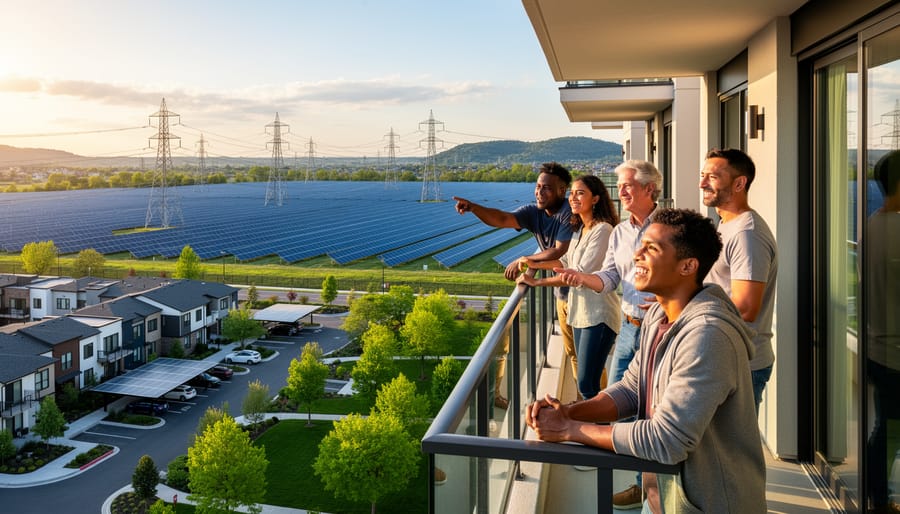
Picture this: You’re renting an apartment with a north-facing roof, or your property is shaded by towering oak trees, yet you’re determined to power your life with clean solar energy. Community solar makes this possible. Instead of installing panels on your own property, you buy or lease a portion of a larger solar array built elsewhere in your community—typically on open land, parking structures, or commercial rooftops—and receive credits on your electricity bill for the power your share produces.
I’ve watched this model transform solar access over the past decade. When I first started tinkering with solar panels in my garage, the technology felt exclusive to homeowners with perfect south-facing roofs and deep pockets. Community solar changed that equation entirely. Today, approximately 5 million American households participate in these shared solar programs, with that number growing by roughly 30% annually.
The mechanics are surprisingly straightforward. A developer builds a solar farm ranging from 100 kilowatts to several megawatts. Local residents subscribe to a portion—maybe enough panels to offset 50% or 100% of their home electricity use. Each month, the solar farm generates power that feeds directly into the grid, and subscribers receive credits that reduce their utility bills, typically saving 5-15% compared to standard electricity rates.
What excites me most is the democratic nature of this approach. Whether you’re in an apartment, own a heavily shaded property, or simply don’t want the maintenance responsibilities of rooftop panels, community solar opens the door. This guide will walk you through understanding how these projects work, finding and joining one in your area, evaluating whether the financial benefits make sense for your situation, and even exploring how to initiate a community solar project if none exists nearby.
What Exactly Is a Community Solar Project?
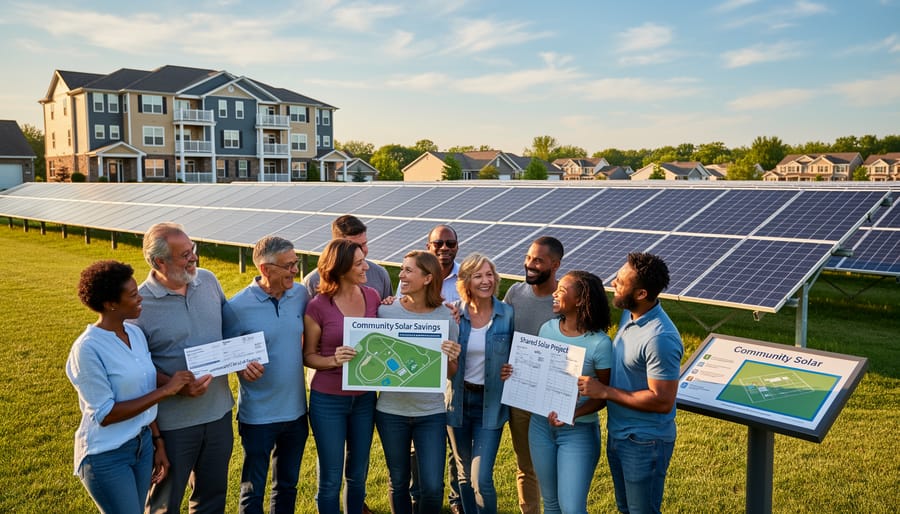
Community solar projects allow multiple households to share the benefits of a single solar installation, making renewable energy accessible to renters and those unable to install rooftop panels.
How the Energy Credits Actually Work
Here’s the thing that surprised me when I first learned about community solar: you’re not actually getting electricity delivered from “your” solar panels to your home. I know, it sounds counterintuitive! But the way it works is actually pretty clever.
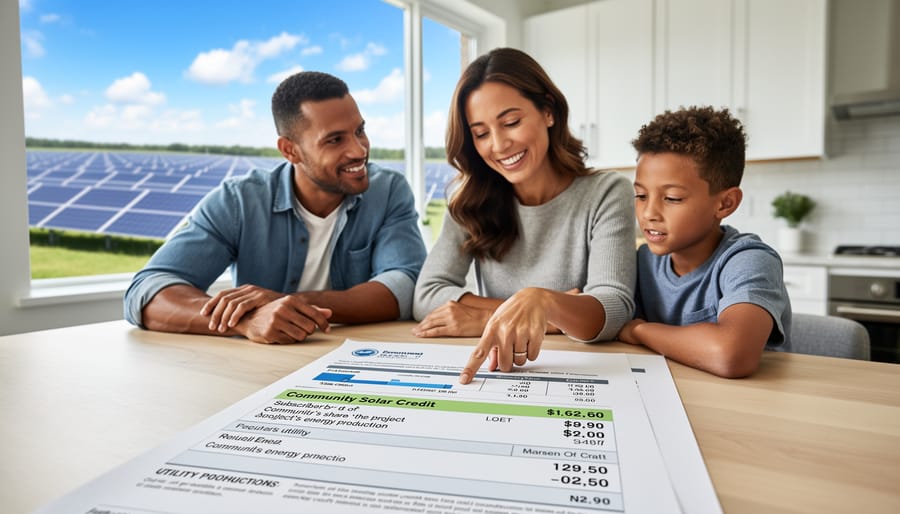
Community solar operates through something called virtual net metering or bill credits. Essentially, the solar farm generates electricity that goes into the general power grid, just like grid-tied solar systems do on residential rooftops. The utility company then tracks how much energy your allocated portion of the community solar array produced that month.
Here’s a simple example: Let’s say you subscribe to a portion of a community solar project that produces 500 kilowatt-hours (kWh) per month. Your regular electric bill shows you used 700 kWh at your home. The utility will credit you for those 500 kWh of solar production, so you only pay for the remaining 200 kWh at the standard rate.
The real savings comes from how those credits are priced. Typically, you’ll pay the community solar provider about 10-15% less than what your utility charges per kWh. So if your utility rate is 14 cents per kWh, you might pay the solar project 12 cents per kWh for those credits. That 2-cent difference on 500 kWh saves you $10 monthly with zero upfront investment or maintenance headaches.
Who Can Benefit Most
Community solar opens doors for folks who’ve felt locked out of the solar revolution, and honestly, that’s what makes it such a game-changer. Let me share who benefits most from this approach.
If you’re renting an apartment or home, community solar might be your golden ticket. You can support renewable energy and reduce your electricity costs without needing permission from a landlord or worrying about moving away from an investment you can’t take with you. The same goes for condo owners who don’t control their building’s roof decisions.
I’ve talked with plenty of homeowners whose properties just aren’t ideal for rooftop panels. Maybe your roof is heavily shaded by mature trees you’d never dream of cutting down, or perhaps it faces the wrong direction. Community solar sidesteps these limitations entirely since you’re subscribing to a solar farm built in an optimal location.
Budget constraints are another big factor. A full rooftop system requires significant upfront investment, even with financing options. Community solar typically involves no installation costs and lets you start small, subscribing to just a portion of a solar array that fits your budget.
Finally, if you’re environmentally conscious but not particularly handy or interested in maintaining your own system, community solar offers the perfect solution. You get clean energy benefits and utility savings without climbing on your roof or troubleshooting inverters. It’s renewable energy made accessible for everyone.
The Real Benefits (Beyond Just Lower Bills)
Financial Perks Without the Upfront Investment
Here’s what really gets me excited about community solar: you get genuine financial benefits without writing a check for $15,000 to $25,000 upfront like you would with rooftop panels. I learned this the hard way when pricing out my own system years ago and realizing the barriers many folks face.
Most community solar subscribers save between 10-15% on their electric bills right from month one. No installation costs, no financing headaches, just straightforward savings. You’re essentially getting a discount on the electricity you’re already using, which makes budgeting much simpler than wondering if your decade-long solar loan will actually pay off.
The maintenance piece is huge too. With rooftop solar, you’re responsible when panels need cleaning, inverters fail, or that surprise hailstorm causes damage. Community solar? That’s all handled by the project operator. Zero surprise repair bills showing up when you least expect them.
Plus, your energy costs become predictable. Unlike shared solar installations that require significant planning, community solar gives you fixed subscription rates that don’t fluctuate with utility price hikes.
Compare this to traditional rooftop solar: yes, owning panels can eventually deliver bigger long-term savings after 7-10 years, but you need that substantial upfront capital, suitable roof conditions, and homeownership stability. Community solar removes those barriers entirely while still putting renewable energy money back in your pocket immediately. It’s not quite the DIY spirit we usually celebrate here, but it’s practical empowerment for real-world situations.
Subscribers receive credits on their regular utility bills based on their share of the community solar project’s energy production.
Making Solar Accessible for Everyone
Community solar breaks down the biggest barriers that keep people from going solar. I remember talking with Maria, a teacher renting an apartment downtown, who felt left out of the solar revolution. Traditional rooftop installations simply weren’t an option for her. Community solar changed that story completely.
Here’s the beautiful part: community solar projects actively prioritize accessibility. Many programs reserve portions of their capacity specifically for low-to-moderate income households, offering subscription rates below retail electricity prices. Some states even mandate that a certain percentage of community solar must serve income-qualified participants, turning renewable energy from a luxury into a genuine right.
The subscription model itself is inherently more democratic. Instead of needing tens of thousands of dollars upfront for rooftop panels, you can join a community solar project with little to no initial investment. You simply subscribe to a portion of the solar farm’s output and receive credits on your utility bill. It’s renewable energy made as accessible as signing up for any other service.
This approach also addresses geographic inequity. Renters, condo owners, people with shaded roofs, and those in multifamily buildings all gain equal access to solar savings. Community solar doesn’t care about your roof condition or your credit score, it just needs your commitment to cleaner energy and a fairer energy future for everyone.
Your Environmental Impact, Multiplied
Here’s something that surprised me when I first joined a community solar project: my small subscription was making a bigger difference than I’d imagined. Even though I was only subscribed to a portion of the solar farm’s output, the environmental benefits added up quickly.
Let’s put this in perspective with numbers that actually mean something. A typical community solar subscription offsetting 6,000 kWh annually is equivalent to planting about 100 trees each year or taking half a car off the road. Over a 25-year project lifespan, that’s like planting a small forest of 2,500 trees.
Think of it this way: while you might not have solar panels on your roof, you’re still directly supporting clean energy generation. Every kilowatt-hour your subscription covers is one less kilowatt-hour generated by fossil fuels. The grid doesn’t care where your renewable energy comes from, it just knows there’s more clean power flowing.
Many community solar programs provide dashboards showing your real-time environmental impact, tracking your carbon offset month by month. It’s incredibly motivating to watch those metrics grow.
How to Join a Community Solar Project in Your Area
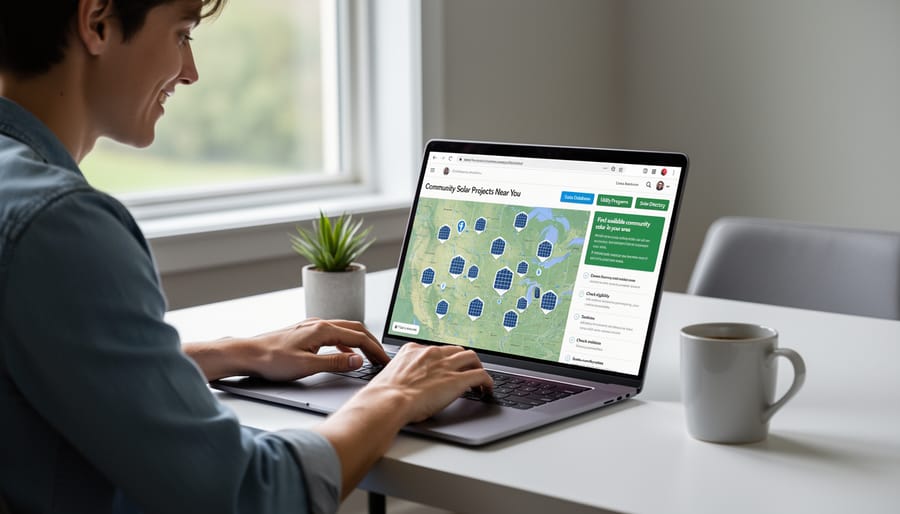
Finding available community solar projects in your area starts with online research through state databases, utility websites, and solar directories.
Finding Available Projects Near You
Ready to join a community solar project but not sure where to start looking? I remember when I first explored this option for my rental property—it felt like searching for a needle in a haystack. Fortunately, there are several reliable resources that make finding local programs much easier than it used to be.
Your best starting point is your state’s energy office website or public utilities commission database. Many states maintain directories of approved community solar projects, complete with eligibility requirements and enrollment information. The Department of Energy’s Community Solar Hub also offers a searchable database covering programs nationwide.
Don’t overlook your utility company’s website. Many utilities either run their own community solar programs or list approved third-party projects in their service area. I’ve found that a quick call to customer service can sometimes reveal upcoming projects that aren’t widely advertised yet.
Online platforms like EnergySage and Community Solar Hub provide comprehensive directories where you can compare projects side-by-side, check pricing structures, and read reviews from current subscribers. These tools work similarly to comparison shopping for any service—extremely helpful for making informed decisions.
Regional solar cooperatives and local environmental organizations often know about smaller, community-led initiatives that might not appear in official databases. Check Facebook groups or Nextdoor for your area too.
Minnesota, New York, Massachusetts, Colorado, and Illinois currently lead the nation with the most developed community solar programs, though more states are adding options every year. If you’re in one of these states, you’ll likely find multiple projects to choose from.
Questions to Ask Before You Subscribe
Before you sign on the dotted line, take a moment to ask your potential provider some important questions. I learned this lesson the hard way when I almost locked myself into a 25-year contract without understanding the exit terms—trust me, reading the fine print matters!
Start with the basics: What’s the contract length, and can you cancel early if needed? Most community solar agreements run between 1 to 25 years, and cancellation policies vary wildly. Some providers let you out with 30 days notice, while others charge hefty fees or lock you in until you move out of the service area.
Next, dig into the numbers. Ask exactly how much you’ll save—is there a guaranteed percentage off your utility bill? What fees do they charge, if any? Some programs have enrollment fees or monthly service charges that can eat into your savings. Request a sample bill so you can see the math clearly.
The moving question is crucial: What happens if you relocate? Can you transfer your subscription to someone else, or are you stuck paying for energy at your old address? Many providers allow transfers within their service territory, but policies differ.
Finally, ask about credit requirements. While community solar opens doors for people who can’t install rooftop panels, some providers still run credit checks. Others welcome participants regardless of credit score, making clean energy truly accessible to everyone. Don’t be shy about asking—these are reasonable questions that any reputable provider should answer transparently.
The Sign-Up Process Demystified
Getting started with community solar is refreshingly straightforward, especially compared to the complexity of installing your own rooftop system. When I first signed up for my local project three years ago, I was pleasantly surprised at how simple the process was—it took me about 15 minutes from start to finish.
Most providers will ask you to provide a recent utility bill and proof of address, like a driver’s license or lease agreement. The utility bill helps them verify your account and estimate your energy usage, ensuring they allocate the right number of solar credits to match your needs. Some programs may also require a credit check if you’re entering into a long-term subscription agreement, though many don’t.
Once you’ve submitted your paperwork, expect a waiting period of anywhere from two weeks to three months before you start seeing credits on your bill. This timeline depends on whether the solar farm is already operational or still under construction. Your first bill with credits will clearly show your subscription charge and the offsetting solar credits, making it easy to track your savings.
The biggest pitfall? Not reading the cancellation terms carefully. Life changes happen, and you’ll want to know exactly what moving or exiting the program looks like before committing.
Starting Your Own Community Solar Initiative
Gauging Interest and Building Your Team
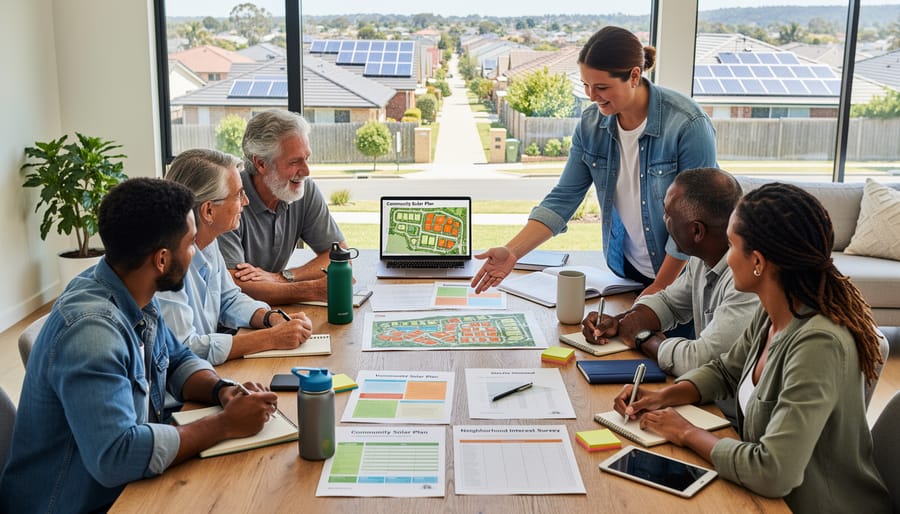
Before diving into the logistics, you’ll want to make sure there’s genuine interest in your neighborhood. I remember when I first floated the idea at a local coffee shop—three conversations turned into fifteen interested households within a week! Start by hosting an informal meeting at a community center or even your backyard. Gauge how many people are curious versus truly committed.
Once you’ve identified interest, form a core team of 3-5 dedicated individuals. You’ll need someone to coordinate everything (that’s your organizer), a technical advisor who understands solar basics and can communicate with installers, and a financial coordinator to track contributions and manage paperwork. Don’t worry if one person wears multiple hats initially—that’s completely normal.
Reach out to existing local environmental groups, neighborhood associations, or sustainability committees. These networks already have engaged members and communication channels you can tap into. They’ve done the hard work of building trust, which is invaluable when you’re asking neighbors to invest in something new together. Many groups are thrilled to support renewable energy initiatives and can help spread the word, host meetings, or even contribute organizational resources. Remember, community solar succeeds because of people power—leverage every connection you have.
Starting a community solar initiative begins with gathering interested neighbors and forming a core organizing team to assess local demand and coordinate development.
Understanding the Legal and Financial Framework
Before you jump into creating a community solar project, let’s talk about the business side of things. I’ll be honest, when I first looked into this, the legal and financial stuff felt overwhelming. But here’s the thing: you don’t need a law degree to understand the basics, and you absolutely should consult with experts when you’re ready to make decisions.
Most community solar projects follow one of three business models. Subscription-based models are the most common, where participants pay a monthly fee to subscribe to a portion of the solar array and receive credits on their utility bills. Ownership share models let you actually buy a piece of the system upfront, giving you long-term benefits. Nonprofit models work great for community groups focused on broader environmental goals rather than individual returns.
The regulatory landscape varies wildly by state. You’ll need to navigate interconnection agreements, which are essentially contracts with your utility company that allow the solar system to connect to the grid. Some utilities are incredibly supportive, while others make it challenging. Check your state’s net metering policies and community solar regulations early in your planning process.
Financing options are more diverse than you might think. Federal and state grants can cover significant startup costs, especially for projects serving low-income communities. Traditional loans, green energy bonds, and crowdfunding platforms have all successfully funded community solar projects. The key is matching your funding approach to your business model and community needs. Consider working with a consultant who specializes in renewable energy financing to explore what makes sense for your specific situation.
Site Selection and System Design Basics
Finding the right spot for your community solar installation is where the dream starts becoming reality. I’ve seen successful projects on everything from unused municipal land to the flat roofs of community centers and local churches. The key is finding a location with good sun exposure (ideally south-facing with minimal shade), structural integrity if roof-mounted, and accessibility for maintenance.
System sizing requires understanding your community’s collective energy needs. Start by gathering approximate monthly electricity usage from participating households. A professional installer can help translate this into kilowatt capacity, but a rough estimate is that a typical 5-kilowatt system produces about 6,000-8,000 kilowatt-hours annually, depending on your location. Don’t forget to consider future needs like battery storage systems if your community wants backup power capabilities.
Here’s where I always remind people: community solar absolutely requires professional installation. Safety, permitting, and grid interconnection aren’t DIY territory. However, your community can stay deeply involved through site preparation, fundraising coordination, and ongoing monitoring. Think of it as collaborative solar rather than purely DIY, and you’ll maintain that empowering community spirit while ensuring a safe, compliant installation.
Resources and Organizations That Can Help
Getting started with community solar is easier when you’ve got the right support. Several national organizations offer practical help for both participants and organizers. The Coalition for Community Solar Access provides toolkits and policy updates to help navigate the landscape. The Rocky Mountain Institute has published excellent case studies showing how projects succeed in different regions, which I found incredibly helpful when researching options in my area.
For hands-on guidance, the Solar Energy Industries Association offers templates and best practices for launching projects. Local organizations matter too. Check with your state’s Clean Energy Coalition or regional sustainability networks for area-specific resources and potential seed funding opportunities.
Look into successful projects like the Sacramento Valley Community Solar program or Minnesota’s community solar gardens. These real-world examples show what’s possible and provide valuable lessons. Many offer transparent data about their development process, costs, and community engagement strategies that you can learn from as you explore participating or starting your own initiative.
Common Challenges and How to Navigate Them
When Savings Don’t Match the Hype
I learned this lesson the hard way when my first community solar subscription promised 15% savings, but my actual credits fluctuated wildly month to month. Here’s the reality: community solar savings aren’t always guaranteed.
Most programs base your credits on the solar farm’s actual production, which varies with weather and seasons. A cloudy summer might mean lower credits than promised. Additionally, some programs charge subscription fees or use credit rates that don’t quite match your utility’s retail rates, eating into your savings.
Before committing, grab a calculator and do the math yourself. Take your average monthly electricity bill and multiply it by the promised savings percentage. Then subtract any monthly subscription fees. If the result is less than $10-15 per month, you’re probably better off skipping it unless your main motivation is environmental impact rather than financial savings.
Ask providers for actual performance data from their existing solar gardens, not just projections. Request a breakdown showing exactly how credits are calculated and whether rates are fixed or variable. A reputable program will happily share this information. If they dodge these questions, that’s your cue to walk away and find a more transparent option.
Dealing with Long Waitlists
Here’s the reality: popular community solar programs often have waitlists stretching months or even years. I learned this the hard way when I first tried signing up in my area. High demand meets limited project capacity, especially in states with strong incentive programs.
Don’t let waitlists discourage you. While waiting, consider joining your utility’s green power program or exploring portable solar options for immediate renewable energy access. The smartest strategy? Get on multiple waitlists simultaneously. Most programs don’t penalize you for being on several lists, and you can always decline when your spot comes up.
Check back quarterly with program administrators. Projects expand, new developments launch, and subscriber turnover happens more often than you’d think. I’ve seen friends move from position 200 to enrolled within six months. Set calendar reminders to revisit waiting lists and explore newly launched projects in neighboring utility territories. Your persistence will pay off.
What Happens If the Project Fails?
This is honestly one of my biggest concerns when I talk to folks about community solar, and it’s absolutely worth addressing head-on. I’ve seen a couple of projects stumble over the years, though thankfully outright failures are rare when you choose established developers.
Most legitimate community solar projects come with solid consumer protections built in. Your subscription agreement should clearly outline what happens if the array stops producing power or the developer goes under. In many cases, state regulations require developers to maintain insurance and performance bonds that protect subscribers. Before signing anything, ask specifically about these safeguards.
Here’s what I always tell my neighbors: vet your developer like you’re hiring a contractor for your home. Check how long they’ve been in business, look up their track record with existing projects, and read reviews from current subscribers. Established companies typically have 5-10 years of operational history and multiple functioning arrays. Don’t be shy about asking for references.
The good news? Most projects are backed by substantial investment, and developers have strong financial incentives to keep them running smoothly. Many also transfer ownership to utility companies or infrastructure funds that specialize in long-term management.
If you’re feeling uncertain, start with a month-to-month subscription rather than a long-term contract. It gives you flexibility while you build confidence in the project’s stability.
Community Solar vs. DIY Rooftop Solar: Which Is Right for You?
Here’s the honest truth: there’s no one-size-fits-all answer to the solar question. Both community solar and traditional rooftop solar installation have their place, and the right choice depends entirely on your situation.
I learned this firsthand when my neighbor Sarah came over excited about going solar. She assumed I’d immediately recommend DIY panels, but after talking through her circumstances—she’s renting, plans to move in two years, and her apartment has a shaded roof—community solar was clearly her best option. Meanwhile, my own home with its south-facing roof made DIY installation the winner for me.
Let’s break down how these options compare:
Community solar shines when you’re renting, have a shaded or unsuitable roof, can’t afford upfront installation costs, or simply don’t want the maintenance responsibility. You get immediate savings without tools, permits, or weekend ladder work. The downside? Your savings are typically smaller (10-15% off electricity bills), you don’t increase property value, and you’re dependent on your utility’s program availability.
DIY rooftop solar wins if you own your home, have good roof conditions, can handle the upfront investment, and enjoy hands-on projects. You’ll see bigger long-term savings (often 50-70% reduction in electricity costs), increase your home’s value, and have complete system control. The tradeoffs include higher initial costs, installation effort, ongoing maintenance, and dealing with permits and regulations.
Here’s a simple framework: If you answered yes to “Do I own my home?” and “Is my roof suitable?” then explore DIY options using tools like the Spheral Solar calculator to estimate costs and savings. If either answer is no, community solar is likely your path to clean energy.
The beautiful part? Both options contribute to renewable energy adoption. Community solar democratizes access to solar power, while DIY installations inspire neighbors and prove solar’s viability. Some homeowners even do both—DIY panels on their garage while subscribing to community solar for additional credits.
The key is taking action rather than waiting for perfect conditions. Whether you’re tightening panel bolts or signing a subscription agreement, you’re moving toward energy independence.
Here’s what gets me excited about community solar: it’s proof that renewable energy isn’t an exclusive club. I remember when I first got into solar, feeling frustrated that so many people couldn’t participate because they rented, lived in shaded areas, or simply couldn’t afford the upfront costs. Community solar changes that entire conversation.
Whether you’re signing up for a share in an existing project or gathering neighbors to start something new in your area, you’re doing something genuinely important. You’re showing that clean energy doesn’t require a perfect south-facing roof or a hefty bank account. You’re part of a movement that’s making solar accessible to apartment dwellers, renters, folks with older roofs, and anyone who’s been told “solar isn’t for you.”
And honestly? That collaborative spirit is exactly what we need more of. Every kilowatt-hour generated by community solar farms is a small victory for accessibility and sustainability.
So here’s my challenge to you: take the next step. Research community solar options in your state. Run the numbers on potential savings. If you’re feeling ambitious, reach out to your neighbors about starting a project together. And whatever you discover, share it in the comments below. Your experience might be exactly what someone else needs to hear to take their own leap into renewable energy. Solar power belongs to all of us, and community solar proves it every single day.
How useful was this post?
Click on a star to rate it!
Average rating 0 / 5. Vote count: 0
No votes so far! Be the first to rate this post.
We are sorry that this post was not useful for you!
Let us improve this post!
Tell us how we can improve this post?
charlesnoble
Here at Spheral Solar, I’m a hands-on solar power enthusiast, constantly exploring and experimenting with DIY solutions. I’m dedicated to sharing my discoveries, insights, and even the bumps I hit along the way, all in the pursuit of a more sustainable future.
Growing Crops Under Solar Panels Actually Works… by Charlesnoble April 3, 2026 Imagine doubling the productivity of your land by growing crops and generating electricity in the same space. That’s exactly what agrivoltaics makes possible—and it’s not just for large-scale farms anymore. An agrivoltaic system combines solar panels with agriculture, mounting photovoltaic arrays high enough that crops, livestock, or pollinator habitats can…
Turn Your Home’s Exterior Into a Power Plant With BIPV Solar by Charlesnoble February 19, 2026 Picture this: your home’s windows generating electricity while you admire the view. Your patio awning powering your outdoor lights as it shades your afternoon barbecue. Your garage door collecting energy every time the sun hits it. This isn’t science fiction – it’s building integrated photovoltaics, and it’s transforming how we…
Why Your Electric Vehicle Needs Solar Panels (And… by Charlesnoble January 19, 2026 Picture yourself pulling into a campsite after hours on the road, your electric vehicle’s battery sitting at 40%, and the nearest charging station is twenty miles back. Now imagine your EV quietly replenishing its own power from panels mounted right on the roof while you set up camp. This isn’t…
Why CSP Solar Never Made It Into Your Backyard (And… by Charlesnoble January 30, 2026 When you see massive solar installations in the desert generating headlines, they’re often concentrating solar power plants—but the panels on your neighbor’s roof? Those are photovoltaics, and understanding the distinction matters more than you might think. Concentrating solar power uses mirrors or lenses to focus sunlight onto a receiver, creating…
Grid-Tied Solar: Why Most DIYers Choose It (And When… by Charlesnoble November 8, 2025 Imagine flipping a switch and watching your electric meter spin backward while your solar panels pump clean energy into the grid—earning you credits that slash your utility bill to nearly zero. That’s the everyday reality of grid-tied solar, the most popular solar setup in America, powering millions of homes and…
Floating Solar Panels Could Change Where You Generate Power by Charlesnoble November 29, 2025 Picture your backyard pond doing double duty: supporting wildlife while generating clean electricity for your home. That’s the promise of floating solar panels, an innovation that’s transforming how we think about renewable energy installation. Floating solar systems, also called floatovoltaics, mount photovoltaic panels on buoyant platforms that rest on water…
Subscribe for handpicked DIY projects, exclusive tips, and giveaways.
Route your PV wires through UV-resistant conduit within 18 inches of leaving the solar array, securing it every 3 feet with proper clamps to prevent wind damage and code violations. This single step prevents 80% of the wire degradation issues I’ve seen in DIY solar installations over the past decade. Group your positive and negative… Read more: Why Your PV Wire Management Could Fail Inspection (And How to Fix It)
Understand that 6000 volts sounds terrifying but delivers surprisingly low amperage—typically around 120 milliamps for just 3/10,000th of a second per pulse. This combination creates an unforgettable shock that trains animals to avoid the fence without causing lasting harm. The voltage pushes current through thick fur and hide, while the minimal amperage and microsecond duration… Read more: Why 6000 Volts Won’t Kill Your Livestock (But Will Stop Predators Cold)
Check the maximum voltage and current ratings first—these determine whether your controller can actually handle your solar panel array without frying itself on the first sunny day. I learned this the hard way when my first DIY system shut down every afternoon because I’d paired 600 watts of panels with a controller rated for only… Read more: Why Your Solar Setup Needs Both a Charge Controller and Inverter (And How to Pick the Right Ones)