This Massive Off-Grid Solar System Powers an Entire Mountain Lodge
Updated:
Imagine powering an entire remote community with nothing but sunshine – that’s exactly what the world’s largest off-grid solar installations achieve today. These engineering marvels, some exceeding 100 megawatts in capacity, are revolutionizing how we think about off-grid solar fundamentals and energy independence. From Australia’s massive Pilbara mine site installation to remote Alaskan villages, these solar giants combine cutting-edge battery storage, sophisticated power management systems, and vast arrays of photovoltaic panels to deliver reliable electricity where traditional power grids can’t reach.
Unlike conventional solar farms, these autonomous power stations must balance generation, storage, and consumption with perfect precision – there’s no grid backup to rely on when clouds roll in. They represent the pinnacle of renewable energy engineering, incorporating redundant systems, weather prediction algorithms, and smart load management to maintain consistent power delivery in the most challenging environments.
Whether you’re planning a homestead system or researching utility-scale solutions, understanding how these massive installations work provides invaluable insights into creating reliable, sustainable power anywhere on Earth. Let’s explore the technology, design principles, and real-world applications that make these solar titans possible.
Understanding Large-Scale Off-Grid Solar Systems
Key Components of Massive Off-Grid Systems
When building massive off-grid solar systems, getting the solar panel selection right is just the beginning. These systems require several key components working together seamlessly to deliver reliable power. Let me walk you through the essential parts you’ll need, based on my experience setting up large-scale installations.
First up are the solar panels themselves, typically arranged in extensive arrays. For massive systems, you’ll want high-efficiency panels rated at 400W or higher, arranged in multiple strings to optimize power generation throughout the day. I’ve found that using microinverters or power optimizers on each panel helps maximize output, especially in partial shade conditions.
The battery bank is your system’s heart. For large off-grid setups, lithium iron phosphate (LiFePO4) batteries are becoming the go-to choice. They offer better depth of discharge, longer lifespan, and safer operation compared to traditional lead-acid batteries. A typical massive system might need 100kWh or more of storage capacity.
Don’t overlook your inverter system – it’s crucial for converting DC power from your panels and batteries into usable AC power. For big installations, you’ll want robust hybrid inverters rated at 10kW or higher. Many of my clients opt for multiple inverters in parallel for redundancy and easier maintenance.
Lastly, a smart charge controller is essential for managing power flow between your panels, batteries, and loads. Modern MPPT controllers can handle high voltages and currents while maximizing charging efficiency.
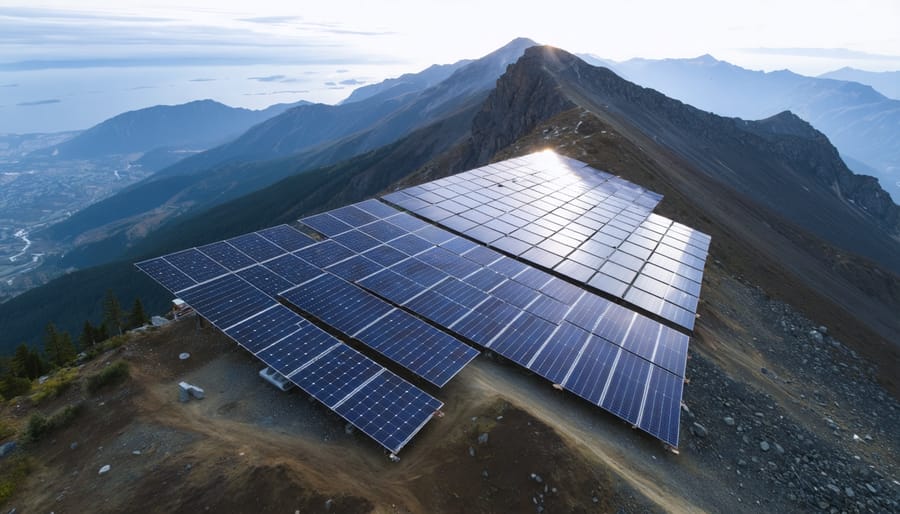
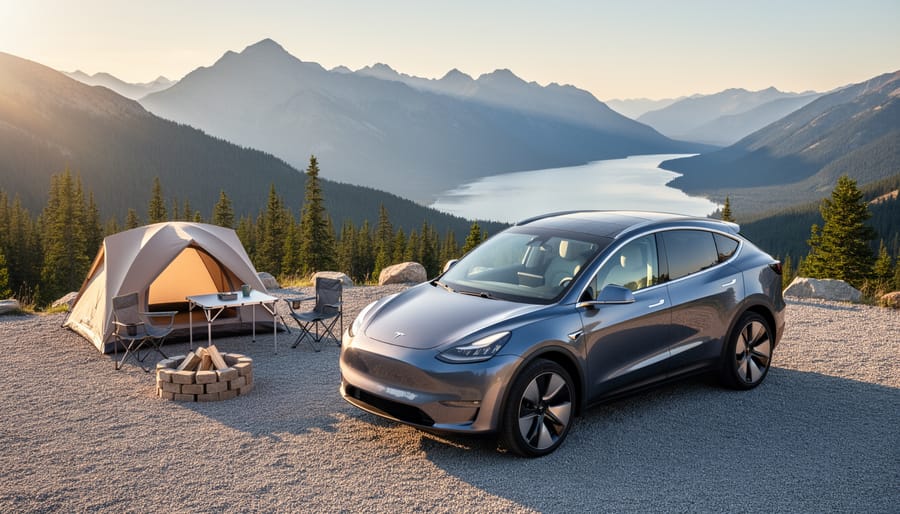
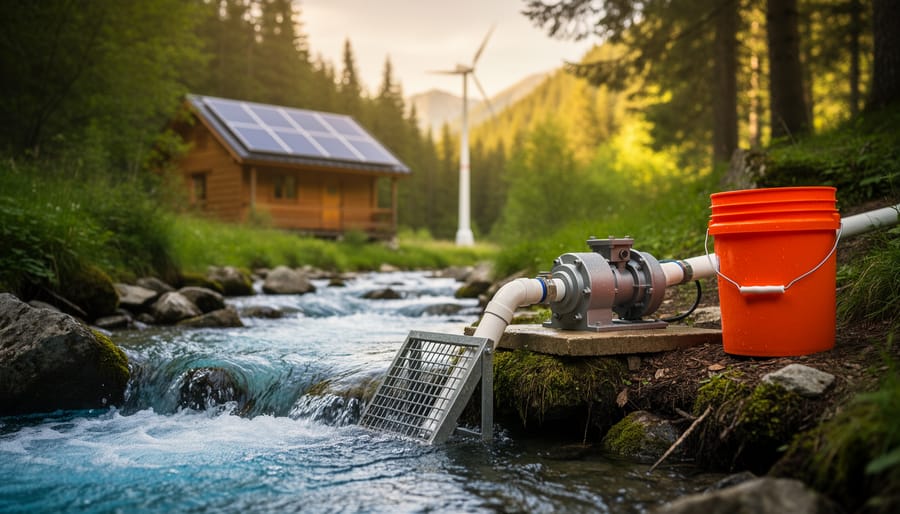
Large-scale solar array installation powering a remote mountain lodge demonstrates the potential of off-grid renewable energy systems.
Power Output and Storage Capabilities
Large off-grid solar power systems typically generate between 10 to 100 kilowatts of power daily, depending on their size and configuration. From my experience working with remote installations, most high-capacity systems are designed to produce at least 30-40 kWh per day to support substantial power needs.
These systems rely heavily on robust battery storage systems to maintain consistent power supply during nighttime and cloudy conditions. Most large-scale off-grid setups feature lithium-ion battery banks with capacities ranging from 40 kWh to over 200 kWh, though I’ve seen some installations push beyond 300 kWh for specialized applications.
A typical large residential off-grid system might include:
– 24-48 high-efficiency solar panels (400W each)
– 48V battery bank configuration
– 8,000-12,000W inverter capacity
– 80-120 kWh storage capacity
The actual power output varies significantly with seasonal changes and local weather patterns. I always recommend designing systems with at least 20% extra capacity beyond your expected needs to account for these variations and future expansion. Most of our community members find that starting with a 40 kWh daily generation capacity provides enough power for a comfortable off-grid lifestyle while leaving room for growth.
Remember, bigger isn’t always better – the key is matching your system’s output to your actual power requirements while maintaining efficiency and reliability.
Real-World Examples of Massive Off-Grid Installations
The Alaska Wilderness Lodge System
Nestled deep in the Alaskan wilderness, the Johnson Family Lodge represents one of the most impressive off-grid solar installations in North America. This 50kW system powers a sprawling lodge complex that hosts adventure tourists and nature enthusiasts throughout the year, proving that sustainable living is possible even in extreme environments.
The system consists of 156 high-efficiency solar panels, strategically positioned to capture the unique seasonal sunlight patterns of Alaska. During summer months, when the region experiences up to 20 hours of daylight, the system generates enough power to support not only the main lodge but also six guest cabins, a commercial kitchen, and various outdoor facilities.
What makes this installation particularly remarkable is its robust energy storage solution. The lodge employs a bank of 48 industrial-grade lithium batteries, providing an impressive 250kWh of storage capacity. This substantial storage is crucial during the winter months when daylight is limited to just a few hours.
The lodge’s owner, Sarah Johnson, shares that the transition to solar wasn’t without challenges. “We had to carefully consider snow loads on the panels and design special mounting systems that could withstand our harsh winters,” she explains. The installation team developed innovative solutions, including heated panel frames to prevent snow accumulation and reinforced mounting structures to handle wind speeds up to 100 mph.
The system’s monitoring setup is equally impressive, featuring remote diagnostics that allow technicians in Anchorage to troubleshoot issues without making the 200-mile journey to the lodge. A backup generator automatically kicks in during extended periods of heavy cloud cover, though Johnson notes it’s rarely needed thanks to the oversized battery bank.
Perhaps most importantly, this solar installation has reduced the lodge’s diesel fuel consumption by 85%, saving approximately 12,000 gallons annually. The success of this system has inspired several other wilderness lodges in Alaska to explore similar solar solutions, proving that even in the most remote locations, sustainable power is achievable with proper planning and implementation.
Australian Outback Ranch Installation
Deep in the heart of the Australian Outback, a remarkable 75kW solar power system stands as a testament to sustainable agricultural innovation. This impressive installation powers a sprawling cattle ranch that previously relied entirely on diesel generators, transforming how remote agricultural operations can embrace renewable energy.
The system consists of 288 high-efficiency solar panels strategically positioned to maximize sun exposure throughout the day. What makes this installation particularly fascinating is its dual-axis tracking system, allowing the panels to follow the sun’s path and generate up to 40% more energy than fixed installations. As someone who’s visited similar setups, I can tell you the sight of these panels moving in unison is quite impressive!
The heart of the system includes a robust battery bank with 400kWh of storage capacity, using lithium iron phosphate batteries chosen specifically for their durability in extreme outback conditions. This storage capacity ensures the ranch operations continue smoothly even during extended periods of cloudy weather.
The system powers essential ranch operations including water pumping for livestock, climate control for animal shelters, and residential needs for the ranch staff. One of the most innovative aspects is the smart load management system, which prioritizes critical operations during periods of lower solar generation.
Installation challenges included transporting equipment across hundreds of kilometers of rough terrain and designing a system tough enough to withstand temperatures exceeding 45°C (113°F). The team overcame these obstacles by using specially reinforced mounting systems and heat-resistant components.
The payback period for this installation is estimated at 4.5 years, considering the previous diesel fuel costs and maintenance expenses. More importantly, the system prevents approximately 140 tonnes of CO2 emissions annually – equivalent to taking 30 cars off the road.
This installation serves as an inspiring example of how remote agricultural operations can transition to renewable energy while maintaining reliable power for critical operations.
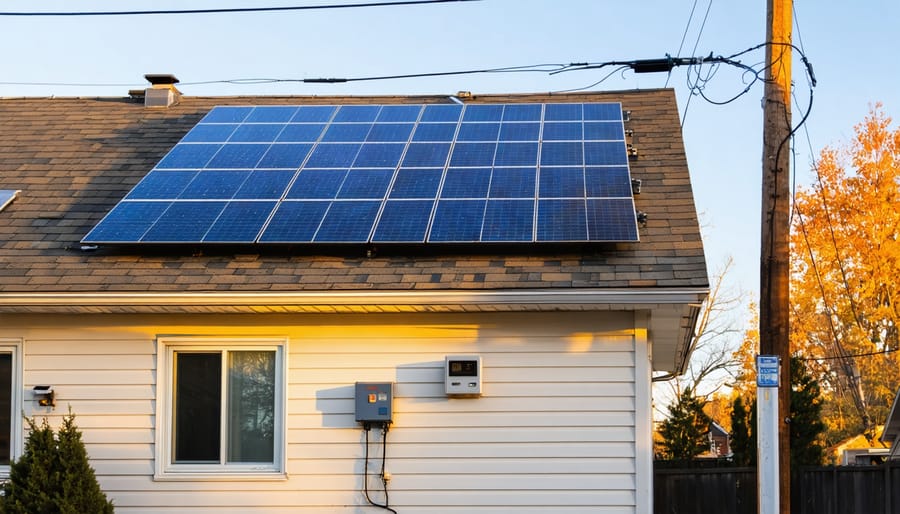
Industrial-scale battery storage system provides reliable power backup for large off-grid installations.
Design Considerations for Large Off-Grid Systems
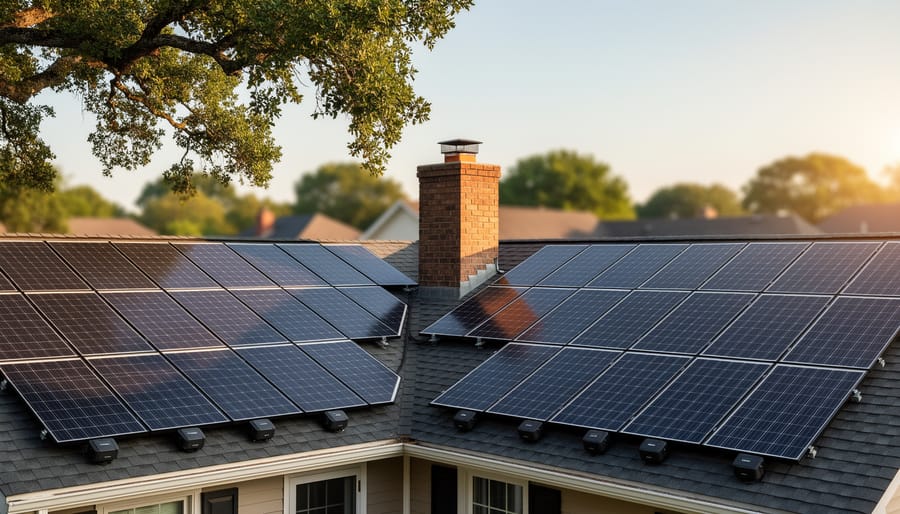
Aerial view of an Australian outback ranch powered by a comprehensive solar array system.
Location and Environmental Factors
The success of large off-grid solar installations heavily depends on their location and surrounding environmental conditions. Sunlight availability is the most crucial factor, with ideal locations receiving 5-6 peak sun hours daily. Desert regions like the American Southwest, parts of Australia, and the Middle East naturally lend themselves to massive solar installations due to their abundant sunshine and minimal cloud cover.
Terrain plays a significant role too. Flat or gently sloping land facing south (in the Northern hemisphere) or north (in the Southern hemisphere) provides optimal conditions for solar panel placement. However, many successful large-scale installations have adapted to challenging terrains through innovative mounting solutions and strategic panel positioning.
Climate considerations go beyond just sunshine. Temperature actually affects solar panel efficiency, with most panels performing best between 59-95°F (15-35°C). While desert locations offer abundant sunlight, the extreme heat can slightly reduce panel efficiency. That’s why you’ll often see raised mounting systems that allow for better airflow and cooling.
Weather patterns also impact system design. Areas prone to high winds require robust mounting systems, while regions with heavy snowfall need steeper panel angles for snow shedding. Coastal locations must account for salt spray corrosion with marine-grade components. Smart system designers factor in these local environmental challenges during the planning phase to ensure long-term reliability and maximum power output.
Scaling Battery Storage
When it comes to battery storage for large off-grid systems, proper scaling is crucial for reliable power supply. I learned this firsthand when I helped design a system for a remote mountain cabin – we initially underestimated our storage needs and had to upgrade within months.
To calculate your battery capacity, start by determining your daily energy consumption in kilowatt-hours (kWh). List all your appliances and multiply their wattage by their daily hours of use. Then, factor in at least 2-3 days of autonomy – the time your system can run without sunlight. For example, if you use 15 kWh per day, you’ll need 45 kWh of storage capacity for three days of backup.
Consider using lithium iron phosphate (LiFePO4) batteries for large systems. While more expensive upfront, they offer better depth of discharge, longer lifespan, and require less maintenance than traditional lead-acid batteries. A good rule of thumb is to add 20% extra capacity to account for efficiency losses and future expansion.
Don’t forget temperature regulation – batteries perform best between 20-25°C (68-77°F). In extreme climates, you’ll need an insulated battery room with proper ventilation. I recommend installing a battery monitoring system to track performance and prevent over-discharge, which can significantly reduce battery life.
Remember, it’s better to slightly oversize your battery bank than to run short on power when you need it most.
Backup Power Integration
When building a large off-grid solar system, incorporating robust backup power solutions is absolutely crucial. I learned this firsthand when a week of cloudy weather left one of my early installations struggling to maintain consistent power. Today’s best practices involve a multi-layered approach to backup power integration.
Start with a hybrid inverter system that can automatically switch between solar and backup power sources. For most large installations, I recommend including at least two diesel or propane generators – one primary and one secondary for redundancy. These should be sized to handle about 50-60% of your peak power requirements.
Battery bank redundancy is equally important. Consider splitting your storage into multiple battery banks rather than one large unit. This way, if one bank fails, you’re not completely without power. I usually suggest having at least 3-4 days of backup power storage capacity for critical loads.
Don’t forget about the control systems! Installing automatic transfer switches and smart load management systems helps prioritize essential equipment during extended periods without solar generation. These systems can automatically start generators when battery levels drop below preset thresholds and manage load shedding to extend backup power duration.
Remember to schedule regular maintenance checks and keep spare parts on hand – especially for remote installations where getting replacement components might take days or weeks.
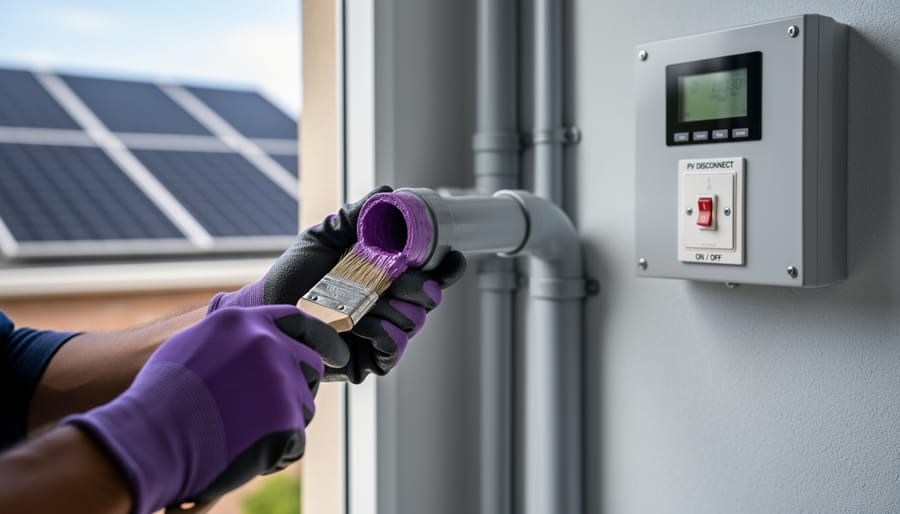
Regular maintenance by trained technicians ensures optimal performance of large-scale solar installations.
Maintenance and Monitoring
Remote Monitoring Solutions
Remote monitoring is the eyes and ears of any large off-grid solar system, and I’ve learned from experience that it’s absolutely essential for maintaining peak performance. Modern monitoring solutions use a combination of sensors, data loggers, and internet connectivity to keep track of every aspect of your system’s operation.
Most monitoring setups include real-time tracking of power production, battery state of charge, and energy consumption patterns. What I love about today’s systems is how user-friendly they’ve become – you can check everything from your smartphone! Many of my DIY friends use apps that send instant notifications if something needs attention, like when battery levels drop too low or if a panel isn’t performing as expected.
The heart of these monitoring systems usually includes weather stations to track solar irradiance, temperature sensors on key components, and power meters at various points in the system. All this data feeds into a central hub that creates easy-to-understand graphs and reports.
For those just getting started, I recommend beginning with basic monitoring equipment that tracks essential metrics like daily energy production and consumption. As you become more comfortable with the system, you can add more sophisticated monitoring tools to fine-tune performance.
Remember, good monitoring isn’t just about collecting data – it’s about using that information to optimize your system’s efficiency and catch potential issues before they become problems.
Preventative Maintenance Schedule
Regular maintenance is crucial for keeping your large-scale off-grid solar system running at peak efficiency. Following proper solar maintenance best practices can significantly extend your system’s lifespan and prevent costly repairs down the line.
Start with weekly visual inspections of your solar panels for dust, debris, or bird droppings. In dusty regions, you might need to clean the panels monthly, while in cleaner environments, quarterly cleaning could suffice. Use soft brushes and non-abrasive cleaners to avoid scratching the panel surface.
Check your battery bank’s fluid levels and terminal connections monthly. Top up batteries with distilled water when needed, and clean any corrosion from terminals using a baking soda solution. Monitor battery voltage readings daily through your charge controller display.
Inspect mounting hardware and wiring connections quarterly for signs of wear or loosening. Tighten any loose connections and replace damaged cables immediately. Your charge controller and inverter should be checked bi-annually for proper operation and cleaned of dust buildup.
Annual professional inspections are recommended to catch potential issues early. Have a certified technician test system performance, check electrical connections, and verify safety systems are functioning correctly. Keep detailed maintenance logs to track system performance and identify patterns that might indicate developing problems.
Remember, prevention is always cheaper than repair. A well-maintained system can easily last 25+ years with minimal issues.
As we’ve explored throughout this article, large off-grid solar power systems have revolutionized how we think about energy independence and sustainability. From remote communities to industrial operations, these systems are proving that living off the grid doesn’t mean compromising on power or reliability.
The key to success lies in careful planning, proper sizing, and smart integration of components. As battery technology continues to advance and solar panel efficiency improves, we’re seeing these systems become more affordable and accessible to a wider range of users. I’ve personally witnessed this transformation over the past decade, with system costs dropping while capabilities expand.
Looking ahead, the future of large off-grid solar systems is incredibly promising. Emerging technologies like advanced energy management systems and AI-powered optimization are making these installations even more efficient. We’re also seeing innovative storage solutions, including flow batteries and hydrogen systems, that could dramatically increase storage capacity and system longevity.
For those considering their own large off-grid system, remember that starting small and scaling up is often the wisest approach. Begin by thoroughly assessing your energy needs, consulting with experienced installers, and learning from existing installations. Join local renewable energy groups and connect with others who have already taken this journey – their insights are invaluable.
As our climate challenges grow more pressing, these systems represent more than just personal energy independence – they’re a crucial part of our sustainable future. Whether you’re planning a remote homestead or a community microgrid, the technology and knowledge are available to make your off-grid dreams a reality. The biggest off-grid systems today are just the beginning of what’s possible tomorrow.
How useful was this post?
Click on a star to rate it!
Average rating 0 / 5. Vote count: 0
No votes so far! Be the first to rate this post.
We are sorry that this post was not useful for you!
Let us improve this post!
Tell us how we can improve this post?
charlesnoble
Here at Spheral Solar, I’m a hands-on solar power enthusiast, constantly exploring and experimenting with DIY solutions. I’m dedicated to sharing my discoveries, insights, and even the bumps I hit along the way, all in the pursuit of a more sustainable future.
Community Solar Projects Made Simple: How You Can… by Charlesnoble March 19, 2026 Picture this: You’re renting an apartment with a north-facing roof, or your property is shaded by towering oak trees, yet you’re determined to power your life with clean solar energy. Community solar makes this possible. Instead of installing panels on your own property, you buy or lease a portion of…
Why CSP Solar Never Made It Into Your Backyard (And… by Charlesnoble January 30, 2026 When you see massive solar installations in the desert generating headlines, they’re often concentrating solar power plants—but the panels on your neighbor’s roof? Those are photovoltaics, and understanding the distinction matters more than you might think. Concentrating solar power uses mirrors or lenses to focus sunlight onto a receiver, creating…
Turn Your Home’s Exterior Into a Power Plant With BIPV Solar by Charlesnoble February 19, 2026 Picture this: your home’s windows generating electricity while you admire the view. Your patio awning powering your outdoor lights as it shades your afternoon barbecue. Your garage door collecting energy every time the sun hits it. This isn’t science fiction – it’s building integrated photovoltaics, and it’s transforming how we…
Why Your DIY Solar Microgrid Will Fail Without the… by Charlesnoble November 22, 2025 Understand that a microgrid energy storage system is your battery bank plus the smart components that decide when to store solar power, when to use it, and when to pull from the grid or a backup generator. This integrated approach transforms disconnected parts into a cohesive power management solution that…
Why Your Electric Vehicle Needs Solar Panels (And… by Charlesnoble January 19, 2026 Picture yourself pulling into a campsite after hours on the road, your electric vehicle’s battery sitting at 40%, and the nearest charging station is twenty miles back. Now imagine your EV quietly replenishing its own power from panels mounted right on the roof while you set up camp. This isn’t…
Grid-Tied Solar: Why Most DIYers Choose It (And When… by Charlesnoble November 8, 2025 Imagine flipping a switch and watching your electric meter spin backward while your solar panels pump clean energy into the grid—earning you credits that slash your utility bill to nearly zero. That’s the everyday reality of grid-tied solar, the most popular solar setup in America, powering millions of homes and…
Subscribe for handpicked DIY projects, exclusive tips, and giveaways.
Match your solar panels to microinverters or power optimizers based on your roof’s shading patterns—even partial shade from a chimney or tree during morning hours means module-level power electronics will recover 15-25% more energy than string inverters lose to the weakest panel. Install power optimizers when you’re working with mixed panel orientations across multiple roof… Read more: Why Smart Solar Modules Could Save Your DIY Array (Before It’s Too Late)
Measure your conduit run before purchasing materials by mapping the exact path from your solar array to the inverter and battery location, accounting for a 10% waste factor and additional length for bends. PVC electrical conduit remains the most cost-effective protective solution for DIY solar installations, but improper installation creates fire hazards, code violations, and… Read more: Why Your Solar Conduit Installation Could Start a Fire (And How to Do It Right)
Walk down to your nearest stream with a five-gallon bucket and a stopwatch. Fill that bucket and time how long it takes—this simple test reveals whether you have enough flowing water to power your off-grid home. If you can fill it in under 10 seconds from a source that drops at least 10 feet in… Read more: The Stream Behind Your House Could Power It (Here’s How Micro Hydro Works)