Why CSP Solar Never Made It Into Your Backyard (And Why PV Did)
Updated:
When you see massive solar installations in the desert generating headlines, they’re often concentrating solar power plants—but the panels on your neighbor’s roof? Those are photovoltaics, and understanding the distinction matters more than you might think.
Concentrating solar power uses mirrors or lenses to focus sunlight onto a receiver, creating heat that drives turbines to generate electricity. Think of it like using a magnifying glass to start a fire, scaled up to industrial proportions. Photovoltaics, on the other hand, convert sunlight directly into electricity through semiconductor materials—no moving parts, no heat engine, just pure conversion.
Here’s the reality that most articles skip: CSP requires thousands of acres, specialized engineering teams, and multi-million dollar budgets. It’s utility-scale technology designed for deserts where land is cheap and sunshine is relentless. You cannot build a CSP plant in your backyard, and you wouldn’t want to—the complexity alone requires dedicated operations staff.
Photovoltaics changed everything by making solar power accessible. A single panel fits on your garage roof. Connect a few together, add a charge controller and battery, and you’re generating your own electricity. This democratization of solar energy means you’re not just reading about renewable energy transitions—you can actually participate.
I’ve spent years helping people transition from curious observers to confident solar DIYers, and the most common misconception I encounter is that newer or more complex technology must be better. CSP has its place in grid-scale renewable energy portfolios, absolutely. But photovoltaics put the power—literally—in your hands. Understanding both technologies helps you make informed choices about the solar revolution happening right now, whether you’re installing your first panel or following energy policy developments that affect us all.
What Actually IS Concentrating Solar Power?
Remember when you were a kid and used a magnifying glass to focus sunlight into a concentrated beam? Maybe you burned your initials into a piece of wood or watched a leaf start smoking? That’s essentially what concentrating solar power does—just on an absolutely massive, industrial scale.
Instead of converting sunlight directly into electricity like the solar panels you might install on your roof, CSP uses mirrors or lenses to concentrate huge amounts of sunlight onto a single point or area. This creates intense heat—we’re talking temperatures that can reach over 1,000 degrees Fahrenheit. That heat then produces steam to spin turbines, which generate electricity the same way traditional power plants do. It’s old-school power generation meeting cutting-edge solar technology.
Here’s where it gets interesting. There are three main types of CSP systems, each with its own approach to catching and concentrating sunlight.
Parabolic trough systems use long, curved mirrors shaped like a half-pipe. These mirrors focus sunlight onto a pipe running down the center, heating special oil inside to incredibly high temperatures. Imagine hundreds of these troughs lined up in the desert, all tracking the sun throughout the day like synchronized sunflowers.
Solar power towers are probably what you’ve seen in photos—they look genuinely futuristic. Thousands of flat mirrors called heliostats surround a tall central tower, all reflecting sunlight to a receiver at the top. The concentrated light creates a brilliant glow visible for miles. The heat collected runs the power plant below.
Dish systems look like giant satellite dishes covered in mirrors. Each dish focuses sunlight onto a receiver at the focal point, often with a small engine attached right there. Think of them as the most intense spotlight nature never intended.
The catch? These systems need direct, strong sunlight and lots of space—we’re talking acres, not rooftops. They’re built in deserts, not suburbs. For most DIY solar enthusiasts and homeowners, CSP isn’t something you can bring home. But understanding how it works helps you appreciate the full spectrum of solar technology working to power our renewable future.
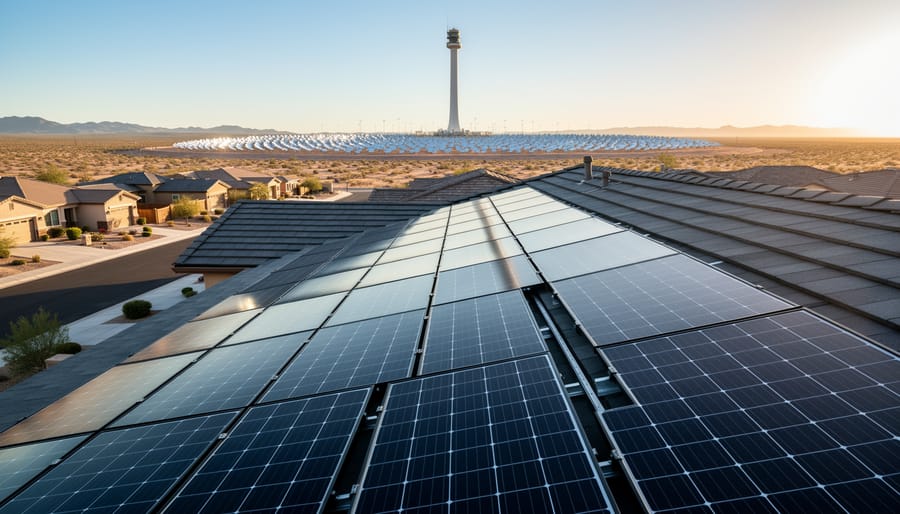
Industrial-scale CSP facilities require vast desert expanses with hundreds of mirror arrays, making them practical only for utility-scale power generation.
How Photovoltaics Work (The Solar You Know)
You’ve probably seen those sleek blue or black panels on rooftops around your neighborhood—that’s photovoltaic (PV) technology in action. If you’ve ever used a solar-powered calculator, you’ve already interacted with this same fundamental technology, just on a much smaller scale.
Here’s the beautiful simplicity of how PV works: when sunlight hits certain materials (typically silicon-based semiconductors), it literally knocks electrons loose. Those freed electrons start moving, and moving electrons are electricity. That’s it. No moving parts, no boiling water, no turbines—just direct conversion from light to usable electrical current.
Think of it like a microscopic domino effect happening millions of times per second across the surface of each solar cell. Photons from the sun strike the semiconductor material, energize electrons, and those electrons flow through an electrical circuit to power your home, charge your phone, or run your refrigerator.
What makes PV so accessible for DIY enthusiasts is this straightforward design. A typical solar panel is essentially a collection of these semiconductor cells wired together, sealed in protective glass, and mounted in an aluminum frame. Connect enough panels together, add an inverter to convert the DC electricity to AC power your home uses, and you’ve got yourself a working solar system.
I remember when I installed my first small PV panel to charge some batteries for camping equipment—the moment I watched my battery indicator climb purely from sunlight felt genuinely magical, even though I understood the science behind it.
Residential photovoltaic systems fit neatly on standard rooftops, making solar power accessible to individual homeowners.
The Scale Problem: Why CSP Needs to Think Big
Space Requirements That Rule Out Residential Use
Here’s where the rubber really meets the road for us DIY solar enthusiasts. The space requirements between these two technologies tell you everything you need to know about which one belongs in your backyard.
A typical concentrating solar power plant needs somewhere between 5 to 10 acres per megawatt of generating capacity. Let me put that in perspective: a modest 100-megawatt CSP facility requires about 500 to 1,000 acres of land. That’s roughly the size of 400 to 800 football fields all lined up together. I remember driving past the Ivanpah Solar Power Facility in California and being absolutely stunned by its massive footprint. It spans over 3,500 acres of desert land with those giant tower receivers visible from miles away.
Now compare that to photovoltaic panels. A typical residential solar installation producing 5 to 10 kilowatts of power needs only about 300 to 600 square feet of roof space. That’s roughly the size of a two-car garage roof. When I installed my first panel array, the entire system fit comfortably on one section of my south-facing roof with room to spare.
This dramatic difference exists because CSP plants need vast open areas for their mirror arrays and thermal storage facilities, plus significant buffer zones between equipment. They’re designed for utility-scale power generation in remote desert locations. Meanwhile, your rooftop PV system quietly produces electricity using space that was already there, doing nothing but keeping the rain out. For homeowners and DIYers, there’s simply no contest when it comes to practical implementation.
The dramatic scale difference between utility CSP installations and residential PV systems illustrates why these technologies serve completely different markets.
The Heat Storage Advantage (That Only Works at Scale)
Here’s where CSP has a genuinely impressive trick up its sleeve: thermal energy storage using molten salt. Let me explain how this works, because it’s actually pretty clever.
When CSP systems concentrate sunlight, they heat up a special mixture of salts until it melts (think temperatures around 1,000°F). This superheated liquid gets stored in massive insulated tanks, where it can keep its heat for hours or even days. When the sun goes down, the facility pumps this molten salt through a heat exchanger to create steam and generate electricity, just like during the day.
I remember visiting a CSP facility in Nevada and being amazed by these storage tanks—each one roughly the size of a school gymnasium. The facility could keep producing power for six hours after sunset, which is incredibly valuable for utilities trying to meet evening demand when everyone comes home and turns on their air conditioning.
This is CSP’s killer advantage over traditional PV solar farms, which go dark the moment the sun sets. But here’s the critical catch: this technology only makes economic sense at massive scale. We’re talking installations measured in hundreds of megawatts with storage tanks that cost tens of millions of dollars.
For DIY solar enthusiasts like us, the equivalent solution is much simpler and more accessible: battery storage options paired with rooftop PV panels. Modern lithium batteries can store solar energy during the day and power your home at night, giving you that same energy-shifting capability at a scale that actually fits in your garage. No molten salt required.
Cost Reality: What Each Technology Actually Runs You
CSP: Utility-Scale Investment Numbers
Let’s talk about the elephant in the room: CSP isn’t something you can tackle in your backyard workshop. These are massive industrial projects that require investments ranging from hundreds of millions to several billion dollars. We’re talking about facilities that typically start at 50 megawatts and can scale up to several hundred megawatts, covering hundreds of acres of land.
To put this in perspective, a typical utility-scale CSP plant might cost anywhere from $4,000 to $9,000 per kilowatt of capacity installed. That means even a modest 100-megawatt facility could require an investment of $400 million to $900 million. These projects need specialized engineering teams, massive infrastructure including towers or parabolic troughs, thermal storage systems, and turbine generators.
I mention these numbers not to discourage you, but to set realistic expectations. When you see headlines about new CSP installations in places like Morocco or California, understand that these are utility-scale solutions designed to power thousands of homes. They’re incredibly important for the renewable energy transition at a grid level, but they exist in a completely different universe from residential solar options. For us DIY enthusiasts and homeowners looking to harness solar power, photovoltaic panels remain the accessible and practical choice.
PV: From DIY Budget to Whole-Home Systems
Now let’s talk real numbers that matter for your home. When I first started exploring solar panels for my garage workshop, I was overwhelmed by vague pricing. So here’s what you actually need to know.
Residential PV systems typically cost between $2.50 and $3.50 per watt before incentives. For typical system sizes of 5-10 kilowatts (enough to power most homes), that translates to $12,500 to $35,000 for a professionally installed system. The federal tax credit currently covers 30 percent, which helps significantly.
But here’s where it gets exciting for DIYers. If you’re comfortable with electrical work and willing to learn, you can slash those costs dramatically. I’ve seen neighbors reduce their expenses by 40-60 percent through DIY installation. A quality 6-kilowatt DIY kit runs around $8,000-$12,000 for panels, inverters, mounting hardware, and wiring. You’ll still want a licensed electrician for the final grid connection in most jurisdictions, adding maybe $500-$1,500.
The DIY approach works best if you have a straightforward roof, basic carpentry skills, and patience for permits. Professional installation makes sense for complex roofs, multi-story homes, or if you simply prefer leaving it to experts.
Want to crunch your specific numbers? Spheral Solar’s calculators let you input your roof dimensions, local electricity rates, and sun exposure to estimate both system size and payback period. I used them before my own installation and found the projections spot-on.
The bottom line: residential PV is genuinely accessible whether you’re budget-conscious and handy or prefer professional installation. Either way, you’re looking at equipment that pays for itself within 6-12 years while generating clean power for 25-plus years.
Efficiency Face-Off: Which Converts Sunlight Better?
When I first started exploring solar technologies, I assumed “efficiency” was a simple percentage—the higher, the better. But comparing CSP and PV efficiency is like comparing apples to oranges, and understanding why matters if you’re deciding where to focus your renewable energy enthusiasm.
Here’s the straight talk: Modern photovoltaic panels typically convert 15-22% of sunlight directly into electricity. That’s it—sunlight hits the panel, electrons get excited, and electricity flows. Simple and measurable.
CSP efficiency is more complicated because it’s a multi-step dance. First, mirrors concentrate sunlight to create heat (with some losses). Then that heat creates steam (more losses). Finally, a turbine converts steam to electricity (even more losses). The overall system efficiency usually lands between 7-25%, depending on the design and conditions. However, CSP’s secret weapon is thermal storage—those systems can store heat and generate electricity after sunset, which PV can’t do without adding battery systems.
In real-world conditions, though, the comparison gets even more interesting. I learned this the hard way during a cloudy week at my home setup. PV panels still generate some power on overcast days—not much, but something. CSP systems, however, need direct, intense sunlight and basically shut down when clouds roll in. They’re also incredibly sensitive to dust and require significant water for cooling in desert locations where they work best.
Geography plays a huge role too. CSP really only makes sense in areas receiving intense, consistent direct sunlight—think southwestern deserts. PV panels work almost anywhere, from cloudy Seattle to sunny Arizona, though output varies. For maintenance, PV systems are remarkably hands-off after installation, while CSP requires regular cleaning of mirrors, turbine maintenance, and skilled technicians.
For us DIY solar enthusiasts, PV’s straightforward efficiency is actually an advantage. You can calculate your expected output, plan your system size, and trust that barring equipment failure, you’ll get consistent performance. CSP might have theoretical advantages at utility scale with storage, but for residential applications, PV’s simplicity, lower maintenance, and ability to work in varied conditions make it the clear winner for converting your roof’s sunlight into usable power.
Where Each Technology Actually Shines
CSP’s Sweet Spot: Desert Power Plants with Storage Needs
Now, you might be wondering: if CSP isn’t something I can install on my roof, where does it actually shine? The answer lies in specific geographic sweet spots where this technology becomes a game-changer.
CSP thrives in regions blessed with intense, direct sunlight and plenty of open space. Think desert climates with minimal cloud cover—places where the sun beats down relentlessly for hours each day. This is where CSP plants can generate massive amounts of electricity while storing thermal energy for nighttime use.
The world’s most successful CSP installations tell this story perfectly. The Noor Complex in Morocco, nestled in the Sahara Desert, powers over a million homes and stores energy to deliver electricity well after sunset. Spain’s Gemasolar plant in Andalusia operates nearly 24/7 during summer months thanks to its molten salt storage system. Here in the United States, the Ivanpah Solar Power Facility in California’s Mojave Desert showcases CSP’s utility-scale potential.
These installations share common characteristics: they’re located in sunny, arid regions with high direct normal irradiance (that’s the technical term for concentrated sunlight hitting a specific surface). They’re utility-scale projects designed to feed power grids, not individual homes.
For us DIY solar enthusiasts, CSP represents the large-scale complement to our rooftop efforts. While we’re empowering our homes with photovoltaic panels, these desert giants are proving that solar can reliably power entire cities. It’s a reminder that renewable energy works at every scale—we’re all part of the same solar revolution.
PV’s Versatility: Rooftops, RVs, and Everything Between
Here’s where photovoltaics really shines compared to CSP: you can install it practically anywhere. While concentrating solar power demands acres of desert real estate and industrial infrastructure, PV panels are remarkably adaptable to your specific needs and situation.
Think about the possibilities. Your residential rooftop? Perfect for PV. That old RV you’re converting into a weekend adventure mobile? Solar panels fit beautifully. Remote cabin in the woods? PV makes it entirely possible to live comfortably off-grid. Even portable folding panels for camping trips give you the freedom to power devices anywhere under the sun.
Charles loves sharing stories from the Spheral Solar community about this versatility. “I once helped a reader calculate power needs for a tiny house on wheels,” he recalls. “Six months later, she sent photos of her completed van conversions with panels on the roof, powering everything from her laptop to a mini-fridge. That same week, another community member reached out about designing a system for a remote hunting cabin. Same technology, completely different applications.”
The beauty of PV scalability means you can start small and expand over time. Maybe you begin with a single panel charging a battery bank, then gradually add capacity as your budget allows. Compare that to CSP, which requires massive upfront investment and operates on an all-or-nothing scale.
Whether you’re powering off-grid cabins, supplementing your home energy usage, or creating mobile power solutions, photovoltaics adapts to your world. That flexibility makes PV the obvious choice for DIY solar enthusiasts and individual energy independence.
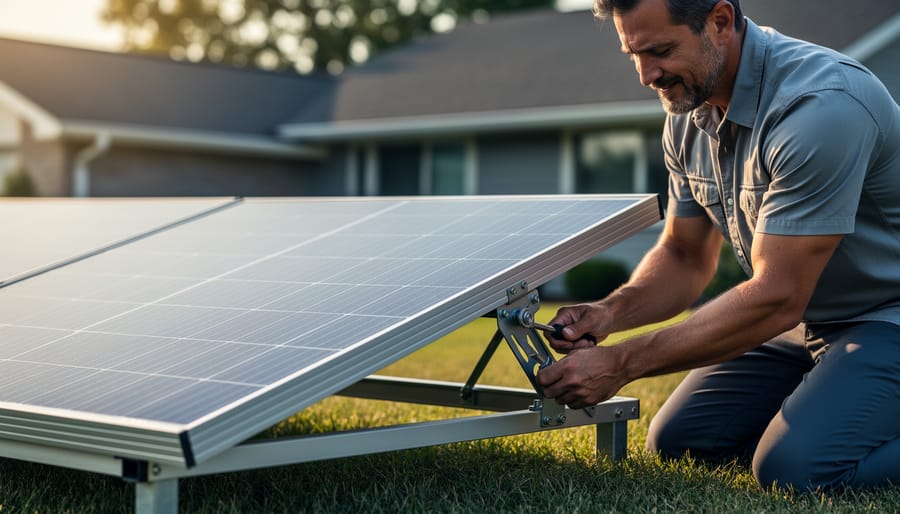
DIY photovoltaic installation empowers homeowners to take control of their energy production with accessible, scalable technology.
What This Means for Your Solar Journey
After exploring both technologies, here’s what really matters for you as a solar enthusiast: while CSP plays an important role in utility-scale renewable energy infrastructure, photovoltaics is the technology that puts power—literally—in your hands.
I’ve spent years working with solar technology, and I can tell you that PV systems are uniquely suited for personal energy independence. They’re modular, meaning you can start small and expand as your confidence and budget grow. There’s no minimum size requirement, no need for vast desert landscapes, and no complex steam turbines to maintain. Just panels, an inverter or charge controller, batteries if you want them, and sunlight.
CSP facilities are impressive feats of engineering that help clean up our grid, and we should celebrate that. But they’re not something you can order online, install on a weekend, and start generating power from on Monday morning. PV systems are.
The beauty of DIY solar projects is that they’re accessible right now. You don’t need to wait for utility companies or government initiatives. You can take action today, whether that means powering a small workshop, running outdoor lighting, or gradually building toward whole-home energy independence.
So what’s your next step? Start by calculating your energy needs and exploring beginner-friendly project options. Join online communities where fellow solar enthusiasts share their experiences and troubleshoot together. The solar revolution doesn’t just happen at massive power plants—it happens on rooftops, in backyards, and in garages where curious people like you decide to take control of their energy future. Your solar journey starts with that first panel.
How useful was this post?
Click on a star to rate it!
Average rating 0 / 5. Vote count: 0
No votes so far! Be the first to rate this post.
We are sorry that this post was not useful for you!
Let us improve this post!
Tell us how we can improve this post?
charlesnoble
Here at Spheral Solar, I’m a hands-on solar power enthusiast, constantly exploring and experimenting with DIY solutions. I’m dedicated to sharing my discoveries, insights, and even the bumps I hit along the way, all in the pursuit of a more sustainable future.
Turn Your Home’s Exterior Into a Power Plant With BIPV Solar by Charlesnoble February 19, 2026 Picture this: your home’s windows generating electricity while you admire the view. Your patio awning powering your outdoor lights as it shades your afternoon barbecue. Your garage door collecting energy every time the sun hits it. This isn’t science fiction – it’s building integrated photovoltaics, and it’s transforming how we…
Growing Crops Under Solar Panels Actually Works… by Charlesnoble April 3, 2026 Imagine doubling the productivity of your land by growing crops and generating electricity in the same space. That’s exactly what agrivoltaics makes possible—and it’s not just for large-scale farms anymore. An agrivoltaic system combines solar panels with agriculture, mounting photovoltaic arrays high enough that crops, livestock, or pollinator habitats can…
Why Your Pool Deserves Floating Solar Lights (And… by Charlesnoble December 21, 2025 Picture this: It’s a warm summer evening, and your pool transforms into a glowing oasis without adding a single dollar to your electricity bill. That’s the magic of floating solar lights—simple devices that charge during the day and automatically illuminate your pool at night, creating ambiance while eliminating the headache…
Floating Solar Panels Could Change Where You Generate Power by Charlesnoble November 29, 2025 Picture your backyard pond doing double duty: supporting wildlife while generating clean electricity for your home. That’s the promise of floating solar panels, an innovation that’s transforming how we think about renewable energy installation. Floating solar systems, also called floatovoltaics, mount photovoltaic panels on buoyant platforms that rest on water…
Community Solar Projects Made Simple: How You Can… by Charlesnoble March 19, 2026 Picture this: You’re renting an apartment with a north-facing roof, or your property is shaded by towering oak trees, yet you’re determined to power your life with clean solar energy. Community solar makes this possible. Instead of installing panels on your own property, you buy or lease a portion of…
Why Your Electric Vehicle Needs Solar Panels (And… by Charlesnoble January 19, 2026 Picture yourself pulling into a campsite after hours on the road, your electric vehicle’s battery sitting at 40%, and the nearest charging station is twenty miles back. Now imagine your EV quietly replenishing its own power from panels mounted right on the roof while you set up camp. This isn’t…
Subscribe for handpicked DIY projects, exclusive tips, and giveaways.
Position your solar panels at an angle equal to your latitude for year-round performance, or adjust seasonally by adding 15 degrees in winter and subtracting 15 degrees in summer to capture maximum sunlight during each season’s sun path. Use a simple angle finder app on your smartphone against the back of your panel to verify… Read more: The Right Tilt Angle Can Boost Your Solar Panel Output by 30% (Here’s How to Find It)
Route your PV wires through UV-resistant conduit within 18 inches of leaving the solar array, securing it every 3 feet with proper clamps to prevent wind damage and code violations. This single step prevents 80% of the wire degradation issues I’ve seen in DIY solar installations over the past decade. Group your positive and negative… Read more: Why Your PV Wire Management Could Fail Inspection (And How to Fix It)
Understand that 6000 volts sounds terrifying but delivers surprisingly low amperage—typically around 120 milliamps for just 3/10,000th of a second per pulse. This combination creates an unforgettable shock that trains animals to avoid the fence without causing lasting harm. The voltage pushes current through thick fur and hide, while the minimal amperage and microsecond duration… Read more: Why 6000 Volts Won’t Kill Your Livestock (But Will Stop Predators Cold)