Why Lithium Batteries Changed Everything for Off-Grid Solar (And How to Choose Yours)
Updated:
Calculate your daily energy consumption in watt-hours before shopping for any lithium battery by listing every device you’ll power, its wattage, and hours of daily use—this single number determines whether you need a 5kWh system or a 20kWh system and prevents the costly mistake of undersizing. Multiply your daily usage by 1.5 to account for inverter losses and weather variability, then divide by your battery’s depth of discharge (typically 80-90% for lithium) to find your minimum capacity.
Choose lithium iron phosphate (LiFePO4) chemistry over standard lithium-ion for off-grid applications because it delivers 3,000-5,000 charge cycles compared to 500-1,000 cycles, tolerates deeper discharges without damage, and operates safely in wider temperature ranges without the thermal runaway risks that plague other lithium chemistries. The upfront cost runs 2-3 times higher than lead-acid, but the per-cycle cost drops to one-third when you factor in lifespan and usable capacity.
Match your battery voltage to your inverter requirements, understanding that 12V systems work for small setups under 1,000 watts, 24V handles 1,000-3,000 watts efficiently, and 48V becomes essential above 3,000 watts because it reduces current draw and allows smaller, less expensive wire gauges throughout your system. Installing the right battery system from the start saves thousands in rewiring costs later.
Verify that your charge controller supports lithium-specific charging profiles with proper voltage settings—bulk charge at 14.4-14.6V for 12V systems, float at 13.6V, and critically, disable equalization charging which damages lithium cells. Most PWM controllers lack these profiles, making MPPT controllers with programmable settings your only reliable option for lithium battery longevity.
What Makes Lithium Batteries Different for Off-Grid Solar
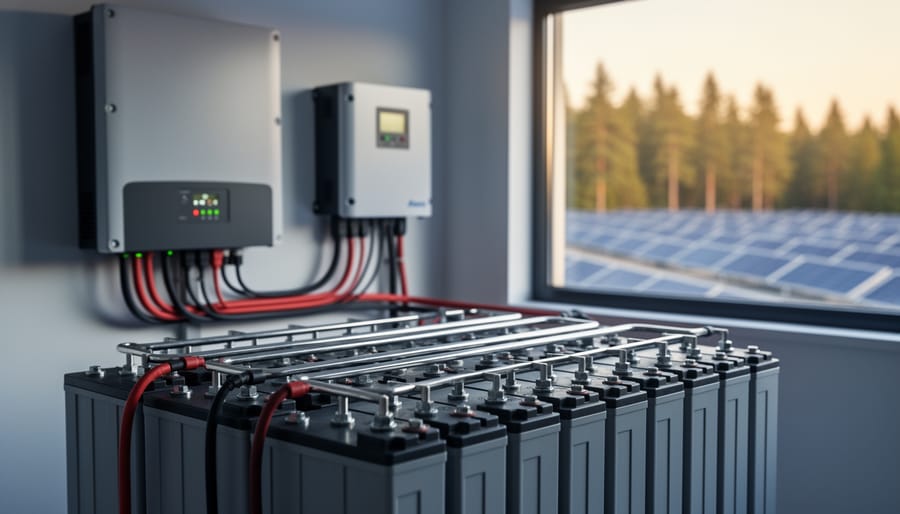
Modern lithium battery banks have transformed off-grid solar systems with their compact size and superior performance compared to traditional lead-acid alternatives.
The Real-World Performance Gap
Here’s where lithium batteries really shine compared to traditional lead-acid options. Let me break this down with some examples from my own off-grid journey and what I’ve seen in the community.
First, depth of discharge. With lead-acid batteries, you can only safely use about 50% of the rated capacity before damaging them. So that 200Ah battery? You’re really working with 100Ah. Lithium batteries let you use 80-90% of their capacity without harm. This means a 100Ah lithium battery actually gives you more usable power than a 200Ah lead-acid.
Cycle life tells an even more compelling story. Lead-acid batteries typically give you 300-500 cycles at 50% discharge. I’ve replaced mine every 3-4 years in my cabin setup. Quality lithium batteries deliver 3,000-5,000 cycles at 80% discharge—that’s potentially 10-15 years of reliable service in off-grid solar systems.
Then there’s efficiency. Lead-acid batteries waste about 15-20% of incoming energy as heat during charging. Lithium batteries operate at 95-98% efficiency. In practical terms, if you’re charging from solar panels, you’re capturing and storing nearly every watt you generate.
I’ve calculated this for my own system: though lithium costs more upfront, the longer lifespan and better efficiency mean lower costs per kilowatt-hour stored over time. For weekend warriors, lead-acid might work. For full-time off-gridders, lithium is the smarter investment.
Why They Cost More Upfront But Save You Money
I’ll be honest with you—when I first saw the price tag on lithium batteries for my cabin project, I nearly fell off my chair. They cost roughly three times more than the lead-acid batteries I’d been researching. But here’s what changed my mind, and it might surprise you.
Let’s run some real numbers together. Say you’re choosing between a $300 lead-acid battery and a $900 lithium battery. Ouch, right? But lead-acid batteries typically last 3-5 years with proper maintenance, while lithium can go 10-15 years. That lead-acid battery? You’ll replace it three times in the lifespan of one lithium battery. Suddenly you’re at $900 versus $900—dead even.
But wait, there’s more to the story. Lead-acid batteries only let you use about 50% of their capacity without damaging them. Lithium batteries? You can safely use 80-90%. So that 200Ah lead-acid battery really gives you 100Ah of usable power, while a 200Ah lithium battery delivers 170Ah. To match the usable capacity, you’d actually need to buy larger lead-acid batteries, driving your costs even higher.
When I factored in replacement costs, reduced capacity needs, and no maintenance expenses (lead-acid requires regular water top-ups and cleaning), my lithium investment paid for itself in about seven years. For anyone serious about off-grid versus grid-tied systems, that long-term value makes lithium the smarter choice.
Understanding Lithium Battery Chemistry (Without the Science Degree)
LiFePO4: The Off-Grid Champion
When I first started researching batteries for my off-grid cabin project, I kept seeing LiFePO4 everywhere—and for good reason. Lithium iron phosphate batteries have essentially become the gold standard for solar energy storage, and once you understand why, the choice becomes pretty clear.
The safety factor alone is impressive. Unlike some other lithium chemistries that can be temperamental, LiFePO4 batteries are incredibly stable. They won’t go into thermal runaway under normal conditions, which means you can sleep soundly knowing your battery bank isn’t a fire hazard. I remember talking to a neighbor who was nervous about installing batteries in his garage—once he learned about the phosphate chemistry, his concerns melted away.
Then there’s the longevity aspect, which honestly blew my mind when I did the math. A quality LiFePO4 battery can handle 3,000 to 5,000 charge cycles at 80 percent depth of discharge. Compare that to lead-acid batteries that might give you 500-1,000 cycles, and suddenly the higher upfront cost makes perfect sense. You’re essentially buying a battery that’ll last 10-15 years instead of replacing cheaper ones every few years.
Temperature performance is another game-changer, especially if you live somewhere with extreme weather. LiFePO4 batteries operate efficiently in a wider temperature range than most alternatives. They’ll charge and discharge reliably in conditions that would make other batteries struggle. I’ve seen them perform beautifully in everything from desert heat to mountain cold.
The combination of safety, durability, and consistent performance explains why experienced off-gridders and newcomers alike gravitate toward LiFePO4. It’s simply the most reliable foundation for building a solar battery bank that’ll serve you well for years to come.
LiFePO4 lithium batteries use prismatic cell design that provides superior safety and longevity for off-grid solar applications.
Other Lithium Types: When They Make Sense (And When They Don’t)
While LFP dominates the off-grid world for good reasons, you’ll occasionally encounter other lithium chemistries worth understanding. The most common alternative is NMC (Nickel Manganese Cobalt), which you’ll recognize from electric vehicles and power tools.
NMC batteries pack more energy into smaller spaces—about 20-30% more energy density than LFP. If you’re building a mobile setup like a camper van or boat where every inch matters, that compactness becomes genuinely valuable. I once helped a friend convert a vintage Airstream, and NMC batteries saved us precious cabinet space that we desperately needed.
However, here’s the trade-off: NMC batteries typically last only 2,000-3,000 cycles compared to LFP’s 6,000-10,000 cycles. They’re also more sensitive to high temperatures and require more sophisticated battery management systems. For a stationary off-grid cabin where space isn’t constrained? You’re usually better off with LFP’s longevity and safety profile.
You might also encounter NCA (Nickel Cobalt Aluminum) or even experimental chemistries marketed for solar applications. Unless you have a specific reason—like extreme space constraints or weight restrictions—these specialized options rarely justify their higher costs and shorter lifespans for typical off-grid installations.
Think of it this way: LFP became the off-grid standard because it balances everything most people need. The other chemistries excel in narrow niches but compromise elsewhere. For 90% of off-grid solar projects, stick with what works best for stationary energy storage.
Sizing Your Lithium Battery Bank: Getting It Right the First Time
Proper voltage monitoring and battery management are essential when sizing and installing lithium battery banks for off-grid systems.
Calculate Your Daily Energy Needs
Before you can choose the right lithium battery for your off-grid system, you need to know how much energy you actually use each day. This is measured in watt-hours (Wh), and it’s simpler to calculate than you might think.
Start by making a list of everything electrical you plan to run in your cabin or home. For each item, note its power draw in watts and roughly how many hours per day you’ll use it. For example, LED lights might use 10 watts for 5 hours (50 Wh), a laptop charger draws about 60 watts for 3 hours (180 Wh), and a small refrigerator could use 150 watts continuously (3,600 Wh). Multiply watts by hours for each device, then add them all up.
I remember when I did this exercise for my first DIY solar setup, I was surprised to discover my coffee maker was one of my biggest energy hogs. That realization helped me prioritize what really mattered.
To make this easier, Spheral Solar offers a handy calculator tool that walks you through common loads step-by-step. Just plug in your appliances and usage patterns, and it automatically tallies your daily watt-hours. Most small cabins use between 1,000-3,000 Wh daily, while full-time off-grid homes might need 5,000-10,000 Wh or more. Once you have this number, you can properly size your lithium battery bank to match your actual needs.
Days of Autonomy: How Much Backup Do You Really Need?
Think of “days of autonomy” as your energy safety net—how many cloudy, sunless days can your battery system keep your home running before needing a recharge? This is one of the most personal decisions in your off-grid setup.
When I first went off-grid, I learned this lesson the hard way during an unexpectedly gray week in February. My undersized battery bank left me rationing power by day three. Now I recommend thinking through three key factors:
Location matters enormously. If you’re in sunny Arizona, two days of backup might be plenty since extended cloudy periods are rare. But in the Pacific Northwest or northeastern states? You’ll want at least three to five days to weather typical winter weather patterns.
Season plays a role too. Winter brings shorter days and more cloud cover, so your backup needs increase when solar production naturally drops.
Risk tolerance is personal. Are you comfortable occasionally running a backup generator, or does the thought of any power interruption stress you out? Conservative planners often aim for five to seven days of autonomy, while those comfortable with backup plans might choose two to three days.
A good starting point for most locations is three to four days of autonomy, then adjust based on your local climate data and personal comfort level. Remember, more backup means higher upfront costs but greater peace of mind.
The 50% Rule and Why Lithium Breaks It
When I first started sizing off-grid systems, I learned about the “50% rule” for lead-acid batteries the hard way. If you need 200Ah of usable energy, you actually need a 400Ah lead-acid battery bank because you can only safely discharge lead-acid batteries to 50% without dramatically shortening their lifespan. Go deeper than that regularly, and you’re looking at replacing batteries in a year or two instead of five.
Here’s where lithium batteries completely change the game. With lithium iron phosphate (LiFePO4) batteries, you can safely use 80-100% of the rated capacity without harming the battery. This means a 200Ah lithium battery actually gives you 200Ah of usable power, not just 100Ah like its lead-acid equivalent.
Let’s put this into perspective with a real example. Say your cabin needs 5kWh of daily storage. With lead-acid at 50% depth of discharge, you’d need a 10kWh battery bank. With lithium at 80% usable capacity, you only need a 6.25kWh battery bank to achieve the same result. That’s nearly 40% less battery capacity required, which often offsets lithium’s higher upfront cost while giving you a lighter, more compact system to install.
Key Features to Look for When Shopping
Built-In BMS: Your Battery’s Brain
Think of the Battery Management System (BMS) as the brain that keeps your lithium off-grid battery healthy and safe. Without it, your expensive battery investment could be damaged or even become dangerous. The BMS constantly monitors each cell in your battery pack, making sure they charge and discharge evenly while protecting against conditions that could cause harm.
Here’s what your BMS does behind the scenes: it prevents overcharging (which can lead to fires), stops the battery from draining too low (which permanently damages capacity), manages temperature extremes, and balances individual cells so they all age at the same rate. I learned this lesson the hard way years ago when I purchased a cheap lithium battery without adequate BMS protection. Three months in, several cells failed because they weren’t balanced properly, and I was out several hundred dollars.
When shopping for a lithium battery, look for these BMS features: cell balancing (active is better than passive), over-current protection, temperature monitoring with automatic shutoff, and communication capability so you can monitor your system. Many quality batteries include Bluetooth connectivity, letting you check cell voltages and health right from your phone. Some advanced systems even integrate with your inverter to optimize charging cycles based on weather forecasts and your energy usage patterns. Don’t skimp on BMS quality—it’s literally what stands between you and a battery disaster.
Temperature Management and Cold Weather Performance
Cold weather can be tricky for lithium batteries, but don’t let winter worries stop you from going off-grid. I learned this the hard way during my first winter with lithium batteries when temperatures dropped below freezing and my system wouldn’t charge. Here’s what you need to know.
Most lithium batteries have built-in low-temperature cutoffs that prevent charging below 32°F (0°C). This protects the cells from damage, but it means you’ll need a strategy for winter living. The good news? Lithium batteries can still discharge energy in cold weather, so you can draw power even when it’s freezing.
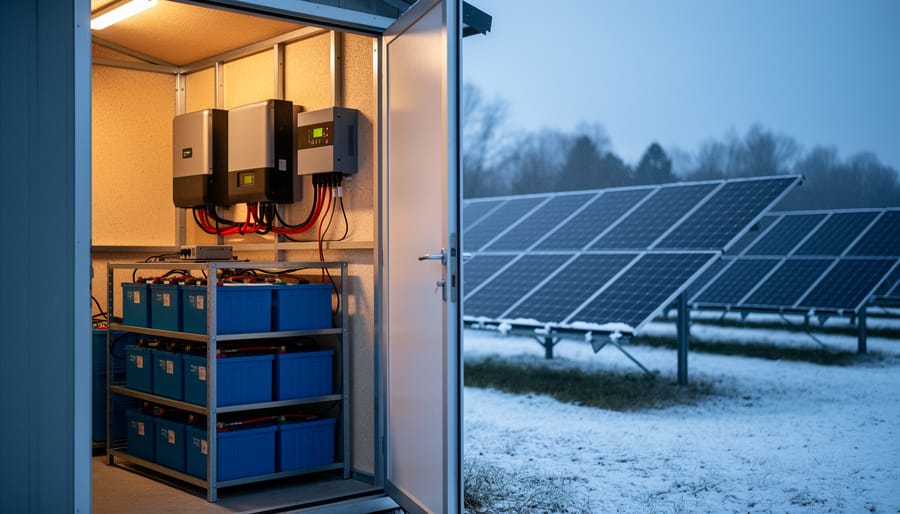
For year-round reliability, consider batteries with self-heating features. These use a small amount of energy to warm the cells before charging begins, making them ideal for cold climates. If your batteries don’t have built-in heating, insulating your battery enclosure can help maintain warmer temperatures. Some DIYers even add inexpensive heating pads controlled by thermostats.
Location matters too. Installing batteries in a semi-conditioned space like a basement or insulated shed keeps them warmer than an unheated garage. Just ensure proper ventilation and follow safety guidelines. With the right preparation, your lithium system will perform reliably through winter’s challenges.
Communication and Monitoring Capabilities
Modern lithium off-grid batteries have come a long way from the days when you’d nervously check your battery bank with a multimeter, hoping everything was still working properly. Today’s batteries often include built-in communication features that let you monitor everything from your smartphone while sipping coffee on your porch.
Most quality lithium batteries now offer Bluetooth connectivity as standard. This lets you check your battery’s state of charge, voltage, current flow, and temperature using a free app on your phone. I remember when I first connected to my battery bank via Bluetooth—it felt like having a conversation with my power system for the first time.
For more serious monitoring, many systems support WiFi connectivity, which uploads your data to the cloud. This means you can check your battery health from anywhere and receive alerts if something’s wrong. Some advanced systems even integrate with home automation platforms, giving you a complete picture of your energy production and consumption.
When shopping for batteries, look for systems with clear, user-friendly apps and reliable connectivity. These monitoring capabilities aren’t just convenient—they help you catch potential issues early and optimize your system’s performance over time.
Installation Tips for DIY Off-Grid Systems
Matching Your Battery with Your Charge Controller
Here’s something I learned the hard way during my first off-grid setup: not all charge controllers speak the same language as lithium batteries. I connected everything, flipped the switch, and watched my beautiful new lithium bank charge at settings meant for flooded lead-acid. Let’s just say my batteries weren’t happy.
Your solar charge controller needs to be lithium-compatible, which means it can handle the specific charging profile these batteries require. Unlike lead-acid batteries that need a multi-stage charging process with absorption and float stages, lithium batteries prefer a simpler approach.
The key voltage settings to verify are the bulk/absorption voltage (typically 14.2-14.6V for 12V systems) and the float voltage (13.6-13.8V). Many older controllers default to lead-acid settings around 14.4V absorption and 13.2V float, which won’t properly charge lithium cells.
Modern MPPT controllers usually have a lithium preset you can select in the settings menu. Look for controllers that specifically mention LiFePO4 compatibility. If your controller doesn’t have lithium settings, you might be able to create a custom profile by manually adjusting the voltage parameters.
Temperature compensation is another consideration. While lead-acid batteries need voltage adjustments based on temperature, lithium batteries generally don’t. Make sure you can disable this feature or set it to zero.
Before connecting anything, download your controller’s manual and confirm it supports lithium charging profiles. This simple check can save you from costly mistakes and ensure your battery investment performs as intended.
Proper series and parallel battery connections with quality cabling ensure safe and efficient power delivery in DIY off-grid installations.
Series vs Parallel: Building Your Battery Bank
When you’re building a battery bank with multiple lithium batteries, you have two main options: series or parallel connections. Let me break this down in simple terms, because getting this right is crucial for both performance and safety.
Connecting batteries in series means linking them positive-to-negative in a chain. This increases your voltage while keeping capacity the same. For example, two 12V 100Ah batteries in series give you 24V at 100Ah. You’d use this setup when your inverter requires higher voltage, like 24V or 48V systems.
Parallel connections involve linking all positive terminals together and all negative terminals together. This keeps voltage the same but adds capacity. Those same two 12V 100Ah batteries in parallel would give you 12V at 200Ah, doubling your runtime.
Here’s something I learned the hard way during my first battery bank installation: always use identical batteries from the same manufacturer, ideally from the same production batch. Mixing different capacities or ages creates imbalances that can dramatically shorten battery life or even create safety hazards.
Safety essentials include using properly rated cables and fuses for each battery connection. I recommend 4AWG cable minimum for most off-grid setups, and always install a fuse or breaker within 18 inches of each battery terminal.
Many lithium batteries come with built-in Battery Management Systems, but when connecting multiple batteries, consider adding a bank-level BMS for extra protection. This monitors the entire system and prevents dangerous imbalances between batteries.
Common Mistakes to Avoid (Learned the Hard Way)
Mixing Old and New Batteries
I learned this lesson the hard way during my first battery expansion project. I had a functioning lithium battery bank and thought I’d just add another battery to increase capacity. Big mistake! Here’s why mixing old and new lithium batteries creates serious problems.
When you connect batteries of different ages or capacities, they fight each other. The newer battery typically has higher voltage and capacity, while the older one has degraded slightly. This mismatch forces the Battery Management System to work overtime, often shutting down your entire system to prevent damage. The new battery tries to charge the old one, while the old battery drags down the new one’s performance.
Even worse, this imbalance accelerates degradation in both batteries. You’re essentially shortening the lifespan of your expensive new battery while overstressing the old one.
The proper way to expand your lithium battery bank is to add identical batteries of the same age, brand, and model simultaneously. If you must expand later, replace your entire bank or create a completely separate battery system with its own charge controller and inverter. This keeps the two systems independent and prevents the conflicts that come from mixing different generations of batteries. Yes, it’s more expensive upfront, but it protects your investment long-term.
Ignoring Temperature Limits
I learned this lesson the hard way during a winter camping trip a few years back. I plugged my lithium battery bank into the solar panels on a frigid morning, and within minutes, the battery management system threw error codes. Turns out, charging lithium batteries below 32°F (0°C) causes serious problems.
Here’s what happens: when temperatures drop below freezing, lithium ions can’t properly intercalate into the battery’s graphite anode. Instead, metallic lithium plates out on the surface, a process called lithium plating. This permanently reduces capacity, increases internal resistance, and creates safety hazards. Even a single freezing charge cycle can shave years off your battery’s lifespan.
The good news? Prevention is straightforward. Most quality lithium off-grid batteries include built-in heating pads and temperature sensors that automatically prevent charging below safe thresholds. If yours doesn’t, you can add a battery box with insulation or heating elements. Some DIYers wrap their batteries in insulated blankets or place them in climate-controlled spaces.
The golden rule: never force-charge a frozen lithium battery. Let it warm naturally to at least 40°F before connecting your charge source. Your battery will thank you with years of reliable service.
Budget-Friendly Options vs Premium Brands: What You’re Actually Paying For
Let me be honest with you—the lithium battery market can feel like the Wild West. I learned this the hard way when I first started exploring off-grid systems and got dazzled by a suspiciously cheap battery pack from an overseas seller. Spoiler alert: you really do get what you pay for, but that doesn’t mean you need to mortgage your house either.
On the budget end, you’ll find Chinese-manufactured batteries ranging from $200-400 per kilowatt-hour. These aren’t automatically bad—many manufacturers have significantly improved quality over the past few years. However, you’re taking a gamble on battery management system quality, actual capacity versus advertised capacity, and lifespan. I’ve seen budget batteries that delivered excellent value for five years, and others that failed within 18 months. The real kicker is customer support—when something goes wrong at 2 AM, good luck reaching anyone.
Mid-tier options from brands like Renogy, Battle Born, or SOK typically run $500-700 per kilowatt-hour. This is the sweet spot for many DIYers. You’re paying for better quality control, more reliable battery management systems, and actual customer service you can reach via phone or email. These brands have reputations to maintain in the North American market, which matters when you’re depending on stored power.
Premium brands like SimpliPhi, Victron, or Tesla Powerwall can exceed $1,000 per kilowatt-hour. What are you getting? Advanced battery chemistry with longer cycle life (often 6,000+ cycles versus 3,000 for budget options), sophisticated monitoring systems, professional installation support, and warranties that actually get honored. If you’re checking out premium battery installations, you’ll notice these systems often include remote monitoring and predictive maintenance features.
My advice? Match your budget to your needs and risk tolerance. For a weekend cabin, budget batteries might work fine. For your primary residence, invest in quality—your future self will thank you during that unexpected cold snap when you need reliable power.
Here’s what I’ve learned after years of helping folks navigate their off-grid battery decisions: there’s no single perfect lithium battery for everyone. Your ideal setup depends on your specific energy needs, budget, climate, available space, and how hands-on you want to be with maintenance and monitoring.
I remember chatting with a homeowner in Montana who needed cold-weather performance, while a friend in Arizona prioritized heat tolerance. Both chose lithium batteries, but completely different models. That’s the beauty of today’s lithium technology—you have options that can truly match your situation.
As you move forward with your decision, take time to honestly assess your daily power consumption, your budget reality, and your comfort level with DIY installation. Use those calculators we discussed earlier to nail down your actual needs rather than guessing. Sometimes a smaller, well-matched system outperforms an oversized one that strains your wallet and space.
I’d love to hear about your own journey with lithium batteries. What challenges have you faced? What surprised you? The Spheral Solar community thrives when we share real experiences—the successes and the learning moments. Drop your questions or stories in the comments below, and let’s keep this conversation going.
Remember, going off-grid is a learning process, not a one-time project. Technology evolves, your needs change, and there’s always something new to discover. Check back regularly for updated guides, tools, and insights as we all continue learning together.
How useful was this post?
Click on a star to rate it!
Average rating 4 / 5. Vote count: 1
No votes so far! Be the first to rate this post.
We are sorry that this post was not useful for you!
Let us improve this post!
Tell us how we can improve this post?
charlesnoble
Here at Spheral Solar, I’m a hands-on solar power enthusiast, constantly exploring and experimenting with DIY solutions. I’m dedicated to sharing my discoveries, insights, and even the bumps I hit along the way, all in the pursuit of a more sustainable future.
The Battery That Keeps Your Off-Grid Solar Running… by Charlesnoble March 13, 2026 Understand your energy storage needs by calculating your daily power consumption in watt-hours—multiply each appliance’s wattage by hours used, then add 20% for system losses and another 25% for days of autonomy when panels aren’t producing. This calculation determines your minimum battery bank capacity and prevents the costly mistake of…
Why Your DIY Solar Microgrid Will Fail Without the… by Charlesnoble November 22, 2025 Understand that a microgrid energy storage system is your battery bank plus the smart components that decide when to store solar power, when to use it, and when to pull from the grid or a backup generator. This integrated approach transforms disconnected parts into a cohesive power management solution that…
Why DC Microgrids Are Perfect for Your DIY Solar Setup by Charlesnoble January 7, 2026 Picture this: you’re running LED lights, a laptop, and a small fridge in your off-grid cabin, and every device is drawing power directly from your solar panels without converting DC to AC and back again. That’s the elegant simplicity of a DC microgrid system, where electricity flows in its natural…
Solar Microgrids: Your Path to True Energy Independence by Charlesnoble February 8, 2026 Picture this: the power grid fails during a storm, but your lights stay on, your refrigerator keeps running, and your phone continues charging. That’s the promise of a solar microgrid—a self-contained energy system that generates, stores, and manages its own electricity independently from the utility company. Unlike traditional grid-tied solar…
This Massive Off-Grid Solar System Powers an Entire… by Charlesnoble October 17, 2025 Imagine powering an entire remote community with nothing but sunshine – that’s exactly what the world’s largest off-grid solar installations achieve today. These engineering marvels, some exceeding 100 megawatts in capacity, are revolutionizing how we think about off-grid solar fundamentals and energy independence. From Australia’s massive Pilbara mine site installation…
Why Your Electric Vehicle Needs Solar Panels (And… by Charlesnoble January 19, 2026 Picture yourself pulling into a campsite after hours on the road, your electric vehicle’s battery sitting at 40%, and the nearest charging station is twenty miles back. Now imagine your EV quietly replenishing its own power from panels mounted right on the roof while you set up camp. This isn’t…
Subscribe for handpicked DIY projects, exclusive tips, and giveaways.
Position your solar panels at an angle equal to your latitude for year-round performance, or adjust seasonally by adding 15 degrees in winter and subtracting 15 degrees in summer to capture maximum sunlight during each season’s sun path. Use a simple angle finder app on your smartphone against the back of your panel to verify… Read more: The Right Tilt Angle Can Boost Your Solar Panel Output by 30% (Here’s How to Find It)
Route your PV wires through UV-resistant conduit within 18 inches of leaving the solar array, securing it every 3 feet with proper clamps to prevent wind damage and code violations. This single step prevents 80% of the wire degradation issues I’ve seen in DIY solar installations over the past decade. Group your positive and negative… Read more: Why Your PV Wire Management Could Fail Inspection (And How to Fix It)
Understand that 6000 volts sounds terrifying but delivers surprisingly low amperage—typically around 120 milliamps for just 3/10,000th of a second per pulse. This combination creates an unforgettable shock that trains animals to avoid the fence without causing lasting harm. The voltage pushes current through thick fur and hide, while the minimal amperage and microsecond duration… Read more: Why 6000 Volts Won’t Kill Your Livestock (But Will Stop Predators Cold)