Why Your DIY Solar System Needs Rapid Shutdown (Before an Inspector Shows Up)
Updated:
Picture this: You’ve just installed your dream solar array, the panels are gleaming in the sun, and you’re ready to flip the switch—then your inspector mentions something about rapid shutdown compliance. If you’re scratching your head wondering what that means and why it matters for your system, you’re not alone.
Rapid shutdown is a National Electrical Code (NEC) requirement that forces your solar panels to automatically reduce their voltage to safe levels within seconds during emergencies. Think of it as an emergency brake for your solar system. When firefighters need to access your roof or an electrician needs to perform maintenance, they shouldn’t have to worry about getting shocked by live DC voltage running through your array. The code mandates that conductors more than one foot from your array must drop to 80 volts or less within 30 seconds of shutdown initiation.
Here’s what catches most DIYers off guard: nearly every residential solar installation since 2017 requires some form of rapid shutdown technology. Whether you’re planning a ground-mount system in your backyard or adding panels to your roof, you’ll need to address this requirement before your system passes inspection.
The good news? You have options. From module-level power electronics (MLPE) like microinverters and DC optimizers to simpler solutions like rapid shutdown boxes and transmitter-receiver systems, there’s a solution that fits your budget and technical comfort level. Understanding these options—and knowing which one matches your DIY solar projects—is essential for building a code-compliant system that keeps everyone safe while maximizing your solar investment.
What Exactly Is Solar Rapid Shutdown?
The Safety Problem Rapid Shutdown Solves
Here’s the thing most people don’t realize until it’s too late: those solar panels on your roof stay electrically live as long as the sun is shining. Even when you flip your main disconnect switch, dangerous DC voltage continues flowing through the wires.
I learned this firsthand during a routine maintenance check. I’d shut everything down—or so I thought—but my voltage meter told a different story. Those panels were still pushing over 300 volts through the system. One accidental wire contact, and I could have been seriously hurt.
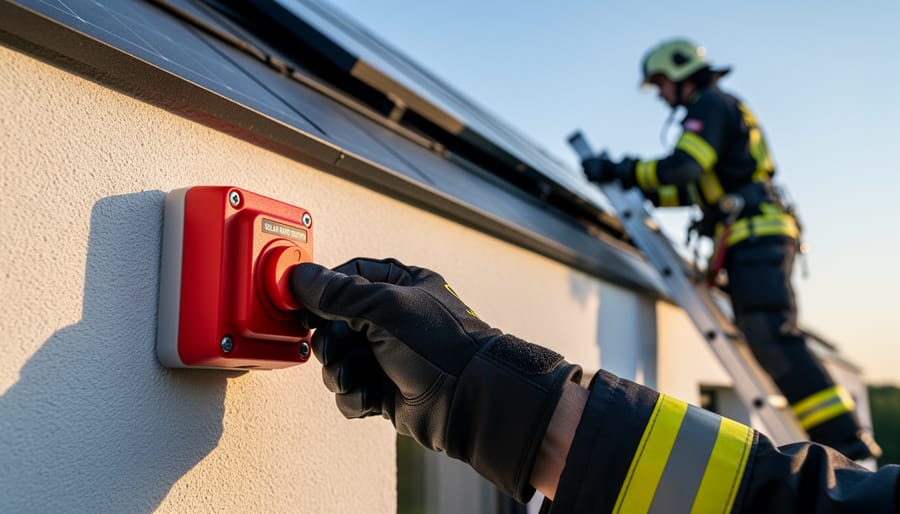
This becomes critical during emergencies. Imagine firefighters arriving at your home during a blaze. They need to ventilate the roof, but can’t safely cut through it because live electrical wires run underneath. In some documented cases, fire crews have let structures burn rather than risk electrocution.
Or picture yourself doing routine maintenance five years from now. You’ve forgotten which circuits are which, and accidentally grab a live conductor. That split-second mistake could mean a trip to the emergency room.
Rapid shutdown systems eliminate this danger by automatically de-energizing conductors within seconds when the system powers down. It’s like having an emergency off switch that actually works when you need it most.
First responders face significant electrical hazards when solar panels remain energized during emergencies, making rapid shutdown technology essential for safety.
How Rapid Shutdown Works (The Simple Version)
Think of rapid shutdown as an emergency brake for your solar system. When everything’s running normally, your panels produce high DC voltage that flows to your inverter and eventually powers your home. But when rapid shutdown kicks in, that voltage drops dramatically within seconds—usually down to 80 volts or less across the entire array, and even lower (around 30 volts) at individual panel level.
Here’s the simple mechanism: When your inverter shuts off or someone flips a dedicated emergency switch, it sends a signal to special devices called rapid shutdown initiators. These are either built into your inverter or mounted separately near your main service panel. That signal then communicates with components at your panels—either module-level devices like optimizers or special transmitter boxes that use your existing wiring.
I remember the first time I saw this in action during an installation with my neighbor. We hit the switch, and within 30 seconds, what was once a high-voltage array became safe to approach. The voltage literally dropped to handshake-safe levels.
The beauty of modern rapid shutdown is that it works automatically. No complicated procedures—just flip one clearly-marked switch, and the system does the rest.
Understanding NEC 2017 and 2020 Code Requirements
Do Off-Grid Systems Need Rapid Shutdown?
Here’s a question I get all the time from fellow DIYers: “My solar setup is just for my off-grid cabin (or RV). Do I really need rapid shutdown?”
The short answer? If your system is truly off-grid and not connected to the utility grid, rapid shutdown requirements typically don’t apply under NEC Article 690. These regulations were primarily designed to protect firefighters and utility workers dealing with grid-connected systems.
That said, I learned something important during my early solar projects: just because something isn’t legally required doesn’t mean it’s not worth considering. Here’s my take from years of building off-grid systems.
If your cabin or RV could ever need emergency service, rapid shutdown adds a genuine safety layer. I remember helping a neighbor whose off-grid system caught fire due to a faulty charge controller. Having a quick way to de-energize those panels would have made the situation far less dangerous.
For solar system planning, consider your specific situation. Is your setup in a remote location where emergency services might be hesitant to respond? Are family members or visitors unfamiliar with solar safety around? These practical considerations matter more than the code itself when you’re off-grid.
When Inspectors Actually Check for This
Here’s the reality: if you’re building a small off-grid system in your backyard shed, inspectors probably won’t knock on your door. Rapid shutdown mainly comes into play when you’re getting permits for grid-tied installations or when your system is visible enough that code enforcement takes notice.
I learned this the hard way on my first rooftop project. The inspector spent maybe two minutes checking my rapid shutdown equipment but a solid twenty examining my conduit work. That said, when they do check, they’re typically looking for proper labeling, accessible shutdown switches, and documentation that your components are listed for rapid shutdown compliance.
For DIYers, the practical concern emerges when you’re dealing with grid interconnection agreements or increasing your home’s value through permitted solar. Most utility companies require proof of code compliance before they’ll approve your connection. If you’re staying off-grid or building experimental systems on your property, rapid shutdown might be more of a “best practice” than an immediate requirement, though safety should always guide your decisions.
Types of Rapid Shutdown Devices for DIY Solar
When I first started exploring rapid shutdown options for my own solar setup, I was surprised to discover there isn’t just one way to meet code requirements. The solar industry has developed several different approaches, each with its own advantages depending on your system design and budget.
The main categories you’ll encounter are module-level devices, string-level solutions, and integrated inverter systems. Module-level devices attach directly to each solar panel, giving you the most granular control but requiring more components. String-level solutions work with groups of panels connected together, offering a middle ground between cost and functionality. Then there are inverters with built-in rapid shutdown capabilities, which can simplify your system design significantly.
Some DIYers prefer transmitter-receiver systems that communicate wirelessly or through your existing wiring, while others opt for devices that physically disconnect power at each panel. There are also hybrid approaches that combine different technologies to meet specific installation needs.
Understanding these categories helps you narrow down what makes sense for your project. In the sections ahead, we’ll dive into each approach in detail, exploring how they work, what they cost, and which situations they’re best suited for. This way, you can make a confident decision that matches both your technical requirements and your DIY capabilities.
Module-Level Power Electronics (MLPE): Microinverters and Optimizers
Microinverters: All-in-One Simplicity
Microinverters take a fundamentally different approach to rapid shutdown by eliminating the DC wiring problem altogether. These compact devices mount directly underneath each solar panel, converting DC electricity to AC right there on the roof. Since rapid shutdown requirements only apply to DC circuits, once the power becomes AC, those rules no longer apply. Pretty clever, right?
Here’s how it works in practice: each panel connects to its own microinverter, which immediately converts the DC power to standard 120V or 240V AC electricity. From there, regular AC wiring runs down to your electrical panel, just like any other household circuit. When you flip the main breaker or the grid goes down, the microinverters automatically shut off within seconds. No additional rapid shutdown equipment needed.
For DIY installations, microinverters offer some genuine advantages. You avoid the complexity of installing separate rapid shutdown devices, and the system is inherently safer since there’s no high-voltage DC on your roof during maintenance. Troubleshooting is easier too, since each panel operates independently. If one panel or microinverter has issues, the rest keep working.
The downsides? Microinverters cost more upfront than traditional string inverters with rapid shutdown add-ons. You’re looking at roughly 20-30% higher equipment costs for a typical residential system. They also live outdoors in harsh conditions, which can affect longevity, though most manufacturers offer 25-year warranties.
Charles installed microinverters on his garage project specifically to simplify the rapid shutdown requirements. “I liked not having to wire in extra boxes and controllers,” he shared. “Everything just worked together seamlessly, and I felt better knowing there wasn’t DC voltage sitting on the roof.”
DC Optimizers: The Middle Ground
DC optimizers offer a smart compromise between traditional string inverters and full microinverter systems, giving you module-level shutdown while keeping costs more manageable. Think of them as safety devices that attach to each panel, paired with a central string inverter that handles the actual power conversion.
Here’s how it works: each optimizer connects to one solar panel and communicates with your string inverter. During normal operation, they optimize each panel’s output independently, which is great if you have shading issues or panels facing different directions. But when rapid shutdown triggers, they immediately reduce voltage at each panel to safe levels, meeting NEC requirements without the higher price tag of microinverters.
I learned this the hard way on my garage installation. I initially went with a basic string inverter to save money, then realized I’d need expensive transmitters and special wiring for rapid shutdown compliance. Switching to optimizers cost about 30% more upfront, but simplified everything. Installation became straightforward: mount optimizer under each panel, snap in DC connectors, and run a single homerun to the inverter.
When do optimizers make sense for DIYers? If you’re installing 8-12 panels or more, dealing with partial shade, or want panel-level monitoring, they’re worth considering. Just verify compatibility between your chosen optimizer brand and inverter model before purchasing. Most major manufacturers like SolarEdge and Tigo have clear compatibility charts online, and their systems include shutdown functionality built-in, eliminating separate rapid shutdown devices entirely.
DC optimizers attach directly to each solar panel, providing module-level rapid shutdown while working with traditional string inverters.
Is MLPE Worth It for Small DIY Systems?
For small systems under 10kW, MLPE can add $500-$1500 to your project cost. Is it worth it? If code compliance matters for your installation, the answer is yes—it’s not optional. But here’s what I’ve learned from my own builds: even for off-grid systems where codes don’t apply, microinverters offer real peace of mind. You get panel-level monitoring to catch issues early, and safer maintenance down the road.
The math gets friendlier as your system grows. For a tiny 4-panel setup, traditional string inverters with separate rapid shutdown devices might save money initially. But once you’re at 8-10 panels, MLPE pricing becomes competitive, especially considering the monitoring benefits. My advice? Calculate your total system cost both ways, factor in your comfort level with electrical work, and remember that safety features protect both you and anyone who might service your system later.
Standalone Rapid Shutdown Devices
Transmitter-Receiver Systems
Transmitter-receiver systems offer a clever middle-ground approach to rapid shutdown. Think of it like a remote control for your solar array. Here’s how it works: you install a transmitter unit at your inverter location, and each solar panel or small group of panels gets a receiver module. When the system needs to shut down (either through the emergency switch or automatically), the transmitter sends a signal to all the receivers, which then reduce the voltage right at the panel level.
The beauty of this setup is its flexibility. You’re not locked into specific panel brands, and the installation is pretty straightforward for most DIYers. I remember Charles mentioning how he helped a neighbor retrofit an older system with these units in just an afternoon—no need to replace existing optimizers or completely redesign the array.
Popular options include systems from manufacturers like Tigo and SolarEdge. These typically cost between $30 to $60 per panel for the receiver modules, plus around $200 to $400 for the transmitter unit. That puts a typical residential system in the $1,500 to $2,500 range for the complete rapid shutdown solution.
Installation difficulty sits comfortably in the intermediate range. You’ll need basic electrical knowledge and comfort working on rooftops. The receivers mount directly to the panel frames or junction boxes using simple clips, and wiring connects in series just like regular panels. Most systems use plug-and-play connectors, eliminating the need for complex electrical terminations. Just remember to follow the manufacturer’s specifications for maximum receivers per transmitter circuit.
Module-Level Shutdown Devices
If you’re working with a tight budget and just need to meet NEC 2017 or later code requirements, module-level shutdown devices are your friend. These small units mount directly to each solar panel and allow individual modules to shut down when the system is turned off, but they don’t provide any of the monitoring or performance optimization you’d get from microinverters or DC optimizers.
Think of them as the minimalist approach to rapid shutdown compliance. When I first encountered these devices, I was honestly relieved—not every DIY project needs all the bells and whistles, and sometimes you just need to check the code compliance box without breaking the bank.
These devices typically install right at the panel junction box or mount nearby on the racking. They’re passive components that respond to a signal from your main inverter or a separate control box. When the signal stops (like during an emergency or maintenance), they automatically isolate each panel to bring the array voltage down to safe levels within seconds.
The main advantage here is cost. You’ll spend significantly less per panel compared to microinverters while still keeping your installation legal and safe. The tradeoff? No panel-level monitoring, no individual panel optimization if shading becomes an issue, and you’ll still need a string inverter to handle the actual DC-to-AC conversion. For straightforward rooftop installations without shading concerns, though, these budget-friendly devices get the job done perfectly well.
Choosing the Right Rapid Shutdown Solution for Your Project
Questions to Ask Before You Buy
Before you invest in rapid shutdown equipment, let’s walk through some key considerations to ensure you get the right solution for your project. I learned this the hard way on my first install—buying components without thinking through the bigger picture led to extra trips to the supplier and unnecessary expenses.
First, check your system voltage and the number of panels you’re installing. This determines whether you need module-level shutdown devices or if a controller-based system will work. Most residential solar-powered systems run at 300-600 volts, but verify your specific setup.
Budget matters too. Module-level devices cost more upfront but offer flexibility, while transmitter-receiver systems are more economical for larger arrays. Think about future expansion as well—will you add panels later? Some systems scale more easily than others.
Your local code requirements are non-negotiable, so contact your authority having jurisdiction before purchasing. They’ll tell you exactly what compliance standards you need to meet.
Finally, honestly assess your DIY skill level and installation complexity. Some rapid shutdown solutions require only basic wiring skills, while others involve more complex configurations. Choose something that matches your comfort zone, and remember that paying a professional for a few hours beats redoing incorrect work.
Cost Comparison: What You’ll Actually Spend
Let me break down what you’ll actually spend on rapid shutdown solutions. For a small system with 6-8 panels, module-level shutdown devices typically run $25-45 per panel, putting your total around $150-360. A medium setup with 12-16 panels might cost $300-720 for the same approach.
If you go with optimizer-based systems like those from major manufacturers, expect $50-80 per panel including the optimizer and compatible inverter costs. That’s $300-640 for a small system and $600-1,280 for medium installations.
The most budget-friendly option remains transmitter-receiver systems, where you’ll spend $100-200 for the control unit plus $5-15 per panel for receivers. Your total? Around $130-320 for small systems and $160-440 for medium ones.
Here’s something I learned the hard way: don’t forget installation supplies. Add another $50-100 for proper conduit, wire management, and mounting hardware. I once had to make a second hardware store run mid-install because I cheaped out on connectors.
Remember, these prices reflect DIY purchasing. Professional installers often get 20-30 percent discounts, but you’re saving thousands in labor costs by doing it yourself. The key is balancing your budget with code compliance—cutting corners on safety equipment never pays off.
DIY Installation Tips and Common Mistakes
Wiring and Compatibility Gotchas
I’ve seen plenty of DIYers run into trouble by mixing rapid shutdown components from different manufacturers without checking compatibility first. Here’s the thing: not all systems play nicely together. A transmitter from Brand A might not communicate properly with receivers from Brand B, leaving you with a system that doesn’t actually shut down when it should.
One mistake I made early on was assuming all PV wire connectors would work universally. They don’t. Some rapid shutdown devices require specific gauge wiring or connector types. Always verify voltage and amperage ratings match your system specifications. I once had to redo an entire string because the shutdown modules I bought were rated for 48V systems, and my array was running at 400V.
Before purchasing, create a complete component list and cross-reference everything with manufacturer spec sheets. Most reputable brands publish compatibility matrices on their websites. Don’t skip this step. Also, check if your inverter has built-in shutdown capabilities that might conflict with or duplicate external systems.
Test your setup before final installation. Use a multimeter to verify voltage drops to safe levels within the required timeframe. Many jurisdictions require specific testing procedures, so check local codes. When in doubt, consult with a licensed electrician who can review your design. It’s cheaper than failing inspection or, worse, creating a safety hazard.
Testing Your Rapid Shutdown System
Before you call for inspection or rely on your system during an emergency, you’ll want to confirm your rapid shutdown is actually working. The simplest test is flipping your breaker or emergency switch while monitoring your system’s DC voltage at the array. If properly functioning, voltage should drop to safe levels (typically under 80V) within 30 seconds. Many modern inverters include built-in testing modes that simulate a shutdown event without cutting power to your home.
I learned this the hard way during my first installation. I assumed everything worked perfectly until the inspector asked me to demonstrate it. Thankfully it did, but those few seconds of uncertainty taught me to always test beforehand! Check your manufacturer’s app or display for diagnostic features. If you’re experiencing issues, basic solar panel troubleshooting techniques apply here too. Document your test results with photos or screenshots for your records and inspection day.
Testing your rapid shutdown system with a multimeter ensures proper functionality and code compliance before inspection.
Look, I’ll be honest with you—when I first started diving into solar installations, rapid shutdown felt like just another box to check off. Another regulation to navigate. But the more systems I built, the more I realized it’s actually one of the most empowering aspects of eco-conscious solar design. It’s not just about satisfying code compliance or getting that final inspection approval. It’s about building solar systems that protect the people who matter most—your family, your neighbors, and the first responders who might one day need to help you.
Think of rapid shutdown as your system’s safety valve, the feature that lets you harness the sun’s power confidently while knowing you’ve built something responsible. Every wire you run, every module-level component you install, every shutdown switch you position—these aren’t just technical details. They’re commitments to doing this right.
And here’s the thing: you’re not alone in this journey. The Spheral Solar community is here to support you, whether you’re planning your first array or your fifth. Check out our solar calculators and system planning tools to help map out your rapid shutdown strategy before you buy a single component. Have questions about whether your setup needs module-level shutdown or if rooftop shutoff will suffice? Drop a comment or reach out. We’re all learning together, one safer installation at a time.
How useful was this post?
Click on a star to rate it!
Average rating 0 / 5. Vote count: 0
No votes so far! Be the first to rate this post.
We are sorry that this post was not useful for you!
Let us improve this post!
Tell us how we can improve this post?
charlesnoble
Here at Spheral Solar, I’m a hands-on solar power enthusiast, constantly exploring and experimenting with DIY solutions. I’m dedicated to sharing my discoveries, insights, and even the bumps I hit along the way, all in the pursuit of a more sustainable future.
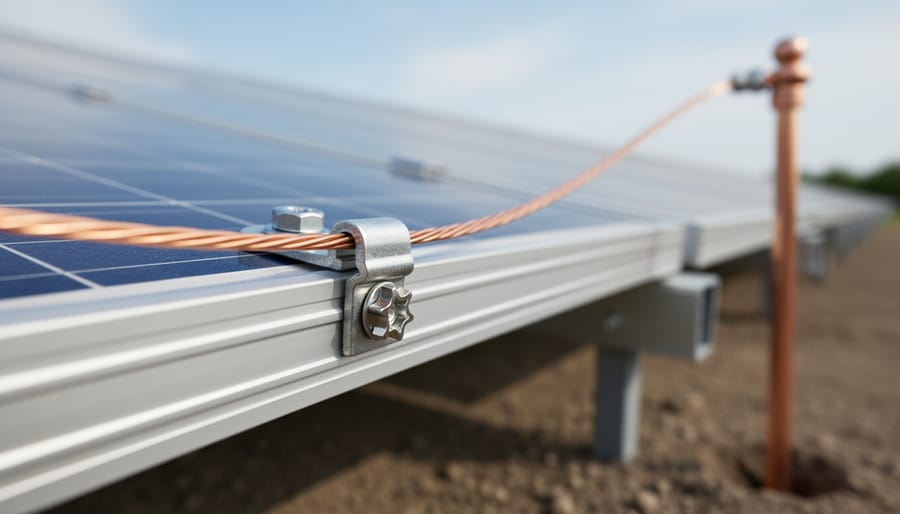
Why Your Solar Panels Need Proper Grounding (And How… by Charlesnoble March 17, 2026 Connect your solar panel frame directly to a grounding rod using 6-gauge bare copper wire and listed grounding lugs—this single action protects your system from lightning strikes and prevents dangerous electrical shocks. Strip back half an inch of wire, insert it into the grounding lug attached to your panel’s frame…
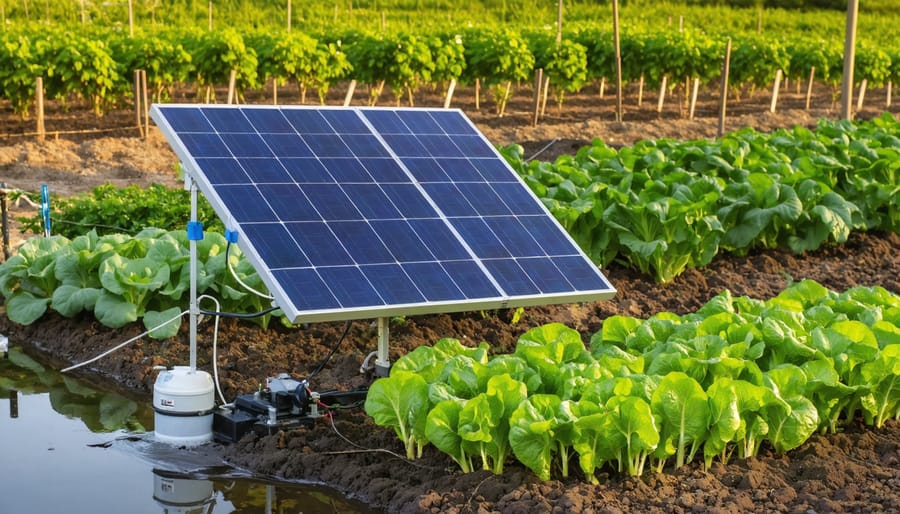
Solar-Powered Irrigation Changed How I Water My… by Charlesnoble November 15, 2025 Last summer, I watched my neighbor haul gasoline cans across his property every few days just to keep his garden watered. Meanwhile, my own irrigation system was running silently on pure sunshine, costing me nothing after the initial setup. That’s the beauty of solar-powered irrigation—it transforms water management from a…
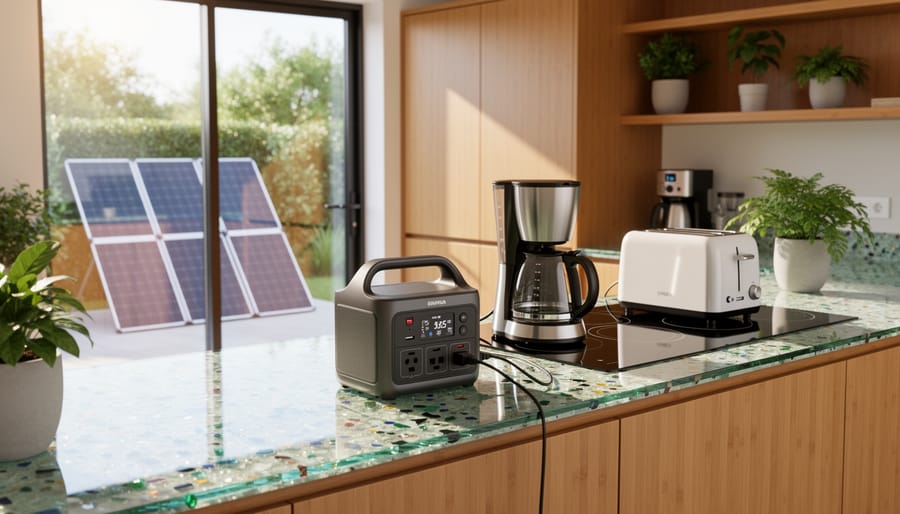
Solar Power Your Kitchen While Saving the Planet (And Money) by Charlesnoble February 21, 2026 Calculate your kitchen’s current energy consumption by tracking appliance usage for one week, noting which devices draw the most power—typically refrigerators, dishwashers, and electric stoves account for 60-80% of kitchen energy use. This baseline becomes your roadmap for meaningful change, showing exactly where solar integration or efficiency upgrades will deliver…
Why Your Solar Panels Are Losing 25% Efficiency (And… by Charlesnoble February 4, 2026 Inspect your solar panels monthly for dust, pollen, bird droppings, and mineral deposits that can reduce energy production by 15-25%. A proper cleaning kit eliminates this performance loss without the $150-300 cost of professional cleaning services, paying for itself after just two uses. Choose a kit with three essential components:…
Why Solar-Powered Fountains Are Better Than You… by Charlesnoble April 1, 2026 Picture a garden fountain that runs entirely on sunlight, requiring no electrical outlets, trenching, or monthly power bills. Solar-powered fountains harness photovoltaic technology to circulate water through decorative displays, creating peaceful ambiance while operating completely off-grid. These self-contained systems typically feature a small solar panel connected to a submersible pump,…
Why Your Solar Watch Needs Different Care Than… by Charlesnoble November 27, 2025 Protect your solar watch investment by exposing the dial to bright light for at least 8 hours monthly, even when fully charged. This prevents the lithium battery from deep discharge, which permanently reduces its lifespan. Position your watch near a window during work hours or wear it outdoors regularly to…
Subscribe for handpicked DIY projects, exclusive tips, and giveaways.
Route your PV wires through UV-resistant conduit within 18 inches of leaving the solar array, securing it every 3 feet with proper clamps to prevent wind damage and code violations. This single step prevents 80% of the wire degradation issues I’ve seen in DIY solar installations over the past decade. Group your positive and negative… Read more: Why Your PV Wire Management Could Fail Inspection (And How to Fix It)
Understand that 6000 volts sounds terrifying but delivers surprisingly low amperage—typically around 120 milliamps for just 3/10,000th of a second per pulse. This combination creates an unforgettable shock that trains animals to avoid the fence without causing lasting harm. The voltage pushes current through thick fur and hide, while the minimal amperage and microsecond duration… Read more: Why 6000 Volts Won’t Kill Your Livestock (But Will Stop Predators Cold)
Check the maximum voltage and current ratings first—these determine whether your controller can actually handle your solar panel array without frying itself on the first sunny day. I learned this the hard way when my first DIY system shut down every afternoon because I’d paired 600 watts of panels with a controller rated for only… Read more: Why Your Solar Setup Needs Both a Charge Controller and Inverter (And How to Pick the Right Ones)