Why Your Electric Vehicle Needs Solar Panels (And How to Make It Work)
Updated:
Picture yourself pulling into a campsite after hours on the road, your electric vehicle’s battery sitting at 40%, and the nearest charging station is twenty miles back. Now imagine your EV quietly replenishing its own power from panels mounted right on the roof while you set up camp. This isn’t science fiction anymore—it’s the reality of solar-integrated electric vehicles, and it’s more accessible than you might think.
The idea of combining solar panels with electric vehicles has moved from concept cars to driveways, camper vans, and DIY garages across the country. While a rooftop solar array won’t replace your home charging setup, it can add 15-40 miles of range per day in optimal conditions, extend your time off-grid, and power auxiliary systems like air conditioning, refrigeration, or camping equipment without touching your main battery.
I’ve spent years helping people integrate solar into unexpected places, from tiny homes to sailboats, and EVs present one of the most exciting opportunities yet. The technology is surprisingly straightforward—you’re essentially creating a mobile power station that happens to move you around. Whether you’re considering a factory-installed solar roof on a new vehicle, retrofitting panels onto your existing EV or converted van, or simply wanting to understand if the math actually works out, the practical reality sits somewhere between the hype and the skepticism.
The key is understanding what solar can realistically do for your specific situation, how the systems actually integrate with modern EV architecture, and which approach makes sense for your budget and technical comfort level. Let’s cut through the marketing and get into what actually works.
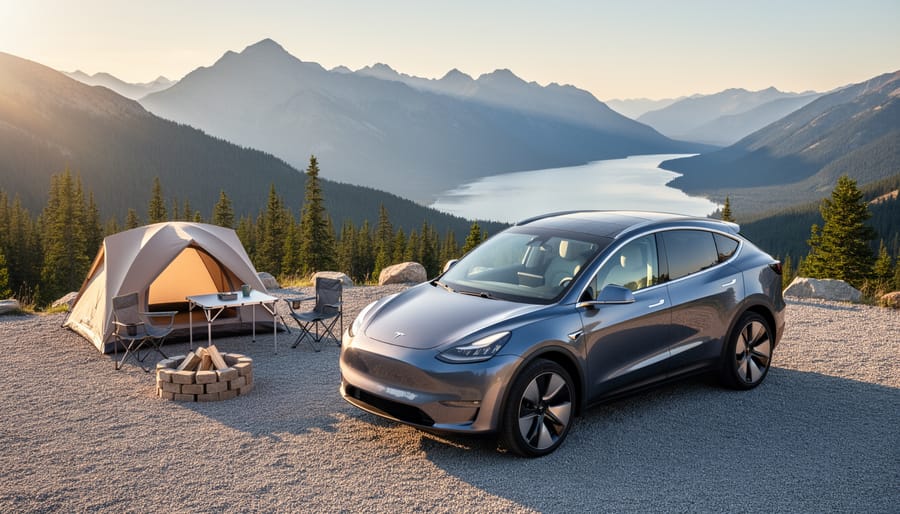
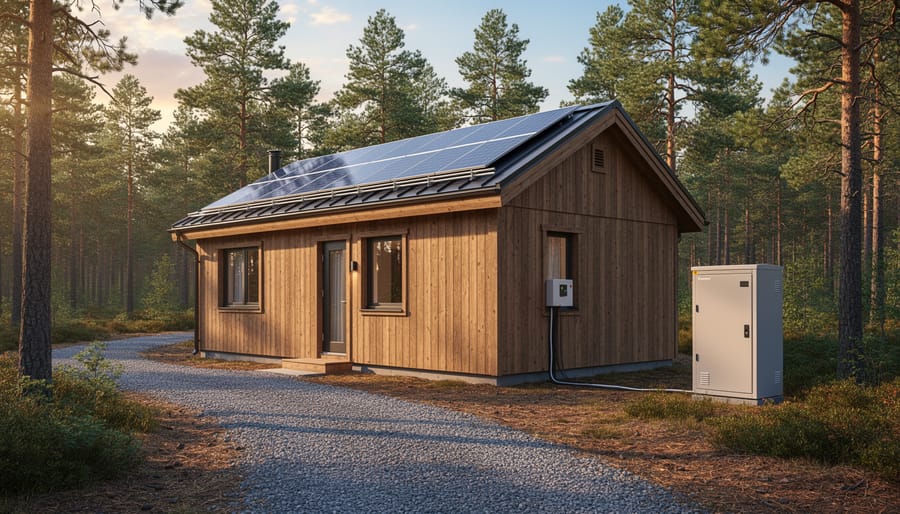
Solar panels integrated into an EV’s roof provide continuous charging capability, especially valuable during outdoor adventures and remote camping trips.
The Real Benefits of Adding Solar Panels to Your EV
Range Extension: What the Numbers Actually Tell Us
Let me be straight with you: solar panels on your electric vehicle won’t replace charging stations, but they can definitely add some free miles to your daily driving. Based on real-world data and conversations I’ve had with EV owners who’ve added solar, here’s what you can actually expect.
In ideal conditions—think sunny summer days in Arizona with perfectly positioned panels—you might squeeze out 15 to 20 miles of additional range per day. That’s genuinely useful for short commutes or running errands around town. However, most drivers see more modest gains of 3 to 7 miles daily under typical conditions.
Several factors influence these numbers. Panel efficiency matters, of course, but so does your parking situation. If your car sits in a covered garage during peak sun hours, you’ll get minimal benefit. Climate plays a huge role too. My friend in Seattle added solar to his EV and gets about 3 miles per day on average, while another friend in Southern California consistently sees 12 to 15 miles.
The sweet spot users tend to find? Those who park outdoors during work hours and have short commutes. One reader shared that his 8-mile round trip to work is completely covered by solar during summer months, meaning he rarely plugs in for weeks at a time. During winter, those same panels still contribute 2 to 4 miles daily.
Think of vehicle solar as supplementary, not primary. It’s free range that accumulates quietly while you’re doing other things.
The Freedom Factor for Outdoor Enthusiasts
For outdoor adventurers, a solar-equipped EV is like having a portable basecamp that powers itself. I’ll never forget the first time I took my solar-paneled vehicle on a week-long camping trip. While traditional EVs would have me anxiously hunting for charging stations, those roof panels gave me something priceless: freedom from range anxiety in the backcountry.
Here’s what makes this setup transformative. Those solar panels provide continuous trickle charging throughout the day, even when you’re parked at a remote trailhead or lakeside campsite. You’re not going to fully recharge your battery from empty, but gaining 10-25 miles of range daily means you can extend your adventures without needing to pack up and find civilization.
The real game-changer is powering your camping gear without touching your main battery. Most solar-equipped EVs let you tap into that solar energy directly. Run your portable fridge, charge your drone batteries, power your lights, and keep all your devices topped up. That off-grid capability transforms how you experience remote locations.
Think about it practically: a weekend at the beach means your cooler stays cold, your phones stay charged, and you still have plenty of range to get home. No noisy generator, no fuel to carry, just quiet, clean power from the sun. For van-lifers and overlanders, this isn’t just convenient; it fundamentally changes what’s possible when you venture off the beaten path.
How Vehicle-Integrated Solar Actually Works
The Three Key Components You Need to Understand
When I first started exploring solar-powered EVs, I was honestly overwhelmed by all the components involved. But here’s the good news: you really only need to understand three essential pieces to make this work. Let me break them down in a way that actually makes sense.
First up are the solar panels themselves. These are your power generators, converting sunlight into electrical energy. For vehicle applications, you’ll typically use monocrystalline panels because they’re more efficient in limited space. Think of them as your miniature power plant on wheels. The wattage you choose depends on your goals—a 100-watt panel might add a few miles of range per day, while a 400-watt setup could significantly extend your driving capacity during sunny conditions.
Next, you need a charge controller, which is basically the traffic cop between your solar panels and your battery. Without one, your panels would send unregulated power that could damage your battery or waste energy. There are two main types: PWM (Pulse Width Modulation) and MPPT (Maximum Power Point Tracking). I learned the hard way that MPPT controllers are worth the extra investment—they’re 20-30% more efficient, especially when your panel voltage doesn’t perfectly match your battery voltage.
Finally, battery management systems are your safety net and efficiency optimizer. These monitor your battery’s health, prevent overcharging or deep discharge, and balance the cells to maximize lifespan. Many modern EVs have built-in systems, but when adding aftermarket solar, you’ll need to ensure everything communicates properly. This component often gets overlooked, but it’s absolutely critical for long-term success and safety.
Factory vs. DIY: Which Path Should You Take?
When I first explored this question, I admit I was torn. Factory-integrated solar EVs like the Sono Sion and Lightyear 0 promise seamless integration and optimized performance, but they come with premium price tags and limited availability. Meanwhile, the DIY route offers flexibility and learning opportunities, though with some trade-offs.
Factory-integrated options shine in their engineering refinement. These vehicles are designed from the ground up with solar in mind, featuring panels perfectly contoured to the body, integrated charging systems, and comprehensive warranties. The Lightyear 0, for example, claims up to 44 miles of solar range daily under ideal conditions. You simply drive and let the system work. The downside? These vehicles often cost significantly more than standard EVs, and some models face production delays or limited market availability.
The DIY approach appeals to hands-on enthusiasts who want customization control. You can add portable panels, flexible panels to flat surfaces, or even create a rooftop solar charging station for home use. This path costs considerably less upfront, typically ranging from a few hundred to a few thousand dollars depending on your setup. However, you’ll need to carefully consider your vehicle’s warranty. Installing panels directly on your car might void certain coverage, and improper installation could damage your vehicle’s electrical system.
My recommendation? If you’re buying new and budget allows, factory-integrated makes sense. For existing EV owners or those who enjoy tinkering, DIY supplemental solar offers practical benefits without breaking the bank. Consider starting with portable panels to test the concept before committing to permanent installations.
Planning Your Vehicle Solar Installation
Measuring Your Vehicle’s Solar Potential
Before you start ordering panels and running wires, let’s figure out what your vehicle can actually deliver. I remember when I first looked at my old van, I got overly excited about the potential—until I actually measured the usable space and realized my roof rack was blocking prime real estate!
Start by measuring your vehicle’s roof area. Grab a tape measure and calculate the length and width of flat, unobstructed space. Don’t forget to account for antennas, roof racks, or that spoiler you added last summer. Most sedan roofs offer about 15-20 square feet of usable space, while vans and RVs can provide 40-60 square feet or more.
Next, consider your location’s solar potential. The National Renewable Energy Laboratory offers free tools that show average daily sun hours for your area. Someone in sunny Arizona might see 6-7 peak sun hours daily, while Seattle residents typically get 3-4. This matters tremendously for your calculations.
Here’s a simple formula to estimate daily energy generation: multiply your panel wattage by peak sun hours, then multiply by 0.75 to account for real-world efficiency losses. For example, a 300-watt panel in a location with 5 sun hours would generate roughly 1,125 watt-hours (300 × 5 × 0.75) daily.
Now factor in your driving patterns. Park in a garage all day? Your generation drops significantly. Outdoor parking with southern exposure? You’re in business. Track your EV’s daily consumption using your vehicle’s app—most show kilowatt-hours used per trip.
Compare your potential generation against your actual consumption. If you drive 30 miles daily consuming 10 kWh, but your panels only generate 1-2 kWh, you’ll know exactly what percentage of your driving could be solar-powered. This realistic assessment helps set proper expectations before investing time and money.
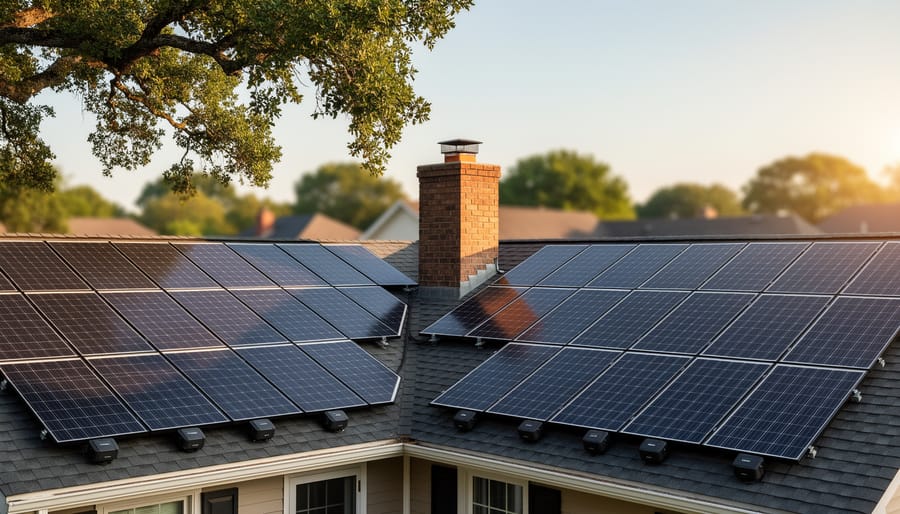
Flexible solar panels designed for vehicle integration feature lightweight construction and efficient monocrystalline cells that conform to curved roof surfaces.
Choosing the Right Solar Panels for Your EV
Selecting the right panels for your EV project can feel overwhelming, but I’ve found it comes down to a few key decisions that match your vehicle type and goals.
First, let’s talk flexible versus rigid panels. I learned this the hard way on my first camper van project: flexible solar panels are fantastic for curved roofs and irregular surfaces. They’re lightweight, easy to install with adhesive backing, and perfect for aerodynamic placement. However, rigid panels typically offer better efficiency and durability for the same price. If you have a flat roof area on an RV or trailer, rigid panels with proper mounting will serve you longer and perform better in hot conditions.
Next up is the monocrystalline versus polycrystalline choice. Monocrystalline panels cost about 20-30% more but deliver higher efficiency in a smaller footprint, which matters when roof space is limited. For compact cars or smaller vehicles, this efficiency boost is worth every penny. Polycrystalline panels work great for larger vehicles like RVs where you have plenty of surface area and want to save money.
Matching wattage to vehicle size is crucial. A sedan might accommodate 100-200 watts maximum, perfect for maintaining your 12V accessories. Compact SUVs can handle 200-400 watts, while full-size RVs offer space for 600-1000+ watts, potentially powering significant onboard systems.
Here’s my practical recommendation: start with quality monocrystalline panels rated at least 100 watts each. This approach mirrors what works well in DIY solar systems where proven components matter more than cutting corners. Calculate your available roof space, subtract 15% for mounting hardware and spacing, then match panels to that realistic area.
The DIY Installation Process Explained
Tools and Materials You’ll Actually Need
Here’s what you’ll need to get started with your solar EV project. I learned the hard way that having everything ready before you begin saves hours of frustration.
First, solar panels rated between 100-400 watts depending on your vehicle’s size. Flexible panels work best for curved surfaces, while rigid panels offer better efficiency. You’ll need mounting hardware including brackets, adhesive sealant, and potentially a roof rack system to secure everything safely without damaging your vehicle.
A charge controller is essential to prevent overcharging your battery. Look for an MPCC controller that matches your panel’s voltage output. You’ll also need appropriate gauge wiring, MC4 connectors for waterproof connections, and inline fuses for safety.
Don’t skip the safety equipment: insulated gloves, safety glasses, and a multimeter to verify connections. A drill with appropriate bits and cable management clips will keep your installation clean and professional-looking.
Consider getting a battery monitor too. This simple device helped me understand exactly how much power I was generating versus consuming, which completely changed how I planned road trips. Budget around $500-1500 for a quality setup, though costs vary based on your vehicle’s requirements and panel capacity.
Mounting Your Panels Without Damaging Your Vehicle
Getting your solar panels mounted properly is crucial—trust me, I learned this the hard way when my first attempt resulted in a whistling sound at highway speeds that nearly drove me crazy! The good news is that you can achieve a professional-grade installation with the right approach.
Start by thoroughly cleaning your vehicle’s roof with isopropyl alcohol to ensure proper adhesion. For most DIY installations, you’ll choose between three main methods: specialized solar panel adhesives, mounting brackets, or roof racks.
If you’re going the adhesive route, use products specifically designed for automotive applications, like 3M VHB tape or marine-grade sealants. These create strong bonds without drilling holes that could compromise your vehicle’s weatherproofing. Apply adhesive in temperatures above 50°F for optimal bonding, and give it at least 24 hours to cure before hitting the road.
Bracket systems offer more flexibility for removal but require careful planning. If you must drill, use a centerpunch to prevent wandering, and always apply silicone sealant around bolt holes to prevent water intrusion. Consider placing brackets over existing roof strengthening points when possible.
Roof racks are my personal favorite for beginners—they’re reversible and don’t require permanent modifications. Just ensure your rack’s weight capacity accounts for both panels and mounting hardware.
Whatever method you choose, keep aerodynamics in mind. Maintain a low profile and angle panels to minimize wind resistance. Run all wiring through existing entry points like tailgate seals or antenna holes, using rubber grommets to protect cables and maintain weather seals. Take your time with this step—rushing leads to leaks and headaches down the road.
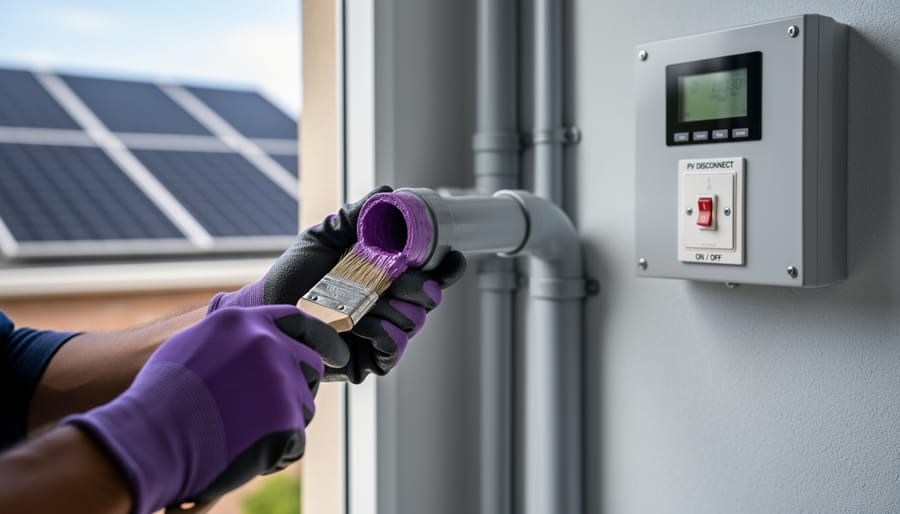
Installing solar panels on an EV requires basic tools and careful attention to mounting techniques that protect the vehicle’s integrity.
Wiring It Right: Connecting to Your EV’s Battery System
Here’s where things get real, friends. Connecting solar panels to your EV isn’t like plugging in a phone charger. You’re dealing with high-voltage systems that demand respect and careful planning.
First, let’s talk about the elephant in the garage: most modern EVs have sophisticated battery management systems that aren’t designed for DIY tinkering. Your vehicle’s electrical system includes protective circuits that can actually reject improperly configured charging sources. This is a good thing, safety-wise, but it means you can’t just splice wires and hope for the best.
The safest approach for most hobbyists is using a proper charge controller that sits between your solar panels and the EV’s charging port. Think of it as a translator that speaks both “solar” and “EV” fluently. This setup mimics how your standard charging cable works, keeping the vehicle’s safety systems happy.
I learned this the hard way when helping my neighbor, who thought he could bypass his Nissan Leaf’s onboard charger. Spoiler alert: the car went into protection mode and wouldn’t charge at all until we reset the system properly.
When should you absolutely call a professional? If you’re considering direct battery connections, working with voltages above 48V, or modifying the vehicle’s internal wiring, stop right there. These situations require licensed electricians with EV certification. It’s not about questioning your skills, it’s about insurance, warranties, and frankly, staying safe.
What I Learned From My Own Vehicle Solar Setup
When I first mounted solar panels on my camper van conversion, I’ll admit I had wildly optimistic expectations. I genuinely thought I’d be cruising around, barely touching the grid, charging my vehicle purely from the sun. Reality, as it often does, had other plans.
My biggest mistake? Overestimating how much juice I’d actually collect while driving. I installed three 100-watt panels on my roof, did all the calculations on paper, and figured I’d get continuous charging during my daily commute. The problem was, I didn’t account for tree cover, parking garages, or the simple fact that my van spends most daylight hours sitting in my driveway pointed the wrong direction. Those first few weeks were humbling, to say the least.
But here’s where things got interesting. While the panels weren’t revolutionizing my daily driving like I’d hoped, they transformed my camping experiences in ways I hadn’t anticipated. On a three-day trip to the mountains, I kept my portable fridge running, charged my laptop twice, powered my lights, and still had enough juice left over to top up the vehicle’s auxiliary battery. I never touched a gas generator once. That’s when it clicked for me: this setup wasn’t about replacing grid charging, it was about independence during adventures.
Another unexpected benefit came during a power outage last summer. While my neighbors were rushing to gas stations, I had a rolling power station sitting in my driveway. I ran extension cords into the house and kept our essentials running for two days straight. The panels kept the auxiliary battery topped up, which in turn powered our critical devices. I never planned for this use case, but it became one of my favorite features.
My advice after two years of real-world use? Start smaller than you think you need. My original plan called for six panels, and I’m glad I started with three. Focus on powering auxiliary systems first rather than trying to charge your main EV battery. Track your actual energy needs for a month before buying anything. And most importantly, think about your realistic use cases, not your ideal scenarios. The camping trips and emergency backup have delivered way more value than my commute ever could have.
Maximizing Your System’s Performance
Getting the most from your vehicle-integrated solar setup is all about understanding a few key principles and developing smart habits. I learned this the hard way during my first summer with solar panels on my camper van. I parked in the shade thinking I’d be clever about staying cool, only to realize my batteries barely charged at all. It was a rookie mistake, but it taught me valuable lessons about strategic positioning.
Let’s start with parking strategies. Whenever possible, position your vehicle to face south if you’re in the Northern Hemisphere, or north if you’re down under. This maximizes sun exposure throughout the day. I know it sounds simple, but you’d be surprised how much difference it makes. Even a 15-degree adjustment can boost your daily energy capture by 10-20 percent. If you’re planning off-grid camping adventures, scout your parking spots ahead of time using satellite imagery to identify areas with minimal tree coverage.
Seasonal adjustments matter more than most people realize. In winter, the sun sits lower in the sky, so your panels might benefit from a slight tilt adjustment if your mounting system allows it. Summer brings longer days and higher sun angles, meaning you’ll generate more power even with flat-mounted panels. Track these patterns using our interactive calculator tool, which helps you understand seasonal variations specific to your location.
Maintenance is refreshingly straightforward. Clean your panels monthly with water and a soft cloth, especially after dusty trips or pollen season. Check connections every few months to ensure everything stays tight and corrosion-free. It takes maybe 15 minutes and can prevent frustrating power drops.
Finally, make friends with the calculator tool on our website. Input your daily driving patterns, parking habits, and location to see realistic performance projections. It’s helped countless DIYers optimize their systems and set proper expectations. The tool also suggests simple tweaks that can significantly improve your energy harvest without requiring major modifications.
Solar-equipped EVs enable true off-grid camping adventures by providing continuous power generation for both vehicle charging and camping equipment.
Adding solar panels to your electric vehicle isn’t just about saving a few dollars on charging costs. It’s about reclaiming a bit of independence and making your adventures more sustainable, one sunny mile at a time. Whether you’re a weekend warrior hitting remote trails or someone who simply wants to reduce their environmental footprint, this technology puts you in the driver’s seat of your energy future.
The beauty of vehicle-integrated solar systems is that you don’t need to go all-in from day one. Start with a small portable panel for maintaining your 12V accessories, test it out on a camping trip, and see how it works for you. As you get comfortable with the technology and understand your real-world energy needs, you can gradually expand your system. I learned this approach the hard way after initially overbuying equipment I didn’t need.
Remember, you’re not alone in this journey. The DIY solar community is incredibly welcoming and full of people who’ve already tackled the challenges you’re facing. Whether you’re troubleshooting a wiring issue or trying to figure out the best mounting solution for your specific vehicle, someone out there has probably solved that exact problem.
What’s your biggest question about adding solar to your EV? Have you already experimented with a small system? Drop your experiences in the comments below. Your real-world insights might be exactly what another reader needs to take their first step toward solar-powered adventures.
How useful was this post?
Click on a star to rate it!
Average rating 0 / 5. Vote count: 0
No votes so far! Be the first to rate this post.
We are sorry that this post was not useful for you!
Let us improve this post!
Tell us how we can improve this post?
charlesnoble
Here at Spheral Solar, I’m a hands-on solar power enthusiast, constantly exploring and experimenting with DIY solutions. I’m dedicated to sharing my discoveries, insights, and even the bumps I hit along the way, all in the pursuit of a more sustainable future.
Turn Your Home’s Exterior Into a Power Plant With BIPV Solar by Charlesnoble February 19, 2026 Picture this: your home’s windows generating electricity while you admire the view. Your patio awning powering your outdoor lights as it shades your afternoon barbecue. Your garage door collecting energy every time the sun hits it. This isn’t science fiction – it’s building integrated photovoltaics, and it’s transforming how we…
Community Solar Projects Made Simple: How You Can… by Charlesnoble March 19, 2026 Picture this: You’re renting an apartment with a north-facing roof, or your property is shaded by towering oak trees, yet you’re determined to power your life with clean solar energy. Community solar makes this possible. Instead of installing panels on your own property, you buy or lease a portion of…
Why CSP Solar Never Made It Into Your Backyard (And… by Charlesnoble January 30, 2026 When you see massive solar installations in the desert generating headlines, they’re often concentrating solar power plants—but the panels on your neighbor’s roof? Those are photovoltaics, and understanding the distinction matters more than you might think. Concentrating solar power uses mirrors or lenses to focus sunlight onto a receiver, creating…
Floating Solar Panels Could Change Where You Generate Power by Charlesnoble November 29, 2025 Picture your backyard pond doing double duty: supporting wildlife while generating clean electricity for your home. That’s the promise of floating solar panels, an innovation that’s transforming how we think about renewable energy installation. Floating solar systems, also called floatovoltaics, mount photovoltaic panels on buoyant platforms that rest on water…
Why DC Microgrids Are Perfect for Your DIY Solar Setup by Charlesnoble January 7, 2026 Picture this: you’re running LED lights, a laptop, and a small fridge in your off-grid cabin, and every device is drawing power directly from your solar panels without converting DC to AC and back again. That’s the elegant simplicity of a DC microgrid system, where electricity flows in its natural…
This DIY Floating Solar Pool Heater Slashed My… by Charlesnoble January 18, 2026 Place your floating solar heater on the pool’s sunny side during morning hours, positioning it where water circulation naturally draws heated water toward your skimmer return. You’ll capture 5-10 degrees of temperature gain on clear days without spending thousands on permanent installations. Build your first unit using black irrigation tubing…
Subscribe for handpicked DIY projects, exclusive tips, and giveaways.
Match your solar panels to microinverters or power optimizers based on your roof’s shading patterns—even partial shade from a chimney or tree during morning hours means module-level power electronics will recover 15-25% more energy than string inverters lose to the weakest panel. Install power optimizers when you’re working with mixed panel orientations across multiple roof… Read more: Why Smart Solar Modules Could Save Your DIY Array (Before It’s Too Late)
Measure your conduit run before purchasing materials by mapping the exact path from your solar array to the inverter and battery location, accounting for a 10% waste factor and additional length for bends. PVC electrical conduit remains the most cost-effective protective solution for DIY solar installations, but improper installation creates fire hazards, code violations, and… Read more: Why Your Solar Conduit Installation Could Start a Fire (And How to Do It Right)
Walk down to your nearest stream with a five-gallon bucket and a stopwatch. Fill that bucket and time how long it takes—this simple test reveals whether you have enough flowing water to power your off-grid home. If you can fill it in under 10 seconds from a source that drops at least 10 feet in… Read more: The Stream Behind Your House Could Power It (Here’s How Micro Hydro Works)