Why Your Solar Array Needs Proper Grounding (Before Lightning Teaches You)
Updated:
Connect your solar array’s metal frame to a grounding rod driven at least eight feet into the earth near your installation. This creates a safe path for electrical faults and lightning strikes to dissipate harmlessly into the ground instead of through your home’s wiring or, worse, through you.
Install grounding lugs on every solar panel frame using stainless steel hardware, then run a continuous copper grounding wire—minimum 6 AWG for most residential systems—from panel to panel and down to your grounding electrode. Strip away paint or anodizing at connection points to ensure metal-to-metal contact, which many first-time installers overlook and later regret during inspections.
Bond your system’s DC and AC sides separately but connect them to the same grounding electrode system. Your charge controller, inverter, battery bank, and combiner box all need their own ground connections that ultimately tie back to your main grounding point. This might seem like overkwork, but I learned the hard way when a nearby lightning strike fried my first inverter because I’d skipped bonding the charge controller.
Verify your ground resistance stays below 25 ohms using a ground resistance tester—you can rent one from tool libraries or electrical supply stores for around twenty dollars. Poor soil conductivity might require multiple grounding rods spaced at least six feet apart and connected with heavy copper wire. Sandy or rocky soil presents the biggest grounding challenges, often needing chemical ground enhancement or deeper rods.
Your local electrical code determines specific requirements, so check before drilling your first hole.
What Grounding Actually Means for Your Solar System
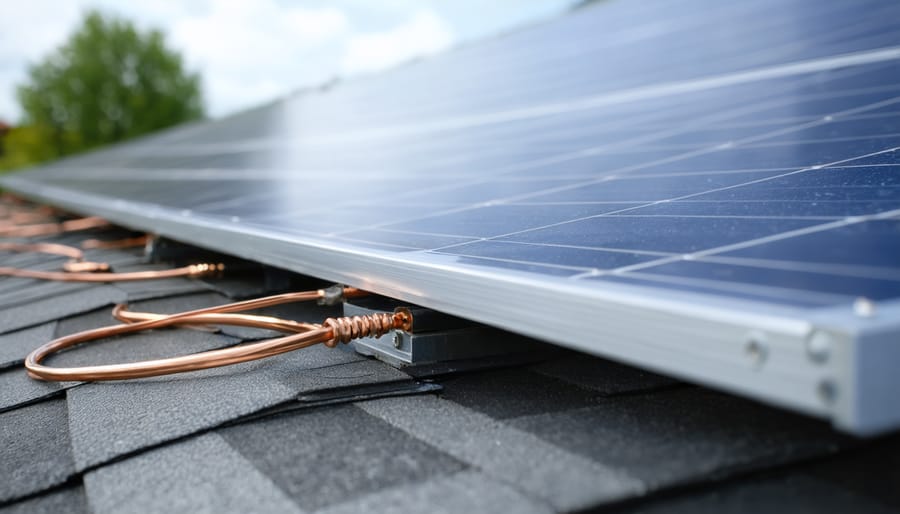
Proper grounding connections on solar panel frames are essential for safety and lightning protection in residential installations.
Equipment Grounding vs. System Grounding
When I first started working with solar systems, I thought grounding was just grounding. Boy, was I in for a surprise! It turns out there are actually two distinct types of grounding in your solar array, and understanding both is crucial for safety and code compliance.
Think of equipment grounding as your safety net. This is the green or bare copper wire you’ll see running throughout your system, connecting all the metal frames, racks, junction boxes, and equipment enclosures back to earth. Its job is simple but vital: if a hot wire comes loose and touches a metal frame, the equipment ground provides a path for that electricity to flow safely to earth instead of waiting for you to become that path. It’s like having a lightning rod for electrical faults.
System grounding, on the other hand, deals with the electrical conductors themselves. In many residential solar setups, this means intentionally connecting one of your DC current-carrying conductors (usually the negative wire) to ground. This is similar to bonding neutral and ground in your home’s AC system. System grounding helps stabilize voltage levels and provides a reference point for your electrical system.
Here’s an easy way to remember the difference: equipment grounding protects you from touching electrified metal parts, while system grounding protects your equipment and helps circuit breakers work properly during faults.
Some newer solar systems use transformerless inverters that don’t require system grounding of the DC conductors, but equipment grounding is always mandatory. Both types work together to create a comprehensive safety system, and you’ll need to address each separately when installing your array.
The Real Dangers of Skipping Proper Grounding
Let me tell you about something I witnessed at a neighbor’s place last summer. Jim had just finished installing his DIY solar array and was proudly showing it off when we noticed a faint burning smell. Turns out, he’d skipped the grounding step to save time. That decision cost him a $3,000 inverter and nearly sparked a roof fire. It was a wake-up call for both of us about why cutting corners on safety just isn’t worth it.
The most immediate danger is fire risk. When lightning strikes or a power surge occurs, an ungrounded system has nowhere to safely channel that energy. Instead, it finds the path of least resistance through your equipment, wiring, or worse, your home’s structure. The National Fire Protection Association has documented numerous cases where improper grounding led to electrical fires in solar installations.
Equipment damage is another costly reality. Modern solar inverters and charge controllers contain sensitive electronics that can’t handle voltage spikes. Without proper grounding, even minor electrical disturbances can fry these components instantly. I’ve seen friends lose entire systems worth thousands of dollars because they didn’t follow the electrical code requirements for grounding.
Then there’s personal safety. An ungrounded system can become energized in unexpected ways. Touch the wrong part during maintenance, and you could complete an electrical circuit with your body. This isn’t theoretical – it happens to DIYers who think they can skip safety protocols.
Finally, here’s something many folks overlook: your insurance company and equipment warranties. Nearly every solar component warranty requires professional installation following code standards. Skip proper grounding, and you’ve just voided thousands of dollars in coverage. Your homeowner’s insurance might also deny claims related to an improperly grounded system.
The good news? Proper grounding isn’t complicated or expensive. It just requires following the right steps, which we’ll cover next.
How to Ground Your Solar Array: The Essential Steps
What You’ll Need: Grounding Equipment Checklist
Let me walk you through exactly what you’ll need to properly ground your solar array. I learned this the hard way during my first installation—I thought I could skip a few items and ended up making two trips to the hardware store. Trust me, having everything ready makes the process so much smoother.
First up, you’ll need grounding wire. This is typically bare copper wire ranging from 6 AWG to 10 AWG depending on your system size. Budget around 15 to 30 dollars for a 50-foot spool. This wire creates the path for fault current to safely reach the earth.
Next, grab some grounding lugs or connectors. These attach your grounding wire to the solar panels and equipment. They run about 2 to 5 dollars each, and you’ll need one per panel plus extras for inverters and charge controllers. Look for ones rated for outdoor use.
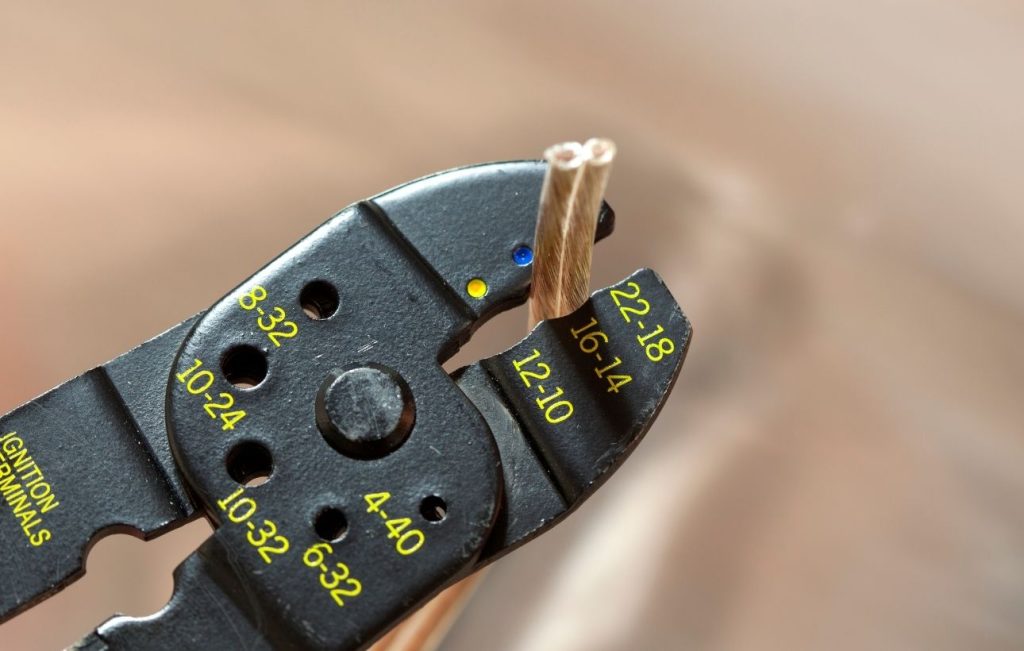
You’ll definitely want quality wire strippers and crimping tools to make solid connections—around 20 to 40 dollars for a decent set. Poor connections are a major safety risk, so this isn’t where you want to cut corners.
Pick up grounding clamps or lay-in lugs for about 3 to 8 dollars each. These secure your wire to metal mounting rails and frames. Don’t forget anti-oxidant compound, which prevents corrosion on connections—just 10 dollars for a tube that’ll last multiple projects.
Finally, you’ll need a grounding electrode, either a copper ground rod (8 feet long, around 20 to 30 dollars) or connection to your existing home grounding system. Add some stainless steel hardware for mounting connections—budget another 15 to 25 dollars.
Total investment? Expect around 100 to 200 dollars for a typical residential system.
Grounding Your Solar Panel Frames
Now let’s get your panel frames properly grounded – this is where safety really comes into play, friends. When I installed my first array, I’ll admit I was tempted to rush through this step. Thank goodness my neighbor, an electrician, stopped by and showed me why this matters so much. A lightning strike or fault can send thousands of volts through ungrounded metal frames, creating serious shock hazards.
Start by identifying the grounding holes or lugs on your panel frames. Most modern panels have pre-drilled holes marked specifically for grounding – they’re usually on the corners or along the frame edges. You’ll need stainless steel or aluminum grounding clips or lugs that match your frame material to prevent corrosion.
Here’s the process: First, clean the contact area on the frame with a wire brush to remove any anodizing or oxidation – you need bare metal for a solid electrical connection. Attach your grounding lug using the provided hardware, making sure it’s tight and secure. Connect a grounding conductor (typically 6 AWG copper wire minimum, but check your local codes) from each lug to your equipment grounding conductor.
For arrays with multiple panels, you can daisy-chain the grounding by running your wire from frame to frame, but ensure every connection point is clean and tight. Some installers prefer using grounding clips that bridge between panel frames on the mounting rails – these work great and speed up installation.
Always verify continuity with a multimeter after making connections. You should read zero or near-zero resistance between any panel frame and your grounding point. This simple test confirms your safety system is working properly before you energize the system.
Creating Your Ground Rod Connection
Installing ground rods is one of those tasks that looks simple but requires attention to detail to get right. I remember my first installation where I thought driving an 8-foot rod into rocky soil would be easy—it wasn’t! But with the right approach, you’ll do just fine.
Start with proper ground rod selection. You’ll need copper-clad steel rods that are at least 5/8 inch in diameter and 8 feet long. This is the standard requirement in most jurisdictions, though some areas with rocky soil may allow shorter rods if you can demonstrate adequate grounding resistance.
Here’s the key part: your ground rod must be driven at least 8 feet into the earth, with no more than 12 inches visible above ground. Drive it vertically if possible. If you hit rock and can’t go deeper, you can install it at a 45-degree angle, but check your local codes first. Some areas require you to bury it horizontally in a trench at least 2.5 feet deep instead.
For larger solar arrays or when soil conductivity is poor, you might need multiple ground rods. Space them at least 6 feet apart—ideally twice the length of the rod itself (16 feet for 8-foot rods). This prevents the grounding zones from overlapping, which reduces effectiveness.
Connect your rods using copper grounding wire, typically 6 AWG minimum. Use listed grounding clamps—those bronze or copper clamps specifically designed for this purpose. Avoid steel clamps, which corrode and create resistance over time. When connecting multiple rods, run a continuous wire between them rather than creating separate connections.
Pro tip: Pour a bucket of water around the area where you’ll drive the rod. It softens the soil and makes driving much easier. Your arms will thank you later!
Installing ground rods to proper depth ensures effective electrical grounding for your solar array system.
Bonding: Connecting Everything Together Safely
Bonding Your Solar Panels and Racking
Bonding your solar panels to the racking system creates a continuous electrical path that’s essential for safety. Think of it as building a highway for stray electricity to safely reach the ground instead of looking for alternate routes through your home or, worse, through you.
Most modern solar panels come with pre-drilled bonding holes in their frames. Your job is to connect these frames to the metal racking using listed bonding devices. These are typically stainless steel clips or lugs specifically designed for solar installations. I learned this the hard way during my first installation when I tried using regular hardware store washers, only to have my inspector shake his head and point me toward proper UL-listed bonding equipment.
Start at one end of your array and work systematically. Place a bonding clip or lug at each connection point where the panel frame contacts the rail. These devices bite through any anodization or coating on both surfaces, ensuring metal-to-metal contact. Tighten them to the manufacturer’s specified torque, usually between 30 and 50 inch-pounds. Under-tightening won’t create proper contact, while over-tightening can crack the panel frame.
For arrays with multiple rows, you’ll need bonding jumpers to connect each rail section together. These ensure continuity across your entire array. Use a multimeter to verify continuity between the first and last panel, checking for resistance below 0.1 ohms.
Remember, proper bonding isn’t optional, it’s your first line of defense against electrical faults and lightning strikes.
Bonding jumpers create electrical continuity between all metal components in your solar array for complete safety.
Surge Protection: Your Second Line of Defense
Choosing the Right Surge Protector for Your System
Picking the right surge protector doesn’t have to feel overwhelming. I learned this the hard way when Charles helped me troubleshoot why my first SPD wasn’t doing its job—turns out I’d grabbed one rated for the wrong voltage. Let me save you that headache.
Start with your system voltage. For most residential setups running 12V, 24V, or 48V battery systems, you’ll need an SPD rated at least 20% above your maximum system voltage. If you’re working with a grid-tied system at 240V or higher, you’ll need Type 2 SPDs rated for AC voltage on both the DC solar side and AC inverter side.
The type of inverter you have matters too. String inverter systems need SPDs installed at the combiner box before the inverter, protecting that single point where all your strings come together. Micro-inverter systems are trickier since each panel has its own inverter—you’ll want panel-level protection or at minimum, an SPD at your AC junction box where the system connects to your home’s electrical panel.
Charles swears by mid-range options for DIYers. His go-to recommendation? Look for SPDs with visual indicators that show when they’re working and when they’ve sacrificed themselves protecting your system. Brands like Midnite Solar and Blue Sea Systems offer reliable protection without breaking the bank, typically ranging from $75 to $200 depending on your voltage and configuration.
Budget-conscious? At minimum, protect your inverter—it’s your most expensive component. You can always add additional protection at combiner boxes or array sections later as funds allow. Just make sure whatever you choose is UL 1449 listed and matches your system’s specifications. Your local inspector will thank you, and your equipment will last years longer.
Where to Install Surge Protection Devices
Surge protection devices (SPDs) act as your system’s safety valves, and placing them strategically throughout your solar setup gives you multiple layers of defense against electrical surges. Think of it like having fire extinguishers in different rooms of your house – you want protection where the danger is most likely to occur.
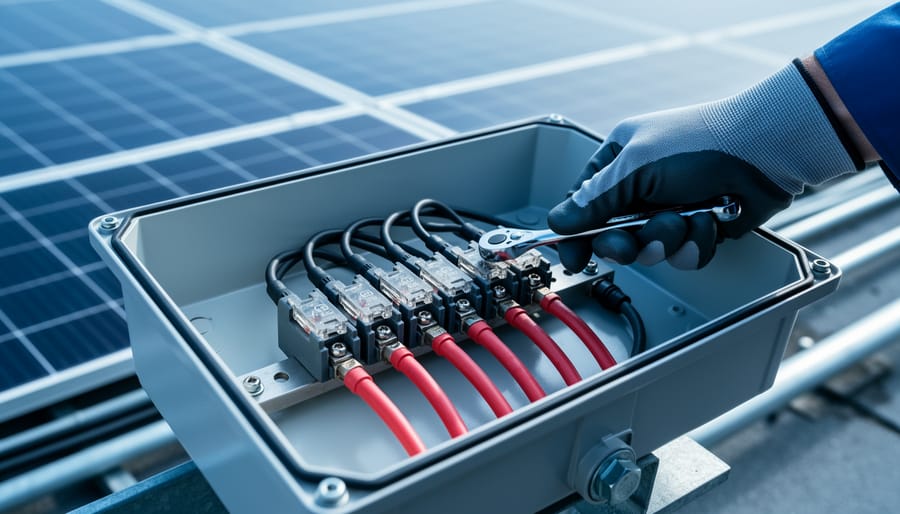
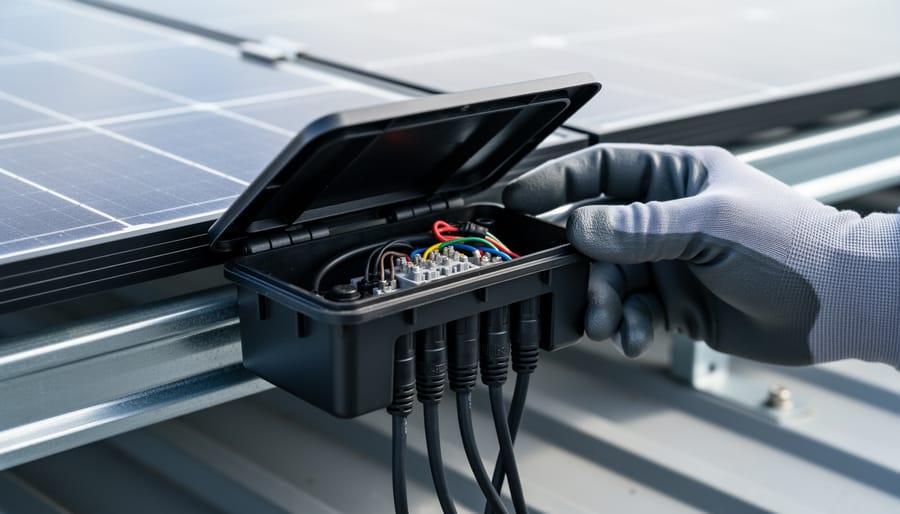
The first critical location is between your solar panels and charge controller. This is where lightning strikes or voltage spikes from the panels themselves can enter your system. When working on your combiner box wiring, install an SPD rated for DC voltage at this point. It should be mounted as close as possible to where the panel wires enter your equipment.
Your inverter represents another vulnerable entry point. Install a dedicated SPD at the inverter’s DC input terminals. Many modern inverters actually have built-in surge protection, but adding an external device provides an extra safety margin. Check your inverter’s manual to see what’s already included before doubling up unnecessarily.
Finally, don’t forget the AC side. Once your solar power converts to AC electricity, it needs protection too. Install an AC-rated SPD at your main electrical panel where the solar system connects to your home’s power. This protects against surges coming from the utility grid.
I learned this lesson the hard way when a nearby lightning strike fried my charge controller years ago. I’d skipped the panel-side SPD to save fifty bucks – ended up costing me ten times that in replacement equipment. Now I always install protection at all three points, and I sleep better during thunderstorms.
Common Grounding Mistakes DIYers Make (And How to Avoid Them)
I’ll be honest with you—I’ve made just about every grounding mistake in the book during my early solar projects, and I’ve seen countless others stumble over the same issues. The good news? These mistakes are incredibly common and completely fixable once you know what to watch for.
The most frequent error I see is undersizing ground wires. I remember my first array where I figured “wire is wire” and used whatever gauge I had lying around. Big mistake. Your grounding conductor needs to handle potential fault currents safely, which means following NEC requirements for wire sizing based on your largest circuit conductor. Generally, you’ll need at least 6 AWG copper for most residential systems, but don’t guess—check the code tables or consult your local inspector.
Poor connections are another pitfall that nearly cost me a system. I once made the rookie move of just wrapping a ground wire around a lug instead of properly crimping it. Within months, that connection had loosened enough to become useless. Always use proper crimping tools and ensure every connection is tight, clean, and corrosion-free. Speaking of corrosion, mixing metals is a recipe for disaster. Connecting copper wire directly to aluminum frames without proper anti-oxidant compound creates galvanic corrosion that destroys your ground path. Use listed grounding lugs designed for dissimilar metals, and when in doubt, stick with all-copper or all-aluminum systems.
Here’s one that catches almost everyone: forgetting to bond all metal components. I once meticulously grounded my panels and racking but completely overlooked the conduit runs and junction boxes. Everything metal in your system needs to be part of the same grounding network. This includes frames, rails, mounting hardware, and any metal enclosures.
Finally, don’t cheap out on materials. I learned this lesson when moisture infiltrated a bargain-bin ground lug I’d installed. Using listed, weather-resistant components and proper solar connectors saves headaches later. Yes, quality grounding equipment costs more upfront, but it’s literally your family’s safety we’re talking about. Trust me, doing it right the first time beats redoing an entire grounding system because you cut corners.
Testing Your Grounding System
Once your grounding system is installed, you’ll want to verify that everything is working correctly before you start generating power. Don’t worry – this isn’t as complicated as it sounds, and I remember feeling that same mix of excitement and nervousness when I tested my first system!
The simplest initial check is a visual inspection. Walk around your array and look for loose connections, corroded wire, or damaged grounding clamps. Everything should be tight, clean, and secure. If you see green corrosion on copper connections or rust on steel components, that’s a red flag that needs addressing.
For a more thorough check, you’ll need a multimeter – a basic one costs about twenty dollars at any hardware store. Set it to measure resistance (the ohm setting) and test the continuity between your solar panel frames and the grounding rod. You should see a reading below 1 ohm, which means electricity can flow freely through your grounding path. If the reading is higher or shows “OL” (overload), something is interrupting the connection.
Here’s what I learned the hard way: test every connection point individually. When my system showed a high resistance reading, I assumed the entire installation was faulty. Turns out, just one loose bolt was the culprit. Testing each junction helped me pinpoint the problem in minutes rather than hours.
While these basic tests give you confidence, there’s a point where professional verification makes sense. If you’re connecting to the grid, your utility company will likely require an inspection anyway. Additionally, if your multimeter shows inconsistent readings, you’re dealing with a system over 10 kilowatts, or you simply want peace of mind, calling a licensed electrician is money well spent. They have specialized equipment like ground resistance testers that measure your system’s performance under various conditions.
Testing your grounding system with a multimeter verifies proper installation and ensures ongoing safety.
You’ve made it through the technical details, and here’s the truth: grounding your solar array isn’t just a checkbox on some electrical code form. It’s the invisible shield protecting your investment, your home, and everyone in it. I remember when I first tackled grounding on my own system, feeling overwhelmed by all the requirements. But looking back now, taking the time to do it right gave me genuine peace of mind during every thunderstorm and every sunny day my panels generate power.
The key takeaways are straightforward: establish both equipment grounding and system grounding, bond all metallic components together, install appropriate surge protection devices, and always verify your work meets local codes. Yes, it requires attention to detail, but you don’t need an engineering degree to get it done properly. Follow the steps, use the right materials, and don’t rush through the testing phase.
If you’re feeling uncertain about any part of the process, that’s completely normal and actually shows good judgment. Reach out to your local solar community, post questions in online forums, or consult with an electrician for a quick review. Many experienced DIYers are happy to share their knowledge, and I’ve learned some of my best tricks from fellow solar enthusiasts who’ve been exactly where you are now.
Remember, proper grounding isn’t optional, it’s essential. But it’s also completely achievable for someone willing to learn and work carefully. Your future self will thank you for taking this seriously.
How useful was this post?
Click on a star to rate it!
Average rating 5 / 5. Vote count: 1
No votes so far! Be the first to rate this post.
We are sorry that this post was not useful for you!
Let us improve this post!
Tell us how we can improve this post?
charlesnoble
Here at Spheral Solar, I’m a hands-on solar power enthusiast, constantly exploring and experimenting with DIY solutions. I’m dedicated to sharing my discoveries, insights, and even the bumps I hit along the way, all in the pursuit of a more sustainable future.
8 Best Wire Strippers in 2023 by Adeyomola August 4, 2021 A lightweight, versatile wire stripper with a sharp cutting edge and a solid grip is great. However, the best wire strippers stand out largely because of their broad wire gauge range. A versatile wire stripper does more than just wire stripping. Some brands design wire strippers and add extra features…
Why 8 AWG Solar Cable Changed How I Wire My Solar… by Charlesnoble December 17, 2025 Choosing 8 AWG solar cable for your DIY solar installation comes down to understanding one critical factor: how much current your system pushes through the wires and over what distance. If you’re running a 400-watt solar panel setup at 12 volts, you’re looking at roughly 33 amps of current, and…
Why Your RV Solar Panels Aren’t Charging (And How to… by Charlesnoble November 30, 2025 Check your multimeter readings at each connection point along your solar charging path—from panels to charge controller to battery—to pinpoint exactly where voltage disappears. Most RV solar systems lose 10-30% of their potential power to voltage drop, but this invisible thief often goes undetected until you systematically measure and compare…
Bonding Neutral and Ground at Main Panel by Charlesnoble October 25, 2023 Bonding the neutral and ground wires in the main electrical service panel is necessary for safety and compliance with the National Electrical Code. This bonding serves critical functions like completing the fault current path and limiting the voltage difference between the neutral and ground wires. In this article, we’ll cover…
Why Your DIY Solar System Needs a 4 String PV… by Charlesnoble January 27, 2026 Connect your solar panel strings to a single positive and negative output cable using a 4 string PV combiner box—the essential junction point that safely consolidates power from four separate string circuits before feeding your charge controller or inverter. This weatherproof enclosure houses individual fuses or circuit breakers for each…
Why Your Solar Panel’s J-Box Matters More Than You Think by Charlesnoble January 8, 2026 Flip over any solar panel and you’ll spot a small weatherproof box attached to the back—that’s the junction box, or j-box, and it’s the critical gateway between your panel’s delicate solar cells and your entire electrical system. Understanding this component isn’t just technical curiosity; it’s essential for anyone wiring their…
Subscribe for handpicked DIY projects, exclusive tips, and giveaways.
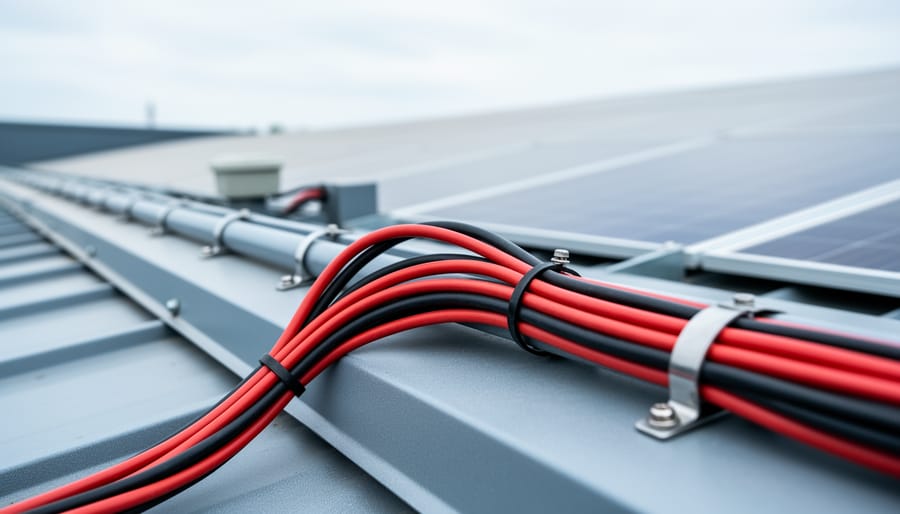
Route your PV wires through UV-resistant conduit within 18 inches of leaving the solar array, securing it every 3 feet with proper clamps to prevent wind damage and code violations. This single step prevents 80% of the wire degradation issues I’ve seen in DIY solar installations over the past decade. Group your positive and negative… Read more: Why Your PV Wire Management Could Fail Inspection (And How to Fix It)
Understand that 6000 volts sounds terrifying but delivers surprisingly low amperage—typically around 120 milliamps for just 3/10,000th of a second per pulse. This combination creates an unforgettable shock that trains animals to avoid the fence without causing lasting harm. The voltage pushes current through thick fur and hide, while the minimal amperage and microsecond duration… Read more: Why 6000 Volts Won’t Kill Your Livestock (But Will Stop Predators Cold)
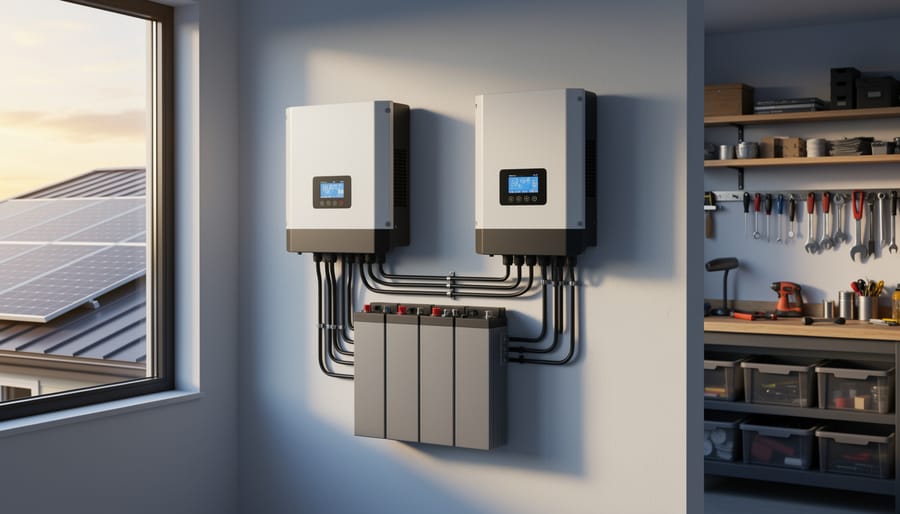
Check the maximum voltage and current ratings first—these determine whether your controller can actually handle your solar panel array without frying itself on the first sunny day. I learned this the hard way when my first DIY system shut down every afternoon because I’d paired 600 watts of panels with a controller rated for only… Read more: Why Your Solar Setup Needs Both a Charge Controller and Inverter (And How to Pick the Right Ones)