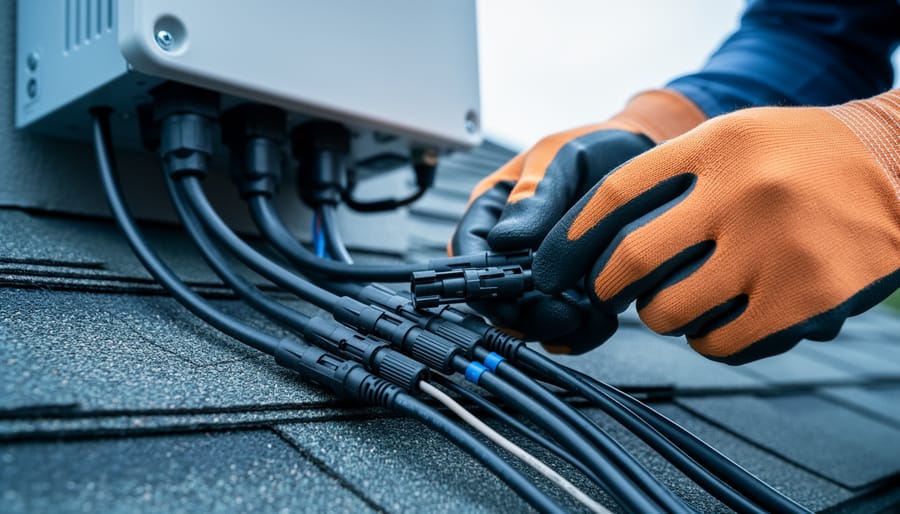
Why Your DIY Solar Microgrid Will Fail Without the Right Battery System
Updated:
Understand that a microgrid energy storage system is your battery bank plus the smart components that decide when to store solar power, when to use it, and when to pull from the grid or a backup generator. This integrated approach transforms disconnected parts into a cohesive power management solution that keeps your lights on when the grid fails or the sun sets.
Size your battery capacity by calculating your daily energy consumption in watt-hours, then multiply by the number of days you want to run independently. A typical household using 30 kWh daily needs roughly 60 kWh of usable storage for two days of autonomy, but account for battery depth of discharge limits since draining lithium batteries below 20% shortens their lifespan significantly.
Match your inverter capacity to your largest simultaneous loads, not your total consumption. If you run a 3,000-watt well pump, 1,500-watt microwave, and 500 watts of lights at once, you need at least a 5,000-watt inverter with surge capacity for motor starting. This distinction trips up many first-time builders who undersize their systems based on average rather than peak demand.
Choose between AC-coupled and DC-coupled architectures based on your existing setup. DC-coupled systems connect solar panels directly to batteries through a charge controller, offering better efficiency for new installations. AC-coupled systems work with existing grid-tie inverters and provide more flexibility for retrofits, though they convert power multiple times.
Integrate a battery management system that monitors cell voltages, temperatures, and state of charge to prevent damage from overcharging or overheating. This often-overlooked component extends battery life from 5 years to 15 years by preventing the silent killers of lithium chemistry.
What Makes a Microgrid Different from Regular Solar (And Why It Matters)
When I first started exploring solar energy, I thought all solar setups worked the same way—panels on the roof, power flowing into your home. But here’s the thing: there’s a fundamental difference between most residential solar systems and microgrids that completely changes how you interact with solar power.
Most home solar installations are grid-tied systems. They connect directly to your utility company, feeding excess power back to the grid and pulling from it when you need more. It’s convenient, but here’s the catch—when the grid goes down, your solar system shuts off too. Yes, even with the sun blazing overhead.
A microgrid flips this script entirely. Think of it as your personal power island. It operates independently, generating, storing, and distributing electricity without relying on external infrastructure. The magic happens through energy storage—typically batteries—that capture surplus solar energy during the day and release it when the sun sets or demand spikes.
This independence is what we call island mode. Your microgrid can disconnect from the main utility grid (or never connect at all) and keep humming along on its own. For off-grid homes, remote cabins, RVs, or anywhere the power lines don’t reach, this isn’t just convenient—it’s essential.
The energy storage component is what makes this possible. Without batteries or another storage method, you’d only have power when the sun shines. With storage, you’re building resilience into your system. You’re not just generating power; you’re creating a complete energy ecosystem that works on your terms.
I’ve seen folks light up when they realize what this means: true energy independence. Whether you’re dealing with frequent outages, living off the beaten path, or simply want control over your power supply, a microgrid puts you in the driver’s seat.
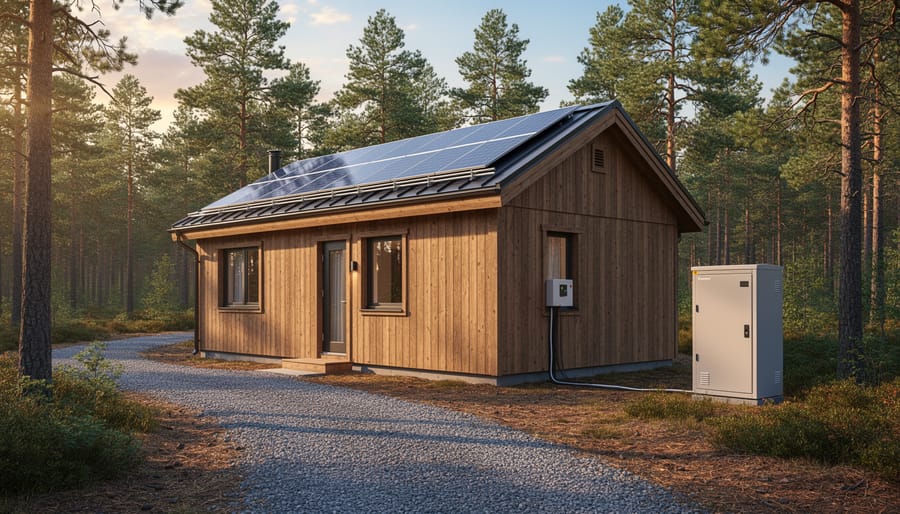
Off-grid homes rely on microgrid energy storage systems to maintain power independence when the sun isn’t shining.
The Three Essential Components of Microgrid Energy Storage
Battery Banks: Your Power Reservoir
Think of your battery bank as a reservoir that catches the energy your solar panels produce during the day so you can use it whenever you need it, especially at night or on cloudy days. When I first started building microgrids, I’ll admit I got a bit overwhelmed by battery choices. But once you understand the basics, it becomes much clearer.
Let’s break down your main options. Lithium-ion batteries, especially LiFePO4 (lithium iron phosphate), have become the go-to choice for most DIYers. They’re lighter, last longer (often 3,000-5,000 charge cycles), and you can safely use about 80-90% of their rated capacity. Yes, they cost more upfront, but the math usually works out over their lifetime. I switched to LiFePO4 in my own system three years ago and haven’t looked back.
Lead-acid batteries are the budget-friendly option. They’ve been around forever, which means they’re reliable and well-understood. However, you can only use about 50% of their capacity without damaging them, and they typically last 500-1,000 cycles. They’re heavier too, which matters if you’re installing them yourself.
Now, let’s talk capacity. Batteries are rated in amp-hours, which tells you how much current they can supply over time. A 100Ah battery at 12 volts gives you 1,200 watt-hours of storage. But remember that usable capacity number—with lead-acid, that 100Ah battery really gives you just 50Ah you should actually use.
To figure out what you need, add up the watt-hours your essential devices use daily, then multiply by 1.5 to 2 for backup days. It’s better to start conservatively and expand later than to undersize from the beginning.
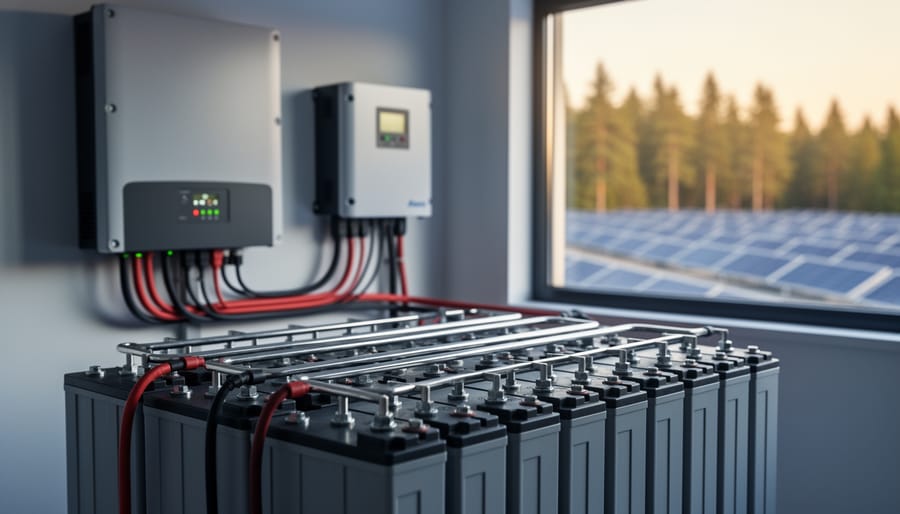
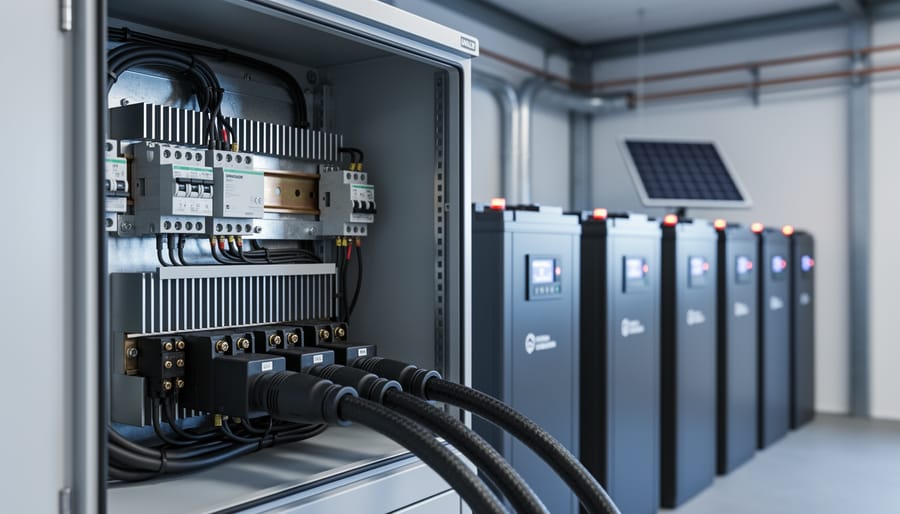
Modern lithium battery banks form the heart of reliable microgrid energy storage systems.
Charge Controllers: The Traffic Cops of Your System
Think of charge controllers as the traffic cops standing between your solar panels and batteries—they make sure electrons flow smoothly and safely, preventing chaos that could damage your precious battery bank.
There are two main types you’ll encounter: PWM (Pulse Width Modulation) and MPPT (Maximum Power Point Tracking). Here’s the difference in plain English: PWM controllers are like direct pipelines—they connect your panels to your batteries but can’t adjust the voltage efficiently. If your panel produces 18 volts but your battery needs 12 volts, you’re basically wasting that extra voltage.
MPPT controllers, on the other hand, are the smart traffic cops. They actively convert that excess voltage into extra current, squeezing 20-30% more power from your panels. I remember when Charles first upgraded from PWM to MPPT on his cabin setup—he couldn’t believe he was suddenly charging his batteries faster on cloudy days without adding a single panel.
For battery health, this matters tremendously. MPPT controllers provide more precise charging, preventing overcharging and undercharging cycles that shorten battery lifespan. They’re especially valuable if you’re running higher-voltage panel strings or dealing with temperature fluctuations.
When selecting a controller for your microgrid, consider these factors: your total solar wattage (size the controller for 125% of panel capacity), battery voltage (12V, 24V, or 48V), and maximum input voltage from your panels. Look for features like temperature compensation, programmable charging profiles for different battery types, and monitoring capabilities.
Yes, MPPT controllers cost more upfront, but they pay for themselves through increased efficiency and longer battery life—especially critical in off-grid microgrid applications where every watt counts.
Inverters: Converting Sun Power to Household Power
Think of an inverter as your microgrid’s translator. Your solar panels and batteries speak DC (direct current), but your home appliances speak AC (alternating current). The inverter bridges that gap, converting stored battery power into electricity you can actually use.
When I helped my neighbor Charles set up his first off-grid cabin system, he was baffled by inverter options. Here’s what matters: Pure sine wave inverters produce smooth, clean power identical to grid electricity. They’re essential for sensitive electronics like computers and modern appliances. Modified sine wave inverters are cheaper but can cause humming in motors and won’t work with some devices. For a home microgrid, always choose pure sine wave.
Sizing your inverter means matching it to your peak power needs. If you’ll run a 1,500-watt microwave, 800-watt coffee maker, and 200-watt refrigerator simultaneously, you need at least 2,500 watts of continuous power, plus surge capacity for motor startups.
Hybrid inverters are game-changers for DIY microgrids. These all-in-one units combine the inverter, solar charge controller, and battery management system. Charles upgraded to a hybrid inverter last year and called it “the control center I didn’t know I needed.” They simplify wiring, reduce failure points, and often include smart monitoring features that help you track your system’s performance through smartphone apps.
Sizing Your Storage: How Much Battery Do You Actually Need?
Here’s the truth about sizing battery storage: most people either wildly overestimate what they need (and spend way too much) or underestimate and end up frustrated when their lights go out. Let me help you find that sweet spot.
The basic calculation is actually pretty straightforward. You need to figure out three things: how much energy you use daily, how many days of backup you want, and how deep you can safely discharge your batteries.
Charles always starts with what he calls the “coffee pot test.” Look at your actual power usage over a typical day. Add up the wattage of everything you plan to run and multiply by the hours used. A coffee maker might draw 1,000 watts for 10 minutes (that’s 167 watt-hours). Your refrigerator might cycle on and off using about 1,500 watt-hours daily. A laptop charging for 3 hours at 65 watts adds another 195 watt-hours. Once you’ve tallied everything up, you’ve got your daily energy needs.
For homeowners looking at backup power, Charles suggests this rule of thumb: take your daily usage and multiply by 1.5 to 2 days. This gives you comfortable breathing room without breaking the bank. So if you use 10 kilowatt-hours daily, you’d want 15-20 kWh of storage capacity.
Van-lifers have different math. You’re typically running fewer devices but need more autonomy since you can’t just plug into the grid. Charles met a couple at a solar workshop who calculated they needed 3 kWh daily for their converted Sprinter van. They installed 6 kWh of lithium batteries, giving them two full days of cloudy weather buffer. Perfect for their lifestyle.
Weekend warriors and outdoor enthusiasts usually need the least storage. A quality 100-200 amp-hour lithium battery can power lights, charge phones, and run a portable fridge for a solid camping weekend.
Don’t forget the discharge depth factor. Lithium batteries can safely discharge to about 80-90% of capacity, while lead-acid batteries should only go to 50%. This means a 10 kWh lithium battery gives you about 9 kWh usable, while a 10 kWh lead-acid only gives you 5 kWh.
Spheral Solar offers some excellent calculators that do the heavy lifting for you. Plug in your devices and usage patterns, and they’ll recommend appropriate battery capacity. It takes the guesswork out and helps you avoid the classic beginner mistake of buying either too little (frustration) or too much (empty wallet).
Remember, you can always start smaller and expand later. Many battery systems are modular, letting you add capacity as your needs grow or your budget allows.
Real-World Microgrid Storage Setups That Actually Work
The Weekend Warrior: Portable Microgrid for Camping
I remember my first camping trip with a portable solar setup—it completely changed how I thought about outdoor adventures. No more hunting for electrical hookups or listening to noisy generators all night. A Weekend Warrior microgrid is essentially a compact power station paired with foldable solar panels, designed to slip into your camping gear without breaking your back.
These systems typically run between $300 to $800, depending on capacity. Most entry-level units offer 500-1000 watt-hours of storage, which is plenty for weekend trips. That’s enough to charge your phones and tablets multiple times, power LED camp lights for several nights, run a small portable fridge, and even brew coffee with a 12V coffee maker. I’ve powered my laptop for an entire weekend while working remotely from a lakeside campsite—pretty sweet setup.
The beauty of these portable microgrids is their plug-and-play simplicity. You unfold your 100-200 watt solar panels during the day, connect them to your battery pack, and you’re generating power while you hike or fish. By evening, you’ve got a fully charged system ready to power your campsite essentials. Plus, these units double as emergency backup power at home, making them a smart investment beyond just recreational use.
Portable microgrid systems provide reliable off-grid power for camping and outdoor adventures.
The Off-Grid Cabin: Medium-Scale Independence
For a medium-sized off-grid cabin or small home, you’re looking at a system that can handle daily essentials without breaking the bank. A typical setup includes a 5-7 kWh battery bank, usually lithium iron phosphate (LiFePO4) for longevity and safety, paired with a 3-4 kW solar array.
Let me share what my friend Sarah built for her weekend cabin in Vermont. She installed six 350-watt solar panels (2.1 kW total) connected to a 7.2 kWh battery bank. Her system powers LED lighting, a refrigerator, water pump, laptop charging, and occasional power tool use. On sunny days, she generates more than she uses. During cloudy stretches, her batteries provide 2-3 days of runtime before needing supplemental charging from a small generator.
The investment? Around $8,000-12,000 for quality components. That includes charge controllers, inverter, mounting hardware, and installation supplies. Sarah’s system pays for itself compared to extending utility lines, which would’ve cost over $20,000 in her remote location.
This size hits the sweet spot for weekend warriors and seasonal cabin owners who want reliable power without the complexity of larger systems.
The Full Home Backup: Whole-House Resilience
Now we’re talking about a system that can carry your entire home through a power outage—or even let you run mostly off-grid if that’s your goal. A whole-house microgrid typically includes 10-20 kWh of battery storage (sometimes more), a robust inverter system rated for your home’s peak demand, and automatic transfer switches that seamlessly disconnect you from the utility grid when it goes down.
I’ll be honest: I used to think these systems were only for wealthy tech enthusiasts. But after helping my neighbor install a 15 kWh system last year, I realized how accessible they’ve become. The key is careful planning. You’ll need to calculate your home’s typical daily energy usage and identify which circuits are essential during an outage. Most families find they can run comfortably on 30-50% of their normal consumption when they’re mindful about big energy hogs like electric dryers or air conditioning.
The beauty of these systems is how they work with your existing grid connection. When the sun’s shining and your batteries are full, excess energy flows back to the grid. When the grid fails, your automatic transfer switch detects it within milliseconds and shifts your home to battery power—you might not even notice your lights flicker. This hybrid approach gives you both security and flexibility.
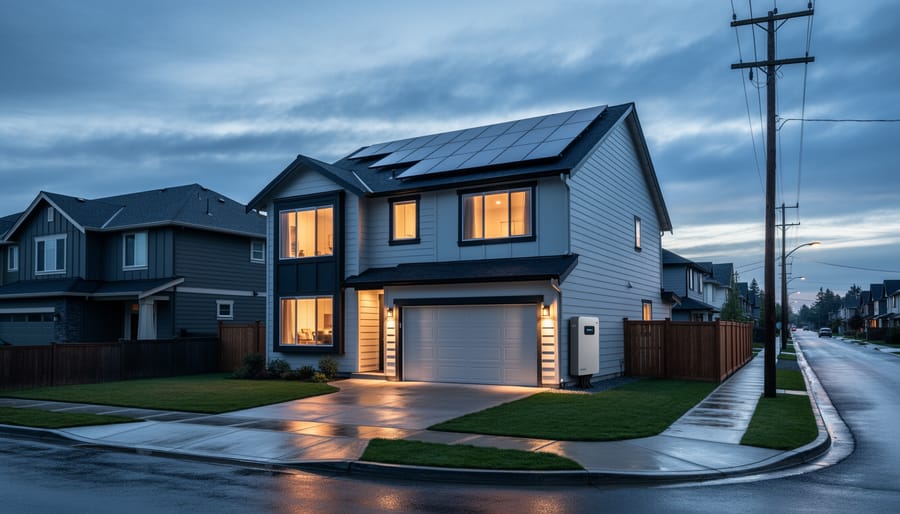
Whole-house battery systems provide backup power and energy independence for residential microgrids.
The Top Mistakes DIYers Make with Microgrid Storage (And How to Avoid Them)
I’ve made plenty of mistakes building microgrids over the years, and I’m willing to bet you’ll make some too—and that’s perfectly okay! The key is learning from them before they become expensive problems. After talking with hundreds of DIYers in our community, I’ve noticed the same issues popping up repeatedly. Let’s walk through the big ones so you can skip the headaches I had to endure.
The most common mistake? Undersizing your battery bank. I get it—batteries are expensive, and the temptation to save money upfront is strong. Charles learned this lesson the hard way when his first system ran out of juice on day two of cloudy weather. Here’s the thing: you need to calculate your actual daily energy consumption, then multiply by the number of backup days you want, and add a safety margin of at least 20%. Don’t just guess or use online averages—measure your real usage with a kill-a-watt meter for a week.
Component compatibility issues come in second place. Just because two products have the same voltage doesn’t mean they’ll play nicely together. Your charge controller needs to match your battery chemistry, your inverter must handle your peak loads, and everything needs compatible communication protocols if you want monitoring. I once spent three frustrating days troubleshooting a system before realizing my lithium batteries needed a different charge profile than my controller provided.
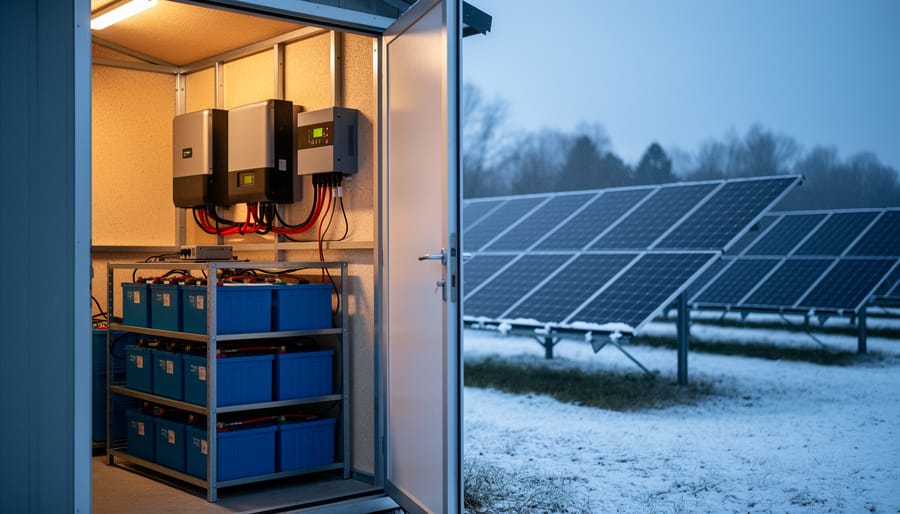
Thermal management gets overlooked constantly, especially by folks in moderate climates. Batteries hate temperature extremes—both hot and cold. If you’re installing in a garage or shed, consider insulation and ventilation. Charles saw a 30% capacity drop in winter before he added a simple insulated enclosure.
Poor wiring practices might seem minor until you’re dealing with voltage drops or, worse, fire hazards. Use properly sized cables, make solid connections with appropriate crimps, and keep things organized. Color-coding saved me countless hours during troubleshooting.
Finally, never skip safety features to save a few bucks. Fuses, breakers, and disconnect switches aren’t optional—they’re your insurance policy. One community member told me a properly rated fuse saved his entire system when a controller failed.
Remember, every expert started as a beginner who refused to give up after their first mistake.
Keeping Your Storage System Healthy for the Long Haul
Think of your battery bank like a classic car—it’ll run beautifully for years if you treat it right, but neglect it and you’ll be shopping for replacements sooner than you’d like. I learned this the hard way when I ignored temperature warnings on my first system and ended up replacing batteries three years early. Don’t be like younger me!
The most important habit you can develop is monitoring your state of charge regularly. Most modern battery systems include monitoring apps, but even a simple weekly check-in works wonders. Try not to let your batteries drop below 20% charge regularly, and avoid keeping them at 100% for extended periods. That sweet spot between 30-80% is where batteries are happiest and live longest.
Temperature management is your second priority. Batteries perform best between 50-80 degrees Fahrenheit. If your storage is in a garage or shed, consider adding insulation or even a small fan for hot climates. One community member in Arizona added a simple shade structure over his battery enclosure and extended his battery life by two years.
Schedule a basic health check every six months. Look for any visible corrosion on terminals, check that connections remain tight, and verify your monitoring system shows normal voltage readings. Most quality battery management systems will alert you to problems, but trust your eyes too.
Finally, plan ahead for upgrades. Battery technology improves rapidly, and what seems like a massive system today might feel limiting in five years. When your batteries consistently hit 80% capacity degradation—usually after 7-10 years with proper care—start researching replacements. Many folks in our community successfully mix old and new components, though matching battery types generally works best.
Achieving real energy independence isn’t just a distant dream—it’s something you can start building today, right in your own backyard or garage. I’ve seen firsthand how empowering it feels to watch your batteries charge from the sun and know you’re ready for whatever the grid throws at you. The beauty of microgrid energy storage is that you don’t need to do everything at once. Start with a modest battery bank that covers your essential loads, learn how the system behaves, and expand when you’re ready. That’s exactly how I approached my first setup, and it gave me the confidence to tackle bigger projects down the road.
Remember, you’re not alone in this journey. The Spheral Solar community is packed with fellow DIYers who’ve been exactly where you are now—asking questions, troubleshooting issues, and celebrating victories. Browse through our forums, use our interactive calculators to fine-tune your system design, and don’t hesitate to share your own experiences as you progress.
The solar DIY movement is growing stronger every day, powered by people like you who refuse to settle for dependence on outdated energy systems. Your microgrid might start small, but every kilowatt-hour you store and use is a step toward true energy freedom. So grab your tools, trust the process, and welcome to the community.
How useful was this post?
Click on a star to rate it!
Average rating 0 / 5. Vote count: 0
No votes so far! Be the first to rate this post.
We are sorry that this post was not useful for you!
Let us improve this post!
Tell us how we can improve this post?
charlesnoble
Here at Spheral Solar, I’m a hands-on solar power enthusiast, constantly exploring and experimenting with DIY solutions. I’m dedicated to sharing my discoveries, insights, and even the bumps I hit along the way, all in the pursuit of a more sustainable future.
Solar Microgrids: Your Path to True Energy Independence by Charlesnoble February 8, 2026 Picture this: the power grid fails during a storm, but your lights stay on, your refrigerator keeps running, and your phone continues charging. That’s the promise of a solar microgrid—a self-contained energy system that generates, stores, and manages its own electricity independently from the utility company. Unlike traditional grid-tied solar…
Why DC Microgrids Are Perfect for Your DIY Solar Setup by Charlesnoble January 7, 2026 Picture this: you’re running LED lights, a laptop, and a small fridge in your off-grid cabin, and every device is drawing power directly from your solar panels without converting DC to AC and back again. That’s the elegant simplicity of a DC microgrid system, where electricity flows in its natural…
The Battery That Keeps Your Off-Grid Solar Running… by Charlesnoble March 13, 2026 Understand your energy storage needs by calculating your daily power consumption in watt-hours—multiply each appliance’s wattage by hours used, then add 20% for system losses and another 25% for days of autonomy when panels aren’t producing. This calculation determines your minimum battery bank capacity and prevents the costly mistake of…
Why Lithium Batteries Changed Everything for… by Charlesnoble January 26, 2026 Calculate your daily energy consumption in watt-hours before shopping for any lithium battery by listing every device you’ll power, its wattage, and hours of daily use—this single number determines whether you need a 5kWh system or a 20kWh system and prevents the costly mistake of undersizing. Multiply your daily usage…
Turn Your Home’s Exterior Into a Power Plant With BIPV Solar by Charlesnoble February 19, 2026 Picture this: your home’s windows generating electricity while you admire the view. Your patio awning powering your outdoor lights as it shades your afternoon barbecue. Your garage door collecting energy every time the sun hits it. This isn’t science fiction – it’s building integrated photovoltaics, and it’s transforming how we…
This Massive Off-Grid Solar System Powers an Entire… by Charlesnoble October 17, 2025 Imagine powering an entire remote community with nothing but sunshine – that’s exactly what the world’s largest off-grid solar installations achieve today. These engineering marvels, some exceeding 100 megawatts in capacity, are revolutionizing how we think about off-grid solar fundamentals and energy independence. From Australia’s massive Pilbara mine site installation…
Subscribe for handpicked DIY projects, exclusive tips, and giveaways.
Charging a battery bank with a 3-phase inverter requires connecting your inverter’s AC output to a compatible battery charger or hybrid inverter system that can convert the 3-phase power back to DC for storage. Most DIY solar setups achieve this by using a hybrid inverter that handles both solar input and battery charging simultaneously, or… Read more: How to Wire and Configure a Battery Inverter 3 Phase System for Off-Grid Solar
Wiring a 7-pin RV plug correctly connects your tow vehicle to your trailer’s lights, brakes, and auxiliary power in about 45 minutes with basic hand tools and careful attention to the color-coded wire standard. The diagram follows a specific layout mandated by the RV Industry Association: each pin controls a distinct function, from left turn… Read more: How to Wire a 7-Way RV Plug: Step-by-Step Diagram and Setup Guide
Nine times out of ten, an E050 arc fault error on your solar inverter means a loose connection somewhere in your DC wiring. Before you panic or call an expensive technician, check every MC4 connector between your panels and inverter. A single connection that wasn’t snapped fully closed or has corroded from weather exposure will… Read more: Why Is My Solar Inverter Showing Arc Fault E050? Causes and How to Fix It