How to Use a Mass Energy Conversion Calculator (Step-by-Step Guide)
Updated:
A mass energy conversion calculator lets you determine how much energy is locked inside any amount of matter using Einstein’s famous equation E=mc². Whether you’re working on a physics assignment or simply curious about the enormous energy potential in everyday objects, the calculation itself takes just seconds once you understand the formula’s three components: energy (E), mass (m), and the speed of light squared (c²).
Here’s something that fascinates me about this equation: a single kilogram of matter, if completely converted to energy, would release about 90 quadrillion joules. That’s roughly 25 billion kilowatt-hours, enough to power the entire United States for several days. Of course, we can’t actually convert matter to energy at that scale in our solar panels (thank goodness, or we’d need very different safety protocols), but understanding the theoretical maximum helps put real-world energy production into perspective.
Key Takeaway: Mass-energy equivalence shows us the theoretical energy ceiling in any material. While solar cells convert sunlight, not mass itself, grasping E=mc² helps you appreciate just how energy-dense even small amounts of matter truly are, and why even modest solar conversion efficiencies can still deliver impressive real-world power.
When you’re sizing up a DIY solar system, you’re dealing with photons striking silicon cells and producing electricity through the photoelectric effect. The energy isn’t coming from converting the panel’s mass into power. But knowing how to calculate theoretical energy maximums gives you a valuable benchmark for understanding efficiency ratings and energy density claims you’ll encounter in product specs.
The good news? You don’t need advanced physics training to use these calculators effectively. The formula is straightforward, the tools are free and accessible online, and the concept connects directly to how we think about energy in practical solar applications.
Understanding Mass-Energy Conversion
A symbolic image representing the idea that a small amount of mass can correspond to an immense amount of energy.
Breaking Down the Formula
Let me break down each piece of Einstein’s famous equation so you can actually work with it.
E stands for energy, measured in joules when you use standard SI units. One joule is roughly the energy needed to lift a small apple one meter off the ground. It’s not much, which makes what comes next pretty mind-blowing.
m represents mass in kilograms. This is the actual physical matter you’re converting. Even a tiny mass produces staggering energy, as we’ll see.
c² is where things get wild. The c stands for the speed of light: 299,792,458 meters per second. When you square that number, you get approximately 9 × 10¹⁶, or 90,000,000,000,000,000. That’s the multiplier applied to any mass you’re converting.
Here’s why that matters: if you somehow converted just one kilogram of matter into pure energy, you’d multiply 1 kg by that enormous c² number. The result? 90 quadrillion joules, or about 25 billion kilowatt-hours. That’s enough electricity to power the average American home for over two million years.
The formula works both ways, too. Want to know how much mass converts into a specific amount of energy? Divide the energy by c². This shows why we don’t see matter spontaneously transforming into energy in our daily lives, the conversion factor is so massive that observable mass changes require truly enormous energy shifts.
Real-World Context for Solar DIYers
Every photon hitting your solar panels began as mass-energy conversion deep inside the sun. About 93 million miles away, hydrogen atoms fuse together under immense pressure and temperature, converting a tiny fraction of their mass into pure energy. That’s E=mc² in action on a stellar scale. The sun converts roughly 4 million tons of matter into energy every second through nuclear fusion, and a minuscule portion of that energy eventually reaches your rooftop as sunlight.
When I first grasped this connection, it completely changed how I thought about my solar panels. Those silicon cells aren’t just capturing heat or light in some vague sense, they’re intercepting photons born from the most powerful mass-energy conversion process in our solar system. Each photon carries energy that once existed as atomic mass before fusion transformed it.
This matters because it grounds your solar work in fundamental physics. You’re not just wiring up panels; you’re harnessing energy from an ongoing nuclear reaction that operates on principles Einstein described. While you’ll never replicate fusion’s mass-energy conversion in your backyard (thankfully, those energies are incomprehensibly large), understanding the source helps you appreciate the elegance of photovoltaic technology.
The fusion reactions creating your solar energy involve converting about 0.7% of hydrogen’s mass into energy. That seemingly small percentage, multiplied by c², generates the light that powers everything from your charge controller to your battery bank. It’s the ultimate renewable source, and knowing its origin adds depth to every solar project you tackle.
Tools and Materials You’ll Need
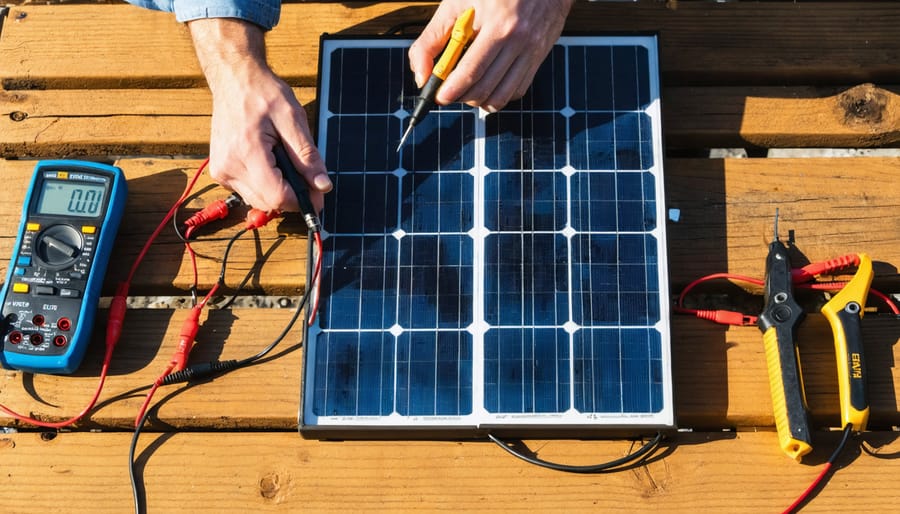
Tools for physics-style calculations, calculator and lab-like materials, set the stage for learning how the mass-energy formula is used.
The beauty of mass-energy conversion calculations is that you don’t need a physics lab or expensive equipment. Most of what you’ll need is probably already on your desk or in your pocket.
Here’s what you should gather before diving into the calculations:
A scientific calculator or smartphone calculator app with exponent functions
Spreadsheet software like Excel or Google Sheets (optional but helpful for tracking multiple calculations)
Internet access for online calculators and verification tools
Pen and paper for working through problems and jotting down intermediate steps
The key feature you need in any calculator is the ability to handle very large numbers and exponents. When you’re squaring the speed of light (299,792,458 meters per second), you’re dealing with numbers in the quadrillions, so your calculator needs to manage scientific notation comfortably.
If you’re using a smartphone, the built-in calculator app usually switches to scientific mode when you rotate your phone to landscape orientation. That’ll give you all the functions you need without downloading anything extra.
For those who like to keep digital records of their work, a spreadsheet is perfect for setting up the formula once and then plugging in different mass values to see how the energy output changes. You can create your own template and reuse it whenever curiosity strikes.
Of course, the easiest option is our interactive mass-energy calculator right here on Spheral Solar, which handles all the heavy mathematical lifting for you while showing the step-by-step process.
Important Safety and Practical Considerations
Before we dive too deep into calculations, let’s talk about what these numbers actually mean in the real world. When you run a mass-energy conversion calculation using E=mc², you’re working with theoretical physics that describes how the universe operates at its most fundamental level. The energies you’ll calculate are staggering, even converting a single gram of matter releases roughly 90 trillion joules, equivalent to the energy from burning nearly 2,000 tons of coal. These aren’t numbers you can tap into with a soldering iron and some wire.
Warning: These calculations involve theoretical physics concepts and enormous energy scales. Home solar systems work through photovoltaic conversion, not mass-energy conversion. Always work with realistic solar energy calculations for your actual projects.
This is a crucial distinction I wish I’d understood earlier in my solar journey. Mass-energy conversion happens in nuclear reactions, like the fusion processes in the sun’s core or in nuclear power plants with strict containment protocols. Your rooftop solar panels capture photons (light particles) that result from the sun’s fusion processes, but they don’t perform mass-energy conversion themselves. They convert light energy into electrical energy through the photovoltaic effect, which operates at entirely different scales with efficiency rates between 15% and 22%.
When you’re planning your DIY solar projects, you’ll work with practical energy units: watts, kilowatt-hours, amp-hours, and voltage. A typical home solar panel produces around 300-400 watts under ideal conditions. That’s the realm where your calculations matter for actual installations, sizing your battery bank, calculating wire gauge, determining panel angles. The mass-energy calculator is a fascinating educational tool that helps you appreciate where solar energy originates, but it won’t help you figure out how many panels you need for your off-grid cabin.
Step-by-Step: Calculating Energy from Mass
Example Calculation 1: Converting a Small Mass
Let’s walk through a concrete example using 1 gram of matter to see how E=mc² works in practice.
Given: mass (m) = 1 gram
First, convert grams to kilograms since SI units require mass in kg:
1 gram = 0.001 kg
Apply the formula: E = mc²
The speed of light (c) = 299,792,458 meters per second
Square the speed of light:
c² = (299,792,458)² = 89,875,517,873,681,764 m²/s²
Now multiply mass by c²:
E = 0.001 kg × 89,875,517,873,681,764 m²/s²
E = 89,875,517,873,681.764 joules
Round to scientific notation for clarity: E ≈ 8.99 × 10¹³ joules
That’s roughly 90 trillion joules from a single gram. To put this in perspective, it’s about 25 billion watt-hours, or 25 million kilowatt-hours. A typical home uses around 30 kWh per day, so theoretically converting one gram of matter would power a house for over 2,000 years.
This massive number explains why nuclear reactions release so much energy and why you need to avoid wiring mistakes in solar systems, even tiny inefficiencies matter when you’re capturing energy from the sun’s ongoing fusion reactions. The sun converts about 4 million tons of mass into energy every second through this same process.
Example Calculation 2: Comparing to Practical Energy Units
Let’s do a second calculation that bridges the theoretical world of mass-energy conversion to the practical energy units you actually use when designing solar systems.
We’ll convert 0.1 grams of matter this time, about the mass of a small paperclip.
Starting with E=mc²:
E = (0.0001 kg) × (299,792,458 m/s)²
E = 0.0001 × 89,875,517,873,681,764
E ≈ 8,987,551,787,368,176 joules
That’s roughly 9 quadrillion joules. But what does that mean in terms you use every day?
Converting to kilowatt-hours (the unit on your electricity bill and solar system output):
That’s about 2.5 billion kilowatt-hours from one-tenth of a gram.
To put that in perspective, a typical 5kW residential solar array produces around 6,000-8,000 kWh per year. This tiny paperclip mass, fully converted, contains enough energy to power that system’s entire output for over 300,000 years.
Or consider it another way: a 10kWh home battery storage system, the kind many DIYers install, would need to be charged and discharged 250 million times to deliver this much energy.
This comparison shows why Einstein’s equation reveals such staggering numbers. The complete conversion of even microscopic masses releases energy scales that dwarf anything we work with in practical solar installations.
Using the Online Mass-Energy Calculator
Now let’s make things even easier. I built an interactive mass-energy calculator right here on Spheral Solar specifically for this purpose, and it takes all the manual work out of the equation, literally.
Here’s how to use it:
Navigate to the calculator. You’ll find it embedded above in this article. The interface is clean and straightforward, just one input field and a calculate button.
Enter your mass value. Type the amount of mass you want to convert into the input box. The calculator accepts values in grams by default, which keeps things simple for most educational examples.
Click “Calculate Energy.” The tool instantly processes your input using the E=mc² formula with the correct constants already programmed in.
Read your result. The calculator displays energy in joules, the standard unit for this calculation. It also shows the equivalent in kilowatt-hours so you can relate it to practical energy measurements you’re familiar with from solar work.
I designed this tool after manually calculating these conversions dozens of times while researching solar physics. The calculator eliminates unit conversion errors and saves you from typing that massive speed-of-light constant repeatedly. Just plug in your mass, and you’ve got your answer in seconds.
Verifying Your Calculations and Next Steps
Once you’ve worked through your mass-energy conversion calculations, it’s smart to verify your results before moving on. Even a small error in units or a misplaced decimal can throw your answer off by orders of magnitude, so taking a few minutes to double-check is always worth it.
Start with this verification checklist to catch the most common mistakes:
Confirm your mass is converted to kilograms (not grams or other units)
Verify you’re using c = 299,792,458 m/s for the speed of light
Check that your final result is in joules before converting to other units
Run the calculation through a second calculator tool to cross-check
Compare the magnitude of your result to reference values (1 gram should give about 90 trillion joules)
I’ve caught myself more times than I’d like to admit forgetting to square the speed of light or mixing up my unit conversions. Using multiple calculator tools is your best defense against simple errors. Try our interactive calculator, then verify with a scientific calculator or spreadsheet to make sure the numbers match.
Once you’re confident in your mass-energy calculations, you’re ready to explore more practical energy conversions that directly apply to your solar projects. Understanding how to convert watts to kWh helps you size battery banks and estimate daily energy production. You’ll also benefit from learning amp-hour calculations for battery capacity, watt-hour conversions for panel output, and efficiency calculations that show how much sunlight actually becomes usable electricity.
The beauty of mastering these fundamental calculations is that they all build on each other. The same careful attention to units and verification steps you practiced with E=mc² applies to every energy conversion you’ll encounter in solar work. You’re developing a mathematical toolkit that makes you more confident and capable with every project you tackle.
Connecting Mass-Energy Conversion to Your Solar Projects
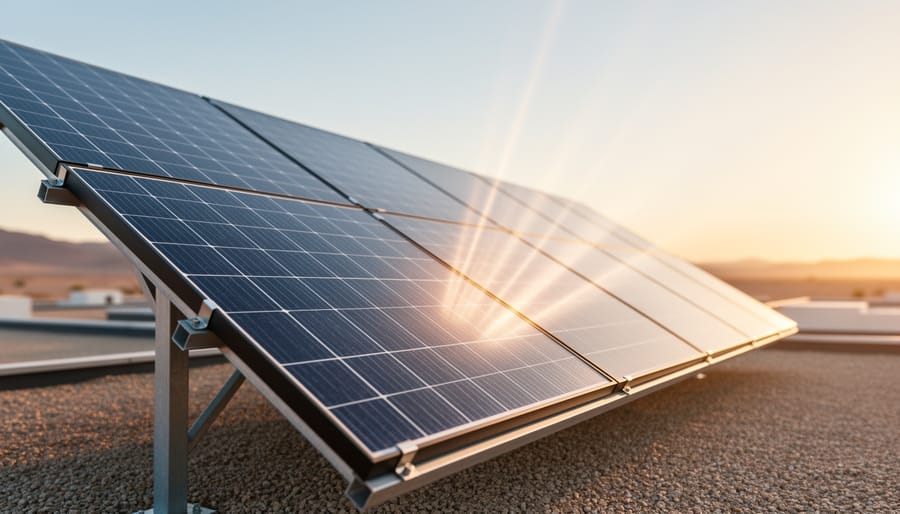
Solar panels illustrate the real-world context where energy concepts connect to practical DIY projects.
Understanding where solar energy truly originates makes you appreciate every photon hitting your panels. When hydrogen atoms fuse in the sun’s core, a tiny fraction of their mass converts to energy, that’s E=mc² happening 93 million miles away. The light traveling to your rooftop represents actual mass-energy conversion from nuclear fusion, and that’s pretty extraordinary when you think about it.
I remember Charles mentioning how this clicked for him during his first major solar installation. “Once I understood that sunlight is literally converted mass energy from the sun, I stopped seeing my panels as just gadgets on the roof,” he told me. “They’re capturing the end result of the most powerful energy conversion process in our solar system.”
This fundamental principle connects to the practical calculations you perform daily. When you’re figuring out Joule vs Watts for your system, tracking how many watt-hours your battery bank stores, or calculating panel efficiency percentages, you’re working with energy conversion on a scale you can actually harness. The math might be simpler (no speed-of-light-squared involved), but the underlying concept remains the same: converting one form of energy into another.
Knowing the science behind your solar setup changes how you approach problems. When your system underperforms, you’re not just troubleshooting equipment, you’re optimizing energy conversion pathways. When you compare panel specifications, you’re evaluating how efficiently different technologies convert solar radiation into electrical energy.
Charles argues this knowledge makes better DIYers. “Understanding the physics doesn’t just help with calculations,” he says. “It builds intuition. You start seeing energy flows instead of just numbers, and that perspective helps you design smarter systems from the ground up.” The mass-energy conversion calculator might seem theoretical, but grasping what it represents connects you to the fundamental forces powering every solar project you build.
Common Questions About Mass-Energy Calculations
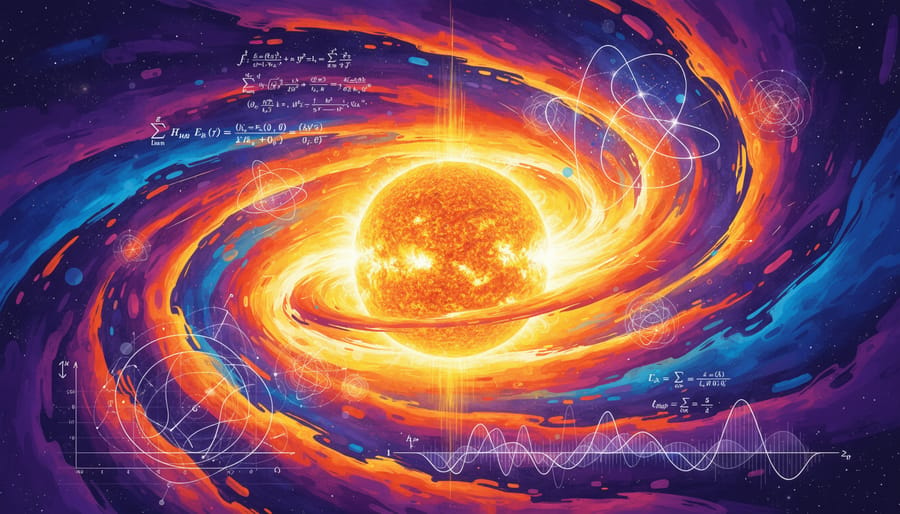
An atmospheric scene that evokes the massive energy scales behind the sun and the physics behind energy conversion.
I get questions about mass-energy conversion all the time, and honestly, most confusion stems from mixing up theoretical physics with practical solar work. Let me clear up the most common points of confusion.
Can I actually use mass-energy conversion in my DIY solar setup?
No, mass-energy conversion is a theoretical calculation that shows the total energy contained in matter. Your solar panels capture photons from the sun’s fusion reactions, but you’re not converting mass to energy in your backyard, you’re harvesting light energy that’s already been converted millions of miles away.
Why do mass-energy calculations produce such enormous numbers?
Because c² (the speed of light squared) is roughly 90 quadrillion. Even a tiny amount of mass multiplied by that huge number yields massive energy values, a single gram converts to about 90 trillion joules, equivalent to the energy in 21 kilotons of TNT.
How does mass-energy conversion relate to my solar panel’s efficiency rating?
It doesn’t directly. Your panel’s 20% efficiency describes how much incoming light energy it converts to electrical energy, not mass-energy conversion. The sun performs mass-energy conversion through fusion; your panel performs photovoltaic conversion of the resulting photons.
What energy conversions do I actually use in solar projects?
Practical conversions include amps to watts for understanding power draw, watt-hours to amp-hours for battery sizing, panel wattage to daily energy production, and charge time calculations based on panel output and battery capacity, all straightforward electrical conversions, not nuclear physics.
The biggest misconception I encounter is people thinking they can somehow tap into mass-energy conversion for home power generation. Nuclear power plants do this in controlled fission reactions, and the sun does it through fusion, but both require conditions impossible to recreate safely in a DIY context. Your role as a solar DIYer is capturing the end product, sunlight, that results from the sun’s mass-energy conversion happening 93 million miles away.
Understanding E=mc² helps you appreciate the staggering amount of energy the sun produces and why even a tiny fraction reaching your panels can power your home. But for actual project work, stick to the electrical conversion calculations that matter: sizing your system, calculating runtime, matching panel output to battery input, and optimizing your array angle. Those practical conversions, not theoretical physics formulas, are what make your solar setup work.
Understanding mass-energy conversion through Einstein’s E=mc² formula might seem purely theoretical at first, but it’s given you a deeper appreciation for where solar energy truly originates. Every photon hitting your panels started as mass converted to energy in the sun’s core, the very process we’ve explored today.
While you won’t be converting matter to energy in your backyard solar setup, grasping these fundamental physics concepts makes you a more informed DIY solar enthusiast. You’ll better understand the incredible energy transformation happening 93 million miles away that powers your home projects.
I’ve found that solar DIYers who take time to learn the underlying science tend to make smarter decisions about their systems. They understand efficiency ratings more deeply, appreciate the engineering behind photovoltaic cells, and troubleshoot problems more effectively.
Take some time to play with the calculator. Experiment with different mass values. See how tiny amounts of matter represent staggering energy quantities. Then explore the other conversion tools we’ve built at Spheral Solar, practical calculators you’ll use regularly for sizing panels, calculating battery capacity, and converting between watts and amp-hours.
Got questions about mass-energy conversion or how it relates to your solar projects? Share your thoughts in the comments below. I love hearing how these concepts click for fellow solar enthusiasts, and our community is always ready to help explain tricky physics questions in plain English.
How useful was this post?
Click on a star to rate it!
Average rating 0 / 5. Vote count: 0
No votes so far! Be the first to rate this post.
We are sorry that this post was not useful for you!
Let us improve this post!
Tell us how we can improve this post?
charlesnoble
Here at Spheral Solar, I’m a hands-on solar power enthusiast, constantly exploring and experimenting with DIY solutions. I’m dedicated to sharing my discoveries, insights, and even the bumps I hit along the way, all in the pursuit of a more sustainable future.
Stop Guessing Energy Numbers: Your Practical Joule… by Charlesnoble November 11, 2025 **Understanding Energy in Real Numbers: Your Joule Conversion Guide** Converting joules into watts, kilowatt-hours, or calories transforms abstract energy measurements into practical numbers you can actually use for your solar projects and off-grid calculations. Whether you’re sizing a battery bank, calculating how long your portable solar panel will run a…
Why Joule Solar Energy Matters More Than Watts for… by Charlesnoble February 11, 2026 Picture this: You’re browsing solar panel specs and suddenly see energy output measured in joules, watt-hours, and kilowatt-hours all mixed together. Confusing, right? I’ve been there myself, standing in my garage with a handful of solar equipment brochures, wondering why some manufacturers use joules while others stick to watts. That…
How Batteries Actually Convert Energy (And Why It… by Charlesnoble April 27, 2026 A battery converts chemical energy stored within its cells into electrical energy that powers your devices—a fundamental transformation that makes everything from your smartphone to your off-grid solar setup possible. Understanding this energy conversion isn’t just academic knowledge; it’s the foundation for choosing the right batteries, calculating how long they’ll…
Stop Burning Out Your Solar Gear: Why Electrical… by Charlesnoble February 22, 2026 Grab your multimeter and calculator—understanding electrical conversions transforms confusing numbers into actionable data for your solar setup. When I first started working with solar panels, I’d stare at spec sheets showing watts, amps, and volts, completely baffled about which numbers actually mattered for sizing my components. That confusion nearly led…
Stop Guessing Your Battery Power: The Conversion… by Charlesnoble October 28, 2025 Grab your battery specifications and check three numbers that matter: amp-hours (Ah) tells you total capacity like a fuel tank size, watt-hours (Wh) reveals actual energy storage accounting for voltage differences, and reserve capacity (RC) shows real-world runtime at a steady draw. These measurements aren’t interchangeable labels for the same…
Why Your Solar System Needs an Energy Conversion… by Charlesnoble April 15, 2026 Sketch your solar system’s energy flow on paper before buying a single component—start with the sun at top, draw arrows through your solar panel, charge controller, battery, and finally to your devices, labeling each conversion point with estimated percentages of energy loss. This simple visual reveals exactly where your power…
Subscribe for handpicked DIY projects, exclusive tips, and giveaways.
A mass energy conversion calculator lets you determine how much energy is locked inside any amount of matter using Einstein’s famous equation E=mc². Whether you’re working on a physics assignment or simply curious about the enormous energy potential in everyday objects, the calculation itself takes just seconds once you understand the formula’s three components: energy… Read more: How to Use a Mass Energy Conversion Calculator (Step-by-Step Guide)
Low voltage circuit protection in DIY solar systems boils down to matching the right fuse or breaker to your wire size and expected current, not to the capacity of your battery bank or inverter. Most fires and equipment failures happen when people oversize protection devices, thinking bigger is safer, when the opposite is true. Your… Read more: How to Size Low Voltage Circuit Protection for Your DIY Solar System
Crimping 8-gauge wire correctly takes about 2 minutes per connection once you’ve got the hang of it, but those two minutes make the difference between a solar installation that lasts 25 years and one that fails in the first storm. An 8-gauge wire crimper is a heavy-duty hand tool designed to cold-forge lugs and terminals… Read more: How to Use an 8 Wire Crimper for Solar Panel and Battery Connections