Don’t Risk Your Life Installing Solar Panels: Fall Protection Systems That Actually Work
Updated:
Secure yourself with a personal fall arrest system before stepping onto any roof pitch over 4:12—that’s a harness, lanyard, and proper anchor point rated for 5,000 pounds per worker. Install temporary roof anchors at the ridge line or use permanent mount anchors if you’re planning multiple trips up for maintenance, ensuring they’re positioned to keep you at least six feet from the roof edge at all times. Set up guardrail systems along roof perimeters during extended DIY solar installation projects lasting more than a day, as they provide hands-free protection and reduce fatigue compared to constantly managing harness connections.
I learned this the hard way during my first solo panel installation—I thought I was being careful, but one loose shingle sent me sliding three feet before my poorly anchored safety line caught me. That wake-up call taught me that fall protection isn’t about being overly cautious; it’s about finishing your solar project without a trip to the emergency room.
The reality hits different when you’re 20 feet up: even experienced DIYers face legitimate dangers from weather changes, unexpected roof conditions, and simple fatigue after hours of physical work. Statistics show falls from roofs account for over 30% of construction-related deaths, and many victims were experienced workers who skipped safety gear “just this once.”
This guide cuts through the confusion around fall protection equipment. You’ll learn which systems work best for residential solar installations, how to properly install and use them, what actually meets OSHA requirements for DIY work, and honest cost breakdowns so you can budget appropriately. We’ll also discuss when calling a professional makes more sense than risking it yourself—because smart DIY means knowing your limits while staying empowered to tackle what you can safely handle.
Why DIY Solar Installers Face Unique Fall Risks
The Hidden Dangers of Rooftop Solar Work
I’ll be honest with you—when I first started helping neighbors with their solar installations, I thought rooftop work was rooftop work. But solar panel projects are fundamentally different from that afternoon you spent patching shingles, and understanding these differences could literally save your life.
The biggest challenge I’ve seen homeowners underestimate is the sheer number of trips up and down that ladder. You’re not making one quick visit to fix a shingle. A typical residential solar installation requires dozens of trips—carrying panels (which weigh 40-50 pounds each), lugging racking equipment, shuttling tools you forgot, and checking measurements repeatedly. Each trip increases your fatigue and your chance of a misstep. Last summer, my friend Tom slipped on his fifth trip up because his legs were simply tired. Thankfully, he was wearing proper solar installation safety equipment.
Then there’s the electrical work itself. While you’re focused on connecting wiring or checking voltage, your attention shifts away from your footing and positioning. This mental distraction is dangerous on a sloped surface. Add shifting your weight while maneuvering heavy panels into position—suddenly your center of gravity moves in ways you didn’t anticipate.
Weather compounds everything. Solar installations often span multiple days, exposing you to changing conditions. Morning dew on shingles, afternoon heat making you dizzy, or unexpected wind gusts can transform a manageable situation into a hazardous one. These aren’t one-and-done projects, and your fall protection strategy needs to reflect that reality.
What the Statistics Tell Us
The numbers around roofing falls are sobering, but they’re worth understanding before you climb up to install those solar panels. According to the CDC, falls from roofs account for roughly one-third of all construction-related deaths, and here’s the thing that surprised me when I first researched this: residential falls aren’t just a professional concern. The Consumer Product Safety Commission reports that over 160,000 people visit emergency rooms annually due to ladder-related injuries alone, with many of these incidents involving homeowners working on their own roofs.
What really drives this home is that most fatal falls from roofs happen from heights under 20 feet, which is exactly the range most of us are dealing with on residential projects. I remember talking to a neighbor who’d been installing solar panels on his single-story garage, just 12 feet up, when he nearly took a serious fall reaching for a dropped wrench.
The good news? These statistics also show us that proper fall protection dramatically reduces injury risk. This isn’t about scaring you away from DIY solar projects, it’s about making sure your clean energy journey doesn’t end with a preventable accident. Understanding these numbers helps us take the right precautions seriously.
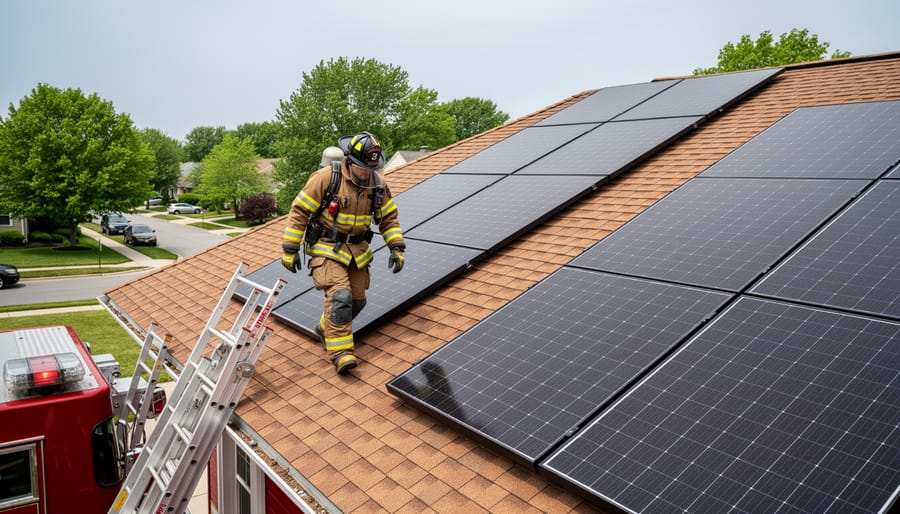
A properly fitted full-body harness with shock-absorbing lanyard connected to a certified roof anchor provides essential fall arrest protection for rooftop solar installation work.
Understanding the Three Types of Fall Protection Systems
Fall Prevention Systems: Your First Line of Defense
Think of fall prevention systems as friendly barriers that simply keep you away from dangerous edges—they’re your safety net before you even need one. When I first started working on roofs for solar installations, I’ll admit I underestimated how easy it is to get caught up in your work and forget how close you are to the edge. A good guardrail system changed everything for me.
Guardrails are the gold standard here. These are physical barriers—typically waist-high metal rails with posts and supports—that you install around the roof perimeter. The beauty is they don’t require you to wear anything special; they just create a safe workspace automatically. For DIY solar projects, temporary guardrail systems are available that clamp onto roof edges or use counterweights instead of permanent anchoring. They’re surprisingly straightforward to set up, though you’ll want two people for the job since the components can be bulky.
Safety railings come in various configurations. Some systems use adjustable posts that fit different roof pitches, while others are designed specifically for flat roofs. The key specification to look for is OSHA compliance—systems should withstand at least 200 pounds of force in any direction.
For shorter projects, you might consider warning line systems, which are essentially rope barriers that mark dangerous zones. While not as robust as guardrails, they’re lightweight, affordable, and genuinely effective at keeping your attention focused on where you’re working. Just remember: these systems work best when you respect them. They’re preventing accidents before they happen, which is always better than trying to stop a fall in progress.
Fall Restraint Systems: Keeping You Away From Danger
Think of fall restraint systems as your invisible fence – they’re designed to keep you physically away from the roof edge so a fall can’t even happen. I learned about these during my first pitched roof solar installation, and honestly, they gave me so much peace of mind knowing I literally couldn’t reach the danger zone.
Here’s how they work: you wear a full-body harness connected to a short lanyard that’s anchored to a secure point on your roof. The key word is “short” – your lanyard is measured specifically so that even if you walk as far as possible in any direction, you still can’t reach the edge. It’s prevention rather than rescue.
The setup requires three components working together. First, you need a solid anchor point – this might be a roof anchor installed into a rafter or truss, capable of supporting at least 5,000 pounds. Second, your body harness distributes any forces safely if you do hit the end of your tether. Third, the lanyard itself should be adjustable but limited to keep you in the safe zone.
Restraint systems work beautifully on pitched roofs where you can install secure anchors and calculate your safe working radius. Before starting my solar panel layout, I actually measured and marked my movement boundary with chalk, which helped me plan where to position panels without needing to venture closer to edges. The limitation? You’re restricted to a smaller work area, so larger projects might need multiple anchor points or repositioning as you progress.
Fall Arrest Systems: Your Safety Net
Think of fall arrest systems as your emergency backup—they won’t prevent a fall, but they’ll catch you before you hit the ground. When I first learned about these systems while installing panels on my garage, I realized they’re literally the difference between a scary moment and a tragedy.
The core of any fall arrest setup is a full-body harness. Unlike those old-school waist belts, a proper harness distributes impact forces across your shoulders, chest, and legs. You’ll want one that fits snugly but comfortably—remember, you might be wearing it for hours while working on your solar installation.
Next up is the shock-absorbing lanyard, which connects your harness to an anchor point. That shock absorber is crucial—it gradually slows your fall instead of creating a sudden, bone-jarring stop. Think of it like the crumple zone in your car. Some lanyards include self-retracting lifelines that automatically adjust as you move around the roof, giving you more freedom while staying protected.
Your anchor point needs to support at least 5,000 pounds per person. On many roofs, this might be a properly installed anchor strap or a permanent roof anchor. Never assume a chimney or vent pipe will work—most won’t.
Here’s something many DIYers overlook: clearance distance. You need enough space below you so that if you fall, you won’t swing into something or hit the ground before the system arrests your fall. Calculate this carefully based on your lanyard length and roof height.
Finally, have a rescue plan. If you’re suspended after a fall, you’ve got maybe 15 minutes before suspension trauma becomes dangerous. Make sure someone knows you’re working and can call for help.
Choosing the Right Fall Protection for Your Solar Project
What Your Roof Pitch Tells You About Protection Needs
Understanding your roof’s pitch is fundamental to choosing the right fall protection—think of it as knowing your terrain before planning a hike. I learned this the hard way during my first solar project when I underestimated a 6:12 pitch roof. What looked manageable from the ground felt entirely different once I was up there.
For low-slope roofs (less than 4:12 pitch, meaning 4 inches of vertical rise per 12 inches of horizontal run), OSHA requires fall protection when you’re working within 6 feet of an edge. These roofs feel deceptively safe, but ice, morning dew, or loose debris can turn them slippery fast. A simple guardrail system or personal fall arrest setup works well here.
Medium-pitch roofs (4:12 to 7:12) are where most residential solar installations happen. These require fall protection at all times when working near edges. You’ll want a reliable anchor point system combined with a full-body harness. This is the sweet spot where investing in proper equipment really pays off.
Steep roofs (over 7:12 pitch) demand serious respect and professional-grade equipment. Honestly, if you’re new to DIY solar and facing a steep roof, consider consulting with a professional for at least the installation phase. There’s no shame in recognizing when a project exceeds comfortable skill levels—safety always trumps saving a few bucks.
Temporary vs. Permanent Anchor Solutions
When I first planned my solar installation, I struggled with whether to invest in permanent anchors or stick with temporary ones. Here’s what I learned about making this choice.
Temporary roof anchors are your go-to solution for one-time or occasional projects. These typically cost between $50-150 per anchor and attach without penetrating your roof membrane. They’re perfect for a weekend solar panel installation where you’ll climb up, complete the work, and likely won’t need roof access again for years. The beauty of temporary anchors is their simplicity—most homeowners can install them in minutes with basic tools, and they won’t void your roof warranty. However, they require setup and removal each time, which adds time to your project.
Permanent anchors, costing $75-200 each plus professional installation (usually $200-500 total), make sense if you’re planning regular maintenance or additions to your solar array. I chose permanent anchors because I knew I’d be expanding my system and wanted that security always available. They’re professionally installed with proper waterproofing, becoming a fixed safety feature of your home.
The deciding factor? If you’ll access your roof more than twice yearly for solar maintenance or monitoring, permanent anchors pay for themselves in convenience and safety. For a single installation with minimal follow-up, temporary anchors are the practical, budget-friendly choice that gets the job done safely without long-term commitment.
Budget-Conscious Protection That Doesn’t Cut Corners
Here’s my honest take after pricing out systems for my own solar installation: quality fall protection doesn’t have to break the bank, but you need to invest smartly. A basic ANSI-certified harness runs $75-150, while a reliable 50-foot rope lifeline with a rope grab costs around $100-200. Add a proper roof anchor ($30-80), and you’re looking at $200-400 total—reasonable considering your solar project costs likely exceed several thousand dollars.
I learned the hard way that used harnesses are a gamble you shouldn’t take. Unlike power tools, fall protection equipment has an invisible history of wear, UV exposure, and shock loads that compromise integrity. One friend bought a “barely used” harness online and discovered frayed stitching inside the padding during inspection—potentially catastrophic.
For occasional DIY work, rent professional-grade systems from equipment rental stores for $40-60 daily instead of buying bargain-basement gear. Your life deserves better than the cheapest option on the internet. Remember: this equipment only needs to work perfectly once to justify every penny spent.
Essential fall protection equipment for DIY solar installation includes a full-body harness, shock-absorbing lanyard or lifeline, certified connectors, and appropriate roof anchors.
Essential Equipment: What You Actually Need
Body Harnesses: Fit and Features That Matter
Choosing the right body harness can feel overwhelming, but think of it as selecting the most important safety tool in your kit—because that’s exactly what it is. When I first helped my neighbor Charles with his solar project, he compared harness shopping to buying hiking boots: you need the right fit, proper support, and comfort for all-day wear.
Start with a full-body harness rated for fall arrest, not just positioning. Look for clearly labeled certification tags showing ANSI or OSHA compliance. The harness should have five adjustment points minimum: shoulders, chest, waist, and both legs. This ensures you can customize the fit regardless of your body type or the layers you’re wearing on cool morning installations.
The dorsal D-ring (the attachment point on your back) matters tremendously. It should sit between your shoulder blades when properly adjusted—not too high near your neck or too low on your back. This positioning ensures the harness distributes arrest forces correctly if you fall.
For extended rooftop work, padding makes a real difference. Look for padded shoulder straps and leg loops, especially if you’ll be wearing the harness for hours. Some harnesses include tool loops and quick-connect buckles that speed up donning and removal—features that become surprisingly valuable when you’re climbing up and down repeatedly.
Before each use, inspect all webbing for fraying, check buckles for secure engagement, and ensure nothing looks worn or damaged.
Lanyards, Lifelines, and Connectors Explained
When I first started planning my rooftop solar installation, the terminology around fall protection components felt like alphabet soup. Let me break down the three main connection types you’ll encounter in straightforward terms.
Shock-absorbing lanyards are essentially heavy-duty tethers with built-in “crumple zones” that deploy if you fall, reducing the impact force on your body. They’re affordable and simple, typically connecting your harness to an anchor point. Think of them like the airbags of fall protection. For most residential solar work, a 6-foot lanyard works well, giving you enough movement to position panels without creating excess slack.
Self-retracting lifelines (SRLs) are spring-loaded devices that automatically adjust cable length as you move, similar to a seatbelt. They lock instantly during a fall and are incredibly convenient for moving around your roof. They cost more than lanyards but offer superior mobility, which matters when you’re wrestling with awkward solar panels all day.
Rope grabs attach to vertical lifelines and slide freely during normal work but grip tight during a fall. They’re ideal if you’re working along a roof ridge with a permanently installed lifeline system.
For typical residential solar installations, I recommend starting with a quality shock-absorbing lanyard for stationary work and considering an SRL if your project involves frequent position changes. The added mobility really does reduce fatigue and make the job safer overall.
Anchor Points: The Foundation of Your Safety System
Think of anchor points as the roots of your safety tree—everything else depends on them holding firm. The golden rule you’ll hear everywhere is the 5,000-pound rating, and here’s why: it’s not because you weigh that much, but because in a fall, the sudden stop creates massive force (called shock load). That 5,000-pound standard gives you a comfortable safety margin even in worst-case scenarios.
When I first installed solar panels on my garage, I spent more time researching anchor points than I did planning the electrical work. That caution paid off.
Your anchor options depend on your roof type. For peaked roofs with rafters, you can use permanent roof anchors that bolt directly through shingles into structural wood—look for ones rated for 5,000 pounds per person. Flat roofs often work better with weighted anchor systems or parapet clamps that don’t penetrate the roof membrane. Some folks use temporary anchors that attach to ridge vents or chimneys, though I’m cautious about these unless specifically engineered for fall protection.
Before trusting any anchor with your life, verify its integrity. Check that fasteners are torqued to manufacturer specs, inspect for rust or damage, and make sure it’s attached to structural members, not just roof decking. When in doubt, hire a certified inspector—your life literally hangs in the balance.
Properly installed roof anchors rated for 5,000 pounds provide the critical foundation for any fall arrest system during solar panel installation.
Installing Your Fall Protection System: A Step-by-Step Approach
Pre-Installation Inspection and Planning
Before you climb onto your roof to install solar panels, you need a solid plan—and I learned this the hard way during my first DIY installation. I was so excited about the panels that I barely glanced at the roof itself. Don’t make that mistake.
Start by inspecting your roof from the ground with binoculars. Look for damaged shingles, soft spots, or anything that might compromise anchor points. Once you’re confident it’s safe to access, do a careful walk-through (while tied off, of course) to identify where you’ll need anchor points. Mark potential locations near ridge lines or sturdy structural members.
Next, map out your work zones. Where will you be positioning panels? Where will you need to move materials? Think of it like choreographing a dance—you need to know every step before the music starts.
Check all your equipment before the install day. Inspect harnesses for fraying, test rope grabs, and verify that anchors are rated for your weight plus a safety margin. I keep a simple checklist on my phone that I run through every single time.
Finally, write it down. Create a simple written plan that includes anchor locations, emergency procedures, and a buddy system. Share it with someone on the ground who can check on you regularly. This isn’t bureaucracy—it’s your safety net in more ways than one.
Setting Up Your System Safely
Getting your fall protection system set up correctly isn’t complicated, but attention to detail matters. I learned this the hard way during my first rooftop solar installation when I rushed through the setup and had to start over completely.
Start by identifying your anchor points. If your roof has structural supports or ridge vents, those often work best. Always verify that anchors can support 5,000 pounds per person. Install them according to manufacturer instructions, typically with lag bolts into solid framing, never just shingles or plywood.
Next, attach your lifeline to the anchor. Double-check all connections and ensure there’s no slack that could cause dangerous swinging if you fall. Your lifeline should allow movement across your work area while keeping you safely away from roof edges.
When putting on your harness, start by stepping through the leg loops, then bring the shoulder straps over and connect the chest strap at mid-chest level. The dorsal D-ring should sit between your shoulder blades. Common mistake: wearing the harness too loose. It should fit snugly but allow comfortable breathing and movement.
Before climbing up, do your final safety check. Tug test every connection, inspect for wear or damage, and verify your rescue plan. Never skip this step, even when you’re in a hurry.
Working Connected: Maintaining Protection Throughout Your Project
Staying connected throughout your solar panel installation requires intentional planning. I learned this the hard way during my first multi-day project when I kept disconnecting and reconnecting to move around the roof, creating unnecessary risk each time.
The key is planning your work zones. Before starting, map out your anchor points so you can reach your entire work area while staying connected. Think of it like drawing circles of protection around each anchor. When working near the edge, use a shorter lanyard to prevent overreach.
Lanyard management sounds trivial until you’re wrestling with twisted lines while trying to position a panel. Keep your lanyard routed over your shoulder, not wrapped around your body or equipment. When repositioning, take an extra ten seconds to straighten everything out.
For anchor repositioning, follow the never-disconnect rule: establish your new connection point before releasing the old one, even if it means temporarily using two anchor points. This continuous connection philosophy should become second nature.
During multi-day projects, start each morning with a quick visual inspection of your entire system. Check for wear, verify anchor integrity, and confirm carabiners are properly locked. These thirty-second checks have caught several issues for me before they became problems.
Working connected to a fall arrest system allows solar installers to move freely across the roof while remaining protected throughout the entire installation process.
When to Call a Professional Instead
Look, I’m going to be straight with you about something: there’s no shame in recognizing when a job is beyond your comfort zone or capabilities. I learned this the hard way years ago when I tackled a steep-pitch barn roof on my uncle’s property. Twenty minutes in, clipped to an anchor I’d installed myself, I realized my hands were shaking and I couldn’t focus on the actual work. That’s when it hit me—being up there wasn’t just risky, it was preventing me from doing quality work.
Here are the situations where hiring a professional makes the most sense. If your roof pitch exceeds 8:12, you’re dealing with significantly increased fall risk that requires advanced training to navigate safely. Heights above two stories create not just psychological challenges but also require more complex anchor systems and rescue plans that most DIYers aren’t equipped to handle.
Complex roof structures with multiple valleys, dormers, or irregular angles make safe anchor point installation incredibly tricky. You need to understand load paths and structural integrity in ways that aren’t always intuitive. Similarly, if your roof material is old, damaged, or made of slate or tile, creating proper anchor points without causing leaks or structural issues requires specialized knowledge.
Maybe the most important factor is your gut feeling. If you’re reading this and thinking “I’m not sure I can do this,” that’s valuable information. Fear isn’t always irrational—sometimes it’s your brain correctly assessing risk. Professional installers work at height daily, carry proper insurance, and have rescue equipment and training you likely don’t.
Your solar project should be exciting, not terrifying. There’s zero shame in delegating the dangerous parts while handling other aspects yourself.
Real Talk: My Personal Fall Protection Setup for Solar Projects
Let me share what I actually use when I’m up on the roof working on solar projects, and more importantly, why I chose each piece after learning some lessons the hard way.
My current setup centers around a temporary anchor point system that I can move around the roof. I went with a ridge anchor that hooks over the peak because my first mistake was buying those suction cup anchors thinking they’d save money. They worked fine until one humid morning when I leaned back and heard that awful pop sound. Nothing happened because I was being cautious, but that was my wake-up call that cheap solutions aren’t actually solutions.
I use a full-body harness, not a belt. Early on, I thought belts looked more comfortable and less restrictive. Then I talked to an ER nurse at a neighborhood cookout who told me about suspension trauma and what happens to your body in a fall arrest with just a belt. That conversation changed my mind real quick. The harness I chose has padding at the shoulders and legs because comfort matters when you’re wearing it for hours. If it’s uncomfortable, you’ll be tempted to take shortcuts.
My lifeline is a self-retracting one, which costs more than a rope grab system but gives me way more freedom to move around while staying protected. The cheap rope grab I started with constantly needed adjustment and honestly, I’d sometimes skip clipping in for quick movements between panels. The self-retracting line keeps tension automatically, so there’s no excuse not to stay connected.
Here’s what I learned matters most: get equipment rated for your weight plus tools, practice using everything on the ground first, and inspect it before every single use. I keep a simple checklist on my phone now because I once climbed up and realized I’d forgotten to check my carabiner gate. Small oversights can have big consequences.
I’ll be honest with you—when I first started working on rooftop solar projects years ago, I saw safety equipment as just another expense eating into my budget. But here’s what changed my perspective: fall protection isn’t a cost, it’s an investment in your ability to keep doing what you love safely for decades to come.
Think about it this way. That solar array you’re installing today? You’ll need to maintain it, maybe expand it, clean those panels, and eventually upgrade components. Every time you climb up there, you’re putting yourself at risk without proper protection. One accident doesn’t just end a project—it can end your DIY journey entirely, not to mention the impact on your family and your ability to work.
When you’re planning your solar project budget, include safety equipment right alongside your panels and inverters. Yes, a quality harness, anchor points, and guardrails might add a few hundred to a couple thousand dollars to your initial investment. But compare that to medical bills, lost work time, or worse. It’s simply not worth the gamble.
The solar DIY community thrives because we look out for each other and share what works. So I’m asking you to do two things: First, commit to budgeting for proper fall protection before you buy anything else. Second, share your safety setup with our community. What equipment did you choose? What challenges did you face during installation? What questions are still keeping you up at night? Your experience could save someone’s life, and together we can make rooftop solar work safer for everyone.
How useful was this post?
Click on a star to rate it!
Average rating 0 / 5. Vote count: 0
No votes so far! Be the first to rate this post.
We are sorry that this post was not useful for you!
Let us improve this post!
Tell us how we can improve this post?
charlesnoble
Here at Spheral Solar, I’m a hands-on solar power enthusiast, constantly exploring and experimenting with DIY solutions. I’m dedicated to sharing my discoveries, insights, and even the bumps I hit along the way, all in the pursuit of a more sustainable future.
Why Your Rooftop Solar Could Block Firefighters (And… by Charlesnoble January 8, 2026 Measure three feet from your roof’s eaves before placing any solar panels—this clearance creates a critical pathway firefighters use to ventilate roofs during emergencies. When flames engulf a building, firefighters climb onto roofs and cut ventilation holes near the eaves to release heat and smoke, giving occupants precious escape time…
Why Your PV Wire Management Could Fail Inspection… by Charlesnoble April 9, 2026 Route your PV wires through UV-resistant conduit within 18 inches of leaving the solar array, securing it every 3 feet with proper clamps to prevent wind damage and code violations. This single step prevents 80% of the wire degradation issues I’ve seen in DIY solar installations over the past decade.…
This Single Mistake Could Destroy Your Entire Solar… by Charlesnoble January 4, 2026 Ground your lightning protection system with at least two 8-foot copper-clad ground rods driven into moist soil and spaced 16 feet apart, then bond them together with 6 AWG bare copper wire. This creates the essential foundation that channels lightning strikes safely into the earth, protecting your solar panels, inverter,…
Why Your DIY Solar System Needs Proper Grounding… by Charlesnoble January 31, 2026 Ground your solar system before you connect a single wire—improper grounding has destroyed thousands of dollars in equipment and created deadly shock hazards in homes just like yours. I learned this the hard way when a lightning strike fried my neighbor’s ungrounded inverter, teaching me that grounding isn’t optional paperwork…
Why Your Solar Conduit Installation Could Start a… by Charlesnoble March 27, 2026 Measure your conduit run before purchasing materials by mapping the exact path from your solar array to the inverter and battery location, accounting for a 10% waste factor and additional length for bends. PVC electrical conduit remains the most cost-effective protective solution for DIY solar installations, but improper installation creates…
Why Your Solar Ground Rod Might Be Too Short (And… by Charlesnoble January 15, 2026 Drive your 8-foot copper-clad steel grounding rod at least eight feet into the earth, or to the depth where you meet solid bedrock. This isn’t arbitrary—the National Electrical Code requires this specific length because it ensures your solar panels and battery storage system have a reliable path to dissipate dangerous…
Subscribe for handpicked DIY projects, exclusive tips, and giveaways.
Position your solar panels at an angle equal to your latitude for year-round performance, or adjust seasonally by adding 15 degrees in winter and subtracting 15 degrees in summer to capture maximum sunlight during each season’s sun path. Use a simple angle finder app on your smartphone against the back of your panel to verify… Read more: The Right Tilt Angle Can Boost Your Solar Panel Output by 30% (Here’s How to Find It)
Route your PV wires through UV-resistant conduit within 18 inches of leaving the solar array, securing it every 3 feet with proper clamps to prevent wind damage and code violations. This single step prevents 80% of the wire degradation issues I’ve seen in DIY solar installations over the past decade. Group your positive and negative… Read more: Why Your PV Wire Management Could Fail Inspection (And How to Fix It)
Understand that 6000 volts sounds terrifying but delivers surprisingly low amperage—typically around 120 milliamps for just 3/10,000th of a second per pulse. This combination creates an unforgettable shock that trains animals to avoid the fence without causing lasting harm. The voltage pushes current through thick fur and hide, while the minimal amperage and microsecond duration… Read more: Why 6000 Volts Won’t Kill Your Livestock (But Will Stop Predators Cold)