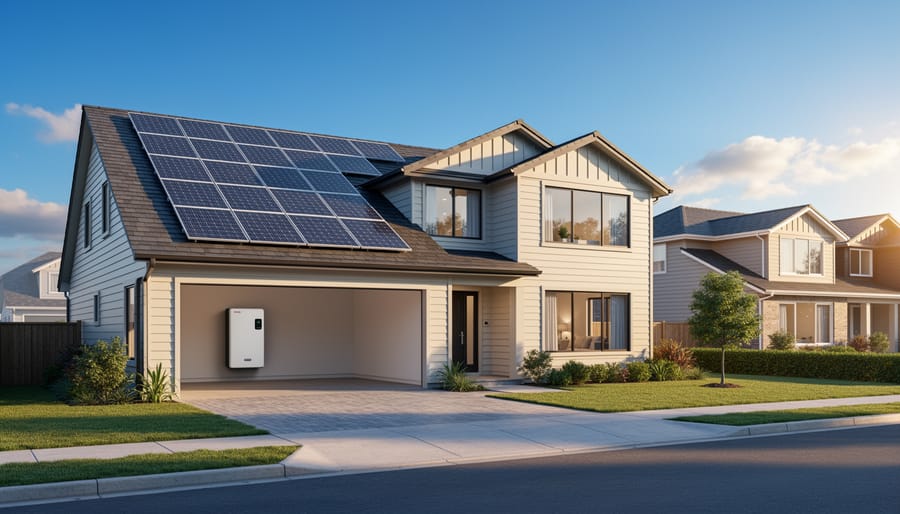
How Solar Energy Actually Works in Your Home (And Why Storage Changes Everything)
Updated:
Capture sunlight with photovoltaic panels that convert solar radiation into direct current electricity through semiconductor technology. Position your panels at the optimal angle for your latitude—typically between 30 and 45 degrees in most locations—to maximize energy absorption throughout the day. Store excess electricity in deep-cycle lithium or lead-acid batteries, which act as your energy reservoir for nighttime use and cloudy days. Connect an inverter to transform that stored DC power into the AC electricity your home appliances require, creating a complete solar system that can reduce or eliminate your grid dependence.
Solar energy usage has evolved from an expensive curiosity into an accessible technology that everyday people can understand and implement. The process follows a straightforward path: collection, conversion, storage, and use. Whether you’re powering a tiny camping setup with a 100-watt panel or designing a whole-home system generating several kilowatts, the fundamental principles remain identical.
The beauty of solar systems lies in their scalability and modularity. Start small with a single panel charging USB devices, then expand as your confidence and budget grow. Many DIY enthusiasts begin with portable setups for RVs or emergency backup power before committing to permanent roof installations. This gradual approach lets you learn the technology hands-on, troubleshoot minor issues without major consequences, and build a system perfectly tailored to your actual energy needs rather than theoretical calculations.
What Solar Energy Utilization Really Means (Beyond Just Panels on Your Roof)

The Journey of Sunlight to Electricity
Let me walk you through the fascinating journey of how sunlight becomes usable electricity in your solar panels. I remember when I first learned this process – it felt like pure magic, but understanding it really empowered me to work confidently with my own solar setup.
It all starts with photons, which are tiny particles of light traveling from the sun to Earth. When these photons hit your solar panel, they encounter something called photovoltaic cells, commonly known as solar cells. These cells are typically made from silicon, a semiconductor material that has a special property: it can convert light energy directly into electrical energy.
Here’s where it gets interesting. Each solar cell contains two layers of silicon that have been treated differently – one positive and one negative. When photons strike the cell, they knock electrons loose from the silicon atoms. This creates an electrical imbalance between the two layers, and those freed electrons start moving from one side to the other, creating an electrical current. Think of it like water flowing downhill – the electrons naturally want to move to restore balance.
Metal conductive plates on the sides of each cell collect these moving electrons and transfer them to wires. At this point, you have direct current electricity, or DC power. This is the same type of electricity you’d find in a battery.
Multiple solar cells are connected together in your solar panel to generate more power, and that DC electricity is now ready for the next stage: either storage in batteries or conversion to alternating current for home use.
Where Your Solar Power Goes (The Three Paths)
Think of your solar power like water flowing from a garden hose. Once your panels generate electricity, it has three possible paths it can take, and understanding these destinations helps you maximize your system’s potential.
The first and most immediate path is straight into your home. When your solar panels produce power during the day, that electricity flows directly to whatever appliances and devices you’re currently using. Your refrigerator, computer, lights, and air conditioner get first dibs on this fresh solar energy. I remember the first time I watched my energy monitor showing my panels powering my entire house during a sunny afternoon—it felt like magic, but it’s actually just smart design prioritizing immediate consumption.
The second path comes into play when you’re generating more power than you’re using at that moment. This excess electricity flows back into the electrical grid, and depending on your utility’s net metering program, you typically receive credits on your bill. Think of it as depositing your surplus energy into a community bank that you can withdraw from later when the sun isn’t shining.
The third option, and increasingly popular among DIY solar enthusiasts, is battery storage. Instead of sending excess power to the grid, you store it in batteries for use during evenings, cloudy days, or power outages. This gives you greater energy independence and ensures nothing goes to waste. Modern battery systems automatically manage this flow, directing power where it’s needed most efficiently.
Why Storage Is the Missing Piece Most Beginners Overlook
The Solar Generation vs. Consumption Problem
Here’s the interesting challenge most solar enthusiasts discover after installation: your panels produce the most electricity when you need it least. Let me paint you a familiar picture from my own home setup.
Solar panels hit peak production between 10 AM and 2 PM when the sun is directly overhead. My system generates about 70% of its daily energy during these midday hours. But here’s the thing—I’m not home using much electricity then. The refrigerator hums along, maybe the Wi-Fi router is running, but that’s about it.
The real energy demand happens during what we call the “bookend hours.” Morning is when everyone’s showering with electric water heaters, brewing coffee, making breakfast, and getting ready for the day. Then evening rolls around—cooking dinner, running the dishwasher, doing laundry, charging devices, watching TV, and running the air conditioning or heating. These peak usage times typically occur before 8 AM and after 5 PM, precisely when solar production is minimal or nonexistent.
In a typical household, you might generate 30 kilowatt-hours during sunny midday but only consume 5 kilowatt-hours during that window. Meanwhile, your evening consumption could hit 15 kilowatt-hours when your panels are producing nothing. This timing mismatch is exactly why storage solutions become essential for maximizing your solar investment.
What Happens to Excess Energy Without Storage
When your solar panels generate more electricity than you’re using, that excess power needs somewhere to go. In grid-tied systems, this surplus energy flows back into the utility grid through a process called net metering. Your meter literally runs backward, and the utility company credits your account for the power you’ve contributed.
Sounds like a win-win, right? Well, here’s where it gets interesting. Most utility companies don’t pay you the same rate for excess electricity that they charge you to use it. While you might pay 12-15 cents per kilowatt-hour for power you consume, they might only credit you 3-5 cents for power you send back. I learned this the hard way during my first summer with solar panels when I watched my system generate way more than I needed during peak hours.
This rate difference is why understanding what happens to excess energy matters for your wallet. Some regions have better net metering policies than others, and regulations keep changing. Additionally, if you’re off-grid completely, excess power without storage simply goes unused, wasting your system’s potential. That’s why storage solutions become crucial for maximizing your solar investment and achieving true energy independence, rather than just reducing your utility bills.
Battery Storage Systems: Your Solar Power’s Safety Net

Lead-Acid vs. Lithium: The Real-World Trade-Offs
When you’re getting started with solar storage, one of your biggest decisions is choosing the right battery chemistry. Let’s break down the real differences between lead-acid and lithium batteries so you can make the best choice for your situation.
Lead-acid batteries are the budget-friendly option upfront. You might spend $150-300 for a decent deep-cycle battery. They’re proven technology that’s been around forever, and if something goes wrong, most people can troubleshoot them. The downside? They need regular maintenance like checking water levels, they’re heavy as bricks, and they typically last 3-5 years with proper care. You can only safely use about 50% of their capacity without damaging them.
Lithium batteries cost 2-3 times more initially, which can be sticker shock. But here’s where it gets interesting. Charles started with lead-acid batteries for his workshop solar setup back in 2018. After replacing them twice in five years, he switched to lithium. His experience? “I wish I’d gone lithium from day one. No maintenance, I can use 80-90% of the capacity, and they’re so much lighter. The math actually works out cheaper over ten years.”
Lithium batteries typically last 10-15 years, weigh about a third as much, and require zero maintenance. They also charge faster and handle deeper discharges without damage. For fixed installations where space isn’t tight and you’re watching every dollar, lead-acid can work. But for most DIY solar projects, especially portable setups, lithium’s advantages usually justify the higher upfront investment.
Sizing Your Battery Bank (Without Overbuying)
Getting your battery bank size right is crucial—too small and you’ll run out of power when you need it most, too large and you’ve wasted money on capacity you’ll never use. Let me walk you through how to calculate exactly what you need.
Start by figuring out your daily energy consumption. List every device you plan to power and multiply its wattage by how many hours you’ll use it daily. For example, if you’re running LED lights (20 watts for 4 hours), a laptop (50 watts for 3 hours), and a small refrigerator (60 watts for 8 hours), that’s 710 watt-hours per day.
Next, decide how many days of backup power you want. Most folks aim for 2-3 days of autonomy in case of cloudy weather. Multiply your daily consumption by this number. In our example, 710 watt-hours times 3 days equals 2,130 watt-hours total.
Here’s where it gets interesting: batteries shouldn’t be drained completely. Lead-acid batteries work best when you only use 50% of their capacity, while lithium batteries can safely go to 80%. So divide your total by 0.5 or 0.8 depending on your battery type. For lithium in our example, that’s 2,663 watt-hours needed.
I’ve created a battery calculator tool on the site that does this math automatically—just plug in your numbers and it’ll recommend the right setup. Remember, this calculation goes hand-in-hand with sizing your solar panels to keep those batteries topped off daily.
Creative Solar Utilization Ideas for DIYers

Vehicle and RV Solar Systems
Taking solar power on the road opens up incredible possibilities for adventure and independence. Whether you’re converting a van, outfitting an RV, or just dreaming of off-grid travel, mobile solar systems require some special considerations compared to stationary home setups.
The biggest challenge with vehicle solar is weight and space. Every pound matters when you’re on the move, so choosing lightweight panels and compact battery systems becomes crucial. Flexible solar panels work great for curved RV roofs, though they typically produce slightly less power than rigid panels. You’ll also need to think about aerodynamics and mounting solutions that can handle highway speeds and vibration.
Charles learned this firsthand during his van conversion project. “I initially overestimated how much power I’d need,” he shares. “After tracking my actual usage for a few weeks, I realized a 400-watt system with a 200Ah lithium battery was plenty for running my laptop, lights, and a small fridge. The key was being realistic about my consumption and adding a charge controller that could handle both solar input and alternator charging while driving.”
Power management becomes more important in vehicles because you’re working with limited capacity. Installing a battery monitor helps you track your state of charge in real-time, preventing those frustrating moments when you’re left without power. Most mobile systems also benefit from multiple charging sources, combining rooftop solar panels with alternator charging to ensure you’re always topping up your batteries.
Camping and Portable Solar Setups
For outdoor enthusiasts, solar power transforms camping from a digital detox into a connected wilderness experience. Foldable solar panels have become incredibly portable, typically ranging from 20-100 watts and weighing just a few pounds. These panels fold into book-sized packages that easily fit into backpacks or vehicle storage.
I remember my first camping trip with solar gear—charging my phone and GPS while hiking felt like having the best of both worlds. Portable solar power banks are game-changers for weekend trips, storing energy during the day for nighttime use. Look for units with multiple USB ports and weatherproof ratings.
For scout groups and outdoor education programs, temporary installations work wonderfully. Set up panels at your campsite base, angle them toward the sun, and connect to a portable battery station. This setup can power LED lighting, charge communication devices, and run small camping appliances. Many camping-specific solar kits now include everything you need: panels, battery storage, charge controllers, and cables in one package, making setup straightforward even for first-time users.
Workshop and Shed Power Solutions
Your workshop or shed doesn’t need to stay powerless just because it’s far from your main electrical panel. Solar power is perfect for these detached spaces, and I’ve seen countless DIYers transform dark, unusable outbuildings into fully functional workshops.
Start with a simple assessment of your needs. Most workshop applications require 200-500 watts of solar capacity with a modest battery bank. A typical setup might include two 200-watt panels, a charge controller, a 100-amp-hour battery, and an inverter for AC tools. This configuration handles basic lighting, phone charging, and occasional power tool use without the expense of trenching electrical lines across your property.
Charles from our community recently shared his experience powering his woodworking shed with a 400-watt system. He runs LED work lights, charges cordless tool batteries, and operates a radio throughout the day. His total investment was around $600, compared to the $2,000 estimate he received for running underground electrical conduit.
Consider your usage patterns carefully. If you primarily need lighting and small device charging, you can start even smaller. A 100-watt panel with a basic battery setup provides plenty of power for LED strips and USB charging stations. For heavier tool use, plan for higher capacity and ensure your inverter can handle surge demands from motors starting up.
Maximizing Your Solar Energy Efficiency
Time-Shifting Your Energy Use
Think of your solar panels as having a “happy hour” between 10 AM and 2 PM, when they’re producing the most energy. That’s your golden window for running power-hungry appliances. I learned this the hard way when I kept running my dishwasher at night, only to realize I was pulling from the grid instead of using all that free sunshine sitting in my battery from earlier.
The simple shift: load your dishwasher after breakfast and set it to run around midday. Same with laundry. If you’re working from home, charge your laptop and devices during peak sun hours rather than overnight. Even preheating or precooling your home during solar peak times can reduce your evening energy draw significantly.
For the tech-savvy among us, smart plugs and home automation systems are game-changers. I’ve programmed my water heater to prioritize heating during solar production hours, and my smart home hub automatically runs the pool pump when my panels are cranking out maximum watts. Many modern inverters now include energy management features that can communicate with smart appliances directly.
Start simple: identify your three biggest energy users and manually shift them to midday for a week. Track the difference in your grid consumption. Once you see those savings, you’ll naturally start planning your household routine around the sun.

Simple Maintenance That Prevents Power Loss
Here’s the truth I learned after my first solar panel lost 20% efficiency in just six months: a little prevention beats a lot of frustration. Most power loss happens gradually, so you might not notice until your batteries aren’t charging like they used to.
Start with monthly visual inspections. Walk around your panels and look for debris, bird droppings, or dust buildup. I keep a soft-bristle brush and a spray bottle with distilled water nearby for quick cleanups. Early morning or late evening works best since hot panels and cold water don’t mix well. For stubborn grime, add a drop of mild dish soap, but rinse thoroughly to avoid residue that actually attracts more dirt.
Check your connections every season. Loose wires create resistance, which means wasted power and potential safety hazards. Gently wiggle each connection point and tighten anything that moves. Look for corrosion around terminals, that white or green crusty stuff that blocks current flow. A light coating of dielectric grease prevents this entirely.
Finally, adjust your panel angles with the seasons if they’re not fixed-mount. In summer, flatten them slightly; in winter, increase the tilt to catch those lower sun angles. This 15-minute task twice yearly can boost your output by 10-15%. Think of maintenance as protecting your investment rather than fixing problems after they’ve already cost you power.
Common Mistakes When Combining Solar Generation and Storage
The Undersizing Trap
I learned this lesson the hard way during my first solar setup. I installed a modest 100-watt panel thinking I’d save money by starting small. Within six months, I was shopping for more panels because my initial system couldn’t handle my growing needs. Here’s the kicker: I ended up spending nearly double what a properly sized system would have cost upfront, thanks to duplicate charge controllers, incompatible components, and wasted equipment.
The undersizing trap catches many newcomers. You install a system based on today’s needs, but as you discover how convenient solar power is, your usage naturally expands. Maybe you add a second device, or realize you want backup power for longer periods. Suddenly, your carefully calculated system is maxed out.
Planning for expansion from day one saves both money and headaches. When sizing your system, calculate your current energy needs, then add 30-50% buffer capacity. This approach costs slightly more initially but avoids expensive retrofits later. Consider modular components that allow easy expansion, like charge controllers with extra capacity or battery systems designed for parallel connections. Think of it as buying shoes with a little room to grow, except here, that foresight can save you hundreds of dollars.
Matching Components Correctly
Getting your solar components to play nicely together is like assembling a team where everyone speaks the same language. The most critical factor? Voltage compatibility. I learned this the hard way when I first started tinkering with solar setups back in 2015. I excitedly connected a 24V solar panel to a 12V battery system without a proper charge controller, and let’s just say it wasn’t my finest moment.
Here’s the golden rule: your solar panels, charge controller, batteries, and inverter must all be compatible voltage-wise. If you’re running a 12V battery bank, you’ll typically want 12V panels (or panels wired to output around 18V for proper charging). Your charge controller needs to handle both your panel voltage input and battery voltage output, while your inverter must match your battery bank voltage.
Common mismatches to avoid include connecting high-voltage panels directly to low-voltage batteries, using an inverter rated for different voltage than your battery bank, or selecting a charge controller that can’t handle your panel’s wattage. Always check the specs carefully and use online calculators to verify compatibility before making purchases. Taking an extra hour to double-check connections can save you hundreds in damaged equipment and countless hours of frustration.
Getting Started: Your First Solar-Plus-Storage Project
Ready to turn theory into practice? The beauty of solar energy is that you don’t need to commit to a massive rooftop installation right away. In fact, I always recommend starting small and building your confidence through hands-on experience.
Your first project could be as simple as a portable solar panel charging station for your devices. Pick up a small 50-100 watt panel, a basic charge controller, and a deep-cycle battery. This manageable setup teaches you the fundamentals without overwhelming your budget or your garage space. You’ll learn how panels respond to different angles and weather conditions, how charge controllers protect your battery, and how to calculate your actual power needs versus your assumptions.
Once you’ve mastered that setup, consider expanding to a small off-grid system for a shed, RV, or camping gear. Each project builds your knowledge and troubleshooting skills. I learned more from my first failed connection than from reading a dozen manuals. The great news? You’re not alone in this journey.
The DIY solar community is incredibly welcoming and eager to help newcomers avoid common pitfalls. Online forums, local maker spaces, and yes, the Spheral Solar community are filled with people who’ve been exactly where you are now. They’ll answer your questions, review your plans, and celebrate your successes.
Before buying any equipment, use our solar system calculator to understand what size system matches your goals. This prevents the costly mistake of over-buying or under-sizing your setup. Remember, every expert started as a beginner holding their first solar panel, wondering if they could really make this work. You absolutely can.
I’ll be honest with you—when I first started exploring solar energy, I felt overwhelmed by all the technical details and options. But here’s what I’ve learned through my own journey and from countless conversations with community members: understanding and implementing your own solar energy system is one of the most empowering steps you can take, both for your wallet and for the planet.
You don’t need to be an electrical engineer or invest thousands of dollars right away. The beauty of solar energy is that you can start small—maybe with a simple panel to charge your devices or power a workshop light—and grow your system as your confidence builds. Every kilowatt-hour you generate from the sun is energy you’re not pulling from the grid, which means real savings on your electricity bills and a tangible reduction in your carbon footprint.
Yes, there’s a learning curve. You’ll encounter new terms, face decisions about equipment, and probably make a few mistakes along the way. That’s completely normal and actually part of the fun. I still remember connecting my first battery bank backwards—learned that lesson quickly!
The most important thing is to take that first step. Browse through our interactive calculators to size a system that fits your needs, read through project guides from fellow DIYers, and don’t hesitate to ask questions in our community forum. Solar energy isn’t just about technology—it’s about people helping people create a cleaner, more sustainable future, one panel at a time.