Keep Your Attic Cool Without Touching Your Electric Bill
Updated:
Look up at your gable vent on a summer afternoon, and you’ll understand why a solar-powered attic fan mounted there makes perfect sense. That triangle-shaped opening at the peak of your home sits exactly where hot air naturally accumulates, and it’s already positioned to catch direct sunlight for most of the day. Unlike roof-mounted versions that require cutting holes through your shingles, gable mount fans install into existing vents, making them the most DIY-friendly option for homeowners who want cooler attics without risking leaks or voiding warranties.
I learned this lesson the hard way three summers ago when my attic temperatures hit 150°F and my air conditioning bills doubled. After researching options, I chose a gable mount solar fan specifically because I could install it myself in about two hours with basic tools. The results surprised me: my attic temperature dropped by 30-40 degrees, and my cooling costs went down noticeably within the first month.
The beauty of gable mount solar fans lies in their simplicity. They require no electrical wiring, no roof penetrations beyond what already exists, and no ongoing electricity costs. You’re essentially upgrading an existing vent into an active cooling system powered entirely by the sun. For most homeowners, this means a straightforward weekend project rather than an expensive professional installation.
This guide walks you through everything you need to know: understanding how gable mount fans differ from other attic ventilation options, selecting the right size and model for your specific home, installing it yourself with confidence, and knowing exactly what performance improvements to expect. Whether you’re dealing with ice dams in winter, excessive heat in summer, or simply want to extend your roof’s lifespan, a properly installed gable mount solar fan delivers measurable results without the complexity or cost of traditional powered ventilation systems.
Why Your Attic Turns Into an Oven (And Why That’s Bad for Your Whole House)
I learned this lesson the hard way during my first summer in an older home. I’d crank the AC down to 68°F, and somehow my house still felt like a sauna by mid-afternoon. The culprit? My attic was secretly working against me, trapping heat like a solar oven perched right above my living space.
Here’s what happens up there: During a typical summer day, your roof absorbs intense sunlight, and temperatures in an unventilated attic can easily soar to 150°F or even higher. Think about that for a moment – that’s hot enough to bake cookies! This superheated air doesn’t just stay put. It radiates downward through your ceiling, forcing your air conditioning system to work overtime battling heat from above while trying to cool from below.
The impact on your wallet is real. Studies show that attic temperatures exceeding 120°F can increase your cooling costs by 10-40%, depending on your insulation quality. Your AC unit runs longer cycles, uses more electricity, and wears out faster trying to compensate for this invisible heat source overhead.
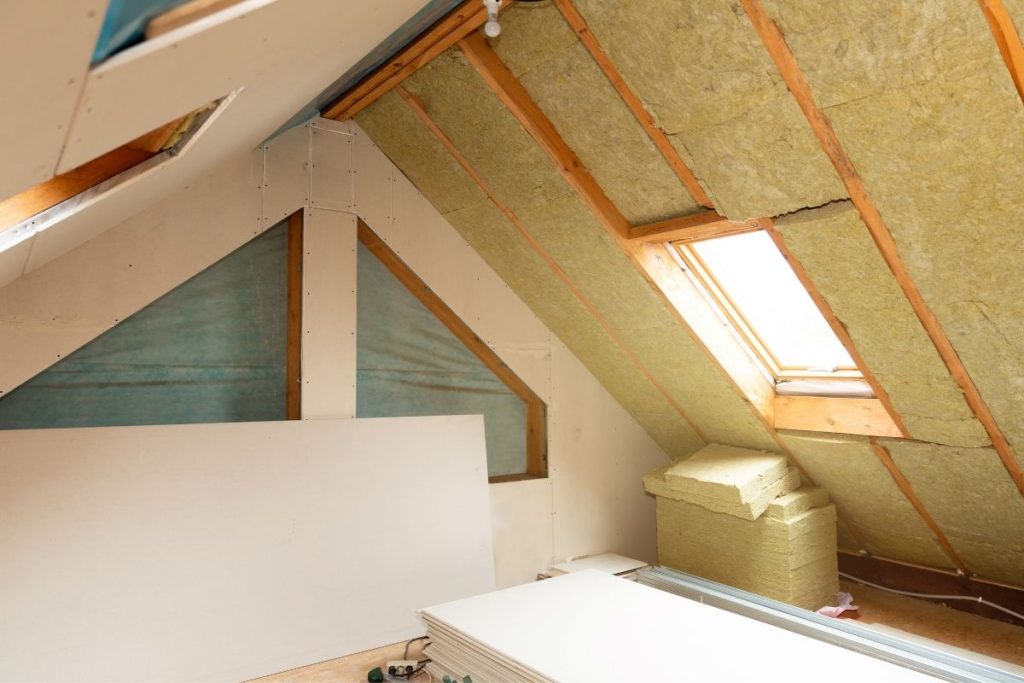
But the damage goes beyond your energy bill. Extreme attic heat literally cooks your roofing materials from the inside out. Asphalt shingles become brittle and crack prematurely, wooden roof decking can warp, and your insulation loses effectiveness over time when exposed to sustained high temperatures. I’ve seen insulation that looked like it had been toasted – crusty, discolored, and about as useful as a screen door on a submarine.
Moisture is another villain in this story. Hot air holds more moisture, and when that humid air meets cooler surfaces, condensation forms. This creates the perfect environment for mold growth, wood rot, and structural damage you won’t notice until it’s expensive to fix.
The solution? Proper ventilation that creates airflow, preventing heat from accumulating in the first place. That’s exactly where solar-powered gable fans come into play.
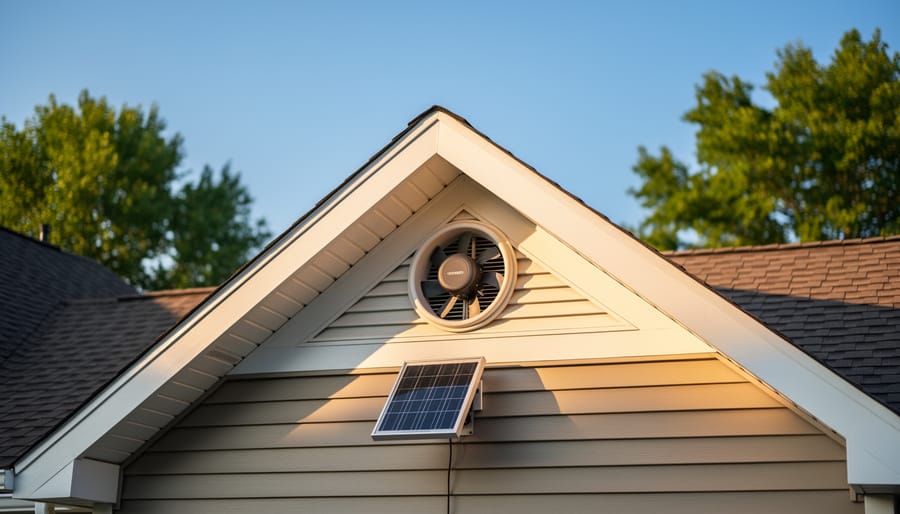
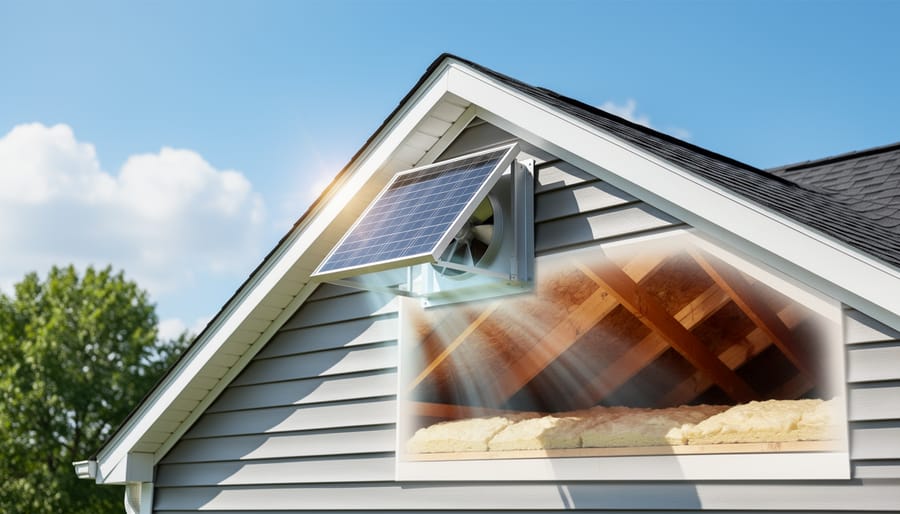
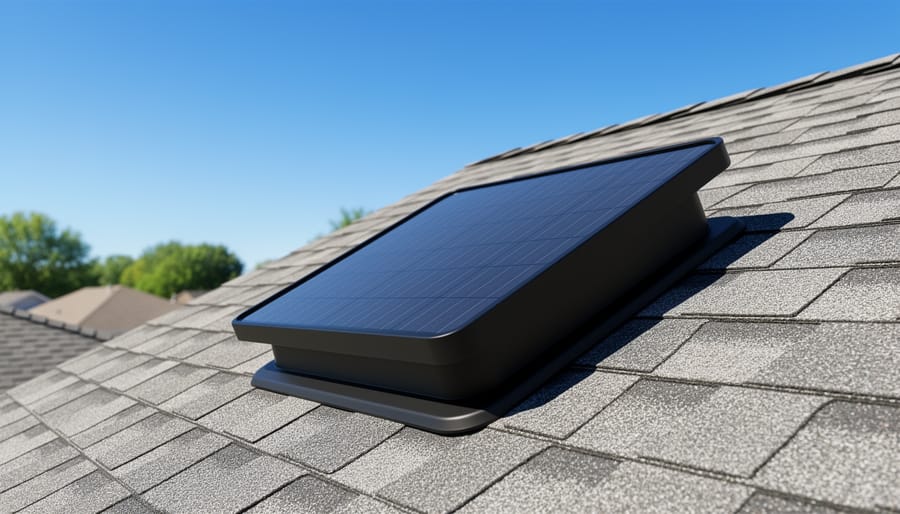
Gable vents provide the ideal mounting location for solar attic fans without requiring roof penetrations.
What Makes Gable Mount Different from Other Attic Fans
The Gable Mount Advantage for DIYers
When I installed my first gable-mounted attic fan back in 2018, I was honestly a bit nervous about drilling into my roof. But that’s exactly what makes gable mounts such a game-changer for DIYers like us – you’re working with your home’s existing gable vent opening instead of creating new holes in your roof deck.
The biggest advantage? No roof penetration means no potential for leaks down the road. I’ve talked to too many homeowners who’ve dealt with water damage from improperly sealed roof-mounted fans. With a gable mount, you’re simply replacing or covering an existing vent opening, which eliminates that worry entirely.
From a practical standpoint, gable vents are incredibly accessible. You can typically reach them with a standard ladder from the outside, or even work from inside your attic if you prefer. Compare that to roof installations where you’re navigating shingles and pitch angles – the gable approach is far less intimidating for first-time installers.
Structurally, you’re not compromising your roof’s integrity. There’s no need to navigate around rafters, cut through sheathing, or worry about load distribution. The gable wall is designed to support vent openings, so you’re working within the home’s existing framework.
Aesthetically, gable mounts blend naturally with your home’s design since they occupy space already designated for ventilation. They’re less visible from street level than roof mounts and maintain your home’s clean roofline. For those of us in HOA-regulated neighborhoods, this can make approval significantly easier.
When Gable Mount Might Not Work for You
Not every home is a perfect match for gable-mounted fans, and that’s completely okay. The most obvious limitation is homes without gable vents. If your attic doesn’t have those triangle-shaped vents on the ends of your house, you’ll need to look at roof-mounted or other ventilation options instead. Creating a gable vent from scratch is possible but requires significant carpentry work that defeats the simplicity of this installation.
Even with gable vents, positioning matters. I learned this the hard way when Charles mentioned his neighbor installed a gable fan facing the wrong direction for their prevailing winds. The fan worked, but it didn’t move air efficiently through the attic space. If your gable vent faces a wall, fence, or dense vegetation within a few feet, airflow will be restricted. You need clear space in front of the vent for proper intake and exhaust.
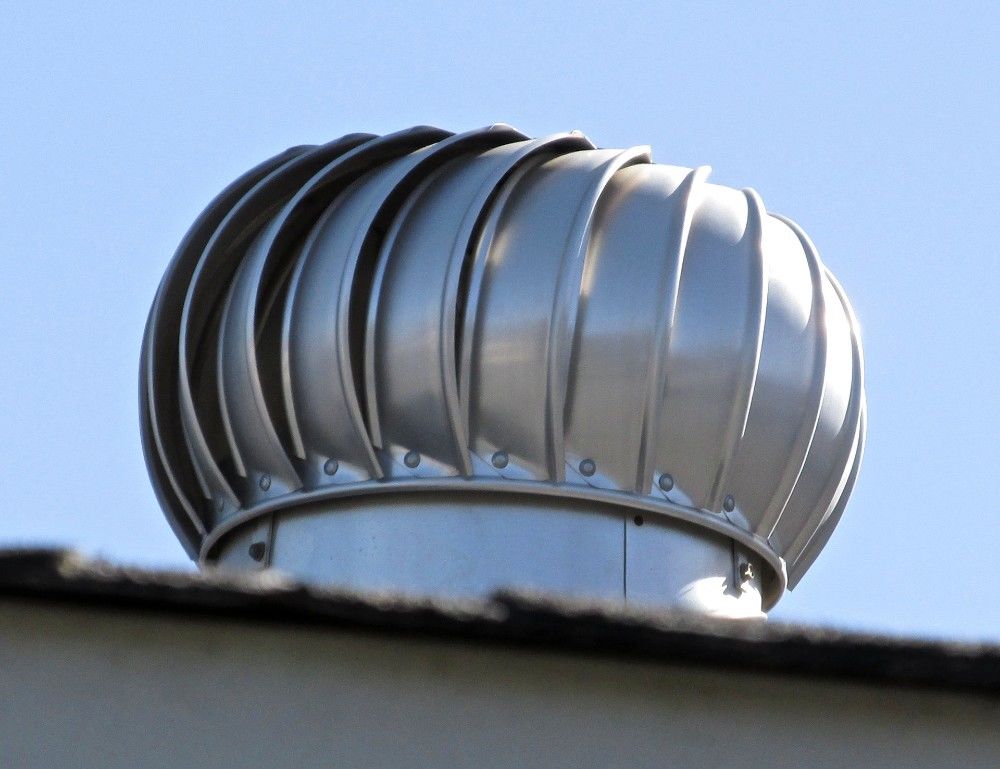
Some homes have decorative gable vents that are too small for standard fans. Measure your vent opening before purchasing to ensure compatibility. If you’re comparing options, check out our guide on solar versus electric attic fans to explore what might work better for your specific situation. Ridge vents, soffit ventilation, or roof-mounted solar fans might be more suitable alternatives for challenging attic configurations.
How Solar-Powered Gable Fans Actually Work
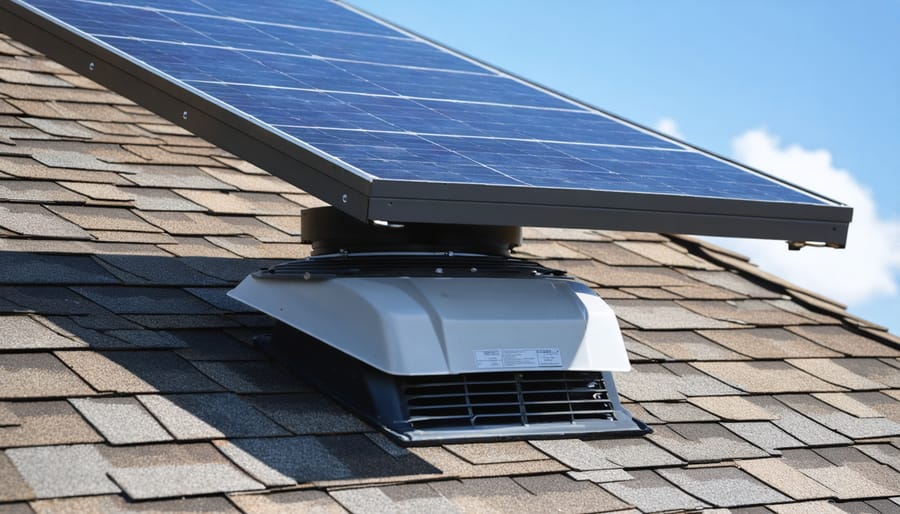
A typical solar gable fan includes the fan unit, solar panel, and mounting hardware—all designed for DIY installation.
The Free Energy Part (No Wiring Required)
Here’s what I love about solar-powered gable fans – they’re basically set-it-and-forget-it systems that run on pure sunshine. No electrician needed, no permit hassles, and definitely no added costs to your monthly electric bill.
The magic happens through a photovoltaic panel mounted right on the fan unit or nearby on your gable. When sunlight hits those solar cells, it converts directly into electricity that powers the fan motor. Simple as that. I installed my first one about five years ago, and honestly, the hardest part was convincing myself it could really be this straightforward.
What makes this system brilliant is its self-regulating nature. Think about it – when does your attic get the hottest? During peak sunshine hours, right? That’s exactly when the solar panel generates the most power, spinning the fan at its highest speed. As the sun moves across the sky or clouds roll in, the fan automatically adjusts its speed. When sunset arrives, the fan stops until morning. No timers, no sensors, no complicated controls.
This natural synchronization means you’re getting maximum ventilation precisely when your attic needs it most. On cloudy days when your attic isn’t baking anyway, the fan runs slower or not at all. It’s like the system just knows what to do.
The best part? Since you’re not tapping into your home’s electrical system, installation is purely mechanical. You’re just mounting hardware and letting the sun do the rest.
What Happens on Cloudy Days
Let me be honest with you—solar panels aren’t magic. On cloudy days, your gable-mounted attic fan will produce less power, typically around 10-25% of its full capacity depending on cloud thickness. But here’s the good news: most quality fans are designed to work even in reduced light conditions, just at lower speeds.
I learned this firsthand during a particularly overcast spring. My fan kept running, albeit more slowly, and still moved enough air to make a difference. The key is proper sizing—if you choose a fan that’s appropriately rated for your attic space, the reduced performance on cloudy days usually isn’t a deal-breaker.
If you live in a frequently overcast region, consider models with battery backup options. These store excess energy from sunny days to keep the fan running during low-light periods. Some homeowners even add small battery banks to ensure consistent operation year-round. It’s not necessary for everyone, but it provides peace of mind and maintains ventilation during extended cloudy stretches.
Choosing the Right Solar Gable Fan for Your Attic
The Numbers You Need to Know
Here’s the honest truth about sizing your solar attic fan: it’s not rocket science, but getting the numbers right makes all the difference between a fan that transforms your attic and one that’s just spinning its wheels.
The basic formula is surprisingly straightforward. Take your attic square footage and multiply by 0.7. That gives you the CFM (cubic feet per minute) airflow you need. So if you have a 1,500 square foot attic, you’re looking at about 1,050 CFM of ventilation power.
I remember when Charles first explained this to me, he pulled out a napkin at a cookout and sketched it out right there. “Why 0.7?” I asked. Turns out it’s based on the general principle that your attic air should be completely exchanged 10-12 times per hour on a hot day. That 0.7 multiplier builds in the variables like your climate, roof pitch, and insulation levels.
Now, I’ll be real with you: doing mental math while standing in a hot attic isn’t my idea of fun. That’s exactly why we built our online CFM calculator at Spheral Solar. Just plug in your attic dimensions, and it does the heavy lifting for you. It even factors in your location’s typical summer temperatures to give you a more precise recommendation.
The key takeaway? Don’t guess. Measure your attic, run the numbers, and choose a gable mount fan that meets or slightly exceeds your CFM requirement.
Features Worth Paying For (And Ones That Aren’t)
When I upgraded my first gable mount solar attic fan, I learned quickly that not all features justify their price tags. Let me walk you through what actually matters.
Adjustable thermostats are absolutely worth the investment. These let you set the exact temperature when your fan kicks on, typically between 60-120°F. I set mine to 90°F, and it’s been perfect for our climate. This feature alone can save you from overworking or underutilizing your fan. Look for models with easy-access adjustment dials rather than complicated digital controls.
Build quality indicators separate the best solar attic fans from budget disappointments. Check for aluminum frames instead of plastic housing, sealed bearing motors, and powder-coated finishes that resist rust. Heavy-gauge steel shutters will last years longer than lightweight alternatives.
Solar panel wattage directly impacts performance. For gable mounts, aim for at least 20-30 watts depending on your attic size. Don’t skimp here, underpowered panels won’t move enough air to make a difference.
Warranty considerations matter more than you’d think. A 5-year warranty minimum shows manufacturer confidence. Some brands offer 25-year panel warranties, which demonstrates real commitment to quality.
Features that aren’t worth extra cost? Remote controls, fancy digital displays, and multi-speed settings. Most gable fans work brilliantly on simple on-off operation. Battery backup sounds appealing, but adds significant cost and maintenance without much real-world benefit for most homeowners.
Installing Your Solar Gable Fan: A Weekend DIY Project
Tools and Prep Work
Before you climb up to tackle your gable mount installation, let’s make sure you have everything ready. I learned this the hard way after making three trips up and down my ladder because I kept forgetting tools!
For tools, you’ll need a power drill with assorted bits, a jigsaw or reciprocating saw for cutting the opening, a tape measure, pencil for marking, level, caulking gun with exterior-grade sealant, and a stud finder. Don’t skip the stud finder—it helps you avoid cutting through important framing members.
Safety equipment is non-negotiable. Grab sturdy work gloves, safety glasses, and a dust mask since cutting through siding creates plenty of debris. If you’re working high up, consider a safety harness.
Before making any cuts, head into your attic to check what’s behind your gable wall. Look for electrical wiring, blocking, or bracing that might interfere with your installation. Measure the exact location where you want the fan, making sure it’s centered and away from any obstructions. Take photos of the area—they’re incredibly helpful when you’re referencing your plan mid-installation.
Finally, verify your fan’s dimensions against the opening you’ll create. Most units need a 14-inch square opening, but always check your specific model’s requirements first.
Installing a solar gable fan is a manageable weekend DIY project for homeowners with basic tool skills.
The Installation Steps
Installing a solar-powered attic fan on your gable is more straightforward than you might think. I remember my first installation, standing on a ladder with butterflies in my stomach, wondering if I’d bitten off more than I could chew. Spoiler alert: I hadn’t, and you won’t either.
Start by removing your existing gable vent. Most vents are held in place with screws around the perimeter, so grab your drill and work your way around carefully. Once it’s off, you’ll see the opening into your attic. This is a good time to measure and compare it with your new fan’s dimensions. You might need to enlarge the opening slightly using a reciprocating saw, or you may need to create a wooden frame to reduce the size if your fan is smaller than the existing vent.
Next, position your fan unit in the opening from the outside. Most gable-mount fans come with a built-in flange that sits flush against your siding. Have someone inside the attic help guide you, ensuring the fan sits level and centered. Secure it using corrosion-resistant screws through the mounting holes, spacing them evenly around the frame.
Now for the solar panel placement. Ideally, mount it on a south-facing roof section where it’ll catch maximum sunlight. Use the included brackets and follow the manufacturer’s spacing recommendations. Run the wire from the panel to the fan, tucking it under shingles where possible to keep it protected and hidden.
Weatherproofing is critical. Apply a generous bead of exterior-grade silicone caulk around the entire perimeter where the fan meets your siding. Don’t skip this step, trust me on that one.
Finally, test everything. On a sunny day, the fan should kick on automatically. Listen for smooth operation and check that air is flowing properly from inside your attic.
Common Installation Mistakes to Avoid
Let me share some hard-won wisdom from installations I’ve seen go sideways. The most common mistake? Skipping proper weatherproofing around the gable opening. I learned this the hard way when I helped my neighbor install his fan, and we got lazy with the caulking. After the first heavy rain, we discovered water stains on the attic floor. Always apply a generous bead of outdoor-grade silicone around the entire perimeter and don’t skimp on the flashing.
Another frequent pitfall is positioning the solar panel where it looks good rather than where it works best. Your fan needs direct sunlight for most of the day, not just morning shade. I’ve watched folks mount panels facing north or under roof overhangs because it seemed neater. The result? A fan that barely spins when you need it most.
Sizing errors trip up many first-timers too. Buying the cheapest or smallest fan might save money upfront, but if your attic is 1,200 square feet and the fan only handles 800, you’re wasting your investment. Always calculate your attic’s square footage and match it to the fan’s CFM rating. Charles often says measure twice, install once, and he’s absolutely right here.
A properly installed solar gable fan operates silently and automatically, cooling your attic whenever the sun shines.
What to Expect: Real-World Performance
Temperature Drops You Can Actually Achieve
Let’s talk real numbers here, because I’ve learned the hard way that managing expectations is crucial when it comes to solar attic fans. From my experience installing these systems and hearing from dozens of community members, you can typically expect your attic temperature to drop between 10 to 20 degrees Fahrenheit on a hot summer day. That’s significant, but it won’t transform your attic into an icebox.
The impact on your living space is more modest, usually somewhere between 2 to 10 degrees Fahrenheit. I remember installing my first gable mount fan and checking the thermometer obsessively. The living room dropped about 5 degrees over the course of an afternoon, which honestly made a noticeable difference in comfort.
Several factors influence these results. The size of your attic matters tremendously. A 1,200 square foot attic will respond differently than a 2,500 square foot space. Your existing insulation plays a huge role too. Better insulation means those cooler attic temperatures translate more effectively into living space comfort. The fan’s CFM rating, your roof color, and even your geographic location all contribute to the final outcome.
One thing I always tell folks: don’t expect miracles, but do expect measurable improvement. These fans work best as part of a comprehensive cooling strategy, not as a standalone solution.
Will This Really Save You Money?
Here’s the honest truth: most homeowners see their cooling costs drop by 10-30% after installing a gable-mounted solar attic fan. I’ve noticed my own AC running noticeably less during those brutal afternoon hours. The installation costs typically range from $300-600 if you DIY it, and you’ll likely break even within 3-5 years depending on your local electricity rates.
But here’s what really matters beyond the dollars: these fans extend your roof’s lifespan by reducing heat damage to shingles, prevent moisture buildup that causes mold, and create a more comfortable living space overall. My attic used to hit 150°F in summer, now it stays around 110°F. That’s a game-changer for your home’s overall health. Plus, you’re reducing your carbon footprint without adding a dime to your electric bill. The peace of mind knowing your ventilation works even during power outages? That’s priceless.
Maintenance and Troubleshooting Your Solar Attic Fan
Good news: solar attic fans are remarkably low-maintenance, but a little attention goes a long way in keeping yours running efficiently for years.
I learned this lesson the hard way after neglecting my first installation for three years. When I finally climbed up to check on it, the solar panel was so covered in pollen and dust that it was only producing about 60% of its rated power. A simple cleaning brought it right back to life.
The most important maintenance task is cleaning your solar panel every 6-12 months, depending on your environment. If you live in a dusty area or near trees, check it twice yearly. Use a soft cloth with plain water or a mild soap solution. Avoid harsh chemicals that might damage the panel’s coating. Early morning or late afternoon cleanings work best since the panel won’t be hot.
While you’re up there, inspect the mounting hardware for any loose screws or bolts. Temperature swings can cause fasteners to loosen over time. Check the weatherproofing seal around the gable opening too. Any gaps could let moisture into your attic, defeating the whole purpose of your ventilation efforts.
If your fan stops working, start with the basics. Is the panel getting adequate sunlight? Sometimes tree growth can create unexpected shade. Check for any obstructions in the fan blades themselves, like leaves or debris.
Most quality gable-mount fans include simple diagnostic features. Some have LED indicators showing power status. If the panel generates power but the fan won’t spin, you might need to replace the motor, which is usually a straightforward swap.
You’ve just taken an important step toward energy independence, and that’s something worth celebrating. Installing a solar powered attic fan on your gable mount isn’t just about improving ventilation or reducing electricity bills, though those benefits are certainly significant. It’s about proving to yourself that renewable energy is accessible, practical, and something you can implement with your own hands.
I remember when I installed my first gable-mounted solar attic fan. The satisfaction of seeing it spin up on its own power, knowing it would work year after year without adding a cent to my energy costs, was incredible. That feeling never gets old, and I hope you experience it too.
The beauty of this project is its simplicity combined with meaningful impact. You’re reducing your carbon footprint, extending your roof’s lifespan through better moisture control, and potentially lowering your cooling costs. These aren’t small wins; they’re the building blocks of a more sustainable home.
Now that you’ve learned the fundamentals of gable-mounted solar attic fans, I encourage you to join our Spheral Solar community. Share photos of your installation, ask questions, and learn from others who’ve taken this journey. We’re stronger when we learn together.
Ready to explore more solar possibilities? Check out our interactive calculators to estimate your energy savings, and browse our library of related solar projects. Your path to energy independence is just beginning, and we’re here to support you every step of the way.
How useful was this post?
Click on a star to rate it!
Average rating 0 / 5. Vote count: 0
No votes so far! Be the first to rate this post.
We are sorry that this post was not useful for you!
Let us improve this post!
Tell us how we can improve this post?
charlesnoble
Here at Spheral Solar, I’m a hands-on solar power enthusiast, constantly exploring and experimenting with DIY solutions. I’m dedicated to sharing my discoveries, insights, and even the bumps I hit along the way, all in the pursuit of a more sustainable future.
Best Way to Keep Attic Cool – 7 Energy Efficient Ways by Adeyomola June 1, 2021 Fixing the leaks and opening the skylights might help make your attic cool, but harnessing the sun’s power – transforming it from problem to solution – could be the answer to keeping your attic cool. But how can you keep your attic cool using the sun? Well, you can improve…
How Do Attic Fans Work? by Adeyomola June 21, 2021 Attic fans work primarily by augmenting the movement of hot air rising out of the attic. They do this by transmitting the mechanical energy (kinetic energy) from their rotation to the molecules of the air around them, thus increasing the rate of convection. As attic fans promote the escape of…
Solar-Powered Ventilation That Slashes Your Energy… by Charlesnoble March 11, 2026 Calculate your home’s air exchange rate by dividing your square footage by 60—most homes need complete air replacement every 1-3 hours to prevent moisture buildup, stale air, and indoor pollutants that trigger allergies and respiratory issues. A 1,500 square foot home requires roughly 25-50 cubic feet per minute of continuous…
Why Your Attic Needs a Solar Roof Vent (Before Summer Hits) by Charlesnoble February 21, 2026 Your attic is probably hotter than you think. On a summer day, temperatures up there can soar past 150°F, turning your top floor into an oven and forcing your air conditioner to work overtime. A solar ventilation fan for your roof tackles this problem head-on by pulling hot air out…
Solar Ventilation Just Saved My Attic (And Cut My… by Charlesnoble November 3, 2025 **Assess your home’s air quality by standing in your living space right now—if you notice stale odors, condensation on windows, or that stuffy feeling when you walk in the door, your home is telling you it needs better ventilation.** Most homes built in the last 30 years are sealed tight…
6 Best Solar Attic Fan Reviews in 2023 by Adeyomola September 30, 2021 High CFM rating, versatility, durability, easy installation, and high solar panel wattage – these features typify the best solar attic fan. A solar-powered attic fan will be installed somewhere on the roof. This means it will be exposed to the elements – UV rays from the sun exposure, rain, snow,…
Subscribe for handpicked DIY projects, exclusive tips, and giveaways.
Walk down to your nearest stream with a five-gallon bucket and a stopwatch. Fill that bucket and time how long it takes—this simple test reveals whether you have enough flowing water to power your off-grid home. If you can fill it in under 10 seconds from a source that drops at least 10 feet in… Read more: The Stream Behind Your House Could Power It (Here’s How Micro Hydro Works)
Brush snow off your panels with a soft-bristled roof rake from ground level, working gently from bottom to top to avoid scratching the glass or damaging your DIY solar setup. Use lukewarm water in a spray bottle for stubborn ice patches, never hot water that could crack cold panels from thermal shock. Install panels at… Read more: Snow on Your Solar Panels? Here’s What Actually Works (And What Wastes Your Time)
Picture this: Last summer, I draped what looked like sparkling fairy lights across my patio pergola, and guests immediately asked where I’d hidden the extension cord. There wasn’t one. These solar powered outdoor curtain lights had transformed my backyard into an enchanting evening retreat without adding a cent to my electric bill or requiring any… Read more: Solar Curtain Lights That Actually Work Outdoors (What I Learned Installing Mine)