Stop Burning Out Your Solar Gear: Why Electrical Unit Conversion Matters
Updated:
Grab your multimeter and calculator—understanding electrical conversions transforms confusing numbers into actionable data for your solar setup. When I first started working with solar panels, I’d stare at spec sheets showing watts, amps, and volts, completely baffled about which numbers actually mattered for sizing my components. That confusion nearly led me to buying an undersized charge controller until I learned the simple relationship between these units.
Start by memorizing the power triangle: watts equals volts multiplied by amps (W = V × A). This single formula unlocks most conversions you’ll need. If your solar panel produces 18 volts and 5 amps, you’re generating 90 watts. Flip it around when shopping for components—a 400-watt inverter running on a 12-volt battery will draw roughly 33 amps, helping you size your wiring correctly.
Convert watt-hours to amp-hours by dividing watt-hours by your system voltage. A 100Wh battery at 12 volts provides 8.33Ah of capacity—critical for calculating how long your devices will run. I keep a simple conversion chart taped inside my electrical box because even experienced DIYers don’t memorize every formula.
Use dedicated solar calculators instead of doing manual math for complex scenarios involving efficiency losses and temperature coefficients. These tools account for real-world variables that basic formulas miss, like voltage drop across long wire runs or inverter efficiency ratings. The difference between theoretical calculations and actual performance often determines whether your system works reliably or leaves you frustrated in the dark.
The Electrical Units That Matter Most in Solar Projects
Understanding electrical units ensures proper connections between solar panels, charge controllers, and battery systems in real-world installations.
Volts, Amps, and Watts: The Core Three
When I first started working with solar panels, voltage, current, and watts felt like a foreign language. But here’s what changed everything for me: thinking about electricity like water flowing through a pipe.
Imagine your solar setup as a water system. Voltage (measured in volts) is like water pressure – it’s the force pushing electrons through your wires. A 12-volt battery has less “push” than a 24-volt battery, just like a garden hose has less pressure than a fire hose.
Current or amperage (measured in amps) is the actual flow rate – how many electrons are moving past a point each second. Think of it as the width of your pipe. A narrow pipe might let through 5 amps while a wider one could handle 20 amps.
Power (measured in watts) is where voltage and current come together – it’s the total work being done. Here’s the simple formula that connects them all: Watts = Volts × Amps. So if your solar panel produces 12 volts at 5 amps, you’re generating 60 watts of power.
In practical terms, this means a 100-watt solar panel might deliver about 5.5 amps at 18 volts on a sunny day. Understanding this relationship helps you figure out if your panel can actually charge that battery or run that appliance. You’re not just buying components anymore – you’re designing a system where everything works in harmony.
This water analogy isn’t just helpful for beginners either. I still use it when explaining setups to friends getting started with solar.
Watt-Hours and Amp-Hours: Measuring Your Solar Storage
When I first started building my solar setup, I thought bigger batteries simply meant more power. Then I learned the crucial difference between watt-hours and amp-hours, and suddenly sizing my battery bank made perfect sense.
Amp-hours (Ah) measure how much current a battery can deliver over time. Think of it like water flow from a tank. A 100Ah battery can theoretically supply 100 amps for one hour, or 10 amps for 10 hours. Simple enough, right?
Here’s where it gets interesting: amp-hours alone don’t tell you how much energy you actually have stored. That’s where watt-hours (Wh) come in. Watt-hours account for both current and voltage, giving you the complete picture of your battery’s energy capacity.
The conversion is straightforward: multiply amp-hours by voltage. A 100Ah battery at 12 volts stores 1,200Wh (100Ah × 12V). The same 100Ah battery at 24 volts? That’s 2,400Wh of energy. This is why our battery power conversion table is essential for accurate planning.
Why does this matter for your project? Let’s say you want to run a 600W refrigerator for 4 hours. You need 2,400Wh of storage (600W × 4h). With a 12V battery system, that means you need 200Ah (2,400Wh ÷ 12V). Understanding this relationship prevents the frustrating mistake of buying undersized batteries.
Always calculate in watt-hours when planning your system’s runtime and total energy needs.
Common Conversion Mistakes That Cost DIYers Money
The Battery Bank Miscalculation
Let me share a cautionary tale from my friend Jake’s first solar setup that perfectly illustrates why understanding voltage matters when converting amp-hours. Jake purchased a 100Ah battery bank rated at 12V for his small off-grid cabin, thinking he could simply compare it to his 24V system requirements. He’d calculated needing 100Ah of storage, so he figured he was all set.
The problem? Those amp-hours weren’t interchangeable between voltages. His 12V 100Ah battery actually provided 1,200 watt-hours of storage (12V x 100Ah). But his 24V system really needed 100Ah at 24 volts, which would be 2,400 watt-hours. He had exactly half the storage capacity he needed!
This is where the watt-hour conversion becomes essential. When comparing batteries at different voltages, you need to convert to watt-hours first: multiply voltage by amp-hours. Then, if you need to know amp-hours at a different voltage, divide those watt-hours by your system voltage. Jake learned this the hard way when his batteries died every evening around dinnertime. After properly converting units, he realized he needed either two 12V batteries or one proper 24V 100Ah battery to meet his actual needs.
Wire Gauge and Voltage Drop
Here’s something I learned the hard way during my first solar installation: knowing your current draw is only half the battle. You also need to make sure your wires can actually handle that current without turning into expensive heating elements or, worse, creating a safety hazard.
When electricity flows through a wire, it encounters resistance. Think of it like water moving through a garden hose – a narrow hose creates more resistance than a wide one. The same principle applies to electrical wiring. If you try to push too many amps through a wire that’s too thin, two problems occur: the wire heats up (potentially causing fires), and you lose voltage along the way, meaning less power reaches your devices.
This is where converting amps to proper wire gauge becomes critical. Wire gauge follows an inverse numbering system – smaller numbers mean thicker wires. For example, 10 AWG wire is thicker than 14 AWG. Your amp calculation tells you the minimum wire thickness needed to safely carry that current without overheating.
But there’s another consideration: voltage drop. Even if a wire can safely handle the current, a long wire run can cause significant voltage loss. For solar installations, especially those with panels mounted far from batteries or inverters, this matters enormously. A 3% voltage drop might not sound like much, but it directly translates to wasted energy and reduced system efficiency.
The conversion process works like this: calculate your maximum current draw in amps, determine your wire run length, then use a wire gauge chart to find the appropriate thickness. This ensures both safety through proper fuse sizing and efficiency through minimal voltage drop.
Incorrect electrical unit conversions can lead to undersized wiring, resulting in dangerous overheating and potential fire hazards.
Essential Electrical Unit Conversions for Solar DIYers
Converting Between Watts, Volts, and Amps
Understanding the relationship between watts, volts, and amps is like having a universal translator for your solar system. The fundamental power formula is beautifully simple: Watts = Volts × Amps (W = V × A). This equation is your best friend when planning any solar setup.
Let me share a practical example from my own garage workshop. When I installed my first solar panel rated at 100 watts and 18 volts, I needed to know how many amps it would produce. Using our formula rearranged (A = W ÷ V), I calculated 100 ÷ 18 = 5.56 amps. This told me exactly what size charge controller I needed.
Here’s another common scenario: you’re sizing an inverter for your system. If you want to run a 1500-watt appliance on a 12-volt battery system, you’ll need to calculate the amp draw. That’s 1500 ÷ 12 = 125 amps. Suddenly, you realize why proper wire sizing matters so much!
The beauty of this formula is you can solve for any variable if you know the other two. Need to find voltage? Use V = W ÷ A. Our watts to amps calculator makes these conversions instant, saving you time and preventing costly mistakes during installation.
Amp-Hours to Watt-Hours (and Back Again)
Converting between amp-hours and watt-hours is something I wish I’d understood better when I first started building my solar setup. Here’s the thing: amp-hours (Ah) tell you how much charge a battery holds, but watt-hours (Wh) tell you how much actual energy you can use. The difference matters when you’re comparing batteries at different voltages.
The formula is straightforward: multiply amp-hours by voltage to get watt-hours. For example, a 100Ah battery at 12V holds 1,200Wh of energy (100 × 12 = 1,200). That same 1,200Wh could also be a 50Ah battery at 24V, or a 25Ah battery at 48V. They all store the same usable energy.
This becomes really practical when you’re shopping for batteries or planning system upgrades. A 200Ah 12V battery bank (2,400Wh) provides the same energy as a 100Ah 24V setup. Going from amp-hours to watt-hours helps you compare apples to apples.
To convert back, simply divide watt-hours by voltage. If you need 3,600Wh of storage and you’re running 48V, you need a 75Ah battery (3,600 ÷ 48 = 75). Understanding this relationship saved me from over-buying batteries and helps you scale your system intelligently.
AC to DC Power Conversions
When you’re working with solar panels and batteries, you’ll constantly move between AC (alternating current) and DC (direct current) power. Solar panels produce DC power, batteries store DC power, but most home appliances run on AC power. That’s where inverters come in, and here’s the catch: they’re not 100% efficient.
I learned this the hard way during my first off-grid cabin project. I sized my inverter thinking I could convert watts directly, but reality hit when my devices didn’t get the full power I expected. Most inverters operate at 85-95% efficiency, meaning you lose 5-15% of your power during conversion.
Here’s a practical example: if you need 1000 watts of AC power for your appliances, don’t buy a 1000-watt inverter. With 90% efficiency, you actually need about 1111 watts of DC power from your batteries (1000 ÷ 0.90 = 1111). Always check your inverter’s efficiency rating on the spec sheet and factor it into your calculations.
This efficiency loss generates heat, which is why quality inverters have cooling fans. When sizing your battery bank and solar array, add that extra 10-15% capacity to account for conversion losses. It seems like a small number, but over time, it makes a real difference in system performance.
Daily Energy Usage: kWh to Wh
When I first looked at my electricity bill to size my solar system, I felt a bit overwhelmed by all those numbers. But here’s the good news: the conversion is actually straightforward. Your utility bill shows daily or monthly energy usage in kilowatt-hours (kWh), which tells you how much energy you consume over time.
To match this with solar equipment specs, you’ll often need to work in watt-hours (Wh). Simply multiply your kWh by 1,000 to get Wh. For example, if your home uses 30 kWh per day, that’s 30,000 Wh (30 × 1,000). This helps you understand your battery storage needs and how many solar panels you’ll require.
I remember designing my first off-grid system and realizing my 25 kWh daily usage meant I needed 25,000 Wh of energy production. This conversion helped me calculate that with 5 peak sun hours in my area, I needed about 5,000 watts of solar panels (25,000 Wh ÷ 5 hours). Understanding this relationship between your consumption and system size is crucial for any successful solar project.
Using Electrical Conversion Tools and Calculators
Online Conversion Calculators: Your Best Friends
Let me be honest with you—I used to scribble conversion formulas on sticky notes and tape them to my workbench. Then I discovered online calculators, and it changed everything. These tools are absolute game-changers for solar projects, and I want to share my favorites with you.
Spheral Solar’s calculator suite is where I always start. Their Watts to Amps converter is incredibly straightforward: you simply input your power in watts, enter your system voltage (usually 12V, 24V, or 48V for DIY setups), and instantly see your amperage. I used this just last month when sizing wire for my shed’s solar array. The interface shows you the math behind the scenes too, which helped me actually understand what was happening rather than blindly trusting numbers.
Their Watt-Hour to Amp-Hour calculator is another lifesaver. When you’re planning battery capacity, this tool does the heavy lifting. Type in your daily energy consumption in watt-hours, select your battery bank voltage, and boom—you know exactly what amp-hour rating you need. The calculator even includes helpful context bubbles explaining each input field.
Beyond Spheral Solar, I recommend keeping RapidTables bookmarked for quick conversions between units like milliamps to amps or kilowatts to watts. For more complex scenarios involving power factor calculations, Calculator.net offers detailed electrical calculators with step-by-step breakdowns.
The beauty of these tools is they eliminate math errors that could lead to undersized components or safety issues. Trust me, double-checking your manual calculations with a reliable online calculator gives you confidence and peace of mind.
When to Double-Check Your Conversions
Look, I’ll be honest with you—I learned this lesson the hard way when I once undersized a wire for my buddy’s off-grid cabin setup. Some calculations absolutely demand a second set of eyes or a verification tool.
Always double-check your conversions when dealing with wire gauge sizing. Getting this wrong can create dangerous heat buildup or even fire hazards. Similarly, fuse and breaker ratings aren’t guesswork territory—these protect your entire system and your home. I recommend running these calculations twice, preferably with different methods or calculators.
Battery bank sizing is another critical area where precision matters. An error here means either wasting money on excess capacity or, worse, creating a system that can’t handle your actual power needs.
Here’s my routine: I use an online calculator for my initial conversion, then verify it manually with a formula, and finally check that both results make practical sense for my specific application. If something feels off—say, a wire seems too thin for the amperage—trust that gut feeling and recalculate. Your safety is worth those extra few minutes.
Practical Applications: Converting Units in Real Solar Scenarios
Sizing a Camper Van Solar System
Let me walk you through sizing a camper van solar system using real-world conversions. When I helped my neighbor Charles plan his van conversion last summer, we broke it down into three simple steps.
First, calculate your daily energy needs in watt-hours. List every device you’ll use: LED lights (20W for 4 hours = 80Wh), a laptop (50W for 3 hours = 150Wh), a mini-fridge (40W for 24 hours = 960Wh), and phone charging (10W for 2 hours = 20Wh). Add these up for your total daily consumption—in this case, 1,210 watt-hours.
Next, convert watt-hours to amp-hours for battery sizing. Use the formula: Amp-hours = Watt-hours ÷ Voltage. For a 12V system, that’s 1,210 ÷ 12 = 100.8 amp-hours. Since you should only discharge batteries to 50% capacity, double this number to 200Ah minimum. Our battery capacity calculator makes this step instant and helps you account for efficiency losses.
Finally, determine solar panel wattage. Multiply your daily watt-hours by 1.3 to account for inefficiencies (1,210 × 1.3 = 1,573Wh). Divide by average daily sun hours in your region—typically 4-5 hours. So 1,573 ÷ 4 = 393 watts of solar panels needed, meaning four 100W panels would cover Charles’s setup perfectly.
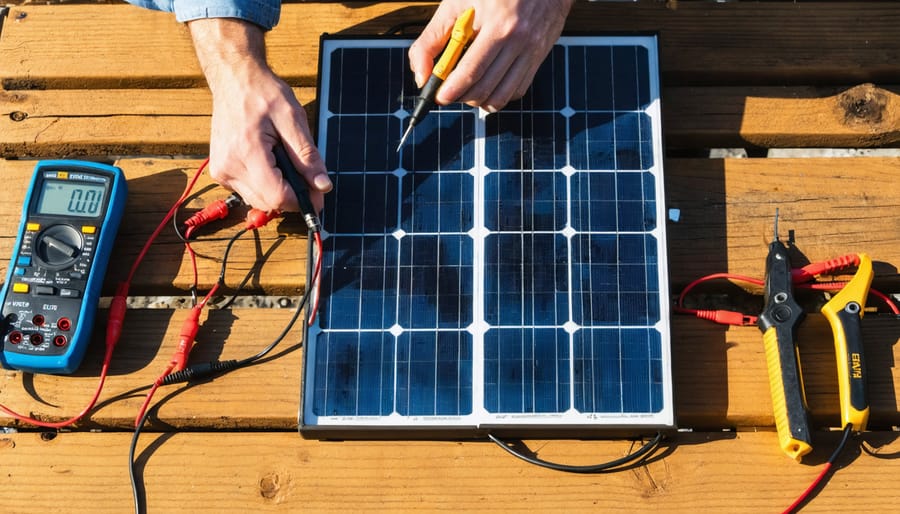
Properly measuring and converting electrical units allows DIY solar enthusiasts to safely maintain and troubleshoot their off-grid power systems.
Adding an Off-Grid Cabin Power System
Let me walk you through a real-world scenario that ties everything together. When I helped my neighbor set up his off-grid cabin last summer, we needed to juggle multiple electrical conversions to get everything working smoothly.
His system included a 12V battery bank (DC), a 2000W inverter converting to 120V AC for household appliances, and solar panels producing 24V DC. Talk about a conversion puzzle!
Here’s how we worked through it: First, we calculated his daily power needs. He wanted to run LED lights (60W), a small refrigerator (150W for 8 hours), and charge his phone. That’s roughly 1,500 watt-hours per day.
Next came the tricky part – converting between AC and DC at different voltages. To find the current draw from his 12V battery bank, we used I = P/V. For 1,500Wh over 24 hours, that’s about 63W average, which equals 5.25 amps from the battery (63W ÷ 12V).
But remember, inverters aren’t 100% efficient. We added 15% loss, bringing our actual requirement to about 6 amps. This meant sizing his battery bank for at least 150 amp-hours to provide two days of backup power.
The solar panels needed similar calculations, converting their 24V output down to charge the 12V batteries efficiently. These real-world conversions make all the difference between a system that works and one that leaves you in the dark!
Troubleshooting an Underperforming System
I learned this lesson the hard way during my first major solar installation. My system was producing power, but my batteries weren’t charging properly. After scratching my head for an afternoon, I realized I’d been thinking in watts when I should have been checking amps.
Here’s the thing: when your solar setup isn’t performing as expected, unit conversion becomes your diagnostic tool. Let’s say your charge controller shows 14.5V reaching your battery bank, but you’re only getting 3A of charging current. Convert that to watts (14.5V × 3A = 43.5W), and you’ll quickly see you’re getting a fraction of what your 200W panel should deliver.
Voltage drop is another culprit. If you measure 18V at your solar panel but only 15V at your charge controller, that 3V difference matters enormously. Converting to percentages (3V ÷ 18V × 100 = 16.7% loss) reveals you’re losing significant power in your cables, probably due to undersized wire.
The solution often lies in converting units to spot the problem. Check your current in amps, multiply by voltage to get watts, and compare against your panel’s rated output. This simple conversion tells you whether you’ve got a wiring issue, shading problem, or faulty equipment.
Here’s the thing I’ve learned from years of tinkering with solar setups: mastering electrical unit conversions isn’t about becoming a math genius overnight. It’s about protecting the money you’ve invested and making sure your system actually delivers the power you need. I remember the first time I confidently converted amps to watts without second-guessing myself—it felt like unlocking a new level in my DIY journey.
My advice? Bookmark a few reliable conversion tools right now. Keep them handy on your phone or computer. Then, grab your system’s specs and practice converting the numbers you see on your panels, charge controller, and battery bank. The more you work with your actual equipment, the more natural these conversions become.
And here’s where the real magic happens: engage with the solar community. Share your conversion challenges, your “aha” moments, and even your mistakes. We’ve all been there, scratching our heads over whether to use nominal or peak voltage.
Ready to put this knowledge into action? Head over to Spheral Solar’s calculators and run some numbers for your own setup. Then come back and tell us what you discovered. What conversion surprised you most? What tool saved you the most time? Your experience might be exactly what another DIYer needs to hear.
How useful was this post?
Click on a star to rate it!
Average rating 0 / 5. Vote count: 0
No votes so far! Be the first to rate this post.
We are sorry that this post was not useful for you!
Let us improve this post!
Tell us how we can improve this post?
charlesnoble
Here at Spheral Solar, I’m a hands-on solar power enthusiast, constantly exploring and experimenting with DIY solutions. I’m dedicated to sharing my discoveries, insights, and even the bumps I hit along the way, all in the pursuit of a more sustainable future.
Stop Guessing Energy Numbers: Your Practical Joule… by Charlesnoble November 11, 2025 **Understanding Energy in Real Numbers: Your Joule Conversion Guide** Converting joules into watts, kilowatt-hours, or calories transforms abstract energy measurements into practical numbers you can actually use for your solar projects and off-grid calculations. Whether you’re sizing a battery bank, calculating how long your portable solar panel will run a…
Stop Guessing Your Battery Power: The Conversion… by Charlesnoble October 28, 2025 Grab your battery specifications and check three numbers that matter: amp-hours (Ah) tells you total capacity like a fuel tank size, watt-hours (Wh) reveals actual energy storage accounting for voltage differences, and reserve capacity (RC) shows real-world runtime at a steady draw. These measurements aren’t interchangeable labels for the same…
Wire Your Solar Panels Wrong and Watch Your… by Charlesnoble December 22, 2025 Match your wire gauge to your system’s amperage before making a single connection—undersized wire creates dangerous heat buildup and wastes the energy you worked hard to capture. For most residential 12V systems running under 30 amps, 10 AWG copper wire handles the load safely, but calculate your specific needs using…
Why Your Solar System Needs a Usage Graph (And How… by Charlesnoble March 11, 2026 Check your solar inverter’s display screen or manufacturer app right now—most modern systems already generate real-time usage graphs without additional equipment. Your inverter likely shows daily production curves, typically peaking between 11 AM and 2 PM, which gives you instant insight into whether your panels are performing as expected. Download…
Calculate Your Solar Panel kWh Output Before You Buy… by Charlesnoble January 29, 2026 Grab your solar panel specs and electricity bill—you’re about to discover exactly how many kilowatt-hours your solar setup can generate and whether it’ll actually cover your energy needs. Most people dive into solar projects with enthusiasm but fuzzy math, leading to oversized systems that waste money or undersized ones that…
Why Joule Solar Energy Matters More Than Watts for… by Charlesnoble February 11, 2026 Picture this: You’re browsing solar panel specs and suddenly see energy output measured in joules, watt-hours, and kilowatt-hours all mixed together. Confusing, right? I’ve been there myself, standing in my garage with a handful of solar equipment brochures, wondering why some manufacturers use joules while others stick to watts. That…
Subscribe for handpicked DIY projects, exclusive tips, and giveaways.
Disconnect your 5G-enabled charge controller from the internet when you’re not actively monitoring it—this single step eliminates 80% of remote attack vectors while still allowing you to check in when needed. Change every default password on your solar monitoring system the day you install it, using unique 16-character combinations that include numbers and symbols, because… Read more: Your Solar Setup’s Hidden Vulnerability: Why 5G Could Be Your Charge Controller’s Weakest Link
Imagine doubling the productivity of your land by growing crops and generating electricity in the same space. That’s exactly what agrivoltaics makes possible—and it’s not just for large-scale farms anymore. An agrivoltaic system combines solar panels with agriculture, mounting photovoltaic arrays high enough that crops, livestock, or pollinator habitats can thrive underneath. Think of it… Read more: Growing Crops Under Solar Panels Actually Works (Here’s Why You Should Care)
Match your LFP battery capacity to your actual lighting needs by calculating your nightly watt-hour consumption and multiplying by three—this gives you enough storage for cloudy stretches without overspending on unused capacity. A 20-watt LED running five hours nightly needs a 300Wh minimum battery, which translates to a 100Ah 12V LFP pack. Choose LFP chemistry… Read more: Why LFP Batteries Changed Everything About Solar Lighting (And How to Use Them Right)