The Highest Watt Solar Panel Won’t Save Your RV Setup (Here’s What Actually Matters)
Updated:
Stop obsessing over wattage alone—it’s the biggest mistake I see RV solar shoppers make. Yes, the highest wattage panels available for RVs currently max out around 400-550 watts, but cramming the most powerful panel onto your roof doesn’t guarantee you’ll have enough power to run your air conditioner or keep your fridge cold through the night.
Here’s what actually matters: Calculate your daily power consumption first, then work backward to determine how many panels and what total system capacity you need. I learned this the hard way during my first RV solar system installation when I bought two 400-watt panels thinking bigger was automatically better, only to discover they were too large for my available roof space and couldn’t be positioned to avoid shade from my AC unit.
The sweet spot for most RVers isn’t necessarily the absolute highest wattage panel—it’s finding the right balance between panel efficiency, physical dimensions, and your actual roof layout. A single 500-watt panel might sound impressive, but three 200-watt panels could generate more total power if they fit your roof better and allow for optimal positioning.
This guide cuts through the marketing hype to show you the actual highest wattage panels available for RV use, but more importantly, it’ll help you understand whether chasing maximum wattage is the right strategy for your specific situation. We’ll explore real-world performance factors, dimensional constraints, and how to choose panels that maximize your limited roof real estate while delivering the reliable power you need for off-grid adventures.
Why Everyone Wants the Highest Wattage Panel (And Why That’s Only Half the Story)
I get it. When you’re standing on your RV roof with a tape measure, squinting at the available space, your brain immediately goes to one question: what’s the biggest, baddest panel I can fit up here? It’s the same instinct that makes us want the highest-capacity battery or the fastest charging system. More watts equals more power, right?
And honestly, that logic isn’t wrong. A 200-watt panel will generate more electricity than a 100-watt panel under identical conditions. If you’re trying to keep your fridge running, charge your batteries, and maybe run a coffee maker in the morning, higher wattage sounds like the obvious solution. I remember my first solar setup planning session, where I proudly announced I’d found 400-watt panels online. Problem solved!
Except it wasn’t quite that simple.
Here’s what I learned the hard way: wattage is just one piece of a much larger puzzle. That 400-watt panel? It was massive, heavy, and wouldn’t fit in the usable space between my RV’s roof vents and air conditioner. Even if it had fit, my roof couldn’t handle the weight without reinforcement.
The reality is that RV solar isn’t like residential solar, where you might have acres of roof space and structural support built for heavy loads. You’re working with maybe 50 to 100 square feet of usable roof real estate, weight restrictions that matter when you’re driving down the highway, and often irregular shapes that make installation tricky.
So while hunting for the highest wattage panel makes perfect sense as a starting point, what you really need to know is how to maximize power generation within your specific constraints. Sometimes three 200-watt panels arranged strategically will outperform one massive 500-watt panel that doesn’t quite fit right. The goal isn’t just big numbers; it’s the right system for your actual roof and your actual power needs.
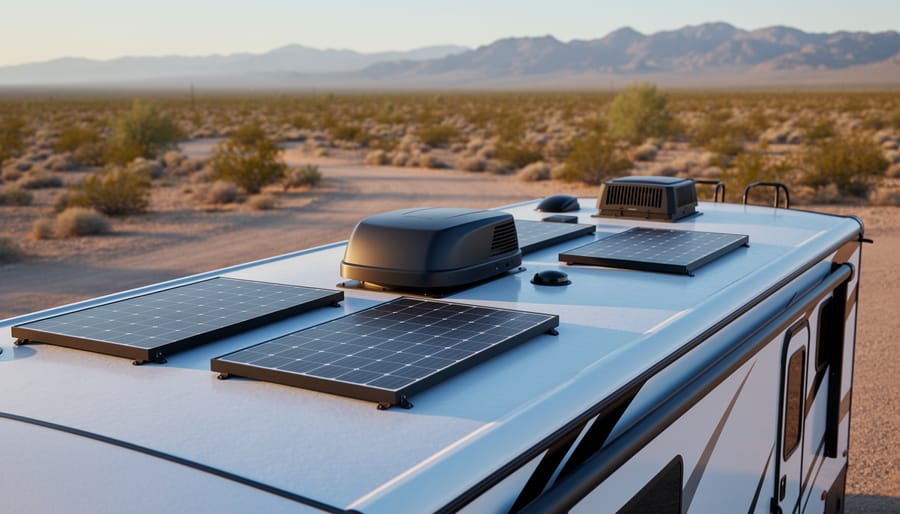
RV roof space must accommodate solar panels alongside existing vents, AC units, and other equipment, making strategic placement crucial.
What’s Actually Available: The Current High-Wattage Champions
Residential-Style Panels: The 400W+ Category
When I first started researching solar for my RV, I kept seeing these gorgeous 400-watt and 500-watt panels online and thought I’d hit the jackpot. Here’s what I learned the hard way: these residential-style panels are absolute powerhouses, but they’re designed for rooftops with plenty of space, not the curved, limited real estate of an RV roof.
Let’s talk real numbers. The Renogy 550W Monocrystalline panel measures about 91 x 42 inches and weighs roughly 62 pounds. Rich Solar offers a 410W panel at 74 x 41 inches, while brands like Canadian Solar and Trina Solar have residential panels pushing 450-500 watts that typically measure 79-91 inches long. To put that in perspective, that’s between 6.5 and 7.5 feet in length for a single panel.
The challenge becomes obvious pretty quickly. Most RV roofs are only about 8 feet wide, and you’ve got roof vents, air conditioning units, satellite dishes, and often a curved roofline eating into that space. Mounting one of these behemoths means you’re likely looking at a single-panel system, or you’ll need some serious custom mounting solutions that extend beyond your roofline, which creates wind resistance and clearance issues.
There’s also the weight factor. Adding 60-70 pounds to your roof might not sound like much, but when you factor in mounting hardware and potentially multiple panels, you could be pushing your RV’s weight capacity. Plus, if something goes wrong with one massive panel, you’ve lost your entire power generation system.
I’m not saying these panels are off-limits for RVs, but they require careful planning and honest assessment of your roof space and structural capacity before pulling the trigger.
Flexible High-Efficiency Panels: The Practical Alternative
Here’s where things get really practical for RV owners. While those massive 600-watt rigid panels sound impressive, flexible high-efficiency panels in the 300-400 watt range often make way more sense for the realities of RV life.
I remember helping my neighbor install solar on her Airstream last summer. We initially got excited about maxing out wattage, but quickly realized that flexible panels offered advantages we hadn’t considered. Brands like Renogy, WindynNation, and SunPower produce excellent flexible panels that typically range from 300 to 400 watts. These panels usually achieve efficiency ratings between 22-24%, which is quite impressive given their lightweight, bendable design.
What makes these panels the practical choice? First, they weigh about 70% less than rigid panels with similar output. That’s crucial when you’re watching your RV’s weight capacity. Second, they can conform to curved RV roofs, something those giant rigid panels simply can’t do. Third, they’re far easier to install as a DIY project since you don’t need heavy mounting hardware.
Sure, you might get 200 watts less than the absolute highest-wattage option, but you can often fit two or three flexible panels where one massive rigid panel would go. A pair of 400-watt flexible panels gives you 800 watts total, likely exceeds what one rigid panel provides, and you’ll actually be able to install them yourself without professional help or structural concerns.
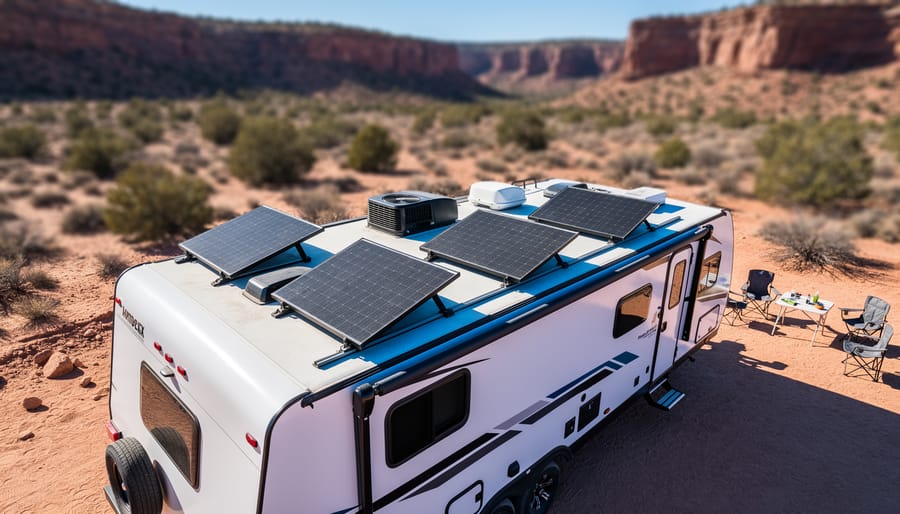
Rigid residential-style panels and flexible panels each offer distinct advantages for RV installations, depending on roof configuration and weight constraints.
The Real-World Trade-offs You Need to Know
Before you commit to those impressive 400+ watt panels, let’s talk about the practical challenges I learned the hard way during my first RV solar installation.
Weight matters more than you’d think. A 400-watt panel typically weighs 40-50 pounds, compared to 25-30 pounds for a 200-watt panel. That extra weight affects your roof load capacity and overall vehicle weight limits. I once helped a friend install three massive panels only to discover they exceeded his RV’s roof rating.
Mounting gets trickier with larger panels too. Those high-wattage beauties are physically bigger, making them harder to maneuver around roof vents, AC units, and antenna mounts. You might find that two 300-watt panels actually fit your roof layout better than one 500-watt monster.
Here’s a quick comparison to consider:
Panel Size: 200W costs around $0.80-$1.00 per watt, weighs 28 lbs, measures roughly 58×40 inches
Panel Size: 400W costs around $0.70-$0.90 per watt, weighs 45 lbs, measures roughly 80×40 inches
Panel Size: 500W costs around $0.85-$1.10 per watt, weighs 55 lbs, measures roughly 90×42 inches
Don’t forget aerodynamics. Those larger panels create more wind resistance, potentially affecting fuel economy. Consider using our solar calculator to determine whether maximizing wattage per panel actually makes financial sense for your specific situation.
What Your RV Roof Actually Needs (Spoiler: It’s Not Just About Watts)
Accurate roof measurements are the essential first step in planning an effective RV solar system.
Measuring Your Usable Roof Space
Before you start dreaming about those high-wattage panels, let’s figure out exactly what space you’re working with. I learned this lesson the hard way on my first RV installation when I bought panels before measuring and ended up having to return them!
Start by grabbing a tape measure and getting safely onto your RV roof. Measure the total length and width of usable flat space. Here’s the key: don’t just measure the entire roof. You need to work around existing obstacles.
Walk the roof and note the location of every vent, skylight, AC unit, satellite dish, and access hatch. Charles always recommends taking photos from different angles and sketching a simple diagram on graph paper. It doesn’t need to be fancy, just accurate enough to show where everything sits.
Here’s a practical tip Charles shared with me: leave at least 3-4 inches of clearance around vents and hatches for airflow and maintenance access. I’ve seen people pack panels in tight and then struggle to replace a vent cover later.
Measure the distance between obstacles too. Sometimes you’ll find that two smaller high-wattage panels fit better than one large panel, even if the total wattage is similar. For example, a space that’s 60 inches wide but broken up by a vent might accommodate two 200-watt panels better than one 400-watt panel.
Pro tip: Use painter’s tape to mark out potential panel locations right on the roof. This gives you a visual sense of how everything will fit together before you commit to purchasing.
Calculating Your Actual Power Needs
Here’s the honest truth: figuring out your power needs doesn’t require a degree in electrical engineering. I’ve helped countless RVers through this process, and most overthink it.
Start with a simple list. Grab your phone and walk through your RV, noting what you actually use daily. Lights, water pump, phone chargers, laptop, TV, coffee maker, refrigerator. Write down how many watts each appliance uses (check the labels or user manuals) and roughly how many hours per day you run them.
For example, LED lights might use 10 watts for 4 hours (40 watt-hours), while your laptop charger pulls 65 watts for 3 hours (195 watt-hours). Your 12V fridge might run about 50% of the time at 60 watts, giving you around 720 watt-hours daily. Add everything up, and you’ll get your daily watt-hour consumption.
Once you have that number, multiply by 1.3 to account for system inefficiencies and cloudy days. This gives you a realistic daily power target.
The beauty of understanding your camper electrical system is that you avoid both undersizing (constant dead batteries) and oversizing (wasting money on panels you don’t need).
If math isn’t your thing, our solar calculators on the site do the heavy lifting for you. Just plug in your appliances, and they’ll recommend appropriate panel wattage. Most weekend RVers find they need between 400-800 watts total, which helps put those high-wattage panels into perspective.
The Weight Factor: Why Your RV’s Payload Capacity Matters
Here’s something I learned the hard way during my first RV solar installation: those high-wattage panels aren’t just larger, they’re also heavier. A typical 400-watt panel weighs between 40-50 pounds, while a 100-watt flexible panel might weigh just 4-5 pounds. That difference adds up quickly when you’re mounting multiple panels.
Your RV type matters significantly here. Class A motorhomes typically have generous payload capacities of 2,000-3,000 pounds, giving you more flexibility. Class B and C motorhomes range from 1,500-2,500 pounds, while travel trailers and fifth wheels can be much more restrictive, sometimes as low as 1,000 pounds for smaller models.
Before committing to those impressive 500-watt panels, grab your RV’s manual and check two numbers: your Gross Vehicle Weight Rating (GVWR) and your actual loaded weight. The difference is your available payload, which must accommodate passengers, gear, water, and yes, your solar setup.
Here’s my practical tip: weigh your RV fully loaded at a truck scale before planning your solar installation. You might discover you have less available payload than expected. Sometimes, choosing four 200-watt panels instead of three 400-watt panels gives you similar power output with better weight distribution and more mounting flexibility.
My Recommendation: Building the Right System Instead of the Biggest One
The Sweet Spot for Most RVers
Here’s what I’ve learned from years of helping fellow RVers: the 200-400W range is the sweet spot for most setups, and it has nothing to do with settling for less power. Let me explain why.
When my neighbor Jake installed a single 500W panel on his Class C, he was thrilled until he parked under his first tree. One branch shadow killed his entire system’s output. Meanwhile, I had three 300W panels that kept producing power even when one was partially shaded. That’s the magic of distributed power generation.
Multiple medium-wattage panels give you incredible flexibility. Need to navigate around roof vents, air conditioners, or satellite dishes? Try doing that with one massive panel. With 300W panels, you can puzzle-piece your way around obstacles and actually use more of your available roof space. Plus, if one panel develops an issue, you’ve still got backup power flowing.
The cost-benefit ratio is better too. While 600W panels might seem impressive, they’re expensive and often require specialized mounting hardware. Three 300W panels typically cost less and are easier to handle during installation. Trust me, wrestling a giant panel onto an RV roof alone is no fun.
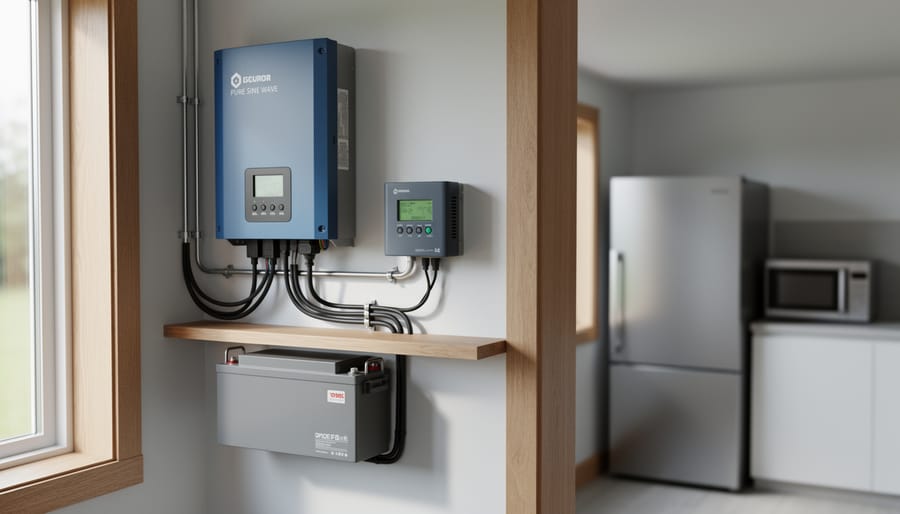
Consider your electrical system too. Medium-wattage panels pair perfectly with standard charge controllers and work seamlessly with common inverter selection options. You’re building a reliable system, not chasing wattage bragging rights. Most weekend warriors and even full-timers find that 600-1200W total capacity handles their needs beautifully when properly distributed across multiple panels.
When High Wattage Actually Makes Sense
Despite what we’ve covered about not automatically defaulting to the highest wattage, there are absolutely situations where those powerful 400-500 watt panels shine.
If you’re rolling in a Class A motorhome with generous roof real estate, high-wattage panels make perfect sense. When you’ve got 200+ square feet of usable roof space, you can fit multiple large panels without the cramped tetris game smaller RVs face. I’ve worked with full-timers who’ve mounted six 400-watt panels on their Class A rigs, generating serious power for running residential fridges, air conditioning, and all the comforts of home.
Full-time RVers particularly benefit from maximum wattage because your energy needs differ dramatically from weekend warriors. You’re running laptops all day for remote work, doing laundry, cooking multiple meals, and powering entertainment systems nightly. That consistent daily demand justifies the investment in premium panels, especially when paired with the right battery configuration to store all that energy.
Certain roof configurations also favor high-wattage panels. If you have an unusual roof shape with limited mounting locations due to vents, AC units, or skylights, getting maximum power from fewer panels becomes crucial. Sometimes one 450-watt panel fits where two 250-watt panels simply won’t.
A properly designed solar system powers extended off-grid adventures, making energy independence a reality for full-time RVers.
The Budget-Friendly Approach That Works
You don’t need to buy everything at once. I learned this from my friend Charles, who started his RV solar journey with just two 200-watt panels instead of the four 400-watt monsters he eventually wanted. His smart move? He bought a charge controller rated for his future system from day one.
This phased approach saved him money upfront and gave him real-world experience with his actual power needs before committing thousands more. Turns out, he didn’t need those extra panels as quickly as he thought.
Start by installing enough capacity to cover your essential loads—refrigerator, lights, phone charging. Leave physical roof space and electrical capacity for expansion. Use quality components that won’t need replacing when you scale up. Map out your dream system on paper, but build it in stages as your budget allows and your usage patterns become clear. This way, you’re learning as you grow rather than potentially overbuying based on guesswork.
Installation Reality Check: What Nobody Tells You About Big Panels on RV Roofs
Let me share something from my friend Charles’s recent RV solar upgrade that caught him completely off guard. He ordered two gorgeous 400-watt panels, envisioning them perfectly positioned on his Class C motorhome roof. When they arrived, reality hit hard: these panels were massive, and his roof suddenly seemed a lot smaller than he remembered.
Here’s what most YouTube videos conveniently skip over. High-wattage panels aren’t just bigger, they’re significantly heavier. A 400-watt panel can weigh 40-50 pounds, and you’re installing it on a roof that flexes, moves, and faces wind resistance at highway speeds. Standard mounting hardware designed for residential installations just won’t cut it.
The mounting bracket situation gets tricky fast. You need low-profile mounts that won’t catch wind or scrape tree branches, but they also must be incredibly secure. Charles learned this when his first mounting attempt created stress points that could have cracked the panel during his maiden voyage. The solution? Marine-grade mounting brackets with multiple attachment points, spreading the load across your roof’s support structure.
Wire management becomes a genuine puzzle with larger panels too. You’re dealing with heavier gauge wires to handle increased amperage, and these cables need protected pathways from roof to battery bank. Many RVers make the mistake of drilling entry holes without considering water intrusion or cable strain from roof flex. Proper cable glands and generous loops of slack are non-negotiable.
The spacing between panels matters more than you’d think. You need enough clearance for maintenance access, cleaning, and air circulation underneath. Cramming panels edge-to-edge might seem efficient, but it creates cleaning nightmares and potential overheating issues.
Before you grab your drill, spend time with DIY installation guides that walk through RV-specific considerations. Create a cardboard template of your panel dimensions and test-fit everything on your roof first. Mark your roof support beams, check for vents and AC units, and plan your wire routes. This dry run saves countless headaches.
The biggest mistake? Rushing the job. Charles took three full days for his installation, and he’s glad he did. Patient measuring, proper sealant curing time, and methodical testing made all the difference.
Here’s the truth I’ve learned after helping hundreds of RVers design their solar systems: asking “what’s the highest watt solar panel?” is like asking “what’s the fastest car?” when what you really need to know is how to get to your destination safely and affordably.
I remember when I started this journey, obsessing over spec sheets and wattage numbers. But the RVers who end up happiest with their systems? They’re the ones who took a step back and asked better questions first. How much power do I actually use? What does my roof space allow? What’s my realistic budget?
Your perfect solar setup might use four 200-watt panels instead of two 400-watt panels. It might mix panel sizes to fit around vents and AC units. The “highest watt” panel sitting in a box because it doesn’t fit your roof helps nobody.
Start with your needs assessment. Calculate your daily power consumption. Measure your available roof space carefully, accounting for obstacles. Then work backward to find the panel configuration that fits your situation, not someone else’s.
We’ve built calculators and guides to walk you through this process step-by-step because making informed decisions beats chasing specs every time. Join our community forums where real RVers share what actually worked for their builds. The knowledge you’ll gain from asking the right questions will serve you far better than simply buying the biggest number on the box. Your solar journey starts with understanding yourself, not a specification sheet.
How useful was this post?
Click on a star to rate it!
Average rating 0 / 5. Vote count: 0
No votes so far! Be the first to rate this post.
We are sorry that this post was not useful for you!
Let us improve this post!
Tell us how we can improve this post?
charlesnoble
Here at Spheral Solar, I’m a hands-on solar power enthusiast, constantly exploring and experimenting with DIY solutions. I’m dedicated to sharing my discoveries, insights, and even the bumps I hit along the way, all in the pursuit of a more sustainable future.
Why Most RV Solar Setups Fail (And How to Build Yours Right) by Charlesnoble December 21, 2025 Calculate your daily power consumption by listing every device you’ll run in your RV—from the refrigerator drawing 40-60 amp-hours daily to your phone charger using just 5 amp-hours—then multiply by 1.3 to account for system losses and cloudy days. This single step prevents the most common mistake I see fellow…
Size Your Off-Grid Solar Inverter Right the First… by Charlesnoble February 10, 2026 Calculate your total daily energy consumption by listing every device you’ll power, multiplying each device’s wattage by hours of daily use, then adding 20% for system losses. This single number becomes your foundation—underestimate it, and you’ll face frustrating power shortages; overestimate significantly, and you’ll waste thousands on oversized equipment. Identify…
Why Your RV Inverter Keeps Failing (And How to Fix It Fast) by Charlesnoble January 11, 2026 Check your battery connections first—loose or corroded terminals account for nearly 60% of inverter issues I’ve seen in my years working with RV solar systems. Remove both positive and negative cables, clean them with a wire brush and baking soda solution, then reconnect tightly. While you’re at it, use a…
Why Your Home Solar System Fails During Power… by Charlesnoble March 8, 2026 Picture this: It’s 2 AM, a storm knocks out power in your neighborhood, and while your neighbors scramble for flashlights, your home stays lit, your refrigerator keeps running, and your family sleeps soundly. That’s the peace of mind a solar battery backup system delivers, and honestly, it’s one of the…
Why 6-Volt RV Batteries Beat 12-Volt for Your Solar Setup by Charlesnoble November 11, 2025 Choose 6-volt golf cart batteries when building your RV solar system if you prioritize longevity and consistent deep-cycle performance over initial simplicity. Wire two 6-volt batteries in series to create 12 volts with roughly double the amp-hour capacity of comparable single 12-volt batteries, giving you more usable power before reaching…
This Device Lets Your Solar System Talk to the Grid… by Charlesnoble February 2, 2026 Verify your utility’s specific anti-islanding requirements before purchasing any equipment—most power companies mandate IEEE 1547-compliant devices that automatically disconnect your solar system when the grid goes down, protecting line workers from unexpected backfeed. Contact your local utility interconnection department directly and request their technical specifications document, which lists approved devices…
Subscribe for handpicked DIY projects, exclusive tips, and giveaways.
Check the maximum voltage and current ratings first—these determine whether your controller can actually handle your solar panel array without frying itself on the first sunny day. I learned this the hard way when my first DIY system shut down every afternoon because I’d paired 600 watts of panels with a controller rated for only… Read more: Why Your Solar Setup Needs Both a Charge Controller and Inverter (And How to Pick the Right Ones)
Grab a 9-volt solar panel from your local electronics supplier and test it with a multimeter in direct sunlight—if it produces 9-12 volts under load, you’ve got a working unit ready for small-scale projects. These compact panels excel at trickle-charging rechargeable 9V batteries, powering LED lighting systems for camping, or running low-draw electronics like portable… Read more: Why 9 Volt Solar Panels Are Perfect for Your First Portable Power Setup
Gather a small solar panel (1.5-6 volts), a lightweight toy car chassis or four bottle caps for wheels, a small DC motor, connecting wires, and a hot glue gun to create your science fair winner in an afternoon. Position the solar panel where it catches maximum sunlight—angled slightly toward the sky works best—and wire it… Read more: Build a Solar-Powered Car That Actually Wins Your Science Fair