This Single Mistake Could Destroy Your Entire Solar System (And How to Prevent It)
Updated:
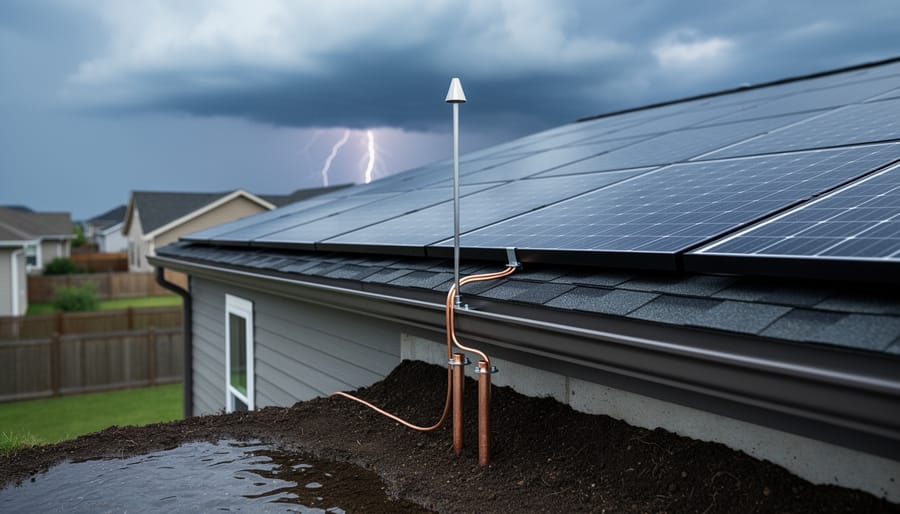
Ground your lightning protection system with at least two 8-foot copper-clad ground rods driven into moist soil and spaced 16 feet apart, then bond them together with 6 AWG bare copper wire. This creates the essential foundation that channels lightning strikes safely into the earth, protecting your solar panels, inverter, and battery storage from catastrophic damage that can total your entire system in milliseconds.
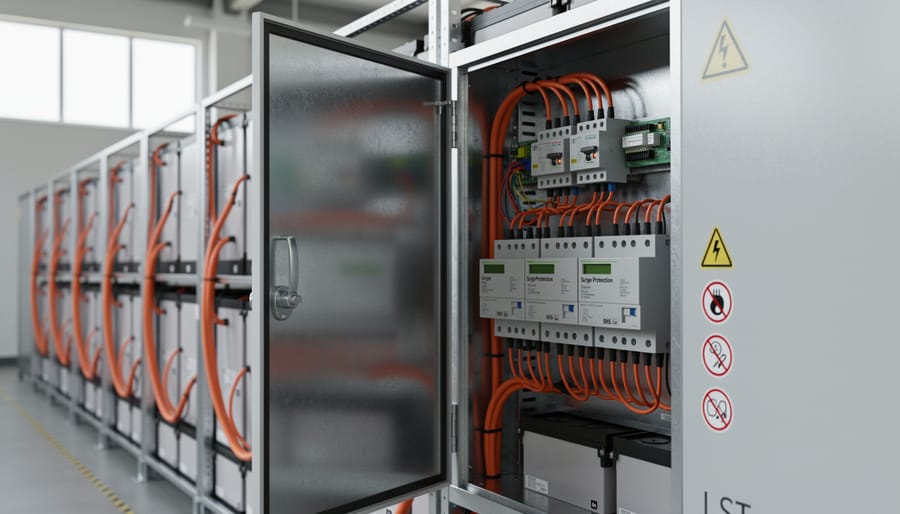
Install a Type 1 or Type 2 surge protective device on your main electrical panel’s line side, positioned between your solar system and the utility grid connection. This device acts as your first line of defense, clamping voltage spikes before they reach sensitive electronics. For systems with battery storage, add a second SPD at the charge controller to protect your expensive battery bank from both direct strikes and induced surges traveling through DC wiring.
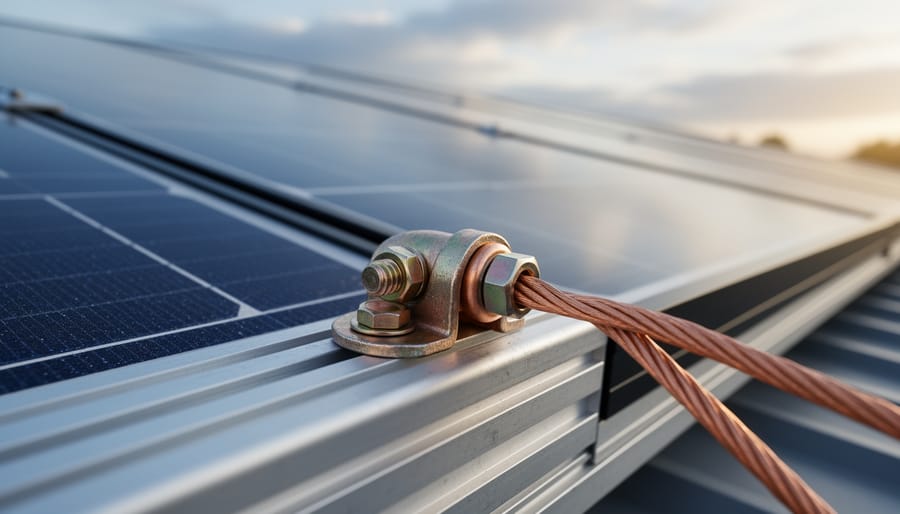
Mount an air terminal rod at the highest point of your array, extending at least 10 inches above your panels, and connect it to your grounding system using a dedicated down conductor. Many DIYers who tackle DIY solar installation overlook this critical component, assuming their mounting rails provide adequate protection. They don’t. Lightning seeks the path of least resistance, and without proper terminals, it will punch through your expensive solar cells.
I learned this lesson the hard way when a nearby strike sent a surge through my neighbor’s unprotected system, frying his $4,000 inverter and melting junction boxes. He’d saved money skipping lightning protection during installation but spent three times that amount on repairs and lost production. The reality is simple: lightning doesn’t care about your budget, and a single strike causes more damage than the cost of proper protection. Whether you’re planning a new installation or retrofitting an existing array, lightning protection isn’t optional in any region that experiences thunderstorms.
Why Your Solar System Is a Lightning Magnet (And What That Means for You)
Here’s the thing about solar panels that nobody mentions in those glossy brochures: they’re basically lightning’s favorite target. I learned this the hard way back in 2018 when a nearby strike fried my neighbor’s inverter. Let me explain why your beautiful rooftop solar array might as well have a “strike here” sign.
First, the obvious part. Your solar panels sit on the highest point of your house, often several feet above the roofline thanks to mounting racks. Lightning takes the path of least resistance to the ground, and that elevated position puts your system right in its crosshairs. It’s like standing on a hill during a thunderstorm, which we all know is a terrible idea.
But it gets more interesting. Those aluminum mounting rails and metal frames create a massive conductive surface—sometimes hundreds of square feet of metal. Your panels are essentially a giant antenna pointed at the sky. Add in the metal conduit running down to your inverter and battery storage, and you’ve got a continuous conductive path from your roof straight into the heart of your electrical system.
Here’s where it gets tricky, though. You actually face two separate threats. Direct strikes are the dramatic ones—a bolt hitting your array directly. These are relatively rare but catastrophic when they happen. The more common danger is indirect strikes. Lightning doesn’t even need to hit your property. A strike a quarter-mile away can send a massive surge through the ground, traveling through your grounding system, or racing along power lines connected to your home.
Your battery storage system compounds this risk because it’s connected to both your solar array and your home’s electrical panel. That creates multiple pathways for surge energy to enter and cause havoc. I’ve seen systems where a nearby strike sent surges through three different entry points simultaneously.
The good news? Understanding these vulnerabilities is the first step toward proper protection.
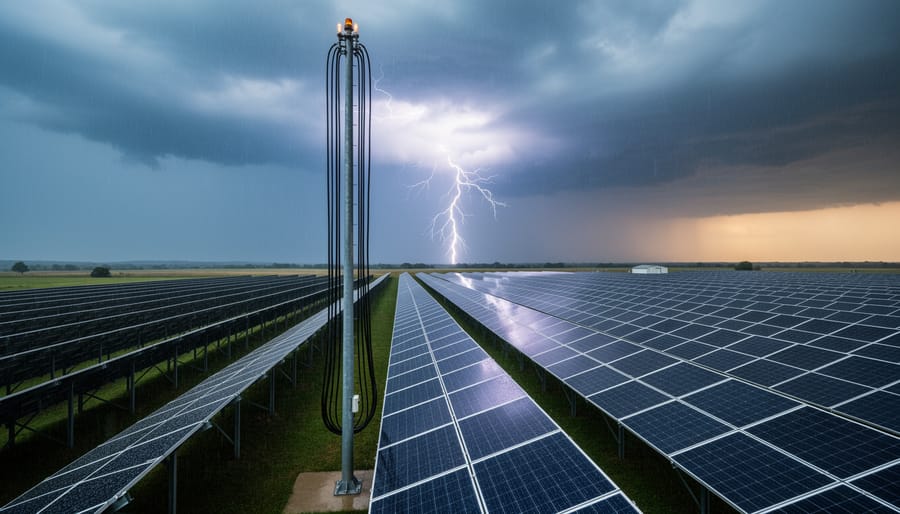
Solar installations face increased lightning strike risk due to their elevated position and large conductive surfaces exposed to storms.
The Real Cost of Skipping Lightning Protection
When lightning finds an unprotected solar system, the results are devastating and expensive. Let me walk you through what actually happens so you understand why protection isn’t optional.
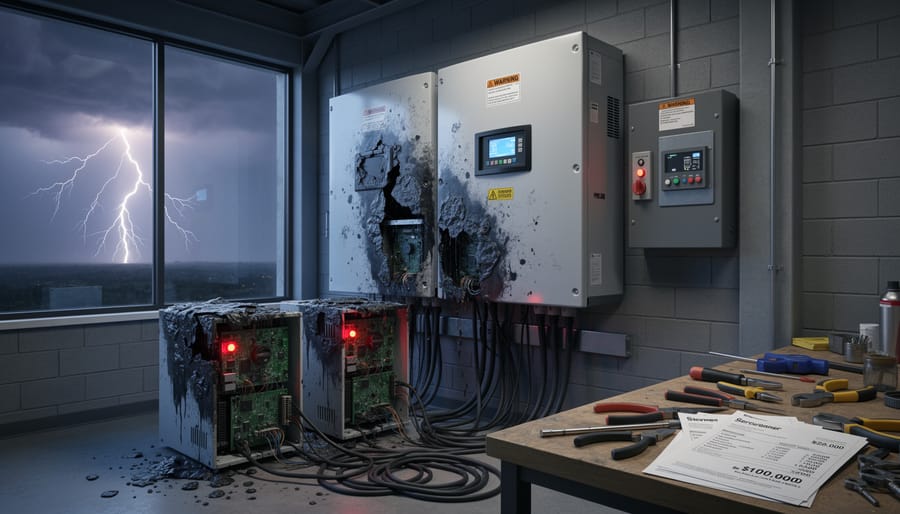
The moment a surge hits, your inverter typically goes first. These sensitive electronics aren’t built to handle thousands of volts, and the internal components literally fry. That’s $800 to $3,000 gone instantly. Your charge controller follows right behind, adding another $200 to $800 to the damage bill. If the surge reaches your battery bank, you’re looking at the worst-case scenario. Lithium batteries can suffer internal damage that makes them dangerous to use, or they might catch fire outright. Replace a 10kWh battery bank? That’s $5,000 to $8,000.
But here’s what really hurts: most manufacturers void warranties if you didn’t install proper surge protection. That expensive inverter you bought with a 10-year warranty? Completely uncovered if lightning damage occurs without protection in place. You’re paying full replacement cost out of pocket.
Charles recently heard from Tom, a community member who learned this lesson the hard way. After a nearby lightning strike, Tom’s $12,000 system was reduced to smoking ruins. No surge protection meant no warranty coverage. “I thought I was saving $300 by skipping the protection devices,” Tom shared. “Instead, I’m rebuilding from scratch.”
The math is brutally simple. A complete lightning protection setup costs $300 to $800 depending on your system size. Compare that to $8,000 or more in replacement costs, plus the weeks without power while you source new components and reinstall everything.
There’s also the fire risk. Damaged batteries and electrical components can ignite hours or even days after a strike, putting your home and family in danger. That’s not a cost you can measure in dollars.
Protection isn’t an upgrade or luxury feature. It’s basic insurance that costs pennies compared to what you’ll lose without it.
Lightning surges can cause catastrophic damage to inverters and electronic components, resulting in thousands of dollars in replacement costs.
Understanding the Two Types of Protection Your System Needs
External Lightning Protection (The Shield)
Think of external lightning protection as building a superhighway for lightning that completely bypasses your solar panels and batteries. It’s like giving Mother Nature a dedicated express lane straight to the ground.
The system has three main components working together. Air terminals, commonly called lightning rods, sit at the highest points of your structure. These aren’t magical lightning magnets, but they provide a preferred strike point. Down conductors are thick cables that run from those terminals down the side of your building, creating the actual highway for the electrical charge. Finally, grounding electrodes buried in the earth dissipate that massive energy safely into the ground.
Here’s how it works in practice: when lightning approaches, it follows the path of least resistance. Your air terminals, being elevated and well-connected, offer an easier route than your solar panels or roof. The down conductors carry that charge, which can reach 200,000 amps, safely downward. The grounding system then spreads it harmlessly into the earth, like releasing pressure from a massive balloon.
Now, when do you actually need this? If you’re installing a small rooftop solar setup on a suburban home in an area with moderate lightning activity, external protection is typically overkill. The existing structure likely provides adequate protection. However, if you’re mounting panels on a detached garage, installing a ground-mounted array in an open field, or living in a lightning-prone region like Florida or the Mountain West, external protection becomes essential.
I learned this lesson from my neighbor Charles, who skipped external protection on his barn-mounted system. One strike later, he wished he’d invested the $2,000 upfront rather than replacing $8,000 worth of equipment.
Internal Surge Protection (The Safety Net)
Think of surge protective devices (SPDs) as shock absorbers for your electrical system. While your external lightning protection handles the big strikes, SPDs deal with the voltage spikes that sneak in through your wiring. Trust me, I learned this the hard way when a nearby lightning strike fried my charge controller years ago, despite having decent grounding.
Here’s what you need to know: SPDs come in three types, and yes, they actually matter. Type 1 SPDs are your heavy hitters, installed at your main service panel where power enters your home. They handle the biggest surges, typically 25,000 amps or more. Think of them as your first line of defense against direct strikes and major grid disturbances.
Type 2 SPDs go at your sub-panels and are the workhorses for most solar installations. They catch medium-level surges that make it past Type 1 protection. For most DIY solar setups, these are your minimum requirement on both the AC side (after your inverter) and DC side (between your panels and charge controller).
Type 3 SPDs are point-of-use protectors, like the surge strip under your desk, but industrial-grade. They’re optional for most solar systems but worth considering for sensitive equipment like monitoring systems.
The key takeaway? Even with perfect external protection, you need SPDs. Lightning doesn’t have to hit your house directly to cause damage. A strike a mile away can send surges through power lines or ground connections. Installing SPDs is straightforward for most DIYers, just make sure they’re rated for your system’s voltage and properly grounded.
Your Step-by-Step Lightning Protection Installation Roadmap
Step 1: Assess Your Risk and Requirements
Before you start gathering materials or climbing on your roof, let’s figure out if you actually need a lightning protection system and what that looks like for your specific situation.
I learned this the hard way when I installed my first solar array without considering lightning risk. I live in Florida—basically the lightning capital of the US—and thought I’d be fine. One summer storm later, I had fried charge controllers and a very expensive lesson learned.
Start with this quick risk assessment checklist:
– Do you live in an area with more than 20 thunderstorm days per year? (Check your local weather service data)
– Is your property on elevated ground, hilltops, or open fields?
– Do you have tall structures like wind turbines or rooftop solar arrays?
– Are you within a mile of large bodies of water?
– Does your area experience frequent power surges?
If you answered yes to two or more questions, lightning protection should be a priority, not an afterthought.
Next, check your local building codes. Many jurisdictions now require lightning protection for solar installations, especially commercial systems. Contact your local building department or use their online portal to understand requirements. Some regions mandate professional installation and certification, which means certain aspects won’t be DIY-friendly.
Here’s the general rule: grounding and surge protection devices are manageable DIY projects for most homeowners. However, if your assessment shows high risk or codes require it, bringing in a certified lightning protection installer for system design and the main air terminal installation is money well spent.
Step 2: Get Your Grounding Right (This Is Critical)
Here’s the thing about grounding: you can have the fanciest lightning rods and surge protectors money can buy, but without proper grounding, you’re basically building a house of cards in a windstorm. I learned this the hard way when I helped my neighbor Charles troubleshoot his solar setup after a nearby lightning strike. His ground rod was only 18 inches deep because he hit a rock and gave up. Bad call.
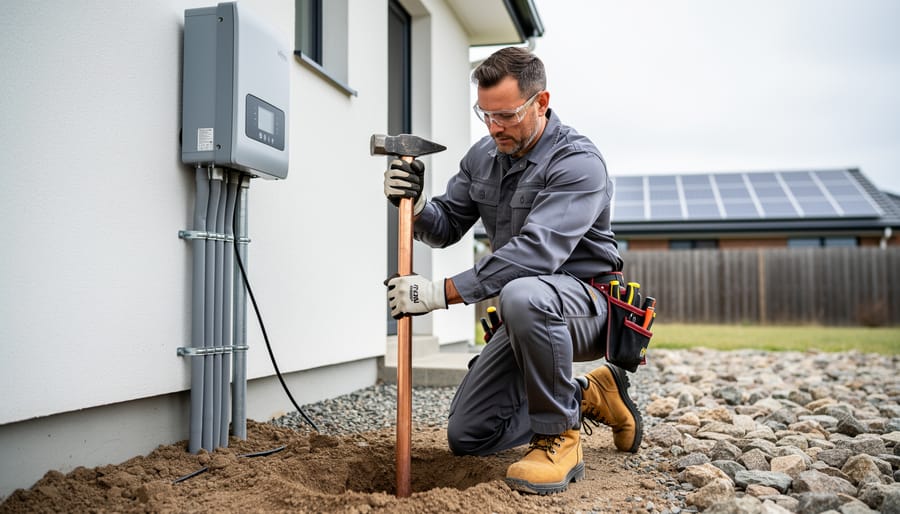
Proper grounding requires driving at least one 8-foot copper-clad steel ground rod completely into the earth. Notice I said completely. Charles tells me the most common mistake he sees is people leaving a foot or two exposed because the ground gets hard. Push through or use a pilot hole with water. The rod needs full contact with moist soil to dissipate energy effectively.
Once your rod is in, attach a heavy copper ground wire (minimum 6 AWG, but 4 AWG is better) using approved clamps. This wire connects to your lightning protection system and bonds to your solar array frame, inverter ground, battery ground, and home electrical ground. Everything metal in your system needs to connect to this single grounding point. No exceptions.
Test your ground resistance with a multimeter. You’re aiming for under 25 ohms, though lower is always better. If readings are high, add a second ground rod 6-8 feet away and bond them together.
Remember, grounding isn’t just about lightning. It’s about giving dangerous electricity somewhere safe to go. Skip this step or do it halfway, and you’re gambling with your equipment and safety. This is as critical as having proper safety equipment and procedures during installation.
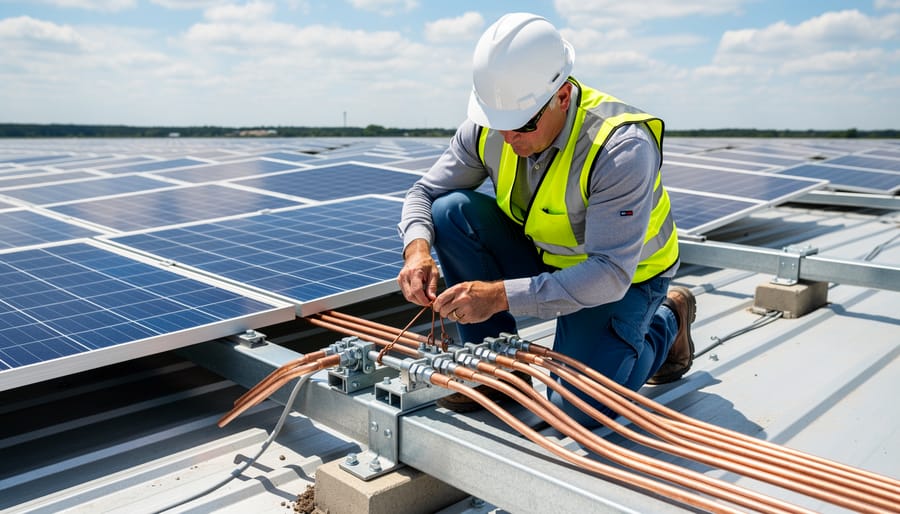
Proper grounding installation forms the critical foundation of any lightning protection system for solar installations.
Step 3: Install DC-Side Surge Protection
The DC side of your solar array needs protection before lightning-induced surges reach your charge controller or inverter. I learned this the hard way when a nearby strike fried my first charge controller—an expensive lesson I’m hoping you can avoid!
Start by installing a Type 2 SPD as close as possible to where your solar panels connect to your system. This typically means mounting it right at your combiner box or near your charge controller input. The key is intercepting surges before they travel through your equipment.
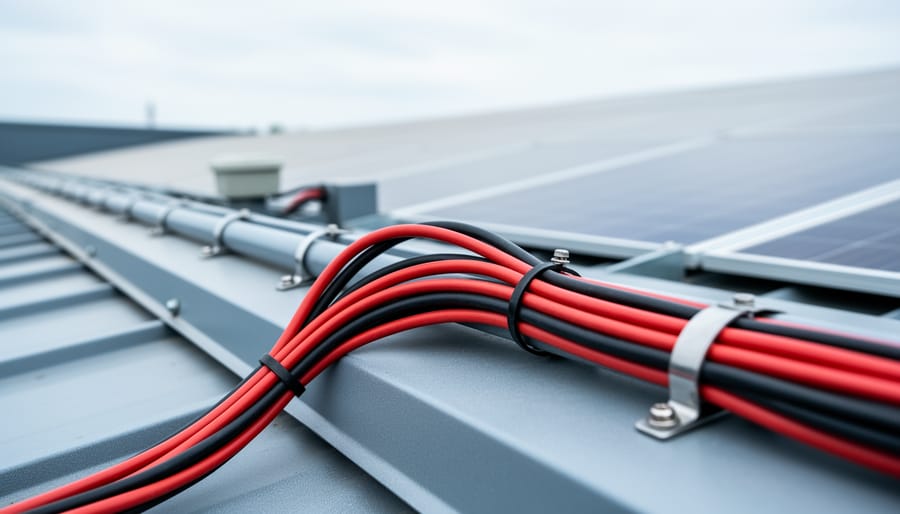
For wiring, use the shortest, straightest conductors possible—ideally 12 inches or less. Lightning follows the path of least resistance, and every bend or extra inch of wire reduces protection effectiveness. Strip your wire carefully and ensure tight connections to prevent arcing. Many DIYers make the mistake of treating these like regular connections, but precision matters here.
Selecting the right voltage rating is crucial. Your SPD must match or exceed your system’s maximum open-circuit voltage. For a typical 12V system with four 100W panels in series, you’d need at least a 600V-rated SPD. Always round up—it’s better to have headroom.
Look for SPDs with clear specifications including maximum discharge current (at least 20kA), response time (under 25 nanoseconds), and temperature ratings suitable for your installation environment. Quality units will include visual indicators showing when they’ve degraded and need replacement—a feature worth paying extra for since it gives you peace of mind.
Step 4: Add AC-Side Protection
Your AC-side protection is just as critical as the DC-side. Install Type 2 SPDs on your inverter’s AC output terminals—these catch surges coming from either direction, protecting both your inverter and home circuits. Most quality inverters have built-in surge protection, but I learned the hard way that it’s not always enough. During a nearby lightning strike, my neighbor’s inverter failed despite having “built-in protection,” while mine survived thanks to an external SPD I’d added.
Next, check your main service panel. If it doesn’t already have whole-home surge protection, now’s the time to upgrade. Look for SPDs rated for at least 50kA surge current with a low voltage protection level (under 1200V for 120/240V systems). Mount it as close to your main breaker as possible—every foot of wire reduces protection effectiveness.
Here’s the coordination trick: your main panel SPD should have a slightly higher voltage rating than your inverter-level protection. This creates a “cascade” effect where the inverter SPD handles smaller surges while the panel protector catches the big ones. If your existing home protection is older than five years or shows a failed indicator light, replace it—they don’t last forever.
Step 5: Consider External Protection for High-Risk Locations
For high-risk locations like hilltops, open fields, or the tallest structure in your area, external protection becomes essential. Lightning rods create a “cone of protection” extending downward at roughly a 45-degree angle, meaning a 20-foot rod protects about a 20-foot radius around it. Position rods at your roof’s highest points, then connect them to dedicated down conductors that run to ground rods placed at least 10 feet from your foundation.
Here’s where I’ll be honest from experience: installing external lightning protection isn’t like mounting solar panels. The engineering calculations for proper coverage, bonding all metal components, and ensuring adequate grounding paths require expertise most DIYers don’t have. If your solar array sits on a vulnerable structure or you’re in a lightning-prone region, call a certified lightning protection installer. They’ll assess your specific situation, ensure code compliance, and provide documentation that might reduce your insurance premiums. This is one area where professional installation pays for itself in peace of mind and actual protection.
Special Considerations for ESS (Battery Storage) Systems
When I first added battery storage systems to my solar setup, I didn’t realize these sophisticated power banks needed extra special attention when it comes to lightning protection. Think of your battery system as having a more sensitive nervous system than your solar panels—it requires careful handling during surge events.
The battery management system, or BMS, is the brain of your energy storage setup. This delicate computer constantly monitors voltage, temperature, and charge levels. A lightning surge can fry this control center in milliseconds, turning your expensive battery into a very heavy paperweight. Always install dedicated surge protection devices on both the AC and DC sides of your battery inverter. These aren’t optional—they’re essential insurance.
Here’s something that keeps me up at night: lithium batteries and electrical surges are a dangerous combination. During a surge event, the rapid voltage spike can trigger thermal runaway, which is a fancy way of saying your battery could catch fire or even explode. I’ve seen the aftermath of this happening to a neighbor’s garage setup, and trust me, it’s not something you want to experience.
Make sure your battery enclosure has proper electrical isolation from ground, but also maintains a clear grounding path for surge protection. This sounds contradictory, but it’s about creating the right pathway for lightning energy to bypass your sensitive equipment. Install your surge protectors as close to the battery system as physically possible—every extra foot of wire gives lightning more opportunity to jump where you don’t want it.
Finally, coordinate your lightning protection with your fire suppression plans. Know where your emergency battery disconnect is located and make sure everyone in your household knows too.
Battery storage systems require specialized surge protection to safeguard sensitive battery management systems and prevent fire hazards.
Safety First: What DIYers Can Do (And When to Call the Pros)
Let me be straight with you: lightning protection isn’t like building a simple solar phone charger. Some aspects are absolutely DIY-friendly, while others require calling in licensed professionals, and knowing the difference could save your life and your investment.
Here’s what I learned the hard way after consulting with several electricians: you can typically handle the preliminary planning, like mapping your system layout and identifying grounding points. Installing basic grounding rods in easily accessible locations is usually manageable for experienced DIYers who follow proper safety precautions. You can also install surge protection devices in lower-voltage DC circuits if you’re comfortable with electrical work.
However, here’s where professionals become non-negotiable: anything involving your main electrical panel, high-voltage AC connections, or rooftop lightning rod installations. Most jurisdictions require licensed electricians for these tasks, and your homeowner’s insurance might deny claims if unpermitted work causes damage.
Speaking of permits, don’t skip them. Yes, they’re tedious and cost money, but insurance companies scrutinize lightning damage claims closely. If they discover unpermitted electrical work, you’re potentially looking at denied coverage on a system worth thousands of dollars.
My friend Jake tried saving money by doing everything himself. When lightning struck nearby, his insurance denied the claim because he’d bypassed permits. He ended up spending triple what a licensed electrician would’ve cost.
Bottom line: assess your skill level honestly, get required permits, and recognize that professional installation isn’t an expense—it’s an investment in protection and peace of mind.
Testing and Maintenance: Making Sure Your Protection Actually Works
Installing lightning protection is just the beginning—regular testing ensures your system will actually protect your investment when it matters most. Think of it like fire extinguisher checks: you hope you never need it, but when you do, it better work.
I learned this lesson after a friend’s system passed a lightning strike unscathed, while his neighbor lost thousands in equipment. The difference? My friend did his annual checks religiously. Here’s your maintenance routine:
Start with visual inspections after every major storm. Walk your property and look for loose connections, damaged conductors, or corrosion on grounding clamps. Check that mounting brackets haven’t shifted and bonding wires remain tight. This takes maybe 15 minutes but catches problems early.
Annual maintenance goes deeper. Test your ground resistance using a simple multimeter or earth ground tester—you’re looking for readings under 25 ohms (lower is better). If resistance creeps up, your ground rods may need cleaning or the soil around them might be too dry.
Check your surge protection device (SPD) status indicators monthly. Most have green/red lights or windows showing their condition. Replace any showing failure immediately—they sacrifice themselves to save your equipment.
Just like battery system maintenance, prevention beats repair every time. Document your checks with photos and dates. This creates a maintenance history that helps spot patterns and proves proper care if you ever need warranty claims.
Installing lightning protection for your solar or energy storage system isn’t an optional luxury—it’s a critical investment in protecting both your equipment and your family’s safety. I’ve seen too many people learn this lesson the hard way, after a single storm erased thousands of dollars in solar equipment and left them in the dark for weeks while waiting for replacements.
The good news? You now have the knowledge and the roadmap to protect your system properly. Whether you’re installing a brand-new array or retrofitting protection onto an existing setup, the principles remain the same: proper grounding, surge protection at every entry point, and attention to bonding details that keep dangerous voltage spikes from finding pathways into your home.
Don’t wait until storm season is bearing down on you to take action. Lightning doesn’t announce its schedule, and procrastination has cost many system owners dearly. The hours you invest now in proper protection will pay dividends in system longevity and uninterrupted power for decades to come.
I remember the first major thunderstorm after I installed my complete lightning protection system. Instead of anxiously watching the sky and worrying about my panels, I actually enjoyed my coffee on the porch, knowing everything was properly safeguarded. That peace of mind is truly priceless.
Have you installed lightning protection on your system? What challenges did you face, or what tips would you share with others? Join our community discussion below and help fellow solar enthusiasts learn from your experience.
How useful was this post?
Click on a star to rate it!
Average rating 0 / 5. Vote count: 0
No votes so far! Be the first to rate this post.
We are sorry that this post was not useful for you!
Let us improve this post!
Tell us how we can improve this post?
charlesnoble
Here at Spheral Solar, I’m a hands-on solar power enthusiast, constantly exploring and experimenting with DIY solutions. I’m dedicated to sharing my discoveries, insights, and even the bumps I hit along the way, all in the pursuit of a more sustainable future.
Why Your DIY Solar System Needs Proper Grounding… by Charlesnoble January 31, 2026 Ground your solar system before you connect a single wire—improper grounding has destroyed thousands of dollars in equipment and created deadly shock hazards in homes just like yours. I learned this the hard way when a lightning strike fried my neighbor’s ungrounded inverter, teaching me that grounding isn’t optional paperwork…
Why Your Solar Ground Rod Might Be Too Short (And… by Charlesnoble January 15, 2026 Drive your 8-foot copper-clad steel grounding rod at least eight feet into the earth, or to the depth where you meet solid bedrock. This isn’t arbitrary—the National Electrical Code requires this specific length because it ensures your solar panels and battery storage system have a reliable path to dissipate dangerous…
Why Your PV Wire Management Could Fail Inspection… by Charlesnoble April 9, 2026 Route your PV wires through UV-resistant conduit within 18 inches of leaving the solar array, securing it every 3 feet with proper clamps to prevent wind damage and code violations. This single step prevents 80% of the wire degradation issues I’ve seen in DIY solar installations over the past decade.…
Why Your Solar Conduit Installation Could Start a… by Charlesnoble March 27, 2026 Measure your conduit run before purchasing materials by mapping the exact path from your solar array to the inverter and battery location, accounting for a 10% waste factor and additional length for bends. PVC electrical conduit remains the most cost-effective protective solution for DIY solar installations, but improper installation creates…
Why Your DIY Solar Trench Could Cave In (And How to… by Charlesnoble March 2, 2026 Dig a trench deeper than four feet for your ground-mounted solar array, and you’re entering territory where the walls can collapse without warning—burying you in seconds under thousands of pounds of soil. I learned this the hard way when planning my first major DIY solar project: what seemed like simple…
Why Your 6-Wire Solar Setup Needs the Right Conduit… by Charlesnoble March 6, 2026 Measure your wire gauge and count of six conductors before selecting conduit—most residential solar installations running six AWG 10 wires require 1-inch conduit, while six AWG 6 wires need 1.5-inch conduit, and six AWG 2/0 wires demand 2.5-inch conduit minimum. Calculate fill capacity using the 40% rule for three or…
Subscribe for handpicked DIY projects, exclusive tips, and giveaways.
Position your solar panels at an angle equal to your latitude for year-round performance, or adjust seasonally by adding 15 degrees in winter and subtracting 15 degrees in summer to capture maximum sunlight during each season’s sun path. Use a simple angle finder app on your smartphone against the back of your panel to verify… Read more: The Right Tilt Angle Can Boost Your Solar Panel Output by 30% (Here’s How to Find It)
Route your PV wires through UV-resistant conduit within 18 inches of leaving the solar array, securing it every 3 feet with proper clamps to prevent wind damage and code violations. This single step prevents 80% of the wire degradation issues I’ve seen in DIY solar installations over the past decade. Group your positive and negative… Read more: Why Your PV Wire Management Could Fail Inspection (And How to Fix It)
Understand that 6000 volts sounds terrifying but delivers surprisingly low amperage—typically around 120 milliamps for just 3/10,000th of a second per pulse. This combination creates an unforgettable shock that trains animals to avoid the fence without causing lasting harm. The voltage pushes current through thick fur and hide, while the minimal amperage and microsecond duration… Read more: Why 6000 Volts Won’t Kill Your Livestock (But Will Stop Predators Cold)