Why 8 AWG Solar Cable Changed How I Wire My Solar Projects (And Why Size Really Matters)
Updated:
Choosing 8 AWG solar cable for your DIY solar installation comes down to understanding one critical factor: how much current your system pushes through the wires and over what distance. If you’re running a 400-watt solar panel setup at 12 volts, you’re looking at roughly 33 amps of current, and 8 AWG handles up to 55 amps safely in most applications, giving you comfortable headroom.
The real challenge isn’t just picking the right wire thickness. It’s making sure your cable works seamlessly with your MC4 connectors and maintains efficiency across your entire system. I learned this the hard way during my first rooftop installation when voltage drop ate away 7% of my power production simply because I miscalculated cable length requirements.
Here’s what matters for your project: 8 AWG strikes the sweet spot between flexibility and current capacity for medium-sized residential solar arrays, typically handling 30-55 amp loads depending on your local electrical codes. It’s thick enough to minimize voltage drop on runs up to 20 feet but still manageable enough that you won’t need industrial crimping tools.
This guide walks you through the technical specifications that actually matter, connector compatibility essentials that prevent costly mistakes, and practical decision frameworks to determine if 8 AWG fits your specific setup. Whether you’re connecting panels on your RV, building a ground-mount array, or expanding an existing system, you’ll know exactly what to buy and why it works.
What Makes 8 AWG Solar Cable Different from Regular Wire
8 AWG solar cable features thick copper conductors and durable UV-resistant insulation designed specifically for outdoor solar installations.
Understanding Wire Gauge Numbers (The Backwards Logic)
Here’s something that trips up almost everyone when they first start working with wire: AWG numbers work backwards from what you’d expect. When I first began my solar journey, I spent an embarrassing amount of time confused about why “bigger” numbers meant smaller wires!
Think of it like numbered highway exits. Lower numbers come first, and in the wire world, lower AWG numbers mean thicker cables. So 8 AWG is actually thicker than 10 AWG or 12 AWG. The scale goes down as the wire diameter increases.
Here’s a helpful comparison: Picture coffee stirrers versus straws versus garden hoses. An 18 AWG wire is like that coffee stirrer – thin and suitable for small jobs. A 12 AWG wire is more like a regular drinking straw. But 8 AWG? That’s approaching garden hose territory – substantially thicker and capable of handling serious current flow.
This matters for solar installations because thicker wires (lower AWG numbers) can carry more electrical current safely over longer distances without overheating or losing power. For most residential solar panel connections, 8 AWG hits the sweet spot between performance and practicality.
What ‘Solar-Rated’ Actually Means
When I first started piecing together my solar setup, I thought cable was just cable. Then I melted through a cheap extension cord during testing (not my proudest moment), and learned why solar-rated cables exist. Let me save you from similar rookie mistakes.
Solar-rated cable isn’t just marketing hype. It refers to specific certifications that ensure your cable can handle the harsh realities of outdoor solar installations. The two main ratings you’ll see on quality 8 AWG solar cable are USE-2 and THWN-2.
USE-2 stands for Underground Service Entrance, rated for both wet and dry locations. This certification means the cable can withstand direct burial, moisture exposure, and temperature extremes from -40°F to 90°C (194°F). That’s crucial when your cable might be running across a hot roof in August.
THWN-2 indicates the cable is rated for wet locations and can handle 90°C in both wet and dry conditions. Many quality solar cables carry dual USE-2/THWN-2 ratings, giving you maximum flexibility for installation.
But here’s the real game-changer: sunlight resistance. Standard electrical wire breaks down under UV exposure, turning brittle and cracking within months. Solar-rated cable uses specially formulated insulation, often cross-linked polyethylene or electron beam cross-linked polymers, designed to resist UV degradation for decades. Look for labels mentioning “sunlight resistant” or “UV resistant” on the jacket.
The construction typically includes tin-coated copper conductors that resist corrosion better than bare copper, especially important in humid or coastal environments. This attention to detail ensures your investment keeps producing power for twenty-plus years, not just a few seasons.
When Your Solar Project Actually Needs 8 AWG Cable
The Amperage Sweet Spot for 8 AWG
When I first started planning my rooftop solar setup, I spent way too much time staring at wire gauge charts. Here’s what you actually need to know about 8 AWG: this cable typically handles between 40 to 55 amps, depending on your installation conditions.
The exact amperage capacity depends on a few factors. If your cable runs through hot attic spaces or gets bundled with other wires, you’re looking at the lower end of that range, around 40 amps. For open-air installations where heat can dissipate freely, you can safely push closer to 55 amps.
So when should you choose 8 AWG? It’s the go-to choice for medium-sized solar arrays, typically in the 2,000 to 3,500 watt range at 48 volts. I used it on my 3,000-watt system, and it’s been perfect. It strikes that balance between handling substantial current without being unnecessarily thick and expensive.
Think of it this way: if your solar setup produces between 40 and 50 amps of current, 8 AWG is your sweet spot. It’s beefy enough to handle the load safely while remaining flexible enough to work with comfortably. For smaller systems under 30 amps, you might get away with 10 AWG, but 8 AWG gives you that extra safety margin I always appreciate.
Distance Matters: Voltage Drop Calculations Made Simple
Here’s something I learned the hard way during my first solar installation: electricity doesn’t travel through wire without losing a bit of its punch along the way. This phenomenon is called voltage drop, and it’s like water pressure decreasing as it flows through a long garden hose.
Think of it this way. When your solar panels generate 12 volts and you need that power to reach your battery 50 feet away, some of that voltage gets “used up” by the wire itself. With 8 AWG cable, you’ll lose less voltage than with thinner wire, but distance still matters tremendously.
The general rule in solar systems is keeping voltage drop under 3 percent for optimal performance. Go beyond that, and you’re essentially wasting the free energy your panels worked hard to collect. I once helped a neighbor troubleshoot why his system seemed underpowered, only to discover he’d run thin wire across his entire property. We switched to 8 AWG for the main run, and his charging performance improved immediately.
Here’s a practical example: if you’re running 8 AWG cable with 20 amps of current over 25 feet (that’s 50 feet total when you count the return path), you’ll see roughly a 2 percent voltage drop in a 12-volt system. Stretch that same setup to 50 feet one-way, and you’re looking at closer to 4 percent, which starts affecting efficiency.
Rather than wrestling with complex formulas, I recommend using our voltage drop calculator tool. Just plug in your distance, current, and system voltage, and it’ll tell you instantly whether 8 AWG fits your needs or if you should size up. It’s saved me countless headaches over the years.
8 AWG Cable in Solar Connector Assemblies: The Complete Picture
Matching Your Connectors to 8 AWG Cable
Getting the right connectors for your 8 AWG cable is absolutely crucial—I learned this the hard way on my first solar installation when a seemingly perfect connection started heating up during testing. Let me save you from that experience!
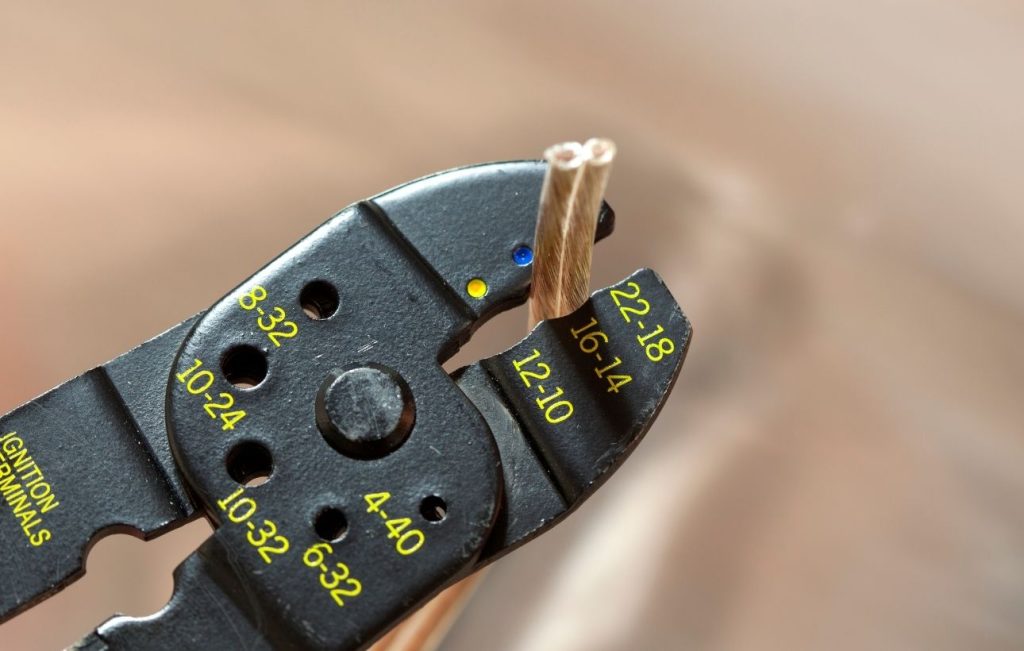
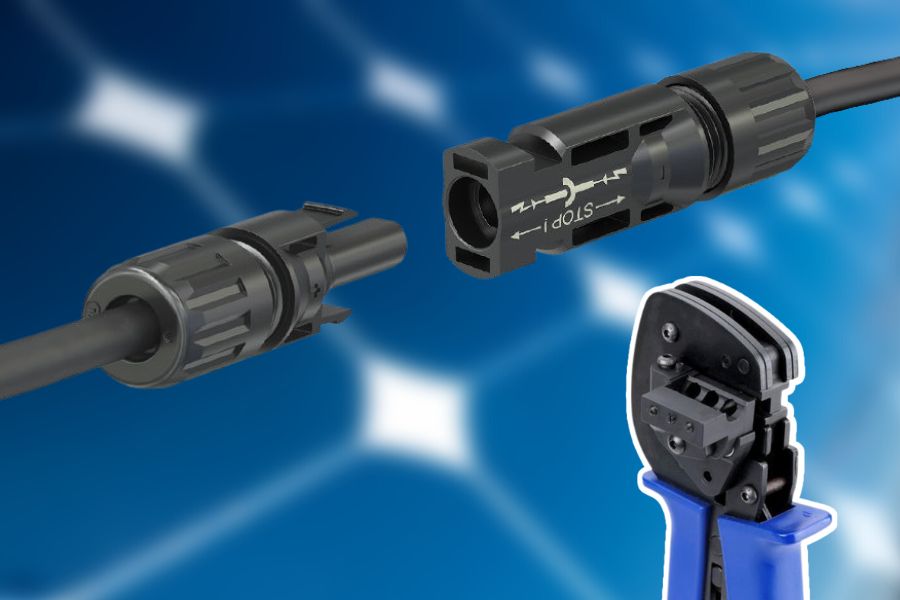
For 8 AWG solar cable, you’ll need MC4 connectors specifically rated for this wire gauge. Most MC4 connectors are designed to handle 10-14 AWG or 10-12 AWG, so double-check the product specifications before buying. The crimp barrel inside the connector must match your cable diameter, or you’ll end up with a loose, dangerous connection.
When crimping MC4 connectors, using the wrong crimp size creates several problems. Too large, and the connection has high resistance, causing heat buildup that can melt insulation or even start fires. Too small, and you’ll damage the conductor strands while struggling to insert the cable, weakening the entire connection.
Here’s what to look for: genuine MC4 connectors from reputable manufacturers typically come with color-coded crimp barrels. For 8 AWG, you’re usually looking at the larger size options. Some manufacturers offer universal connectors with adjustable crimps, but I prefer dedicated 8 AWG-rated versions for reliability.
Understanding solar connector compatibility matters because mixing connector brands can sometimes work, but matching brand to brand ensures the tightest weatherproof seal. A proper match gives you decades of trouble-free performance, while mismatched components might fail within months, especially in harsh weather conditions.
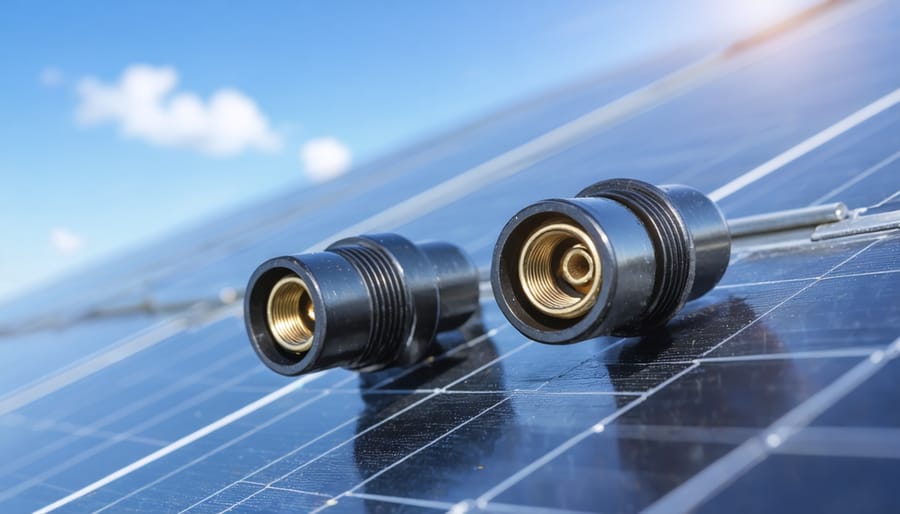
Properly matched MC4 connectors ensure reliable connections when working with 8 AWG solar cable in DIY installations.
Pre-Made vs. DIY Connector Assembly
When you’re setting up your solar system with 8 AWG cable, you’ll face an important decision: should you buy pre-assembled cables with connectors already attached, or go the DIY route and crimp your own? Let me walk you through both options so you can make the best choice for your project.
Pre-assembled cables are the grab-and-go solution. They arrive at your door ready to connect, with MC4 connectors already crimped onto both ends. The biggest advantage here is convenience and reliability. Professional manufacturers use specialized crimping equipment that creates incredibly strong, weatherproof connections. You’re essentially getting factory-quality connections without any effort. This option works great if you need standard lengths and want to minimize installation time. The downside? Pre-made cables come in fixed lengths, so you might end up with excess cable coiled up somewhere or cables that are slightly too short for your needs. Cost-wise, expect to pay a premium for the convenience, typically 30-50% more than buying bulk cable and connectors separately.
Now, the DIY approach gives you complete flexibility. You buy bulk 8 AWG cable and your own MC4 connectors, then cut and crimp to exact lengths. I remember Charles mentioning how satisfying it was to create custom-length cables for his oddly-shaped roof installation, eliminating all that excess wire. You’ll need to invest in proper crimping tools and quality wire strippers, which adds upfront cost, but if you’re doing multiple panels or future expansions, you’ll save money long-term. The challenge is ensuring proper crimping technique. A poorly crimped connector can create resistance, heat buildup, or complete connection failure.
For most DIYers doing their first small system, pre-made cables offer peace of mind. But if you’re tackling multiple installations or want maximum customization, learning to DIY opens up possibilities.
Real-World Applications: Where I Use 8 AWG in My Builds
RV and Van Solar Installations
If you’re setting up solar on your RV or camper van, 8 AWG cable is often the perfect middle ground. I learned this the hard way after initially using 10 AWG on my friend Charles’s first van build—we had to redo the entire run when he upgraded from 200W to 400W panels because the voltage drop became problematic.
For typical mobile setups in the 200-400 watt range, 8 AWG handles the current beautifully without being unnecessarily bulky. Remember, space is premium in an RV, and you don’t want cables so thick they’re impossible to route through tight spaces. At the same time, you need enough capacity to handle peak charging currents, which can reach 20-25 amps with a 400W system.
The flexibility matters too. Mobile installations experience vibration and movement that stationary homes don’t face. Quality 8 AWG solar cable with fine-strand copper construction stays flexible in cold weather and won’t crack from constant motion. When wiring your RV system, this cable size works seamlessly with standard MC4 connectors and can handle runs of 10-15 feet from roof to charge controller without significant power loss. It’s genuinely the goldilocks choice—not too heavy, not too light, just right for most mobile solar adventures.
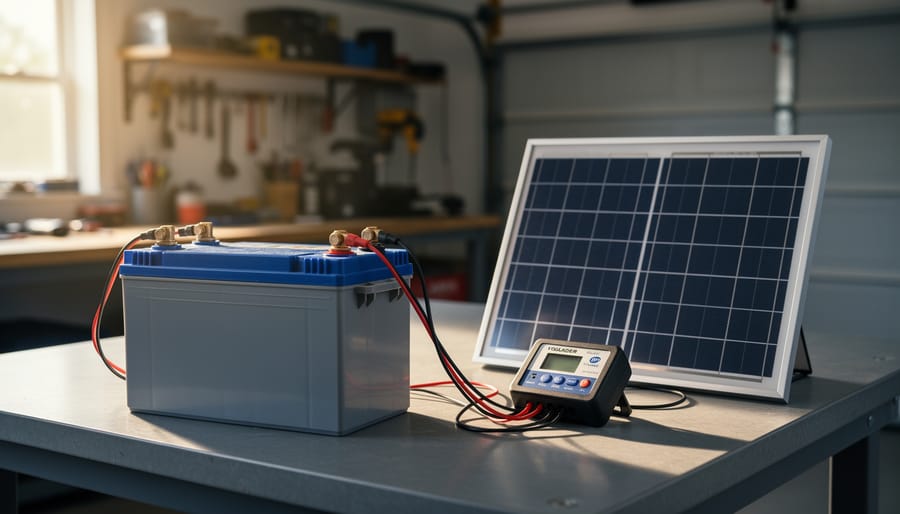
RV and van solar installations commonly use 8 AWG cable to connect rooftop panels to interior charge controllers and battery systems.
Ground-Mount and Rooftop Arrays
For fixed ground-mount and rooftop arrays, 8 AWG cable hits the sweet spot for many residential DIY setups. I remember installing my first rooftop system, and after running the calculations, 8 AWG handled my 400-watt panels beautifully with runs under 30 feet to the charge controller.
Here’s the reality check: 8 AWG works great when you’re connecting panels within about 25-35 feet of your equipment, especially for systems running between 1,500 to 2,500 watts. The cable’s 40-50 amp capacity gives you headroom without breaking the bank on oversized wire.
But you’ll want to size up to 6 AWG when your cable runs exceed 35 feet or you’re building a larger array pushing 3,000 watts or more. Voltage drop becomes your enemy on longer runs, and that thicker wire keeps your system efficient. I learned this the hard way when a neighbor ignored the distance factor and lost nearly 5% of his power production.
Conversely, you might size down to 10 AWG for very short runs under 15 feet with smaller panels, though honestly, the cost savings are minimal and 8 AWG gives you flexibility for future expansion.
The key consideration for fixed installations is that once everything’s mounted and connected, rewiring becomes a major headache. When in doubt, go slightly larger. Your future self will thank you when you decide to add another panel or two to your array.
Shopping Smart: What to Look for When Buying 8 AWG Solar Cable and Assemblies
Quality Markers That Actually Matter
When you’re shopping for 8 AWG solar cable, don’t just grab the cheapest option. I learned this the hard way on my first installation when I discovered not all cables are created equal. The quality markers that matter most start with certifications. Look for UL 4703 certification, which specifically tests cables for photovoltaic applications. You’ll also want to see “PV Wire” or “USE-2” designation on the jacket. These aren’t just fancy labels—they confirm the cable meets electrical code requirements and can handle direct sunlight exposure for decades.
Next, confirm you’re getting actual copper conductors, not copper-clad aluminum (CCA). While CCA costs less, it has higher resistance and isn’t approved for most solar installations. Pure copper might add 20-30% to your budget, but it’s non-negotiable for safety and performance.
Finally, check the insulation rating. Quality 8 AWG solar cable should be rated for at least 90°C (194°F) and 600V minimum. Better cables offer 1000V or 2000V ratings, which provides extra safety margin and future-proofs your system as technology evolves. These temperature and voltage ratings appear printed directly on the cable jacket every few feet.
Cost Expectations and Where to Buy
When I started shopping for 8 AWG solar cable for my first rooftop installation, I was surprised by how much prices varied. Here’s what you can realistically expect to pay and where to find the best deals.
Most reputable suppliers charge between $0.75 and $1.50 per foot for quality 8 AWG solar cable. The price depends on factors like UV resistance rating, insulation quality, and whether it’s listed for wet locations. I’ve found that online retailers like Amazon and specialized solar shops typically fall in the $0.85-$1.20 range for single-color cable. Your local electrical supply stores might charge $1.00-$1.50 per foot, but they offer the advantage of seeing the product firsthand and getting immediate advice from knowledgeable staff.
Here’s a money-saving tip from experience: buying in bulk makes a huge difference. A 100-foot spool usually costs 20-30% less per foot than buying by the foot. If your project needs 75 feet, spring for the 100-foot spool. You’ll use those extra 25 feet eventually for repairs or expansions, trust me.
Compare shipping costs carefully when ordering online. Cable is heavy, and shipping can add $15-30 to your order. Sometimes that “cheap” online price isn’t actually cheaper once delivery fees hit your cart.
Common Mistakes I’ve Made (So You Don’t Have To)
Let me share some of my early missteps with 8 AWG cable, because honestly, we all learn best from our fumbles. My first big mistake? Thinking I could get away with cheap crimpers from the hardware store. I spent an entire Saturday crimping MC4 connectors onto my 8 AWG wire, feeling pretty proud of myself. Three weeks later, I noticed my panel output dropping. Turns out, those loose crimps were creating resistance and heat. I ended up redoing everything with proper ratcheting crimpers designed for solar work. The lesson? Invest in the right tools from the start—your future self will thank you.
My second blunder involved UV protection. I ran some 8 AWG cable along the outside of my shed, thinking the insulation would handle anything. Six months of sun exposure left that cable jacket cracked and brittle. Always use cable rated for outdoor UV exposure, or better yet, run it through conduit when exposed to direct sunlight.
Here’s an embarrassing one: I mixed cable gauges in a single run because I ran short on 8 AWG halfway through a project. I figured ten feet of 10 AWG wouldn’t hurt. Wrong. That section became a bottleneck, limiting my entire system’s performance. Keep your gauge consistent throughout each circuit.
My final lesson came from ignoring voltage drop calculations on a long run to my battery bank. Fifty feet seemed reasonable, but at higher currents, I was losing precious watts. Sometimes 8 AWG isn’t enough for distance—do the math first, or consider stepping up to 6 AWG for longer runs.
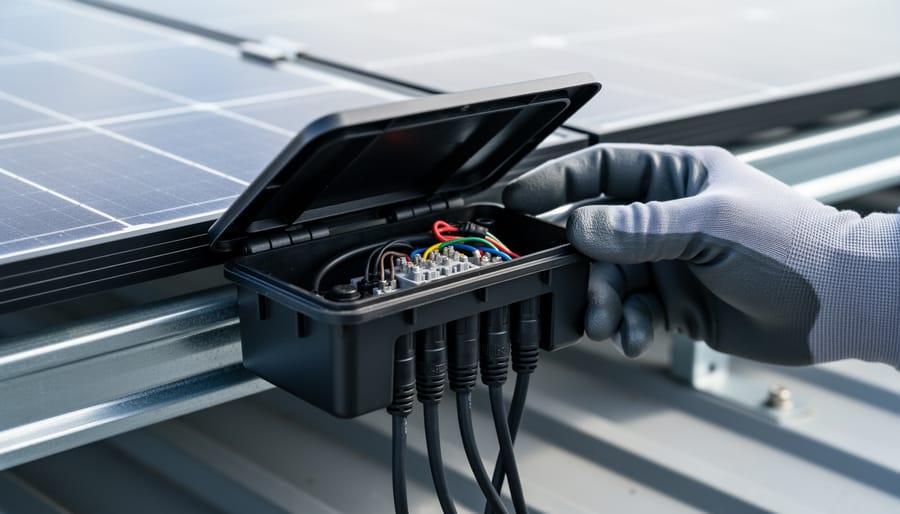
Undersized cables or poor connections can lead to overheating and insulation damage, making proper gauge selection critical for system safety.
Choosing the right cable for your solar setup doesn’t have to be overwhelming. Throughout this guide, we’ve covered how 8 AWG solar cable strikes that sweet spot for many residential projects, offering solid current-carrying capacity while remaining flexible enough for DIY installation. Remember, the key factors are your system’s voltage, the distance your power needs to travel, and ensuring your connectors match your cable gauge perfectly.
I’ve seen countless DIYers succeed with their first solar projects by taking it step-by-step and double-checking their numbers. That’s exactly why we’ve built easy-to-use calculators on this site. Take a few minutes to plug in your specific measurements and verify that 8 AWG is right for your situation. Sometimes you’ll need to size up or down, and that’s completely normal.
Got questions about connector compatibility or wondering if your particular setup needs something different? Drop a comment below. This community thrives on shared experiences, and your question might help someone else facing the same decision. Let’s keep learning together and building better solar systems, one connection at a time.
How useful was this post?
Click on a star to rate it!
Average rating 5 / 5. Vote count: 1
No votes so far! Be the first to rate this post.
We are sorry that this post was not useful for you!
Let us improve this post!
Tell us how we can improve this post?
charlesnoble
Here at Spheral Solar, I’m a hands-on solar power enthusiast, constantly exploring and experimenting with DIY solutions. I’m dedicated to sharing my discoveries, insights, and even the bumps I hit along the way, all in the pursuit of a more sustainable future.
Why Your Solar Panel’s J-Box Matters More Than You Think by Charlesnoble January 8, 2026 Flip over any solar panel and you’ll spot a small weatherproof box attached to the back—that’s the junction box, or j-box, and it’s the critical gateway between your panel’s delicate solar cells and your entire electrical system. Understanding this component isn’t just technical curiosity; it’s essential for anyone wiring their…
Why Your RV Solar Panels Aren’t Charging (And How to… by Charlesnoble November 30, 2025 Check your multimeter readings at each connection point along your solar charging path—from panels to charge controller to battery—to pinpoint exactly where voltage disappears. Most RV solar systems lose 10-30% of their potential power to voltage drop, but this invisible thief often goes undetected until you systematically measure and compare…
8 Best Wire Strippers in 2023 by Adeyomola August 4, 2021 A lightweight, versatile wire stripper with a sharp cutting edge and a solid grip is great. However, the best wire strippers stand out largely because of their broad wire gauge range. A versatile wire stripper does more than just wire stripping. Some brands design wire strippers and add extra features…
Solar Connectors That Won’t Fail (Complete… by Charlesnoble October 22, 2025 Solar connectors serve as the critical linking points in any photovoltaic system, making the difference between a safe, efficient installation and potential hazards. From the industry-standard MC4 to the newer MC4-EVO 2, these specialized electrical components ensure reliable power transfer while protecting against moisture, UV radiation, and environmental stress. Whether…
Why Connecting Your Solar Panel Directly to a… by Charlesnoble March 11, 2026 The short answer is yes, you can physically connect a solar panel directly to a battery, but you absolutely shouldn’t in most cases. Without a charge controller acting as the middleman, you’re essentially playing Russian roulette with your battery’s lifespan and potentially creating a fire hazard. I learned this lesson…
How to Crimp MC4 Connectors by Charlesnoble September 15, 2023 MC4 connectors are crimped using a specialized MC4 crimping tool to attach male and female pins to solar cables, which are then inserted into the connector housings and tightened for a secure connection. This comprehensive guide provides detailed, step-by-step instructions on properly crimping male and female MC4 connectors for solar…
Subscribe for handpicked DIY projects, exclusive tips, and giveaways.
Match your solar panels to microinverters or power optimizers based on your roof’s shading patterns—even partial shade from a chimney or tree during morning hours means module-level power electronics will recover 15-25% more energy than string inverters lose to the weakest panel. Install power optimizers when you’re working with mixed panel orientations across multiple roof… Read more: Why Smart Solar Modules Could Save Your DIY Array (Before It’s Too Late)
Measure your conduit run before purchasing materials by mapping the exact path from your solar array to the inverter and battery location, accounting for a 10% waste factor and additional length for bends. PVC electrical conduit remains the most cost-effective protective solution for DIY solar installations, but improper installation creates fire hazards, code violations, and… Read more: Why Your Solar Conduit Installation Could Start a Fire (And How to Do It Right)
Walk down to your nearest stream with a five-gallon bucket and a stopwatch. Fill that bucket and time how long it takes—this simple test reveals whether you have enough flowing water to power your off-grid home. If you can fill it in under 10 seconds from a source that drops at least 10 feet in… Read more: The Stream Behind Your House Could Power It (Here’s How Micro Hydro Works)