Why Lithium-Ion Batteries Changed Everything About Solar Storage (And What You Need to Know)
Updated:
Match your battery’s voltage to your solar panel system—12V, 24V, or 48V configurations must align perfectly, or you’ll waste energy through conversion losses and potentially damage expensive equipment. Check the battery’s amp-hour (Ah) rating against your daily power consumption: multiply your total watt-hours by 1.2 to account for inefficiency, then divide by your system voltage to find the minimum Ah capacity you need.
Calculate depth of discharge (DoD) tolerance before committing to any battery purchase. Lithium-ion batteries typically handle 80-90% DoD compared to lead-acid’s 50%, meaning a 100Ah lithium battery actually gives you 80-90 usable amp-hours. This single specification dramatically affects how much battery capacity you’ll need and how long your investment will last.
Verify the battery management system (BMS) includes temperature sensors, cell balancing, and overcharge protection. I learned this the hard way when a cheap battery without proper BMS protection swelled dangerously during a heat wave, forcing an emergency shutdown of my entire system. The BMS isn’t optional—it’s the difference between a battery that lasts 10+ years and one that fails within months.
Compare cycle life ratings at the manufacturer’s specified DoD level. A battery rated for 3,000 cycles at 80% DoD will actually last longer than one rated for 5,000 cycles at 50% DoD when you’re running a solar system that regularly draws significant power. Understanding these specifications transforms you from a confused buyer into someone who can confidently size a system that meets your actual energy needs without overspending or undersizing.
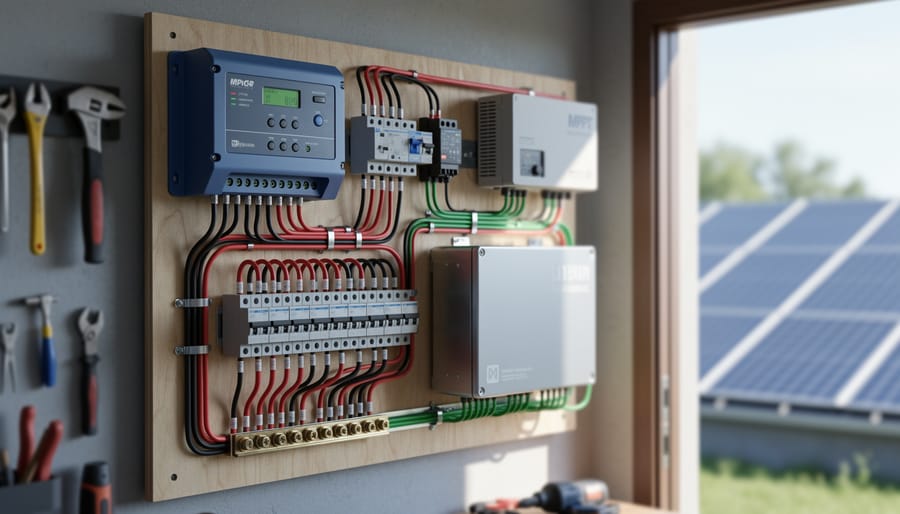
Modern lithium-ion battery systems offer compact, efficient energy storage for off-grid solar installations.
What Makes Lithium-Ion Batteries Different for Solar Storage
The Chemistry Behind the Power
Think of a lithium-ion battery like a rechargeable parking lot for electrons. When your solar panels generate electricity during the day, they’re creating a flow of electrons that need somewhere to go. The battery stores these electrons by moving lithium ions back and forth between two layers, kind of like guests checking into a hotel.
Inside the battery, you have two main areas: the anode (negative side) and cathode (positive side), separated by a special liquid called electrolyte. When charging, lithium ions travel from the cathode through the electrolyte to the anode, where they hang out until needed. When you need power at night, the process reverses. The ions flow back to the cathode, creating an electrical current that powers your home.
I remember when I first explained this to my neighbor during a backyard solar project. She said it finally clicked when I compared it to a water tower: you pump water up when you have extra energy, then let gravity do the work when you need it back. Same concept, just with electrons instead of water. The beauty is this chemical dance can repeat thousands of times, making these batteries perfect partners for solar energy systems.
The internal structure of lithium-ion cells enables efficient energy storage and release through chemical reactions.
Why Solar Systems Love Lithium-Ion
I remember when I first paired my solar panels with lithium-ion batteries, and the difference from my old lead-acid setup was like night and day. Here’s why these batteries have become the go-to choice for solar enthusiasts everywhere.
First up is depth of discharge, or DoD. Most lithium-ion batteries let you safely use 80-90% of their stored energy, compared to just 50% with lead-acid batteries. This means if you have a 10 kWh battery, you actually get to use 8-9 kWh of that power. In practical terms, you’re getting almost twice the usable energy from the same capacity rating.
Efficiency is another game-changer. Lithium-ion batteries boast round-trip efficiency of 90-95%, meaning very little energy gets lost during charging and discharging. When you’re trying to maximize the energy from your solar panel specifications, every percentage point matters for your investment.
Lifespan sets them apart too. Quality lithium-ion batteries typically deliver 3,000-5,000 charge cycles, lasting 10-15 years in real-world conditions. That’s roughly three times longer than traditional alternatives, making the higher upfront cost much easier to justify.
Finally, there’s the weight advantage. Lithium-ion batteries are about 70% lighter than lead-acid batteries with similar capacity. For home installations, this means simpler mounting options and less structural reinforcement needed. I installed mine on a second-floor utility room wall without any concerns about weight load.
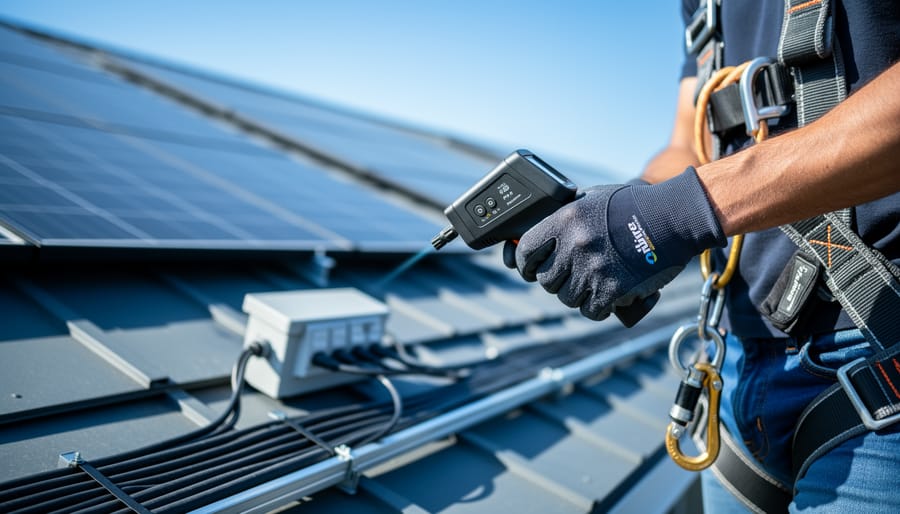
Understanding battery specifications and testing capabilities ensures proper system performance and safety.
The Critical Specs You Actually Need to Understand
Capacity and Usable Energy (kWh vs. Ah)
When I first started building my solar setup, I got confused by battery specs showing both kilowatt-hours (kWh) and amp-hours (Ah). Here’s what I learned the hard way so you don’t have to.
Think of kWh as the total energy your battery can store, like the size of your gas tank. Amp-hours tell you the electrical charge capacity, but it’s only part of the picture. To convert Ah to kWh, multiply by the battery voltage, then divide by 1,000. For example, a 200Ah battery at 12V gives you 2.4 kWh (200 x 12 ÷ 1,000).
Here’s the catch: total capacity isn’t what you can actually use. Most lithium batteries advertise their total capacity, but you shouldn’t drain them completely. Quality lithium batteries typically offer 80-90% usable capacity, which manufacturers call the depth of discharge. A 10 kWh battery might only give you 8-9 kWh of safe, usable energy.
Before calculating your power needs, check the spec sheet for usable capacity rather than total capacity. This matters hugely for sizing your system correctly. I once undersized my first battery bank by 20% because I didn’t account for this difference.
To calculate what you need, add up your daily energy consumption in watt-hours, convert to kWh, then add 20-30% for cloudy days and system losses. If you use 5 kWh daily, aim for at least 6-7 kWh of usable capacity.
Depth of Discharge (DoD) – Why 100% Isn’t Always 100%
Depth of Discharge refers to how much of your battery’s capacity you can actually use without damaging it. Here’s where lithium-ion batteries really shine compared to their lead-acid cousins.
With traditional lead-acid batteries, you’d typically only use about 50% of the rated capacity. That 200Ah battery? You’d realistically get 100Ah of usable power. Go deeper regularly, and you’d significantly shorten its lifespan.
Lithium-ion batteries flip this limitation on its head. Most quality lithium-ion batteries safely handle 80-100% DoD. That same 200Ah capacity? You can actually use 160-200Ah without worry.
I learned this the hard way on my first solar setup. I sized everything around a lead-acid battery’s 50% DoD, then switched to lithium-ion later. Suddenly, I had nearly double the usable storage with the same physical battery size.
This changes how you plan your system. When calculating your energy needs, you can count on accessing most of the battery’s rated capacity. If you need 5kWh of daily storage, a 6kWh lithium battery will comfortably cover that. With lead-acid, you’d need a 10kWh battery to safely provide the same 5kWh.
Cycle Life and What It Really Tells You
Here’s the thing about cycle life ratings: they sound impressive on paper, but they need context to be useful. When a battery claims “5,000 cycles,” what does that actually mean for you?
A cycle is one complete discharge and recharge. But here’s where it gets interesting: a 50% discharge followed by a recharge counts as half a cycle, not a full one. Most manufacturers rate cycles at 80% depth of discharge, meaning you’re using 80% of the battery’s capacity each time. If you’re gentler with your battery and only discharge it 50% daily, you’ll get significantly more cycles out of it.
Let me share something I learned the hard way: Charles once told me he assumed his 6,000-cycle battery would last about 16 years if he cycled it daily. Turns out, he only cycled it every other day on average because his solar panels kept it topped up most days. That extended his projected lifespan considerably.
To translate cycles into years, divide the cycle count by how many times you’ll realistically cycle the battery per year. Daily cycling means 365 cycles yearly, so a 5,000-cycle battery gives you roughly 13-14 years. But partial cycles stretch this further.
We’ve created a simple battery lifespan calculator to help you estimate your specific situation based on your usage patterns and depth of discharge habits.
Charge and Discharge Rates (C-Rating Explained)
Think of C-rating as how fast your battery can safely charge or discharge its energy. It’s expressed as a multiple of the battery’s capacity. A 1C rating means the battery can fully charge or discharge in one hour. A 0.5C rating means it takes two hours, while a 2C rating means just 30 minutes.
Here’s why this matters for solar setups: Your solar panels produce power at varying rates depending on sunlight conditions, similar to how peak power ratings fluctuate throughout the day. If your battery has a low C-rating but you’re trying to charge it quickly during peak sun hours, you’re wasting potential energy. On the flip side, if you’re running power-hungry appliances, you need a battery that can discharge fast enough to meet demand.
Let me share a practical example: I once helped a neighbor set up his workshop. He had a 100Ah battery with a 0.5C charge rating, meaning it could only accept 50 amps maximum. His solar array could produce 80 amps at noon, so he was literally leaving energy on the table. We added a second battery to capture that excess power.
For most home solar systems, look for batteries with at least 0.5C charge and 1C discharge ratings for balanced performance.
Voltage, Configuration, and System Compatibility
Understanding Battery Voltage in Solar Systems
When I first started building solar systems, the voltage question tripped me up more than I’d like to admit. Let me break down what you need to know about system voltages and why lithium-ion batteries change the game.
Solar systems typically operate at 12V, 24V, or 48V. Think of voltage like the width of a pipe carrying water—higher voltage means you can move more power with thinner wires and less loss.
For small applications like RVs, boats, or tiny cabins drawing under 1,000 watts, 12V systems work great. They’re simple and many DC appliances run on 12V directly. Once you’re powering a small home with 1,000-3,000 watts of demand, 24V becomes more efficient. For serious whole-home systems above 3,000 watts, 48V is your friend—it reduces current, minimizes wire costs, and plays nicely with modern inverters.
Here’s where lithium-ion gets interesting. Traditional lead-acid batteries have a nominal voltage of 12V (actually 12.6V fully charged). Lithium-ion batteries typically sit at 12.8V or 13.2V for a “12V” battery. This slight difference means lithium batteries maintain steadier voltage throughout discharge, giving you more usable power without the voltage sag that plagues lead-acid systems.
When shopping, match your battery bank voltage to your inverter. Most quality inverters specify their optimal voltage, and mixing voltages creates headaches you don’t need. The beauty of lithium-ion is that whether you choose 12V, 24V, or 48V, you’ll get consistent performance from full charge down to about 20 percent capacity.
Series, Parallel, and Series-Parallel Configurations
Understanding how to wire your lithium-ion batteries correctly is essential for creating a solar storage system that meets your specific power needs. Let me break down the three main configurations in a way that actually makes sense.
Series wiring connects batteries positive to negative, like linking train cars together. This adds up the voltage while keeping capacity the same. So two 12V 100Ah batteries in series give you 24V at 100Ah. I remember Charles telling me about his first off-grid cabin project where he needed 24V for his inverter but only had 12V batteries. Series wiring solved that puzzle perfectly.
Parallel wiring connects all positive terminals together and all negative terminals together. This keeps voltage the same but adds capacity. Those same two 12V 100Ah batteries wired parallel give you 12V at 200Ah, meaning longer runtime before needing a recharge.
Then there’s the hybrid approach, combining both methods. Series-parallel configurations let you scale both voltage and capacity simultaneously. Four 12V 100Ah batteries wired as two parallel strings in series deliver 24V at 200Ah.
Safety considerations are critical here. Always use batteries with identical voltage ratings, capacity, and preferably from the same manufacturing batch. Mixing different batteries creates imbalances that can damage your system or create fire hazards. Use proper gauge wiring, install fuses on each positive connection, and ensure your charge controller matches your battery bank’s total voltage. Double-check all connections before powering up your system.
Safety Features and Battery Management Systems (BMS)
What a BMS Does (And Why You Can’t Skip It)
Think of a Battery Management System (BMS) as the guardian angel of your lithium-ion battery pack. Without one, you’re basically flying blind, and that’s when bad things happen.
Here’s what your BMS is doing behind the scenes. First, it prevents overcharging, which is when you stuff too much energy into your cells. I learned this the hard way years back when a cheap battery pack without proper protection swelled up like a balloon. Not fun. The BMS cuts off charging at the safe voltage limit, typically around 4.2 volts per cell.
On the flip side, it prevents over-discharge too. Draining lithium cells below about 2.5 volts can permanently damage them, reducing capacity or killing them entirely. Your BMS acts as a safety net, disconnecting the load before you hit that danger zone.
Temperature monitoring is equally critical. Lithium batteries hate extreme heat and cold. A good BMS will shut things down if temperatures spike above 140°F or drop below freezing during charging. I’ve seen battery packs catch fire when this protection failed, usually from sketchy imported units.
Finally, cell balancing ensures all your cells charge and discharge evenly. Without it, weaker cells get overworked and fail early, taking your whole expensive pack with them. The BMS redistributes energy during charging so every cell stays happy and healthy, maximizing your investment’s lifespan.
Safety Specs to Look For
When I first started shopping for lithium batteries, the safety certification labels looked like alphabet soup. Here’s what actually matters.
Look for UL1642 or UL9540A certification at minimum. These standards verify the battery won’t catch fire or explode under normal use. UN38.3 certification means it’s safe for shipping, which sounds basic but indicates the manufacturer followed proper testing protocols. Premium batteries also carry IEC 62619 certification, the gold standard for stationary energy storage systems.
Temperature ranges tell you where you can safely install your system. Adequate batteries operate from 32°F to 113°F, which works for climate-controlled garages. Premium models handle -4°F to 140°F, perfect if you’re mounting batteries in an uninsulated shed or hot attic space.
Check for built-in Battery Management Systems, or BMS. Every quality lithium battery needs one. The BMS prevents overcharging, monitors cell balance, and shuts things down if temperatures spike. Think of it as your battery’s brain keeping everything safe.
Short circuit protection and thermal runaway prevention are non-negotiable. I learned this the hard way when a budget battery without proper protection nearly ruined my first solar setup. These features cost manufacturers money, so their presence usually indicates overall quality.
Temperature Performance and Environmental Considerations
Temperature plays a surprisingly dramatic role in how well your lithium-ion batteries perform, something I learned the hard way during a winter camping trip in Colorado. My battery bank dropped from full charge to nearly useless overnight because I didn’t account for the cold.
Lithium-ion batteries have a sweet spot, typically performing best between 32°F and 113°F (0°C to 45°C). Here’s what happens outside that range: in cold weather, the chemical reactions inside slow down dramatically, reducing available capacity by up to 20-30% at freezing temperatures. Even more critical, charging cold batteries can cause permanent damage through lithium plating on the internal components.
Heat creates different problems. When temperatures climb above 113°F, batteries degrade faster, losing cycle life with each hot day. Think of it like leaving chocolate in your car during summer—things just don’t work the same afterward.
For camping and RV applications, practical solutions make all the difference. Many modern lithium batteries include built-in heating elements that activate automatically in cold conditions. If yours doesn’t have this feature, consider insulating your battery compartment or storing batteries inside your vehicle overnight during winter trips.
Off-grid installations benefit from battery enclosures with proper ventilation for heat dissipation in summer and insulation for winter protection. I’ve seen setups where simple foam board insulation around a battery box kept temperatures stable enough to maintain performance through shoulder seasons.
The good news? Most quality lithium batteries designed for solar applications include thermal management systems and built-in protections. Your battery management system (BMS) will typically prevent charging when it’s too cold and throttle performance when temperatures climb too high, protecting your investment even if you forget to check conditions.
Comparing Lithium-Ion Types: LiFePO4 vs. NMC vs. Others
When I first started building my solar setup, the alphabet soup of lithium battery types had me completely lost. Let me break down the main chemistries you’ll encounter, because understanding these differences will save you both money and headaches.
LiFePO4, or Lithium Iron Phosphate, has become the darling of the DIY solar community, and for good reason. These batteries are incredibly safe—they won’t catch fire even if punctured or overheated. They also last forever in battery terms, typically delivering 3,000 to 5,000 charge cycles before dropping to 80% capacity. I’ve been running LiFePO4 cells in my shed system for four years with zero issues. The downside? They’re bulkier and heavier than other types because they store less energy per pound. But for stationary home solar storage, who cares about weight?
NMC batteries (Nickel Manganese Cobalt) pack more punch into a smaller space, which is why Tesla uses them in their cars. They’re lighter and more energy-dense than LiFePO4, making them attractive if you’re tight on space. However, they typically only last 1,000 to 2,000 cycles, and they’re more temperature-sensitive. They also require more sophisticated battery management systems to stay safe. For home solar, I generally steer people away from NMC unless space is absolutely critical.
You might also encounter NCA (Nickel Cobalt Aluminum) batteries, which offer similar benefits and drawbacks to NMC, or older LCO (Lithium Cobalt Oxide) cells, which are increasingly rare in solar applications.
For most DIY solar builders, LiFePO4 hits the sweet spot. The longer lifespan means better value over time, the safety factor gives you peace of mind, and they handle the temperature swings in garages and sheds much better. Yes, you’ll need more physical space, but you’ll sleep better knowing your battery bank isn’t a fire hazard.
Real-World Application: Matching Specs to Your Project
For Weekend Camping and RV Use
For weekend warriors and RV enthusiasts, portability and reliability take center stage. Look for compact batteries in the 100-200Ah range that deliver enough juice for your essentials without eating up precious cargo space. Charles here—I learned the hard way on a rainy camping trip that a battery’s cold weather rating matters more than you’d think. Choose lithium iron phosphate (LiFePO4) chemistry for its safer profile around family and pets.
Weight becomes critical when you’re hauling gear, so prioritize energy density. Modern lithium batteries weigh about a third of traditional lead-acid options while lasting three times longer. For portable solar projects, ensure your battery has a built-in battery management system (BMS) to prevent overcharging from folding panels. A robust IP rating (IP65 or higher) protects against dust and splashes. Consider drop-in replacements that fit your existing RV battery compartment—they’re game-changers for quick upgrades without rewiring your entire setup.
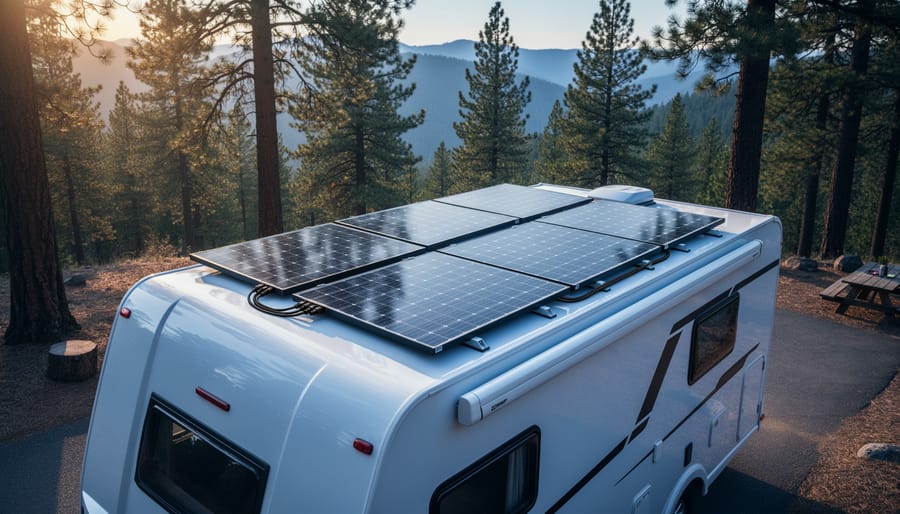
Lithium-ion batteries enable reliable off-grid power for RVs and mobile solar applications in remote locations.
For Off-Grid Cabins and Tiny Homes
For off-grid living, you’re building a system that needs to work reliably day after day, often in challenging conditions. I learned this the hard way during a winter at my friend’s cabin when his undersized battery bank left us in the dark by day three of cloudy weather.
Prioritize cycle life above all else. Look for batteries rated for at least 3,000 cycles at 80% depth of discharge. This translates to roughly 8-10 years of daily use before capacity significantly degrades. Temperature tolerance matters too since cabins experience wider temperature swings than grid-tied homes. Choose batteries with built-in heating elements or plan to insulate your battery enclosure.
Capacity should cover 3-5 days of autonomy during low-sun periods. Calculate your daily energy consumption, multiply by five, and add a 20% safety margin. Don’t forget about expandability. Select systems that allow you to add capacity later as your needs grow, whether that’s adding more appliances or extending your off-grid season into winter months.
For Grid-Tied Home Backup Systems
When you’re setting up a grid-tied system with battery backup, you’ll want to think about how much power you need during outages. I learned this the hard way during my first installation when I sized my battery bank thinking about total capacity, but forgot to check the continuous power output rating. My system could store plenty of energy, but couldn’t run my well pump and refrigerator simultaneously.
For home backup, look for batteries with at least 5kW continuous output if you want to power essential circuits during an outage. Round-trip efficiency matters here too, since you’re cycling the batteries regularly. Aim for 90% or higher to minimize energy waste. Most quality lithium-ion systems now include built-in inverters and automatic transfer switches, making installation much simpler than older setups.
Consider modular systems that let you start small and expand later. Your power needs might change, and scalability gives you flexibility without replacing everything.
Common Mistakes When Reading Battery Specs
I’ll be honest with you—I’ve fallen for some sneaky marketing tricks myself over the years, and I’ve watched plenty of fellow DIYers make costly mistakes that could’ve been avoided. Let me share what I’ve learned the hard way so you don’t have to repeat these errors.
The biggest trap? Confusing capacity with usable capacity. A battery might advertise 10kWh on the front of the box, but buried in the fine print, you’ll discover the manufacturer only recommends discharging it to 80% depth. Suddenly, that 10kWh becomes 8kWh of actual usable storage. Charles, a member of our community, shared his frustration after purchasing what he thought was a 15kWh system for his off-grid cabin, only to realize he had barely 11kWh to work with after accounting for the discharge limitations.
Another common gotcha involves cycle life ratings. Manufacturers love to advertise impressive numbers like “6,000 cycles,” but they often base this on shallow discharge cycles at perfect temperatures. Dig deeper into the spec sheet, and you might find that 6,000 drops to 3,000 cycles when you’re actually using 80% of the battery’s capacity in real-world conditions.
Temperature ratings also deserve scrutiny. Some batteries claim to work in extreme cold, but their charging capabilities might be severely restricted below certain temperatures—a detail that’s conveniently minimized in marketing materials.
Watch out for warranty language too. A “10-year warranty” might only cover catastrophic failure, not the gradual capacity degradation that actually affects performance. Always read what the warranty actually protects against and what capacity retention they guarantee over time. The difference between a good warranty and a mediocre one can mean thousands of dollars down the road.
You’ve now got the tools to decode those intimidating spec sheets and make confident decisions about lithium-ion batteries for your solar setup. Remember, the numbers aren’t there to confuse you—they’re your roadmap to finding the perfect battery that matches your energy needs, budget, and space constraints.
Start by using the solar calculator tools right here on our site to figure out your actual energy consumption. Once you know what you need, those capacity ratings, C-rates, and cycle life numbers will suddenly make a lot more sense. You’ll be able to spot which batteries deliver real value versus which ones are all marketing hype.
Don’t hesitate to share your experiences in the comments below. What batteries are you considering? What specs are still giving you trouble? This community thrives when we learn from each other’s successes and mistakes. Your question today might save someone else hours of research tomorrow.
Charles always says understanding specifications isn’t about becoming an engineer—it’s about becoming an informed buyer. “When you know what those numbers actually mean for your daily life,” he tells me, “you stop second-guessing your choices. You build systems that work reliably for years because you matched the technology to your real needs, not someone’s sales pitch.”
Take your time, use the tools available, and trust yourself. You’re more capable of this than you think.
How useful was this post?
Click on a star to rate it!
Average rating 0 / 5. Vote count: 0
No votes so far! Be the first to rate this post.
We are sorry that this post was not useful for you!
Let us improve this post!
Tell us how we can improve this post?
charlesnoble
Here at Spheral Solar, I’m a hands-on solar power enthusiast, constantly exploring and experimenting with DIY solutions. I’m dedicated to sharing my discoveries, insights, and even the bumps I hit along the way, all in the pursuit of a more sustainable future.
Wire Your Solar System Right the First Time (Before… by Charlesnoble March 18, 2026 Sketch your complete solar system on paper before purchasing a single component—mapping the physical distance from your solar panels to the charge controller, then to the battery bank, and finally to your inverter will reveal the exact wire gauges you need and prevent the costly mistake of voltage drop that…
Why Series-Parallel Is the Sweet Spot for Small Solar Setups by Charlesnoble December 2, 2025 Connect two panels in series to double your voltage, then wire two of these series pairs in parallel to maintain higher voltage while increasing your amperage—this series-parallel configuration gives you the sweet spot between performance and practicality for most small-scale solar setups. I learned this the hard way during my…
How to Test Your DIY Solar System Like a Pro… by Charlesnoble March 19, 2026 Flip the main DC disconnect three times while monitoring voltage drop—this single action reveals whether your connections can handle full load without dangerous resistance buildup. Check every MC4 connector with an infrared thermometer under peak sun; any reading more than 10 degrees above ambient temperature signals a faulty crimp that…
Why Your Solar Panel Connectors Matter More Than You Think by Charlesnoble March 4, 2026 Choose MC4 connectors for most residential solar installations—they’ve become the industry standard since 2011, offering waterproof reliability and simple snap-together connections that even first-time DIYers can master in minutes. I learned this the hard way when my first solar setup used mismatched connectors that corroded after one rainy season, costing…
Why Your Solar Panels Need the Right Mounting System… by Charlesnoble February 7, 2026 Your solar panels are only as reliable as what holds them in place. A solar array mounting system is the structural foundation that secures your panels to rooftops, ground surfaces, RVs, or portable setups, and choosing the wrong one can lead to damage, reduced efficiency, or even safety hazards. Think…
Why 8 AWG Solar Wire Might Be Wrong for Your System… by Charlesnoble December 29, 2025 Calculate your system’s maximum current first—8 AWG solar wire safely handles 40-55 amps depending on installation conditions, making it the sweet spot for mid-sized solar arrays between 1,200 and 3,000 watts at 12-24 volts. If your panels produce more than 40 amps combined, you need thicker wire; less than 30…
Subscribe for handpicked DIY projects, exclusive tips, and giveaways.
Match your solar panels to microinverters or power optimizers based on your roof’s shading patterns—even partial shade from a chimney or tree during morning hours means module-level power electronics will recover 15-25% more energy than string inverters lose to the weakest panel. Install power optimizers when you’re working with mixed panel orientations across multiple roof… Read more: Why Smart Solar Modules Could Save Your DIY Array (Before It’s Too Late)
Walk down to your nearest stream with a five-gallon bucket and a stopwatch. Fill that bucket and time how long it takes—this simple test reveals whether you have enough flowing water to power your off-grid home. If you can fill it in under 10 seconds from a source that drops at least 10 feet in… Read more: The Stream Behind Your House Could Power It (Here’s How Micro Hydro Works)
Brush snow off your panels with a soft-bristled roof rake from ground level, working gently from bottom to top to avoid scratching the glass or damaging your DIY solar setup. Use lukewarm water in a spray bottle for stubborn ice patches, never hot water that could crack cold panels from thermal shock. Install panels at… Read more: Snow on Your Solar Panels? Here’s What Actually Works (And What Wastes Your Time)