Why Your Solar Conduit Installation Could Start a Fire (And How to Do It Right)
Updated:
Measure your conduit run before purchasing materials by mapping the exact path from your solar array to the inverter and battery location, accounting for a 10% waste factor and additional length for bends. PVC electrical conduit remains the most cost-effective protective solution for DIY solar installations, but improper installation creates fire hazards, code violations, and system failures that cost thousands to repair.
Cut your PVC conduit with a hacksaw or PVC cutter at perfect 90-degree angles, then immediately deburr all edges with a reaming tool or file to prevent wire insulation damage during pulls. I learned this lesson the hard way during my first installation when rough edges stripped the jacket off my DC wiring, forcing me to re-pull 75 feet of expensive solar cable.
Apply PVC primer and cement generously to both the conduit end and fitting interior, then twist the joint a quarter-turn while inserting to ensure complete adhesive coverage. This creates waterproof seals that protect your electrical connections from moisture infiltration, which causes ground faults and equipment damage in outdoor solar applications.
Plan your bends strategically using sweep elbows rather than sharp 90-degree fittings whenever possible, as gradual curves reduce wire pulling tension and prevent insulation damage. National Electrical Code limits you to 360 degrees of total bends between pull points, meaning four 90-degree turns requires an access junction box for future maintenance.
Support your conduit every 3 feet for horizontal runs and every 5 feet for vertical installations using proper straps or clamps designed for PVC. Unsupported conduit sags over time, creating low spots where condensation accumulates and potentially damages your solar system’s expensive conductors. This guide walks you through every critical step, from material selection through final inspection, ensuring your DIY solar conduit installation meets professional standards and passes code requirements.
Understanding PVC Conduit in Solar Systems
Why Solar Wiring Is Different
When I first installed conduit for my friend’s rooftop solar array, I made the rookie mistake of treating it like indoor electrical work. Big mistake! Solar installations face challenges that your typical indoor wiring never encounters, and understanding these differences is critical for a safe, long-lasting system.
First up is the outdoor exposure factor. Unlike the protected environment inside your walls, solar conduit deals with rain, snow, ice, and blazing sun day after day, year after year. That constant moisture exposure means you need conduit rated specifically for wet locations, not just damp ones. I learned this the hard way when water pooled inside poorly sealed conduit after a heavy rainstorm.
Temperature extremes are another game-changer. Your rooftop can easily hit 150°F on a summer afternoon, then drop below freezing at night. This constant expansion and contraction stresses both the conduit and the connections. PVC becomes brittle in extreme cold and can soften in intense heat, which is why choosing the right schedule thickness matters so much for solar applications.
Then there’s the DC voltage consideration. Solar panels generate high DC voltages that behave differently than the AC power in your home. While the conduit itself doesn’t care about voltage type, the unique electrical characteristics mean proper grounding and separation become even more important.
Finally, UV degradation is the silent destroyer. Standard PVC conduit not rated for sunlight exposure will become chalky and brittle within just a few years. Always look for UV-resistant or sunlight-resistant ratings on any conduit exposed to direct sun.
Types of PVC Conduit for Solar Applications
When I first started working with solar installations, I made the rookie mistake of thinking all PVC pipe was created equal—it’s not, and choosing the right conduit matters more than you’d think.
For solar applications, you’ll encounter two main thickness ratings: Schedule 40 and Schedule 80. Schedule 40 works fine for most residential installations and is lighter on your wallet. Schedule 80 has thicker walls, making it tougher and required for exposed areas where physical damage is likely—think along driveways or in high-traffic zones.
You’ll also choose between rigid PVC (the straight sections you cut to length) and flexible PVC (bendable sweeps that reduce the need for elbow fittings). Rigid is your workhorse for most runs, while flexible makes navigating corners cleaner.
Here’s the critical part: only use gray electrical-rated PVC conduit, never white plumbing pipe. While they look similar, white PVC isn’t UV-resistant, flame-rated, or code-compliant for electrical work. Inspectors will flag it immediately, and sunlight will degrade it within months. The few dollars you’d save aren’t worth the safety risk or failed inspection.
Schedule 40 and Schedule 80 PVC conduits differ in wall thickness and durability, with Schedule 80 being required for exposed outdoor solar installations.
Planning Your Conduit Run Before You Buy Anything
Measuring and Mapping Your Path
Before you start bending conduit or drilling holes, grab a cup of coffee and spend quality time planning your route. I learned this lesson the hard way when I had to redo an entire conduit run because I didn’t account for the HVAC unit that got installed two months after my solar setup. Trust me, measuring twice really does save you from installing twice.
Start at your solar panels and trace the logical path to your inverter or charge controller, then onward to your battery bank installation. Walk this route physically, smartphone in hand, taking photos of every obstacle: roof vents, AC units, trees that might grow, and areas where you might want to add panels later.
Use masking tape or chalk to mark your proposed conduit path along walls and ceilings. This visual guide helps you spot problems before they become expensive mistakes. Consider vertical versus horizontal runs, keeping in mind that water can accumulate in conduit, so you’ll need drainage points at low spots.
Think about expansion now, not later. That single conduit might seem adequate today, but what happens when you add more panels next year? Running a second, larger conduit alongside your first is much harder than starting with appropriate sizing. Leave at least 6 inches of clearance around your conduit route for future maintenance access. Your future self, crouched in that tight attic space, will thank your present self for this foresight.
Code Requirements You Can’t Ignore
Let me be straight with you—I’ve seen too many DIY solar projects that looked great until the inspector showed up. The National Electrical Code Article 352 covers PVC conduit, and while you don’t need to memorize the whole thing, there are some non-negotiable rules you need to follow.
First up, burial depth. Underground PVC conduit must be buried at least 18 inches deep when protected by GFCI protection, or 24 inches without it. These proper burial depth requirements aren’t suggestions—they protect your conduit from damage and prevent someone from accidentally digging into live electrical lines. I learned this the hard way when a neighbor’s landscaper nearly hit my shallow-buried line with a shovel.
Support spacing matters too. You need to secure PVC conduit every 3 feet and within 3 feet of any junction box or enclosure. This prevents sagging and stress on your connections over time.
Fill capacity is critical but simple: never fill your conduit more than 40 percent with wire. A 3/4-inch conduit can handle three 10-gauge wires comfortably. Overstuffing makes pulling wire nearly impossible and violates code.
Now, when do you need a professional? Always pull permits for solar installations—no exceptions. If you’re connecting to your main service panel, running circuits over 50 amps, or feeling uncertain about any step, call a licensed electrician. Your insurance and safety depend on it. Remember, permits aren’t obstacles—they’re your protection against costly mistakes.
Tools and Materials Checklist
Before you dive into your PVC conduit installation, let’s make sure you’ve got everything lined up. I learned this lesson the hard way during my first solar project when I made three trips to the hardware store in one afternoon. Trust me, checking off this list beforehand will save you time, frustration, and gas money.
First up, you’ll need PVC conduit itself. For most outdoor solar installations, I recommend Schedule 40 PVC in the appropriate diameter for your wire gauge. Schedule 40 is UV-resistant and durable enough for exposed runs. Schedule 80 is stronger but costs more, so save it for areas where the conduit might take a beating. Most residential solar setups work fine with 3/4-inch or 1-inch conduit, but always check your wire fill calculations first.
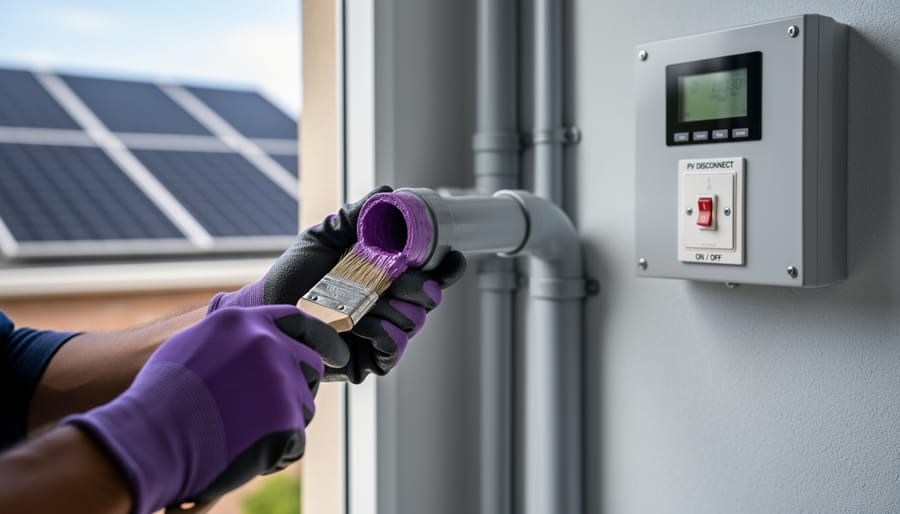
For connections, grab PVC fittings including elbows, couplings, junction boxes, and sweep bends. Sweep bends are gentler on wires than sharp 90-degree elbows, making wire pulling much easier. You’ll also need PVC cement and primer. The purple primer isn’t just for show, it actually prepares the plastic for bonding. Get the cement and primer combo pack for budget savings.
Your cutting and measuring tools should include a hacksaw or PVC cutter, measuring tape, and a marker. A PVC cutter gives cleaner cuts than a hacksaw and costs around fifteen dollars, making it a worthwhile investment if you’re running more than a few pieces.
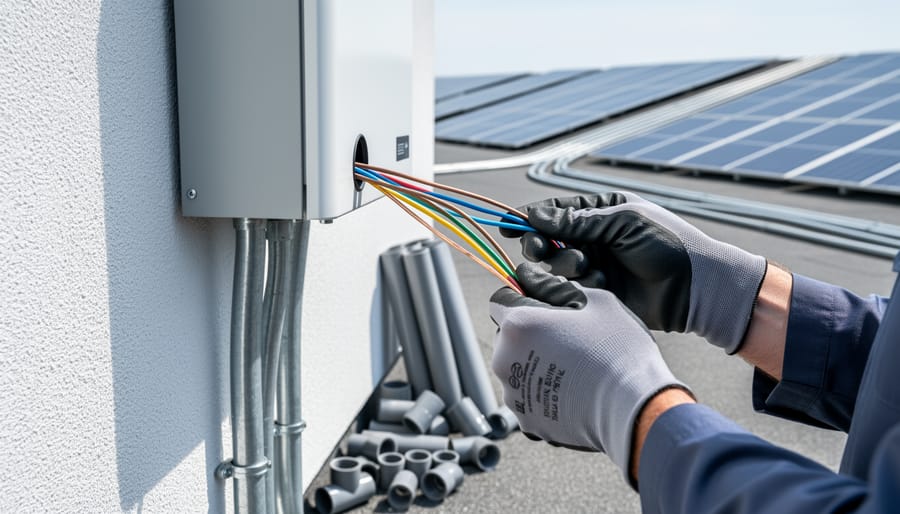
For wire installation, you’ll need fish tape or a pull string, wire lubricant designed for electrical applications, and proper gauge wire rated for your system. Don’t skip the lubricant, it prevents insulation damage and makes pulling wire dramatically easier.
Safety gear is non-negotiable: safety glasses, work gloves, and proper footwear. If you’re working on a roof or ladder, add fall protection equipment.
Finally, keep a deburring tool or file handy to smooth cut edges, preventing wire insulation nicks during pulling. Some installers use sandpaper, which works but takes longer.
Step-by-Step PVC Conduit Installation
Cutting and Deburring Conduit
Clean cuts make all the difference when working with PVC conduit for your solar installation. I learned this the hard way on my first project when rough edges inside the conduit actually damaged wire insulation during pulling. Not fun to discover after everything was already in place.
For cutting, a standard hacksaw works perfectly fine, though a PVC tubing cutter gives you straighter cuts with less effort. Whatever tool you choose, measure twice and cut once. Hold the conduit steady in a vise or against a stable surface, and use smooth, even strokes to avoid cracking.
Here’s the non-negotiable part: deburring. Those sharp edges and plastic shavings inside the freshly cut conduit are like tiny knives waiting to nick your wire insulation. When you’re pulling expensive solar cables through, the last thing you want is compromised protection that could lead to shorts or failures down the road.
The technique is beautifully simple. Grab a deburring tool, rounded file, or even a folded piece of medium-grit sandpaper. Insert it into the cut end and rotate it around the interior edge until smooth. Run your finger inside to check. If it feels rough, keep going. The exterior edge needs attention too, just a quick pass to knock down any burrs. This thirty-second step protects your entire electrical system.
Proper cutting and deburring techniques prevent wire insulation damage and ensure smooth wire pulls through conduit runs.
Dry-Fitting Your Entire Run First
Here’s my biggest lesson from ten years of solar installations: every minute you spend dry-fitting saves an hour of frustration later. Trust me on this one.
Dry-fitting means assembling your entire conduit run without glue, just pushing pieces together snugly. It’s like a rehearsal before the big performance. Start at your solar array and work toward your combiner box or inverter, connecting every straight section, elbow, and coupling along the way.
Why bother? Because once that PVC cement sets, you’re committed. I learned this the hard way when I permanently installed a beautiful conduit run that ended up three inches short of my junction box. Not my proudest moment.
During your dry-fit, check three things: First, does everything actually reach where it needs to go? Second, are your bends gradual enough that wires will pull through easily later? Third, can you access all your junction points for future maintenance?
Walk the entire route and gently wiggle each connection. Mark problem spots with painter’s tape. If an elbow creates too sharp a turn, consider adding another support and using two gentler bends instead. Adjust support spacing if sections sag.
Once everything fits perfectly and you’ve double-checked measurements, you’re ready to make it permanent.
Proper Gluing and Assembly Techniques
Getting your PVC conduit joints right is absolutely critical for protecting your solar wiring long-term. I learned this the hard way on my first installation when a poorly glued joint popped apart during a cold snap, leaving my conduit run looking like a broken sprinkler system. Let me walk you through the process so you can avoid my rookie mistakes.
First, you need both primer and cement, not just cement alone. The purple primer isn’t just there to mark your work. It actually softens the PVC surface and removes the glossy manufacturing coating, creating a chemical bond that fuses the pieces together. Apply primer to both the inside of the fitting and the outside of the pipe, working quickly since it dries fast.
Immediately follow with PVC cement while the primer is still wet. Apply a generous, even coat to both surfaces, then push the pipe into the fitting with a quarter-turn twist. You’ve got about 30 seconds of working time, so move with purpose but don’t panic. Hold the joint firmly for 15-30 seconds to prevent push-out.
Temperature matters more than most people realize. When it’s below 40°F, the cement sets much slower and joints can fail. If you must work in cold conditions, warm your materials indoors first and allow double the normal cure time. In hot weather above 100°F, reduce your working time by half since everything sets faster.
Allow joints to cure for at least 15 minutes before handling, two hours before pressure testing, and a full 24 hours before pulling wire. Rushing this step causes more failures than any other mistake.
Proper primer and cement application with adequate working time ensures permanent, leak-proof conduit joints that won’t fail under stress.
Mounting and Supporting Conduit
Getting your conduit properly supported is essential for a clean, professional installation that passes inspection and lasts for decades. I learned this the hard way on my first solar project when I spaced my supports too far apart—within six months, I had sagging conduit that looked terrible and put stress on my connections.
The golden rule for PVC conduit is to place supports every 3 feet for straight runs. When you have bends or directional changes, add a support within 3 feet of each side of the fitting. This prevents stress on joints and keeps everything aligned. For vertical runs, tighten up that spacing slightly to every 2.5 feet.
Choosing the right hardware matters too. For wooden surfaces like roof rafters or wall studs, one-hole straps with corrosion-resistant screws work beautifully. On masonry or concrete, you’ll need masonry anchors or tapcons. For metal surfaces, self-tapping screws designed for metal work best. When securing conduit to the ground for longer runs, use ground stakes or concrete-mounted j-hooks every 5 feet.
Here’s a pro tip from years of installations: before tightening your straps completely, step back and sight down the entire run from multiple angles. Make small adjustments to ensure your conduit runs perfectly straight and level—this attention to detail transforms a functional installation into something you’ll be proud to show your neighbors.
Weatherproofing Entries and Exits
Water is the enemy of electrical systems, so protecting your conduit transitions is absolutely critical—especially where your system meets the outside world. I learned this the hard way when a poorly sealed entry point on my first solar setup let in rainwater during a storm, causing a frustrating weekend of repairs.
Start with a quality weatherhead at the top of any vertical conduit run exposed to the elements. These specially designed fittings curve downward, preventing rain from entering your conduit. For horizontal entries through walls or roofs, LB fittings (shaped like an “L” with a removable back plate) work beautifully and allow easy wire pulling while keeping water out.
The real magic happens with proper sealing. Apply silicone caulk generously around all penetrations where conduit enters buildings or equipment. Don’t skimp here—create a complete seal that bonds to both the conduit and the surface material. For threaded connections on weatherheads and LB fittings, use pipe thread sealant or Teflon tape to prevent moisture from wicking into threads.
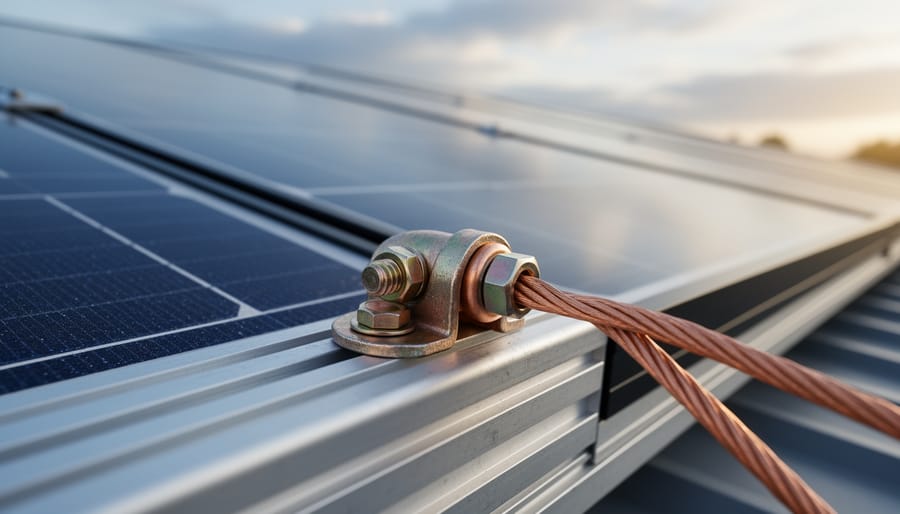
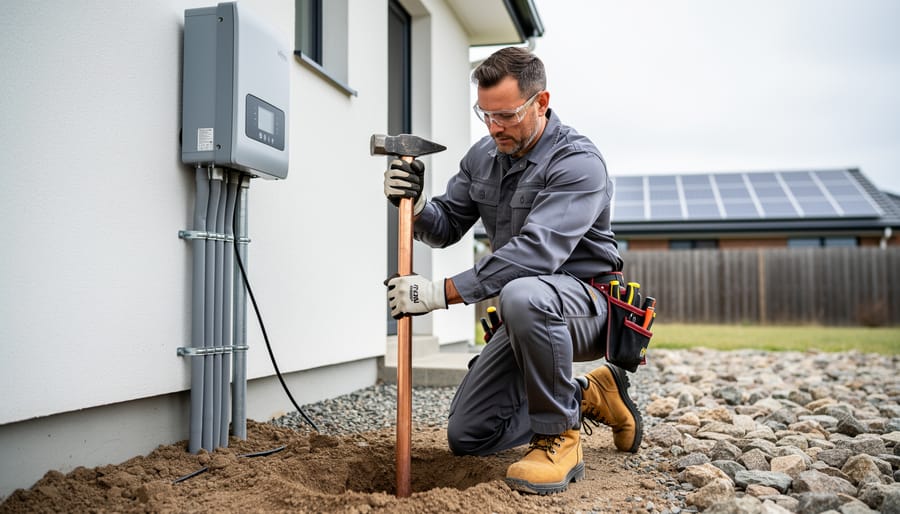
Remember, your conduit system works alongside your proper grounding system to keep everything safe. Every outdoor connection should include a drainage hole or weep hole at the lowest point to let any condensation escape rather than pool inside. Think of it as giving your system a way to breathe while keeping the rain out.
Professional conduit installation with proper support spacing and weatherproof fittings protects solar wiring from environmental damage and ensures code compliance.
Pulling Wire Through Conduit Without Losing Your Mind
I’ll be honest with you – my first wire-pulling experience was humbling. I spent two hours fighting with 50 feet of 10-gauge wire before my neighbor Charles wandered over, watched me struggle for about thirty seconds, and said, “You know they make lubricant for that, right?” Game changer.
Let’s start with the math, because cramming too much wire into your conduit is asking for trouble. The National Electrical Code limits conduit fill to 40% for three or more conductors. Most online conduit fill calculators will do the heavy lifting for you – just input your wire gauge and conduit size. For a typical solar installation running four conductors (two positives, two negatives) in 3/4-inch PVC, you’re usually in good shape with 10 AWG wire, but always verify.
Fish tape is your best friend here. I prefer fiberglass fish tape for PVC work because it’s flexible and won’t scratch up your conduit interior. Start by feeding the tape through your conduit before attaching any wire – this confirms your path is clear and gives you a feel for any tight bends. If your tape gets stuck, you’ve likely got a problem that needs addressing before you attempt wire pulling.
Here’s where that lubricant comes in. Wire-pulling lubricant (not soap, not oil – actual pulling lube) reduces friction dramatically. Apply it generously to your wires, especially at the entry point. Charles swears by the gel formulas, and after years of doing this, I agree. A little goes a long way, but don’t be stingy.
For runs under 50 feet with minimal bends, one person can usually handle the job. Beyond that, recruit a helper. One person feeds wire while the other pulls steadily – no jerking motions. Communication is critical. We use simple calls: “feeding” and “stop” work perfectly.
If you’re pulling through multiple bends or distances over 100 feet, consider installing pull boxes at strategic points. These junction boxes break your run into manageable sections and give you access points for future modifications.
Know when you’re beaten. If you’ve tried twice and your wire won’t budge, stop. Forcing it risks damaging wire insulation, which creates serious safety hazards. Sometimes the answer is rethinking your conduit route or adding another pull point.
Critical Safety Mistakes DIYers Make (That I’ve Made Too)
I’ll be honest with you—I’ve learned most of what I know about conduit installation by making mistakes first. My very first solar project? I buried Schedule 40 PVC only four inches deep because I figured “close enough” to code was fine. Six months later, a landscaper’s shovel went right through it. That repair cost me a full weekend and my pride.
The most common mistake I see (and made myself) is using the wrong conduit type. Not all PVC is created equal. I once grabbed some plumbing PVC from the hardware store because it looked identical and was cheaper. Big problem—plumbing PVC isn’t rated for electrical work and can’t handle the heat from wire current. Always use gray electrical-rated Schedule 40 or Schedule 80 conduit, depending on your application.
Overfilling conduit is another trap that’s easy to fall into. I remember cramming eight conductors into a three-quarter-inch conduit because I didn’t want to upsize. The wires got damaged during the pull, and I had to start over. The fill capacity tables exist for good reasons—follow them religiously. Generally, you want to keep total wire area under 40 percent of the conduit’s cross-section.
Then there’s the expansion fitting issue. PVC expands and contracts significantly with temperature changes, something I learned watching my first conduit run buckle during a hot summer day. Long runs need expansion fittings every 100 feet or so, especially in areas with wide temperature swings.
UV exposure is sneaky too. I left exposed PVC on my roof thinking it was fine since it’s plastic. Within two years, it became brittle and cracked. If your conduit sees sunlight, use UV-resistant Schedule 80 or paint Schedule 40 with two coats of latex paint.
These critical installation mistakes seem minor until they cause real problems. Learn from my experiences and save yourself the headaches.
Inspection and Testing Your Installation
Before you flip any breakers or connect your solar array, let’s talk about the crucial step many DIYers rush through: inspection and testing. I learned this lesson the hard way during my first garage solar setup when I skipped ahead and had to redo three conduit runs because of code violations an inspector caught.
Start with a visual walk-through of your entire installation. Check that every coupling is tight, support straps are properly spaced (remember that 3-foot rule for PVC), and conduit ends are properly reamed with no sharp edges that could damage wire insulation. Look for any sagging sections or spots where the conduit might collect water without proper drainage holes. Take photos as you go – these become invaluable documentation later.
Next, verify your wire pull went smoothly by gently tugging on conductors at both ends. There should be a bit of slack, not tension. Before making any connections, use a simple continuity tester or multimeter to check that your ground wire maintains connection throughout the run and that no conductors are shorted together.
When the official inspector arrives, they’ll focus on several key areas: proper conduit sizing for wire fill, secure mounting, correct transition fittings between buried and above-ground sections, and appropriate junction box accessibility. They’ll also verify you’ve maintained required clearances from windows, doors, and other structures.
Create a simple documentation folder with your photos, a hand-drawn diagram showing conduit routes, wire gauges, and breaker sizes. Include product specifications and receipts. Future you (or the next homeowner) will thank you when it’s time for system expansion or troubleshooting. This record also demonstrates the professional approach you took, which can positively impact home value and insurance considerations.
Here’s the thing I’ve learned after years of working with solar systems: proper PVC conduit installation isn’t just about getting wires from point A to point B. It’s about creating a system that will protect your investment and keep your family safe for decades to come. I remember one of my first installations where I rushed through the conduit work, thinking it was just the boring prep work before the exciting solar panel installation. Years later, I had to redo sections because water had infiltrated through poorly sealed connections. That lesson stuck with me.
The good news? You absolutely can do this right, even if you’ve never touched conduit before. I’ve seen countless DIYers successfully tackle their first installations by simply taking their time, double-checking measurements, and not being afraid to redo a connection that doesn’t feel quite right. That patience and attention to detail is what separates a professional-grade installation from one that’ll cause headaches down the road.
Remember, electrical code requirements exist because they’re based on real-world failures and safety lessons learned over generations. Following them isn’t bureaucratic hassle, it’s your blueprint for success.
If you’re planning your conduit runs and need help sizing your wire gauge correctly, check out our solar wire size calculator to ensure your entire electrical system works together seamlessly.
Have questions about your specific installation scenario or want to share your own conduit installation experience? Drop a comment below and let’s help each other build safer, more reliable solar systems.
How useful was this post?
Click on a star to rate it!
Average rating 0 / 5. Vote count: 0
No votes so far! Be the first to rate this post.
We are sorry that this post was not useful for you!
Let us improve this post!
Tell us how we can improve this post?
charlesnoble
Here at Spheral Solar, I’m a hands-on solar power enthusiast, constantly exploring and experimenting with DIY solutions. I’m dedicated to sharing my discoveries, insights, and even the bumps I hit along the way, all in the pursuit of a more sustainable future.
Why Your 6-Wire Solar Setup Needs the Right Conduit… by Charlesnoble March 6, 2026 Measure your wire gauge and count of six conductors before selecting conduit—most residential solar installations running six AWG 10 wires require 1-inch conduit, while six AWG 6 wires need 1.5-inch conduit, and six AWG 2/0 wires demand 2.5-inch conduit minimum. Calculate fill capacity using the 40% rule for three or…
Why Your DIY Solar System Needs Proper Grounding… by Charlesnoble January 31, 2026 Ground your solar system before you connect a single wire—improper grounding has destroyed thousands of dollars in equipment and created deadly shock hazards in homes just like yours. I learned this the hard way when a lightning strike fried my neighbor’s ungrounded inverter, teaching me that grounding isn’t optional paperwork…
Why Your Solar Ground Rod Might Be Too Short (And… by Charlesnoble January 15, 2026 Drive your 8-foot copper-clad steel grounding rod at least eight feet into the earth, or to the depth where you meet solid bedrock. This isn’t arbitrary—the National Electrical Code requires this specific length because it ensures your solar panels and battery storage system have a reliable path to dissipate dangerous…
This Single Mistake Could Destroy Your Entire Solar… by Charlesnoble January 4, 2026 Ground your lightning protection system with at least two 8-foot copper-clad ground rods driven into moist soil and spaced 16 feet apart, then bond them together with 6 AWG bare copper wire. This creates the essential foundation that channels lightning strikes safely into the earth, protecting your solar panels, inverter,…
Why Your Rooftop Solar Could Block Firefighters (And… by Charlesnoble January 8, 2026 Measure three feet from your roof’s eaves before placing any solar panels—this clearance creates a critical pathway firefighters use to ventilate roofs during emergencies. When flames engulf a building, firefighters climb onto roofs and cut ventilation holes near the eaves to release heat and smoke, giving occupants precious escape time…
Why Your DIY Solar Trench Could Cave In (And How to… by Charlesnoble March 2, 2026 Dig a trench deeper than four feet for your ground-mounted solar array, and you’re entering territory where the walls can collapse without warning—burying you in seconds under thousands of pounds of soil. I learned this the hard way when planning my first major DIY solar project: what seemed like simple…
Subscribe for handpicked DIY projects, exclusive tips, and giveaways.
Match your solar panels to microinverters or power optimizers based on your roof’s shading patterns—even partial shade from a chimney or tree during morning hours means module-level power electronics will recover 15-25% more energy than string inverters lose to the weakest panel. Install power optimizers when you’re working with mixed panel orientations across multiple roof… Read more: Why Smart Solar Modules Could Save Your DIY Array (Before It’s Too Late)
Measure your conduit run before purchasing materials by mapping the exact path from your solar array to the inverter and battery location, accounting for a 10% waste factor and additional length for bends. PVC electrical conduit remains the most cost-effective protective solution for DIY solar installations, but improper installation creates fire hazards, code violations, and… Read more: Why Your Solar Conduit Installation Could Start a Fire (And How to Do It Right)
Walk down to your nearest stream with a five-gallon bucket and a stopwatch. Fill that bucket and time how long it takes—this simple test reveals whether you have enough flowing water to power your off-grid home. If you can fill it in under 10 seconds from a source that drops at least 10 feet in… Read more: The Stream Behind Your House Could Power It (Here’s How Micro Hydro Works)