Why Commercial Rooftop Solar Isn’t Just for Experts (And How to Get Started)
Updated:
Calculate your building’s solar potential by measuring the usable roof area—subtract space for HVAC units, vents, and required maintenance walkways, then multiply by 15 watts per square foot for a quick capacity estimate. Most commercial roofs between 5,000 and 50,000 square feet can support systems ranging from 30kW to 400kW, enough to offset 40-80% of typical small business energy costs.
Verify your local utility’s interconnection requirements before designing anything. Small commercial systems under 100kW often qualify for streamlined approval processes, but you’ll need specific documentation including single-line electrical diagrams, structural engineering stamps, and proof of liability insurance. Contact your utility’s distributed generation department directly—their requirements will shape everything from inverter selection to metering equipment.
Assess your roof’s structural capacity through a professional engineering evaluation, even if you plan to handle other aspects yourself. Commercial roofs typically need to support 3-5 pounds per square foot for solar arrays, but older buildings, especially those with flat roofs or long spans between supports, may require reinforcement costing $2-8 per square foot. This step isn’t optional and cannot be accurately DIYed—structural failure liability far exceeds any cost savings.
Understanding how solar systems work at the residential level provides a foundation, but commercial installations introduce additional complexity through three-phase power, demand charges, and time-of-use rates that dramatically affect system design and financial returns.
Choose between ballasted and attached mounting systems based on your roof type and local wind loads. Ballasted systems work well on flat commercial roofs, require no roof penetrations, and simplify future removal, but add significant weight. Attached systems penetrate the roof membrane but distribute loads more efficiently and withstand higher wind speeds—critical for buildings in coastal or high-wind areas where insurance and code requirements become stricter.
What Makes Commercial Rooftop Solar Different from Residential
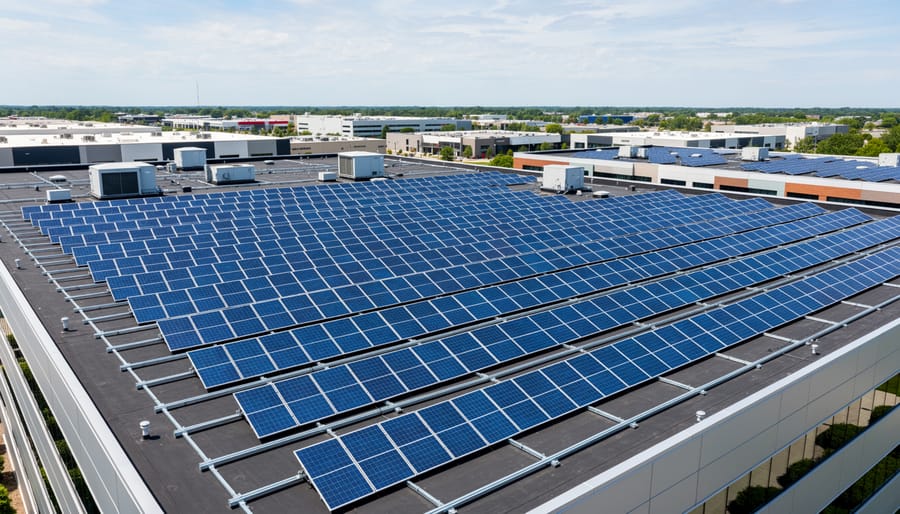
Commercial rooftop solar installations typically range from 25kW to several megawatts, utilizing the expansive flat roof space available on commercial buildings.
Scale and System Capacity
When I first started exploring solar beyond my own rooftop, the jump from residential to commercial systems felt intimidating. But understanding the scale difference really helped put things in perspective, and I think it’ll do the same for you.
Residential solar systems typically range from 3kW to 10kW, which is perfect for powering a home. Commercial rooftop systems, on the other hand, start around 25kW and can scale up to several megawatts depending on the building size and energy needs. To put this in practical terms, a 100kW commercial system might produce around 120,000-150,000 kWh annually in a sunny location, enough to power roughly 10-15 average homes.
The beauty of commercial rooftops lies in their unique opportunities. First, you’ve got significantly more unshaded space to work with. While your home might have trees, chimneys, or awkward roof angles limiting panel placement, commercial buildings often feature large, flat, unobstructed surfaces that are ideal for solar arrays. Second, the economics shift dramatically at this scale. Businesses can take advantage of accelerated depreciation, commercial tax incentives, and lower per-watt installation costs due to bulk purchasing.
I remember visiting a local warehouse that installed a 250kW system on their roof. The owner told me they were generating about 80 percent of their daytime electricity needs, and the return on investment was projected at just six years. That’s the power of scale working in your favor. The larger the system, the more efficient the entire operation becomes, from installation to ongoing energy production.
Structural and Load-Bearing Considerations
When I first started exploring commercial solar installations, I was surprised to learn how fundamentally different rooftop requirements are compared to residential projects. Understanding these differences is essential whether you’re researching options for your business or considering a more ambitious DIY project.
Commercial buildings typically feature flat or low-slope roofs rather than the pitched roofs you’d find on most homes. This changes everything about how solar panels get mounted. Instead of attaching directly to angled shingles, commercial systems use ballasted racking systems or penetrating mounts that secure to the roof deck. Ballasted systems use weighted trays to hold panels in place without drilling holes, which many building owners prefer since it maintains roof integrity. However, they require careful weight calculations to ensure the roof can handle the load.
Here’s where things get technical but important: commercial roofs must support significantly more weight than residential installations. A typical commercial solar array can add 3-5 pounds per square foot, sometimes more with ballasted systems. Your building’s structural engineer needs to verify that existing load-bearing capacity can accommodate this additional weight, factoring in snow loads, wind uplift forces, and equipment weight. Older buildings may require reinforcement before installation can proceed.
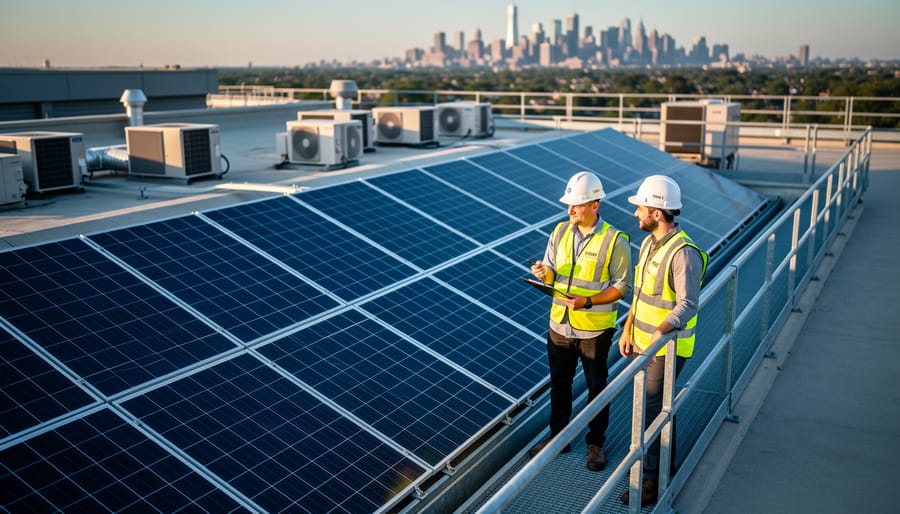
The mounting systems themselves are more robust than residential versions. Commercial installations often use aluminum or steel racking designed for larger panel arrays spanning hundreds of feet. These systems must account for thermal expansion, wind zones, and seismic requirements specific to your location. While understanding these principles is valuable, this is definitely an area where professional engineering assessment isn’t optional—it’s a building code requirement and crucial for safety.
Commercial mounting systems must account for weight distribution, wind loads, and different roof types compared to residential pitched roof installations.
The Design Fundamentals You Need to Know
Site Assessment: Reading Your Rooftop’s Potential
Before you even think about permits or panel specifications, you need to understand what you’re working with. I learned this the hard way during my first commercial consultation when I showed up with grand plans, only to discover the roof could barely support the existing HVAC units, let alone a solar array!
Start with the basics: orientation and shading. South-facing roofs are your sweet spot in the Northern Hemisphere, capturing maximum sunlight throughout the day. East and west orientations work too, though they’ll produce less overall. Take note of nearby buildings, trees, or structures that cast shadows. Even partial shading can significantly impact your system’s performance, so grab your smartphone and take photos at different times of day, especially morning and mid-afternoon when shadows are longest.
Next, measure your available square footage. Commercial roofs often have more obstacles than residential ones—HVAC systems, exhaust vents, skylights, and maintenance walkways all reduce usable space. A good rule of thumb: you need roughly 100 square feet per kilowatt of solar capacity, though modern high-efficiency panels can squeeze more power into less space.
Here’s where it gets exciting. Many commercial systems generate 250 to 400 watts per panel, meaning a 2,000 square foot clear area could support a 20-30 kilowatt system. That’s substantial power generation for a small to medium business.
To make this easier, we’ve developed interactive calculators on our site that help you estimate your system capacity based on your specific measurements and location. Input your roof dimensions, shading factors, and local sun hours, and you’ll get a realistic projection of what your rooftop can deliver. These tools take the guesswork out of preliminary planning and help you decide whether scaling up to commercial makes sense for your situation.
System Configuration and Equipment Selection
When you’re stepping up from residential to commercial rooftop solar, the equipment decisions become more critical—and honestly, a bit more exciting. I remember touring my first commercial installation with a friend who owns a local brewery, and seeing how different the component choices were compared to home systems really opened my eyes.
Let’s talk inverters first. You’ve essentially got two main camps: string inverters and microinverters. String inverters are the workhorse of commercial installations. They’re cost-effective for larger arrays, handle higher voltages efficiently, and when you’ve got a roof without shading issues, they’re fantastic. One string inverter can manage multiple panels, which means fewer connection points and simpler monitoring. However, if one panel underperforms, it can drag down the whole string—something to keep in mind.
Microinverters, on the other hand, attach to each individual panel. They’re brilliant for roofs with complex layouts, chimneys, HVAC units, or partial shading. Each panel operates independently, so you won’t lose production from your entire array if one panel has issues. They’re pricier upfront, but the panel-level monitoring is incredibly valuable for catching problems early and keeping your maintenance requirements minimal.
For panel selection, commercial applications demand durability. Look for panels rated for high wind loads and with strong warranties—typically 25 years for performance. Monocrystalline panels offer better efficiency per square foot, which matters when roof space is premium.
Finally, racking systems need to match your roof type. Ballasted systems work great for flat commercial roofs without penetrating the membrane, while attached racking provides security for sloped installations. Always verify your roof can handle the additional weight—this is where consulting a structural engineer becomes essential, even for experienced DIYers.
Electrical Design Basics
Understanding the electrical side of commercial rooftop solar doesn’t require an engineering degree—think of it like understanding the difference between the wiring in your home and a small office building. Commercial systems are essentially scaled-up versions of residential setups, but with some important distinctions.
Commercial solar arrays use string configurations where multiple panels connect in series to increase voltage, then multiple strings connect in parallel through combiner boxes. Picture it like a river system: individual streams (panel strings) merge into larger tributaries (combiners) before flowing into the main river (your building’s electrical service). These combiner boxes consolidate all that DC power, making the system manageable and efficient.
One major difference from residential systems is three-phase power. Most homes use single-phase electricity, but commercial buildings typically run on three-phase power to handle larger loads. Your solar inverter must match this configuration, distributing power evenly across all three phases—like balancing weight equally on a three-legged stool rather than a single post.
Safety equipment is non-negotiable in commercial installations. Disconnect requirements are more stringent, typically requiring both a rooftop DC disconnect and a ground-level AC disconnect. These allow firefighters and maintenance workers to safely de-energize the system during emergencies.
I learned this firsthand when helping a community workshop install their system—the inspector spent considerable time verifying every disconnect switch was properly labeled and accessible. That attention to detail isn’t bureaucratic hassle; it’s about keeping everyone safe while maximizing your solar investment.
Navigating the Compliance Maze (Without Losing Your Mind)
Building Codes and Structural Engineering Requirements
Before those solar panels ever touch your commercial roof, you’ll need to make sure the building can actually handle them. I learned this the hard way when I consulted on a project where we discovered mid-installation that the roof structure needed reinforcement—talk about an expensive surprise!
Most commercial buildings require a structural engineering assessment before solar installation. Your engineer will calculate whether the existing roof can support the added weight of panels, mounting equipment, and potential snow accumulation. Older buildings, especially those built before modern codes, often need extra attention. The assessment typically costs between $1,500 and $5,000, but it protects you from catastrophic failures that could damage your entire building.
Building codes exist to keep everyone safe, and they’re surprisingly specific about solar installations. Fire setbacks are a big one—most jurisdictions require clear pathways around your array so firefighters can access the roof safely. These setbacks are typically 3-6 feet wide and can significantly impact how many panels you can install. Wind and snow load calculations determine how your mounting system needs to be anchored. A roof in Buffalo faces very different requirements than one in Phoenix!
Your local building department will review these calculations during the permit process. They’re not trying to make your life difficult—they’re ensuring your investment doesn’t become a liability. Working with experienced solar installers who understand local codes saves enormous headaches. They’ll handle most of this paperwork, but understanding these requirements helps you ask the right questions and budget appropriately from the start.
Electrical Codes and NEC Standards
When you’re stepping into commercial rooftop solar, you’re entering a world where electrical codes become much more serious than residential installations. The National Electrical Code (NEC) sets the ground rules, and understanding these requirements isn’t just about passing inspections—it’s about keeping people safe.
Let me share something from my early days working with commercial systems: I once saw a beautifully installed array that had to be partially dismantled because the rapid shutdown requirements weren’t properly implemented. It was a costly lesson for everyone involved. Rapid shutdown systems ensure that if there’s an emergency, firefighters and other first responders can quickly de-energize the solar panels. These systems must reduce DC voltage to safe levels within seconds, typically bringing conductors more than ten feet from the array down to 80 volts or less. This requirement exists because solar panels continue producing power as long as sunlight hits them—there’s no simple off switch.
Grounding requirements are another critical aspect. Commercial systems need robust grounding to protect against lightning strikes and electrical faults. The NEC specifies exact bonding methods for racking systems and equipment grounding conductor sizing based on your system’s amperage.
Labeling is often overlooked but essential. Every junction box, combiner, inverter, and disconnect needs clear, durable labels indicating voltage, current ratings, and shutdown procedures. These labels literally save lives during emergencies.
Here’s the reality: while enthusiastic DIYers can design and plan commercial systems, electrical code compliance requires working with qualified electricians who understand commercial requirements. Think of it as a collaboration—you bring the solar knowledge and vision, they ensure everything meets code and keeps everyone safe.
Permitting and Inspection Process
Navigating the permitting process for commercial rooftop solar can feel overwhelming, but breaking it down into steps makes it manageable. Charles learned this firsthand when helping his community center install their first commercial array. “The inspector became our ally once we showed we understood the requirements,” he recalls.
Expect the permitting timeline to take 4-8 weeks in most jurisdictions, though some areas move faster. You’ll typically need structural engineering calculations, electrical one-line diagrams, site plans showing array placement, and interconnection applications for your utility company. Many jurisdictions now accept digital submissions, which speeds things up considerably.
The key documents include your engineered roof load analysis (remember, commercial roofs handle weight differently than residential), detailed electrical plans showing all components from panels to inverters to the grid connection point, and fire department access pathways. Some cities require specific clearances around roof edges and equipment.
Working with inspectors goes smoother when you’re prepared. Schedule a pre-application meeting if possible to discuss your project before submitting paperwork. Charles suggests bringing preliminary drawings to these meetings. “Inspectors appreciate when you ask questions upfront rather than making assumptions,” he notes.
Common approval delays include incomplete structural calculations, missing fire setback requirements, and unclear emergency shutdown procedures. Creating a checklist from your jurisdiction’s requirements and double-checking everything before submission saves weeks of back-and-forth.
Consider hiring a solar permit expediting service if you’re working across multiple locations or facing tight deadlines. They know local requirements intimately and can navigate bureaucratic nuances that trip up first-timers.
Working with building inspectors and understanding compliance requirements is essential for successful commercial solar installations.
Interconnection and Utility Requirements
Getting your commercial rooftop solar system connected to the grid involves navigating the interconnection process, which honestly felt intimidating when I first helped my neighbor’s small warehouse go solar. But once you understand the basics, it’s manageable.
The interconnection process starts with submitting an application to your utility company. This typically includes your system design plans, electrical diagrams, and equipment specifications. The utility reviews everything to ensure your system won’t negatively impact the grid. Processing times vary wildly by location—I’ve seen approvals happen in three weeks or stretch to six months depending on your utility’s workload and efficiency.
Net metering is the financial heart of commercial solar. It allows you to send excess electricity back to the grid during peak production hours and draw power when you need it, with your meter literally spinning backward when you’re generating surplus. Your utility credits you for that exported power, though commercial net metering rates and structures differ significantly from residential programs. Some utilities offer full retail rate credits, while others provide wholesale rates, which dramatically affects your return on investment.
Here’s the tricky part: utility requirements vary tremendously by location. Some utilities require additional safety disconnect switches, specific inverter certifications, or external meters. Others mandate insurance certificates or performance bonds for larger systems. Before designing anything, contact your local utility’s interconnection department and request their commercial solar interconnection requirements document. It’ll save you costly redesigns later. Many utilities also have capacity limits in certain grid areas, so timing matters.
Safety Considerations for Commercial Installations
Let me be absolutely clear about this: commercial rooftop solar installations are a completely different ball game from residential projects. I learned this lesson the hard way when I consulted on my first commercial project and realized just how much more serious the stakes become when you’re working 30 feet up on a flat commercial roof with electrical systems that could power an entire neighborhood.
The height factor alone changes everything. While residential roofs might be 15-20 feet high, commercial buildings often reach 30-50 feet or more. At these heights, fall protection isn’t just recommended—it’s legally required and absolutely non-negotiable. We’re talking full-body harnesses, properly anchored lifelines, guardrail systems, and in many cases, safety monitors. One gust of wind with improperly secured equipment, and you’re facing catastrophic consequences. This isn’t about being overly cautious; it’s about recognizing that commercial installations demand professional-grade safety equipment and training.
Electrical safety concerns escalate dramatically with commercial systems too. You’re not dealing with a 5-10 kW residential array—commercial systems often run 50-500 kW or more. The voltage levels, amperage, and potential for arc flash incidents require specialized knowledge and protective equipment. A mistake that might trip a breaker in a home system could cause serious injury or property damage in a commercial setting.
Here’s where I encourage you to be honest with yourself: knowing your limits isn’t admitting defeat—it’s showing wisdom. There’s plenty you can contribute to a commercial solar project, like preliminary site assessments, understanding system design principles, or managing documentation. But the actual installation, especially the electrical interconnection and structural mounting, typically requires licensed professionals for good reason.
If you’re passionate about commercial solar, consider partnering with certified installers. Many professionals welcome knowledgeable clients who understand the basics and can meaningfully participate in planning discussions. Your DIY spirit doesn’t have to disappear—it just needs to acknowledge that some projects genuinely require professional expertise to be done safely and legally.
When to DIY and When to Call the Pros
Let me be straight with you: commercial rooftop solar isn’t your typical weekend DIY project. I learned this the hard way when I consulted on my first small business installation. The moment you step into commercial territory, you’re dealing with different rules, higher stakes, and legitimate safety concerns that go beyond residential systems.
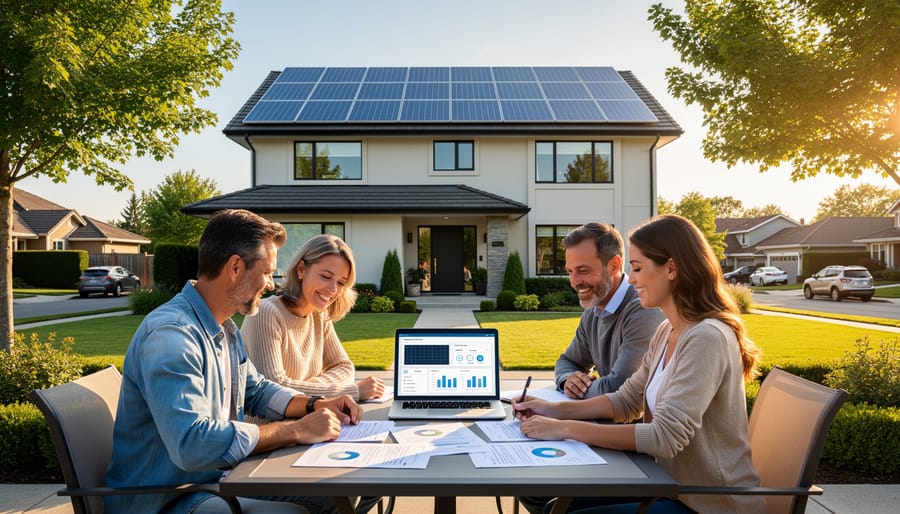
Here’s the reality check. You can absolutely handle certain planning phases yourself. Calculating your business’s energy needs, measuring your roof space, researching equipment options, and understanding your local utility’s interconnection requirements are all excellent DIY tasks. These preliminary steps can save you thousands in consultation fees and help you speak knowledgeably with contractors. I’ve seen business owners create detailed preliminary designs using basic solar calculators and satellite imagery, which gave them tremendous bargaining power when getting quotes.
However, there are clear boundaries where professionals become necessary, and often legally required. Most jurisdictions mandate that licensed electricians handle all electrical work on commercial properties. Structural engineering assessments are non-negotiable because commercial roofs support heavier loads and face stricter building codes. Professional installers carry liability insurance that protects your business from catastrophic failures. Your insurance company will likely require proof of professional installation to maintain coverage.
The permitting process alone demands professional involvement. Commercial solar requires electrical permits, building permits, utility interconnection agreements, and often zoning approvals. Engineers must stamp your plans, and inspectors need documentation that meets commercial standards far exceeding residential requirements.
Think of your role as project manager rather than installer. You can research, plan, and oversee the work while professionals handle the technical execution and compliance paperwork. This hybrid approach lets you leverage your DIY skills without exposing your business to unnecessary risk or code violations. The money you save doing preliminary research and careful contractor selection often matches what you’d save attempting a full DIY installation, but with far better outcomes and zero legal headaches.
Small commercial installations on workshops, barns, or small businesses provide an accessible entry point for understanding commercial solar principles.
Real-World Example: Breaking Down a Small Commercial Project
Let me walk you through a project I helped consult on last year that really brings these concepts to life. A friend runs a small woodworking shop in Oregon, about 3,500 square feet with a flat roof. He’d been getting hammered by rising electricity costs and wanted to explore solar, but felt overwhelmed by the commercial requirements.
His monthly electric bill averaged around $850, with peak usage during daytime operations when all the equipment was running. Perfect for solar, right? Here’s how we approached it.
First, we did a proper roof assessment. His building was from the 1980s, so we brought in a structural engineer to verify the roof could handle the additional load. This cost him $400 but saved potential disaster down the road. Turns out, some reinforcement was needed in one section, adding about $2,000 to the project, but it was essential for safety and code compliance.
We calculated he needed a 25kW system to offset about 70% of his usage. Rather than trying to maximize every inch, we designed for what made sense financially and structurally. This is a key lesson: bigger isn’t always better when you’re balancing costs against real-world constraints.
The permitting process took about six weeks. His local jurisdiction required stamped engineering drawings, electrical plans, and fire department approval because the building exceeded 5,000 square feet when you included the warehouse section. He initially tried navigating this alone but quickly partnered with a local solar installer who handled the paperwork for a flat fee of $1,500. Sometimes the DIY approach means knowing when to bring in help.
One unexpected challenge: his utility required a commercial-grade disconnect that cost $800 more than residential equivalents. Nobody mentioned this in his initial research. Always budget 15-20% extra for these surprises.
He also integrated complementary energy systems by adding a small battery backup for critical equipment. This required additional permits but gave him peace of mind during outages.
The total project came in at $52,000 before incentives. With federal tax credits and state incentives, his net cost dropped to around $34,000. His payback period is projected at 7.5 years.
Key takeaways: Don’t skip the engineering assessment, budget generously for permitting and unexpected requirements, and recognize that commercial projects need professional involvement at critical points. Your DIY skills are valuable for research and project management, but safety and compliance aren’t areas to cut corners.
I’ll be honest with you—when I first looked into commercial rooftop solar, I felt overwhelmed. The systems are bigger, the stakes are higher, and there’s definitely more red tape than what I was used to with residential installations. But here’s what I discovered: it’s not as intimidating as it seems once you break it down into manageable pieces.
Commercial rooftop solar is absolutely within your reach, even if you’re coming from a residential DIY background. The fundamentals remain the same—you’re still capturing sunlight and converting it into usable electricity. The difference is scale and the regulatory framework you’ll need to navigate. But that’s exactly why education is your best investment right now.
Start small. Use the interactive calculators and tools available on our site to model different scenarios. Spend time understanding load calculations, structural requirements, and your local permitting process before diving in. Read through case studies, ask questions in the community forums, and don’t rush the learning curve. Every commercial solar expert started exactly where you are today.
Remember, you don’t have to figure everything out alone. Our community is filled with people who’ve tackled these challenges and are eager to share their experiences. Whether you’re seriously considering a commercial installation or just curious about the possibilities, the knowledge you build now will serve you well.
Take that first step—explore our resources, join the conversation, and discover what’s possible when you combine sustainable energy with practical know-how. Your commercial solar journey starts with curiosity and education.
How useful was this post?
Click on a star to rate it!
Average rating 0 / 5. Vote count: 0
No votes so far! Be the first to rate this post.
We are sorry that this post was not useful for you!
Let us improve this post!
Tell us how we can improve this post?
charlesnoble
Here at Spheral Solar, I’m a hands-on solar power enthusiast, constantly exploring and experimenting with DIY solutions. I’m dedicated to sharing my discoveries, insights, and even the bumps I hit along the way, all in the pursuit of a more sustainable future.
How the Solar Tax Credit Puts Thousands Back in Your Pocket by Charlesnoble January 16, 2026 Claim up to 30% of your solar installation costs back from the federal government through the residential solar tax credit—officially called the Investment Tax Credit (ITC)—which applies to equipment, labor, and even permits when you install solar panels on your home. This credit directly reduces what you owe the IRS…
Why Florida Homeowners Are Going Solar (And How You Can Too) by Charlesnoble March 6, 2026 Calculate your home’s solar potential by checking your annual electricity bills and measuring your available south-facing roof space—Florida homes typically need 20-30 panels to offset 100% of energy usage. Contact your utility provider to understand net metering policies, as companies like Duke Energy, FPL, and Tampa Electric have different buyback…
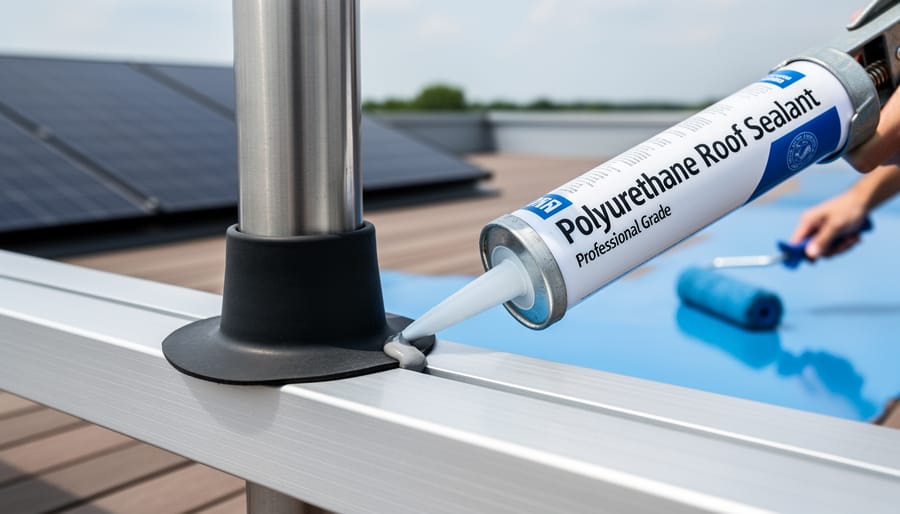
Why Your Rooftop Solar Installation Needs… by Charlesnoble January 28, 2026 Seal every penetration point where your solar mounting hardware breaks through the deck surface with marine-grade polyurethane caulk rated for continuous UV exposure and thermal cycling. I learned this the hard way after my first DIY installation when I assumed standard silicone would suffice—three months later, I discovered water pooling…
How I Built a Zero Energy Home Without Breaking the Bank by Charlesnoble November 14, 2025 **Imagine slashing your electricity bill to zero—permanently.** A zero energy home produces as much renewable energy as it consumes over the course of a year, transforming your house from an energy drain into a self-sustaining powerhouse. It’s not science fiction or reserved for millionaires; thousands of homeowners are already living…
Six Energy Sources That Work With Your Solar Panels… by Charlesnoble December 16, 2025 Harness the sun’s energy streaming onto your roof right now—solar panels convert sunlight into electricity that powers your home while slashing monthly utility bills. Capture moving air with residential wind turbines mounted on your property, generating supplemental power during breezy days and nights when solar production drops. Tap into the…
Solar Panel Maintenance Actually Costs Less Than You… by Charlesnoble November 20, 2025 Budget between $150 and $330 annually for basic solar panel maintenance—that’s typically what most homeowners spend keeping their systems running at peak efficiency. Compare this to the $0 you’ll pay in fuel costs, and you’ll quickly see why the benefits of solar energy far outweigh these minimal upkeep expenses. Inspect…
Subscribe for handpicked DIY projects, exclusive tips, and giveaways.
A battery converts chemical energy stored within its cells into electrical energy that powers your devices—a fundamental transformation that makes everything from your smartphone to your off-grid solar setup possible. Understanding this energy conversion isn’t just academic knowledge; it’s the foundation for choosing the right batteries, calculating how long they’ll actually power your gear, and… Read more: How Batteries Actually Convert Energy (And Why It Matters for Your Solar Setup)
Check your existing solar lights before buying new batteries by removing the old NiCd cells and testing them with a multimeter—most failures stem from corroded battery contacts, not dead batteries. Clean the terminals with white vinegar and a wire brush, and you’ll likely resurrect 60% of “dead” lights without spending a dime. Replace NiCd batteries… Read more: Why NiCd Batteries Keep Your Solar Lights Alive (When Others Fail)
Picture this: You’ve just finished wiring your DIY solar panel array to your main electrical panel, feeling pretty accomplished, when a fellow solar enthusiast asks, “Did you install surge protection?” You pause. You know your system needs breakers, but surge protector breakers? That’s when you realize there’s a gap in your solar safety knowledge. If… Read more: Why Your Solar System Needs a QO Surge Protector Breaker (Before It’s Too Late)