Why Joule Solar Energy Matters More Than Watts for Your DIY Projects
Updated:
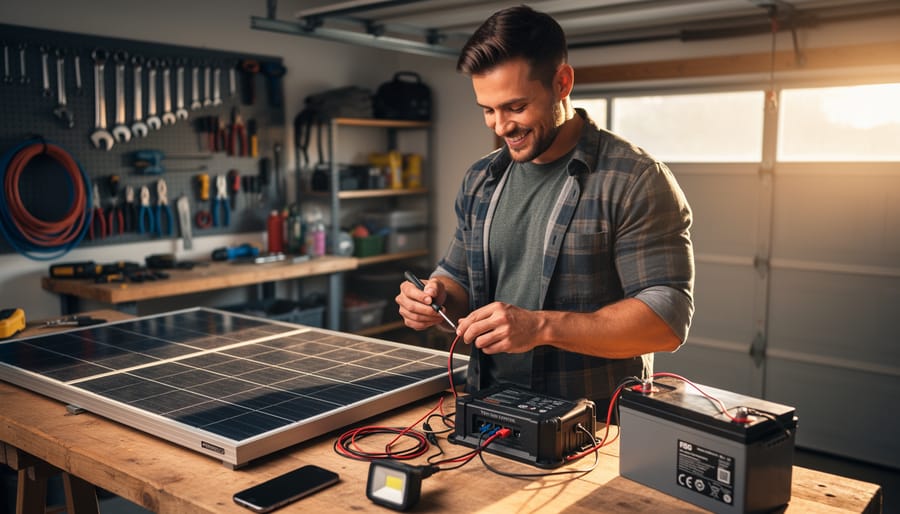
Picture this: You’re browsing solar panel specs and suddenly see energy output measured in joules, watt-hours, and kilowatt-hours all mixed together. Confusing, right? I’ve been there myself, standing in my garage with a handful of solar equipment brochures, wondering why some manufacturers use joules while others stick to watts. That moment sparked my journey into understanding how energy measurement actually works in solar systems.
Here’s the straightforward truth: a joule is simply a unit of energy, and every solar panel you install generates energy measured this way. One watt equals one joule per second, which means your 300-watt solar panel produces 300 joules every single second it operates at full capacity. Understanding this relationship transforms how you size systems, calculate storage needs, and predict real-world performance.
Most DIY solar enthusiasts get tripped up because they focus only on watts without grasping the time component. Your battery doesn’t care about watts—it stores joules of energy. Your appliances consume joules over time. When you understand that your phone charger using 10 watts for one hour consumes 36,000 joules (or 10 watt-hours), suddenly sizing your solar setup becomes crystal clear.
This guide breaks down exactly how joules work in solar energy systems, why this matters for your specific projects, and how to use this knowledge to avoid the costly mistakes I made when building my first off-grid system. No engineering degree required—just practical math you can apply today.
What Actually Is a Joule in Solar Energy?
When I first started exploring solar energy, I kept seeing “joules” mentioned in specifications and honestly felt a bit lost. Here’s what I wish someone had explained to me from the start: a joule is simply a unit that measures energy—specifically, how much work something can do or how much energy it stores.
Think of it like this. Imagine a water tank on your roof. The total amount of water in that tank represents joules—the stored energy available. Now, imagine opening a tap. The rate at which water flows out is like watts—it’s the power being delivered at any given moment. A joule tells you what you have stored up, while a watt tells you how fast you’re using it or producing it.
In solar terms, when your panels generate electricity, they’re producing power measured in watts. But over time, that power accumulates into energy, measured in joules (or more commonly in solar applications, watt-hours, which are just joules bundled differently for easier math). One watt-hour equals 3,600 joules, so when your battery stores 100 watt-hours, that’s actually 360,000 joules of energy sitting there ready to power your devices.
The basic relationship is beautifully simple: Energy (joules) = Power (watts) × Time (seconds). If you run a 100-watt solar panel for 10 seconds, you’ve generated 1,000 joules. Understanding watts to watt-hours conversion helps you translate this into practical battery storage numbers.
This distinction matters when you’re sizing systems. Your solar panel’s wattage rating tells you its power output right now, but calculating the total joules (or watt-hours) it produces throughout the day tells you whether it’ll actually charge your batteries enough to run your fridge overnight. That’s the difference between guessing and knowing your system will work.
Understanding energy storage in joules helps DIYers properly size their solar panels and battery systems for reliable off-grid power.
Why Your Solar Setup Needs Joule Thinking, Not Just Watt Thinking
The Battery Storage Problem
Here’s where joules become your best friend in avoiding one of the most common DIY solar mistakes. I learned this the hard way when I first sized my battery bank based only on amp-hours without considering my actual energy needs throughout the day.
Most people pick batteries by looking at their amp-hour rating, but that only tells part of the story. Think about it this way: if you know your household uses 15,000 joules per hour (or about 4.2 watt-hours), and you want three days of backup power, you need to calculate total energy storage in joules. That’s 15,000 joules × 24 hours × 3 days = 1,080,000 joules (300 watt-hours).
Without understanding joules as your energy unit, you might oversize or undersize your battery bank dramatically. A battery capacity calculator helps you convert these joule calculations into the right battery specifications.
The beauty of working in joules is that you’re accounting for total energy over time, not just instantaneous power draw. This means you’ll size your batteries for real-world usage patterns, considering those late-night refrigerator cycles and morning coffee maker surges together as one complete energy picture.
Planning for Cloudy Days and Night Use
Here’s where joule calculations really prove their worth. When the sun sets or clouds roll in, you need stored energy to keep things running, and knowing exactly how many joules you need can save you from both over-buying expensive batteries and the frustration of running out of power.
Let me share something from my early solar days. I calculated my daytime energy needs perfectly but completely forgot about nighttime usage. My first cloudy weekend was a rude awakening when my phone charger and LED lights drained my tiny battery by 9 PM. I learned the hard way that you need to calculate for complete 24-hour cycles, not just sunny periods.
Here’s the practical approach. First, calculate your total daily energy consumption in joules using the methods we covered earlier. Let’s say your household uses 36 million joules per day. Now consider your backup needs. If you want two days of autonomy for cloudy weather, you’ll need 72 million joules of storage capacity.
But batteries aren’t 100 percent efficient, and you shouldn’t fully discharge them to preserve lifespan. Apply a safety factor of about 1.5, bringing your requirement to roughly 108 million joules, or 30 kilowatt-hours in battery capacity.
Think about your local weather patterns too. If you live somewhere with frequent multi-day storms, increase your autonomy target. Desert dwellers might get away with less storage since sunny days are more reliable.
This calculation ensures you’re prepared when the sun takes a break, keeping your solar setup reliable year-round.
Calculating Your Daily Joule Budget: A Step-by-Step Approach
Listing Your Devices and Their Energy Appetite
Before you can size your solar setup properly, you need to know what you’re actually powering. Think of it like planning a road trip—you wouldn’t guess your fuel needs without knowing the distance, right?
Start by making a simple list of everything you want to run on solar. For each device, check the label or manual for its power consumption, usually listed in watts. Your phone charger might be 10-15 watts, a laptop charger typically runs 45-90 watts, LED bulbs are around 8-15 watts each, and a mini-fridge can range from 40-100 watts depending on size.
Here’s where it gets practical: multiply the wattage by how many hours per day you’ll use each device. A laptop drawing 60 watts for 4 hours needs 240 watt-hours daily. That’s 864,000 joules if you want to think in those terms (just multiply watt-hours by 3,600).
When I first started my solar journey, I underestimated how much my coffee maker would impact my system. Those quick morning brews added up fast! My advice? Track your usage for a typical day before buying any panels.
Write everything down. Phone charging: 15 watts for 2 hours. Camping lights: 10 watts for 5 hours. This inventory becomes your solar blueprint, showing exactly how much energy your system needs to generate and store.
Converting Everything to Joules (And Why It Makes Shopping Easier)
When I first started comparing solar equipment, I felt overwhelmed by all the different units: watt-hours, amp-hours, volts, watts. Then I discovered that converting everything to joules creates a common language for comparison. Here’s the quick truth: one watt-hour equals 3,600 joules. That’s your magic number.
Let’s say you’re comparing two batteries. One lists 100Ah at 12V (1,200Wh), while another shows 50Ah at 24V (also 1,200Wh). Converting both to joules (4,320,000 joules each) immediately shows they store identical energy despite different specifications. This prevents costly mistakes.
For solar panels, multiply the rated watts by hours of sunlight, then by 3,600. A 100W panel in 5 hours of sun produces 500Wh or 1,800,000 joules of energy.
I keep a simple battery power conversion table handy when shopping. It saves me from impulse purchases based on impressive-sounding numbers that don’t actually deliver more energy. Once you think in joules, you’ll spot marketing gimmicks instantly and make smarter choices based on actual energy storage capacity.
Adding a Safety Buffer You Can Trust
Real-world solar systems rarely operate at perfect efficiency, so I always recommend adding a 25-30% safety buffer to your energy calculations. This cushion accounts for cloudy days, dirt accumulation on panels, and the inevitable times when you run the blender longer than expected. When I first sized my workshop system, I skipped this step and found myself scrambling on overcast winter days—lesson learned!
Start by calculating your total daily energy needs in joules, then multiply by 1.25 to 1.3 depending on your local climate. If you live in frequently cloudy areas, lean toward the higher percentage. This buffer also compensates for battery inefficiencies and aging, since batteries lose capacity over time. Use our solar panel charge time calculator to factor in these real-world variables and get a more accurate picture of your system’s performance throughout the year. Remember, slight over-capacity is smarter than constant power anxiety—your future self will thank you.
Real-World Tools That Make Joule Calculations Effortless
Tracking joules in your solar system doesn’t require expensive laboratory equipment or an engineering degree. When I first started measuring my system’s performance, I made the mistake of thinking I needed professional-grade meters that cost hundreds of dollars. Turns out, there are plenty of accessible tools that make monitoring energy in joules straightforward and even enjoyable.
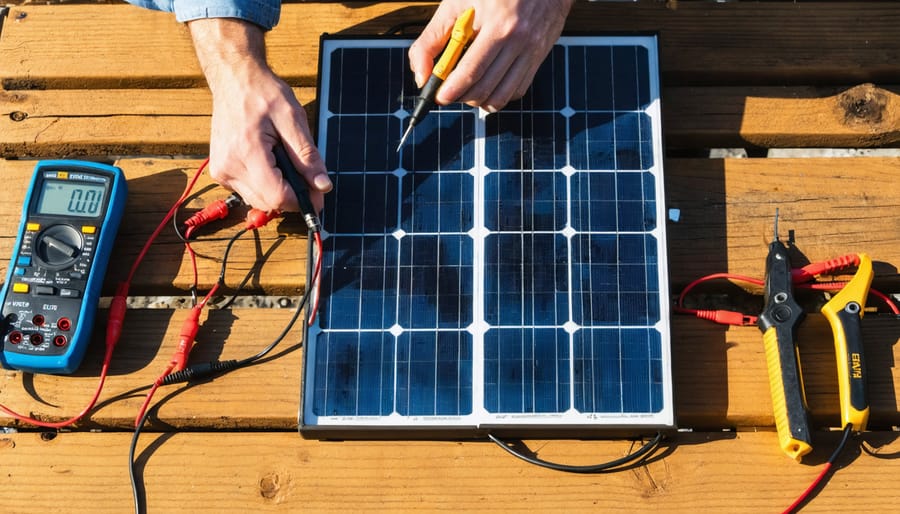
The simplest starting point is a basic wattmeter, which you can find for under thirty dollars at most hardware stores. These plug-in devices measure power in watts, and since you now know that joules equal watts multiplied by seconds, you can easily calculate energy production or consumption. Just plug it between your device and power source, and watch the numbers roll in. Many models have built-in timers and cumulative energy displays that do the math for you.
For those who prefer digital solutions, smartphone apps have revolutionized energy monitoring. Apps like Solar Analytics and Energy Monitor connect to compatible hardware or work with smart plugs to track your system’s performance in real-time. Most display data in kilowatt-hours but can show instantaneous power readings that help you understand joule production second by second. The visual graphs make it easy to spot patterns in your energy generation throughout the day.
If you want to plan before you measure, interactive calculators are incredibly valuable. Spheral Solar offers user-friendly calculators that help you estimate joule production based on your panel specifications, location, and sun exposure. These tools take the guesswork out of system sizing and help you understand what kind of energy output to expect before making any investment.
For the truly dedicated, dedicated solar charge controllers with LCD displays show real-time power flow in watts and cumulative energy in watt-hours. These give you direct visibility into how many joules your panels generate and how efficiently your batteries store that energy. The data empowers you to optimize placement, adjust angles seasonally, and truly understand your system’s capabilities.
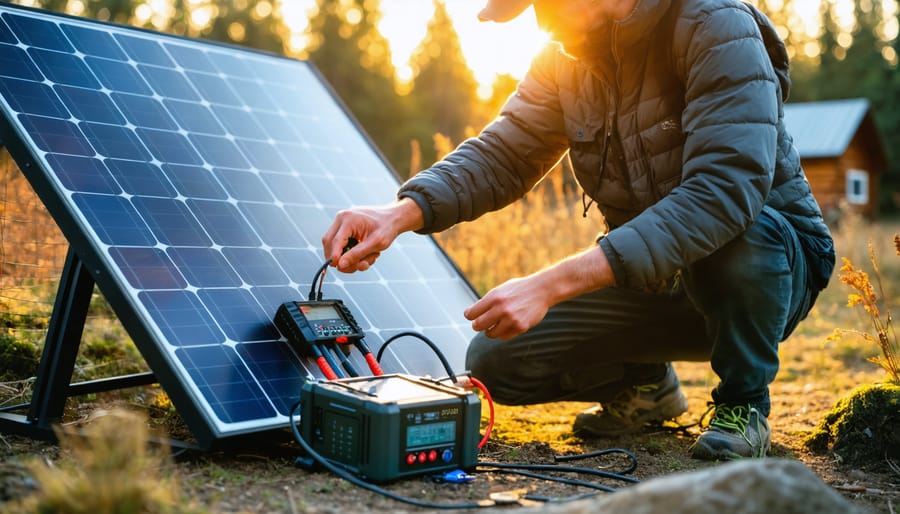
Accurate measurement tools help track actual joule consumption and production in your solar system.
Common Joule Mistakes That Cost DIYers Money
Confusing Battery Capacity Ratings
I learned this the hard way when I bought my first battery bank—I thought bigger amp-hour numbers automatically meant more storage, but I was only seeing part of the picture. Battery capacity gets labeled three different ways, and mixing them up can cost you hundreds of dollars on the wrong equipment.
Amp-hours (Ah) tell you how much current a battery can deliver over time, but they don’t tell the whole story without knowing the voltage. A 100Ah battery at 12 volts stores very different energy than a 100Ah battery at 24 volts. That’s where watt-hours (Wh) come in—they multiply amp-hours by voltage to show actual energy storage. A 12V 100Ah battery stores 1,200Wh, while a 24V 100Ah battery stores 2,400Wh.
Joules measure the same thing as watt-hours, just in different units—one watt-hour equals 3,600 joules. When you see solar panel specs listing joules, you can convert back to the more familiar watt-hours by dividing by 3,600.
The real problem? Many beginners compare batteries using only amp-hours without checking voltage, ending up with half the capacity they actually need. Always convert to watt-hours first using a watt-hours to amp-hours calculator, then you’re comparing apples to apples.
Ignoring Conversion Losses
Here’s a reality check from my early solar days: I was thrilled when my panels generated 5,000 joules per second (5,000 watts), thinking I could power all my 5,000-watt devices. Wrong. I learned the hard way that not all those joules make it to your appliances.
The problem? Conversion losses. Your solar panels produce DC (direct current) power measured in joules per second, but most household devices need AC (alternating current). That’s where inverters come in, and they’re not perfect transformers—they waste energy as heat during the conversion process.
A typical inverter operates at 85-95% efficiency. This means if your panels generate 1,000 joules per second, you might only get 850-950 joules per second of usable power. The remaining 50-150 joules simply disappear as heat. Better inverters cost more but waste less energy, so they’re worth considering for larger systems.
Charge controllers, which regulate power flowing to your batteries, add another layer of efficiency loss. PWM (Pulse Width Modulation) controllers typically run at 75-80% efficiency, while MPPT (Maximum Power Point Tracking) controllers achieve 95-98% efficiency.
When calculating your system needs, multiply your panel output by these efficiency factors. If you need 10,000 joules per second for your home, and your inverter is 90% efficient, your panels actually need to produce about 11,111 joules per second to deliver what you need. Always plan for these losses—your future self will thank you when everything actually works as expected.
Applying joule-based planning ensures your DIY solar projects deliver the reliable power you actually need.
Putting Joule Knowledge to Work in Your Next Project
Now that you understand how joules relate to your solar energy needs, let’s put this knowledge into action. Whether you’re planning a weekend camping trip, converting a van into your mobile home, or building a backup power system for emergencies, thinking in terms of joules helps you size everything correctly from the start.
For a camping solar setup, start by listing your devices and their energy consumption. That smartphone charger uses about 18,000 joules per charge, while a portable fridge might consume 432,000 joules daily. Add these up, convert to watt-hours if needed, and you’ll know exactly what size solar panel and battery to purchase instead of guessing.
When I first helped my neighbor plan his van conversion, we calculated his daily energy needs in joules before buying anything. His laptop, lights, and water pump totaled about 3.6 million joules daily. This translated directly into choosing a 400-watt solar array and appropriate battery bank, avoiding the expensive mistake of undersizing his system.
For backup power systems, understanding joules means you can prioritize which appliances matter most during an outage. Your refrigerator consuming 4.3 million joules daily becomes a tangible number you can plan around rather than an abstract concern.
The best part? You don’t have to figure this out alone. Use our interactive calculators to crunch the numbers for your specific situation, and join our community forum where fellow DIYers share their real-world experiences and solutions. Your solar journey starts with understanding the energy, and continues with taking that first confident step forward.
You know, when I first started tinkering with solar panels, I felt like I was flying blind half the time. But once I wrapped my head around joules and how energy actually moves through these systems, everything clicked. Understanding that a joule is simply a unit of energy—and knowing how to calculate what you need—transforms you from someone who’s guessing into someone who’s building with confidence.
The beauty of thinking in joules is that it takes the mystery out of solar projects. Whether you’re sizing a battery bank for your workshop or figuring out if that panel will charge your camping gear, you’re working with real numbers that tell you exactly what to expect. No more hoping it’ll work out or buying equipment that’s way oversized for your needs.
I’d love to hear how this changes your approach to solar. Have you tackled a project where understanding energy measurements made the difference? Jump into the comments and share your story—we’re all learning together here. And don’t forget to bookmark those calculators we’ve shared throughout this article. They’re game-changers when you’re in the middle of planning.
Your next solar project doesn’t have to feel overwhelming. Armed with this foundational knowledge about joules and energy flow, you’re ready to build something amazing. Let’s keep this conversation going and help each other create smarter, more efficient solar solutions.
How useful was this post?
Click on a star to rate it!
Average rating 0 / 5. Vote count: 0
No votes so far! Be the first to rate this post.
We are sorry that this post was not useful for you!
Let us improve this post!
Tell us how we can improve this post?
charlesnoble
Here at Spheral Solar, I’m a hands-on solar power enthusiast, constantly exploring and experimenting with DIY solutions. I’m dedicated to sharing my discoveries, insights, and even the bumps I hit along the way, all in the pursuit of a more sustainable future.
Stop Guessing Energy Numbers: Your Practical Joule… by Charlesnoble November 11, 2025 **Understanding Energy in Real Numbers: Your Joule Conversion Guide** Converting joules into watts, kilowatt-hours, or calories transforms abstract energy measurements into practical numbers you can actually use for your solar projects and off-grid calculations. Whether you’re sizing a battery bank, calculating how long your portable solar panel will run a…
Stop Guessing Your Battery Power: The Conversion… by Charlesnoble October 28, 2025 Grab your battery specifications and check three numbers that matter: amp-hours (Ah) tells you total capacity like a fuel tank size, watt-hours (Wh) reveals actual energy storage accounting for voltage differences, and reserve capacity (RC) shows real-world runtime at a steady draw. These measurements aren’t interchangeable labels for the same…
How Batteries Actually Convert Energy (And Why It… by Charlesnoble April 27, 2026 A battery converts chemical energy stored within its cells into electrical energy that powers your devices—a fundamental transformation that makes everything from your smartphone to your off-grid solar setup possible. Understanding this energy conversion isn’t just academic knowledge; it’s the foundation for choosing the right batteries, calculating how long they’ll…
Stop Tripping Your Solar System: Size Your 3-Phase… by Charlesnoble April 19, 2026 Calculate your three-phase breaker size by multiplying your load’s full-load current by 1.25, then selecting the next standard breaker rating above that value. For a 40-amp three-phase motor, you’d calculate 40 × 1.25 = 50 amps, meaning you need a 50-amp breaker minimum. Verify your voltage system first—208V, 240V, 480V,…
Stop Burning Out Your Solar Gear: Why Electrical… by Charlesnoble February 22, 2026 Grab your multimeter and calculator—understanding electrical conversions transforms confusing numbers into actionable data for your solar setup. When I first started working with solar panels, I’d stare at spec sheets showing watts, amps, and volts, completely baffled about which numbers actually mattered for sizing my components. That confusion nearly led…
Why Your Solar System Needs a Usage Graph (And How… by Charlesnoble March 11, 2026 Check your solar inverter’s display screen or manufacturer app right now—most modern systems already generate real-time usage graphs without additional equipment. Your inverter likely shows daily production curves, typically peaking between 11 AM and 2 PM, which gives you instant insight into whether your panels are performing as expected. Download…
Subscribe for handpicked DIY projects, exclusive tips, and giveaways.
Building a solar powered outdoor table takes about 8 to 12 hours and requires basic woodworking skills plus some familiarity with electrical connections. You’ll mount solar panels directly onto a custom-built or modified outdoor table, wire them to a charge controller and battery system housed underneath, and add USB ports or AC outlets for charging… Read more: How to Build a Solar Powered Outdoor Table for Your Camping Setup
Charging a battery bank with a 3-phase inverter requires connecting your inverter’s AC output to a compatible battery charger or hybrid inverter system that can convert the 3-phase power back to DC for storage. Most DIY solar setups achieve this by using a hybrid inverter that handles both solar input and battery charging simultaneously, or… Read more: How to Wire and Configure a Battery Inverter 3 Phase System for Off-Grid Solar
Wiring a 7-pin RV plug correctly connects your tow vehicle to your trailer’s lights, brakes, and auxiliary power in about 45 minutes with basic hand tools and careful attention to the color-coded wire standard. The diagram follows a specific layout mandated by the RV Industry Association: each pin controls a distinct function, from left turn… Read more: How to Wire a 7-Way RV Plug: Step-by-Step Diagram and Setup Guide