Why Your 6-Wire Solar Setup Needs the Right Conduit (Before You Regret It)
Updated:
Measure your wire gauge and count of six conductors before selecting conduit—most residential solar installations running six AWG 10 wires require 1-inch conduit, while six AWG 6 wires need 1.5-inch conduit, and six AWG 2/0 wires demand 2.5-inch conduit minimum. Calculate fill capacity using the 40% rule for three or more conductors, which means your total wire cross-sectional area cannot exceed 40% of the conduit’s internal area to prevent overheating and allow smooth pulling.
Check your specific wire combination against NEC Chapter 9 Tables 4 and 5, which provide exact conduit fill requirements—I learned this the hard way during my first solar array installation when I confidently bought 3/4-inch conduit for six AWG 8 wires, only to discover during the pull that it was impossibly tight and violated code. The correct 1-inch conduit made the entire installation smoother and safer.
Choose PVC conduit for underground runs and direct burial applications due to corrosion resistance and lower cost, but switch to EMT or rigid metal conduit for exposed exterior installations where physical protection and grounding requirements matter more. Account for derating factors when running current-carrying conductors together, as six wires generate more heat than individual runs.
Add 20% to your conduit size if you anticipate future system expansion or if your wire run includes multiple bends exceeding 180 degrees total—the extra space dramatically simplifies pulling and reduces jacket damage. Remember that local codes may impose stricter requirements than NEC minimums, so verify with your jurisdiction before purchasing materials.
What Does ‘6 Wire Conduit Size’ Actually Mean for Your Solar Project?
When you’re searching for “6 wire conduit size,” you’re likely in the thick of planning your solar setup and wondering, “What size pipe do I need to safely run six conductors?” I remember standing in the hardware store aisle myself, staring at different conduit diameters and thinking the same thing.
Here’s what you’re actually dealing with: In solar installations, running six wires typically happens in three common scenarios. First, you might have a three-phase system with three hot wires, a neutral, a ground, and maybe a sixth for monitoring. Second, you could be connecting batteries in your energy storage setup, where you need multiple conductors for charge controllers and battery management systems. Third, and this is super common, you might be bundling multiple circuit runs together to save on conduit costs and installation time.
The key difference between solar-specific conduit sizing and general electrical work comes down to heat and ampacity. Solar conductors carry sustained loads for hours during peak sun, unlike typical household circuits that cycle on and off. When you cram six current-carrying conductors into one conduit, they generate heat collectively, which means each wire can’t carry its full rated amperage anymore. This is called derating, and it’s crucial for safety.
What matters most is that you’re not just fitting six wires into a tube. You’re ensuring adequate space for heat dissipation, accounting for fill requirements mandated by electrical code, and leaving enough room for smooth wire pulling without damaging insulation. Getting this wrong means potential overheating, code violations, and possibly redoing your entire installation. That’s why understanding your specific wire gauges and application before choosing conduit diameter makes all the difference.
Understanding Wire Fill and Why It’s Your Best Friend
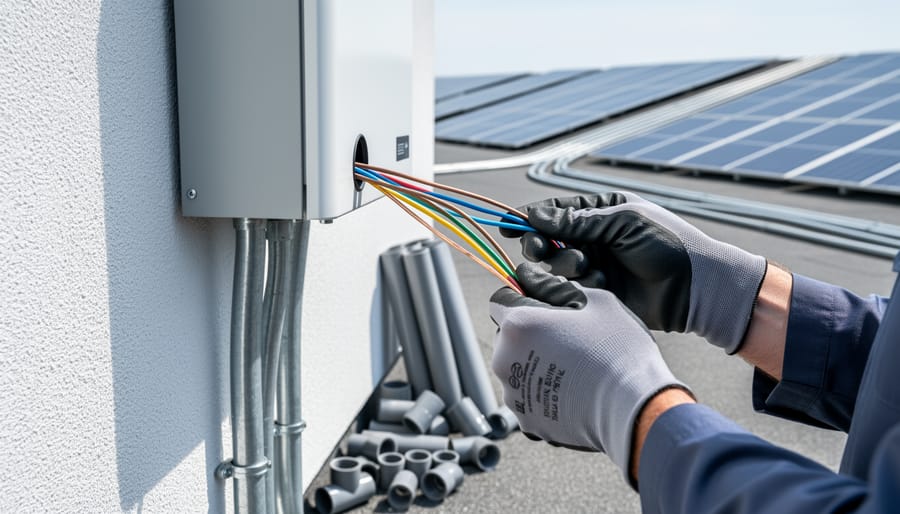
Proper conduit sizing ensures adequate space for all conductors while maintaining safe heat dissipation and allowing for future modifications.
The Math You Actually Need (Don’t Worry, It’s Simple)
Here’s the good news: you don’t need to become a mathematician to figure this out. The National Electrical Code provides fill tables that do the heavy lifting for you, and honestly, most of us just reference those rather than calculating wire cross-sections by hand at midnight.
Let me walk you through a real-world example. Say you’re running six 10 AWG THWN-2 wires (a pretty common setup for solar arrays). Each 10 AWG wire has a cross-sectional area of about 0.0211 square inches. Multiply that by six wires, and you get roughly 0.1266 square inches of total wire area. The NEC allows you to fill conduit to 40% capacity when you have more than two conductors, so you’d need a conduit with at least 0.3165 square inches of internal area. That works out to 3/4-inch conduit, though many installers go up to 1-inch for easier pulling.
Before your eyes glaze over, I’ll let you in on a secret: I rarely do this math myself anymore. Instead, I use the Spheral Solar conduit calculator tool, which lets you plug in your wire gauge, insulation type, and number of conductors. It instantly tells you the minimum conduit size based on current NEC tables. It’s saved me countless headaches and ensures I’m always compliant with code requirements. The calculator accounts for different conduit types too, since PVC and EMT have slightly different internal dimensions even at the same nominal size.
Choosing the Right Conduit Size for Your 6-Wire Solar Run
Common Wire Gauge Combinations and Their Conduit Needs
Let me share what I’ve learned from years of helping DIYers figure out their conduit needs. The key is knowing your wire gauge and having the right reference points. I remember my first solar project—I stood in the electrical supply store completely overwhelmed by conduit options. Here’s the straightforward guidance I wish I’d had back then.
For six 10 AWG wires, you’ll typically need 3/4-inch conduit. This is one of the most common scenarios for residential solar installations, especially for branch circuits connecting panels to combiner boxes. The 10 AWG wire is manageable to work with, and the 3/4-inch conduit gives you enough room without excessive struggle during the pull.
When you step up to six 8 AWG wires, you’re looking at 1-inch conduit. This gauge often comes into play for higher-amperage runs or longer distances where voltage drop becomes a concern. I’ve found that trying to squeeze six 8 AWG wires into anything smaller creates a nightmare scenario—trust me, your knuckles will thank you for sizing up.
For six 6 AWG wires, plan on 1-1/4 inch conduit. These thicker conductors need breathing room, and proper sizing here becomes critical for heat dissipation. This gauge typically handles your main power runs from solar arrays to inverters.
Now, here’s where it gets interesting: mixed gauge runs. Let’s say you’re combining four 10 AWG wires with two 12 AWG ground wires. You’ll calculate based on total cross-sectional area, but generally, the larger wire determines your baseline. A handy rule: when in doubt, round up to the next conduit size. The extra few dollars spent on slightly larger conduit pays dividends in easier installation and better long-term performance.
PVC vs. Metal Conduit: What Works Best for Solar?
When I first started installing solar panels, I went straight for the cheapest option: PVC conduit. It seemed like a no-brainer for cost savings. But after watching a few sections crack under intense summer sun and realizing I’d created a grounding headache, I learned this decision deserves more thought.
PVC conduit is lightweight, affordable, and resistant to corrosion, making it popular for underground conduit runs. Schedule 40 PVC works well in buried applications where UV exposure isn’t an issue. However, exposed PVC can degrade under direct sunlight unless you use Schedule 80 with UV-resistant coating. Also, PVC has temperature limitations. Standard PVC is rated for 140°F, which rooftop installations can exceed on hot days, potentially causing deformation.
Metal conduit, specifically EMT (electrical metallic tubing) or rigid metal conduit, offers superior durability and heat resistance. It naturally provides equipment grounding, eliminating the need for a separate grounding conductor in many installations. This can actually offset the higher material cost since you’re running fewer wires. Metal conduit also handles temperature extremes better and won’t sag or warp.
The tradeoff? Metal conduit costs roughly two to three times more than PVC and requires more skill to work with, including bending and threading connections.
My personal preference for above-ground solar installations is metal conduit. The grounding benefits, durability, and peace of mind knowing it won’t crack under UV exposure make it worth the extra investment. For underground runs where conditions are stable, PVC remains an excellent economical choice.
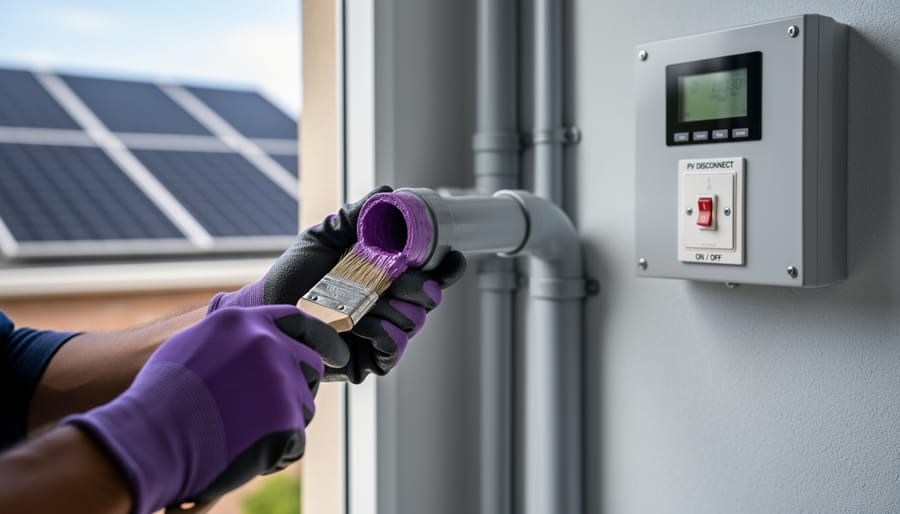
Choosing between PVC and metal conduit depends on factors like UV exposure, temperature ratings, and grounding requirements in solar installations.
When to Size Up (And Why I Always Do)
Here’s something I learned the hard way: when you’re standing on a ladder at 3 PM on a sweltering August afternoon, trying to fish six stubborn wires through a conduit that’s just barely big enough, you’ll wish you’d gone one size larger. Trust me on this one.
I always recommend sizing up when possible, and here’s why it matters more than you might think. First, there’s the future expansion factor. About three years ago, I installed a basic solar setup for my neighbor with perfectly adequate 1-inch conduit for his initial six-wire run. Last spring, he wanted to add monitoring equipment and needed an extra conductor. We had to run entirely new conduit because there was zero room left. If we’d started with 1.25-inch, we could’ve saved a weekend and about $200 in materials.
The physics side is pretty straightforward too. More space means less friction when you’re pulling wires, which translates to less wear on the insulation and a much easier installation day. Your arms will thank you. Plus, wires generate heat when they carry current, and cramming them tightly together means that heat has nowhere to go. A slightly roomier conduit allows better air circulation and cooler operation, which extends the life of your entire system.
My rule of thumb: if you’re on the fence between two conduit sizes, go bigger. The cost difference is usually just a few dollars, but the long-term benefits are substantial. It’s one of those small decisions that future-you will really appreciate.
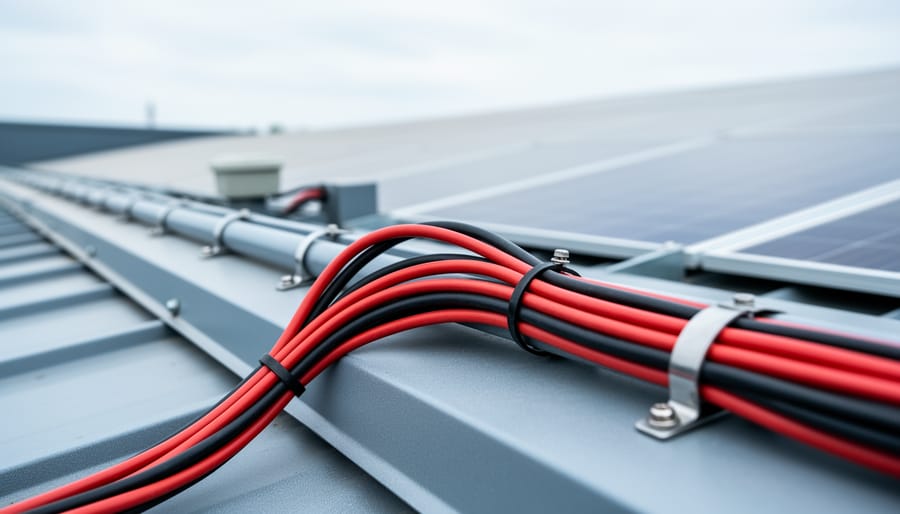
Oversized conduit makes wire pulling significantly easier during installation and allows for future system expansion without replacement.
Safety Considerations You Can’t Ignore
Look, I’m going to be straight with you—skipping safety considerations when running conduit for your solar system isn’t just risky, it’s potentially catastrophic. I learned this the hard way early in my solar journey when I discovered a friend’s installation with undersized conduit that had overheated wiring. The smell alone was enough to make my stomach drop.
First and foremost, proper grounding is non-negotiable. Your conduit itself can serve as part of your grounding system if it’s metal, but only when properly bonded at both ends. Every connection point matters, and loose fittings create resistance that defeats the purpose. For PVC conduit, you’ll need to run a separate ground wire, which counts toward your wire fill calculations.
Temperature ratings are where many DIYers get tripped up. Solar installations generate heat, and that six-wire bundle in your conduit creates even more. Always use wire rated for at least 90 degrees Celsius, and remember that direct sunlight on exposed conduit can push temperatures well beyond ambient. I’ve measured surface temperatures over 60 degrees Celsius on black conduit in full sun—your wire insulation needs to handle that sustained heat without degrading.
Fire hazards are real, folks. Overfilled conduit means poor heat dissipation, which leads to insulation breakdown, which eventually causes shorts and potentially fires. This is why we follow the 40 percent fill rule religiously. It’s not arbitrary—it’s based on decades of electrical safety research.
UV exposure deserves special attention for any conduit exposed to sunlight. Standard gray PVC conduit isn’t UV-stabilized and will become brittle over time. Always use UV-rated conduit for outdoor runs, or better yet, schedule 80 PVC or metal conduit for superior longevity. Your installation should last 25-plus years—your conduit needs to match that lifespan.
Code Compliance and Inspection Tips
I’ll be honest with you—when I first started working with conduit installations, I thought the National Electrical Code was just red tape getting in the way of progress. Then I met an inspector who showed me photos of a house fire caused by overstuffed conduit. That changed my perspective entirely. Code compliance isn’t bureaucracy; it’s literally decades of safety lessons learned the hard way.
The NEC’s conduit fill requirements exist because cramped wires generate heat and can’t dissipate it properly. For your 6-wire installation, you’ll primarily reference NEC Chapter 9, Table 4 (which lists conduit dimensions) and Table 5 (which provides wire fill capacities). The 40% fill rule for three or more conductors isn’t arbitrary—it’s based on thermal testing that determines safe operating temperatures.
Here’s my practical advice for working with inspectors: call your local building department before you buy materials. I’ve found that most inspectors genuinely want to help you succeed. Ask them if they have any local amendments to the NEC that might affect conduit sizing. Some jurisdictions require larger conduits than the minimum, especially for outdoor installations exposed to temperature extremes.
Document everything. Take photos of your conduit before pulling wires, showing it’s clean and properly secured. Keep your wire spool labels proving you used the correct gauge. Print out the NEC tables you referenced for sizing decisions. When the inspector arrives, having this documentation ready shows professionalism and usually speeds up approval.
One tip from experience: if you’re right on the borderline between two conduit sizes, go larger. That extra quarter-inch costs maybe ten dollars more but gives you breathing room during inspection and makes wire pulling infinitely easier. Inspectors notice when someone cuts corners versus when they prioritize safety.
Common Mistakes That’ll Cost You Time and Money
I’ve been guilty of a few of these myself, and let me tell you, fixing conduit mistakes after everything’s installed is no fun. Learning from these common mistakes will save you both headaches and cash.
The biggest rookie error? Sizing your conduit with zero room for growth. Sure, you’re running six wires today, but what happens when you expand your solar array next year? You’ll end up running a whole new conduit because you can’t fit additional conductors. Always consider leaving 10-20% extra capacity when possible.
Another wallet-drainer is forgetting about junction box fill calculations. Your conduit might be perfectly sized for the straight runs, but if you’re not accounting for the volume those six wires take up inside junction boxes, you could fail inspection. Each conductor, splice, and device counts against your box capacity.
Here’s one that caught me early on: improper bend radius. The National Electrical Code requires conduit bends to be at least six times the conduit diameter for conductors size 4 AWG and larger. Tight bends damage wire insulation and make pulling wire brutally difficult. I once spent three hours fighting a wire pull that should’ve taken twenty minutes because my bends were too sharp.
Using indoor-rated conduit outdoors is another expensive mistake. PVC comes in different schedules, and what works inside won’t necessarily hold up to UV exposure and weather. Always verify your material ratings match your installation environment.
Finally, many DIYers miscount ground wires in their fill calculations. While ground wires do count toward conduit fill, they’re sometimes calculated differently depending on whether they’re insulated or bare. Double-check those NEC tables carefully before committing to a conduit size.
Your Action Plan: Making This Work in Real Life
Ready to put this knowledge into action? Here’s your game plan for getting those six wires properly conduit-sized and installed.
Start by making a detailed diagram of your planned conduit runs. Measure the distance from your solar array to your charge controller, then to your battery bank and inverter. Add 10% extra length for unexpected obstacles and routing adjustments. Trust me on this one—I learned the hard way when I had to redo an entire run because I cut my measurements too close.
Next, gather your tools: tape measure, conduit cutter or hacksaw, fish tape for pulling wires, wire lubricant, and a conduit bender if you’ll need any turns. You’ll also want your wire specifications handy—gauge size and insulation type matter for those fill calculations we discussed earlier.
Before purchasing materials, use an online conduit fill calculator to verify your sizing. Input your six wire gauges and insulation types, and it’ll confirm whether that 1-inch or 1.25-inch conduit will work. Keep your receipt—sometimes reality surprises you during installation.
Here’s when to call a professional: if your installation requires running conduit through walls with existing electrical systems, if you’re uncertain about local code requirements, or if your project involves connecting to the grid. There’s no shame in getting expert eyes on complex situations.
Got questions during your project? Head over to the Spheral Solar community forums where fellow DIYers share real-world experiences and troubleshooting tips. We’re all learning together, and your question might help someone else facing the same challenge tomorrow.
Getting your conduit sizing right isn’t just about checking boxes on a permit application. It’s about creating a solar installation that’s safe, reliable, and built to last decades. When you take the time to properly size your conduit for those six wires, you’re investing in the long-term performance of your system and protecting your home.
I’ll be honest with you—I learned some of these lessons the hard way. Years ago, I tried squeezing conductors into undersized conduit because I had it on hand and didn’t want to make another trip to the supply house. That “time-saver” cost me hours of frustration and a redo that took twice as long. Now I always size up when I’m unsure, and I sleep better knowing my installations have room to breathe.
Take your time with the planning phase. Measure twice, calculate carefully, and don’t hesitate to consult that NEC fill chart one more time. Your future self will thank you when you’re not wrestling with stuck wires or dealing with overheated conductors.
What’s your experience been with conduit sizing? Have you run into challenges or discovered helpful tricks along the way? Drop your questions or stories in the comments below—we’re all learning together in this solar community.
How useful was this post?
Click on a star to rate it!
Average rating 0 / 5. Vote count: 0
No votes so far! Be the first to rate this post.
We are sorry that this post was not useful for you!
Let us improve this post!
Tell us how we can improve this post?
charlesnoble
Here at Spheral Solar, I’m a hands-on solar power enthusiast, constantly exploring and experimenting with DIY solutions. I’m dedicated to sharing my discoveries, insights, and even the bumps I hit along the way, all in the pursuit of a more sustainable future.
Why Your Solar Conduit Installation Could Start a… by Charlesnoble March 27, 2026 Measure your conduit run before purchasing materials by mapping the exact path from your solar array to the inverter and battery location, accounting for a 10% waste factor and additional length for bends. PVC electrical conduit remains the most cost-effective protective solution for DIY solar installations, but improper installation creates…
Why Your PV Wire Management Could Fail Inspection… by Charlesnoble April 9, 2026 Route your PV wires through UV-resistant conduit within 18 inches of leaving the solar array, securing it every 3 feet with proper clamps to prevent wind damage and code violations. This single step prevents 80% of the wire degradation issues I’ve seen in DIY solar installations over the past decade.…
Why Your Rooftop Solar Could Block Firefighters (And… by Charlesnoble January 8, 2026 Measure three feet from your roof’s eaves before placing any solar panels—this clearance creates a critical pathway firefighters use to ventilate roofs during emergencies. When flames engulf a building, firefighters climb onto roofs and cut ventilation holes near the eaves to release heat and smoke, giving occupants precious escape time…
Why Your Battery Storage System Needs Better Airflow… by Charlesnoble December 31, 2025 Position your Energy Storage System at least three feet away from walls and combustible materials to ensure adequate air circulation prevents dangerous gas buildup and heat accumulation. Last summer, I learned this lesson when a friend’s improperly ventilated battery bank overheated during a heatwave—the batteries swelled, and we had to…
How Orlando Airport’s Solar EV Charging Could… by Charlesnoble April 30, 2026 Picture this: You’ve just landed at Orlando International Airport after a long flight, your electric vehicle waiting in long-term parking with a battery that’s somehow fuller than when you left it. Sound like science fiction? It’s happening right now at MCO, where solar-powered EV charging stations are transforming how travelers…
The Perfect Pair: Home Renovations and Solar… by Charlesnoble December 19, 2025 As the demand for sustainable living continues to grow, homeowners are increasingly looking beyond traditional upgrades to make their homes more efficient and environmentally responsible. One of the smartest ways to achieve both is by combining home renovations with solar installation. Whether you’re remodeling a luxury residence or updating an…
Subscribe for handpicked DIY projects, exclusive tips, and giveaways.
There is something special about a mature tree. Decades of growth, shade that actually cools the house, branches that the kids climbed, a root system that has quietly held the yard together through every storm. So when circumstances force a move, whether it is a home renovation, a new driveway, or a construction project that… Read more: How to Move a Mature Tree Without Killing It: The Complete Relocation Guide
A mass energy conversion calculator lets you determine how much energy is locked inside any amount of matter using Einstein’s famous equation E=mc². Whether you’re working on a physics assignment or simply curious about the enormous energy potential in everyday objects, the calculation itself takes just seconds once you understand the formula’s three components: energy… Read more: How to Use a Mass Energy Conversion Calculator (Step-by-Step Guide)
Low voltage circuit protection in DIY solar systems boils down to matching the right fuse or breaker to your wire size and expected current, not to the capacity of your battery bank or inverter. Most fires and equipment failures happen when people oversize protection devices, thinking bigger is safer, when the opposite is true. Your… Read more: How to Size Low Voltage Circuit Protection for Your DIY Solar System