How Much Battery Backup Do You Really Need? (Sizing Your 5kW System)
Updated:
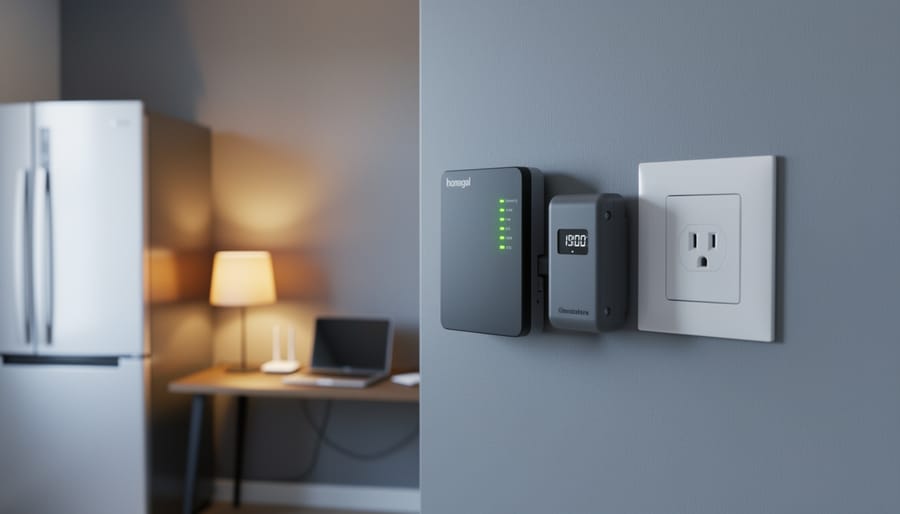
Calculate your actual power needs before committing to a 5kW battery backup system by listing every device you want to run during an outage and adding up their wattages. A 5kW system means you can draw 5,000 watts of power at any given moment, but the real question is for how long. That refrigerator pulling 200 watts, combined with your router, a few lights, and maybe a laptop, totals perhaps 500 watts—meaning a 5kWh battery would theoretically run these essentials for about 10 hours, though real-world efficiency losses reduce this to around 8 hours.
Understand that 5kW refers to power output capacity while the battery’s energy storage is measured in kilowatt-hours (kWh). A common mistake I see in our DIY community is confusing these terms. You might have a 5kW inverter paired with a 5kWh battery bank, or perhaps a 10kWh bank for extended runtime. The inverter determines how much power you can use simultaneously, while the battery capacity determines duration.
Design your system around realistic usage patterns rather than theoretical maximums. During my first backup system build, I oversized everything thinking bigger was always better, but that just meant unnecessary expense. Start by monitoring your essential loads during a typical day. Most households need 3-7 kWh for basic overnight backup, making a 5kW system with 5-10kWh storage a practical sweet spot.
Choose between lithium and lead-acid batteries based on budget and space constraints. Lithium batteries cost more upfront but deliver better depth of discharge, longer lifespan, and compact sizing. Four 280Ah LiFePO4 cells in series create a robust 12V foundation that many DIYers successfully scale up for residential backup applications.
What Does a 5kW Battery Backup Actually Power?
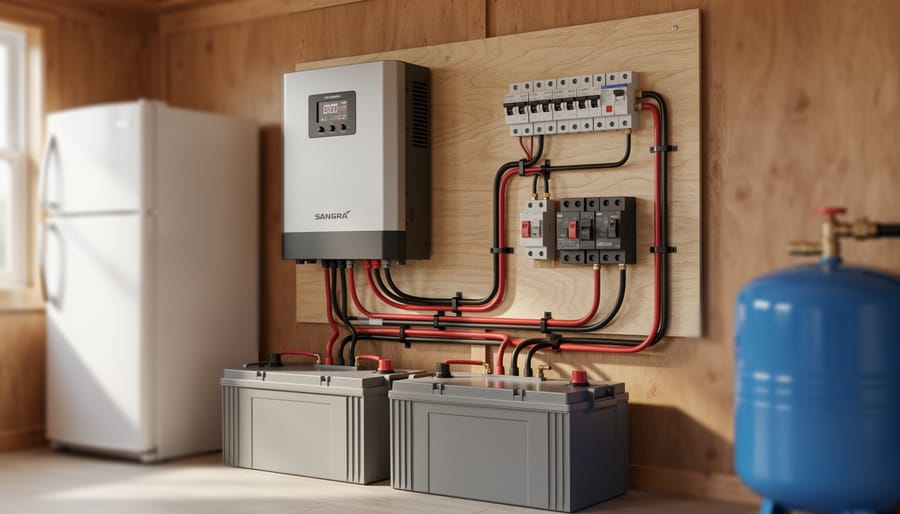
A 5kW battery backup system can simultaneously power essential household appliances including refrigeration, lighting, and small kitchen devices during an outage.
Peak Power vs. Continuous Power (And Why It Matters)
Here’s something I learned the hard way during a power outage last winter: not all 5kW ratings are created equal. When my neighbor showed off his new “5kW” battery backup, I was confused why it couldn’t start his well pump. The answer? Peak power versus continuous power.
Think of it like sprinting versus jogging. Your battery system has two power ratings: continuous power (what it can sustain indefinitely) and peak power (what it can handle for short bursts). A true 5kW continuous rating means your system can deliver 5,000 watts all day long. But many appliances need a surge of extra power just to get started.
Electric motors are the usual culprits. Your refrigerator compressor might run on 800 watts continuously, but it needs 2,400 watts for the two seconds it takes to start up. Air conditioners, well pumps, and power tools all behave similarly. I’ve seen a table saw that draws 1,500 watts during operation demand 4,500 watts at startup.
Most quality inverters offer peak power ratings around double their continuous rating. So a 5kW continuous system typically handles 10kW peaks for a few seconds. When shopping for components, look for both specifications clearly listed.
This matters enormously for system design. Calculate not just your running wattage, but also the highest startup surge you’ll encounter. Otherwise, you’ll have plenty of stored energy but an inverter that shuts down protectively whenever your AC kicks on. Nobody wants that surprise during summer heat.
Runtime Reality Check
Let me give you the straight talk about runtime that nobody wants to admit upfront: that “5kW” number on your battery doesn’t tell you how long it’ll actually power your stuff. Here’s why.
First, we need to clear up the confusion between power (kilowatts) and capacity (kilowatt-hours). A 5kW battery backup typically refers to a system with about 5 kilowatt-hours of usable capacity. Think of it like a 5-gallon bucket of water—how long it lasts depends entirely on how fast you’re drinking from it.
Let me walk you through some real-world scenarios I’ve tested in my own setup:
If you’re running essential circuits only—a refrigerator (200W), LED lights (50W), phone chargers (25W), and your internet router (15W)—you’re pulling about 290 watts total. Your 5kWh battery would theoretically last over 17 hours. Pretty impressive, right?
But here’s where reality bites. Fire up your coffee maker (1500W), microwave (1200W), or electric space heater (1500W), and suddenly you’re draining that battery in 2-3 hours instead. Run your central AC unit? You might get 90 minutes if you’re lucky.
The simple calculation anyone can do: divide your battery capacity (5000 watt-hours) by your total load in watts. So 5000 divided by 300 watts equals roughly 16.6 hours. Just remember to account for efficiency losses—most systems operate around 85-90% efficiency, so knock off about 15% from your theoretical runtime for realistic expectations.
Building Your 5kW Battery Bank: The Core Components
Battery Chemistry Showdown: LiFePO4 vs. Lead-Acid for Backup
When you’re building a 5kW backup system, choosing between LiFePO4 and lead-acid batteries might feel overwhelming, but I’ll break down what actually matters in real-world use.
I learned this lesson the hard way. My first backup system used flooded lead-acid batteries because they were cheaper upfront. I paid about $1,200 for enough capacity to run my essentials. Fast forward three years, and I was replacing them. Meanwhile, my neighbor installed LiFePO4 batteries at $2,800 for similar usable capacity, and five years later, they’re still going strong.
Here’s the real cost picture. Lead-acid batteries give you about 50% usable capacity before damaging them, so a 10kWh bank really provides 5kWh. LiFePO4 batteries let you use 80-90% of their capacity safely. That 10kWh LiFePO4 bank actually delivers 8-9kWh of usable power.
Lifespan tells an even more interesting story. Quality lead-acid batteries last 3-5 years with proper maintenance, giving you maybe 500-800 cycles. LiFePO4 batteries typically deliver 3,000-5,000 cycles and last 10-15 years. When you divide the initial cost by lifespan, LiFePO4 actually costs less per year of service.
For backup applications specifically, LiFePO4 wins on several practical fronts. They charge faster, meaning your system recovers quicker after an outage. They handle partial state-of-charge better, which is perfect for backup systems that might sit partially discharged between power failures. And honestly, the maintenance-free aspect is worth something too. No checking water levels or cleaning terminals.
My recommendation? If you can afford the upfront investment, go with LiFePO4. The longer lifespan, better performance, and lower maintenance make them the smarter choice for serious backup power. Lead-acid still works if budget is tight, but plan for replacement costs down the road.
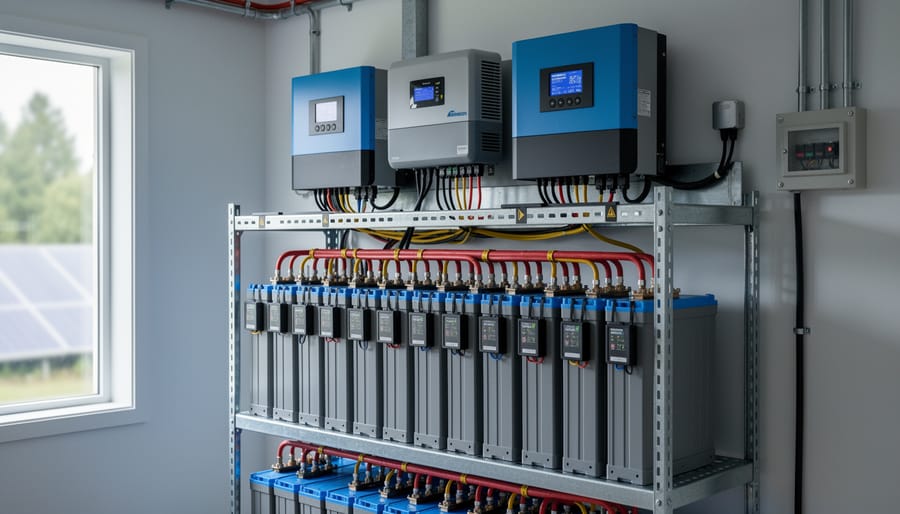
LiFePO4 batteries connected in series provide the voltage and capacity needed for a complete 5kW battery backup system.
Inverter Selection: Matching Power to Your Needs
When you’re working with a 5kW battery backup system, choosing the right inverter can make or break your setup. I learned this the hard way when I first paired a cheap modified sine wave inverter with my battery bank—my laptop charger buzzed like an angry bee, and my microwave acted like it was confused about its purpose in life.
For a 5kW battery system, you’ll want an inverter rated between 3kW and 5kW continuous output. Here’s my rule of thumb: match your inverter to your actual load requirements, not necessarily your battery capacity. If your essential loads only draw 3kW during an outage, a 3kW inverter works perfectly fine, even with a larger battery bank. This approach saves money and improves efficiency.
Always go with a pure sine wave inverter. Yes, they cost more than modified sine wave models, but they’re essential for sensitive electronics, medical equipment, and anything with a motor. Your battery backup system is meant for peace of mind, so don’t compromise on power quality.
Pay attention to surge capacity too. Many appliances need 2-3 times their running wattage to start up. A quality inverter should handle these surges without tripping. Look for models with at least 150 percent surge capacity for 5-10 seconds.
Most importantly, ensure your inverter’s battery voltage matches your system—typically 48V for 5kW setups. This configuration minimizes current draw and reduces cable thickness requirements, making installation much more manageable.
The Unsung Hero: Your Battery Management System
When I first started building battery systems, I’ll admit I underestimated the Battery Management System (BMS). I thought it was just a nice-to-have safety feature. Boy, was I wrong. The BMS is actually the brain of your 5kW battery backup, constantly monitoring and protecting your investment.
Think of your BMS as a vigilant guardian that never sleeps. It watches each battery cell’s voltage, temperature, and charge state, making sure no single cell gets overcharged or depleted too deeply. Without it, one weak cell could drag down your entire battery bank or, worse, create a dangerous situation.
Here’s what your BMS does behind the scenes: it balances cells so they charge and discharge evenly, prevents thermal runaway (overheating that can lead to fires), and disconnects the system if anything goes wrong. For a 5kW system, you’ll want a BMS rated for at least your maximum continuous current draw, typically around 100-150 amps.
The best part? Modern BMS units communicate with you through smartphone apps, showing real-time data about your battery’s health. This transparency means you’ll catch small issues before they become expensive problems, extending your battery’s lifespan by years.
BMS Deep Dive: Protecting Your Investment
A Battery Management System monitors and protects your 5kW battery bank by managing cell balance, temperature, and charging parameters.
What Your BMS Actually Does (In Plain English)
Think of your Battery Management System as the air traffic controller for your 5kW battery backup—it’s constantly monitoring everything to keep your system safe and running smoothly.
At its core, the BMS does three critical jobs that protect both your investment and your home. First, there’s cell balancing, which I like to compare to filling water glasses at a dinner party. Just like you’d want each glass filled evenly rather than some overflowing while others sit empty, your BMS ensures each battery cell charges and discharges at the same rate. Without this, weaker cells fail prematurely, and you’ll replace batteries way sooner than necessary.
Second, temperature monitoring acts like your system’s thermostat. I learned this the hard way during my first summer with a homemade battery bank—things got hot fast! The BMS tracks temperature across your battery pack and throttles charging or triggers cooling fans when needed. Most quality units will shut everything down if temperatures hit dangerous levels, typically around 140°F.
Third, and perhaps most important, are the protection features. Your BMS prevents overcharging (which can cause thermal runaway), stops over-discharging (which permanently damages cells), and manages current limits to prevent dangerous situations. It’s like having a vigilant guardian that never sleeps, constantly asking: “Is this safe? Should I allow this?”
For a 5kW system, you’ll want a BMS rated for at least 100A continuous current and communication capability so you can monitor performance through an app or display.
Choosing the Right BMS for Your Battery Configuration
Selecting the right Battery Management System for your 5kW backup setup can feel overwhelming, but breaking it down into key specifications makes the decision much easier. I learned this the hard way when I first built my system and chose a BMS that couldn’t handle my peak discharge rates during heavy loads.
Start with voltage compatibility. Your BMS must match your battery configuration exactly. For a typical 5kW system at 48V, you’ll need a BMS rated for your battery chemistry and cell count. If you’re using lithium cells, a 16S configuration (16 cells in series) works perfectly for 48V nominal. Always verify the BMS supports your exact series count.
Current capacity is where many DIYers stumble. Here’s the practical math: a 5kW system at 48V draws roughly 104 amps continuously (5000W ÷ 48V = 104A). Your BMS should handle at least 125-150 amps continuous to provide headroom for efficiency losses and peak demands. I recommend going 20-30 percent above your calculated continuous draw. This prevents the BMS from hitting thermal limits during extended use.
Communication features matter more than you might think. A BMS with Bluetooth or WiFi connectivity lets you monitor individual cell voltages, temperatures, and state of charge from your phone. This real-time visibility is invaluable for troubleshooting and optimization. Many modern units communicate directly with inverters through CAN bus protocols, enabling smarter power management.
Common mistakes to avoid include buying undersized BMSs to save money (they’ll throttle your system or fail prematurely), ignoring temperature sensors (critical for safety), and overlooking balancing current ratings. A good BMS should balance cells at 1-2 amps minimum for reasonable charging times. Remember, your BMS is the brain protecting your investment, so don’t skimp here.
Designing Your System: From Paper to Power
Calculating Your Actual Energy Needs
Before you invest in a 5kW battery backup system, let’s figure out if that’s actually what you need. I learned this lesson the hard way when I first started with solar—I thought bigger was always better, but matching your system to your actual needs saves money and prevents frustration.
Start with a simple home energy audit. Walk through your house and list everything you want to keep running during an outage. Check the wattage label on each appliance (usually found on the back or bottom). Your refrigerator might use 200 watts, a few LED lights add up to 50 watts, your internet router uses 20 watts, and so on. Don’t forget those sneaky phantom loads from devices in standby mode.
Next, estimate how many hours per day each device runs. Multiply watts by hours to get watt-hours (Wh), then add everything up. If your daily total comes to around 5,000Wh or less, a 5kW battery system should work well for you. Remember to add a 20-30 percent buffer for efficiency losses and unexpected usage.
To make this process easier, Spheral Solar offers a battery calculator tool on their website that does the math for you. Just plug in your appliances and usage patterns, and it’ll show whether a 5kW system fits your needs or if you should consider scaling up or down. This quick assessment can save you from buying the wrong size system.
Series vs. Parallel: Configuring Your Battery Bank
Understanding how to wire your batteries together is crucial for creating an effective 5kW backup system. Think of it like building with LEGOs—you can stack them vertically (series) or line them up side-by-side (parallel), and each method gives you different results.
When you wire batteries in series, you’re connecting the positive terminal of one battery to the negative terminal of the next. This configuration adds up the voltages while keeping the amp-hour capacity the same. For example, if you connect four 12V batteries in series, you’ll get 48V total. This is what I did in my workshop setup, and it’s the configuration most professional installers recommend for larger systems because it reduces current, which means thinner, less expensive wires and less energy lost as heat.
Parallel wiring, on the other hand, connects all positive terminals together and all negative terminals together. This keeps the voltage the same but adds up the capacity. Four 12V 100Ah batteries in parallel would give you 12V with 400Ah capacity. I’ve seen this work well in smaller RV setups, but for a 5kW home backup, you’ll likely need higher voltage.
Here’s a practical example: To achieve 5kWh at 48V, you’d need about 104Ah of capacity (5000Wh ÷ 48V = 104Ah). You could use four 12V 100Ah batteries in series, giving you 48V and roughly 100Ah. For a 24V system, you’d need 208Ah, which might mean wiring pairs of batteries in series, then connecting those pairs in parallel.
The key to successful battery system design is matching your voltage to your inverter requirements while achieving sufficient capacity. Most quality 5kW inverters operate at 48V, making series configuration the most straightforward choice for DIY builders.
Safety First: Essential Protection Devices
Let me share something important I learned the hard way: no matter how well you’ve planned your 5kW battery backup system, it’s only as safe as the protection devices you install. I once helped a friend troubleshoot his setup after a short circuit nearly turned his garage into a very expensive fire hazard. That experience taught me that safety components aren’t optional extras—they’re the foundation of any reliable system.
Every battery backup system needs several layers of protection. First up are fuses or circuit breakers rated appropriately for your system voltage and current. For a 5kW system running at 48V, you’re looking at roughly 104 amps under full load, so I recommend breakers rated for at least 125 amps to provide a safety margin. These interrupt power flow during overload conditions or short circuits, protecting both your equipment and your home.
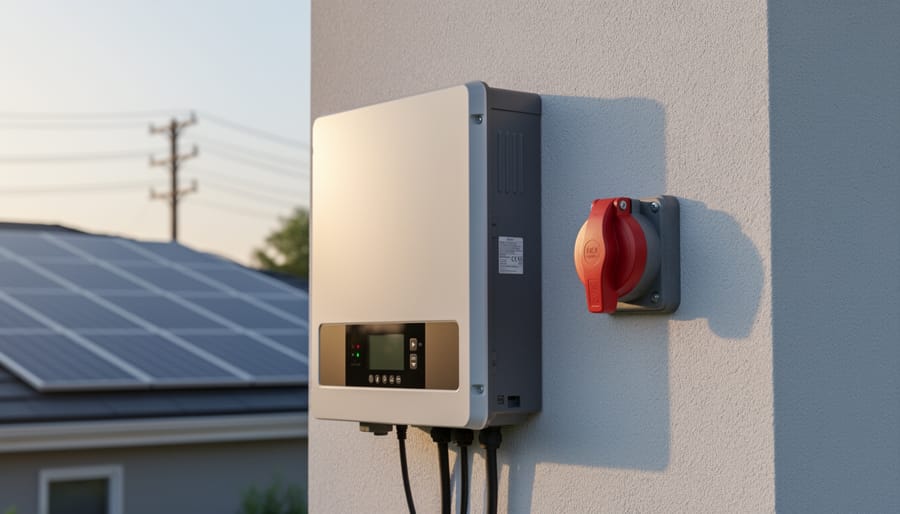
Next are disconnect switches, which let you safely isolate different parts of your system for maintenance. You’ll want one between your batteries and inverter, and another between your solar panels and charge controller. These essential safety components ensure you can work on your system without any live power flowing through it.
Don’t forget about battery management system protections that monitor cell temperatures and voltages. I also strongly recommend a DC-rated ground fault detector, which can identify dangerous current leaks before they become problems. Finally, invest in proper wire ratings and conduit—using undersized wiring is asking for trouble. Remember, cutting corners on safety equipment to save a few dollars makes absolutely no sense when you’re protecting thousands of dollars worth of batteries and equipment.
Off-Grid vs. Backup: Tailoring Your 5kW System
Backup-Only Systems: Keeping It Simple
If you’re not interested in solar integration or selling power back to the grid, a backup-only system offers the simplest path forward. I remember helping my neighbor set up exactly this type of system after a three-day power outage convinced him he needed something reliable but straightforward.
A backup-only 5kW system focuses on one job: keeping essential circuits running when the grid goes down. This approach eliminates the complexity of grid-tie inverters, net metering agreements, and utility inspections. You’ll need your battery bank, a quality inverter with transfer switch capability, and a critical load panel to separate your emergency circuits from regular household loads.
The beauty here is automatic transfer. Modern inverters detect grid failures in milliseconds and seamlessly switch to battery power without you lifting a finger. When grid power returns, the system switches back and begins recharging your batteries. Some folks charge their batteries overnight during off-peak hours to save money, while others use a basic solar panel setup just for keeping batteries topped off between outages. This middle-ground approach keeps your investment reasonable while delivering reliable emergency power when you need it most.
Off-Grid Additions: Solar Integration and Charging
Expanding your 5kW battery backup to work with solar panels transforms it from a temporary power solution into a sustainable off-grid system. I learned this firsthand when I added solar to my own setup, and the difference was remarkable—suddenly, my battery wasn’t just draining during outages, it was actively recharging itself every sunny day.
The heart of solar integration is the charge controller, which regulates power flow from your panels to your battery bank. You’ll need to choose between two types: PWM (Pulse Width Modulation) or MPPT (Maximum Power Point Tracking). For most 5kW systems, I recommend MPPT controllers because they’re 20-30% more efficient, especially if your solar array voltage doesn’t perfectly match your battery voltage. Size your controller to handle your total solar array output—if you’re installing 3,000 watts of panels, you’ll need a controller rated for at least that capacity with some headroom.
Your solar array size depends on your daily energy consumption and local sunlight hours. A good rule of thumb: if you’re using 5kW continuously, you’ll need 6-8kW of solar panels in most locations to both power your loads and recharge your batteries during daylight hours. Don’t forget proper disconnects and safety devices between your panels, controller, and battery bank—safety always comes first in any electrical system.
Real-World Installation Tips from the Trenches
The Mistakes I Made (So You Don’t Have To)
Let me share some hard-earned lessons from my first 5kW battery backup installation that nearly turned into a very expensive paperweight.
My biggest mistake? I went cheap on the wiring. I figured 10-gauge wire would handle everything just fine. Wrong. Under heavy load, those cables got hot enough to make me seriously nervous. Turns out, for the 400+ amps my system could potentially draw, I needed at least 4/0 gauge cable. That upgrade cost me an extra weekend and a few hundred dollars I should’ve budgeted from the start.
Then there was the ventilation issue. I installed my battery bank in a small closet, thinking the compact space would be perfect. Three months later, I noticed the batteries running warmer than they should. The BMS kept throttling performance to prevent overheating. I ended up cutting ventilation holes and installing two computer fans – something that would’ve taken 30 minutes during initial installation instead of the half-day retrofit it became.
I also learned the hard way about surge capacity versus continuous output. During a power outage, I tried running my well pump, refrigerator, and microwave simultaneously. The inverter immediately shut down. I hadn’t calculated that startup surges can be three times the running wattage. Now I keep a simple chart on my wall showing which appliances I can run together.
The lesson? Plan for reality, not best-case scenarios. Budget an extra 20 percent for proper components, give your batteries room to breathe, and always test with realistic loads before you actually need the backup power.
Testing and Commissioning Your System
Before you flip the switch and celebrate, let’s make sure everything works safely. I learned this the hard way when I rushed through testing my first system and ended up troubleshooting a wiring mistake at midnight during an actual power outage. Not fun.
Start with a visual inspection. Double-check all connections are tight and properly insulated. Look for any exposed wires or loose terminals. With everything still disconnected from household loads, power on your battery system and verify the voltage readings match your specifications. A 48V system should read between 48-58V depending on charge state.
Next, test your inverter by connecting a small load, like a lamp or phone charger. Monitor the display for any error codes or unusual behavior. Gradually increase the load to verify your system can handle bigger draws without tripping protections.
Now comes the fun part: simulate a power outage by disconnecting from the grid and running essential appliances. Time how long your system maintains power with typical loads. This real-world test reveals whether your 5kW capacity truly meets your needs.
Finally, test the automatic transfer switch if you have one. Cut grid power and confirm the system switches seamlessly to battery backup. Document everything you learn during testing. These notes become invaluable reference points for future adjustments and troubleshooting.
Proper testing and commissioning ensures your 5kW battery backup system operates safely and reliably when you need it most.
Maintaining Your 5kW Battery Backup for the Long Haul
Monthly Checks and Monitoring
Once your 5kW battery backup is up and running, spending just 15 minutes each month on monitoring can save you from expensive headaches down the road. I learned this the hard way when I ignored a slowly declining voltage reading, which turned into a costly cell replacement.
Start by checking your voltage readings. Use a multimeter to measure each battery bank or module. Write these numbers down in a simple notebook or spreadsheet so you can spot trends over time. If one module drops significantly lower than others, you’ve caught an issue early.
Next, look for physical changes. Are any terminals showing corrosion? That white or greenish buildup isn’t just ugly—it increases resistance and reduces efficiency. A quick wipe with a baking soda solution fixes this easily.
Check your Battery Management System display for any warning lights or error codes. Most modern systems track temperature, charge cycles, and individual cell health. Screenshot these readings monthly to compare later.
Finally, listen to your system. Unusual humming, clicking, or buzzing sounds often signal loose connections or failing components. Trust your senses—they’re excellent diagnostic tools that complement your technical measurements.
When to Worry: Warning Signs Your System Needs Attention
Your 5kW battery backup system will usually give you signs before serious problems develop. I learned this the hard way when I ignored a slightly puffy battery cell for too long—don’t make my mistake!
Watch for these red flags: Any swelling or bulging in your battery cells means immediate shutdown. This indicates dangerous gas buildup inside. If you notice your batteries getting unusually hot during normal operation (warm is okay, but too hot to comfortably touch is concerning), something’s wrong with either the charging rate or internal resistance.
Your Battery Management System should alert you to voltage imbalances between cells. If one cell consistently reads significantly higher or lower than others, it’s failing. Similarly, if your system can’t hold a charge like it used to—say your backup time dropped from 5 hours to 3 without increased usage—individual cells may be degrading.
Strange smells, especially a sweet or chemical odor, warrant immediate investigation. Visible corrosion around terminals, repeated BMS shutdowns, or error codes you can’t easily explain all deserve attention.
The good news? Catching these early usually means replacing a component rather than rebuilding your entire system. Check your setup monthly during the first year, then quarterly once everything’s stable and proven reliable.
You’ve made it this far, which means you’re serious about taking control of your energy independence. Whether you’re looking at a 5kW battery backup to keep essentials running during outages or building a complete off-grid power solution, the path forward is clearer than you might think.
Here’s the beautiful truth I’ve learned after years of tinkering with these systems: you don’t have to build everything at once. Start small if you’re new to this. Grab a single battery, wire up a basic inverter, and power a few lights. Learn how the components talk to each other. Once you’re comfortable, scale up to that full 5kW system.
For those ready to dive deeper, head over to Spheral Solar’s interactive calculators to design your exact system. Input your actual power needs, see what components match your situation, and get a realistic picture of costs and capabilities. There’s no substitute for running the numbers based on your unique setup.
The DIY solar community thrives on shared knowledge. Your questions have probably been answered before, and your eventual successes will help someone else down the line. Don’t hesitate to engage, ask questions, and share what works for you.
Battery backup isn’t rocket science anymore. It’s accessible, practical, and incredibly rewarding. Whether you’re protecting against grid failures, reducing your carbon footprint, or simply enjoying the satisfaction of building something meaningful, your 5kW journey starts with that first component. What are you waiting for?
How useful was this post?
Click on a star to rate it!
Average rating 0 / 5. Vote count: 0
No votes so far! Be the first to rate this post.
We are sorry that this post was not useful for you!
Let us improve this post!
Tell us how we can improve this post?
charlesnoble
Here at Spheral Solar, I’m a hands-on solar power enthusiast, constantly exploring and experimenting with DIY solutions. I’m dedicated to sharing my discoveries, insights, and even the bumps I hit along the way, all in the pursuit of a more sustainable future.
Why Your Backup System Needs a Critical Load Panel… by Charlesnoble December 28, 2025 Picture this: It’s 2 AM, the power’s out, and your backup battery system is silently draining itself trying to keep your pool pump, water heater, and every other non-essential appliance running. By morning, you’re out of power—right when you actually need it for your refrigerator and medical equipment. I learned…
Stop Oversizing Your Off-Grid Inverter (Here’s What… by Charlesnoble December 24, 2025 Calculate your total daily energy consumption in watt-hours by listing every appliance you plan to run off-grid, from your refrigerator drawing 150 watts for 8 hours to your laptop charging at 65 watts for 3 hours. Multiply each appliance’s wattage by its daily runtime, then add everything together. This number…
Why Your Off-Grid Battery System Fails (And How to… by Charlesnoble January 4, 2026 Calculate your daily energy consumption in watt-hours by listing every device you’ll power, its wattage, and hours of daily use—this single number determines whether you need a 5kWh system or a 50kWh system. Most first-time builders overestimate their needs by 40% or underestimate by forgetting phantom loads like WiFi routers…
The Stream Behind Your House Could Power It (Here’s… by Charlesnoble March 26, 2026 Walk down to your nearest stream with a five-gallon bucket and a stopwatch. Fill that bucket and time how long it takes—this simple test reveals whether you have enough flowing water to power your off-grid home. If you can fill it in under 10 seconds from a source that drops…
Why Grid Code Compliance Matters (Even When You’re… by Charlesnoble January 16, 2026 Check your local utility’s interconnection requirements before assuming your off-grid system is exempt from grid codes—many jurisdictions now require compliance even for systems with no planned grid connection, especially if your property remains connected to utility lines. Download your utility’s technical standards document and your state’s electrical code amendments, then…
This Critical Safety Switch Could Save Your Solar… by Charlesnoble February 22, 2026 Picture this: you’ve just finished mounting your solar panels, the sun is shining, and DC power is flowing through your system at voltages high enough to seriously injure or kill someone. Without a proper DC isolator switch, you have no safe way to disconnect that power for maintenance, emergencies, or…
Subscribe for handpicked DIY projects, exclusive tips, and giveaways.
Check your existing solar lights before buying new batteries by removing the old NiCd cells and testing them with a multimeter—most failures stem from corroded battery contacts, not dead batteries. Clean the terminals with white vinegar and a wire brush, and you’ll likely resurrect 60% of “dead” lights without spending a dime. Replace NiCd batteries… Read more: Why NiCd Batteries Keep Your Solar Lights Alive (When Others Fail)
Picture this: You’ve just finished wiring your DIY solar panel array to your main electrical panel, feeling pretty accomplished, when a fellow solar enthusiast asks, “Did you install surge protection?” You pause. You know your system needs breakers, but surge protector breakers? That’s when you realize there’s a gap in your solar safety knowledge. If… Read more: Why Your Solar System Needs a QO Surge Protector Breaker (Before It’s Too Late)
Mount your solar area lights where they’ll receive at least 6-8 hours of direct sunlight daily, avoiding shade from trees, buildings, or eaves that can cut charging efficiency by 70% or more. I learned this the hard way when my driveway lights barely lasted two hours each night until I repositioned them just three feet… Read more: Why Your Solar Area Lights Keep Failing (And How to Fix Them for Good)