Why Your Solar Area Lights Keep Failing (And How to Fix Them for Good)
Updated:
Mount your solar area lights where they’ll receive at least 6-8 hours of direct sunlight daily, avoiding shade from trees, buildings, or eaves that can cut charging efficiency by 70% or more. I learned this the hard way when my driveway lights barely lasted two hours each night until I repositioned them just three feet to the left.
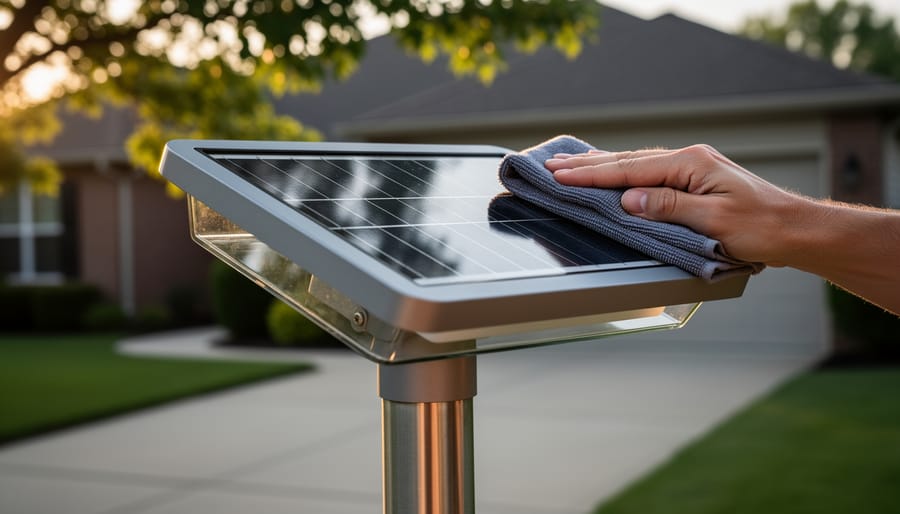
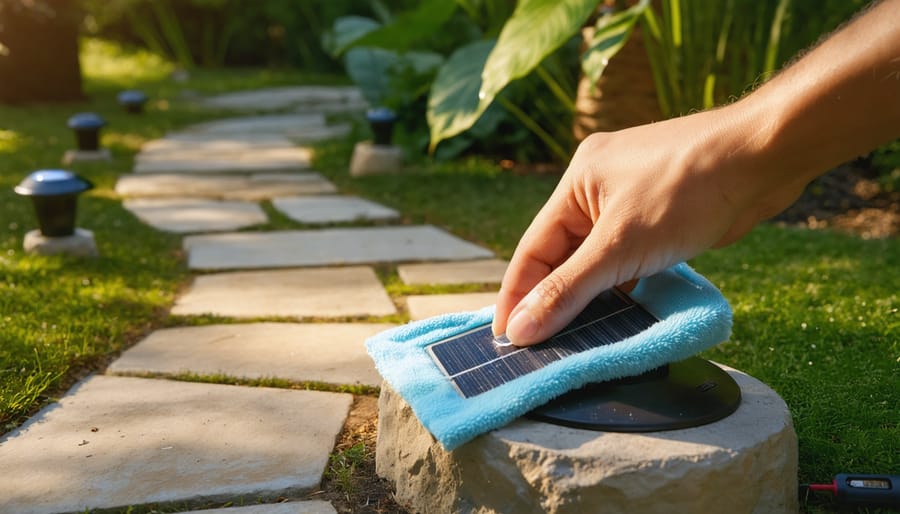
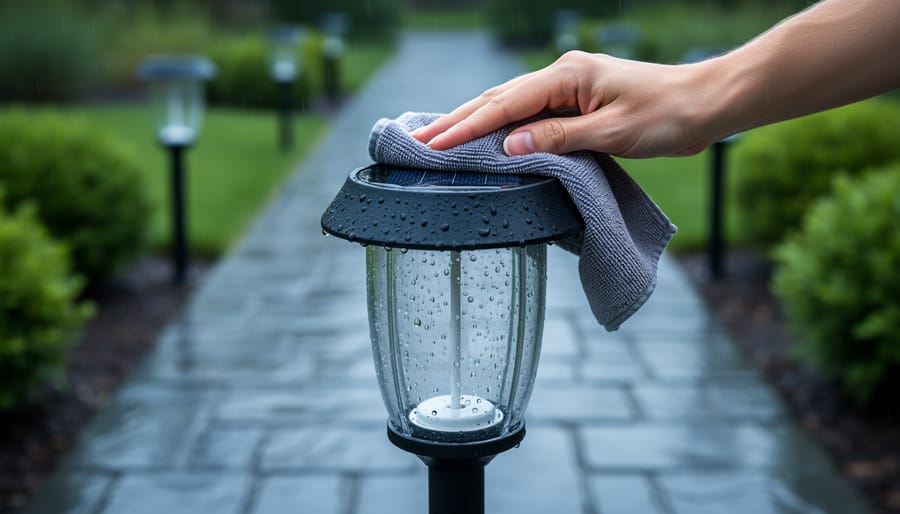
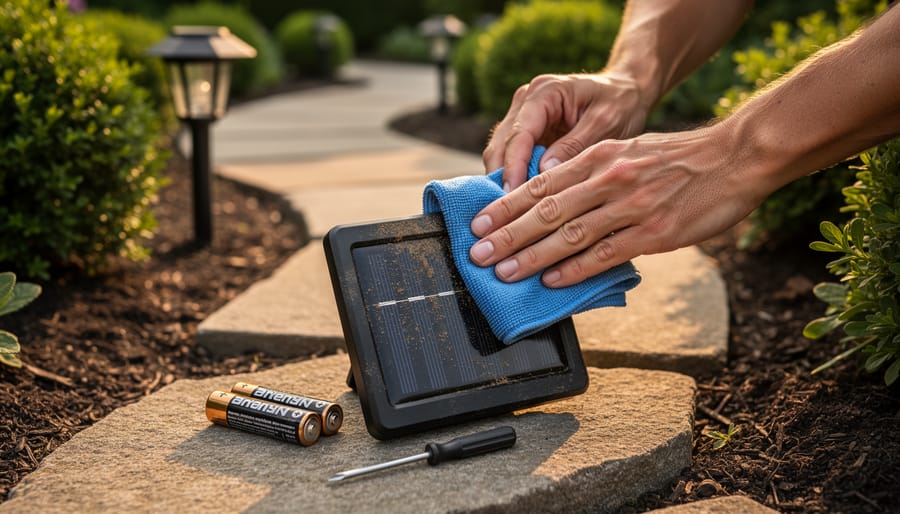
Clean the solar panels monthly with a soft cloth and mild soap solution, because even a thin layer of dust, pollen, or bird droppings can reduce energy absorption by up to 25%. During winter months or in dusty areas, increase cleaning to every two weeks for optimal performance.
Replace rechargeable batteries every 1-2 years, even if lights still function, since degraded batteries hold progressively less charge and cause dimming or shortened run times. Most quality solar area lights use standard AA or 18650 batteries that cost just a few dollars but restore full brightness and duration.
Test your lights after major weather events by covering the solar panel with your hand at dusk to trigger the light sensor, ensuring the fixture actually illuminates and the motion sensor responds if equipped. This simple 30-second check identifies water damage, loose connections, or failed components before they become safety hazards in your driveway or walkway.
Check mounting hardware quarterly and retighten any loose screws or brackets, because vibration from wind gradually loosens connections and misaligns solar panels away from optimal sun angles. A quick inspection with a screwdriver prevents fixtures from falling or tilting into shaded positions that ruin performance.
What Makes Solar Area Lighting Different from Other Solar Lights
Solar area lights provide broad illumination for outdoor living spaces, unlike focused spotlights or pathway markers.
Coverage vs. Intensity: Finding the Right Balance
Finding the sweet spot between coverage area and light intensity can be tricky, but it’s one of the most important decisions you’ll make when setting up solar area lighting. Here’s what I’ve learned from trial and error in my own backyard.
Think of it like choosing between a spotlight and a floodlight. A single high-intensity solar light might brilliantly illuminate your patio table, but it’ll create harsh shadows and leave the corners of your yard pitch black. On the flip side, spreading multiple lower-intensity lights across the same space gives you even coverage without dark spots, though each individual area might be a bit dimmer.
During a camping trip last summer, I made this mistake firsthand. I brought one powerful solar lantern thinking it would light our entire campsite. It worked great for the picnic table area, but anyone walking to the tent felt like they’d stepped into a cave. The next trip, I switched to three smaller solar path lights positioned strategically around our setup. Much better experience, and everyone could actually see where they were walking.
For outdoor living spaces, I recommend the multiple-light approach for general areas like patios and walkways. You want consistent, comfortable lighting that doesn’t create glare or harsh contrasts. Save your high-intensity lights for specific task areas like outdoor kitchens, reading nooks, or security zones where you genuinely need that extra brightness. Most DIYers find that combining both strategies works best, creating layers of light that serve different purposes throughout your space.
Where Area Lighting Shines Best
Solar area lighting really comes into its own in places where running electrical wiring would be a headache or just plain impractical. I’ve tested these setups in all sorts of situations, and I’m always amazed at how versatile they are.
My favorite application? Camping. Last summer, I set up a portable solar area light at our family campsite, and it transformed our evenings completely. Instead of stumbling around with flashlights or dealing with smelly lanterns, we had bright, reliable lighting that charged itself all day. The kids could play cards after sunset, and I didn’t worry about running out of fuel or batteries.
RV enthusiasts absolutely love these systems too. I helped my neighbor install a couple of solar area lights around his RV parking spot, and now he’s got excellent visibility for hooking up and leveling, even when he arrives at a site after dark. The best part? No extension cords snaking across the campground.
Around the home, driveways and patios are perfect candidates. I installed solar area lights along my driveway three years ago, and they’ve paid for themselves in peace of mind alone. Coming home late at night used to mean navigating a dark pathway, but now everything’s well-lit automatically.
Off-grid cabins benefit enormously from this technology. A friend runs his entire cabin’s exterior lighting on solar, and it’s been maintenance-free for years. He just wipes down the panels occasionally and enjoys reliable illumination without touching his backup generator.
The common thread? These are all spaces where solar area lighting eliminates hassle while providing dependable, eco-friendly illumination exactly when and where you need it.
The Five Critical Features That Separate Good from Great
Solar Panel Quality and Positioning
When I first started researching solar area lights, I was completely overwhelmed by the different panel types. Let me break this down in a way that actually makes sense for your project.
The two main solar panel types you’ll encounter are monocrystalline and polycrystalline. Think of monocrystalline panels as the premium option – they’re made from single silicon crystals, which means they’re more efficient at converting sunlight to electricity. They typically convert about 15-20% of sunlight into usable energy and perform better in low-light conditions. Polycrystalline panels, made from multiple silicon fragments melted together, are slightly less efficient at around 13-16%, but they’re also more affordable. For area lighting, I generally recommend monocrystalline panels if your lights will be in partially shaded areas or if you live somewhere with frequent cloudy weather.
Now, here’s something I learned the hard way: panel wattage really matters. For basic pathway lights, 2-5 watts is usually sufficient. However, for genuine area lighting that illuminates driveways, patios, or larger outdoor spaces, you’ll want panels in the 10-20 watt range. Anything less just won’t provide enough juice to keep those lights running through the night.
Panel positioning is where many people struggle. The ideal angle depends on your latitude, but a general rule is to tilt your panel at an angle equal to your latitude for year-round performance. In practice, most solar area lights come with adjustable panels – position them facing true south in the Northern Hemisphere and angle them to catch maximum midday sun. Even a 10-degree adjustment can improve charging efficiency by up to 25%. Keep the panels clear of overhanging branches and check them monthly for debris buildup that blocks sunlight.
High-quality monocrystalline solar panels feature uniform crystalline structures that efficiently convert sunlight into electrical energy.
Battery Capacity: The Make-or-Break Component
Here’s the thing about batteries in solar area lights – they’re honestly the component that determines whether your lights shine bright all night or flicker out disappointingly around midnight. I learned this the hard way when my first DIY solar project kept dying after just three hours. Turns out, I’d completely underestimated battery capacity.
Let’s talk about your two main battery options. Lithium-ion batteries are the premium choice – they pack more power into a smaller package, handle cold weather better, and typically last 3-5 years. NiMH (Nickel-Metal Hydride) batteries are the budget-friendly alternative. They’re perfectly serviceable but don’t hold quite as much charge and may need replacing every 2-3 years. For most hobbyists, I recommend lithium-ion if your budget allows – the longevity justifies the cost.
Now, capacity ratings measured in milliamp-hours (mAh) tell you how much energy your battery stores. Here’s a practical way to calculate if your battery can handle your lighting needs: First, check your LED’s power consumption in milliamps (mA). A typical 3-watt LED draws about 250mA. Multiply this by how many hours you want light – let’s say 8 hours. That’s 250mA × 8 = 2,000mAh minimum capacity needed.
However, here’s my insider tip: always add a 20-30% buffer. Batteries lose efficiency over time, and cloudy days mean less charging. So for that 2,000mAh requirement, I’d actually choose a 2,500-3,000mAh battery. This ensures consistent performance even when conditions aren’t perfect.
When shopping, look for batteries rated for at least 500 charge cycles. This translates to genuine longevity rather than just impressive initial numbers that fade quickly.
LED Quality and Light Distribution
Let me share something I learned the hard way: not all solar area lights are created equal, and the LED quality makes a huge difference in how long your investment lasts.
When shopping for solar area lights, you’ll see lumens mentioned everywhere. Think of lumens as the brightness output – the higher the number, the brighter the light. For reference, a typical 60-watt incandescent bulb puts out about 800 lumens. Most quality solar area lights range from 800 to 3,000 lumens depending on their purpose. Pathway lighting might only need 100-200 lumens, while security lighting benefits from 1,000 lumens or more.
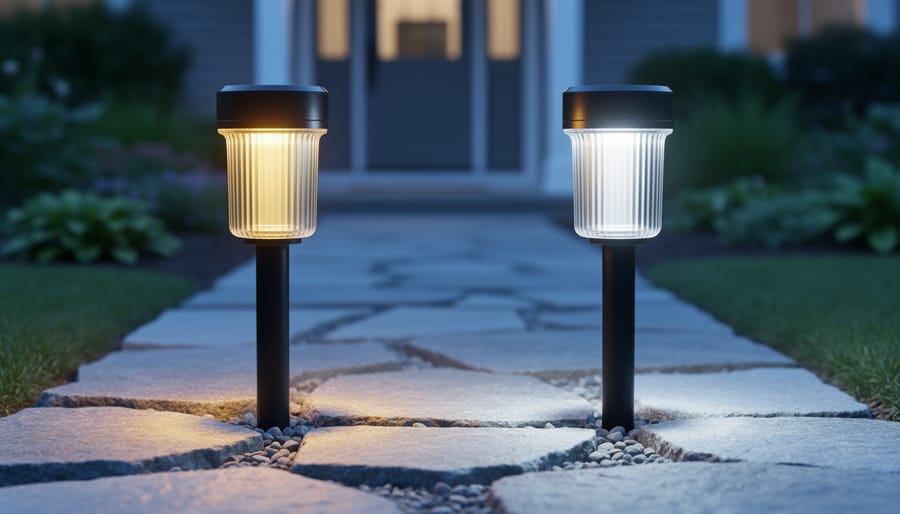
Color temperature, measured in Kelvin, describes how warm or cool the light appears. Lower numbers (2,700K-3,000K) give off that cozy, yellowish glow like traditional bulbs, perfect for entertaining areas. Higher numbers (5,000K-6,500K) produce a crisp, bluish-white light that’s great for security purposes since it mimics daylight and helps cameras pick up details better.
Beam angle determines how light spreads. Narrow beams (25-45 degrees) create focused spotlights, while wide beams (90-120 degrees) provide broader coverage for general area lighting.
Here’s what I discovered after replacing three sets of cheap solar lights: bargain LEDs fail faster because they use inferior chips that degrade quickly and generate excessive heat. Quality LEDs include proper heat sinks and weather-sealed housings. The difference becomes obvious after six months – cheap lights dim noticeably or develop that annoying flicker, while quality units maintain consistent brightness. Just like choosing between lithium-ion vs. NiMH batteries, investing in better LED components pays off long-term.
Motion Sensors and Smart Controls
Motion sensors can transform your solar area lights from constant energy drainers into smart, efficient fixtures that only work when needed. I learned this the hard way when my first DIY solar setup ran out of juice by 2 AM every night. Adding a basic motion sensor extended my runtime by three times, and honestly, it felt like magic.
For most outdoor spaces, motion sensors make sense in areas where you don’t need constant illumination. Think pathways, side yards, or garage approaches. You’ll want full-time lighting near entryways or entertainment areas, but motion-activated lights work beautifully for security and occasional-use zones.
When choosing motion sensors for your solar setup, look for adjustable sensitivity settings. I discovered this after my lights kept triggering for every passing cat and windblown leaf. Most decent sensors let you dial the sensitivity up or down, plus adjust the detection range from about 10 to 50 feet. Start conservative and increase sensitivity if needed rather than battling false triggers.
Timer functions add another layer of control. Many solar controllers now include programmable timers that let you set “active hours” for motion detection. Mine kicks in at dusk, switches to motion-only mode at 11 PM, and turns off at dawn. This scheduling prevents wasted energy during hours when nobody’s around.
Remote control options have become surprisingly affordable for DIY installations. Basic RF remotes start around fifteen dollars and let you adjust settings without climbing ladders. Some newer systems even offer smartphone connectivity through Bluetooth adapters, though I’ll admit the simpler remote works just fine for my needs.
Weather Resistance Ratings You Can Actually Trust
When you’re shopping for solar area lights, you’ll see codes like IP65 or IP67 plastered all over product descriptions. These are Ingress Protection ratings, and they actually tell you something useful once you crack the code. The first number (after “IP”) rates protection against solid objects like dust, while the second number indicates water resistance.
Here’s what matters for your outdoor lights: IP65 means the unit is completely dust-tight and can handle water jets from any direction. Think heavy rain and garden hose spray. IP67 steps it up—it can be temporarily submerged in water up to a meter deep. IP68 is the champion, offering extended submersion protection.
Charles learned this the hard way during a particularly brutal winter in Maine. His IP44-rated lights (marketed as “weather resistant”) failed within months, while his IP65 units from the same installation are still going strong five years later. The difference? Those two digits.
For most homeowners, IP65 is the sweet spot for area lighting. It handles rain, snow, and typical outdoor conditions without breaking the bank. If you’re in flood-prone areas or placing lights near sprinklers, consider IP67. Don’t waste money on IP68 unless you’re literally mounting lights in areas that flood regularly.
Pro tip: Check that both the solar panel and the light fixture have adequate ratings. Some manufacturers skimp on one or the other. Also, weatherproofing affects motion sensor settings and battery compartments, so verify those components specifically have proper sealing.
Maintenance That Actually Works: My Weekly and Seasonal Routine
The Five-Minute Weekly Check
I’ll be honest with you—when I first installed my solar area lights, I thought they were maintenance-free. Two months later, they were barely putting out half their original brightness. Turns out, a little weekly attention goes a long way in keeping these lights performing at their best.
Set aside just five minutes each week for a quick check-up. Start by visually inspecting each light fixture. Look for obvious issues like cracks in the housing, loose mounting hardware, or water inside the lens. These problems only get worse if ignored, so catching them early saves you hassle down the road.
Next, give those solar panels a quick wipe-down. Dust, pollen, and bird droppings are brightness killers. For everyday cleaning, plain water on a soft microfiber cloth works perfectly fine. I keep a dedicated cleaning cloth in my garage just for this purpose.
For tougher grime, mix up this simple DIY cleaning solution: combine one cup of water with two tablespoons of white vinegar and a single drop of dish soap. This gentle mixture cuts through residue without leaving streaks or damaging the panel surface. Spray it on, wipe with your microfiber cloth, and finish with a dry pass to prevent water spots.
Don’t forget to clear away any debris around the base of your lights. Fallen leaves, grass clippings, and overgrown vegetation can block sensors or create moisture problems. A quick sweep around each fixture keeps everything working smoothly and extends the life of your investment considerably.
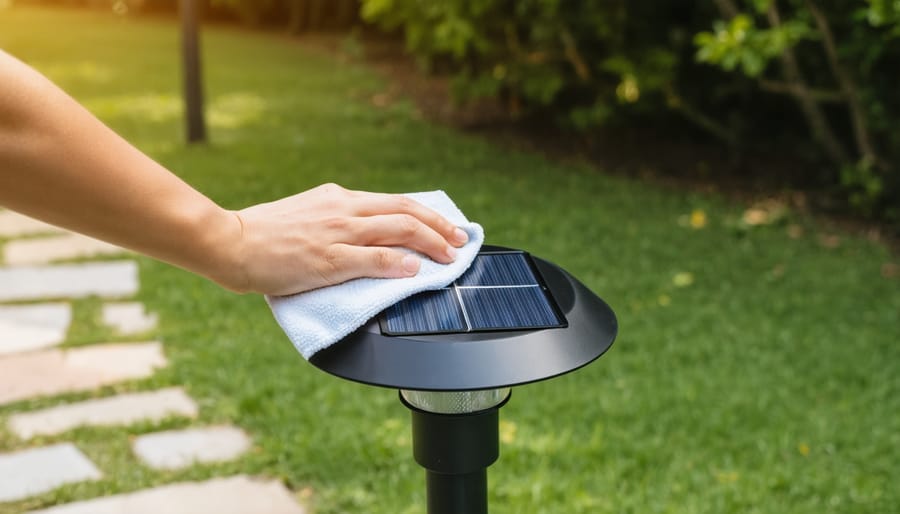
Regular cleaning of solar panels removes dust and debris that reduce charging efficiency, taking only minutes per week.
Monthly Deep Maintenance
Once a month, set aside about 30 minutes for a deeper maintenance check of your solar area lights. I learned this the hard way when I ignored mine for three months and ended up replacing components that could have been saved with regular attention.
Start by inspecting all electrical connections. Gently wiggle the panel connections and battery terminals to check for looseness. Corrosion appears as white, green, or blue crusty deposits around metal contacts. If you spot any, disconnect the battery (always safety first) and clean terminals with a wire brush or sandpaper. A thin layer of petroleum jelly can help prevent future corrosion.
Battery health deserves special attention during your monthly check. Most solar lights use rechargeable batteries that degrade over time. If your lights aren’t lasting through the night despite clean panels, the battery might be the culprit. You can test this by fully charging the light on a sunny day and timing how long it runs. Compare this to the manufacturer’s specifications. Most batteries last 2-3 years before needing replacement.
Beyond basic panel cleaning techniques, monthly maintenance includes checking the angle of your panels. As seasons change, the sun’s path shifts significantly. In my backyard, I adjust my panel angles three times yearly: steeper in winter when the sun sits lower, flatter in summer for overhead sun. A 15-degree adjustment can boost charging efficiency by 20-30 percent.
Finally, check mounting hardware for rust or loosening. Tighten any wobbly fixtures and replace rusted screws before they fail completely.
Seasonal Prep: Winter and Summer Strategies
I learned about seasonal prep the hard way when my first set of solar area lights barely survived their first winter. The batteries lost charge quickly, and by spring, two of my four lights were completely dead. Since then, I’ve developed a reliable routine that keeps my lights running strong year-round.
Winter presents the biggest challenge for solar area lights. When temperatures drop below freezing, battery performance suffers dramatically. If you live in a climate with harsh winters, consider bringing removable battery packs indoors during the coldest months. For permanently installed lights, adding insulation around the battery compartment can make a real difference. I wrap mine with weatherproof foam insulation, which helps maintain a slightly warmer microclimate. Also, remember that shorter days and frequent cloud cover mean less charging time, so clean your solar panels more frequently during winter to maximize every bit of available sunlight.
Summer brings its own set of concerns, mainly heat damage. Excessive heat can shorten battery lifespan and cause premature degradation. Position your lights where they’ll get morning sun but some afternoon shade if possible. I’ve noticed that lights facing south in full afternoon sun tend to overheat, especially the darker housing models. If relocating isn’t an option, consider adding a small shade structure or positioning them near vegetation that provides partial afternoon cover.
Before each season change, inspect all connections, clean panels thoroughly, and test each light individually. Replace any batteries showing signs of swelling or corrosion immediately. This fifteen-minute check twice a year has extended my lights’ lifespan by at least three years, and they still perform like new.
Troubleshooting Common Problems Before You Replace Anything
Lights Won’t Turn On or Stay Dim
When your solar area lights refuse to turn on or seem stuck at candlelight-level brightness, don’t assume they’re dead just yet. I learned this the hard way after nearly tossing a whole set of pathway lights that just needed a good cleaning.
Start with the simplest culprit: dirty solar panels. Dust, pollen, and grime can block up to 50% of sunlight absorption. Wipe the panel with a damp cloth and see if performance improves after a full day’s charge. While you’re at it, check if tree branches or other objects are casting shadows on your panels during peak sun hours (typically 10 AM to 2 PM).
Next, examine the battery. Most solar lights use rechargeable batteries that last 1-3 years. If your lights are older or haven’t been used in months, the battery might be depleted beyond recovery. Remove the battery compartment cover and look for corrosion (white or green crusty buildup). Clean any corrosion with a cotton swab dipped in white vinegar, then try replacing the battery with a fresh one matching the same voltage and chemistry type.
Check the on/off switch too. Sometimes it’s as simple as accidentally bumping the switch, or the sensor being confused by nearby porch lights. Try covering the solar panel completely to trick the sensor into night mode.
If lights still won’t cooperate after these steps, test the LED itself by temporarily connecting it to a regular battery. No light? The LED has failed, and replacement is usually your only option since LEDs aren’t typically serviceable in budget solar fixtures.
Inconsistent Performance: On Some Nights, Off Others
I’ve noticed with my own solar area lights that some evenings they shine brilliantly, while other nights they barely flicker to life. If you’re experiencing this frustrating pattern, you’re dealing with one of the most common solar light problems, and the good news is it’s usually fixable.
Start your diagnosis by checking the solar panel surface. I learned this the hard way last fall when leaves and dust accumulated on my panels without me noticing. Even a thin layer of grime can reduce charging efficiency by 30-40%. Give them a gentle wipe with a damp cloth and see if performance improves over the next few nights.
Next, investigate partial shading throughout the day. That tree branch that seems harmless might be casting shadows during peak charging hours between 10am and 2pm. I once had a fixture that worked great in summer but failed in winter because the sun’s angle changed, creating unexpected shade patterns. Walk around your property at different times to identify these sneaky shade sources.
Motion sensor issues also cause erratic behavior. Test your sensor by walking past at various angles and distances. Sometimes sensors get misaligned or their sensitivity settings drift. Most units have adjustment dials you can tweak to fine-tune the detection zone.
Finally, check your battery connections. Corrosion or loose terminals create intermittent contact, causing unpredictable performance. A quick inspection and gentle cleaning with a dry cloth often resolves these connection issues immediately.
Rapid Battery Drain: Getting Through the Night
I learned this lesson the hard way when three of my pathway lights stopped working after just eight months. I’d wake up to a dark driveway every morning, and it turned out the batteries had given up entirely.
The telltale signs of battery degradation are pretty straightforward. If your lights only stay on for two to three hours instead of the usual six to eight, or they’re noticeably dimmer than when new, your battery is probably on its way out. You might also notice the lights fail to turn on at all on cloudy days, even though they worked fine before.
Here’s a simple test I use: fully charge the light on a sunny day, then cover the solar panel at dusk to simulate nighttime. Check how long it stays lit. If it’s less than half the manufacturer’s claimed runtime, it’s replacement time.
Most solar area lights use rechargeable NiMH or lithium-ion batteries. The good news? They’re usually replaceable. Look for a small compartment near the solar panel or beneath the light fixture. Take note of the battery size (typically AA or 18650) and voltage rating before shopping for replacements.
When upgrading, consider switching from NiMH to lithium batteries if your fixture allows it. Lithium options last longer and perform better in cold weather. I made this switch on my remaining lights, and they’ve been running strong for two years now.
One pro tip: replace batteries before winter hits. Cold temperatures accelerate failure in already-weak batteries, and you don’t want to troubleshoot frozen fixtures in January.
DIY Upgrades That Extend Life and Boost Performance
Understanding the internal components of solar lights helps diagnose issues and identify upgrade opportunities for better performance.
Battery Replacement and Capacity Upgrades
I learned this lesson the hard way when my favorite pathway light died after just 18 months. The culprit? A worn-out battery. The good news is that replacing batteries is straightforward, and upgrading to higher-capacity options can dramatically extend runtime between charges.
Start by checking your solar light’s battery compartment, usually accessed via a small panel on the back or bottom. Before opening anything, let the light sit in darkness for a few hours to ensure it’s fully discharged. This simple safety step prevents any electrical surprises.
Once open, note the existing battery specifications. Most solar area lights use either NiMH (Nickel-Metal Hydride) or lithium-ion batteries. The key details you need are voltage (typically 1.2V for NiMH or 3.7V for lithium), size (like AA or 18650), and capacity measured in mAh (milliamp hours). Never mix battery types or voltages, as this can damage your light’s circuitry.
Here’s where it gets exciting: you can often upgrade to higher-capacity batteries within the same voltage and size category. For example, replacing a 600mAh NiMH battery with a 2000mAh version can triple your runtime. Through my testing, I’ve found Panasonic Eneloop Pro batteries exceptional for NiMH upgrades, while Samsung or LG cells work beautifully for lithium replacements.
Charles recommends purchasing from reputable suppliers like Battery Junction or 18650 Battery Store to avoid counterfeit cells. When installing, ensure proper polarity (positive to positive, negative to negative), then let your light charge for two full sunny days before first use. This conditioning cycle helps maximize battery lifespan.
Adding External Solar Panels
Sometimes your solar area lights just aren’t getting enough juice, especially if they’re installed under tree cover or in areas with limited sun exposure. The good news? You can absolutely upgrade them with external solar panels, and it’s easier than you might think.
I learned this the hard way when I installed pathway lights along my fence line, only to realize a nearby oak tree blocked afternoon sun. Rather than relocating everything, I connected a small external panel positioned in a sunnier spot about ten feet away.
Start by checking your light’s existing panel voltage and amperage, usually marked on the back. You’ll need a matching or slightly higher voltage external panel. Most solar area lights use 2V to 6V panels with 100-200mA output. Look for panels with the same voltage but higher amperage for faster charging.
For the connection, you’ll need 18-gauge outdoor-rated wire, waterproof wire connectors, and silicone sealant. Open your light’s battery compartment and locate where the existing panel wires connect, typically to the rechargeable battery or circuit board. Note the polarity: red is positive, black is negative.
Run your wire from the external panel location to the light fixture. Strip about half an inch from each wire end, twist the external panel’s positive wire together with the existing panel’s positive connection point, and repeat for negative. Secure with waterproof connectors and seal thoroughly with silicone.
You can even connect multiple panels in parallel for increased charging capacity, which works great when pairing with higher-capacity alternatives in your battery compartment. Just ensure all panels match in voltage while their amperages can add together.
Improving Light Distribution with Reflectors
Sometimes your solar area lights work perfectly fine, but the light just isn’t hitting where you need it most. I learned this the hard way when my pathway lights illuminated my neighbor’s fence beautifully while leaving my actual walkway in shadows! That’s where simple reflector modifications come in.
The easiest approach uses aluminum foil or aluminum flashing from your hardware store. Cut a piece slightly larger than your light fixture and curve it into a half-moon or parabolic shape. Position it behind or around the light source to bounce illumination toward your target area. For pathway lights, this might mean redirecting light downward onto the path instead of spreading everywhere.
For a more durable solution, grab some reflective emergency blankets from the camping section. They’re weather-resistant and bendable, making them perfect for outdoor use. You can also use old CDs or small mirrors, though these work best for accent lighting rather than functional illumination.
The key is experimenting with angles. I spent about twenty minutes adjusting my foil reflectors one evening, moving them just slightly until the light pooled exactly where I needed it. Start by positioning your reflector at a 45-degree angle and adjust from there based on results. Most people find that even basic modifications can increase effective light output in desired areas by 30-50 percent, essentially giving you brighter coverage without buying new fixtures.
Here’s the truth I’ve learned from years of tinkering with solar projects: reliable area lighting doesn’t require perfection from day one. The combination of choosing lights with proper weatherproofing, quality batteries, and efficient LED technology creates a solid foundation. But what really transforms these systems from frustrating to fantastic is consistent, simple maintenance.
Start small. I’m talking ridiculously small. Clean your panels once a month. Check battery connections every season. Replace worn gaskets before they leak. These tiny habits compound over time, and before you know it, you’ve got lights that actually work when you need them. I remember feeling overwhelmed by all the technical details when I started, but breaking everything down into monthly 15-minute checks made all the difference.
If you’re planning a new installation or upgrading an existing system, proper sizing makes everything easier down the road. The calculators at Spheral Solar can help you match panel capacity to your actual lighting needs, which prevents both underpowered disappointments and wasteful oversizing. I wish these tools existed when I was guessing my way through my first backyard setup.
The DIY solar community thrives because we share what works and what doesn’t. Your backyard is essentially a testing ground for solutions that might help someone else. Drop your experiences, questions, or clever workarounds in the comments. Someone struggling with dim lights next month might benefit from what you figured out today. That’s how we all get better at this together.
How useful was this post?
Click on a star to rate it!
Average rating 0 / 5. Vote count: 0
No votes so far! Be the first to rate this post.
We are sorry that this post was not useful for you!
Let us improve this post!
Tell us how we can improve this post?
charlesnoble
Here at Spheral Solar, I’m a hands-on solar power enthusiast, constantly exploring and experimenting with DIY solutions. I’m dedicated to sharing my discoveries, insights, and even the bumps I hit along the way, all in the pursuit of a more sustainable future.
Your Hampton Bay Solar Light Stopped Working? Here’s… by Charlesnoble November 2, 2025 **Check the solar panel surface first** – dirt, leaves, or a thin film of grime blocks sunlight absorption and prevents charging. I learned this the hard way when my own Hampton Bay pathway lights died after just two weeks; a simple wipe with a damp cloth brought them back to…
Why Your Solar Lights Glow Yellow (And How to Fix Them) by Charlesnoble December 30, 2025 Notice your once-bright solar lights glowing yellow or dim? This frustrating problem typically signals one of three culprits: aging batteries that can’t hold a full charge, dirty solar panels blocking sunlight absorption, or LEDs nearing the end of their lifespan. I’ve dealt with this issue countless times in my own…
Your Solar Light Won’t Turn On? Here’s Why (And How… by Charlesnoble November 10, 2025 Check your solar panel first—nine times out of ten, dirt, leaves, or shade are blocking the sunlight your fixture needs to charge. I learned this the hard way when my entire pathway lighting system “died” last fall, only to discover a thin film of pollen had cut charging efficiency by…
How to Clean Solar Lights – Why, When and How by Paul August 17, 2021 Heads up: some links here are affiliate links, and purchases through them support the site. As an Amazon Associate I earn from qualifying purchases. Solar lights and their moderately dirty panels are best cleaned with a mild detergent and a soft, damp cloth. Light lenses that have become cloudy can…
Why Your Solar Lights Stopped Working After Rain… by Charlesnoble May 21, 2026 Check the solar panel surface first—wipe away any water droplets, dirt, or debris that accumulated during the rain, as even a thin film can block up to 25% of light absorption. I learned this the hard way last spring when my pathway lights stayed dark for three days straight, and…
Why Your Solar Lights Stop Working (And How to Fix… by Charlesnoble December 1, 2025 Check the solar panel first by wiping away dirt, leaves, and debris that block sunlight absorption. A grimy panel is the number one reason solar lights stop working, and a simple cleaning with soapy water restores function in about 60% of cases. While you’re at it, reposition any lights that…
Subscribe for handpicked DIY projects, exclusive tips, and giveaways.
Nine times out of ten, an RV generator that won’t start has a stale fuel problem. If your generator hasn’t run in more than 30 days, degraded gasoline is likely gumming up the carburetor and preventing ignition. Before you panic or call for expensive roadside service, try this: turn on the generator’s fuel valve (if… Read more: RV Generator Troubleshooting: Common Problems and How to Fix Them
A 5kW solar system occupies between 250 and 350 square feet of roof or ground space and produces roughly 20 to 25 kilowatt-hours of electricity per day in most U.S. locations. That’s enough to power a typical three-bedroom home with moderate energy use, though your exact needs depend on your daily consumption patterns, climate zone,… Read more: How to Size a 5kW Solar System for Your Home or RV
Installing a home solar system yourself takes 2-4 weekends for an average 5kW setup, requires solid electrical knowledge and comfort working at heights, and can save you $5,000-$8,000 in labor costs if you tackle everything except the final utility interconnection. The process breaks down into five main phases: permitting and design, mounting the racking system,… Read more: Solar Power Installation Step by Step: Complete DIY Guide From Start to Finish