Why NiCd Batteries Keep Your Solar Lights Alive (When Others Fail)
Updated:
Check your existing solar lights before buying new batteries by removing the old NiCd cells and testing them with a multimeter—most failures stem from corroded battery contacts, not dead batteries. Clean the terminals with white vinegar and a wire brush, and you’ll likely resurrect 60% of “dead” lights without spending a dime.
Replace NiCd batteries only with exact voltage matches, typically 1.2V per cell, and verify your solar panel still generates at least 4-5 volts in direct sunlight before investing in new batteries. I learned this the hard way after replacing batteries in twelve pathway lights, only to discover the real culprit was cloudy solar panels that couldn’t charge anything.
Understand that NiCd technology isn’t obsolete—it’s actually superior for temperature extremes and can handle more charge-discharge cycles than cheaper alternatives. If your lights sit in freezing winters or scorching summers, NiCd batteries often outlast NiMH options despite being older technology. The key consideration in solar light battery selection is matching your climate conditions to battery chemistry.
Determine capacity needs by calculating your light’s runtime—a 600mAh battery provides roughly 6-8 hours of illumination for typical LED solar lights, while 300mAh cells manage only 3-4 hours. Upgrading from 300mAh to 600mAh NiCd batteries costs minimal extra money but doubles your lighting duration, making it the single best performance improvement you can make to budget solar lights.
What Makes NiCd Batteries Different (And Why Solar Lights Love Them)
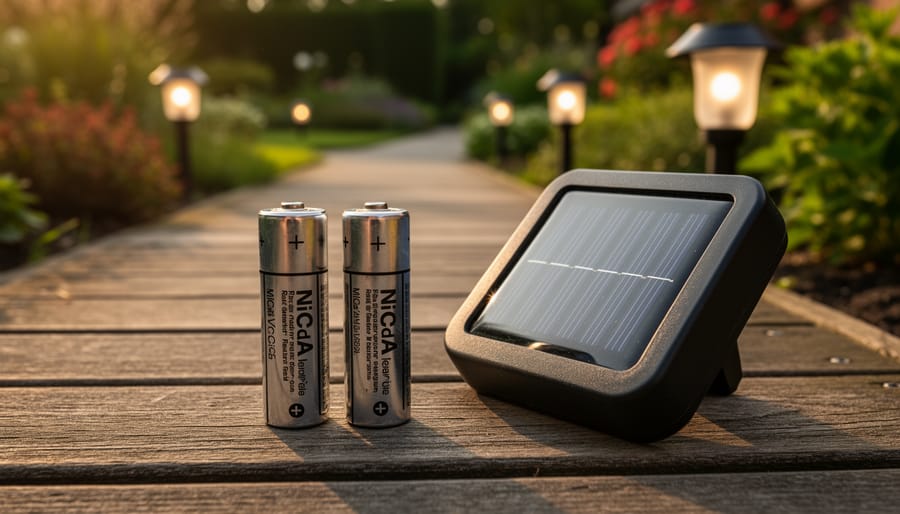
NiCd batteries are specifically designed to withstand the demanding charge-discharge cycles of solar-powered lighting applications.
The Temperature Tolerance Advantage
Here’s where NiCd batteries really shine in solar applications. I learned this the hard way during a particularly brutal winter when my neighbor’s lithium-ion solar lights completely gave up, while my old NiCd-powered fixtures kept trucking along at minus 15 degrees Fahrenheit.
NiCd batteries can operate in temperatures ranging from minus 4°F to 140°F, which is significantly wider than most other rechargeable battery chemistries. While NiMH batteries start losing capacity below freezing and lithium-ion cells can actually become damaged in extreme cold, NiCd batteries just keep working. They won’t perform at 100% capacity in freezing weather, you’ll typically see about 70-80% of their normal output, but that’s still far better than alternatives that might drop to 40% or stop functioning entirely.
For heat tolerance, NiCd batteries handle scorching summer days remarkably well. Those black solar light fixtures sitting in direct sunlight can get incredibly hot, sometimes reaching 120°F or more internally. NiCd batteries won’t suffer permanent damage from these conditions, though you’ll want to ensure your solar lights have adequate ventilation. This temperature resilience makes them genuinely practical for outdoor applications where weather extremes are unavoidable.
Solar lights with NiCd batteries continue operating reliably even in extreme cold temperatures where other battery types often fail.
Built for the Charge-Discharge Marathon
Solar lights face a demanding daily routine that would exhaust many battery types. Every evening, they discharge completely as they illuminate your pathway or garden. Each morning, they recharge under the sun. This happens 365 days a year, rain or shine. That’s a lot to ask from a battery.
Here’s where NiCd batteries really earn their place in solar lighting. I learned this the hard way when I first switched some of my solar lights to standard alkaline batteries, thinking I’d save money. They failed within weeks because alkaline batteries aren’t designed for repeated charging cycles.
NiCd batteries, on the other hand, thrive on this charge-discharge marathon. They’re engineered to handle hundreds, even thousands of deep discharge cycles without significant performance loss. Unlike some alternatives that degrade quickly when fully drained, NiCd batteries actually prefer being completely discharged before recharging. This matches perfectly with how solar lights operate.
The secret lies in their robust chemistry. NiCd batteries maintain consistent voltage output throughout their discharge cycle, meaning your lights stay bright longer into the night. They also tolerate the temperature swings that outdoor solar lights experience, from hot summer days to cool autumn evenings, without throwing a fit.
The Real Talk: NiCd Drawbacks You Should Know
The Memory Effect Myth vs. Reality
I used to worry constantly about the dreaded “memory effect” with my garden solar lights until I actually understood what it meant. Here’s the reality: the memory effect happens when you repeatedly recharge a NiCd battery before it’s fully discharged. The battery can “forget” its full capacity and start delivering less power than it should.
But here’s the good news for solar light users – this is rarely a problem in real-world situations. Your solar lights naturally discharge almost completely each night as they illuminate your pathway or garden. Then they recharge during the day. This daily cycle actually works in your favor, preventing memory effect from building up.
That said, I’ve found a couple simple practices helpful. During winter months when daylight is short, I occasionally let my solar lights run completely dead before recharging – maybe once every few months. Some folks also recommend removing the batteries and doing a full discharge-recharge cycle annually, though honestly, I’ve found this unnecessary for most outdoor applications.
The memory effect concern is legitimate, but it’s overblown for typical solar light use. Your lights’ natural charge-discharge pattern does most of the work preventing it.
Environmental Considerations Worth Knowing
Let’s talk about the elephant in the room: cadmium isn’t exactly Mother Nature’s best friend. This heavy metal can contaminate soil and water if batteries end up in landfills, which is why I’ve become pretty passionate about proper disposal over the years.
Here’s the deal—while NiCd batteries contain toxic materials, they’re also one of the most recyclable battery types available. Many retailers and municipal waste facilities accept them for recycling, where up to 95% of materials can be recovered and reused. I always keep a small container in my garage for spent batteries until I have enough to drop off.
Never toss NiCd batteries in regular trash. Check Earth911.com or call your local waste management to find nearby recycling centers. Some hardware stores also offer collection programs. By recycling responsibly, you’re not just disposing of batteries—you’re contributing to a circular economy that keeps harmful materials out of the environment while recovering valuable resources for future use.
When NiCd Batteries Are Your Best Bet
I’ll be honest with you – NiCd batteries get a bad rap these days, but they’re not obsolete. In fact, there are specific situations where they’re actually your smartest choice. Let me walk you through when sticking with NiCd makes perfect sense.
If you’re setting up solar lights in extreme weather conditions, NiCd batteries are tough cookies. I learned this the hard way during a winter camping trip in Montana. My friend brought fancy new solar lights with lithium batteries, while I stuck with my old NiCd-powered setup. Guess whose lights kept working when temperatures dropped below freezing? NiCd batteries can handle scorching summers and brutal winters without breaking a sweat, operating reliably from -40°F to 140°F. That makes them ideal for year-round garden lights in places with harsh seasonal swings.
Budget-conscious projects are another sweet spot for NiCd. When you’re outfitting a large yard with dozens of pathway lights, the cost difference adds up quickly. NiCd batteries cost roughly half what NiMH batteries do, and even less compared to lithium options. For basic decorative lighting where maximum brightness isn’t critical, why spend more than you need to?
Here’s a practical consideration many folks overlook: if you already own solar lights designed for NiCd batteries, replacing them with the same chemistry often works best. These fixtures have charging circuits specifically calibrated for NiCd voltage profiles. While you can sometimes swap in NiMH batteries, you might not get optimal performance without circuit modifications.
Commercial applications like parking lot security lights or remote monitoring stations also benefit from NiCd’s reliability and long service life under constant charge-discharge cycles. They’re workhorses that just keep going.
The bottom line? NiCd batteries aren’t the newest technology, but they excel in demanding environments, tight budgets, and existing systems designed around them. Understanding your specific needs helps you make the right choice rather than just following trends.
Choosing the Right NiCd Battery for Your Solar Lights
Matching Voltage and Capacity to Your Lights
Getting the right battery for your solar lights is easier than you might think. Let me walk you through it step by step, just like I did when I replaced the batteries in my pathway lights last spring.
First, locate the battery compartment on your solar light—usually it’s underneath the solar panel or inside the light housing. Remove the old battery and look for the label. You’ll see two critical numbers: voltage (typically 1.2V for individual NiCd cells) and capacity measured in milliamp-hours (mAh), commonly ranging from 300mAh to 1000mAh.
Here’s the golden rule: voltage must match exactly. If your light uses a 1.2V battery, replace it with another 1.2V. Using 1.5V alkaline batteries won’t work properly because solar lights are designed specifically for rechargeable batteries.
For capacity (mAh) considerations, you have more flexibility. You can match the original capacity or go slightly higher. For example, if your light came with a 600mAh battery, you could use anywhere from 600mAh to 800mAh. Higher capacity means longer runtime but requires more sunlight to fully charge.
Let’s look at a practical example: a standard garden light with a “AA 600mAh 1.2V NiCd” battery can be replaced with any AA-sized NiCd rated at 1.2V and 600-800mAh. Check the physical size too—AAA batteries won’t fit in AA compartments, even if the voltage matches.
When in doubt, snap a photo of your old battery’s label before shopping. This simple trick has saved me countless returns!
Selecting the correct battery size and capacity requires matching your solar light’s specifications with compatible NiCd replacements.
What to Look for on the Battery Label
When you’re shopping for replacement NiCd batteries for your solar lights, the label holds valuable clues about what you’re actually getting. Here’s what to focus on.
First, look for the voltage rating, typically 1.2V for individual NiCd cells. Your solar light probably uses one or two cells, so check what your original batteries show. Mixing voltages is a recipe for disappointment.
Next, check the mAh (milliamp-hour) rating, which tells you the battery’s capacity. Common ratings range from 600mAh to 1000mAh for solar garden lights. Higher numbers mean longer runtime, but they also need more charging time. I learned this the hard way when I installed 1000mAh batteries in a spot that only got four hours of sun, they never fully charged.
Look for the AA or AAA size designation to ensure proper fit. Some manufacturers list dimensions in millimeters, which helps avoid surprises.
Quality indicators matter too. Reputable brand names, certification marks like CE or UL, and clear manufacturing dates suggest better reliability. Avoid batteries without manufacturing information, they’re often lower quality despite cheaper prices.
Finally, compare your options against our guide to best rechargeable batteries to see if newer chemistry might serve you better long-term.
Getting Maximum Life from Your NiCd Solar Batteries
Here’s the thing about NiCd batteries – they’re surprisingly forgiving if you treat them right. I learned this the hard way when half my pathway lights died one winter, and I realized I’d been basically neglecting them for two years straight.
Getting maximum life from your batteries starts with proper installation. Make sure your solar panels face south (in the Northern Hemisphere) and aren’t shaded by trees or roof overhangs. Sounds obvious, but I’ve seen countless setups where afternoon shade cuts charging time in half.
Here’s my personal maintenance routine that’s kept my garden lights running strong for three years now. Every spring and fall, I spend about an hour doing a full checkup. First, I wipe down all the solar panels with a damp microfiber cloth – you’d be amazed how much dust and pollen accumulates. Even a thin film can reduce charging efficiency by 20-30 percent.
Next, I check the battery contacts for corrosion. If I spot any white or greenish buildup, I gently clean it with a cotton swab dipped in white vinegar, then dry it thoroughly. This simple step prevents voltage drops that can shorten battery life.
During winter months, if you live in freezing climates, consider bringing your solar lights indoors or at least removing the batteries. NiCd batteries can handle cold better than most chemistries, but repeated freeze-thaw cycles still accelerate degradation.
Watch for these replacement signals: if your lights only stay on for an hour or two after a full sunny day, or if they take several days of sun to charge fully, it’s time for new batteries. Also, any battery showing physical swelling or leakage needs immediate replacement – no exceptions.
One quick tip: every few months, let your batteries fully discharge by covering the solar panel for a few days, then give them a complete recharge cycle. This helps prevent the memory effect NiCd batteries are known for, keeping them performing at their best.
NiCd vs. NiMH vs. Li-ion: Making the Right Choice
Let me break this down in a way that actually matters for your solar light project. I’ve tested all three battery types in my own garden lights, and here’s what I’ve learned through real-world experience.
NiCd batteries are the old reliable choice. They handle temperature swings like champions, working fine in my Minnesota winters when it hits -20°F. They’re also the cheapest option, usually running about $2-3 per battery. The downside? They hold less charge than newer options and contain toxic cadmium, so disposal requires a trip to a recycling center.
NiMH batteries pack about 30% more capacity in the same size, meaning your lights stay brighter longer each night. They’re my go-to for pathway lights that need consistent performance. However, they don’t love extreme cold as much as NiCd, and they cost roughly double. For a detailed breakdown, check out our NiCd vs. NiMH comparison.
Li-ion batteries are the premium choice, offering the longest runtime and lightest weight. They’re perfect for high-end solar fixtures or security lights where performance matters most. The catch? They typically cost $8-12 each and require specific charging circuits, so you can’t just drop them into older solar lights designed for NiCd.
Here’s my practical advice: stick with NiCd if you’re replacing batteries in existing budget solar lights or live in extreme climates. Choose NiMH for better performance without compatibility headaches. Save Li-ion for new, quality fixtures designed to use them. Your wallet and your lights will thank you.
Well-maintained solar lights with quality NiCd batteries provide reliable illumination season after season in outdoor settings.
Here’s the truth I’ve learned after years of tinkering with solar lights in my backyard: NiCd batteries aren’t outdated just because something newer exists. They’re simply a different tool for different situations. If you’re working with budget solar pathway lights, facing extreme temperature swings, or need batteries that bounce back after sitting unused all winter, NiCd batteries remain an excellent choice.
The key is matching the battery to your actual needs, not following what’s trendy. I’ve seen folks spend three times as much on NiMH batteries for basic garden lights that would have performed just fine with NiCd. Conversely, I’ve watched people struggle with NiCd in high-drain applications where lithium-ion would have saved them headaches.
Before making your final decision, I’d recommend checking out Spheral Solar’s battery calculator tool. It takes your specific setup, climate conditions, and usage patterns into account to suggest what’ll work best for you. Sometimes the answer is NiCd, sometimes it isn’t, and that’s perfectly okay.
The solar lighting community thrives when we share honest experiences and make informed choices rather than assumptions. Whatever you choose, you’re taking a step toward sustainable energy, and that’s what truly matters.
How useful was this post?
Click on a star to rate it!
Average rating 0 / 5. Vote count: 0
No votes so far! Be the first to rate this post.
We are sorry that this post was not useful for you!
Let us improve this post!
Tell us how we can improve this post?
charlesnoble
Here at Spheral Solar, I’m a hands-on solar power enthusiast, constantly exploring and experimenting with DIY solutions. I’m dedicated to sharing my discoveries, insights, and even the bumps I hit along the way, all in the pursuit of a more sustainable future.
Why NiMH Batteries Keep Your Solar Lights Running… by Charlesnoble November 20, 2025 Choose rechargeable NiMH batteries rated between 600-1000mAh for most standard solar garden lights, matching the voltage of your original batteries—typically 1.2V AA or AAA sizes. These batteries outperform regular alkaline batteries because they handle the constant charge-discharge cycles that solar lights demand daily, lasting 2-3 years compared to just months…
NiCd vs NiMH for Solar Lights by Charlesnoble September 15, 2023 Nickel Metal Hydride batteries (NiMH batteries) are generally the better choice over Nickel Cadmium batteries (NiCd batteries) for most solar light applications today. NiMH offers a higher capacity to store more energy from the sun, lasts longer through more recharge cycles, and is more eco-friendly. However, NiCd can be a…
Why Your RV Solar System Isn’t Charging (And How to Fix It) by Charlesnoble May 6, 2026 Picture this: You’re parked at a stunning boondocking spot, miles from the nearest electrical hookup, and your RV batteries are draining fast. Your fridge starts warming, lights dim, and you’re left wondering if you’ll need to pack up and find a campground. I’ve been there, and it’s frustrating. RV solar…
10 Best Rechargeable Batteries for Solar Lights by Nick April 23, 2021 Heads up: some links here are affiliate links, and purchases through them support the site. As an Amazon Associate I earn from qualifying purchases. While lithium-ion batteries have long been touted as the future of the solar battery world, some close rivals are giving them a run for their money.…
Why Your 8 Volt Battery Won’t Charge (And How to Fix… by Charlesnoble February 25, 2026 Match your charger voltage to your battery’s 8-volt requirement, or risk permanent damage to your battery bank. Most standard chargers output 6V or 12V, making them incompatible with the less common 8V configuration found in certain golf carts, floor scrubbers, and older solar setups. Use a dedicated 8-volt charger with…
Why LFP Batteries Changed Everything About Solar… by Charlesnoble April 3, 2026 Match your LFP battery capacity to your actual lighting needs by calculating your nightly watt-hour consumption and multiplying by three—this gives you enough storage for cloudy stretches without overspending on unused capacity. A 20-watt LED running five hours nightly needs a 300Wh minimum battery, which translates to a 100Ah 12V…
Subscribe for handpicked DIY projects, exclusive tips, and giveaways.
There is something special about a mature tree. Decades of growth, shade that actually cools the house, branches that the kids climbed, a root system that has quietly held the yard together through every storm. So when circumstances force a move, whether it is a home renovation, a new driveway, or a construction project that… Read more: How to Move a Mature Tree Without Killing It: The Complete Relocation Guide
A mass energy conversion calculator lets you determine how much energy is locked inside any amount of matter using Einstein’s famous equation E=mc². Whether you’re working on a physics assignment or simply curious about the enormous energy potential in everyday objects, the calculation itself takes just seconds once you understand the formula’s three components: energy… Read more: How to Use a Mass Energy Conversion Calculator (Step-by-Step Guide)
Low voltage circuit protection in DIY solar systems boils down to matching the right fuse or breaker to your wire size and expected current, not to the capacity of your battery bank or inverter. Most fires and equipment failures happen when people oversize protection devices, thinking bigger is safer, when the opposite is true. Your… Read more: How to Size Low Voltage Circuit Protection for Your DIY Solar System