Why Connecting Your Solar Panel Directly to a Battery Could Destroy Both (And What to Do Instead)
Updated:
The short answer is yes, you can physically connect a solar panel directly to a battery, but you absolutely shouldn’t in most cases. Without a charge controller acting as the middleman, you’re essentially playing Russian roulette with your battery’s lifespan and potentially creating a fire hazard.
I learned this lesson the hard way during my first solar experiment back in 2015. I connected a 100-watt panel straight to a deep-cycle battery, thinking I’d save $30 on a charge controller. Three weeks later, my battery was bloated, leaking acid, and completely ruined. That “savings” cost me $180 in battery replacement and a valuable lesson about electrical safety.
Here’s what actually happens without proper regulation: solar panels produce inconsistent voltage throughout the day, ranging from near-zero at dawn to peak output at noon. Batteries need precise charging voltages to avoid overcharging (which causes gassing, overheating, and permanent damage) or undercharging (which leads to sulfation and reduced capacity). A charge controller monitors voltage constantly and adjusts the current flow to match your battery’s exact needs at every stage of charging.
That said, there are legitimate exceptions where direct connection works, specifically with small trickle-charge panels under 5 watts used for maintaining vehicle batteries. These panels are specifically designed with built-in diodes and voltage limitations. For everything else, understanding the proper configuration with a charge controller, appropriate wiring, and safety disconnects isn’t just recommended; it’s essential for a system that actually works long-term.
The Short Answer: Yes, But Only in Very Specific Situations
Let me give you the straight answer right away: yes, you can technically connect a solar panel directly to a battery, but in 95% of situations, you absolutely shouldn’t. I learned this the hard way during my first solar experiment back in 2015 when I enthusiastically hooked up a 50-watt panel to my RV battery without any protection. The battery worked great for about three weeks, then started showing signs of overcharging damage that eventually shortened its lifespan by half.
Here’s when direct connection is actually acceptable. If you’re working with a tiny maintenance setup like a 5-watt trickle charger keeping a boat battery topped off during winter storage, you’re probably fine. These small panels physically can’t produce enough current to damage your battery. Think of it like filling a swimming pool with a garden hose versus a fire hydrant—the trickle charger is the garden hose.
Another rare scenario is when you have a perfectly matched system: a solar panel with built-in voltage regulation that exactly matches your battery type, and you’re monitoring it regularly. Some specialized panels designed for specific battery maintenance applications fall into this category.
However, if you’re planning a system with panels over 10 watts, multiple batteries, or anything you want to last more than a season, skip the direct connection entirely. Unregulated solar panels can continue pumping voltage into a full battery, causing overheating, electrolyte loss, and permanent damage. During peak sun hours, even a modest 100-watt panel can deliver dangerously high voltage that literally boils the water out of your battery.
The good news? The proper setup isn’t complicated or expensive, and we’ll walk through exactly what you need in the next sections.
What Actually Happens When You Connect Solar Panels Directly to Batteries
The Overcharging Problem
Here’s the thing about solar panels that catches a lot of first-timers off guard: they don’t have an “off switch” when your battery gets full. I learned this the hard way during my first solar setup when I noticed my battery getting suspiciously warm on a sunny afternoon.
When sunlight hits your solar panel, it generates voltage regardless of what’s connected to it. Once your battery reaches full charge, typically around 12.6-12.8 volts for a standard 12V battery, the panel doesn’t stop pushing power. Instead, it continues forcing current into an already-full battery, kind of like trying to overfill a water balloon.
This excess energy has to go somewhere, and unfortunately, it manifests as heat. Your battery starts overheating, and with flooded lead-acid batteries, you’ll see excessive gassing, where the electrolyte literally boils away. Even sealed batteries suffer internal damage from this thermal stress.
The result? What should be a 5-7 year battery lifespan can shrink to just 1-2 years. I’ve seen batteries develop bulging cases, corroded terminals, and complete failures within months of direct solar connection. The money you save by skipping a charge controller gets eaten up many times over in premature battery replacements.
Overcharged batteries show visible damage including case swelling and deformation when connected directly to solar panels without proper regulation.
The Reverse Current Problem (Nighttime Battery Drain)
Here’s something I learned the hard way during my first solar setup: batteries don’t just sit there passively at night. When the sun goes down and your solar panel stops producing electricity, it actually becomes a pathway for your battery to leak power back out into the darkness.
Think of it like leaving a garden hose connected to your rain barrel. Without a valve to stop the flow, water can actually siphon back out through the hose. The same principle applies here. Your battery sees the solar panel’s wiring as just another circuit, and without protection, it’ll happily send current backward through the panel, wasting the precious energy you collected during the day.
This reverse current drain might seem small, maybe just a few milliamps, but over the course of a night, it adds up. I once lost nearly 15% of my battery’s charge overnight before I realized what was happening. For a small system, that could mean the difference between having power for your morning coffee or not.
This is precisely why charge controllers exist. They act as one-way gates, allowing current to flow from the panel to the battery but blocking this nighttime backflow completely.
When Direct Connection Might Actually Work
Small solar panels under 5 watts can safely trickle charge batteries without additional components in specific maintenance charging applications.
The 5-Watt Rule for Trickle Charging
Here’s a handy guideline I learned early in my solar journey: if your panel is rated at 5 watts or less, you can typically connect it directly to your battery for maintenance charging without worrying about damage. This is what I call the “5-Watt Rule.”
Why does this work? Small panels produce such minimal current that they won’t overcharge a healthy battery, even in full sun. A 5-watt panel generates roughly 0.3 amps at 12 volts, which is less than most batteries naturally self-discharge. Think of it like a gentle trickle from a garden hose rather than a fire hydrant.
I’ve used this approach myself to maintain batteries in my boat during winter storage. The panel keeps the battery topped off without any risk of overcharging, and I don’t need to invest in a charge controller for such a small setup.
However, this rule only applies to maintenance charging on batteries that are already in good condition. If you’re trying to recharge a deeply discharged battery or using anything larger than 5 watts, you absolutely need proper charging equipment. Also, if you’re connecting to lithium batteries, skip this shortcut entirely as they require precise voltage management regardless of panel size.
Temporary Field Charging (With Constant Monitoring)
I’ll be honest with you – there have been times in the field when I’ve had to do a direct panel-to-battery connection in a pinch. Maybe you’re testing a new setup, dealing with a controller failure in a remote location, or facing an emergency where you need power immediately. In these situations, you can temporarily connect your solar panel directly to your battery, but only under strict conditions.
First, this only works with small panels (under 5 watts) or during overcast conditions when voltage output is naturally limited. You must physically monitor the battery voltage every 15-30 minutes using a multimeter. For a 12V battery, disconnect immediately if voltage exceeds 14.4V. Keep the connection time under one hour maximum.
I once had to charge a battery this way during a camping emergency when my charge controller died. I checked voltage every 20 minutes and stayed close by the entire time. It worked, but it was stressful and not something I’d recommend as anything more than a last resort.
This approach requires your constant presence – you can’t walk away or let it charge overnight. Think of it like babysitting a toddler near a swimming pool. The moment you look away, something could go wrong. For any regular charging situation, investing in a proper charge controller is always the safer, smarter choice.
Self-Regulating Battery Systems
Here’s a little-known option that’s worth mentioning: some specialized batteries come with built-in charge regulation. These smart batteries have integrated circuitry that manages incoming power automatically, theoretically making a separate charge controller unnecessary.
I’ll be honest with you though—in my years working with DIY solar setups, I’ve rarely come across these in residential applications. They’re more common in small-scale applications like portable power stations or certain lithium battery packs designed for RVs. The technology exists, but these batteries typically cost significantly more than standard options, and they’re not widely available at your local hardware store.
If you’re planning a DIY solar project on a budget, banking on self-regulating batteries probably isn’t your best bet. Most hobbyists stick with conventional batteries paired with affordable charge controllers, which gives you more flexibility and easier troubleshooting down the road.
The Right Way: Essential Components Between Panel and Battery
Charge Controllers: Your Battery’s Best Friend
Think of a charge controller as your battery’s personal bodyguard—it stands between your solar panel and battery, making sure everything stays safe and balanced. Without one, your battery faces the risks we talked about earlier: overcharging, undercharging, and a shortened lifespan.
So what exactly does a charge controller do? It regulates the voltage and current flowing from your panels to your batteries, preventing overcharge during sunny days and stopping reverse current drain at night (when your panels could actually pull power back from your battery). Pretty clever, right?
You’ll encounter two main types when shopping around. PWM (Pulse Width Modulation) controllers are the budget-friendly option, typically costing $20-50. They work well for smaller systems (under 200 watts) where your panel voltage closely matches your battery voltage. Think of them as the reliable economy car of charge controllers—they get the job done without fancy features.
MPPT (Maximum Power Point Tracking) controllers are the premium choice, usually running $100-300. They’re 20-30% more efficient than PWM controllers because they actually convert excess voltage into additional current. I learned this the hard way on my first cabin setup—I cheaped out with a PWM controller for a 400-watt system and left significant power on the table.
For systems under 200 watts with matched voltages, PWM works fine. Anything larger, or if your panel voltage significantly exceeds your battery voltage, invest in MPPT. Your batteries will thank you with years of reliable service.
A quality charge controller protects batteries from overcharging while maximizing energy harvest from solar panels.
Blocking Diodes: The Minimum Protection
If you’re setting up a super simple solar system – maybe just a small panel charging a battery for a camping setup – a blocking diode might be your minimum safety net. Think of it as a one-way valve for electricity: it lets current flow from your panel to the battery, but stops the battery from discharging back through the panel at night.
Here’s the thing: blocking diodes work, but they’re pretty basic protection. They prevent that reverse current drain I mentioned earlier, which is great. I remember Charles telling me about his first solar experiment – a 10-watt panel with just a blocking diode keeping his boat battery topped up. It worked fine for that simple application.
However, blocking diodes have real limitations. They don’t prevent overcharging, which means your battery can still get damaged if the panel keeps pumping energy into a full battery. They also create a small voltage drop (usually 0.5-0.7 volts), which means you’re losing a bit of your precious solar power as heat.
When are they sufficient? Honestly, only for very small systems where the panel is significantly undersized compared to the battery, and you’re not too concerned about battery longevity. For anything more serious, you’ll want proper charge control.
Fuses and Disconnect Switches: Safety First
Let me share something important from my early solar days: I once watched a friend’s system spark dramatically because he skipped the safety components. Don’t be that person.
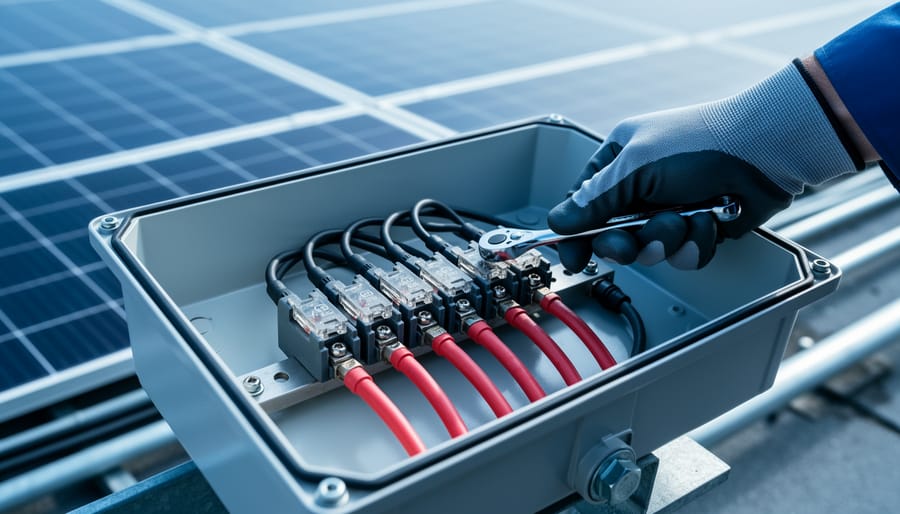
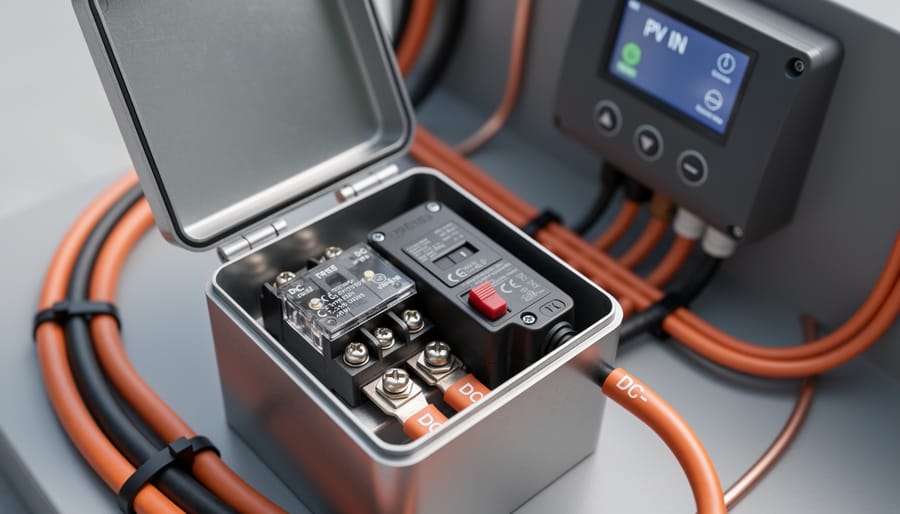
Fuses are your first line of defense against electrical shorts. They’re simple devices that break the circuit if too much current flows, preventing fires and equipment damage. Think of them as the circuit breaker in your house, but specifically sized for your solar setup. Install an inline fuse between your charge controller and battery, rated slightly above your normal operating current.
Disconnect switches serve a different but equally crucial purpose. They let you safely isolate parts of your system for maintenance or emergencies. I always install one between my panels and controller, and another between controller and battery. This way, if something goes wrong or I need to work on the system, I can quickly cut power without fumbling with wires.
These components cost maybe twenty dollars total but could save you hundreds in damaged equipment or prevent a dangerous situation.
Real-World Wiring Configurations That Actually Work
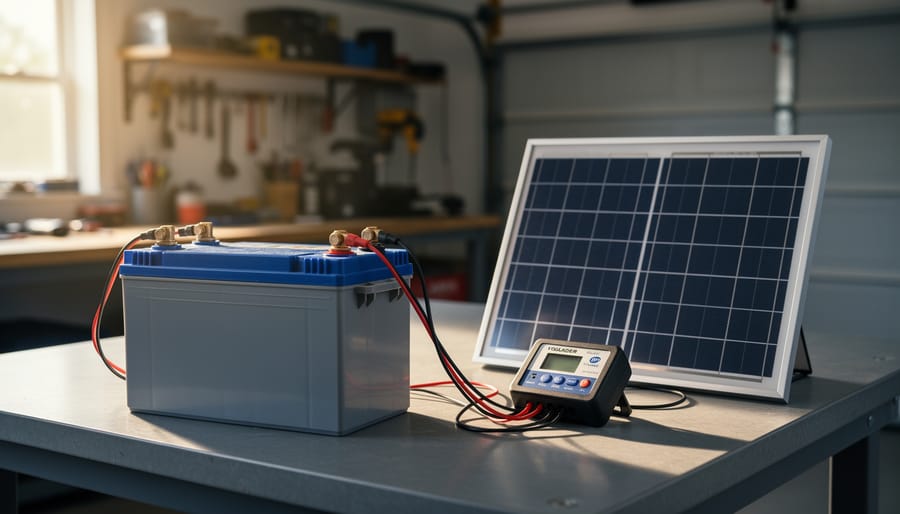
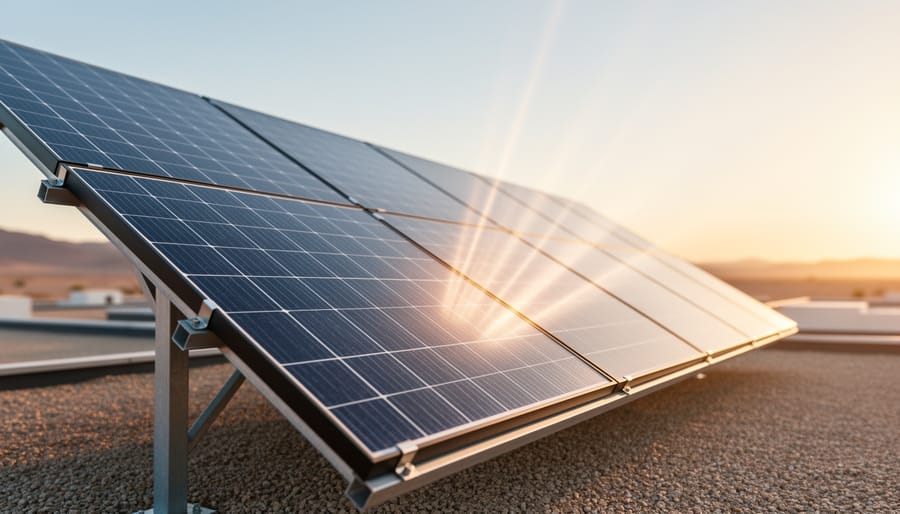
A properly configured basic off-grid system includes solar panel, charge controller, and battery with appropriate wiring and safety disconnects.
The Basic Off-Grid Setup (Single Panel, Single Battery)
Let me walk you through the simplest safe setup I recommend for beginners – one panel, one battery, and the essential components that keep everything running smoothly.
First, you’ll need a charge controller rated for your panel’s wattage. For a typical 100W panel charging a 12V battery, a 10A PWM or MPPT controller works perfectly. I learned this the hard way when I tried skimping on my first project – replacing a fried battery taught me that cutting corners isn’t worth it.
Here’s your step-by-step configuration:
Start by selecting the right cables. For runs under 10 feet with a 100W panel, 10 AWG wire is adequate, but I prefer proper wire sizing with 8 AWG for better efficiency and future expandability.
Connect your panel to the charge controller using proper solar connectors – MC4 connectors are industry standard. If you’re making custom lengths, crimping MC4 connectors is straightforward with the right tool.
Wire the battery to the charge controller next (always connect the battery before the solar panel to allow the controller to detect system voltage). Use ring terminals on battery connections and ensure they’re tight.
Finally, connect your panel to the controller. The controller’s display should light up, showing charging status.
This basic panel configuration powers small devices, charges phones, or runs LED lighting – perfect for learning the fundamentals before scaling up.
The Camping/RV Configuration
When I helped my friend Charles set up solar on his camping van last summer, we discovered that portable systems are where charge controllers really shine. His setup needed to be compact, reliable, and easy to disconnect when he parked in sketchy areas overnight.
For RV and camping applications, you absolutely need a charge controller, but the good news is they’ve become incredibly user-friendly. We installed a compact 20-amp PWM controller (about the size of a paperback book) that cost less than $30. It came with quick-disconnect terminals that let Charles unplug his 100-watt panel in seconds when needed.
The beauty of portable setups is that modern charge controllers designed for camping often include built-in USB ports and LED displays showing your battery status at a glance. Charles can now check his power levels without any guesswork, which is crucial when you’re off-grid for days.
Many camping-specific controllers also feature temperature compensation, automatically adjusting charging based on weather conditions. This proved invaluable during Charles’s summer desert trips where temperatures swung wildly between day and night. The controller protected his battery from both overcharging in the heat and undercharging in cool mornings, something a direct connection simply cannot do.
The Budget-Friendly Starter System
Getting started with solar doesn’t have to drain your wallet. I remember my first setup cost me less than a fancy dinner out, and it powered my workshop lights for years.
Here’s a budget-friendly approach that keeps both your batteries and your budget healthy. Start with a small 10-20 watt solar panel (around $20-30), paired with a basic PWM charge controller (roughly $15-25). These controllers are affordable workhorses that prevent overcharging without fancy features you might not need yet.
For batteries, consider starting with a single deep-cycle lead-acid battery. They’re forgiving, widely available, and inexpensive compared to lithium options. You can find quality ones at auto parts stores for $50-100.
The beauty of this starter system is scalability. You’re not compromising on safety, just keeping things simple. The charge controller protects your investment, and you’ll learn the fundamentals without risk. As your confidence grows, you can add more panels or upgrade components one piece at a time. This modular approach means you’re never stuck with incompatible parts or wasted money on features you don’t understand yet.
Think of it as your solar training wheels – safe, functional, and surprisingly capable for small projects.
Mistakes I’ve Seen (And Made) With Direct Connections
I’ll be honest with you – I learned about charge controllers the hard way. Back in 2018, I was experimenting with a small 50W panel and a 12V marine battery for a camping setup. I thought I was being clever by skipping the charge controller to save fifty bucks. The first few weeks were fine, but then I noticed the battery getting warm during sunny afternoons. I ignored it. Big mistake. One day, I came out to find the battery had bulged and leaked acid all over my garage floor. That “savings” cost me a new battery, cleaning supplies, and a hefty dose of humility.
A community member named Sarah shared a similar story on our forum last year. She connected a 100W panel directly to her RV battery, thinking the small size wouldn’t matter. Everything seemed great until she left her RV parked for two weeks during a sunny spell. The battery overcharged so severely it damaged her RV’s electrical system, requiring expensive repairs. What stung most was that a basic charge controller would have cost less than forty dollars.
Then there’s Mike’s tale, which actually had a happy ending. He tried connecting panels directly to power some garden lights with a small battery. When the lights started acting erratically, he reached out before any real damage occurred. We helped him understand that even his modest 20W setup needed regulation. He installed a simple PWM controller and hasn’t had issues since.
The pattern I’ve noticed across dozens of these stories? People skip the charge controller thinking their situation is somehow different or special. Maybe the panel is small, or they’ll monitor it closely, or they’ve read about someone else doing it successfully. But electricity doesn’t care about our rationalizations. It follows the laws of physics every single time, and batteries are particularly unforgiving when mistreated.
How to Size Your Charge Controller Correctly
Getting the right-sized charge controller isn’t as complicated as it sounds. I learned this the hard way when Charles told me about his first solar setup—he eyeballed the controller size and ended up with a unit that kept shutting down on sunny days. Not ideal when you’re trying to power your workshop!
The basic formula is surprisingly straightforward: take your total solar panel wattage, divide it by your battery voltage, then add a 25% safety margin. So if you have 200 watts of panels and a 12-volt battery, that’s 200 ÷ 12 = 16.67 amps. Add 25% and you need about 21 amps of capacity.
Here’s the simple version: Total Panel Watts ÷ Battery Voltage × 1.25 = Required Controller Amps
To make this even easier, Spheral Solar offers a calculator tool that does the math for you. Just plug in your panel specifications and battery voltage, and it’ll recommend the right controller size. Charles always recommends using it because it accounts for temperature variations and other real-world factors that can affect performance.
A quick tip from the community: always round up, never down. If your calculation gives you 21 amps, go with a 30-amp controller rather than a 20-amp model. Controllers running near their maximum capacity tend to run hotter and wear out faster. Plus, this gives you room to expand your system later without replacing components.
For MPPT controllers, you’ll also want to check the maximum input voltage from your panels, but most quality controllers handle standard panel configurations without issues. The investment in proper sizing pays off through longer equipment life and better charging efficiency.
So, can you connect a solar panel directly to a battery? Yes, technically you can in very specific situations with tiny panels, but honestly, it’s just not worth the risk for most real-world setups. I learned this lesson the expensive way years ago when I fried a perfectly good battery trying to save a few bucks on a charge controller. Trust me, replacing a damaged battery costs way more than buying proper equipment from the start.
Think of a charge controller as insurance for your solar investment. We’re talking about a component that typically costs between $20 to $100, depending on your system size. Compare that to replacing batteries every few months or dealing with potential fire hazards, and the math becomes pretty clear.
The good news? Setting up a proper solar charging system isn’t complicated once you understand the basics. We’ve built some interactive tools and calculators on the site to help you figure out exactly what size charge controller you need for your specific panels and batteries. No guesswork required.
Here’s my advice: do it right the first time. Get yourself a basic PWM charge controller for small systems or an MPPT controller if you’re building something larger. Your batteries will last longer, your panels will perform better, and you’ll sleep easier knowing everything’s running safely.
I’d love to hear about your solar setup in our community section. What configuration are you planning? What challenges have you run into? Sharing experiences helps everyone learn faster and avoid common pitfalls.
How useful was this post?
Click on a star to rate it!
Average rating 0 / 5. Vote count: 0
No votes so far! Be the first to rate this post.
We are sorry that this post was not useful for you!
Let us improve this post!
Tell us how we can improve this post?
charlesnoble
Here at Spheral Solar, I’m a hands-on solar power enthusiast, constantly exploring and experimenting with DIY solutions. I’m dedicated to sharing my discoveries, insights, and even the bumps I hit along the way, all in the pursuit of a more sustainable future.
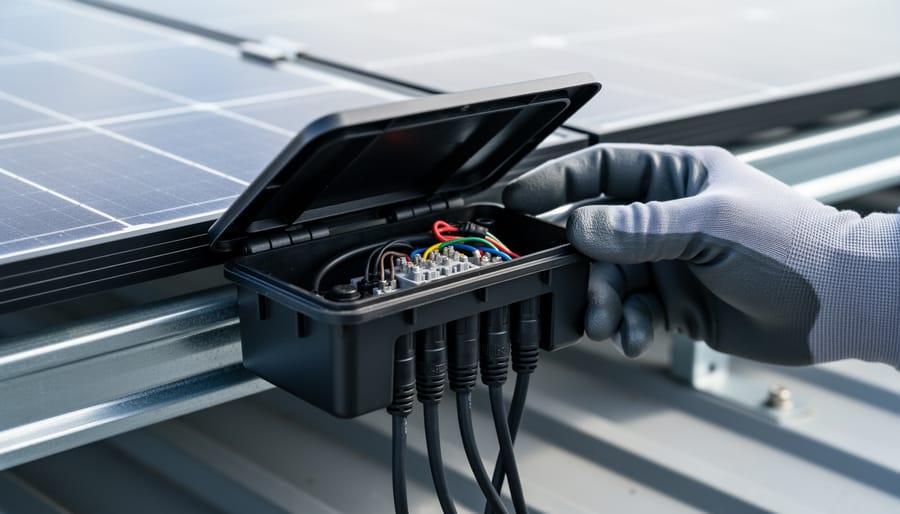
Why Your Solar Panel’s J-Box Matters More Than You Think by Charlesnoble January 8, 2026 Flip over any solar panel and you’ll spot a small weatherproof box attached to the back—that’s the junction box, or j-box, and it’s the critical gateway between your panel’s delicate solar cells and your entire electrical system. Understanding this component isn’t just technical curiosity; it’s essential for anyone wiring their…
Why Your RV Solar Panels Aren’t Charging (And How to… by Charlesnoble November 30, 2025 Check your multimeter readings at each connection point along your solar charging path—from panels to charge controller to battery—to pinpoint exactly where voltage disappears. Most RV solar systems lose 10-30% of their potential power to voltage drop, but this invisible thief often goes undetected until you systematically measure and compare…
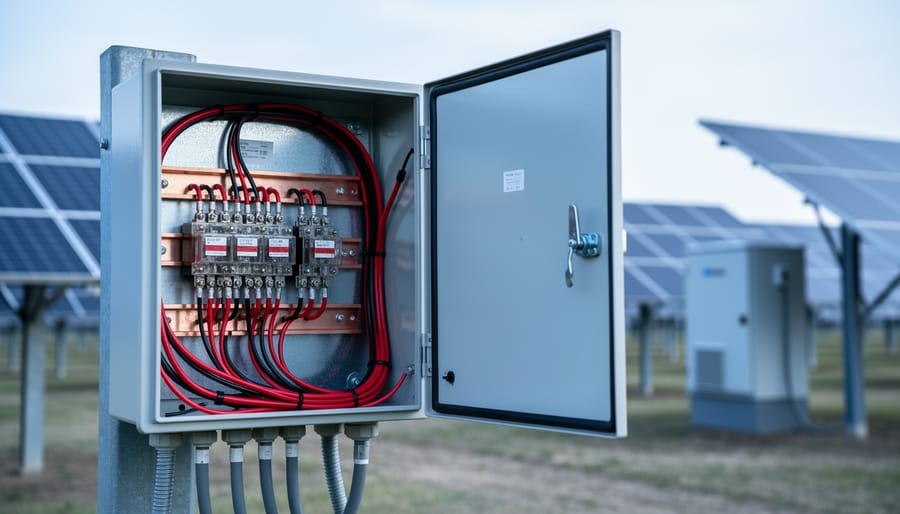
Why Your 1500V DC Solar System Needs the Right… by Charlesnoble May 22, 2026 When I first upgraded my solar array to 1500V, I learned quickly that the combiner box isn’t just another component—it’s the critical safety hub protecting your entire system from potentially catastrophic overcurrent events. This unassuming metal enclosure sits between your solar panel strings and inverter, consolidating multiple DC inputs while…
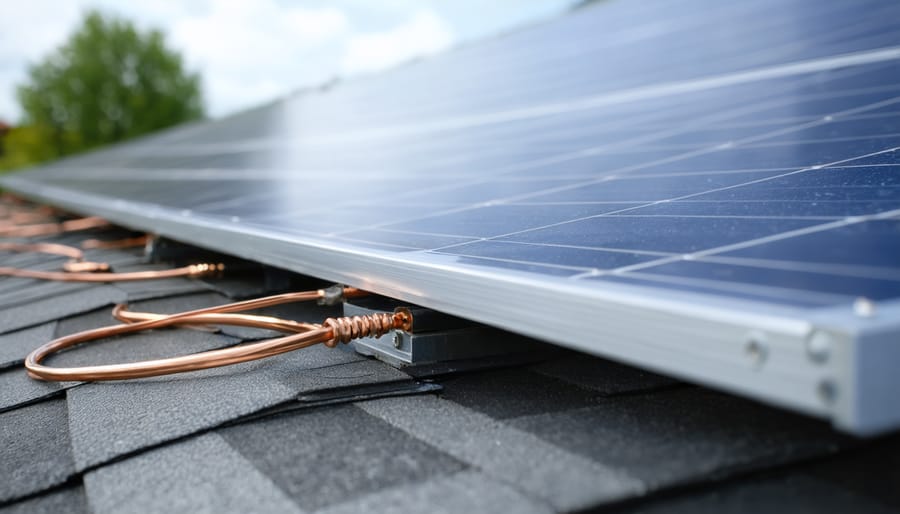
Why Your Solar Array Needs Proper Grounding (Before… by Charlesnoble November 24, 2025 Connect your solar array’s metal frame to a grounding rod driven at least eight feet into the earth near your installation. This creates a safe path for electrical faults and lightning strikes to dissipate harmlessly into the ground instead of through your home’s wiring or, worse, through you. Install grounding…
Why Your DIY Solar System Needs a 4 String PV… by Charlesnoble January 27, 2026 Connect your solar panel strings to a single positive and negative output cable using a 4 string PV combiner box—the essential junction point that safely consolidates power from four separate string circuits before feeding your charge controller or inverter. This weatherproof enclosure houses individual fuses or circuit breakers for each…
Why 8 AWG Solar Cable Changed How I Wire My Solar… by Charlesnoble December 17, 2025 Choosing 8 AWG solar cable for your DIY solar installation comes down to understanding one critical factor: how much current your system pushes through the wires and over what distance. If you’re running a 400-watt solar panel setup at 12 volts, you’re looking at roughly 33 amps of current, and…
Subscribe for handpicked DIY projects, exclusive tips, and giveaways.
There is something special about a mature tree. Decades of growth, shade that actually cools the house, branches that the kids climbed, a root system that has quietly held the yard together through every storm. So when circumstances force a move, whether it is a home renovation, a new driveway, or a construction project that… Read more: How to Move a Mature Tree Without Killing It: The Complete Relocation Guide
A mass energy conversion calculator lets you determine how much energy is locked inside any amount of matter using Einstein’s famous equation E=mc². Whether you’re working on a physics assignment or simply curious about the enormous energy potential in everyday objects, the calculation itself takes just seconds once you understand the formula’s three components: energy… Read more: How to Use a Mass Energy Conversion Calculator (Step-by-Step Guide)
Low voltage circuit protection in DIY solar systems boils down to matching the right fuse or breaker to your wire size and expected current, not to the capacity of your battery bank or inverter. Most fires and equipment failures happen when people oversize protection devices, thinking bigger is safer, when the opposite is true. Your… Read more: How to Size Low Voltage Circuit Protection for Your DIY Solar System