How the Solar Tax Credit Puts Thousands Back in Your Pocket
Updated:
Claim up to 30% of your solar installation costs back from the federal government through the residential solar tax credit—officially called the Investment Tax Credit (ITC)—which applies to equipment, labor, and even permits when you install solar panels on your home. This credit directly reduces what you owe the IRS dollar-for-dollar, making it far more valuable than a standard deduction. If your system costs $20,000, you’ll receive $6,000 back on your taxes, significantly shortening your payback period and making why going solar financially attractive right now.
File IRS Form 5695 when you submit your tax return for the year your solar system becomes operational, ensuring you capture the credit even if you install it in December. The credit rolls over to future tax years if your tax liability doesn’t cover the full amount, so you won’t lose money if you owe less than the credit value. Both DIY installations and professional setups qualify equally—the IRS doesn’t distinguish between them as long as you own the system rather than leasing it.
The 30% rate remains locked in through 2032, then drops to 26% in 2033 and 22% in 2034 before potentially expiring, creating a genuine window of opportunity for homeowners planning solar projects. Your system must be new or being used for the first time by you, and it needs to generate electricity for your primary or secondary U.S. residence. Off-grid systems, grid-tied configurations, and even battery storage added alongside solar panels all count toward eligible expenses, giving you flexibility in designing your perfect energy solution while maximizing your tax savings.
What the Residential Solar Tax Credit Actually Is
Let me break down the federal solar tax credit in the simplest terms possible, because when I first started exploring solar, the financial jargon nearly scared me away from what turned out to be one of the best decisions I ever made.
The residential solar tax credit, officially called the Investment Tax Credit or ITC, is essentially the government saying “thank you” with cold, hard cash for choosing clean energy. Here’s what makes it special: it’s a credit, not a deduction, and that difference is huge.
Think of it this way. A tax deduction reduces your taxable income before calculations happen. If you earn $80,000 and get a $10,000 deduction, you’re taxed as if you earned $70,000. Nice, but modest savings. A tax credit, however, reduces what you actually owe the IRS dollar-for-dollar after everything’s calculated. If your tax bill is $15,000 and you have a $10,000 credit, you now owe just $5,000. That’s real money back in your pocket.
Currently, the ITC stands at 30% of your total solar installation costs, and this rate is locked in through 2032. Let’s put real numbers to this. Say your solar system costs $20,000 to install. You’ll receive a $6,000 credit when you file your taxes. If your complete setup runs $30,000, that’s $9,000 back. These aren’t small amounts we’re talking about.
The federal government created this incentive to accelerate America’s transition to renewable energy. By making solar financially attractive to homeowners, they’re encouraging millions of people to reduce carbon emissions without mandating it. It’s voluntary environmental action with a financial reward attached.
One thing that catches people off guard: this credit applies to your federal income tax liability. If you don’t owe federal taxes in a given year, you can’t use it that year, though you can roll it forward to future tax years. But for most homeowners planning a solar installation, this credit dramatically improves your return on investment, sometimes cutting your payback period nearly in half.
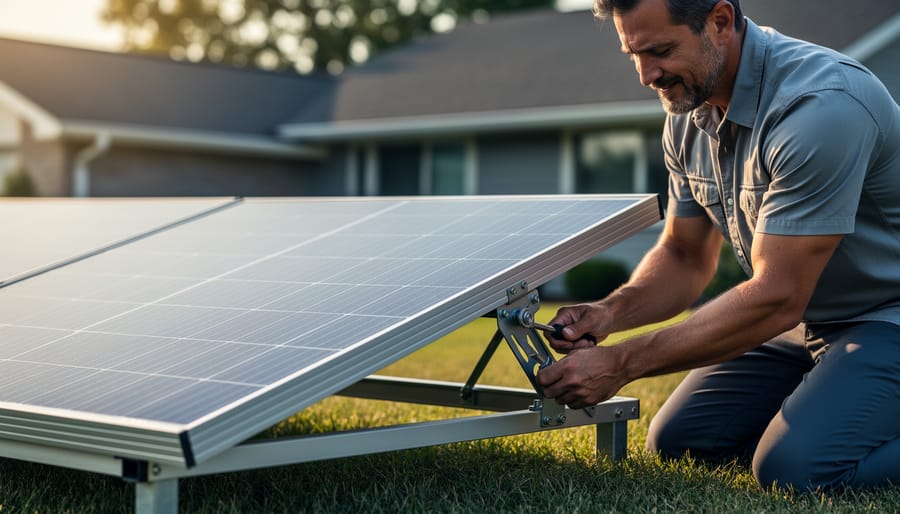
Residential solar installations qualify for the federal solar tax credit, including all equipment and mounting hardware costs.
Does Your DIY Solar Project Qualify?
Equipment That Counts Toward the Credit
Here’s some great news: the federal solar tax credit is surprisingly generous when it comes to what qualifies. I remember when I first installed my system back in 2019, I was pleasantly shocked to discover that nearly everything counted toward the credit—not just the panels themselves.
The credit covers all the major components you’d expect: solar panels (obviously), inverters that convert DC power to usable AC electricity, mounting hardware and racking systems, and all the wiring that connects everything together. If you’re adding battery storage to your system, those batteries qualify too, which is fantastic since they’re typically one of the pricier components. Understanding how solar systems work helps you appreciate why each piece matters for the credit.
Here’s where it gets even better: labor costs for installation count, along with permitting fees, inspection costs, and even developer fees if you’re working with a contractor. For DIY enthusiasts like many of us, any contractor labor you do hire—say, for the electrical connection to your main panel—qualifies.
What doesn’t qualify? Equipment used to heat your pool or hot tub, even if it’s solar-powered. Also, if you rent your equipment through a lease or power purchase agreement rather than owning it, you can’t claim the credit. The tax credit only applies to systems you own outright. Used equipment purchased from someone who already claimed the credit also doesn’t qualify—the credit only applies once per system.
The Owner-Occupied Home Rule
Here’s something I learned the hard way when I first looked into claiming the solar tax credit: the IRS is pretty specific about what qualifies as a home. You need to install your solar system on a property you own and use as a residence. This includes your primary home, but here’s the good news – it also covers your second home, like that lake cabin you escape to on weekends.
When I was researching this, I spoke with my neighbor Tom who’d installed panels on his vacation cottage. He was thrilled to discover it qualified, even though he only spent summers there. The key requirement is that you actually use it as a dwelling, not as a rental property generating income.
Now, here’s where it gets interesting for some of you adventurous types. Off-grid cabins can qualify, as long as you own the property and use it as a residence. Even RVs and mobile homes count if they’re stationary and serve as your primary or secondary home. However, if you’re constantly moving your RV around, things get trickier with the IRS.
One important catch: you can’t claim the credit for installations on properties you rent out to others. The residence requirement means you need to be living there yourself, at least part-time.
Installation Costs You Can Claim
Here’s something I learned the hard way: your own sweat equity doesn’t count toward the tax credit. When I helped my neighbor install his first panels, we thought we could claim his weekend labor hours. Nope! The IRS specifically excludes DIY labor costs from the credit calculation.
However, installation-related expenses absolutely do qualify. If you hire contractors for any part of the work, those labor costs count. This is great news for hybrid DIYers who tackle the planning and panel mounting themselves but bring in experts for professional electrical work and final connections.
You can also claim costs for essential installation materials like mounting hardware, wiring, conduit, and disconnect switches. Permits and inspection fees qualify too, which is a nice bonus since those can add up quickly depending on your local jurisdiction.
The key is keeping detailed receipts for everything. If you’re doing a hybrid approach, clearly separate your material purchases from any contractor invoices to make tax filing smoother.
Calculating Your Solar Tax Credit (With Real Examples)
Small System Example: My 3kW Garage Setup
Let me share the numbers from my own garage solar project to show you how this works in real life. Back in 2023, I installed a modest 3kW system on my detached garage—nothing fancy, just enough to offset my workshop’s energy use and charge my electric tools.
Here’s what I spent: $7,200 for the panels, inverter, and racking system, plus another $800 for electrical components and mounting hardware. Since I did all the installation work myself (with help from my neighbor who’s an electrician), I saved on labor costs but still had to pay $400 for the permit and inspection fees. My total qualifying costs came to $8,400.
At the 30% federal tax credit rate, I calculated my credit at $2,520. That’s real money back when I filed my taxes the following year. It brought my effective cost down to $5,880 for the entire system—suddenly making the payback period much more attractive.
One thing I learned: keep every single receipt. I created a dedicated folder for all my solar expenses, including shipping costs and even the conduit I bought at the hardware store. The IRS doesn’t mess around, and you want documentation ready if they ever ask questions about your claim.
Whole-Home System Example
Let’s look at a full-scale residential solar installation to see how the tax credit really adds up. A typical 8-10kW system is what most average homes need to cover their energy usage—maybe even reaching zero energy home status if you’re strategic about efficiency.
Here’s a realistic breakdown: An 8kW system with quality panels, inverters, racking, and installation costs around $24,000 before incentives. That’s about $3 per watt, which is pretty standard these days. With the 30% federal tax credit, you’re looking at $7,200 back on your taxes. Your actual out-of-pocket cost drops to $16,800.
For a 10kW system running closer to $30,000, the credit jumps to $9,000, bringing your net cost down to $21,000. These savings significantly improve your payback period—often cutting it from 12-15 years down to 8-10 years.
The beauty of this credit is it scales proportionally. Whether you go bigger or smaller, that 30% reduction applies across the board, making solar accessible for various budgets and energy needs.
Using Our Solar Tax Credit Calculator
Ready to see how much you could save? Our Solar Tax Credit Calculator makes it incredibly simple to estimate your potential federal tax credit before you start your solar journey. I remember when I was planning my first installation—having a clear number helped me convince my spouse it was worth the investment!
Here’s how to use it: Just enter your total project costs, including panels, inverters, mounting equipment, and any professional installation fees if you’re going that route. The calculator instantly shows your estimated 30% federal tax credit. For example, if your DIY system costs $12,000, you’ll see a projected credit of $3,600.
The tool accounts for all qualifying expenses, so don’t forget to include batteries if you’re adding storage, electrical upgrades directly related to your solar system, and even labor costs for portions you might hire out. It’s designed for real-world scenarios we see in our community every day, giving you reliable estimates to inform your planning and budgeting decisions.
How to Actually Claim the Credit on Your Taxes
Maintaining detailed receipts and documentation for all solar equipment and installation costs is essential for claiming your tax credit.
Documentation You Need to Save Now
Start gathering your paperwork from day one—trust me, future you will be grateful! When I installed my first solar array, I learned the hard way that organization makes all the difference when tax season rolls around.
First up, save every single receipt and invoice related to your solar purchase. This includes solar panels, inverters, batteries, mounting hardware, wiring, and even those seemingly minor items like connectors and junction boxes. The IRS wants to see the total system cost, and every component counts toward your credit calculation.
Take timestamped photos throughout your installation process. Capture your roof before installation, during mounting, panel placement, and the completed system. While the IRS doesn’t typically require photos, they’re invaluable if questions arise about your installation timeline or if you need to prove the work was completed.
Keep your manufacturer certification documents showing that your equipment meets performance and quality standards. Your panels and inverters should come with spec sheets—file these away safely.
Document your installation date with dated photos or a simple installation log. The credit applies to the year your system becomes operational, not when you purchased the equipment.
Create a dedicated folder, either physical or digital, labeled with your tax year. Include your utility interconnection agreement, any permits you obtained, and inspection certificates if applicable. This comprehensive record-keeping transforms a potentially stressful tax filing into a straightforward process.
Filing Form 5695: The Non-Scary Version
Let me tell you, the first time I looked at Form 5695, I thought I’d need an accounting degree. Turns out, it’s actually pretty straightforward once you know what goes where.
The form has two main parts, but you’ll focus on Part I for your solar credit. Start by grabbing your final invoice from your solar installer—that total cost is what you’ll need. If you did a DIY installation like I did back in 2019, gather all your receipts for panels, inverters, mounting equipment, and installation materials. Every penny counts here.
Part I, Line 1 asks for your total qualified solar electric property costs. This is simply the sum of everything you spent on your system. Don’t include any rebates you received—those come off the top before calculating your credit.
Line 14 is where the magic happens—multiply your costs by 0.30 (that’s the 30% credit rate). So if you spent $15,000, you’d enter $4,500. Pretty satisfying, right?
The biggest mistake I see folks make is forgetting to subtract state or utility rebates from their total costs before calculating. If you got a $2,000 rebate, you’d calculate the credit on $13,000, not $15,000. Another common slip-up is including maintenance costs or repairs—those don’t qualify.
One more thing: keep all your receipts and documentation for at least three years. The IRS rarely asks, but when they do, you’ll be glad you kept everything organized in a folder labeled “Solar Savings.”
Filing for the solar tax credit using IRS Form 5695 is straightforward when you have proper documentation and understand the requirements.
What If Your Credit Exceeds Your Tax Liability?
Here’s the good news if your solar tax credit is bigger than what you owe in taxes: you won’t lose that money. The federal solar tax credit comes with a carryover provision that lets you roll unused portions forward to future tax years. There’s no expiration date on this carryover, which gives you plenty of breathing room.
Let me share what happened with my neighbor Tom. His 8kW system generated a $7,200 credit, but he only owed $3,000 in federal taxes that year. He applied the $3,000 immediately, then carried forward the remaining $4,200 to the next year when his tax liability was higher. It worked perfectly.
This carryover feature is particularly helpful for retirees or anyone with lower annual tax liability. You can claim the credit bit by bit over multiple years until you’ve used every dollar. When planning your solar installation, consider reviewing your typical tax liability from previous years. If you consistently have lower tax bills, you’ll simply spread the credit across more years. Our interactive calculator can help you estimate how this might work for your specific situation, giving you a clearer picture of your actual savings timeline.
Timing Your Solar Project to Maximize Benefits
Timing your solar installation strategically can make a real difference in how much you save. Let me share what I learned when I installed my system back in 2019—getting the timing right helped me maximize my tax credit benefits without rushing the process.
The federal solar tax credit currently sits at 30% through 2032, which gives you a comfortable window to plan properly. However, it’s scheduled to step down to 26% in 2033 and 22% in 2034 before potentially expiring. This timeline means you’ve got breathing room, but it’s still smart to act sooner rather than later, especially if you’re considering a DIY approach that might take longer to complete.
Here’s something crucial I wish someone had told me earlier: your tax credit applies to the year your system becomes operational, not when you purchase the equipment. So if you buy panels in December but don’t get them installed and connected until January, you’ll claim the credit on the following year’s taxes. This can actually work in your favor if you’re planning your tax situation strategically.
Consider your personal tax liability carefully. The credit is non-refundable, meaning you can only use it to offset taxes you actually owe. If you typically get a small refund or break even, you might want to time your installation for a year when you expect higher income. The good news is that you can carry forward any unused credit to future tax years, so it won’t go to waste.
For DIYers, factor in realistic completion timelines. A weekend warrior approach might stretch your project across several months, which could push you into a different tax year. There’s no penalty for taking your time, but knowing when you’ll likely finish helps you plan which year to claim the credit.
Also think about the bigger picture: ongoing solar maintenance costs and your overall budget timeline. Starting your project in spring or summer often makes more sense than winter installations, both for weather conditions and giving yourself adequate time before year-end.
Stacking Incentives: State and Local Programs
Here’s the exciting part: the federal solar tax credit is just the beginning. You can often stack it with state rebates, local utility programs, and other incentives to supercharge your savings. I remember when my neighbor Carlos installed his system and discovered he qualified for three separate programs on top of the federal credit—his jaw practically hit the floor when he calculated his total savings.
Think of it like this: the federal tax credit reduces your tax liability, but state rebates often arrive as direct payments or bill credits. They’re separate benefits that work alongside each other, not against each other. For example, if your system costs $20,000, you might get $6,000 back from the federal credit, plus a $1,500 state rebate, plus $500 from your utility company. That’s $8,000 in combined savings.
Many states offer income tax credits or property tax exemptions specifically for solar installations. Some utility companies provide performance-based incentives that pay you over time based on how much energy your system produces. Then there’s the SREC market—Solar Renewable Energy Certificates—where you can actually sell credits for the clean energy you generate. It’s like getting paid for doing something good for the planet.
The key is knowing where to look. Start with your state energy office’s website and the Database of State Incentives for Renewables and Efficiency (DSIRE). Your local utility company’s website should list any programs they offer. Don’t forget to ask your installer too—they usually know the landscape inside and out.
One important note: some programs have first-come, first-served funding or specific application windows. I’ve seen folks miss out on thousands simply because they didn’t research early enough. Start investigating incentives before you finalize your installation plans, not after.
A complete residential solar installation includes panels, inverters, batteries, and all electrical components that qualify for the federal tax credit.
Common Questions From the DIY Solar Community
Over the years, I’ve received countless emails from readers navigating the ins and outs of the solar tax credit. Let me share some of the most common questions that pop up in my inbox, along with straightforward answers based on both IRS guidance and real experiences from our community.
Can I claim the credit if I bought used solar panels? Unfortunately, no. The tax credit only applies to new equipment. I know it’s tempting to save money upfront by purchasing secondhand panels from someone upgrading their system, but you won’t qualify for the federal incentive. That said, if the price is right, used equipment might still make financial sense for your project, just don’t count on that 30% credit when doing your calculations.
What if I expand my system in a few years? Great news here. You can claim the credit again for the expansion. Last year, a reader named Tom installed a 5kW system and claimed his credit. Two years later, he added another 3kW of panels to cover his new electric vehicle charging needs and successfully claimed the credit on that additional capacity. Just keep detailed records separating the two projects.
Should I worry about being audited? I won’t sugarcoat this: the IRS does scrutinize home improvement credits. However, if you maintain thorough documentation, there’s nothing to fear. Keep your receipts, invoices showing equipment costs separately from labor if you hired help for parts of the job, photos of the installation, and your interconnection agreement with the utility. I keep everything in a dedicated folder, both physical and digital copies.
Can I claim the credit if I financed my system? Absolutely. Whether you paid cash, used a home equity loan, or got solar-specific financing, you’re eligible. The key is that you own the system. Leased systems where a third party owns the equipment don’t qualify because the leasing company typically claims the credit instead.
What happens if my tax liability is lower than the credit amount? The credit rolls forward. If you generate a $9,000 credit but only owe $6,000 in taxes this year, you’ll get the full $6,000 back and can apply the remaining $3,000 to next year’s tax bill. It won’t go to waste.
Here’s the thing I’ve learned after years of helping folks navigate their solar journeys: the residential solar tax credit is genuinely a game-changer, especially for those of us tackling installations ourselves. With the credit sitting at a solid 30% through 2032, there’s never been a better time to take the leap into solar energy. I remember when I first looked into this years ago, the tax forms seemed intimidating, but honestly, it turned out to be far simpler than I expected.
Don’t let tax complexity become the barrier that stops you from harnessing free energy from the sun. Yes, Form 5695 might look daunting at first glance, but thousands of DIYers claim this credit successfully every year. The money you save makes it absolutely worth spending an afternoon with the paperwork or budgeting for a tax professional’s help.
That said, everyone’s tax situation is unique. While I can share general guidance based on what’s worked for our community, I always recommend sitting down with a qualified tax professional who understands your specific circumstances. They can help you maximize your credit and ensure everything’s filed correctly.
Ready to dive deeper into your solar journey? We’ve got tons of resources here to help you succeed. From choosing the right panels to sizing your system correctly, our community is here to support your renewable energy goals. The financial incentives are real, the technology is proven, and the community is ready to help. What are you waiting for?
How useful was this post?
Click on a star to rate it!
Average rating 0 / 5. Vote count: 0
No votes so far! Be the first to rate this post.
We are sorry that this post was not useful for you!
Let us improve this post!
Tell us how we can improve this post?
charlesnoble
Here at Spheral Solar, I’m a hands-on solar power enthusiast, constantly exploring and experimenting with DIY solutions. I’m dedicated to sharing my discoveries, insights, and even the bumps I hit along the way, all in the pursuit of a more sustainable future.
How I Built a Zero Energy Home Without Breaking the Bank by Charlesnoble November 14, 2025 **Imagine slashing your electricity bill to zero—permanently.** A zero energy home produces as much renewable energy as it consumes over the course of a year, transforming your house from an energy drain into a self-sustaining powerhouse. It’s not science fiction or reserved for millionaires; thousands of homeowners are already living…
Why Florida Homeowners Are Going Solar (And How You Can Too) by Charlesnoble March 6, 2026 Calculate your home’s solar potential by checking your annual electricity bills and measuring your available south-facing roof space—Florida homes typically need 20-30 panels to offset 100% of energy usage. Contact your utility provider to understand net metering policies, as companies like Duke Energy, FPL, and Tampa Electric have different buyback…
Why Commercial Rooftop Solar Isn’t Just for Experts… by Charlesnoble January 2, 2026 Calculate your building’s solar potential by measuring the usable roof area—subtract space for HVAC units, vents, and required maintenance walkways, then multiply by 15 watts per square foot for a quick capacity estimate. Most commercial roofs between 5,000 and 50,000 square feet can support systems ranging from 30kW to 400kW,…
Six Energy Sources That Work With Your Solar Panels… by Charlesnoble December 16, 2025 Harness the sun’s energy streaming onto your roof right now—solar panels convert sunlight into electricity that powers your home while slashing monthly utility bills. Capture moving air with residential wind turbines mounted on your property, generating supplemental power during breezy days and nights when solar production drops. Tap into the…
How Sunlight Becomes Electricity in Your Home (The… by Charlesnoble November 3, 2025 Understand the photovoltaic effect—when sunlight hits solar panels, photons knock electrons loose from silicon atoms, creating an electrical current through a principle Einstein won a Nobel Prize for discovering. Your solar panels generate direct current (DC) electricity, which then flows to an inverter that converts it into alternating current (AC)…
Why Solar Alone Isn’t Enough: Five Energy Sources… by Charlesnoble February 11, 2026 Combine multiple power sources to create a resilient energy system that keeps your home running when solar panels can’t produce electricity. Start by identifying which backup sources match your property’s natural resources—flowing water, consistent wind, or reliable grid access—then layer them strategically so you’re never dependent on a single energy…
Subscribe for handpicked DIY projects, exclusive tips, and giveaways.
Position your solar panels at an angle equal to your latitude for year-round performance, or adjust seasonally by adding 15 degrees in winter and subtracting 15 degrees in summer to capture maximum sunlight during each season’s sun path. Use a simple angle finder app on your smartphone against the back of your panel to verify… Read more: The Right Tilt Angle Can Boost Your Solar Panel Output by 30% (Here’s How to Find It)
Route your PV wires through UV-resistant conduit within 18 inches of leaving the solar array, securing it every 3 feet with proper clamps to prevent wind damage and code violations. This single step prevents 80% of the wire degradation issues I’ve seen in DIY solar installations over the past decade. Group your positive and negative… Read more: Why Your PV Wire Management Could Fail Inspection (And How to Fix It)
Understand that 6000 volts sounds terrifying but delivers surprisingly low amperage—typically around 120 milliamps for just 3/10,000th of a second per pulse. This combination creates an unforgettable shock that trains animals to avoid the fence without causing lasting harm. The voltage pushes current through thick fur and hide, while the minimal amperage and microsecond duration… Read more: Why 6000 Volts Won’t Kill Your Livestock (But Will Stop Predators Cold)