Why Your DIY Solar System Needs a 4 String PV Combiner Box (And How to Wire It Safely)
Updated:
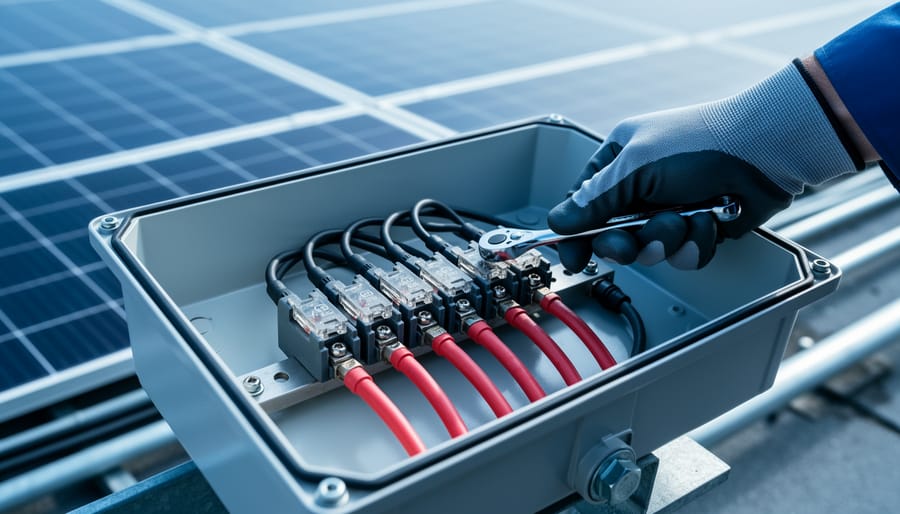
Connect your solar panel strings to a single positive and negative output cable using a 4 string PV combiner box—the essential junction point that safely consolidates power from four separate string circuits before feeding your charge controller or inverter. This weatherproof enclosure houses individual fuses or circuit breakers for each string, protecting your entire system from the dangerous overcurrent conditions that occur when one panel develops a fault or partial shading causes reverse current flow.
Choose a combiner box rated for at least 1.56 times your string short-circuit current, ensuring each protective device handles the combined backfeed from your other three strings during fault conditions. Mount the box as close to your array as possible to minimize voltage drop and ensure all DC wiring before the combiner remains protected—a mistake I see frequently where DIYers run unprotected conductors fifty feet from their roof, creating a serious fire hazard.
Wire each string’s positive conductor through its dedicated overcurrent protection device, while connecting all negative conductors directly to a common busbar unless your system design requires negative-side protection for specific ground-fault detection. Use appropriately sized conductors based on your string’s maximum current multiplied by 1.25, then apply NEC ampacity derating factors for conduit fill and ambient temperature—typically resulting in 10 AWG copper minimum for most residential strings producing 8-10 amps.
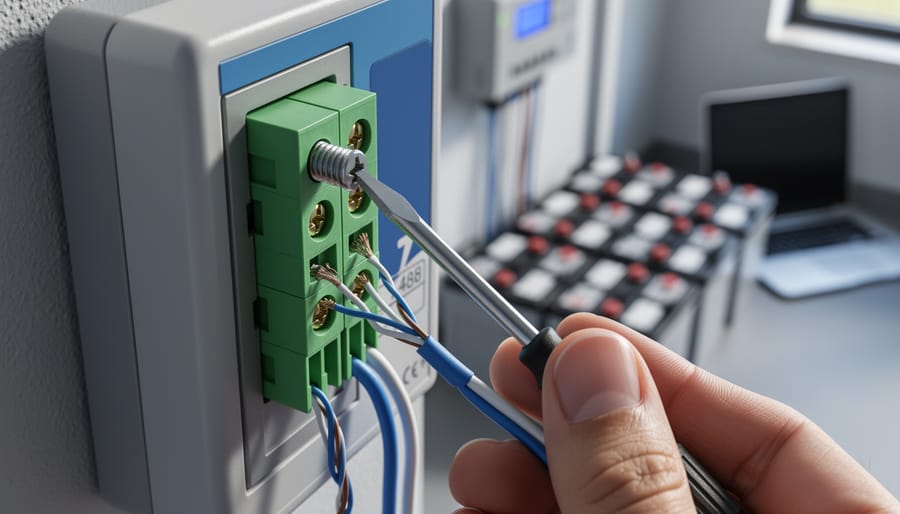
Strip wire insulation to the exact length specified by your terminal blocks, typically one-half inch, because exposed copper invites corrosion while insufficient insertion creates high-resistance connections that generate heat. Torque all terminals to manufacturer specifications using an inch-pound torque wrench rather than guessing with a standard screwdriver, since loose connections cause 80 percent of combiner box failures in the field.
What Exactly Is a 4 String PV Combiner Box?
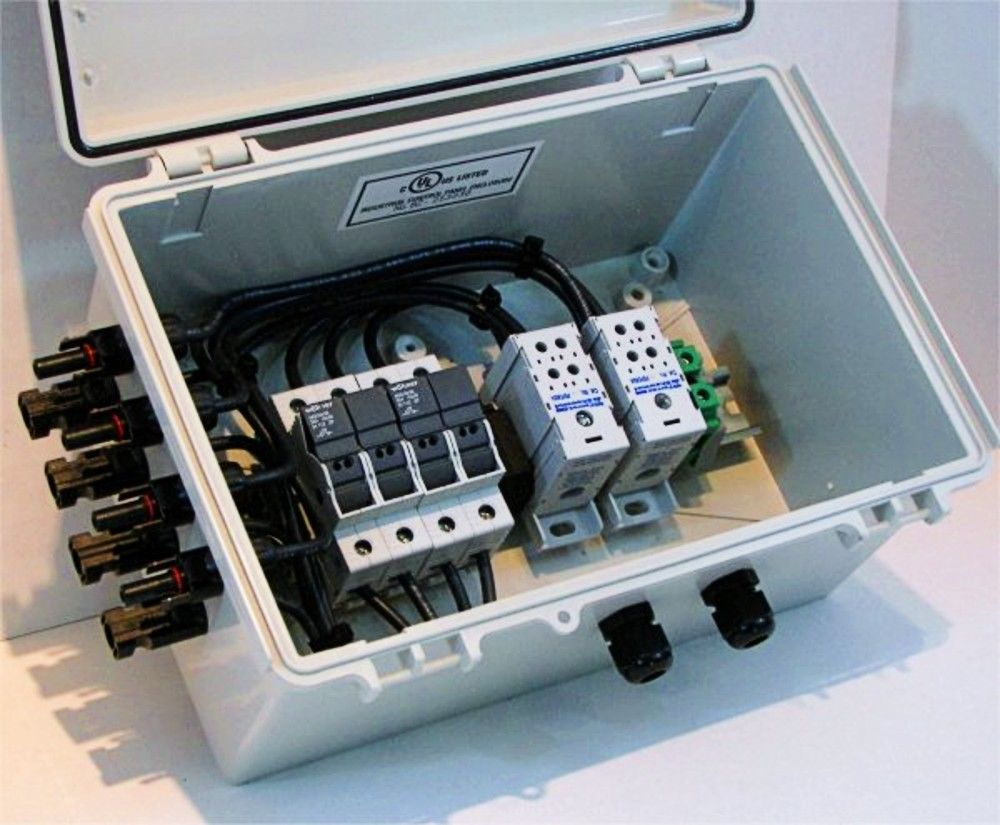
Breaking Down the Components Inside
Let me take you on a quick tour inside a 4 string combiner box. When I first opened one up, I was pleasantly surprised by how straightforward everything looked. Think of it as the organized control center where your solar strings come together safely.
At the heart of the box, you’ll find either fuses or circuit breakers, one for each string. These are your first line of defense. If one of your solar strings starts acting up or pushing too much current, the fuse blows or the breaker trips, protecting your entire system. I always recommend breakers over fuses for DIY setups because you can simply reset them instead of hunting for replacement fuses at midnight when something goes wrong. Trust me on that one.
Next up are the bus bars, which are basically thick metal strips that collect all the positive connections from your strings into one output, and all the negatives into another. They’re like highways merging multiple lanes of traffic into one smooth flow heading toward your charge controller or inverter.
The terminal blocks are where your actual string wires connect. These screw-down connectors hold each wire securely in place. Quality matters here because loose connections create heat, and heat creates problems. When I installed my first system, I learned to check these twice because vibration over time can loosen things up.
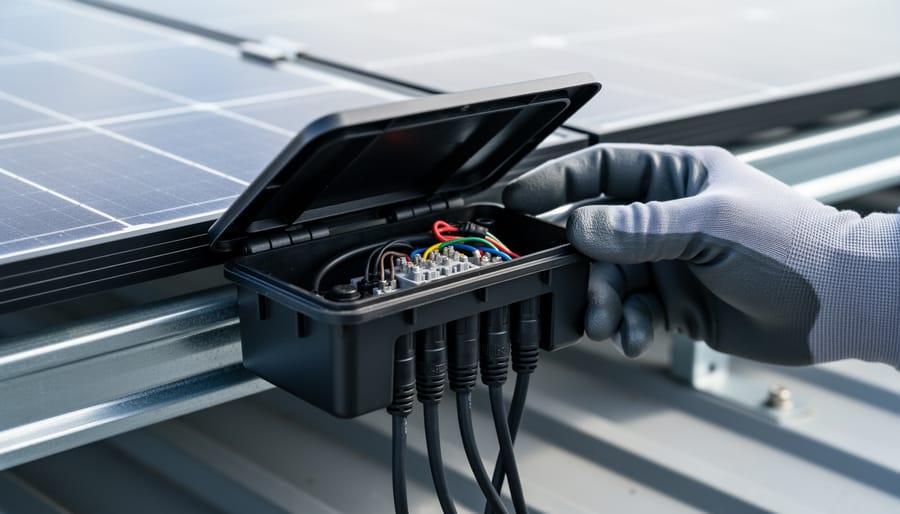
The housing itself is typically rated for outdoor use with weatherproof seals and cable glands where wires enter and exit. Look for a NEMA 3R or better rating if you’re mounting it outside. The enclosure also provides crucial electrical safety, keeping curious hands away from live DC voltage.
Inside a typical 4-string PV combiner box, showing the fuses, bus bars, and terminal connections that safely combine multiple solar panel strings.
When Does Your System Actually Need One?
Here’s the truth I’ve learned from helping dozens of DIYers: most people overthink combiner box sizing. A 4-string PV combiner box hits a sweet spot that works surprisingly well for many common scenarios.
Think of it this way—you need a 4-string box when you’re connecting four separate strings of solar panels into one main feed. Each string typically consists of panels wired in series or parallel configuration. But when does four strings actually make sense?
For small RV setups with just two or three panels, you probably don’t need a combiner box at all. You can wire those directly to your charge controller without much fuss.
Here’s where a 4-string box becomes your friend: medium-sized cabin systems (typically 2-4kW) work perfectly with four strings. I helped my neighbor set up his off-grid cabin last summer with sixteen 250W panels arranged as four strings of four panels each. The 4-string combiner box gave him exactly the flexibility he needed without wasting money on oversized equipment.
Full home systems between 3-6kW also fit this profile nicely. If you’re planning beyond four strings, though, save yourself future headaches and go bigger from the start. Upgrading later means buying twice.
The golden rule? Count your planned strings, add one or two for future expansion, then choose your box. Four strings works when that number lands right around 4-5 total strings needed.
The Critical Role of DC Overcurrent Protection
Why DC Fires Are Different (And More Dangerous)
Here’s something I wish someone had explained to me when I first started working with solar panels: DC electricity behaves very differently from the AC power flowing through your home’s outlets, especially when things go wrong.
When an AC arc starts, it actually extinguishes itself 120 times per second as the current alternates direction. Think of it like a candle flame being blown out repeatedly. With DC power, though, there’s no alternation. The current flows in one continuous direction, which means once an arc starts, it just keeps burning. And burning. And burning.
Charles learned this the hard way early in his solar journey. He once helped a neighbor troubleshoot a DIY installation where someone had used standard AC-rated wire nuts inside their combiner box. “I’ll never forget the sound,” he recalls. “This angry buzzing followed by a bright flash. The DC arc had actually melted the wire nut’s plastic housing and welded the copper wires together. If that box hadn’t been metal, we could have had a serious fire.”
DC arcs can sustain themselves at lower voltages and across larger gaps than AC arcs. Even a tiny bit of corrosion or a loose connection in your combiner box can create enough resistance to generate intense heat. When you’re dealing with four strings pumping DC power into one box, that risk multiplies.
This is exactly why proper overcurrent protection and quality connections aren’t optional in your 4 string combiner box setup.
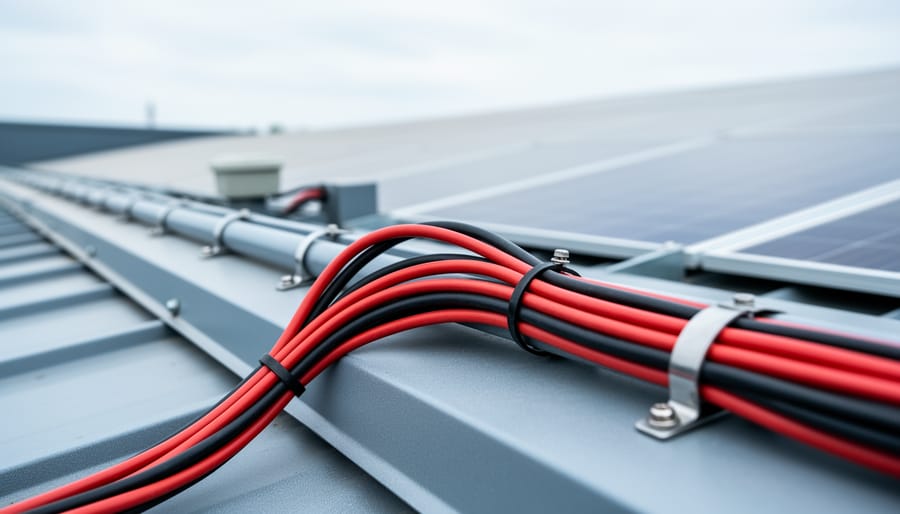
Damaged DC wiring from improper overcurrent protection demonstrates why safe combiner box installation is critical.
Fuses vs. Breakers: Which Should You Choose?
When I first started building solar arrays, I spent way too long staring at combiner boxes trying to figure out which protection method was right for my setup. Let me save you that headache by breaking down the fuses versus breakers debate in plain terms.
Fused combiner boxes are the traditional choice and honestly, they’re hard to beat for simplicity. Each string gets a fuse holder, and if something goes wrong, the fuse blows and breaks the circuit. The biggest advantage? Cost. Fuses are significantly cheaper than breakers, sometimes just a few dollars each compared to twenty or thirty for a quality DC-rated breaker. For a 4-string setup, that difference adds up. They’re also incredibly compact, letting manufacturers squeeze more circuits into a smaller box.
The downside is maintenance. When a fuse blows, you need to replace it. This means keeping spares on hand and actually going up to your array to swap them out. Not a huge deal, but it’s definitely less convenient than simply flipping a breaker back on.
Breaker-based combiner boxes offer that convenience factor. Trip a breaker? Just reset it. No climbing ladders with replacement parts. They’re also easier for troubleshooting since you can quickly disconnect and reconnect individual strings without pulling fuses. I’ve found this invaluable when diagnosing shading issues or testing new configurations.
The catch is price and space. DC-rated breakers cost more upfront, and they’re physically larger, meaning bigger boxes overall. For beginners, though, the reset feature provides peace of mind and simplifies learning.
My recommendation? If budget is tight and you’re comfortable with basic electrical maintenance, go fused. If you value convenience and plan to tinker with your system regularly, invest in breakers. Both work perfectly well for protecting your 4-string array.
Sizing Your Overcurrent Protection Correctly
Understanding String Current Ratings
Before you can safely wire your 4 string combiner box, you need to understand one critical number from your solar panel specifications: the short-circuit current, or Isc. I remember when I first started working with solar panels, I glossed over this number thinking it wasn’t that important. That was a mistake I only made once!
The Isc rating tells you the maximum current your panel can produce under ideal conditions when the positive and negative terminals are directly connected. You’ll find this number clearly listed on your panel’s spec sheet, usually in the electrical characteristics table. For example, a typical 300-watt panel might show an Isc of 9.5 amps.
Here’s why this matters for your combiner box: the National Electrical Code requires you to multiply this number by 1.25 (or 125 percent) to account for real-world conditions where panels sometimes exceed their rated output on cold, bright days. So that 9.5 amp panel actually needs to be calculated at about 11.9 amps.
When you have four strings feeding into your combiner box, you need to ensure each string’s input can handle this calculated current. The good news is that Spheral Solar offers a handy sizing calculator that does this math for you. Simply enter your panel’s Isc value, and it will recommend the appropriate fuse ratings and wire sizes for your specific setup, taking all the guesswork out of the equation while keeping your system safe and code-compliant.
Step-by-Step: Wiring Your 4 String Combiner Box
Tools and Materials You’ll Actually Need
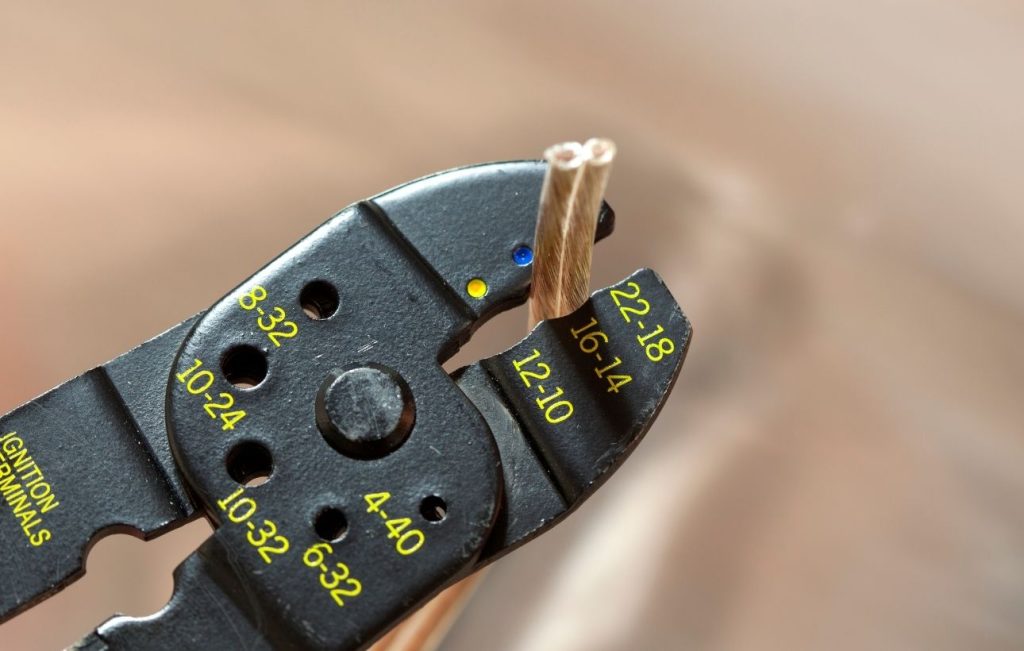
Let me share what I keep in my solar toolbox after years of trial and error. For your 4-string combiner box project, you’ll need quality wire strippers that can handle 10 AWG wire (around $20-30 for a reliable pair). Don’t skimp here—clean cuts matter for safe connections.
You’ll also need a crimping tool for crimping MC4 connectors, which typically runs $25-40. I learned the hard way that cheap crimpers create loose connections that can arc and fail.
For wire, grab 10 AWG PV wire (rated for sunlight exposure) in red and black. Calculate your longest run and add 20% extra—trust me on this. You’ll need about 50 feet total for a typical installation.
Other essentials include a multimeter for testing voltage (budget options work fine at $15-25), cable ties for organization, and a drill with appropriately sized bits if you’re mounting your box. Heat-shrink tubing is optional but adds weather protection to connections.
Total investment? Expect around $150-200 for quality tools you’ll use on future projects, making this a worthwhile addition to your renewable energy toolkit.
Proper wire preparation and crimping tools are essential for safe and reliable combiner box connections.
Making the Connections: Positive and Negative Bus Bars
Alright, let’s talk about making the actual connections, which is honestly the most satisfying part of the whole process. I remember the first time I connected my strings to the bus bars—there’s something about that final click that just feels right, knowing you’re channeling the sun’s power safely into your system.
Each of your four strings will have a positive wire and a negative wire coming into the combiner box. Your job is to connect all the positive wires to the positive bus bar and all the negative wires to the negative bus bar. Sounds simple, right? It is, but polarity matters more than anything here. One reversed connection can damage your entire system, so take your time and double-check everything.
Before making any connections, grab your multimeter and verify polarity on each string. Touch the red probe to what you think is the positive wire and the black probe to the negative. If you see a positive voltage reading, you’re good. If it shows negative, your wires are backwards. Mark each wire clearly with red tape for positive and black for negative once you’ve confirmed.
When connecting to the bus bars, you’ll typically use a torque wrench to tighten the terminal screws. The manufacturer’s specs will tell you exactly how tight, usually somewhere between 30 and 50 inch-pounds for most residential combiner boxes. Think of it like tightening a bicycle handlebar—snug and secure, not gorilla-strong. Too loose creates dangerous resistance and heat; too tight can strip the threads or crack components.
If you need a visual reference, check out our detailed solar combiner box wiring diagram for additional guidance. Work methodically, connecting one string at a time, and never rush this critical step.
Grounding: The Safety Step You Can’t Skip
Here’s something I learned the hard way during my first combiner box installation: a perfectly wired box means nothing if it’s not properly grounded. I once helped a neighbor troubleshoot why his system kept tripping, only to discover his grounding wire was barely finger-tight. Don’t be that person.
Grounding your 4 string combiner box protects both your equipment and your family. It provides a safe path for fault currents and helps prevent electrical fires or shock hazards. Following proper grounding procedures isn’t optional, it’s essential.
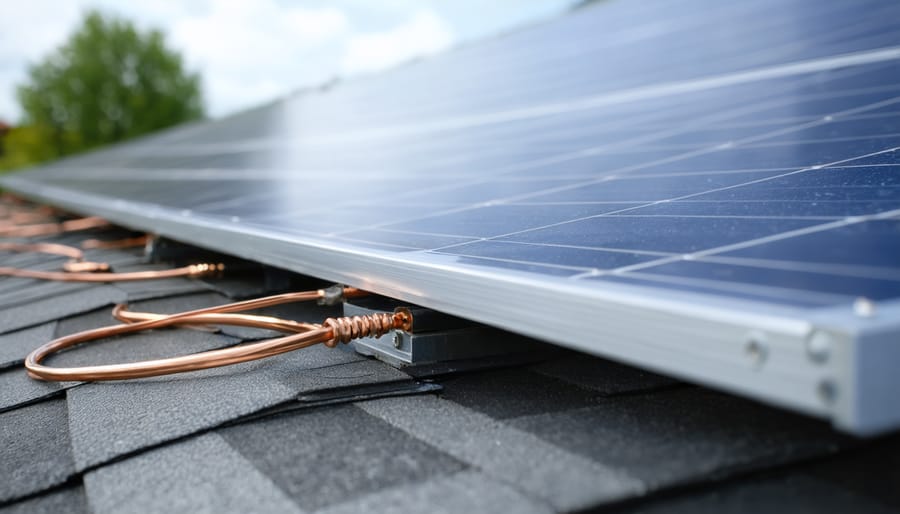
Start by connecting your equipment grounding conductor (the bare copper or green wire) to the designated grounding lug inside the combiner box. This lug is typically marked with a ground symbol and should be located on the enclosure itself, not floating. Use the correct size copper grounding wire based on your largest circuit conductor, usually 10 AWG minimum for most residential setups.
Next, ensure the metal enclosure bonds to your system’s grounding electrode conductor, which connects to your ground rod or grounding system. All connections should be tight and corrosion-free.
Common mistakes I see include using aluminum wire without proper connectors, forgetting to remove paint where connections touch metal, skipping bonding washers, and worst of all, assuming the mounting bracket provides adequate grounding. It doesn’t. Every connection matters, so double-check everything before energizing your system.
Installation Location and Environmental Considerations
Finding the right home for your 4 string combiner box is just as important as wiring it correctly. I learned this lesson the hard way during my first installation when I mounted a box too close to the ground, only to have it splashed with mud during the first heavy rainstorm. Let me save you from making similar mistakes.
First, let’s talk about NEMA ratings. These numbers tell you how well your combiner box handles the elements. A NEMA 3R rating works great for most outdoor installations, protecting against rain and sleet. If you live in a dusty area or near the coast where salt spray is a concern, consider upgrading to NEMA 4 or 4X for better protection. The X means corrosion resistance, which is your friend in salty environments.
Temperature matters more than most beginners realize. Your combiner box contains electrical components that don’t appreciate extreme heat. Mount it on a north-facing wall if possible, or install a simple sunshade to keep it cool. I’ve seen boxes mounted in direct sunlight reach temperatures that shorten component life significantly. Aim for a location that stays under 140 degrees Fahrenheit.
Height is your friend for multiple reasons. Mount the box between four and six feet off the ground. This puts it above snow accumulation, keeps it away from lawn mowers and weed trimmers, and makes maintenance comfortable without needing a ladder. Speaking of maintenance, leave at least two feet of clearance in front of the box so you can open the door fully and work safely.
Consider the cable run from your solar array too. Shorter runs mean less voltage drop and lower material costs. Position your combiner box reasonably close to where your strings come down from the roof, but not so close that you compromise accessibility or weather protection.
Common Mistakes DIYers Make (So You Don’t Have To)
Look, I’ve made plenty of mistakes with combiner boxes over the years, and I’ve seen even more from folks in our DIY solar community. The good news? Most of these errors are totally preventable once you know what to watch for. Let me walk you through the big ones so you can skip the headaches I had to learn from.
The most common mistake I see is going too small on the fuses or breakers. Here’s what happened to me early on: I calculated my string current perfectly, but I forgot that solar panels can actually produce more than their rated current on cold, super-bright days. I installed 10A fuses for strings rated at 8A, thinking I had plenty of cushion. Wrong. Those fuses kept blowing on crisp winter mornings until I bumped up to 15A fuses properly sized according to NEC requirements. Remember, you need to multiply your short-circuit current by 1.25, then round up to the next standard fuse size. Trust me on this one.
Wire sizing is another trap. I once used 12AWG wire for a long run to my combiner box because it seemed hefty enough. The problem wasn’t the current capacity, it was the voltage drop over that 40-foot distance. My system underperformed for weeks before I figured it out. Always use a voltage drop calculator and factor in the actual wire run length, not just the ampacity charts.
The mistake that really gets people in trouble though? Skipping the testing phase. I know you’re excited to flip the switch and see those watts flowing, but please resist that urge. Before connecting to your charge controller or inverter, use a multimeter to verify every string voltage, check for shorts, and confirm your polarity. Taking fifteen minutes to test can save you from releasing the magic smoke from expensive equipment. Been there, smelled that, bought the replacement inverter.
Testing and Troubleshooting Your Installation
Once everything’s wired up, it’s time for the moment of truth—testing your installation! I remember the first time I fired up my combiner box. My hands were a bit shaky holding that multimeter, but when those numbers lit up exactly as expected, it felt absolutely fantastic.
Start by grabbing your multimeter and setting it to DC voltage. Before connecting anything to your inverter or charge controller, test each string individually at the combiner box inputs. You should see the open-circuit voltage (Voc) from each string, typically between 35-45 volts for a standard 12V system, or proportionally higher for 24V or 48V systems. Check your panel specifications to know what to expect—your Voc should match what’s listed on the datasheet.
Next, measure the combined output at the main terminals. This voltage should equal a single string’s voltage (remember, we’re combining parallel, so voltage stays the same). If you see significantly different voltages between strings, something’s amiss—double-check your connections and panel orientations.
Now for current: carefully measure the current from each string using your multimeter’s DC amperage setting. Each string should produce similar current readings on a sunny day. Major discrepancies often indicate shading issues, dirty panels, or loose connections.
Common troubleshooting tips: If you’re getting no voltage, check your MC4 connections first—they can be tricky! Low voltage usually means a loose wire or poor crimp connection. Document everything with photos and write down your readings. Trust me, you’ll thank yourself later when you’re comparing performance over time. There’s real satisfaction in seeing your system work perfectly because you took the time to test it right.
You’ve made it this far, and that’s something to be genuinely proud of. Understanding how to properly wire and protect a 4 string PV combiner box isn’t just about following instructions – it’s about taking control of your energy future while keeping safety at the forefront.
Let me share something from my own journey: the first time I closed up a combiner box I’d wired myself, checked all the connections, and watched those first amps flow safely into my system, I felt an incredible sense of accomplishment. Not because it was perfect (it wasn’t, and I’ve learned so much since then), but because I’d built something that would serve my home for years to come, and I’d done it the right way.
The key takeaways we’ve covered – proper overcurrent protection for each string, correct wire sizing, weatherproof installations, and double-checking polarity – these aren’t just technical requirements. They’re the foundation of a system you can trust. Remember, those fuses or breakers are your first line of defense against potential fires or equipment damage. Never compromise on them.
I’d love to hear about your own combiner box projects. What challenges did you face? What surprised you during installation? Share your experiences in our community forums – your story might be exactly what helps another DIYer succeed. Building a safe, code-compliant solar system is absolutely within your reach, and you’re now equipped with the knowledge to make it happen.
How useful was this post?
Click on a star to rate it!
Average rating 0 / 5. Vote count: 0
No votes so far! Be the first to rate this post.
We are sorry that this post was not useful for you!
Let us improve this post!
Tell us how we can improve this post?
charlesnoble
Here at Spheral Solar, I’m a hands-on solar power enthusiast, constantly exploring and experimenting with DIY solutions. I’m dedicated to sharing my discoveries, insights, and even the bumps I hit along the way, all in the pursuit of a more sustainable future.
Why Your Solar Panel’s J-Box Matters More Than You Think by Charlesnoble January 8, 2026 Flip over any solar panel and you’ll spot a small weatherproof box attached to the back—that’s the junction box, or j-box, and it’s the critical gateway between your panel’s delicate solar cells and your entire electrical system. Understanding this component isn’t just technical curiosity; it’s essential for anyone wiring their…
8 Best Wire Strippers in 2023 by Adeyomola August 4, 2021 A lightweight, versatile wire stripper with a sharp cutting edge and a solid grip is great. However, the best wire strippers stand out largely because of their broad wire gauge range. A versatile wire stripper does more than just wire stripping. Some brands design wire strippers and add extra features…
Solar Combiner Box Wiring Diagram: Essential… by Paul June 8, 2021 If you have a solar combiner box with a confusing or missing wiring diagram, you’ll have to find a better example, seek advice on deciphering it, or even draw one up yourself. We can help you do this by describing the different types of diagrams you may encounter and how…
Why Your RV Solar Panels Aren’t Charging (And How to… by Charlesnoble November 30, 2025 Check your multimeter readings at each connection point along your solar charging path—from panels to charge controller to battery—to pinpoint exactly where voltage disappears. Most RV solar systems lose 10-30% of their potential power to voltage drop, but this invisible thief often goes undetected until you systematically measure and compare…
Why 2-Wire RS485 Is the Smartest Choice for Your DIY… by Charlesnoble March 31, 2026 Check your solar inverter’s communication ports right now – if you see two screw terminals labeled A and B (or D+ and D-), you’re looking at 2-wire RS485, the most common communication protocol in DIY solar monitoring setups. This simple two-wire system lets your solar equipment talk to monitoring devices,…
Why Your Solar Array Needs Proper Grounding (Before… by Charlesnoble November 24, 2025 Connect your solar array’s metal frame to a grounding rod driven at least eight feet into the earth near your installation. This creates a safe path for electrical faults and lightning strikes to dissipate harmlessly into the ground instead of through your home’s wiring or, worse, through you. Install grounding…
Subscribe for handpicked DIY projects, exclusive tips, and giveaways.
Position your solar panels at an angle equal to your latitude for year-round performance, or adjust seasonally by adding 15 degrees in winter and subtracting 15 degrees in summer to capture maximum sunlight during each season’s sun path. Use a simple angle finder app on your smartphone against the back of your panel to verify… Read more: The Right Tilt Angle Can Boost Your Solar Panel Output by 30% (Here’s How to Find It)
Route your PV wires through UV-resistant conduit within 18 inches of leaving the solar array, securing it every 3 feet with proper clamps to prevent wind damage and code violations. This single step prevents 80% of the wire degradation issues I’ve seen in DIY solar installations over the past decade. Group your positive and negative… Read more: Why Your PV Wire Management Could Fail Inspection (And How to Fix It)
Understand that 6000 volts sounds terrifying but delivers surprisingly low amperage—typically around 120 milliamps for just 3/10,000th of a second per pulse. This combination creates an unforgettable shock that trains animals to avoid the fence without causing lasting harm. The voltage pushes current through thick fur and hide, while the minimal amperage and microsecond duration… Read more: Why 6000 Volts Won’t Kill Your Livestock (But Will Stop Predators Cold)