Why Your Camper Van Power System Keeps Failing (And How to Build One That Actually Works)
Updated:
Picture this: You’re parked along a stunning coastline, laptop open, fridge humming, and lights glowing as the sun sets—all powered by the system you built yourself. A well-designed camper van power system transforms your vehicle from basic transportation into true freedom on wheels, letting you work remotely, cook meals, and live comfortably anywhere your tires can take you.
The beauty of van electrical systems is that they’re far simpler than most people imagine. You’re essentially creating a small off-grid home that captures energy from solar panels or your alternator, stores it in batteries, and delivers it where needed through a few key components. I remember staring at electrical diagrams during my first build, completely overwhelmed, convinced I’d need an engineering degree. Three van conversions later, I can tell you the fundamentals click into place faster than you’d expect.
Whether you’re planning weekend camping trips running just a phone charger and fan, or full-time vanlife with a microwave and air conditioner, the core principles remain identical. The real question isn’t if you can build a reliable power system—it’s sizing it correctly for your lifestyle and budget. Understanding your actual energy needs, choosing compatible components, and wiring them safely makes the difference between a system that empowers your adventures and one that leaves you stranded without power. Let’s break down exactly what you need to know to design a system that works.
Understanding What a Camper Van Power System Actually Does
Think of your camper van’s power system like a mini utility company on wheels. Just as your house has electricity flowing from the grid, your van needs its own independent way to generate, store, and deliver power to everything from your phone charger to your refrigerator.
Here’s the simple truth: a power system does three essential jobs. First, it captures energy from a source, usually solar panels on your roof or your vehicle’s alternator while driving. Second, it stores that energy in batteries for later use, kind of like filling up a water tank so you have reserves when you need them. Third, it converts and delivers that stored energy in the right form for your devices.
Let me share what surprised me during my first van build. I assumed the battery was the power system, but that’s like saying the water tank is your entire plumbing setup. The battery is just one piece. You also need a charge controller, which acts like a traffic cop directing energy from your solar panels into the battery without overcharging it. Then there’s the inverter, which transforms the battery’s DC power into the AC power your laptop expects from a wall outlet.
The beauty of understanding these three functions is that it demystifies the whole project. You’re not building some complicated electrical nightmare. You’re simply creating a pathway for energy to flow: collect it, save it, use it. Each component has one clear job, and together they give you the freedom to power your adventures without searching for electrical hookups. That’s the empowering part about going solar in your van.
The Four Core Components Every Van Power System Needs
Power Source: Solar Panels vs. Alternator Charging
When I first built my camper van, I wrestled with the classic question: should I rely on solar panels, alternator charging, or both? After three years on the road, I’ve learned they each shine in different situations.
Solar panels are your set-it-and-forget-it power solution. They quietly generate electricity whenever the sun’s out, whether you’re driving or parked at a campsite for weeks. I’ve found them perfect for extended stays in sunny locations. My 400-watt rooftop array keeps my batteries topped off during summer camping trips without ever starting the engine. The beauty is that you’re generating power while hiking, swimming, or simply relaxing.
However, solar has limitations. Charles, a fellow van lifer I met in Oregon, learned this the hard way during a winter trip through the Pacific Northwest. “Five straight days of rain and heavy clouds meant my solar panels barely produced anything,” he told me. “I was down to 30% battery capacity before I realized I needed a backup plan.”
That’s where alternator charging comes in. Your vehicle’s alternator charges your house batteries while driving, making it incredibly reliable regardless of weather. It’s particularly valuable during winter months, cloudy climates, or when you’re covering long distances. By sizing your DC-to-DC charger correctly, you can fully recharge your battery bank during a few hours of driving.
The winning combination? Both systems working together. Solar handles your baseline power needs during stationary periods, while alternator charging provides reliable backup and rapid recharging during travel. Some van dwellers even supplement with portable solar panel options they can position for optimal sun exposure at campsites.
Solar panels mounted on a camper van roof provide the primary power generation for off-grid living.
Battery Bank: Your Energy Storage Heart
Think of your battery bank as the beating heart of your camper van’s power system—it stores all that beautiful solar energy for when you need it most. When I built my first van, I agonized over battery choices for weeks. Let me save you some of that headache.
You’ve got two main contenders: AGM (Absorbent Glass Mat) and lithium batteries. AGM batteries are the budget-friendly option, costing roughly half what lithium does upfront. They’re proven technology and work fine for weekend warriors who aren’t pushing their limits. However, they’re heavy, you can only safely use about 50% of their stated capacity, and they typically last 3-5 years.
Lithium batteries, specifically LiFePO4 (lithium iron phosphate), are the modern favorite for good reason. Yes, they cost more initially, but here’s the thing: you can use 80-100% of their capacity, they weigh about 60% less, and they last 10+ years. I switched to lithium on my second build and never looked back. For daily van life, the investment pays for itself in performance and longevity.
Now, let’s talk capacity without getting lost in the math. Start by listing your devices and their power draw. A laptop might use 50 watts, a fridge 40 watts, LED lights 10 watts. Multiply each by the hours you’ll use them daily, then add everything together. That’s your daily watt-hours.
Here’s my rule of thumb: Weekend campers who mostly charge phones and run lights can get by with 100-200Ah of lithium (about 1,280-2,560 watt-hours). Part-time van lifers working remotely need 200-300Ah. Full-timers running fridges, computers, and other creature comforts? Go for 300-400Ah minimum.
I’ve created a simple calculator below to help you determine your exact needs based on your actual devices—no engineering degree required. Punch in your numbers and see what fits your camping style.
A properly installed lithium battery bank serves as the energy storage heart of any camper van power system.
Charge Controller: The Traffic Cop for Your Electricity
Think of your charge controller as the traffic cop directing power from your solar panels to your battery bank. Without it, you’d risk overcharging your batteries (definitely not good) or completely wasting the energy your panels are generating.
There are two main types you’ll encounter: PWM (Pulse Width Modulation) and MPPT (Maximum Power Point Tracking). Here’s the real-world difference.
PWM controllers are the budget-friendly option, and honestly, they work fine for smaller systems. They’re simple and reliable, but here’s the catch: they can only charge your batteries at the battery’s voltage. So if you have a 12V battery system, your solar panels essentially operate at 12V, even if they could produce more power at higher voltages. It’s like driving in second gear when you could be cruising in fifth.
MPPT controllers are smarter and more efficient, typically harvesting 20-30% more power from your panels. They can take higher voltage from your panels and convert it to the voltage your batteries need, capturing energy that a PWM would miss. When I upgraded to MPPT on my first van build, I immediately noticed my batteries charging faster on cloudy days.
For sizing, your controller needs to handle the total wattage of your solar array. Take your total panel wattage, divide by your battery voltage, and add 25% headroom. So for 400 watts of panels on a 12V system: 400÷12 = 33 amps, plus 25% safety margin means you’d want a 40-amp controller minimum.
Inverter: Converting Power for Your Everyday Devices
Your inverter transforms the DC power stored in your batteries into AC power that runs regular household devices like laptops, phone chargers, and coffee makers. Think of it as a translator between your battery bank and everyday electronics.
Here’s what many van builders get wrong: they assume bigger is always better. I learned this the hard way when I installed a massive 3000-watt inverter for my first build, only to realize I rarely used more than 500 watts. That oversized inverter wasted power just sitting idle and cost three times what I actually needed.
Start by listing what AC devices you’ll actually use. Most phone chargers and laptops work great with a small 300-500 watt inverter. Planning to run a blender or hair dryer? You might need 1000-1500 watts. Only go bigger if you’re running power tools or high-draw appliances regularly.
Pro tip: Many devices people think need an inverter actually have 12V alternatives. USB chargers, fans, and even portable fridges run directly off DC power, which is far more efficient than converting to AC first.
When you’re ready for installing a power inverter, choose pure sine wave models for sensitive electronics. They cost more upfront but protect your gear and run more efficiently than modified sine wave versions.
Calculating Your Actual Power Needs (Without the Confusion)
Here’s the truth: figuring out your power needs doesn’t require an engineering degree. I remember sitting in my half-converted van with a notebook, completely overwhelmed by wattage calculations and conversion formulas. But once I broke it down into simple steps, everything clicked into place.
Let me walk you through the exact process I used, and the same one I recommend to anyone building their first camper van power system.
Start by making a list of every electrical device you plan to use in your van. I mean everything – from your phone charger to your water pump. Don’t worry about numbers yet; just write them all down.
Next, find the power consumption for each item. This is usually listed on the device itself or in the manual, measured in watts. For example, my laptop charger draws 65 watts, my LED lights use about 10 watts total, and my mini fridge power consumption sits around 40 watts when running.
Now comes the important part: estimate how many hours per day you’ll actually use each device. Be realistic here. My laptop might draw 65 watts, but I only use it for about 3 hours daily. That’s 195 watt-hours per day (65 watts x 3 hours).
Do this calculation for every device on your list, then add them all together. This gives you your total daily energy consumption in watt-hours.
In my van, my daily total came to about 960 watt-hours. That includes my fridge running 8 hours, lights for 4 hours, laptop for 3 hours, phone charging, water pump usage, and a few other odds and ends.
To make this process even easier, I’ve created a calculator tool on Spheral Solar that does the math for you. Just plug in your devices and usage times, and it calculates your daily needs automatically. It even suggests appropriate battery and solar panel sizes based on your results.
One critical tip from my experience: add a 20-25 percent buffer to your final number. You’ll inevitably use more power than you think, especially on cloudy days or during winter camping. My 960 watt-hours became 1,200 watt-hours after adding this safety margin, which saved me from several potential power shortages during my first cross-country trip.
This simple methodology takes about 30 minutes but saves you from expensive mistakes like undersizing your battery bank or buying panels that can’t keep up with your consumption.
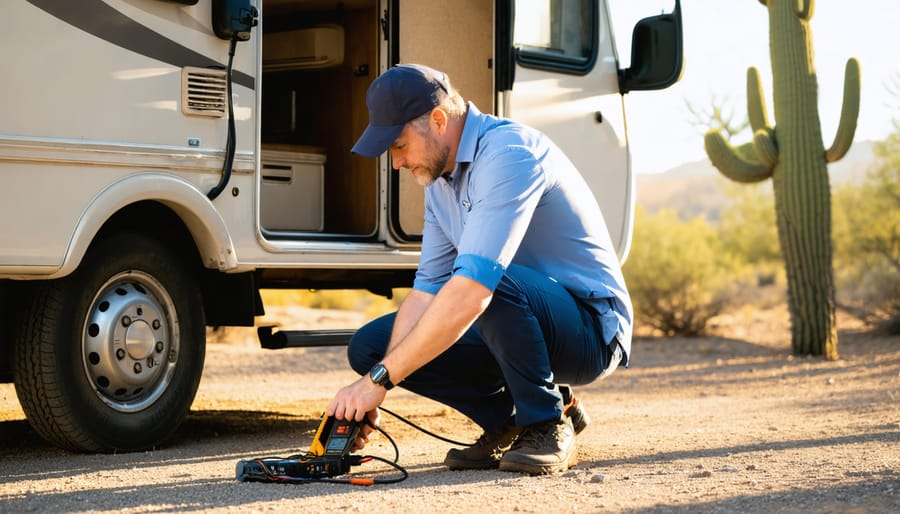
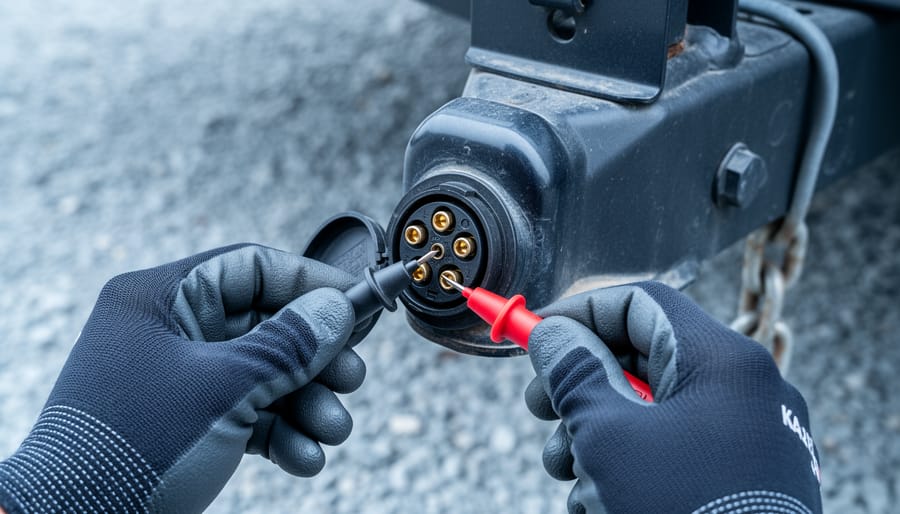
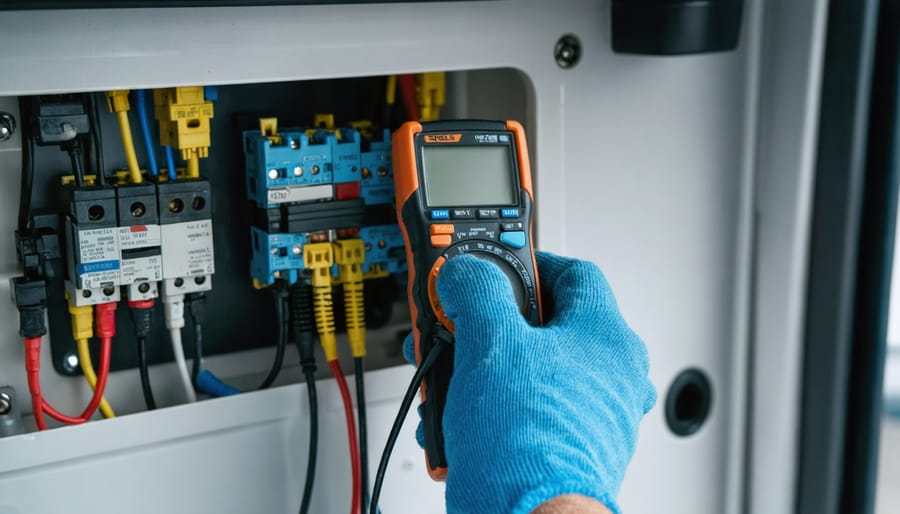
Testing and monitoring your power system components ensures reliable performance during off-grid adventures.
Three Proven Power System Setups for Different Van Lifestyles
The Weekend Warrior System (Basic)
When I first started weekend camping trips in my van, I quickly realized I didn’t need a power system that could run a microwave and air conditioning. I just needed enough juice to keep my phone charged, power some LED lights, and maybe run a small fan on warm nights. This basic setup saved me hundreds of dollars and got me on the road faster.
The beauty of the Weekend Warrior system is its simplicity. You’ll need a 100-watt solar panel mounted on your roof, which costs around $100-150. Pair this with a single 100Ah lithium battery (roughly $250-350) and a basic 20-amp charge controller (about $30-50). Don’t forget an inverter if you need AC power, but honestly, a 300-watt model for under $50 will handle phone chargers and small devices just fine.
This setup delivers approximately 400-500 watt-hours of usable power daily, assuming decent sunlight. That’s plenty for LED lighting throughout the evening, charging multiple devices, and running a USB fan. I’ve tested this exact configuration during three-day trips, and it never let me down.
Installation is straightforward enough for beginners. Mount your panel, connect it to the charge controller, wire that to your battery, and you’re essentially done. Total investment? Around $500-600, which is incredibly reasonable for energy independence on weekend adventures. Plus, you can always expand this system later if your camping habits evolve.
The Full-Timer System (Intermediate)
This is where things get serious—and honestly, where most full-time van lifers should aim. If you’re planning to work remotely, keep food cold, and live comfortably without constantly worrying about running out of juice, this tier is your sweet spot.
I’ll be straight with you: this is the system I run in my own van, and it’s been a game-changer. After years of tinkering and upgrading from a basic setup, I landed on a configuration that handles everything I throw at it.
Here’s what a solid full-timer system typically includes:
A 300-400 watt solar array (usually two 200-watt panels) provides enough daily charging to recover from overnight use and handle cloudy days without panic. You’ll want 300-400 amp hours of lithium batteries—yes, lithium is worth it at this level. The weight savings, charging efficiency, and lifespan make them essential for serious van life.
Your inverter should be in the 2000-3000 watt range to handle a laptop, phone charging, maybe a small blender, and other devices simultaneously. I went with a 3000-watt pure sine wave inverter, and it’s handled everything from power tools during van modifications to running my espresso machine (priorities, right?).
Don’t forget a quality battery monitor. This became my best friend—it tells me exactly how much power I’m using, what’s coming in from solar, and how many amp hours remain. It transformed my relationship with power from guessing to knowing.
The investment runs roughly $2,500-4,000 depending on component choices, but it delivers genuine energy independence for full-time living.
The Off-Grid Workhorse (Advanced)
Now we’re talking serious off-grid capability. I learned the hard way during a two-week stay in the Utah desert that if you want to truly work from anywhere without generator noise or constant battery anxiety, you need to build a system with real capacity.
This setup is designed for folks running laptops, monitors, camera batteries, drones, coffee makers, and other equipment that would drain a basic system in hours. You’re looking at a minimum 600Ah lithium battery bank, though I’d recommend 800Ah if your budget allows. That’s about 10kWh of usable energy, enough to run professional equipment plus all your household loads.
Solar capacity needs to match your ambition. I run 800 watts on my rig, but many remote workers push toward 1,000 watts or more. The key is having enough panel area to fully recharge your batteries even on partly cloudy days. Consider roof space carefully and look into flexible panels for curved surfaces or portable panels you can position separately.
Your inverter should be a 2,000-3,000 watt pure sine wave model. This handles power tools, blenders, microwaves, and provides enough surge capacity for compressor-based appliances. The charge controller will likely be a 60-80 amp MPPT unit to handle your solar array efficiently.
Budget around 8,000-12,000 dollars for components. Yes, it’s an investment, but the freedom to work from stunning remote locations without compromise? That’s genuinely priceless. Just remember to calculate your actual daily consumption first using our calculator tool above.
Common Mistakes That Kill Van Power Systems (I’ve Made Them All)
Let me be brutally honest: I’ve personally made at least four of the mistakes I’m about to share with you. My first van system lasted exactly three weeks before I had to rebuild half of it. The good news? You can learn from my expensive lessons.
The biggest mistake I see (and made myself) is undersizing the battery bank. I originally installed just 200Ah of lithium because it seemed like plenty on paper. Reality hit hard when I wanted to run my laptop, charge camera batteries, and keep the fridge cold overnight after a cloudy day. I was constantly anxious about power levels. The fix cost me another $800 and a weekend of rewiring. A good rule of thumb: calculate what you think you need, then add 30-50% capacity as a buffer. Your future self will thank you.
Poor wiring practices come in a close second. I’ve seen systems where people used automotive wire for high-amperage battery connections, creating dangerous voltage drops and heat buildup. Even worse, I initially skimped on proper fuse placement. Every positive wire from your battery needs a fuse within 7 inches of the terminal. No exceptions. I learned this after a short circuit melted through some wire insulation, thankfully while I was awake and nearby.
Inadequate ventilation almost destroyed my friend’s entire system last summer. Batteries, especially when charging, need airflow. His lithium batteries were tucked in a sealed cabinet and hit thermal shutdown repeatedly. Charge controllers and inverters also generate significant heat. Give them breathing room and consider small computer fans for enclosed spaces.
Here’s one that sneaks up on everyone: neglecting inverter management best practices and general maintenance. I used to leave my inverter running 24/7, which drained about 1-2% of my battery daily just in standby power. Now I use physical switches for devices I don’t need constantly running. Also, check your wire connections every few months. Vibration from driving loosens things over time.
The final mistake? Not testing your system thoroughly before hitting the road. Spend a weekend living in your van in the driveway. Run your typical loads, cook meals, work on your laptop. Finding issues at home is infinitely better than discovering them in a remote campsite.
Installation Tips That Actually Matter
I learned this the hard way during my first van build: mounting your inverter upside down seemed clever at the time (easier access to terminals!), but it created ventilation issues that shortened its lifespan. Here’s what actually matters when installing your complete camper electrical system.
Mount your batteries as low as possible in your van. Not just for stability, but because they’re your heaviest components. I secured mine between the wheel wells using marine-grade brackets. Leave at least 2 inches of ventilation space around them, especially if you’re using flooded lead-acid batteries that off-gas.
Wire sizing isn’t something to guess at. For every foot of wire, you lose voltage through resistance. Use our wire sizing calculator to determine the right gauge, but here’s the quick rule: 12V systems carrying 100 amps need at least 2/0 AWG wire for runs over 5 feet. Going bigger never hurts, going smaller creates heat and fire risk.
Fusing protects everything. Place a fuse or breaker within 7 inches of your battery’s positive terminal. This isn’t bureaucratic nonsense, it’s what prevents a short circuit from turning your van into a fireball if wires chafe through their insulation. Size your fuses to match your wire’s ampacity, not your component’s draw.
Keep things accessible. I initially tucked my charge controller behind paneling for a clean look, then needed to adjust settings three times that first month. Now everything lives behind easily removable panels. Your future self will thank you during troubleshooting sessions.
Label everything with a label maker. Which breaker controls the fridge? You’ll forget six months from now. Color-code your wires (red for positive, black for negative, yellow for solar) and photograph your connections before closing things up. Trust me on this.
Finally, use terminal boots and heat shrink on every connection. Vibration and moisture are constants in van life, and proper strain relief prevents mysterious failures down the road.
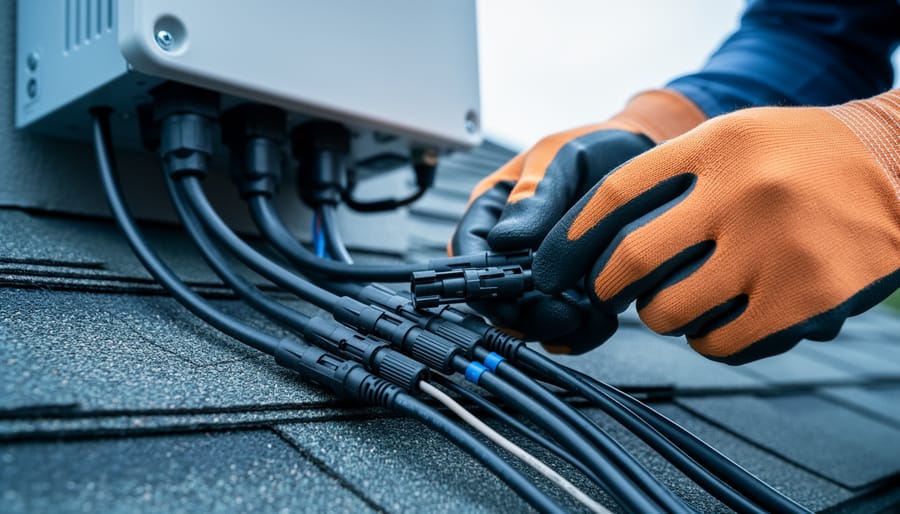
Proper wire management and component mounting are essential for a safe, reliable camper van electrical system.
Building your own camper van power system might seem daunting at first, but I promise it’s one of the most rewarding parts of a van conversion. I remember staring at a pile of components before my first installation, wondering if I’d bitten off more than I could chew. But here’s the truth: if you can follow a recipe and aren’t afraid to learn as you go, you can absolutely do this.
The beauty of DIY solar is that you can start simple and expand later. Maybe you begin with just a basic battery and shore power charging, then add solar panels when you’re ready. There’s no single “right” way to do it, only the system that works for your adventures and budget.
Throughout this guide, we’ve covered the essentials, from understanding amp-hours to wiring batteries safely. You’ve got the knowledge foundation now. The next step is yours to take.
I’d love to hear about your build. What worked well? What challenges did you face? The van life community thrives when we share our experiences, both the victories and the learning moments. Head over to Spheral Solar where you’ll find additional resources, interactive calculators to help size your specific system, and a community of fellow DIYers ready to help.
Your freedom-on-wheels powered by the sun is closer than you think. Start planning, stay curious, and don’t hesitate to reach out. We’re all in this together, one solar panel at a time.
How useful was this post?
Click on a star to rate it!
Average rating 0 / 5. Vote count: 0
No votes so far! Be the first to rate this post.
We are sorry that this post was not useful for you!
Let us improve this post!
Tell us how we can improve this post?
charlesnoble
Here at Spheral Solar, I’m a hands-on solar power enthusiast, constantly exploring and experimenting with DIY solutions. I’m dedicated to sharing my discoveries, insights, and even the bumps I hit along the way, all in the pursuit of a more sustainable future.
How Much Power Does Your RV Mini Fridge Really Use? by Charlesnoble January 12, 2026 Measure your mini fridge’s actual power draw by plugging a Kill-A-Watt meter between the outlet and your fridge for 24 hours—this $25 tool gives you the exact kWh reading rather than relying on manufacturer estimates that often miss real-world conditions. Most compact mini fridges consume between 0.5-1.5 kWh per day,…
10 Best Solar Ovens in 2026 by Charlesnoble September 21, 2021 Heads up: some links here are affiliate links, and purchases through them support the site. As an Amazon Associate I earn from qualifying purchases. There is no better heat source than the sun; with solar ovens, you can use that energy to your advantage. Many campers are beginning to see…
Why Your Motorhome Electrical System Keeps Failing… by Charlesnoble November 18, 2025 Picture this: You’re three days into a dream cross-country trip when your lights flicker, the refrigerator stops cooling, and you’re left wondering whether to call for expensive roadside assistance or figure it out yourself. I’ve been there, and here’s what I wish someone had told me before my first electrical…
Wire Your RV Tow Vehicle the Right Way (7-Pin… by Charlesnoble May 14, 2026 Identify the seven wires in your RV connector by their standard color codes: brown carries running lights, yellow handles left turn signal and brake, green manages right turn signal and brake, white serves as ground, blue powers electric brakes, black provides 12V battery charge, and red or purple connects auxiliary…
How Many Amps Does a Mini Fridge Use by Charlesnoble August 7, 2023 A typical mini fridge uses 0.2-0.6 amps when connected to a 120V AC power source and 3-7 amps on a 12V DC battery system during regular operation. Start-ups can see a spike of up to three times regular consumption. However, these numbers are for reference only and will vary depending…
Why Your RV Appliances Keep Tripping the Breaker… by Charlesnoble November 17, 2025 Turn off shore power and disconnect your battery bank before touching any wire in your RV—this single step prevents the most common DIY electrical accidents. Check your circuit breaker panel ratings against your actual appliance loads, because that microwave drawing 1500 watts on a 15-amp circuit is exactly why you’re…
Subscribe for handpicked DIY projects, exclusive tips, and giveaways.
Wiring a 7-pin RV plug correctly connects your tow vehicle to your trailer’s lights, brakes, and auxiliary power in about 45 minutes with basic hand tools and careful attention to the color-coded wire standard. The diagram follows a specific layout mandated by the RV Industry Association: each pin controls a distinct function, from left turn… Read more: How to Wire a 7-Way RV Plug: Step-by-Step Diagram and Setup Guide
Nine times out of ten, an E050 arc fault error on your solar inverter means a loose connection somewhere in your DC wiring. Before you panic or call an expensive technician, check every MC4 connector between your panels and inverter. A single connection that wasn’t snapped fully closed or has corroded from weather exposure will… Read more: Why Is My Solar Inverter Showing Arc Fault E050? Causes and How to Fix It
Most Defiant solar motion lights fail because the battery no longer holds a charge or the solar panel has accumulated enough grime to choke off charging completely. Before you assume your light is dead and start shopping for a replacement, pull off the panel cover and check the battery terminals for corrosion. That 30-second inspection… Read more: Why Is My Defiant Solar Motion Security Light Not Working? Causes and How to Fix It