Why Series-Parallel Wiring Could Save Your Solar Setup (And Your Wallet)
Updated:
When your solar array needs more power than a simple series connection provides, but your charge controller can’t handle high voltages, series-parallel wiring becomes your solution. This hybrid approach combines the voltage-boosting benefits of series connections with the current-increasing advantages of parallel wiring, giving you the flexibility to match your system’s exact requirements.
Most DIYers hit this crossroads when expanding beyond basic setups. Maybe you started with two 100-watt panels wired in series, but now you want to add two more without exceeding your controller’s voltage limit. Or perhaps you’re dealing with partial shading that’s killing your array’s performance. Series-parallel configuration solves both problems by creating multiple series strings that connect in parallel, balancing voltage and amperage to maximize efficiency.
The concept intimidates newcomers, but it’s simpler than it sounds. Think of it like organizing books on shelves: series wiring stacks books vertically on one shelf (increasing height), parallel wiring adds more shelves side-by-side (increasing width), and series-parallel does both, creating a bookcase that’s taller and wider. Your solar panels work the same way, with voltage stacking up in series and current multiplying across parallel strings.
I learned this configuration’s value the hard way during my first RV solar upgrade. Four panels seemed straightforward until I discovered my charge controller couldn’t handle them all in series. Switching to two series strings connected in parallel solved everything instantly, and the whole system finally performed as expected. Understanding when and how to use this wiring method transforms frustrating solar projects into successful power solutions.
What Series-Parallel Wiring Actually Means (No Engineering Degree Required)
Multiple solar panels connected in a series-parallel configuration maximize both voltage and current output for residential installations.
Series Wiring: The Voltage Booster
Think of series wiring like stacking batteries end-to-end in your flashlight. When you connect solar panels in series, you’re linking the positive terminal of one panel to the negative terminal of the next, creating a chain. Here’s the cool part: the voltage adds up with each panel you connect.
Let me share something I learned early on. I once tried powering a 24-volt water pump with just one 12-volt panel, and nothing happened. Then I connected two 12-volt panels in series, and suddenly I had the 24 volts needed. It clicked for me then: series wiring is your voltage booster.
Imagine water flowing through a pipe. Series wiring is like adding more pressure to push water uphill. Each panel contributes its voltage to the total, so three 18-volt panels in series give you 54 volts. However, the amperage (current) stays the same as a single panel.
This setup shines when you need higher voltage for specific equipment, like certain inverters or charge controllers that require minimum voltage thresholds. It’s also perfect for long wire runs since higher voltage means less power loss over distance.
Parallel Wiring: The Current Multiplier
Think of parallel wiring like adding more lanes to a highway. Instead of making cars go faster (voltage), you’re allowing more cars to travel at once (current). When you connect solar panels in parallel, you’re joining all the positive terminals together and all the negative terminals together. The voltage stays the same as one panel, but the current adds up.
Here’s my favorite analogy: imagine you’re filling a swimming pool. One garden hose (one panel) might take all day. Connect three hoses in parallel, and you’re moving three times the water in the same amount of time. That’s exactly how parallel wiring works with electricity.
So when is parallel wiring your best friend? It shines when you need more power but your charge controller or battery system can only handle a specific voltage. If you’re working with a 12-volt system, parallel wiring lets you stack up the amperage without pushing the voltage higher. It’s also more forgiving with shading issues since one underperforming panel won’t drag down the whole string’s voltage like it would in series.
Combining Both: The Best of Both Worlds
Series-parallel wiring is like getting the best of both worlds – imagine creating strings of panels in series first, then connecting those strings together in parallel. Picture it this way: you might wire three panels together in series to boost your voltage, creating what we call a string. Then, you connect two or three of these identical strings in parallel to increase your amperage. This hybrid approach lets you reach the voltage your charge controller needs while still maintaining enough current to charge your batteries efficiently, even when some panels are partially shaded. I learned this the hard way during a camping trip when my simple series setup failed every time a tree cast shadows across just one panel. By switching to series-parallel, my system became much more resilient. The beauty here is flexibility – you can scale your system up or down by adding or removing strings, and you’re not locked into the limitations of using purely one method or the other.
When You Actually Need Series-Parallel Wiring
Your System Voltage Requirements Don’t Match Your Panels
Sometimes your panels and your system just don’t speak the same voltage language, and that’s where series-parallel wiring becomes your best friend. Let me share a scenario I ran into last summer: I had four 12V panels lying around from an old RV project, but I wanted to build a 24V battery bank for my workshop because it’s more efficient for running power tools and reduces wire thickness requirements.
Here’s the deal: if you need 24V but have 12V panels, you can’t just wire them all in parallel (that keeps you at 12V). And wiring all four in series would give you 48V, which is too high. The solution? Series-parallel configuration. Wire two panels in series to get 24V, then do the same with the other two panels, and finally connect both pairs in parallel. Boom! You’ve got 24V at double the amperage.
This approach works for any voltage mismatch situation. Need 48V from 12V panels? Create series strings of four panels each, then parallel those strings together. The key is doing the math first: divide your target system voltage by your individual panel voltage to figure out how many panels go in each series string.
You’re Dealing with Partial Shading Issues
Shading is the nemesis of solar panels. When leaves, bird droppings, or even your neighbor’s tree cast shadows on your panels, things can get tricky. Here’s where series-parallel wiring really shines compared to a pure series setup.
In a purely series-connected system, shading just one panel can drag down the performance of every single panel in that string. It’s like a traffic jam where one slow car backs up the entire highway. I learned this the hard way when Charles and I first set up panels on his RV. A small tree branch shaded one corner panel, and suddenly our entire charging rate dropped dramatically.
With series-parallel wiring, you’re essentially creating multiple independent highways. If one string gets partially shaded, it mainly affects just that string while the other parallel strings continue producing power normally. The shaded string might generate less voltage or current, but your other strings keep chugging along at full capacity.
This doesn’t mean series-parallel makes you immune to shading problems, but it definitely softens the blow. You’ll maintain better overall array output when conditions aren’t perfect. For camping setups or rooftop installations where complete shade-free placement isn’t always possible, this resilience makes a real difference in your daily energy harvest.
You Want Flexibility and Expandability
One of my favorite things about series-parallel wiring is how it grows with you. When I first started with solar, I installed just four panels on my garage. A year later, I added four more. Series-parallel made that expansion straightforward without rewiring everything from scratch.
This wiring method is perfect if you’re dipping your toes into solar energy. Maybe you’re starting with a small off-grid cabin setup or a weekend camper system. Series-parallel lets you begin with a modest array and add more panels as your budget allows or your energy needs increase. You’re not locked into a final configuration from day one.
Even better, series-parallel accommodates different panel types more forgivingly than pure series wiring. While I always recommend matching panels when possible, life happens. Maybe you find a great deal on slightly different wattage panels, or one panel fails and the exact replacement isn’t available. Series-parallel configurations handle these mismatches better by grouping similar panels together in strings, then combining those strings in parallel. This flexibility means your system adapts to real-world situations instead of requiring perfect components every time.
How to Wire Your Panels in Series-Parallel (The Step-by-Step Way)
Plan Your Configuration First
Before you grab your wire cutters and start connecting panels, take a moment to sketch out your configuration on paper. Trust me, I learned this the hard way when I had to rewire my entire camping trailer setup because I didn’t plan ahead properly!
Start by gathering three key numbers: your charge controller’s maximum voltage input, your battery bank voltage, and the specifications of your solar panels. Look at each panel’s open circuit voltage and current rating, which you’ll find on the back label or spec sheet.
Here’s the basic planning process. First, determine how many panels you can safely connect in series without exceeding your charge controller’s voltage limit. Divide your controller’s max input voltage by your panel’s open circuit voltage, then round down. For example, if your controller handles 100V and each panel produces 22V open circuit, you could wire 4 panels in series (88V total).
Next, calculate how many of these series strings you can run in parallel. This depends on your charge controller’s current rating and your desired total system power. Consider the array design considerations specific to your panel type and installation location.
To make this easier, we’ve created a solar array calculator tool on our resources page. It handles the math for you and suggests optimal configurations based on your equipment specs. Just plug in your numbers, and it’ll show you several safe wiring options to choose from.
Gather Your Materials and Safety Gear
Before you dive into wiring your solar panels, let’s make sure you’ve got everything you need. I learned this the hard way during my first installation when I was halfway through the project and realized I was missing a critical connector. Trust me, having everything ready saves time and frustration.
For connectors and wiring, you’ll need MC4 connectors, which are the industry standard for solar panel connections. Make sure to grab both male and female ends. You’ll also want 10 AWG or 12 AWG solar cable, depending on your system size and the distance between panels and your charge controller. Pick up wire strippers, a crimping tool specifically designed for MC4 connectors, and some zip ties or cable clips to keep everything tidy.
Safety comes first. Always wear insulated work gloves to protect against electrical shock, and safety glasses are essential when working outdoors and cutting wire. A multimeter is your best friend for testing voltage and verifying connections before you hook everything up to your battery system.
For tools, you’ll need a screwdriver set, diagonal cutters, and possibly a drill if you’re mounting panels. Keep a notepad handy to diagram your wiring layout as you go. This simple sketch has saved me countless times when troubleshooting later.
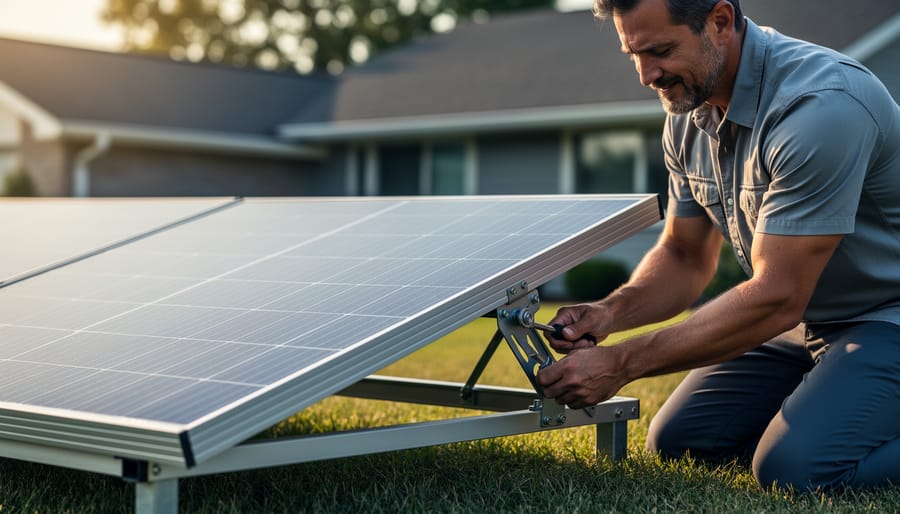
Proper MC4 connector installation is essential for creating reliable series-parallel connections between solar panels.
Making the Connections
Alright, let’s get our hands dirty with the actual wiring process. I remember my first series-parallel setup – I was so nervous about making a mistake that I triple-checked every connection. Turns out, if you follow a methodical approach, it’s pretty straightforward.
Start by creating your series strings first. This is where you connect panels end-to-end to boost voltage. Connect the positive terminal of your first panel to the negative terminal of your second panel, and continue this pattern for all panels in that string. I like to work on one complete string at a time rather than jumping around – it keeps things organized and reduces confusion.
Before you touch anything, make sure your panels are covered with an opaque blanket or tarp. Even on cloudy days, panels can generate electricity, and I learned this the hard way when I got a mild shock during an overcast afternoon setup. Also, always wear insulated gloves and use tools with insulated handles.
Once you have all your series strings completed, it’s time to connect them in parallel. This is where you bring together the positive leads from each string to a common positive bus bar or combiner box, and do the same with all the negative leads. Think of it like tributaries flowing into a main river – each string contributes its current to the combined flow.
Common mistakes to watch for: mixing up polarity when paralleling strings (double-check with a multimeter), forgetting to use properly rated wire for your combined current, and neglecting to install fuses or circuit breakers on each string before combining them. That last one is crucial for safety – each string needs its own protection to prevent backfeed issues if one string fails.
Common Series-Parallel Mistakes (And How I Learned to Avoid Them)
Mixing Different Panel Types in the Same String
Here’s a mistake Charles learned the hard way during his first larger solar setup: mixing a 100-watt panel with a 50-watt panel in the same string. The result? Both panels underperformed dramatically. When you connect panels of different wattages, voltages, or even from different manufacturers in series, the weakest panel becomes the bottleneck for the entire string. Think of it like a water pipe where the narrowest section limits flow for everything downstream.
This happens because panels in series must pass the same current through each one. If one panel produces less current, it restricts what flows through the entire string. The problem gets even trickier with newer technologies like bifacial solar panels, which have unique output characteristics.
The solution is straightforward: match your panels within each string. Use panels with identical wattage, voltage ratings, and ideally from the same manufacturer and production batch. If you must mix panels, create separate strings for each panel type, then combine those strings in parallel. This way, each string operates independently at its optimal level without dragging down the others. Your system will thank you with better performance and longer lifespan.
Ignoring Wire Gauge and Connector Ratings
Here’s a mistake I made early in my solar journey that could’ve ended badly. I once used some leftover thin wire from an old speaker setup to connect a few panels, thinking “wire is wire, right?” Wrong. Within an hour, that wire was hot enough to make me seriously nervous, and I was losing a surprising amount of power before it even reached my charge controller.
Wire gauge matters tremendously in solar installations. When you’re pushing current through wires that are too thin, physics works against you in two dangerous ways. First, you create resistance that generates heat, potentially melting insulation or even starting fires. Second, you lose precious energy as that heat dissipates into the air instead of powering your devices.
Think of it like trying to drain a swimming pool through a coffee stirrer versus a garden hose. The stirrer creates resistance and pressure buildup, just like undersized wire creates voltage drop and heat.
For series-parallel setups, calculate your maximum current draw and consult a wire gauge chart. Generally, 10 AWG wire handles most small-to-medium residential systems, while larger installations need 8 AWG or thicker. Don’t forget about connectors either. Those cheap MC4 knockoffs might save a few dollars upfront, but they can create resistance hotspots and corrode quickly outdoors. Invest in quality rated connectors that match your system’s voltage and amperage requirements. Your safety and system efficiency depend on it.
Skipping Overcurrent Protection
When you wire solar panels in parallel, you’re creating multiple pathways for electricity to flow—and that’s exactly when things can go wrong without proper protection. I learned this the hard way during my first camping setup when a faulty panel created a reverse current that could have damaged my entire array.
Here’s the deal: parallel connections allow current from functioning panels to backfeed into a shaded or damaged panel, potentially causing overheating or fire. Fuses or circuit breakers act as your safety net, automatically disconnecting problem panels before damage occurs.
Place a fuse or breaker on the positive wire of each parallel string before they combine at your junction point. Size these according to your panel’s short-circuit current rating—typically 1.25 to 1.5 times that value. For example, if your panel produces 8 amps, use a 10-12 amp fuse.
Think of it like having individual shut-off valves on water pipes—if one springs a leak, you can isolate it without shutting down the whole system. These small components cost just a few dollars but protect your entire investment.
Real-World Applications: Where Series-Parallel Shines
RV and Van Builds with Limited Roof Space
RV and van builds present a unique challenge that I’ve personally wrestled with during my own camper conversion. You’re working with limited, oddly-shaped roof space interrupted by vents, air conditioners, and roof racks. Series-parallel wiring becomes your secret weapon here because it lets you mix different panel sizes and orientations while maintaining system efficiency.
Here’s where series-parallel really shines: let’s say you can fit two 100-watt panels on one side of your roof and a single 100-watt panel on the other side. By wiring the two panels in series to create one string, then connecting that string in parallel with the solo panel, you maintain reasonable voltage while maximizing your available roof real estate. This approach gives you flexibility in panel array optimization without sacrificing power output. Plus, if shade from a roof vent hits one panel, your entire system won’t crash since each string operates somewhat independently, keeping your fridge running and batteries charging even in less-than-ideal conditions.
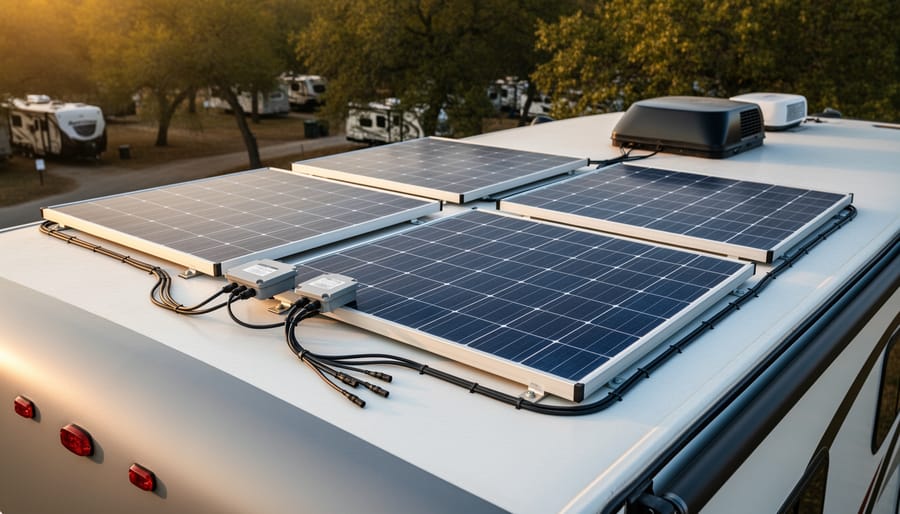
Partial shading from trees is a common challenge for RV solar installations, where series-parallel wiring helps minimize power loss.
Off-Grid Cabin Arrays with Variable Sun Exposure
I learned this lesson the hard way during a week-long camping trip in the Smokies. My buddy and I set up a basic series configuration for our off-grid cabin, and by mid-afternoon, tree shadows crawling across the panels knocked our power production down to almost nothing. That’s when series-parallel wiring really proves its worth in woodland settings.
For camping scenarios with variable shade, I recommend a 2-series by 2-parallel configuration if you’re running four panels. This setup keeps two panels in series for voltage needs while creating parallel strings that work independently. When trees shade one string, the other keeps producing without the whole system choking.
Here’s the practical advantage: morning sun might hit your eastern panels while western ones stay shaded, then conditions flip by afternoon. With series-parallel wiring, you’re harvesting power from whatever’s available rather than losing everything to the weakest link. Mount panels at slightly different angles if possible to catch shifting sun positions throughout the day. For weekend warriors and seasonal cabin users, this flexibility means reliable power without constantly repositioning panels or trimming back every branch overhead.
Off-grid cabin solar installations benefit from series-parallel configurations that accommodate variable sun exposure and future expansion.
Home DIY Systems That Grow Over Time
I learned this the hard way when I started with just two panels on my shed. Series-parallel wiring is perfect for growing your system because you build in blocks. Start with a small series string, then add another parallel string when you’re ready. Your original solar array design stays intact, you just expand it.
Here’s the beauty: if you wire two panels in series now, you can add another matched pair in parallel later without touching the first string. Each addition follows the same pattern. Just make sure your charge controller can handle the eventual total current, and you’re golden.
I’ve expanded my setup three times over two years, adding pairs as budget allowed. No rewiring, no regrets, just gradual growth toward energy independence.
You’ve got this! Series-parallel wiring might seem intimidating at first glance, but with the right approach, it’s totally within reach for any DIY enthusiast willing to take their time and follow best practices. I remember my first attempt at combining strings—I must have rechecked my connections a dozen times before flipping the switch. That caution paid off, and yours will too.
The most important takeaway? Never rush the planning stage. Sketch out your wiring diagram, double-check voltage and current calculations, and always prioritize safety. Work when panels aren’t in direct sunlight if possible, use proper gauge wire, and invest in quality connectors. These simple precautions make all the difference between a smooth installation and a frustrating troubleshooting session.
Remember, the solar community thrives on shared knowledge and experience. Whether you’re wiring panels for your RV, building an off-grid cabin setup, or expanding your home system, you’re joining thousands of others on the same journey. Don’t hesitate to use our site’s calculators to verify your configurations—they’re designed specifically to take the guesswork out of voltage and current calculations.
If you hit a snag or want to share your success story, our community forums are full of helpful folks who’ve been exactly where you are now. Post your questions, share photos of your setup, and learn from others’ experiences. Solar energy is as much about the community as it is about clean power. Now get out there and start connecting those panels—your perfectly balanced array awaits!
How useful was this post?
Click on a star to rate it!
Average rating 0 / 5. Vote count: 0
No votes so far! Be the first to rate this post.
We are sorry that this post was not useful for you!
Let us improve this post!
Tell us how we can improve this post?
charlesnoble
Here at Spheral Solar, I’m a hands-on solar power enthusiast, constantly exploring and experimenting with DIY solutions. I’m dedicated to sharing my discoveries, insights, and even the bumps I hit along the way, all in the pursuit of a more sustainable future.
The Right Tilt Angle Can Boost Your Solar Panel… by Charlesnoble April 10, 2026 Position your solar panels at an angle equal to your latitude for year-round performance, or adjust seasonally by adding 15 degrees in winter and subtracting 15 degrees in summer to capture maximum sunlight during each season’s sun path. Use a simple angle finder app on your smartphone against the back…
Why Your Bifacial Solar Panels Need a Completely… by Charlesnoble March 22, 2026 Flip your bifacial solar panels over and you’ll find a second active surface that can boost your system’s energy production by 10-30% – but only if you design your array to take advantage of it. Unlike traditional panels that capture sunlight from one side, bifacial modules harvest energy from both…
How Orlando Airport’s Solar EV Charging Could… by Charlesnoble April 30, 2026 Picture this: You’ve just landed at Orlando International Airport after a long flight, your electric vehicle waiting in long-term parking with a battery that’s somehow fuller than when you left it. Sound like science fiction? It’s happening right now at MCO, where solar-powered EV charging stations are transforming how travelers…
Subscribe for handpicked DIY projects, exclusive tips, and giveaways.
AGM batteries outperform traditional flooded lead acid batteries in nearly every practical measure that matters for solar installations, but whether that performance justifies their 50-100% higher upfront cost depends entirely on how hands-off you want your system to be and how often you’ll cycle the battery deeply. After running both types through real-world solar setups… Read more: AGM vs. Lead Acid Batteries: Which Is Better for Your Solar Setup?
A portable power station will typically run your camping devices for anywhere from a few hours to several days on a single charge, depending on what you’re powering and the station’s capacity. As for lifespan, most quality units last between 3 to 10 years before the battery degrades enough to need replacement. The distinction matters… Read more: Your Portable Power Station Won’t Last as Long as You Think (Here’s Why)
A J1772 solar charger combines a standard J1772 charging connector (the same Type 1 plug used by most North American EVs and electric bikes) with solar panels and battery components to create an off-grid or grid-supplemented charging system. You’ll need three core elements: solar panels (typically 400-800 watts for practical ebike charging), a battery storage… Read more: How to Choose a J1772 Solar Charger for Your Ebike: A Buying Guide