Why Your Solar Panels Are Losing Power (And How to Fix Shading Problems)
Updated:
Picture this: You’ve just invested in solar panels, excited about clean energy and lower bills, only to watch your power output plummet because a neighbor’s tree casts shadows across your array every afternoon. I learned this lesson the hard way during my first installation—what seemed like minimal shade reduced my system’s performance by nearly 40%. That single experience taught me that understanding and managing shade isn’t optional for solar panel owners; it’s absolutely critical.
Shade is the silent killer of solar performance. Even a shadow covering just one cell on a single panel can create a bottleneck effect, dragging down the entire string’s output. It’s like having one person walking slowly in a single-file line—everyone behind them has to slow down too. This happens because traditional solar systems wire panels together in series, meaning the weakest link determines the strength of the whole chain.
The good news? You’re not powerless against shading issues. Whether you’re troubleshooting an existing system that’s underperforming or planning a new installation in a less-than-ideal location, practical solutions exist at every budget level. Some fixes cost nothing more than your time—strategic panel placement, seasonal tree trimming, or adjusting your array’s angle. Others involve technology like power optimizers or microinverters that let each panel work independently, eliminating that bottleneck effect entirely.
This guide walks you through everything you need to know about shading solar panels, from understanding why it matters so much to implementing real-world solutions that maximize your energy production. We’ll cover assessment techniques, prevention strategies, and the specific technologies that can rescue a shaded installation, giving you the complete toolkit to protect your solar investment.
Understanding How Shading Kills Your Solar Panel Performance
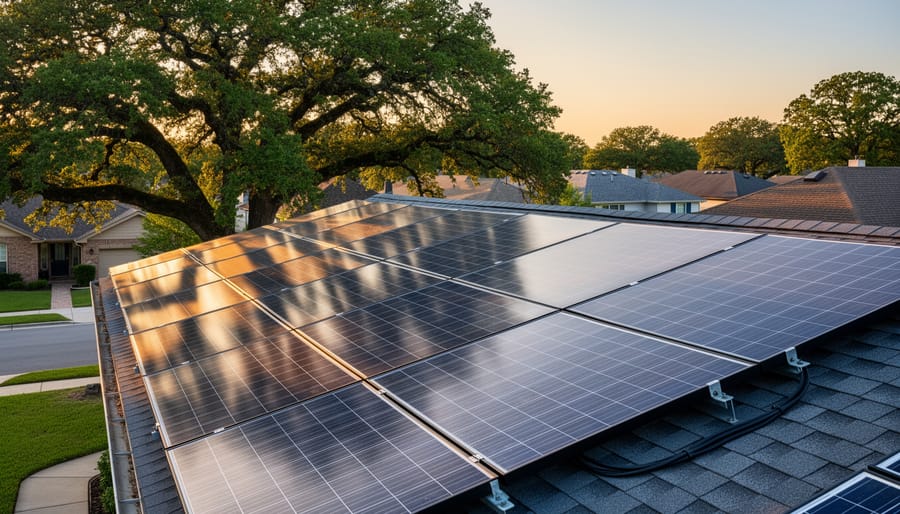
Tree shadows cast across solar panels demonstrate how even partial shading can significantly impact system performance.
The Christmas Light Effect
Remember those old strings of Christmas lights where one burnt-out bulb would kill the entire strand? That’s exactly how most solar panels behave when they’re wired in series. It’s frustrating, and I learned this lesson the hard way.
Charles here. A few years back, I installed my first DIY solar setup on my camper van. Everything looked great on paper, and I was thrilled watching my panels soak up the morning sun. But around noon, when I expected peak performance, my power output dropped to almost nothing. I checked connections, tested the charge controller, even wondered if I’d gotten defective panels. Turns out, a small shadow from my roof vent was falling across just one corner of one panel. That tiny bit of shade was choking my entire system.
Here’s what’s happening: when solar cells are connected in series (which is how most panels are built internally), they’re like links in a chain. The weakest link determines the strength of the whole chain. Even if 95 percent of your panel is in full sun, that shaded 5 percent becomes a bottleneck. The electricity can only flow as fast as the slowest cell allows. One partially shaded cell can reduce your panel’s output by 50 percent or more, and when multiple panels are strung together, the problem multiplies. Understanding this Christmas light effect is the first step toward solving your shading problems.
Different Types of Shade and Their Impact
Not all shade is created equal when it comes to solar panels. Understanding the different types can help you troubleshoot performance issues and make smarter installation decisions.
Hard shade versus soft shade makes a huge difference in how your panels perform. Hard shade comes from solid objects like chimneys, branches, or nearby buildings that completely block sunlight from reaching your panels. Think of it like someone putting their hand directly over your panel—no light gets through at all. Soft shade, on the other hand, is more diffused. This happens with high clouds, fog, or light filtering through leaves. While soft shade definitely reduces output, your panels can still generate some power because scattered light still reaches the cells.
I learned this distinction the hard way during a camping trip with my portable setup. A nearby tree cast hard shade across just one corner of my panel in the morning, and my charge controller showed almost no power coming in. When I moved the panel into an area with only soft shade from overhead clouds, I was surprised to see it still producing about 30-40% of its rated capacity.
Permanent shade sources stay put year-round—that chimney isn’t going anywhere. Temporary shade changes with seasons, time of day, or weather conditions. In home installations, you might notice a vent pipe creates hard shade only during winter months when the sun sits lower in the sky. For camping setups, temporary shade is actually your friend on hot days, letting you strategically position panels to balance power generation with keeping your equipment cool.
Site Assessment: Finding the Shadows Before They Find You
The Simple Smartphone Method
You don’t need expensive solar analysis equipment to figure out where shade is hitting your panels. Your smartphone already has everything you need to become a shade detective.
Start by downloading a free sun path app like Sun Surveyor or SunCalc. These apps use your phone’s GPS and compass to show you exactly where the sun travels throughout the day and across different seasons. Point your phone at your solar panel location, and the app overlays the sun’s arc on your camera view. I learned this trick from Charles, who discovered that his “perfectly placed” panels were getting hit by his neighbor’s tree shadow every winter afternoon, something that wasn’t obvious during his summer installation.
The beauty of these apps is they show you future sun positions. You can stand in your yard in July and see where shadows will fall in December. This is incredibly helpful for planning new installations or diagnosing mysterious winter performance drops.
For a more detailed analysis, set up time-lapse photography using your phone’s built-in feature or a free app. Position your phone to capture your solar panel area and record footage from sunrise to sunset on a clear day. Speed it up, and you’ll watch shadows march across your installation like a fast-forwarded movie. Do this during different seasons if possible.
This simple method reveals patterns you’d never notice with casual observation. You might discover that morning shade clears up earlier than you thought, or that a seemingly small obstruction casts surprisingly long afternoon shadows. Armed with this knowledge, you can make informed decisions about tree trimming, panel repositioning, or whether those power optimizers are worth the investment.
What to Look For: Trees, Buildings, and Seasonal Changes
Before you install your first panel or start troubleshooting mysterious power drops, let’s talk about the usual suspects that cast shadows on your solar dreams—literally.
Trees are the most common shading culprit I encounter when helping DIYers optimize their setups. That charming oak tree providing summer shade to your patio? It’s probably stealing 30-50% of your solar production during peak hours. Here’s the tricky part: trees grow, and that sapling that barely reaches your roofline today might tower over your panels in five years. When assessing tree shade, look up during different times of day and imagine each tree about 20% taller than it currently stands. Deciduous trees lose their leaves in winter, which seems helpful until you realize winter sun sits lower on the horizon—those bare branches still create a surprising shadow web across your panels.
Buildings and structures present more predictable challenges. Your neighbor’s two-story house, that new garage, even your own chimney—they all cast shadows that shift dramatically with the seasons. The winter sun travels a much lower arc across the sky than summer sun, extending building shadows significantly. I learned this the hard way during my first installation when panels that seemed perfectly positioned in July were completely shaded by my house every December afternoon.
Seasonal sun angles create what I call the “shadow dance.” In summer, the sun rises northeast and sets northwest, staying high overhead. Winter brings a southeastern rise, southwestern set, and a low arc that can triple the length of shadows. This shift affects east-west facing installations differently than south-facing ones, adding another layer to your planning.
Document shadow patterns during the worst-case scenario—winter months around solar noon—to understand your baseline. Many seasonal performance challenges stem from not accounting for these dramatic changes in sun position throughout the year.
Strategic Panel Placement: Your First Line of Defense
Smartphone apps make it easy for DIYers to track sun paths and identify potential shading issues before installation.
Working Around Obstacles You Can’t Move
Not all obstacles can be trimmed or removed, and that’s perfectly okay. I learned this the hard way when I tried to convince my neighbor that his decorative weathervane was ruining my solar setup. Spoiler alert: he wasn’t budging, and I had to get creative instead.
Chimneys are probably the most common fixed obstacle you’ll encounter on rooftops. The key is working around them rather than treating them as deal-breakers. When planning your array layout, create a perimeter buffer zone of at least three feet around chimneys during peak sun hours. Use your shadow tracking observations to map exactly where that chimney shadow falls throughout the day, then position panels outside those zones. Sometimes this means splitting your array into two sections on either side of the obstruction, which actually works fine with modern racking systems.
Vents and antennas present similar challenges but smaller footprints. Consider bifacial panel configurations that can capture reflected light from surfaces below, potentially offsetting minor shading from small protrusions. For camping setups dealing with rocks or tree stumps, portable tilt mounts let you angle panels away from obstacles while maintaining optimal sun exposure.
If you’re installing permanently, power optimizers become your best friend when obstacles create unavoidable partial shading. Each panel gets its own optimizer, preventing one shaded panel from dragging down the entire string’s performance. Yes, they add cost, but the long-term energy gains usually justify the investment when obstacles can’t be moved.
Tilt and Orientation Tricks
Here’s a game-changer I learned from my neighbor Charles: sometimes the simplest solution to shading is repositioning your panels. By adjusting your panel angle and orientation, you can often dodge shade while still catching plenty of sun.
Start by observing how shadows move across your installation area throughout the day. Morning shade from that oak tree? Tilting your panels at a steeper angle might help sunlight reach them earlier. Afternoon shadows creeping in? Adjusting the azimuth (the compass direction your panels face) by even 10-15 degrees can make a surprising difference.
The beauty of optimal tilt angles is that they’re not set in stone. If perfect south-facing orientation puts you in partial shade, try southeast or southwest instead. Yes, you might lose a bit of theoretical maximum output, but gaining four extra hours of unshaded sun beats having perfect orientation with shadow problems.
For portable setups like RVs or camping rigs, this flexibility becomes your superpower. Mount panels on adjustable brackets so you can reposition them as the sun moves or when you park in different spots. Charles swears by his quick-adjust mounts for weekend camping trips.
Power Optimizers and Microinverters: Game-Changing Technology
How They Actually Work (In Plain English)
Here’s the thing about solar panels and shade: it’s not as simple as “less light equals less power.” The problem runs much deeper because of how panels are wired together.
Think of a solar panel like a water pipe. When everything’s flowing smoothly, you get maximum output. But even a small shadow across one cell acts like a kink in that pipe, restricting flow for the entire string of cells. This is called the “Christmas light effect”—when one bulb goes out, it affects the whole strand.
Most solar panels contain 60 or 72 individual cells connected in series. If just one cell gets shaded, it can bottleneck the entire panel’s performance, sometimes dropping output by 50% or more. Even worse, that shaded cell can heat up as electricity tries forcing through it, potentially causing permanent damage called hot spots.
Here’s where modern technology steps in. Maximum Power Point Tracking, or MPPT, is the smart brain that optimizes power flow. Traditional systems use one MPPT controller for multiple panels, meaning one shaded panel drags down the whole array. But newer smart solar modules put MPPT at the individual panel level through microinverters or power optimizers.
With panel-level MPPT, each panel operates independently. If one gets shaded, the others keep producing at full capacity. It’s like giving each panel its own dedicated brain instead of forcing them all to share one.
This technology fundamentally changes how we approach shade management in DIY solar installations.
When They’re Worth the Investment
Here’s the thing about shading solutions – they’re not always necessary, and knowing when to invest can save you hundreds or even thousands of dollars.
I learned this lesson the hard way on my first off-grid cabin project. I spent over $400 on power optimizers before realizing that simply moving two panels six feet to the left would’ve solved my morning shade problem for free. That experience taught me to always exhaust the simple fixes first.
Power optimizers and microinverters really shine when you’re stuck with unavoidable shade. Take my neighbor Janet’s situation – she had a gorgeous oak tree that shaded her south-facing roof every afternoon. The tree was protected by local ordinances, and there was no better roof placement available. In her case, adding optimizers made complete sense. Her system went from producing 60% of its potential to nearly 95%, paying for itself in about three years.
On the flip side, I recently helped a friend who was considering optimizers for occasional morning shadows from a chimney. We did the math together, and the extra cost would’ve taken twelve years to recoup. Instead, we repositioned three panels and trimmed back some shrubs. Problem solved for under $50.
The sweet spot for investing in shading solutions typically involves permanent obstacles you can’t remove, irregular roof layouts where panels must go in multiple orientations, or situations where your only installation option has partial shade. For temporary or seasonal shading, or when you have flexibility in panel placement, start with the free solutions and work your way up only if needed.
Bypass Diodes: Your Panel’s Built-In Safety Net
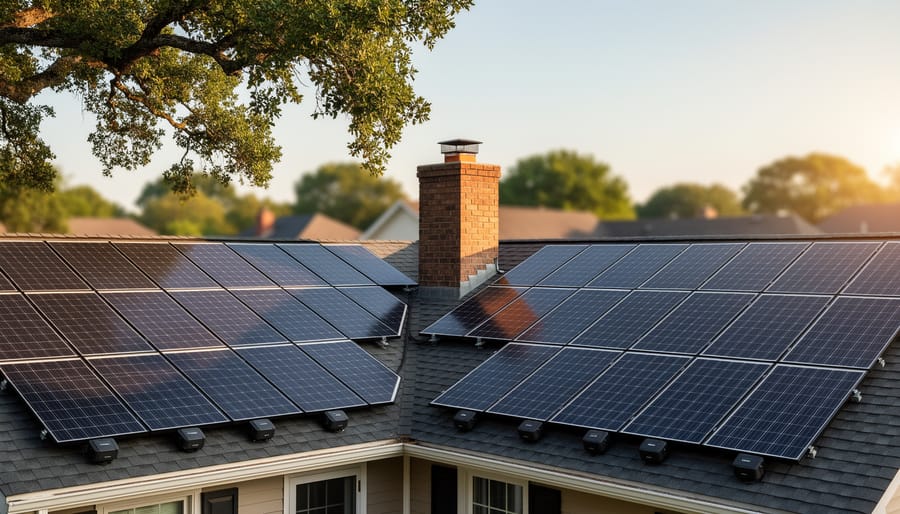
Power optimizers allow each panel to operate independently, preventing shaded panels from reducing the output of the entire array.
Checking If Your Panels Have Adequate Bypass Protection
Before you buy panels or if you’re troubleshooting performance issues, it’s worth checking whether your panels have built-in bypass protection. Most modern solar panels come with bypass diodes already installed, typically one diode for every 20-24 cells in the panel. Here’s the thing though: not all manufacturers are created equal.
When shopping for panels, look at the specifications sheet and search for mentions of bypass diodes. Quality panels will clearly state something like “3 bypass diodes” for a standard 60-cell panel. If this information isn’t listed, that’s a red flag. I learned this the hard way when Charles told me about a budget panel he bought years ago that had no bypass protection whatsoever. One shaded corner basically turned the whole panel into a space heater instead of a power generator.
If you already own panels, checking for bypass diodes usually requires opening the junction box on the back of the panel. You’ll see small cylindrical components soldered into the circuit. Fair warning though: opening this box might void your warranty, so check your documentation first. For peace of mind on future purchases, stick with reputable manufacturers who clearly document their bypass diode configuration.
The Limitations of Bypass Diodes
Here’s the truth about bypass diodes: they’re helpful, but they’re not miracle workers. When I first learned about them, I thought they’d solve all my shading problems. They didn’t.
Bypass diodes help minimize damage when partial shading occurs, but they don’t prevent power loss entirely. Think of them as a detour route when traffic blocks the main road—you keep moving, but you’re still not going full speed. If one cell in a series gets shaded, the bypass diode routes power around it, but you’ve still lost the output from that entire string of cells.
The real limitation hits when you’re dealing with significant or frequent shading. A bypass diode can’t create energy that isn’t there. If half your panel sits in shadow most of the day, those diodes are just managing the problem, not fixing it. You’ll still see substantial production drops.
This is where power optimizers or microinverters become necessary. These devices work at the individual panel level, allowing each panel to operate independently regardless of what’s happening to its neighbors. For serious shading issues—like chimneys, nearby buildings, or tree coverage—bypass diodes alone won’t cut it. You need smarter technology or better panel placement to truly solve the problem.
Practical Shade Management Solutions for DIYers
Trimming and Tree Management
Before reaching for the chainsaw, let’s talk about smart vegetation management. I learned this lesson the hard way when I trimmed back a neighbor’s overhanging branch without asking first – not my proudest moment! Always start by identifying which trees are actually yours. Property line issues can get messy fast, so if shade is coming from a neighbor’s tree, have a friendly conversation first. Most folks are happy to help once they understand the situation.
For your own trees, focus on strategic pruning rather than full removal. Removing lower branches or selectively thinning the canopy often provides enough light without sacrificing the tree’s health or your yard’s aesthetics. The best time for trimming is typically during dormancy in late winter, though this varies by species. If you’re dealing with large trees or branches near power lines, hire a certified arborist – this isn’t the place to DIY if you’re not experienced.
Consider the long game too. That sapling planted fifteen feet from your array might not be a problem today, but in five years? Think ahead about growth patterns. Sometimes the simplest solution is relocating young trees before they become established shade-throwers.
Creative Mounting Solutions
Sometimes the best solution to shading isn’t optimizing around it—it’s physically moving your panels out of harm’s way. I learned this lesson the hard way during a camping trip in the Rockies when I stubbornly tried to position my portable panel on the ground, only to watch a tree’s shadow creep across it by mid-morning. That’s when I started experimenting with creative mounting solutions that have since saved countless solar setups.
Pole mounts offer one of the simplest elevation strategies. By raising panels six to ten feet above ground level on sturdy posts, you can often clear low-lying obstacles like bushes, fences, or even nearby structures. Many off-grid enthusiasts swear by this approach because it’s surprisingly affordable—just galvanized steel pipe and some cement. The added bonus? Better air circulation underneath keeps your panels cooler and more efficient.
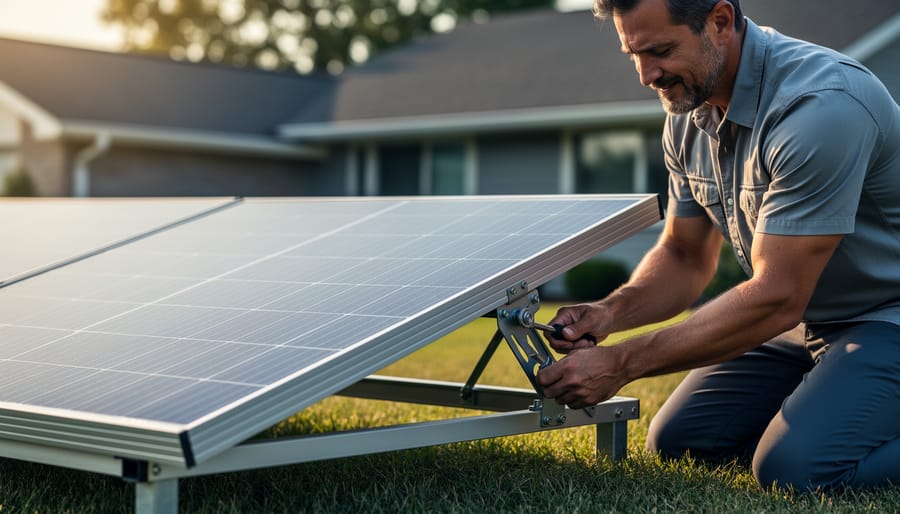
Ground mounts with adjustable tilt mechanisms give you incredible flexibility, especially for seasonal shade patterns. I’ve seen DIYers create simple hinge systems using basic hardware store materials that let them reposition panels throughout the day. One clever camping setup I encountered used a modified camera tripod head—sounds unconventional, but it allowed for quick 360-degree adjustments to chase the sun and dodge shadows.
For the truly adventurous, full tracking systems aren’t just for commercial installations anymore. Budget-friendly linear actuator kits have made simple single-axis trackers accessible to hobbyists. While these require more setup and occasional maintenance, they maximize your daily energy harvest by keeping panels perpendicular to sunlight—and naturally avoiding stationary shade sources.
The key is matching your mounting solution to your specific situation and commitment level.
String Configuration Strategies
When shade hits even one panel in your array, how you’ve wired everything together determines whether it’s a minor hiccup or a major power drain. Think of it like holiday lights: when one bulb fails in a series string, the whole strand goes dark. Solar panels work similarly.
In a series connection (where panels link positive to negative in a chain), the shaded panel becomes a bottleneck, dragging down the entire string’s output to match its reduced performance. I learned this the hard way on my first installation when a neighbor’s tree shaded just one corner panel during afternoon hours, and my whole system’s production plummeted by 60 percent.
Parallel wiring (connecting all positives together and all negatives together) isolates each panel’s performance. If one gets shaded, only that panel’s output drops while others keep humming along at full capacity. The tradeoff? You’ll need thicker cables to handle higher current, which costs more.
For most DIY setups facing partial shade, series-parallel wiring configurations offer the sweet spot, creating smaller series strings connected in parallel. This approach balances voltage requirements, wire costs, and shade resilience, giving you flexibility without breaking the bank.
Monitoring and Troubleshooting Shading Issues
Reading the Signs: Performance Drops and What They Mean
I learned this the hard way when my panels suddenly dropped to about 40% output one autumn afternoon. My first instinct was to assume something broke, but understanding what the monitoring data was telling me saved me hours of unnecessary troubleshooting.
Shading creates distinctive performance patterns that look different from equipment failures. If you’re seeing gradual output drops throughout the day that follow the sun’s path, you’re likely dealing with shade rather than hardware problems. A broken inverter or failed panel typically causes sudden, complete losses or consistent underperformance at all times.
Here’s what to look for in your monitoring system. Partial shading usually shows up as disproportionate drops in power. For example, if 10% of your array is shaded, you might see a 30-50% performance hit because of how panels interact electrically. If your output chart shows regular dips at the same time each day, trace that timing to tree positions or nearby structures.
Temperature-related losses behave differently. Panels naturally produce less power on hot days, but this affects all panels equally and correlates with weather patterns. Shading, however, creates irregular patterns where some panels perform normally while others don’t.
Try this quick test: on a clear day, check your system monitoring every hour and note which panels are underperforming. Then physically inspect those panels for shadows. If the timing matches up with moving shadows from trees or buildings, you’ve confirmed shading as your culprit. This detective work helps you prioritize which obstacles to address first.
Simple Tests You Can Run Today
You don’t need fancy equipment to figure out what’s casting shadows on your panels. I learned this the hard way when my RV setup wasn’t producing what I expected, and a simple afternoon of observation solved the mystery.
Start with the shadow dance test. Grab a lawn chair and spend 15-30 minutes at different times of day just watching your panels. Note when shadows appear and where they’re coming from. I like doing this around 9 AM, noon, and 3 PM to catch the sun’s movement. Take photos with timestamps so you can compare patterns over several days.
Next, break out a basic multimeter. You can pick one up for under twenty dollars at any hardware store. In full sun, measure the voltage output of each panel individually. Write down the numbers. If one panel shows significantly lower voltage than its neighbors, you’ve likely found your shading culprit. Compare these readings to your panel’s spec sheet, which should list expected voltage output.
The shade severity ranking is simple: note whether shadows are partial or complete, how long they last, and whether they hit the same spot daily. Morning shade is generally less problematic than midday shade when the sun is strongest. Keep a simple log for a week, and you’ll have all the data you need to decide on your next steps.
Special Considerations for Mobile and Portable Solar Setups
Parking and Site Selection Strategies
When you’re camping or traveling with solar panels, a little strategic thinking about where you park can make all the difference in your power generation. I learned this the hard way on a trip to the Rockies when I picked the shadiest spot in the campground because it looked cozy, only to wake up with barely enough charge to make morning coffee.
The best approach is to scout your location during midday if possible, when the sun is highest. Look for open areas away from tall trees, buildings, or cliffs that could cast shadows. Southern exposures work best in the Northern Hemisphere, giving you maximum sun throughout the day. Even if you arrive at dusk, take a moment to look up and around, noting where obstacles might block morning or afternoon sun.
For RV and van dwellers, consider arriving early to claim spots with clear southern access. Many experienced campers use sun-tracking apps on their phones to visualize the sun’s path before committing to a spot. If you’re tent camping with portable panels, you have more flexibility to move your setup throughout the day, following the sun while keeping your camp in that perfect shady spot under the trees. The key is separating where you rest from where your panels work.
Quick-Deploy Shade Mitigation Tactics
Sometimes you need a quick fix when shade shows up unexpectedly. Maybe you’re camping and that perfect sunny spot from morning is now under tree shadow, or perhaps you set up your portable panel only to realize it’s not getting the sun you thought it would. That’s where quick-deploy solutions really shine.
Extension cables are your first line of defense. I learned this the hard way during a weekend camping trip when my solar setup was perfect except for a stubborn patch of shade that crept in around noon. A simple 10 to 25-foot extension cable let me relocate just the panel while keeping my charge controller and battery in the shade where they belonged. The key is getting cables rated for your system’s voltage and amperage to avoid power loss.
Adjustable mounting brackets transform how you work with temporary setups. These lightweight stands let you tilt, rotate, and reposition panels throughout the day without breaking down your entire system. I’ve seen folks increase their daily output by 30 percent just by making two simple angle adjustments as the sun moves.
For camping enthusiasts, portable ground mounts with quick-release clamps mean you can chase the sun without hassle. They’re especially handy when you’re parked in one spot but shade patterns change throughout the day. The best part? Most of these solutions cost under fifty dollars and require zero technical expertise to implement.
Here’s the truth I’ve learned after years of helping folks troubleshoot their solar setups: shading doesn’t have to be the end of your solar dreams. Sure, I’ve seen plenty of DIYers get discouraged when they discover a tree casting shadows across their perfect roof spot, but I’ve also watched them turn those challenging installations into success stories with the right approach.
The key takeaway? Knowledge and planning beat perfect conditions every time. Whether you’re dealing with morning shadows from a neighbor’s chimney or afternoon shade from your own trees, you now have a toolkit of solutions. Maybe it’s as simple as adjusting your panel angle or trimming a few branches. Perhaps you’ll invest in microinverters or power optimizers to squeeze every available watt from partially shaded arrays. The point is, you have options.
Take a few minutes to honestly assess your situation. Walk around your installation site at different times of day. Snap some photos. Even reducing shade by just 10-20% can translate to meaningful gains in your energy production and faster payback on your investment.
Ready to get specific? Head over to our solar calculators to model your exact scenario and see how different shade mitigation strategies might impact your system’s performance. And here’s where I’m asking for your help: if you’ve tackled a tricky shading challenge, share your solution in the comments below. This community thrives when we learn from each other’s real-world experiences. Your workaround might be exactly what someone else needs to hear today.
How useful was this post?
Click on a star to rate it!
Average rating 0 / 5. Vote count: 0
No votes so far! Be the first to rate this post.
We are sorry that this post was not useful for you!
Let us improve this post!
Tell us how we can improve this post?
charlesnoble
Here at Spheral Solar, I’m a hands-on solar power enthusiast, constantly exploring and experimenting with DIY solutions. I’m dedicated to sharing my discoveries, insights, and even the bumps I hit along the way, all in the pursuit of a more sustainable future.
Why Smart Solar Modules Could Save Your DIY Array… by Charlesnoble March 27, 2026 Match your solar panels to microinverters or power optimizers based on your roof’s shading patterns—even partial shade from a chimney or tree during morning hours means module-level power electronics will recover 15-25% more energy than string inverters lose to the weakest panel. Install power optimizers when you’re working with mixed…
Why Your Bifacial Solar Panels Need a Completely… by Charlesnoble March 22, 2026 Flip your bifacial solar panels over and you’ll find a second active surface that can boost your system’s energy production by 10-30% – but only if you design your array to take advantage of it. Unlike traditional panels that capture sunlight from one side, bifacial modules harvest energy from both…
The Right Tilt Angle Can Boost Your Solar Panel… by Charlesnoble April 10, 2026 Position your solar panels at an angle equal to your latitude for year-round performance, or adjust seasonally by adding 15 degrees in winter and subtracting 15 degrees in summer to capture maximum sunlight during each season’s sun path. Use a simple angle finder app on your smartphone against the back…
4 Best Solar Deck Lights of 2026, Tested and Reviewed by Charlesnoble August 8, 2026 After testing solar deck lights across multiple months of evening use, we found the VOLISUN Solar Deck Lights 16 Pack deliver the best combination of brightness, runtime, and installation simplicity for most outdoor spaces. These lights outperformed competitors in our real-world testing, staying reliably bright through the night and requiring…
How Orlando Airport’s Solar EV Charging Could… by Charlesnoble April 30, 2026 Picture this: You’ve just landed at Orlando International Airport after a long flight, your electric vehicle waiting in long-term parking with a battery that’s somehow fuller than when you left it. Sound like science fiction? It’s happening right now at MCO, where solar-powered EV charging stations are transforming how travelers…
Subscribe for handpicked DIY projects, exclusive tips, and giveaways.
After testing dozens of solar chargers across camping trips, power outages, and backyard experiments, we found the X-Dragon 20W delivers the most reliable charging performance for phones and tablets, while the Goal Zero Nomad 50W steps up when you need to power larger devices or handle extended emergencies. If you’re planning weekend hikes, assembling an… Read more: 7 Best Solar Powered USB Chargers of 2026, Tested and Reviewed
There is something special about a mature tree. Decades of growth, shade that actually cools the house, branches that the kids climbed, a root system that has quietly held the yard together through every storm. So when circumstances force a move, whether it is a home renovation, a new driveway, or a construction project that… Read more: How to Move a Mature Tree Without Killing It: The Complete Relocation Guide
A mass energy conversion calculator lets you determine how much energy is locked inside any amount of matter using Einstein’s famous equation E=mc². Whether you’re working on a physics assignment or simply curious about the enormous energy potential in everyday objects, the calculation itself takes just seconds once you understand the formula’s three components: energy… Read more: How to Use a Mass Energy Conversion Calculator (Step-by-Step Guide)