Why Smart Solar Modules Could Save Your DIY Array (Before It’s Too Late)
Updated:
Match your solar panels to microinverters or power optimizers based on your roof’s shading patterns—even partial shade from a chimney or tree during morning hours means module-level power electronics will recover 15-25% more energy than string inverters lose to the weakest panel. Install power optimizers when you’re working with mixed panel orientations across multiple roof planes, since they let each module operate independently while feeding a single central inverter. Choose microinverters for maximum simplicity if you’re expanding your system incrementally over several years, as they eliminate complex string calculations and let you add panels one at a time without rewiring.
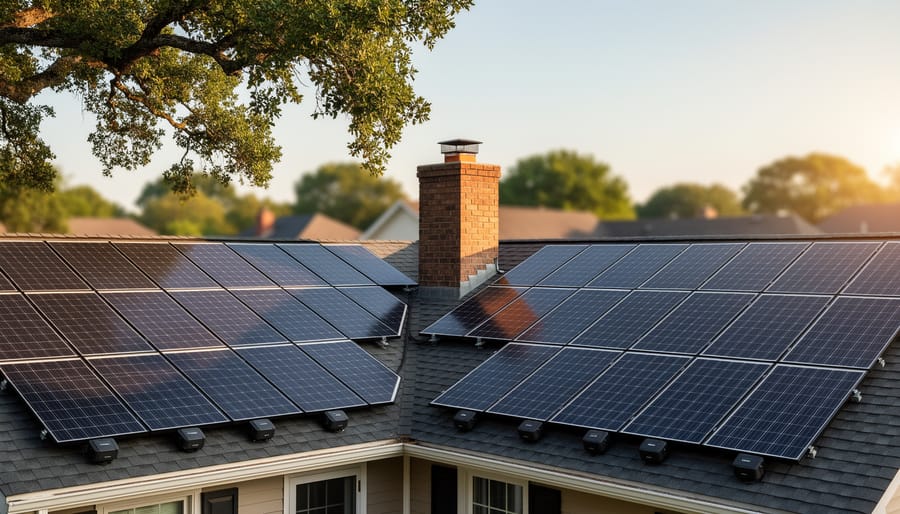
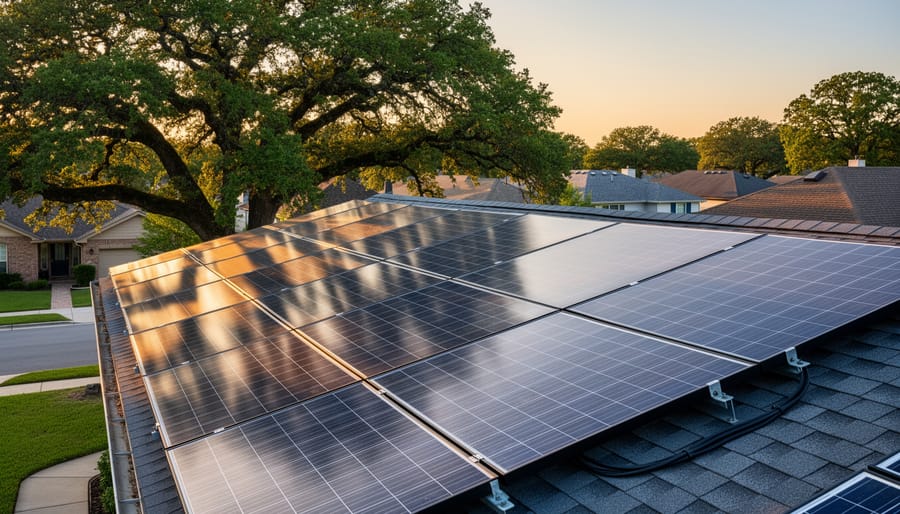
I learned this the hard way during my first installation when a neighbor’s oak tree shaded just three panels on a 12-panel string system every afternoon. Those three shaded panels dragged down the entire string’s performance to their reduced output level, costing me about 400 kWh annually. After switching to power optimizers, each panel operated at its own maximum potential regardless of shade, and my production jumped immediately.
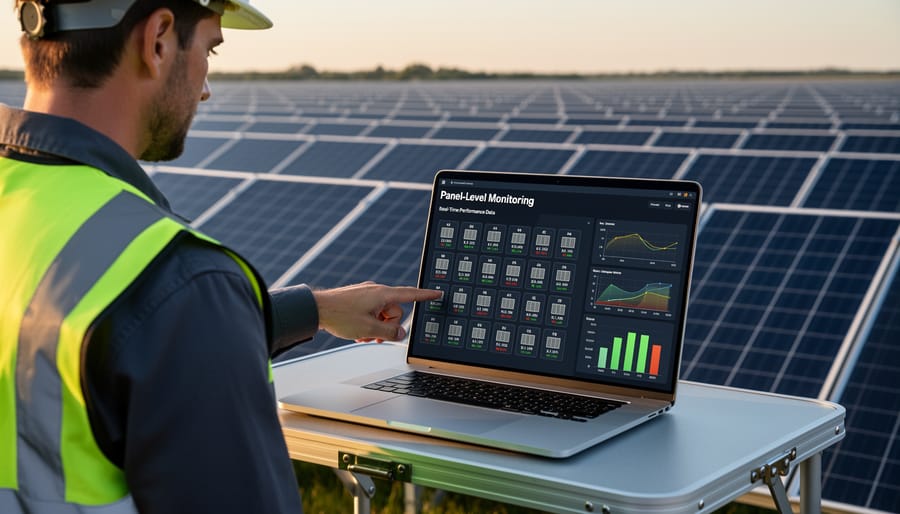
Module-level power electronics transform how your solar array handles real-world challenges. Traditional string inverters force all panels to operate at the same voltage, meaning your system performs only as well as your worst-performing panel. MLPEs break this limitation by managing each panel individually, extracting maximum power even when conditions vary across your roof. They also provide panel-level monitoring so you’ll spot a failing panel within hours instead of watching your whole system underperform for months.
The technology isn’t new, but deciding whether MLPEs justify their 15-30% cost premium over string inverters depends entirely on your specific installation conditions, and that’s exactly what we’re unpacking today.
What Makes a Solar Module ‘Smart’ (And Why It Matters)
The Old Way: String Inverters and the Weakest Link Problem
Let me paint a picture you’ve probably seen before: those old-fashioned Christmas lights where one bulb goes out and the entire string goes dark. Frustrating, right? Well, traditional solar setups with string inverters work remarkably similarly, and understanding this helps explain why many DIYers are looking for better options.
In a string inverter system, your solar panels are wired together in a series, like links in a chain. The electricity flows from one panel to the next, eventually reaching a single central inverter that converts the DC power from your panels into AC power your home can use. On paper, this seems simple and cost-effective, which is exactly why it dominated the solar industry for years.
Here’s the catch: because all your panels are connected in series, they can only produce as much power as the weakest panel in the string. If one panel gets shaded by a tree branch, a chimney, or even bird droppings, it doesn’t just lose its own production. It drags down the performance of every other panel connected to it. I learned this the hard way when a neighbor’s tree grew just enough to shade two panels on my roof for a few hours each morning. My entire array’s output dropped by nearly 40 percent during those hours, not just the shaded panels.
This “weakest link” problem becomes particularly challenging if you have a complex roof with multiple orientations, nearby trees, or chimneys. Even minor shading issues can create major production losses. While there are workarounds like series-parallel wiring configurations, they add complexity without fully solving the fundamental limitation.
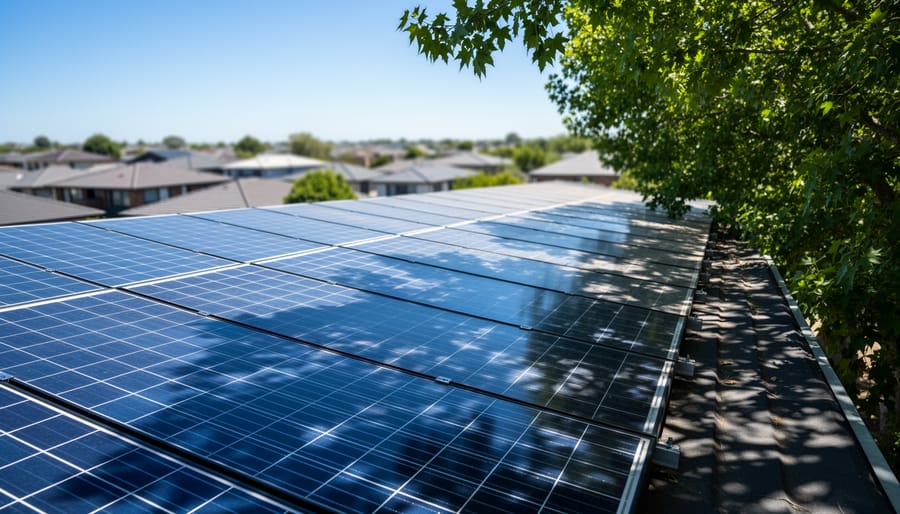
Partial shading from nearby trees can dramatically reduce solar panel performance in traditional string inverter systems.
The New Way: Each Panel Works for Itself
Here’s where things get exciting. Instead of forcing all your panels to march in lockstep like soldiers, module-level power electronics give each panel its own brain and independence. Think of it like upgrading from a bicycle built for ten people (where everyone has to pedal at the same speed) to giving each person their own bike.
With MLPEs, each solar panel operates at its own maximum power point. When shade hits one panel at 3 PM, or leaves pile up on another, those panels handle their own problems without dragging down the entire system. The sunny panels keep producing at full capacity while the shaded ones do their best with what they’ve got.
I remember installing my first system with microinverters, and honestly, I was skeptical about whether the difference would be noticeable. But the monitoring data told the story immediately. On a partly cloudy morning, I could watch individual panels ramping up and down independently as clouds passed overhead. The system was harvesting every possible watt instead of being limited by the weakest link.
This independence matters most in real-world conditions. Your roof probably isn’t a perfectly uniform surface with identical sun exposure all day. Maybe you have a chimney, a dormer, or a neighbor’s tree. Perhaps morning fog lingers on one section while another gets early sun. With MLPEs, these everyday challenges become minor inconveniences rather than major performance killers. Each panel simply does its own thing, maximizing your total energy harvest without compromise.
The Two Types of Module-Level Power Electronics
Microinverters: The All-in-One Solution
If you’re looking for the simplest path to converting sunlight into usable electricity, microinverters might just be your best friend. Think of them as the all-in-one solution that eliminates many of the headaches traditional solar setups can create.
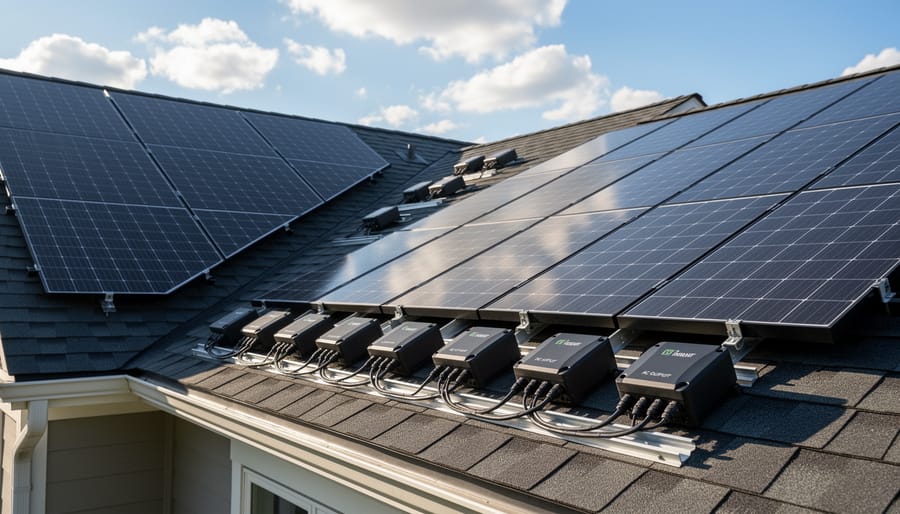
Here’s how they work: instead of routing all your solar panel DC power to one central inverter, microinverters attach directly to the back of each individual panel. Right there on your roof, they convert DC electricity to AC electricity that your home can use immediately. It’s like having a tiny power station on each panel rather than one big converter box on your garage wall.
I remember when Charles first installed microinverters on his workshop roof. He was amazed at how straightforward the whole process became. “It felt like plugging in Christmas lights,” he told me. “Each panel just daisy-chains to the next one with standard AC connectors. No complicated DC wiring, no worrying about matching panel voltages.”
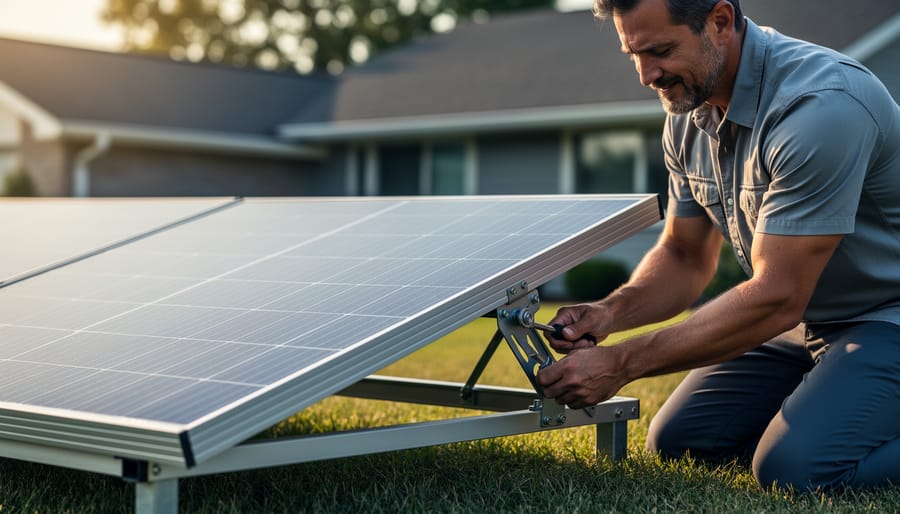
For DIY installations, this simplicity is a game-changer. Since you’re working with AC electricity after each panel, the safety concerns drop significantly compared to handling high-voltage DC strings. The plug-and-play nature means you can literally install panels one at a time, testing as you go, rather than needing the entire array completed before anything works.
Another huge benefit: shading problems virtually disappear. When one panel gets shaded with microinverters, only that panel’s output drops. The rest of your array keeps humming along at full capacity. With traditional string inverters, one shaded panel can drag down your entire system’s performance.
The monitoring capabilities are pretty fantastic too. Most microinverter systems let you check each panel’s performance individually through a smartphone app, making troubleshooting incredibly easy.
Microinverters attach directly to individual solar panels, converting DC to AC power right at the source.
Power Optimizers: The Middle Ground
If microinverters feel like too much of a leap but you’re dealing with shading issues or a complex roof, power optimizers might be your sweet spot. Think of them as a hybrid approach that gives you some of the benefits of module-level control without completely ditching the traditional central inverter setup.
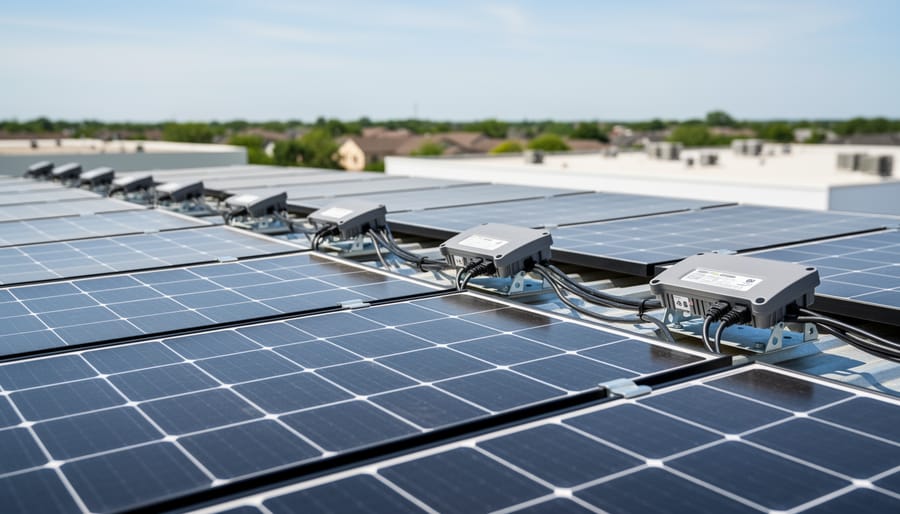
Here’s how they work: each solar panel gets its own power optimizer attached to the back. These little boxes do the maximum power point tracking at the panel level, just like microinverters, but instead of converting DC to AC right there, they condition and optimize the DC power before sending it down to a single string inverter. So you’re still using one main inverter (which keeps costs down), but each panel operates independently to squeeze out its maximum potential.
I remember Charles telling me about a neighbor who installed power optimizers on a roof with a chimney creating partial shade. Before the optimizers, those shaded panels would drag down the performance of the entire string. Afterward, the unshaded panels kept producing at full capacity while the shaded ones did their best without affecting the others. The difference in daily production was honestly impressive.
The cost consideration is important here. Power optimizers typically fall somewhere between basic string inverters and full microinverter systems. You’re paying for the optimizers themselves plus a compatible string inverter, which is usually more expensive than a standard inverter but cheaper than buying microinverters for every panel.
They’re particularly smart for installations where you have some shading issues but not severe ones, or if you want panel-level monitoring without the full microinverter price tag. You also get similar safety benefits since optimizers can reduce DC voltage during emergencies.
The tradeoff? You still have that single inverter as a potential point of failure, though many manufacturers offer solid warranties. And installation is slightly more complex than a basic string system, though simpler than microinverters since you’re only running DC wiring to one central location.
Real-World Scenarios Where MLPEs Make Sense for DIYers
Your Roof Has Shade (And You Can’t Cut Down That Tree)
Let me tell you about Charles’s neighbor situation – because it’s probably yours too. He’s got this gorgeous old oak tree that shades his roof every afternoon. The tree predates the house, provides amazing summer cooling, and honestly? His family would riot if he even suggested removing it.
This is where module-level power electronics become absolute heroes. Traditional string inverter systems treat your entire solar array like a chain – when one panel gets shaded, it drags down the performance of all the others in that string. It’s like having one slow runner anchor an entire relay team.
Microinverters and power optimizers solve this beautifully. Each panel operates independently, so the shaded modules underperform without affecting their sunny neighbors. Charles saw this firsthand when he upgraded his partially-shaded system – his energy production jumped nearly 35% just by letting each panel do its own thing.
Got a chimney casting shadows? Neighbor’s two-story addition blocking morning sun? No problem. Module-level electronics turn what used to be deal-breakers into minor inconveniences. You’re essentially future-proofing your system against shade patterns that might change as trees grow or new construction happens nearby. The technology adapts to your real-world roofline, not some ideal laboratory condition.
When Your Panels Face Different Directions
Not every home has a simple, single-roof setup that faces perfectly south. When I first started working with solar, I assumed complex roof layouts meant compromising on efficiency. But here’s where module-level power electronics really shine.
If you’ve got panels facing east on one section of your roof and west on another, or if dormers and architectural features mean some panels catch morning sun while others get afternoon light, traditional string inverters create a problem. They force all your panels to operate at the performance level of the worst-performing group. It’s like asking a marathon runner to slow down because they’re tied to someone walking.
MLPEs eliminate this constraint completely. Each panel operates independently, so your east-facing panels can harvest morning sunlight at full capacity while your west-facing panels wait for their afternoon glory without holding each other back. This independence makes MLPEs particularly valuable for homes with complex rooflines.
I’ve installed systems on Victorian homes with five different roof planes, and the performance difference compared to string inverters was remarkable. The array design considerations become simpler too, since you’re not limited to grouping panels by orientation. You can place panels wherever they physically fit and still maintain optimal performance across your entire system.
Module-level power electronics excel in installations where panels must face different directions due to roof architecture.
Building Your Array Over Time
One of the biggest advantages of module-level power electronics is the flexibility they give you to grow your solar setup at your own pace. Unlike traditional string inverter systems that work best when fully installed, MLPE systems let you start with just a few panels and add more whenever your budget allows.
I remember Charles telling me about a neighbor who started with just four panels on their garage roof. Because they used microinverters, each panel worked independently right from day one, producing usable AC power for their home. Six months later, they added six more panels to their main roof without any system reconfiguration or equipment upgrades. The new panels simply plugged into the existing monitoring system, and everything worked seamlessly together.
This modular approach is particularly valuable for DIYers who want to test the waters before committing to a full-scale installation. You can start small, learn the ropes of wiring your panels, and gain confidence in your skills while still generating real savings on your electric bill. Each panel operates at peak efficiency regardless of how many others are in your array, so there’s no performance penalty for starting small and building gradually over time.
The Hidden Benefits Charles Wishes He’d Known Earlier
Panel-Level Monitoring Changes Everything
Here’s something I learned the hard way during my first solar installation: one underperforming panel can drag down your entire system’s output, and you might not even know it’s happening. That’s where module-level power electronics really shine.
With traditional string inverters, you get one number telling you your total production. But with panel-level monitoring, you can see exactly what each individual module is producing in real-time. When I upgraded to microinverters, I discovered that one panel was producing 40% less than its neighbors due to a manufacturing defect I never would have caught otherwise.
The beauty of this technology is instant problem detection. Did a bird decide your panel makes a great perch? You’ll see the production dip immediately. Is morning shade hitting panel three longer than you expected? The data shows you exactly which modules need attention.
Our interactive solar calculator on the site lets you model how different monitoring solutions might benefit your specific setup. You can input your roof layout and see potential optimization gains. Many users find that identifying even one consistently underperforming panel pays for the monitoring system within a couple of years through increased production.
Panel-level monitoring provides real-time performance data for each solar module, making troubleshooting and optimization simple.
Safer Installations for the DIY Solar Builder
One of the biggest advantages of module-level power electronics is the peace of mind they bring to DIY installations. I remember when I first started tinkering with solar, Charles shared a story about his early days working with high-voltage DC strings. “The voltage could climb to 600 volts or more,” he told me, “and that made troubleshooting nerve-wracking, even for professionals.” With microinverters and power optimizers, that concern largely disappears.
Microinverters convert DC to AC right at each panel, meaning you’re only dealing with standard household voltage in your wiring. This dramatically reduces shock hazards during installation and maintenance. Power optimizers, while still using DC, typically include rapid shutdown features that automatically reduce voltage to safe levels within seconds when the system is turned off or in an emergency.
This rapid shutdown capability isn’t just a nice feature, it’s actually required by modern electrical codes in many areas. Module-level systems make compliance straightforward for DIYers. If firefighters need to access your roof during an emergency, these systems can drop voltage to under 80 volts almost instantly, protecting both first responders and your family.
For anyone planning a DIY installation, these safety features mean you can work confidently without the specialized training required for high-voltage DC systems. It’s empowering to know the technology itself has your back.
What to Watch Out For (The Honest Drawbacks)
Let me be upfront with you—module-level power electronics aren’t perfect, and pretending they are would do you a disservice. I learned this the hard way during my first MLPE installation when I dramatically underestimated both the complexity and the costs involved.
First, let’s talk money. MLPEs will significantly increase your upfront investment, typically adding 15-30% to your total system cost compared to a traditional string inverter setup. When I priced out my neighbor’s 5kW system last year, adding microinverters bumped the cost from around $8,500 to nearly $11,000. For many DIYers working with tight budgets, that’s a tough pill to swallow, even with the performance benefits.
Then there’s the failure point question. Here’s something that sounds counterintuitive: while MLPEs can prevent one faulty panel from dragging down your whole system, you’re also installing 20-30 individual electronic devices instead of one central inverter. More components theoretically means more potential failure points. I’ve had exactly two microinverters fail in my arrays over the past four years—not catastrophic, but replacing them meant working on the roof rather than simply swapping a wall-mounted inverter.
Compatibility can also trip you up if you’re not careful. Not all microinverters work with every panel type, and power optimizer systems require specific inverters from the same manufacturer. I once purchased a fantastic deal on optimizers only to discover they weren’t compatible with my existing inverter brand. That was an expensive lesson in reading spec sheets thoroughly.
The installation complexity deserves mention too. While not impossible for DIYers, working with MLPEs requires more roof time, more electrical connections, and stricter attention to waterproofing details. Each additional connection point is another opportunity for water intrusion if not properly sealed.
Finally, monitoring systems sometimes require ongoing subscription fees or premium features locked behind paywalls, which can add unexpected recurring costs to your investment.
Choosing the Right Module-Level Solution for Your Project
When I helped my neighbor decide between microinverters and optimizers last summer, I realized most DIYers get stuck on the same questions. Let me share a framework that actually works in real life, not just on paper.
Start by asking yourself three fundamental questions. First, do you have shading issues? Even a chimney shadow for part of the day makes module-level solutions worth considering. Second, what’s your roof situation? Multiple orientations or split arrays benefit enormously from independent panel management. Third, are you planning to expand your system later? Module-level equipment makes adding panels much simpler down the road.
Now let’s talk money honestly. Traditional string inverters might cost you $1,000-1,500 for a typical residential system, while microinverters add roughly $0.40-0.60 per watt to your total project cost. Power optimizers fall somewhere in between. Before you panic at the numbers, remember you’re comparing upfront costs against long-term energy production and system flexibility.
Here’s a practical comparison approach. Calculate your current shading losses if any exist. Even 10 percent shading on a string system can reduce total output by 40-50 percent. With module-level solutions, that same shading only affects the covered panels. The math often favors spending more initially to capture significantly more energy over 25 years.
I recommend using a simple spreadsheet with three columns: equipment cost, estimated annual production increase, and payback period. Most module-level solutions pay for themselves within 5-8 years if you have any shading or complex roof geometry. For perfectly unshaded, south-facing roofs, string inverters still make perfect sense.
Don’t forget installation complexity. Microinverters require more AC wiring but eliminate heavy equipment mounting. Optimizers need DC wiring plus a central inverter location. Consider whether you’re comfortable with each approach before committing.
Finally, think about monitoring. optimizing panel performance becomes much easier when you can see individual panel output. That visibility alone has helped dozens of people in our community catch issues early and maintain peak efficiency. The choice isn’t just about equipment, it’s about understanding your specific situation and priorities.
When I first started exploring module-level power electronics, I’ll be honest—I felt overwhelmed by all the choices and technical considerations. But here’s what I learned through trial and error: there’s no one-size-fits-all answer. Your roof conditions, shading patterns, budget, and energy goals all play important roles in determining whether MLPEs make sense for your project.
If you’ve made it this far, you already have a solid foundation to make an informed decision. Maybe traditional string inverters are the perfect fit for your sunny, unshaded roof. Or perhaps microinverters will unlock the potential of that tree-shaded section you thought was unusable. Power optimizers might be your sweet spot, balancing performance gains with cost considerations.
The beauty of the solar community is that you don’t have to figure this out alone. I encourage you to explore our site’s interactive calculators to estimate your specific savings and payback periods based on your unique situation. We’ve also put together step-by-step tutorials that walk you through everything from initial system design to installation tips I wish someone had shared with me years ago.
Got questions or want to share your own MLPE experiences? Drop a comment below or join our community forum. Your insights might be exactly what another DIY solar enthusiast needs to hear. Together, we’re building a future powered by clean, optimized energy—one solar module at a time.
How useful was this post?
Click on a star to rate it!
Average rating 0 / 5. Vote count: 0
No votes so far! Be the first to rate this post.
We are sorry that this post was not useful for you!
Let us improve this post!
Tell us how we can improve this post?
charlesnoble
Here at Spheral Solar, I’m a hands-on solar power enthusiast, constantly exploring and experimenting with DIY solutions. I’m dedicated to sharing my discoveries, insights, and even the bumps I hit along the way, all in the pursuit of a more sustainable future.
Why Your Solar Panels Are Losing Power (And How to… by Charlesnoble May 13, 2026 Picture this: You’ve just invested in solar panels, excited about clean energy and lower bills, only to watch your power output plummet because a neighbor’s tree casts shadows across your array every afternoon. I learned this lesson the hard way during my first installation—what seemed like minimal shade reduced my…
Why Your Bifacial Solar Panels Need a Completely… by Charlesnoble March 22, 2026 Flip your bifacial solar panels over and you’ll find a second active surface that can boost your system’s energy production by 10-30% – but only if you design your array to take advantage of it. Unlike traditional panels that capture sunlight from one side, bifacial modules harvest energy from both…
The Right Tilt Angle Can Boost Your Solar Panel… by Charlesnoble April 10, 2026 Position your solar panels at an angle equal to your latitude for year-round performance, or adjust seasonally by adding 15 degrees in winter and subtracting 15 degrees in summer to capture maximum sunlight during each season’s sun path. Use a simple angle finder app on your smartphone against the back…
4 Best Solar Deck Lights of 2026, Tested and Reviewed by Charlesnoble August 8, 2026 After testing solar deck lights across multiple months of evening use, we found the VOLISUN Solar Deck Lights 16 Pack deliver the best combination of brightness, runtime, and installation simplicity for most outdoor spaces. These lights outperformed competitors in our real-world testing, staying reliably bright through the night and requiring…
How Orlando Airport’s Solar EV Charging Could… by Charlesnoble April 30, 2026 Picture this: You’ve just landed at Orlando International Airport after a long flight, your electric vehicle waiting in long-term parking with a battery that’s somehow fuller than when you left it. Sound like science fiction? It’s happening right now at MCO, where solar-powered EV charging stations are transforming how travelers…
Subscribe for handpicked DIY projects, exclusive tips, and giveaways.
After testing dozens of solar chargers across camping trips, power outages, and backyard experiments, we found the X-Dragon 20W delivers the most reliable charging performance for phones and tablets, while the Goal Zero Nomad 50W steps up when you need to power larger devices or handle extended emergencies. If you’re planning weekend hikes, assembling an… Read more: 7 Best Solar Powered USB Chargers of 2026, Tested and Reviewed
There is something special about a mature tree. Decades of growth, shade that actually cools the house, branches that the kids climbed, a root system that has quietly held the yard together through every storm. So when circumstances force a move, whether it is a home renovation, a new driveway, or a construction project that… Read more: How to Move a Mature Tree Without Killing It: The Complete Relocation Guide
A mass energy conversion calculator lets you determine how much energy is locked inside any amount of matter using Einstein’s famous equation E=mc². Whether you’re working on a physics assignment or simply curious about the enormous energy potential in everyday objects, the calculation itself takes just seconds once you understand the formula’s three components: energy… Read more: How to Use a Mass Energy Conversion Calculator (Step-by-Step Guide)