Wire Your First Solar Panel Without Frying Everything (Or Yourself)
Updated:
Grab a multimeter and test your first solar panel connection right now—even if you’ve never touched electrical wiring before. Solar wiring isn’t the mysterious, dangerous territory most beginners imagine. It’s actually more forgiving than household AC wiring because you’re working with low-voltage DC power, typically 12 to 48 volts, which gives you room to learn without the same risks.
I’ll be honest with you: my first solar project was a mess. I connected a small panel directly to a battery without a charge controller, overcharged it within hours, and learned a $60 lesson about why components matter. That failure taught me more than any manual ever could, and it’s exactly why I’m walking you through this process—so you can skip the expensive mistakes I made.
The beauty of solar DIY is that you can start ridiculously small. A simple phone charger powered by a 10-watt panel costs less than $30 in components and takes about 20 minutes to wire together. Once you understand how electrons flow from panel to controller to battery to load, you’ve mastered the fundamental pattern that scales up to whole-home systems.
This guide breaks down solar wiring into actual projects you can complete this weekend, starting with beginner-friendly builds that require nothing more than basic wire strippers and a screwdriver. We’ll tackle the three most common wiring mistakes that cause 90% of DIY solar failures, decode those confusing wiring diagrams into plain English, and build your confidence one connection at a time. Whether you’re wiring a camping setup or taking your first step toward energy independence, you’re about to discover that solar power is accessible to anyone willing to twist a few wires together.
Why Solar Wiring Scares People (And Why It Shouldn’t)
I’ll be honest with you—when I first considered working with solar wiring, I had visions of accidentally electrocuting myself or burning down my garage. If you’re feeling that same nervous flutter in your stomach, you’re not alone. But here’s what I wish someone had told me on day one: most DIY solar projects operate at voltages far lower than what’s running through your home’s walls right now.
Let’s tackle the big scary misconception first. When most people think “electrical wiring,” they’re imagining the 120-volt or 240-volt AC power coursing through their household outlets—the stuff that absolutely demands respect and licensed expertise. But the majority of beginner-friendly solar projects run on low-voltage DC systems, typically 12 to 24 volts. That’s the same voltage range as your car battery or doorbell transformer. Could you still get a mild shock? Theoretically, yes. Is it dangerous like household current? Not even close.
The fire hazard concern is equally overblown, provided you follow basic safety protocols. The real risk isn’t from solar energy itself—it’s from the same issues that plague any electrical project: undersized wires, loose connections, and skipping fuses or breakers. When you use properly rated components and make secure connections, you’ve eliminated 95 percent of the risk right there.
As for complexity, I remember staring at my first solar panel like it was alien technology. The truth? Solar wiring follows simple, logical principles. Power flows from panels to a charge controller, then to batteries, and finally to your devices. It’s essentially a one-way street with a few traffic signals along the route.
The difference between someone who successfully completes solar projects and someone who stays intimidated isn’t talent or some engineering degree—it’s simply taking that first step with the right information. You’ve already got the hardest part covered by seeking out knowledge before diving in.
Essential solar wiring components including cables, connectors, and protection devices form the foundation of any DIY solar project.
The Essential Wiring Components You Actually Need
Cables and Wire Gauge Demystified
Wire gauge is basically the thickness of your wire, and it matters more than you might think. Think of it like a water pipe – a skinny pipe restricts flow, while a thicker one lets everything move freely. In solar systems, undersized wires create resistance, waste energy as heat, and can even become fire hazards.
The gauge number works backwards – smaller numbers mean thicker wires. So 10 AWG is thicker than 14 AWG. I learned this the hard way when Charles first showed me his workshop setup. He had a small 100W panel connected with wire that was way too thin, and we could actually feel it getting warm. Not good.
For copper versus aluminum, stick with copper for DIY projects. It’s more conductive, easier to work with, and safer overall. Aluminum is cheaper but requires special connectors and larger gauges to carry the same current.
Here’s a practical breakdown: For a single 100W panel producing around 6 amps at 12 volts over a short run (under 10 feet), 14 AWG works fine. But step up to a 400W array pushing 25 amps, and you’ll need 10 AWG minimum, especially if running 20-30 feet to your charge controller.
The calculation considers three factors: current (amps), distance, and acceptable voltage drop (typically 3 percent or less). Online wire gauge calculators make this simple – just plug in your numbers. Charles always says measure your actual distance first, then round up to the next wire size. Better oversized than undersized every time.
Connectors That Won’t Let You Down
When I first started my solar journey, I’ll admit I underestimated connectors. I thought, “They’re just plastic pieces that click together, right?” Wrong. Good connectors are what keep your system humming for decades, while poor connections lead to voltage drops, overheating, and complete system failures.
MC4 connectors are the industry standard, and for good reason. These waterproof connectors lock together with a satisfying click and won’t come apart unless you use the proper removal tool. You’ll encounter two main options: crimp-style and plug-and-play. Crimp connectors require a special crimping tool but create the most reliable connection. I prefer them for permanent installations. Plug-and-play versions are easier for beginners and work fine for temporary setups or if you plan to reconfigure your system frequently.
Here’s where people go wrong: skipping the waterproofing step. Even with MC4 connectors, moisture can creep in if you don’t properly seat the cable. Always give that outer ring a good twist to compress the seal. Another mistake? Mixing connector brands. Stick with one manufacturer since tolerances vary, and mismatched connectors can leak or create resistance.
Pro tip: before crimping, do a test fit. Once that metal sleeve is crimped, there’s no going back. Trust me on this one.
Proper connector crimping technique ensures reliable connections that won’t fail in outdoor conditions.
Protection Devices That Keep Everything Safe
Think of protection devices as the safety net for your entire solar setup—they’re not optional extras, they’re absolute essentials. I learned this the hard way when a friend skipped fuses on his first project and ended up with melted wires. Not fun.
Let’s break down your options. Fuses are simple, inexpensive devices that blow when too much current flows through them. They’re one-time use, so you’ll need to replace them after they trip. Circuit breakers, on the other hand, can be reset after they trip, making them more convenient for systems you access regularly. Inline fuses are compact versions you can place directly in wire runs, perfect for smaller components.
Here’s where you need them: Always place a fuse or breaker between your solar panels and charge controller, and another between your battery and any loads. This protects against shorts and overloads in both directions.
For sizing, use this simple rule: your fuse should be rated about 25% higher than your maximum expected current. So if your panels produce 10 amps, use a 12-15 amp fuse. For batteries, check your battery manufacturer’s recommendations, but generally you’ll want a fuse rated slightly above your maximum draw.
My go-to recommendation? Start with automotive-style blade fuses for smaller projects—they’re cheap, widely available, and easy to replace.
Three Beginner-Friendly Solar Wiring Projects
Project 1: Basic Solar Panel to Battery Connection
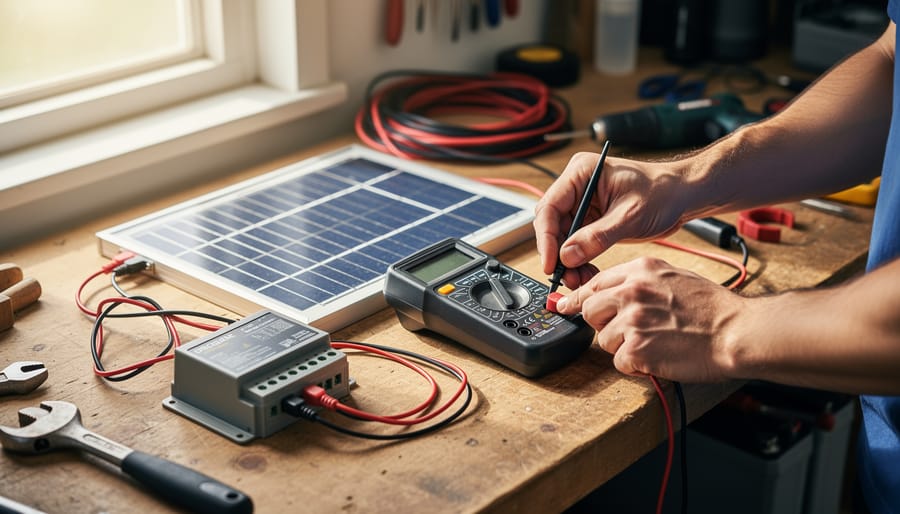
Let me walk you through the absolute easiest way to get started with solar power. This is the setup I built for my first camping trip with solar, and it worked like a charm. You’ll have a simple system that can charge your phone, run a small fan, or power LED lights – perfect for understanding the basics before tackling bigger projects.
Here’s what you’ll need for your shopping list: one 100-watt solar panel (around $100-150), a 12V PWM charge controller rated for at least 10 amps ($20-30), one 12V deep cycle battery with at least 35Ah capacity ($80-150), and basic MC4 solar cables with adapters (usually $15-25). Don’t forget battery terminal connectors and some 10-gauge wire if your charge controller doesn’t include them.
Now for the fun part – connecting solar panels to batteries is actually straightforward once you see it done. Start by positioning your charge controller near the battery but never directly on top of it. First, connect your battery to the charge controller’s battery terminals – positive to positive, negative to negative. This step must come first to let the controller calibrate. Next, connect your solar panel’s cables to the solar input terminals on the controller, again matching positive to positive and negative to negative.
That’s genuinely it. When sunlight hits your panel, you should see an indicator light on your charge controller showing it’s working. The controller automatically prevents overcharging and protects your battery.
For a simple wiring diagram, picture this: Panel connects to Controller’s solar terminals, then Controller’s battery terminals connect to Battery. Everything flows through that charge controller, which acts as the brain of your system.
Start small, learn the basics, and you’ll be amazed at what you can power.
A simple single-panel solar setup demonstrates how accessible DIY solar wiring can be for beginners.
Project 2: Parallel Panel Array for Your RV or Shed
Ready to power something bigger than a single light? Connecting multiple solar panels in parallel is your ticket to running an entire RV electrical system or keeping your backyard shed fully operational. The beauty of parallel wiring is that it increases your available current (amps) while maintaining the same voltage, giving you more power to work with.
Here’s how it works: you’ll connect all the positive wires from your panels together and all the negative wires together. Think of it like adding more lanes to a highway – more current can flow to your batteries or charge controller at once.
The key component you’ll need is a combiner box, which safely houses all your panel connections in one weatherproof location. These boxes include fuses or breakers for each panel string, protecting your system from electrical faults. You can find detailed combiner box wiring diagrams that show exactly how to make these connections safely.
Charles learned a crucial lesson during his first RV installation: never mix panels with different specifications. “I thought I could combine my old 100-watt panel with two new 150-watt ones,” he recalls. “The system worked, but the mismatched panels meant I was only getting about 70% of the potential output. Stick with identical panels whenever possible.”
Proper grounding is absolutely essential in a multi-panel setup. Run a copper grounding wire from your combiner box to a proper ground rod, creating a safe path for any electrical surges. This isn’t optional – it protects both your equipment and anyone working on the system. With panels properly matched and grounded, you’ll have a reliable, expandable solar array that can grow with your power needs.
Project 3: Complete Off-Grid System with Inverter
Ready to take things up a notch? This project combines everything you’ve learned into a functional off-grid system that can power real AC devices. I remember my first complete system—it felt like magic watching my laptop charge from pure sunshine!
This setup includes solar panels, a charge controller, a battery bank, and an inverter to convert DC power into usable AC electricity. Before we dive in, let me be crystal clear: inverters deal with significant power, and respect for safety protocols isn’t optional.
Start by securing your charge controller and inverter to a mounting board in a well-ventilated area. Never install an inverter in an enclosed space without proper airflow—these devices generate heat and need breathing room. Connect your solar panels to the charge controller first, following the manufacturer’s wiring diagram exactly. Then wire your battery bank to the charge controller’s battery terminals, double-checking polarity before making any connections.
Here’s where things get serious. When connecting your inverter to the battery bank, use appropriately sized cables and install a fuse or circuit breaker within 18 inches of the battery. This is your safety lifeline. Study proper inverter wiring techniques before touching any wires. A complete electrical system setup requires methodical planning and careful execution.
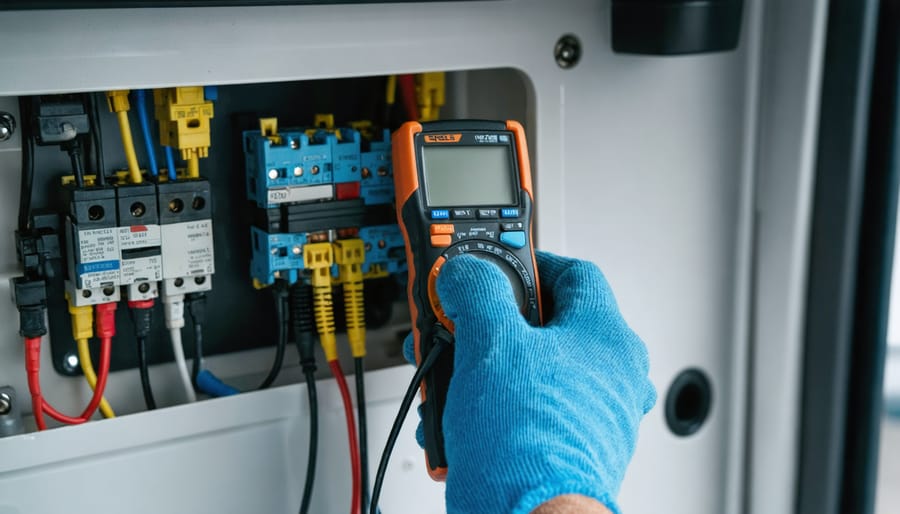
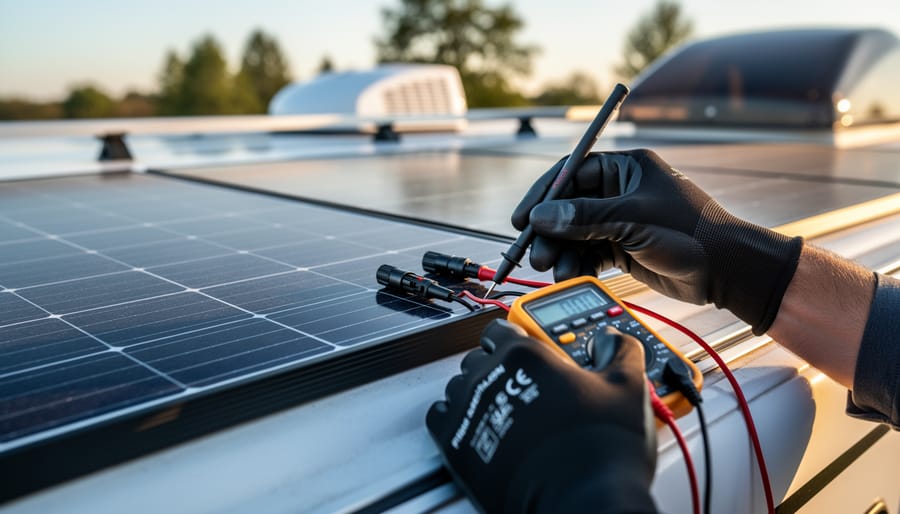
Organize your wiring with cable ties and label everything. Trust me, future you will appreciate knowing which wire does what! Test each connection with a multimeter before powering up the system, and never work on live circuits.
Once energized, start small—maybe power a lamp or phone charger—before connecting larger loads. This gradual approach helps you understand your system’s capabilities while maintaining safe operating conditions.
The Safety Rules That Actually Matter
Let me be honest with you: most generic safety advice sounds scary but isn’t specific enough to actually help. When I first started with solar projects, I read “be careful with electricity” a dozen times without understanding what that really meant for solar systems specifically. So let’s talk about the hazards that matter most.
First, short circuits in solar systems are uniquely dangerous because the sun doesn’t stop producing power when something goes wrong. Unlike household circuits with breakers, a short-circuited solar panel keeps pushing current until something melts or catches fire. Always use properly rated fuses or circuit breakers on both the positive and negative sides of your system. I learned this the hard way when a loose wire touched my charge controller’s case and welded itself there before I could react.
Battery safety deserves serious attention because batteries store massive amounts of energy that can discharge instantly. A dropped wrench across battery terminals creates an arc welder effect—I’ve seen metal tools literally melt. Always remove jewelry before working near batteries, use insulated tools, and work one-handed when possible to avoid creating a path through your body. Keep baking soda nearby for lead-acid batteries; it neutralizes acid spills instantly.
Here’s your proper disconnection sequence: always disconnect from the battery first, then the panels. When reconnecting, reverse it—panels first, battery last. This prevents voltage spikes and protects your charge controller.
For personal gear, invest in safety glasses rated for electrical work, insulated gloves for battery connections, and a multimeter you trust completely. Keep a fire extinguisher rated for electrical fires within arm’s reach.
If something goes wrong, don’t be a hero. If you smell burning plastic or see smoke, disconnect everything starting with the battery. Cover solar panels with a blanket if you can’t physically disconnect them—blocking light stops power production. Remember, you can replace equipment, but not yourself.
Common Wiring Mistakes (And How to Fix Them)
I’ll be honest with you—I’ve made most of these mistakes myself, and I’ve heard countless similar stories from our community members. The good news? Every single one is fixable, and learning from them makes you a better solar DIYer.
The most common mistake I see (and made during my second project) is using undersized wires. Charles, a regular contributor to our forum, shared how his first camping setup kept shutting down mysteriously. Turns out, he’d used 18-gauge wire for a 20-foot run from panel to controller. The voltage drop was killing his system’s efficiency. The fix? He upgraded to 10-gauge wire, and suddenly everything worked perfectly. As a rule of thumb, longer distances and higher currents need thicker wires. Use a wire gauge calculator before purchasing—it’ll save you headaches and money.
Reversed polarity is another classic. You’d think positive-to-positive and negative-to-negative would be foolproof, but when you’re working with multiple components, it’s surprisingly easy to cross wires. I once connected my charge controller backwards and, thankfully, the built-in protection kicked in. Not all components are so forgiving. Always double-check with a multimeter before powering up, and label your wires clearly with colored tape or markers.
Loose connections drive me crazy because they’re so preventable. Heat, vibration, and weather all conspire to loosen terminals over time. One community member, Sarah, couldn’t figure out why her system worked intermittently until she discovered a loose ring terminal at her battery connection. Give every connection a firm tug during installation, and revisit them quarterly for maintenance.
Finally, mixing incompatible components—like a 24-volt panel with a 12-volt controller—causes confusion and potential damage. Always verify voltage and amperage ratings match across your entire system. When in doubt, consult the manufacturer’s specs or ask the community before connecting anything permanently.
Tools and Resources to Make Wiring Easier
When I first started wiring solar projects, I quickly learned that having the right tools makes all the difference between a frustrating afternoon and an empowering success. You don’t need to break the bank, but investing in a few key items will save you time, prevent mistakes, and keep your projects safe.
Let’s start with the essentials. A quality wire stripper is absolutely critical. For budget-conscious builders, the IRWIN VISE-GRIP stripper works great at around fifteen dollars. If you’re planning multiple projects, the Klein Tools automatic stripper is worth the upgrade. You’ll also need a crimping tool for making solid connections. The Wirefy crimper is a solid mid-range option that handles most solar connectors beautifully.
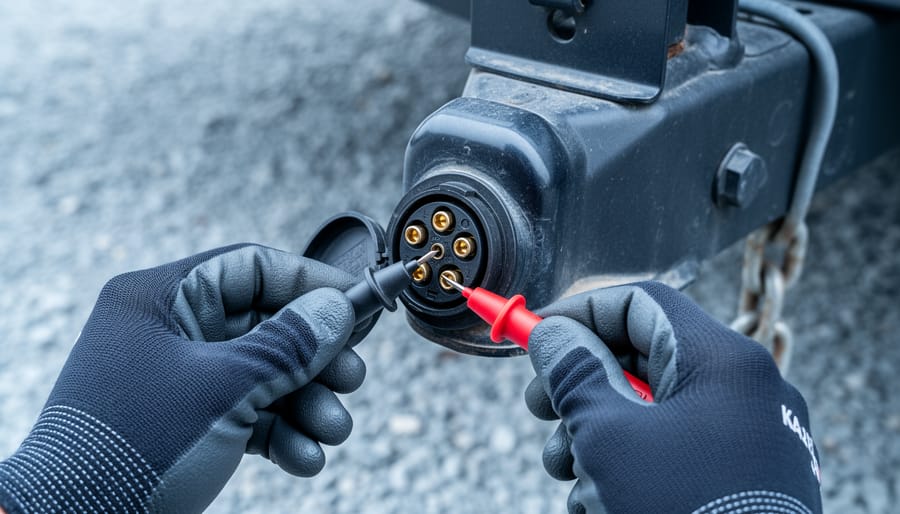
A multimeter is your best friend for troubleshooting and verifying connections. I can’t count how many times mine has saved me from head-scratching moments. The AstroAI digital multimeter offers excellent value for beginners, while the Fluke 115 is the gold standard if you’re committed to ongoing solar work.
For working with quality portable solar panels and permanent installations alike, grab a good set of MC4 connectors and a specialized MC4 crimping tool. These weatherproof connectors are industry standard and essential for outdoor solar applications.
Here’s something that changed my approach completely: online calculators. Spheral Solar offers free wire sizing calculators and system design tools that take the guesswork out of determining proper wire gauge for your voltage and distance requirements. These calculators have prevented countless errors in my projects and give you professional-level planning without the learning curve.
Don’t forget heat shrink tubing, electrical tape, cable ties, and a headlamp for those inevitable times when you’re working in tight spaces. With these tools ready, you’re equipped to tackle real solar wiring with confidence.
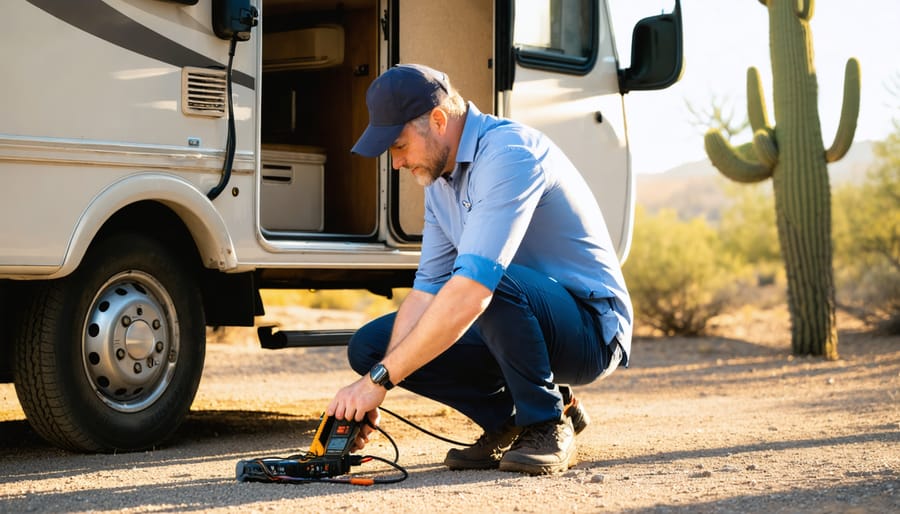
A multimeter is essential for testing connections and troubleshooting solar wiring issues safely.
You’ve made it this far, and that means you’re ready to start your solar wiring journey. Here’s the truth: every solar expert you admire started exactly where you are right now, staring at components and wondering if they could really pull this off. The answer is yes, you absolutely can.
I remember my first solar project—a simple USB charger that took me three attempts to get right. My hands were shaky, I double-checked every connection about five times, and I was convinced I’d somehow blow something up. But when that little LED finally lit up, confirming my panel was charging the battery, I felt like I’d conquered the world. That tiny victory gave me the confidence to tackle bigger projects, and now wiring solar systems feels as natural as making morning coffee.
The beautiful thing about solar wiring is that it’s genuinely a learnable skill. You don’t need an engineering degree or years of experience. You just need patience, respect for the fundamentals, and willingness to start small. Wire that garden light first. Get comfortable with connections. Build your confidence one project at a time.
We’d love to hear about your solar adventures at Spheral Solar. Share your first successful connection, your creative problem-solving moments, or even your mistakes—because that’s how we all learn together. Our community thrives on real experiences from real people just like you.
So grab those wire strippers, pick your starter project, and take that first step. The endless possibilities of solar power are waiting for you.
How useful was this post?
Click on a star to rate it!
Average rating 0 / 5. Vote count: 0
No votes so far! Be the first to rate this post.
We are sorry that this post was not useful for you!
Let us improve this post!
Tell us how we can improve this post?
charlesnoble
Here at Spheral Solar, I’m a hands-on solar power enthusiast, constantly exploring and experimenting with DIY solutions. I’m dedicated to sharing my discoveries, insights, and even the bumps I hit along the way, all in the pursuit of a more sustainable future.
Why Your RV Appliances Keep Tripping the Breaker… by Charlesnoble November 17, 2025 Turn off shore power and disconnect your battery bank before touching any wire in your RV—this single step prevents the most common DIY electrical accidents. Check your circuit breaker panel ratings against your actual appliance loads, because that microwave drawing 1500 watts on a 15-amp circuit is exactly why you’re…
Why Your RV Solar Panels Aren’t Charging (And How to… by Charlesnoble November 30, 2025 Check your multimeter readings at each connection point along your solar charging path—from panels to charge controller to battery—to pinpoint exactly where voltage disappears. Most RV solar systems lose 10-30% of their potential power to voltage drop, but this invisible thief often goes undetected until you systematically measure and compare…
Why Your Motorhome Electrical System Keeps Failing… by Charlesnoble November 18, 2025 Picture this: You’re three days into a dream cross-country trip when your lights flicker, the refrigerator stops cooling, and you’re left wondering whether to call for expensive roadside assistance or figure it out yourself. I’ve been there, and here’s what I wish someone had told me before my first electrical…
Wire Your RV Tow Vehicle the Right Way (7-Pin… by Charlesnoble May 14, 2026 Identify the seven wires in your RV connector by their standard color codes: brown carries running lights, yellow handles left turn signal and brake, green manages right turn signal and brake, white serves as ground, blue powers electric brakes, black provides 12V battery charge, and red or purple connects auxiliary…
Why Your RV Battery Dies Overnight (And How a 55 Amp… by Charlesnoble December 5, 2025 Your RV’s lights are flickering, the refrigerator isn’t keeping food cold, and your phone charger barely works. Sound familiar? That frustrating power struggle often points to an undersized or failing power converter, and upgrading to a 55 amp RV power converter might be exactly what you need. Here’s what’s happening:…
Why 48V is the Sweet Spot for Your RV Solar System by Charlesnoble May 20, 2026 Calculate your actual power consumption before jumping to 48V—most RVers overestimate their needs and waste money on unnecessary voltage conversions. Pull out your last month of camping data and add up the watt-hours your appliances actually use daily, not what you think you might need someday. If you’re consistently pulling…
Subscribe for handpicked DIY projects, exclusive tips, and giveaways.
Nine times out of ten, an RV generator that won’t start has a stale fuel problem. If your generator hasn’t run in more than 30 days, degraded gasoline is likely gumming up the carburetor and preventing ignition. Before you panic or call for expensive roadside service, try this: turn on the generator’s fuel valve (if… Read more: RV Generator Troubleshooting: Common Problems and How to Fix Them
A 5kW solar system occupies between 250 and 350 square feet of roof or ground space and produces roughly 20 to 25 kilowatt-hours of electricity per day in most U.S. locations. That’s enough to power a typical three-bedroom home with moderate energy use, though your exact needs depend on your daily consumption patterns, climate zone,… Read more: How to Size a 5kW Solar System for Your Home or RV
Installing a home solar system yourself takes 2-4 weekends for an average 5kW setup, requires solid electrical knowledge and comfort working at heights, and can save you $5,000-$8,000 in labor costs if you tackle everything except the final utility interconnection. The process breaks down into five main phases: permitting and design, mounting the racking system,… Read more: Solar Power Installation Step by Step: Complete DIY Guide From Start to Finish