Why 48V is the Sweet Spot for Your RV Solar System
Updated:
Calculate your actual power consumption before jumping to 48V—most RVers overestimate their needs and waste money on unnecessary voltage conversions. Pull out your last month of camping data and add up the watt-hours your appliances actually use daily, not what you think you might need someday. If you’re consistently pulling less than 3000 watt-hours per day, a well-designed 12V system will serve you better and save thousands in component costs.
Assess whether you truly need the efficiency gains that 48V provides. The sweet spot for 48V systems starts around 4000+ watts of solar panels and 400+ amp-hours of lithium batteries—anything smaller means you’re paying premium prices for marginal benefits. I learned this the hard way after my first attempt at upgrading, where the conversion losses actually made my mid-sized system less efficient than staying with 12V.
Understand that 48V creates a parallel electrical universe in your RV. Your existing 12V fridge, water pump, furnace, and lights won’t run on 48V without DC-to-DC converters, which add cost, complexity, and new failure points. You’ll essentially maintain two complete electrical systems unless you’re willing to replace nearly every appliance—a reality that catches most people off-guard during planning.
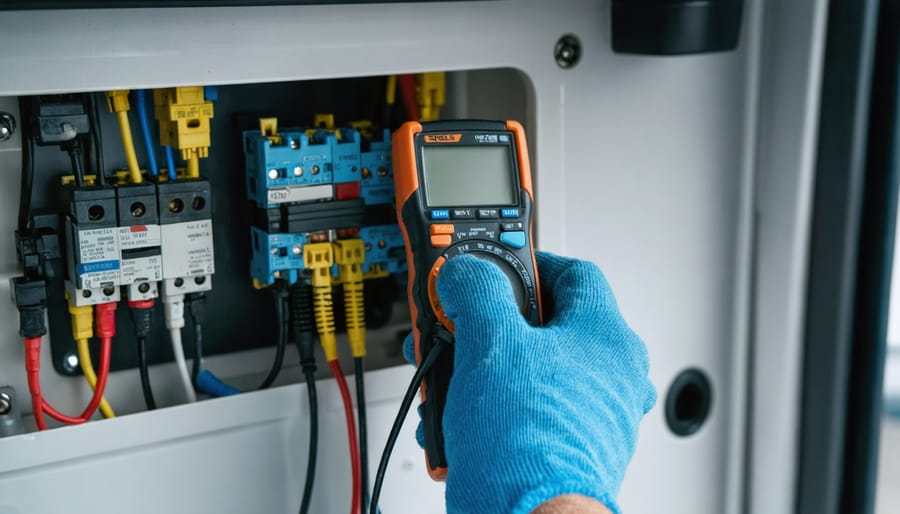
Commit to learning basic electrical troubleshooting before installation. Unlike 12V systems where problems are obvious and fixes are straightforward, 48V components require multimeters, proper safety protocols, and genuine electrical knowledge. The RV repair shop down the road probably can’t help you, so you become your own technician whether you planned for it or not.
What Makes 48V Different from Standard RV Solar Systems
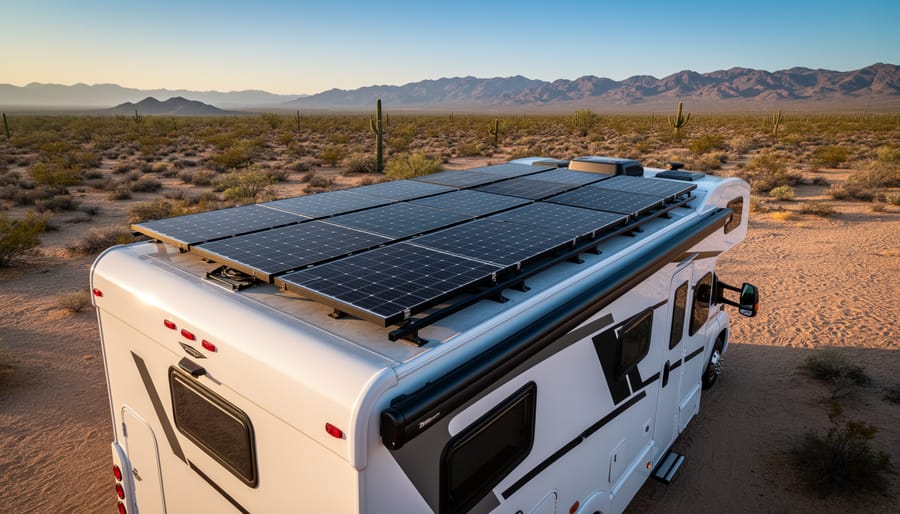
A properly configured 48V solar array on an RV roof maximizes power generation while working within limited mounting space.
The Water Hose Analogy
Think of your electrical system like a garden hose carrying water. Voltage is like the water pressure, and amperage is like the volume of water flowing through. When I first upgraded from 12V, this comparison really helped me understand what was happening in my RV’s wiring.
Here’s the key insight: if you need to deliver the same amount of power (measured in watts), you can either push a large volume at low pressure or a smaller volume at high pressure. A 48V system is like that high-pressure option. You’re moving the same energy with less current flowing through your wires.
Why does this matter? When electricity flows through wires, some energy gets lost as heat, especially with high amperage. At 12V, you need four times more amperage to deliver the same power as a 48V system. That means thicker, more expensive cables and more wasted energy heating up your wiring instead of powering your appliances.
When I switched to 48V in my own setup, I immediately noticed my cables ran cooler and I could use thinner gauge wire for the same power loads. It’s one of those upgrades where the physics really work in your favor.
Real-World Efficiency Gains
Let me show you what the efficiency gains look like in actual practice, because the numbers tell a compelling story.
Picture this: You’re running a 1500-watt air conditioner in your RV on a hot summer afternoon. With a traditional 12V system, you’re pulling 125 amps through your wiring to power that AC unit. Now switch to a 48V setup, and you’re only drawing 31.25 amps for the exact same cooling power. That’s the beauty of basic physics working in your favor.
Here’s where it gets really interesting. Over a 10-foot cable run, that 12V system loses about 25 watts just to heat and resistance. The 48V system? Only about 1.5 watts lost. That’s energy you’re keeping instead of literally throwing away as heat.
I learned this firsthand when I helped my neighbor Tom upgrade his 35-foot fifth wheel last summer. His old 12V system required 4 AWG wire for his main runs, which cost him nearly 400 dollars just in copper. When we switched to 48V, we used 10 AWG wire that cost under 150 dollars and performed better. The wire savings alone paid for a good chunk of his new inverter.
For a typical weekend boondocking scenario with moderate power use, 1500 watt-hours per day, a 12V system wastes approximately 150-200 watt-hours to inefficiency. The 48V system? Maybe 30-40 watt-hours. That difference means an extra half-day of power from the same battery bank, which translates to real freedom when you’re off-grid.
When a 48V System Actually Makes Sense for Your RV
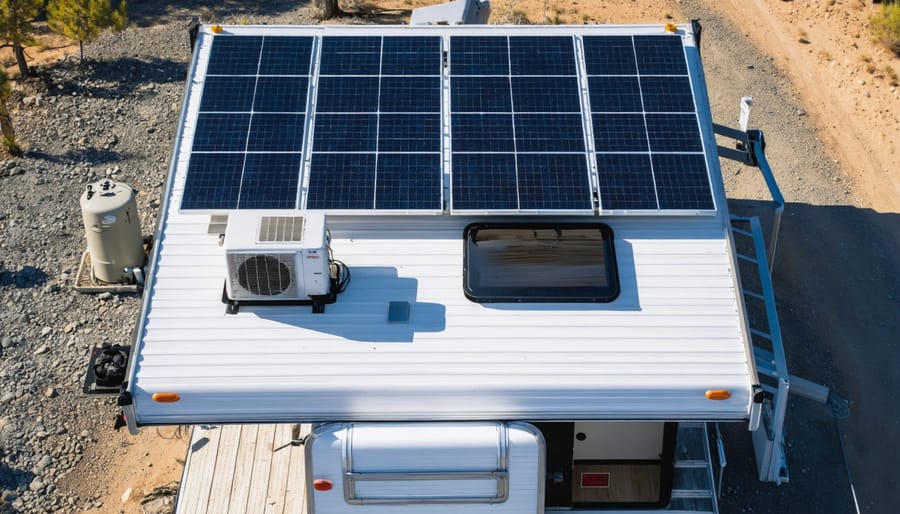
Power-hungry appliances like air conditioning and induction cooking make 48V systems worthwhile for full-time RV living.
Power-Hungry Appliances That Justify the Upgrade
Let’s talk about the appliances that really make a 48V system shine. If you’re running air conditioning for extended periods, especially in hot climates, you’ll appreciate the efficiency gains. A typical 15,000 BTU RV air conditioner pulls serious watts, and a 48V system handles that surge current much more gracefully than a 12V setup ever could.
Induction cooktops are another game-changer. I remember the first time I used my induction cooktop in my upgraded RV—boiling water in under two minutes without heating up the entire living space. These typically draw 1,800 watts or more, which at 12V would require massive cable runs and create significant voltage drop issues. At 48V, it’s manageable and practical.
Power tools are where things get really interesting for those of us who work remotely or enjoy woodworking on the road. Running a table saw, air compressor, or welder becomes feasible with a properly sized 48V system. The higher voltage means your inverter runs more efficiently and experiences less strain during startup surges.
Microwave ovens, hair dryers, and coffee makers also benefit significantly. Basically, if you want to run multiple high-wattage appliances simultaneously without constantly monitoring your battery bank or running a generator, 48V starts making serious sense. It’s about expanding your lifestyle possibilities rather than just keeping the lights on.
When to Stick With 12V or 24V Instead
Let me be honest with you—48V isn’t for everyone, and that’s perfectly okay. I learned this the hard way when I convinced my friend Tom to upgrade his modest weekend camper to 48V. He barely runs anything beyond LED lights and a small fridge, and the complexity became a headache he didn’t need.
If your power needs stay under 2,000 watts and you’re mostly running basic appliances like lights, a fridge, phone chargers, and maybe a small TV, a well-designed 12V or 24V system will serve you beautifully. These lower voltage systems are simpler to troubleshoot, have more readily available components at RV stores, and don’t require the learning curve that 48V demands.
Weekend warriors and occasional campers especially should think twice. The cost difference can easily run $1,000-2,000 more for 48V components, and if you’re only using your rig a few times a year, you’ll never recoup that investment through efficiency gains.
Similarly, if you’re not comfortable with electrical work beyond basic plug-and-play installations, 12V systems offer far more forgiveness. You can find pre-wired kits, local RV techs familiar with the setup, and abundant YouTube tutorials specific to your exact components.
Consider 24V as your middle ground—it offers improved efficiency over 12V without the complexity jump to 48V. For most RVers running moderate loads like a residential fridge, occasional microwave use, and standard electronics, 24V hits that sweet spot between performance and practicality. Save 48V for when you truly need it.
Key Components You’ll Need for a 48V RV Solar Setup
Solar Panels and Series Configuration
Getting to 48V requires wiring panels in series rather than the parallel connections common in 12V setups. Here’s the basic principle: when you connect solar panels in series, you add their voltages together while maintaining the same amperage. For example, four 12V panels wired in series give you 48V.
I learned this the hard way during my first 48V attempt. I grabbed four 100W panels rated at about 18V each (remember, nominal voltage differs from actual output). Connected in series, they produced around 72V in full sun, perfect for charging a 48V battery bank through an MPPT controller.
Here’s a practical tip: always use panels with matching specifications when wiring in series. Mismatched panels create bottlenecks, limiting your entire string to the weakest panel’s output.
Safety note: higher voltages mean extra precautions. Always use properly rated wire, MC4 connectors, and disconnect switches. Work in low-light conditions when making connections, and double-check polarity before energizing your system. A simple multimeter becomes your best friend here, helping you verify voltage before connecting to your batteries.
Charge Controllers Built for 48V
Your charge controller is the brain of your 48V system, and choosing the right one makes all the difference. When I upgraded my RV setup to 48V, I learned quickly that not all MPPT controllers are created equal, especially at higher voltages.
Look for controllers specifically rated for 48V battery banks with at least 60 amps of charging capacity. Popular options include the Victron SmartSolar 150/60 and the Morningstar TriStar MPPT 600V series. These handle the higher voltages efficiently and include monitoring features that help you track system performance from your phone.
Pay close attention to the maximum input voltage rating. Your controller needs headroom above your panel array’s open-circuit voltage, especially on cold mornings when voltage spikes. I recommend controllers rated for at least 150V input to give yourself flexibility with panel configurations.
Compatibility matters too. Make sure your controller communicates with your battery management system and inverter. Most quality 48V controllers use standard protocols like CAN bus or Modbus, letting everything talk to each other seamlessly. This integration prevented several potential issues in my own setup and gives you real-time insights into how your system performs under different conditions.
Battery Banks That Can Handle Higher Voltage
When I upgraded to 48V in my RV, choosing the right battery bank was honestly the most critical decision. Here’s what I learned through plenty of research and a few mistakes along the way.
Lithium batteries are really the gold standard for 48V systems. They handle the higher voltage beautifully, last significantly longer than lead-acid, and weigh considerably less. I went with four 12V lithium batteries wired in series to achieve my 48V setup. Yes, they’re pricier upfront, but the lifespan and performance make them worth every penny for serious boondockers.
Lead-acid batteries can work for 48V systems if budget is tight, but you’ll need more space and weight capacity. They also require more maintenance and don’t handle deep discharges as well, which matters when you’re off-grid for extended periods.
Here’s something crucial: you absolutely need a quality Battery Management System with a 48V setup. The BMS protects your investment by balancing cells, preventing overcharging, and monitoring temperature. Think of it as your battery bank’s guardian angel. Most good lithium batteries come with built-in BMS, but always verify this before purchasing.
When wiring batteries in series to reach 48V, double-check your connections. A single loose connection can cause major headaches down the road.
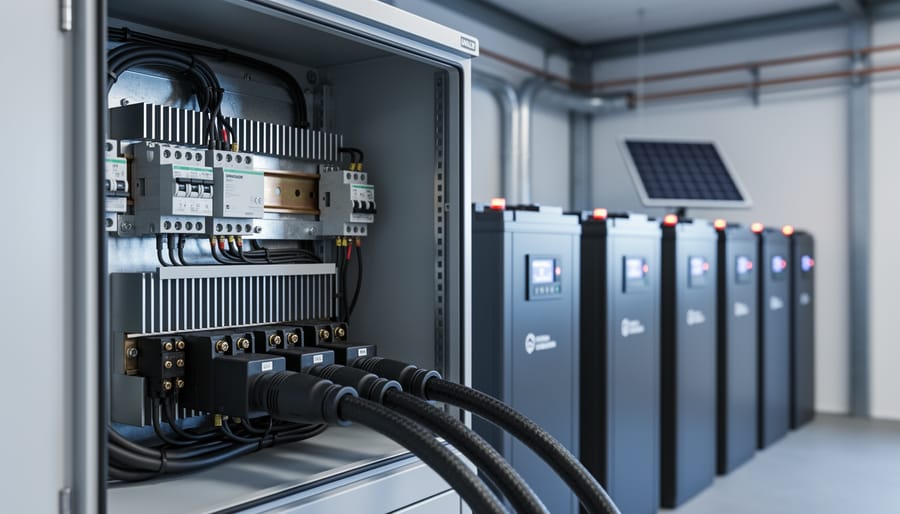
High-voltage lithium battery banks with integrated BMS systems are essential components for reliable 48V RV solar installations.
Inverters and the Critical Conversion Step
Here’s where things get really interesting—and where many DIYers stumble. Your inverter is the bridge between your 48V battery bank and your everyday AC appliances. Getting inverter selection right means matching wattage to your actual needs, not just your wishlist. I learned this the hard way when I initially undersized mine and couldn’t run my air conditioner during a Texas summer.
Calculate your simultaneous loads—what you’ll actually run at once—then add 20% headroom. For 48V systems, pure sine wave inverters are non-negotiable since they protect sensitive electronics. Most RVers find 3000-5000 watt inverters hit the sweet spot, handling standard appliances without breaking the bank. Remember, bigger isn’t always better—oversized inverters waste energy during idle periods.
Designing Your 48V System: A Practical Walkthrough
Calculating Your Daily Power Consumption
Before jumping into 48V territory, let’s figure out how much power your RV actually needs. I remember when I first tackled this with my own setup – I was amazed at how the little things added up!
Start by making a simple list of everything that uses electricity in your RV. Walk through your typical day and jot down each appliance or device. For each item, note its wattage (usually on a label or manual) and how many hours per day you use it. Then multiply watts times hours to get watt-hours.
Here’s a quick example from my travels: My 12V refrigerator uses about 60 watts and runs roughly 8 hours daily (accounting for cycling), giving me 480 watt-hours. Add my LED lights at 30 watts for 4 hours (120 watt-hours), laptop charging at 65 watts for 3 hours (195 watt-hours), and so on.
Create a worksheet with columns for Device, Watts, Hours Used, and Daily Watt-Hours. Total everything up at the bottom. Don’t forget those sneaky phantom loads – inverters, charge controllers, and USB chargers all sip power even when idle.
Most RVers find they use between 1,500 and 5,000 watt-hours daily, depending on whether you’re running air conditioning or just basics. This number becomes your foundation for sizing your entire 48V system.
Sizing Your Battery Bank for Real-World Use
Getting your battery bank size right makes all the difference between comfortable off-grid living and unexpected power shortages. Let’s break this down practically.
Start with depth of discharge (DOD). Lithium batteries can safely discharge to 80-90% without damage, unlike lead-acid which should stay above 50%. For a 48V system, I recommend planning around 80% DOD to balance usability with longevity.
Next comes days of autonomy, which is how long your batteries should run everything without solar input. Most RVers find 2-3 days hits the sweet spot. I learned this the hard way during a week of Pacific Northwest rain when I’d only planned for one day. Now I calculate for three days of typical usage, which covers most weather hiccups without going overboard.
Here’s my simplified formula: Daily energy use (in watt-hours) multiplied by days of autonomy, divided by usable DOD (0.8 for lithium), then divided by 48 volts equals your amp-hour capacity needed.
For example, if you use 6,000Wh daily: (6,000 x 3) / 0.8 / 48 = 469Ah at 48V. Round up to account for efficiency losses and future expansion, so you’d target around 500Ah.
Panel Array Planning for Space-Limited RVs
RV roof space is precious real estate, and when I first started planning my 48V system upgrade, I quickly realized that every square inch counts. Unlike ground-mounted home installations, you’re working with maybe 100-200 square feet at most, often with awkward shapes around vents, air conditioners, and satellite dishes.
Here’s my approach: start by creating a simple roof diagram. Grab some graph paper or use a free online tool and map out all the obstacles. I learned the hard way that those little roof vents can create significant shading issues that tank your whole array’s performance.
For 48V systems, you’ll typically need four panels minimum to reach adequate voltage. This actually works to your advantage in tight spaces. Instead of sprawling 12V arrays with thick cables, you can achieve similar power with fewer, more efficiently arranged panels. I positioned mine in a 2×2 configuration on my Class A, leaving the front section clear for my air conditioner.
Consider flexible panels if you have curved surfaces or irregular spaces. They’re pricier but can squeeze into areas rigid panels can’t. My neighbor mounted two flexible panels along his slide-out edges, brilliant use of otherwise wasted space.
Remember: south-facing orientation matters, but on an RV that moves, optimal placement trumps perfect compass direction every time.
Installation Tips and Safety Considerations
Wire Sizing: Where Most DIYers Go Wrong
Here’s where I learned an expensive lesson during my first 48V RV upgrade. I sized my wires based on standard ampacity charts, completely forgetting that RVs aren’t stationary homes. The constant vibration and movement create unique challenges that can turn properly-sized wire into a fire hazard.
In RVs, you need to upsize at least one gauge beyond what calculators suggest. Those jolts from bumpy roads can loosen connections over time, increasing resistance right where wire meets terminal. I found this out when a connection point got warm enough to melt the insulation slightly.
For a typical 48V system, use 4 AWG wire for runs up to 10 feet between your battery bank and inverter, even if calculations say 6 AWG is sufficient. For anything longer, jump to 2 AWG. Between solar panels and charge controller, 10 AWG works for most setups under 30 feet, but consider 8 AWG if you’re running along the roof where temperatures spike.
Always use stranded wire, not solid core. Stranded handles flexing without breaking internal conductors. And here’s a pro tip: secure wires every 18 inches with appropriate clamps. This prevents the wire itself from vibrating, which reduces metal fatigue and extends lifespan considerably.
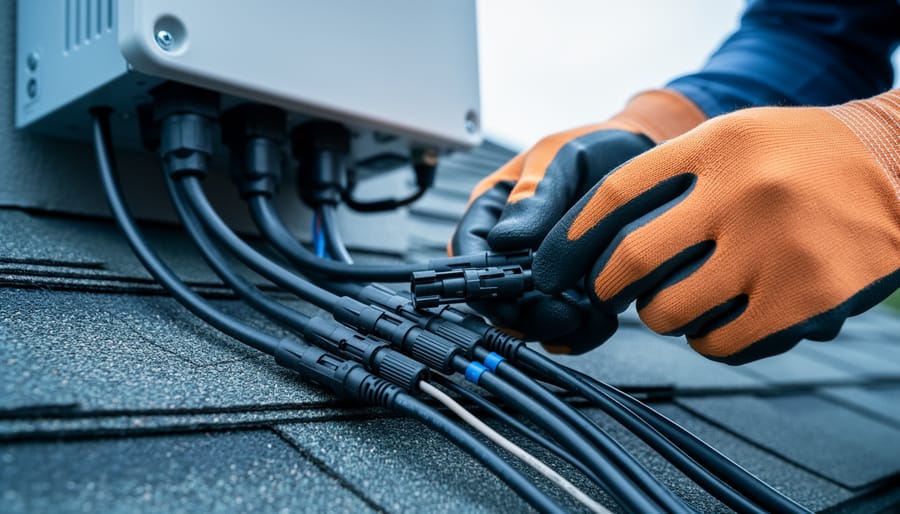
Proper wire sizing and termination techniques are critical safety considerations when installing higher voltage solar systems.
Fusing and Disconnects You Absolutely Need
Let me be blunt here: proper fusing and disconnects aren’t optional extras in a 48V system. They’re the difference between a safe installation and a potential fire hazard that could destroy your entire RV.
I learned this lesson the hard way during my second solar install. I cheaped out on a fuse holder, thinking “it’s just a fuse, right?” Wrong. That bargain-bin fuse holder couldn’t handle the current properly, created resistance, got hot, and nearly melted before I caught it during a routine check. That was a wake-up call.
Here’s what you absolutely need: First, a properly rated fuse or breaker between your solar panels and charge controller. For most RV systems, you’re looking at 15-30 amp fuses depending on your array size. Second, another fuse between your charge controller and battery bank. Third, a disconnect switch that lets you safely isolate your batteries for maintenance.
The fuses need to be rated for DC voltage, not AC. This is crucial because DC arcs are much harder to extinguish than AC. I recommend ANL fuses for larger systems or inline fuses for smaller ones. Make sure every fuse is rated at least 25 percent above your maximum expected current.
Your disconnect switches should be accessible but protected from accidental activation. I mount mine inside a cabinet near the battery bank. And please, use proper marine-grade or solar-rated components. Your family’s safety depends on it.
Common Challenges and How to Solve Them
Running Your 12V RV Accessories on a 48V System
Here’s the reality most RVers face when upgrading to 48V: almost all your existing gear runs on 12V. Your lights, water pump, fans, and entertainment system weren’t designed for higher voltage systems. But don’t worry—there are practical solutions that won’t break the bank.
The most common approach is installing a DC-DC converters to step down your 48V power to 12V for standard accessories. Think of it as a translator between your new system and old equipment. I remember when I first upgraded my travel trailer—I installed a 30-amp DC-DC converter that handled all my basic loads beautifully. These converters are surprisingly affordable, typically ranging from $150 to $400 depending on amperage needs.
Another option is running a dual-system setup, keeping your existing 12V battery bank for accessories while using 48V exclusively for high-draw appliances like air conditioning or induction cooktops. This approach integrates smoothly with traditional RV electrical systems and lets you upgrade gradually. The key is choosing quality converters with proper efficiency ratings—aim for 95% or higher to minimize energy loss during conversion.
Dealing with Space and Weight Constraints
Space is your most precious commodity in an RV, and a 48V system requires some creative thinking to fit everything in. I learned this the hard way during my first installation when I assumed my components would magically squeeze into the existing battery compartment!
Start by taking accurate measurements of your available spaces before buying anything. Battery compartments, roof areas, and exterior storage bays vary wildly between RV models. For batteries, vertical mounting racks can double your capacity in the same footprint, though you’ll need proper ventilation regardless of orientation.
Roof real estate demands strategic planning. Consider rigid panels for maximum efficiency in limited space, or flexible panels that conform to curved RV roofs. Mount your charge controller as close to the batteries as possible to minimize voltage drop, even if it means running longer wire runs from the panels.
Component consolidation helps tremendously. Look for combination inverter-chargers that eliminate separate boxes, and choose compact 48V lithium batteries over bulky lead-acid banks. Some RVers successfully mount controllers inside climate-controlled spaces, extending their lifespan.
Under-bed storage, closet floors, and even modified dinette benches can house battery banks when traditional compartments are full. Just ensure proper ventilation and secure mounting, because nothing should shift while driving down bumpy roads. Weight distribution matters too, so place heavy batteries over or near axles when possible.
Budget Breakdown: What to Expect to Spend
Let me be straight with you: jumping to 48V isn’t the cheapest route, but you’re getting serious capability for the investment. When I first priced out my system, I had a bit of sticker shock compared to my old 12V setup, but understanding where those dollars go helped me appreciate the value.
For a solid mid-range 48V RV system capable of running most appliances, expect to budget around $4,000 to $7,000. That includes your solar panels (about $800-1,200 for 1,200-1,600 watts), a quality 48V charge controller ($400-800), a 48V lithium battery bank ($2,000-3,500 for around 200-300Ah), and a 48V inverter ($600-1,200). You’ll also need proper wiring, connectors, breakers, and mounting hardware, which adds another $300-500.
Compare that to a comparable 12V system at $2,500-4,500, and yes, you’re paying roughly 40-60% more upfront. But here’s what changed my perspective: the 48V system uses thinner, cheaper wire because of lower current draw, and you’ll likely never need to upgrade again. My buddy Jake went the budget 12V route three times over five years, spending more total than if he’d gone 48V initially.
Budget-friendly option? Start with a smaller 48V battery bank (100-150Ah, around $1,200-1,800) and expand later. Most 48V systems are modular, so you’re not locked into one configuration forever.
Premium route? Top-tier components with monitoring systems and expandable architecture can push toward $10,000-12,000, but you’re getting commercial-grade reliability and features that would make any off-grid enthusiast jealous. I’ve learned that buying quality components once beats replacing cheap ones repeatedly.
Here’s the truth I’ve learned after years of tinkering with solar setups: there’s no one-size-fits-all answer when it comes to choosing between 12V and 48V for your RV. If you’re running multiple air conditioners, powering a mobile office, or living full-time in your rig with energy-hungry appliances, a 48V system isn’t just an upgrade—it’s a game-changer that can genuinely improve your off-grid lifestyle. The efficiency gains, reduced power loss, and expandability make it worth every penny of the investment.
But here’s what I also want you to hear: if your current 12V system is meeting your needs, there’s absolutely no shame in sticking with it. Not every RVer needs 48V, and that’s perfectly okay. The best solar system is the one that matches your actual energy usage, your budget, and your comfort level with the technology.
I encourage you to grab our calculators and plug in your real numbers. Look at your energy consumption honestly, consider your future plans, and let the data guide your decision rather than following trends or feeling pressured to upgrade.
And once you’ve made your choice—whether you’re diving into 48V or optimizing your 12V setup—I’d love to hear about your experience. Share your story in the comments below or join our community forums. Your real-world insights help fellow RVers make better decisions, and that’s what this journey is all about: learning together and empowering each other to harness the sun’s energy in whatever way works best for us.
How useful was this post?
Click on a star to rate it!
Average rating 0 / 5. Vote count: 0
No votes so far! Be the first to rate this post.
We are sorry that this post was not useful for you!
Let us improve this post!
Tell us how we can improve this post?
charlesnoble
Here at Spheral Solar, I’m a hands-on solar power enthusiast, constantly exploring and experimenting with DIY solutions. I’m dedicated to sharing my discoveries, insights, and even the bumps I hit along the way, all in the pursuit of a more sustainable future.
Why Your Motorhome Electrical System Keeps Failing… by Charlesnoble November 18, 2025 Picture this: You’re three days into a dream cross-country trip when your lights flicker, the refrigerator stops cooling, and you’re left wondering whether to call for expensive roadside assistance or figure it out yourself. I’ve been there, and here’s what I wish someone had told me before my first electrical…
Why Your RV Appliances Keep Tripping the Breaker… by Charlesnoble November 17, 2025 Turn off shore power and disconnect your battery bank before touching any wire in your RV—this single step prevents the most common DIY electrical accidents. Check your circuit breaker panel ratings against your actual appliance loads, because that microwave drawing 1500 watts on a 15-amp circuit is exactly why you’re…
How Much Power Does Your RV Mini Fridge Really Use? by Charlesnoble January 12, 2026 Measure your mini fridge’s actual power draw by plugging a Kill-A-Watt meter between the outlet and your fridge for 24 hours—this $25 tool gives you the exact kWh reading rather than relying on manufacturer estimates that often miss real-world conditions. Most compact mini fridges consume between 0.5-1.5 kWh per day,…
Why Your Camper Van Power System Keeps Failing (And… by Charlesnoble January 24, 2026 Picture this: You’re parked along a stunning coastline, laptop open, fridge humming, and lights glowing as the sun sets—all powered by the system you built yourself. A well-designed camper van power system transforms your vehicle from basic transportation into true freedom on wheels, letting you work remotely, cook meals, and…
Why Your RV Solar Panels Aren’t Charging (And How to… by Charlesnoble November 30, 2025 Check your multimeter readings at each connection point along your solar charging path—from panels to charge controller to battery—to pinpoint exactly where voltage disappears. Most RV solar systems lose 10-30% of their potential power to voltage drop, but this invisible thief often goes undetected until you systematically measure and compare…
Running Your RV Air Conditioner on Solar: Why Most… by Charlesnoble November 5, 2025 **Calculate your air conditioner’s starting watts before buying any inverter**—most RV AC units need 2,800-3,500 watts to start but only 1,200-2,000 watts to run. This surge requirement catches most first-time solar RV owners off guard, leading to undersized systems that can’t handle the initial power draw. **Match your inverter capacity…
Subscribe for handpicked DIY projects, exclusive tips, and giveaways.
Charging a battery bank with a 3-phase inverter requires connecting your inverter’s AC output to a compatible battery charger or hybrid inverter system that can convert the 3-phase power back to DC for storage. Most DIY solar setups achieve this by using a hybrid inverter that handles both solar input and battery charging simultaneously, or… Read more: How to Wire and Configure a Battery Inverter 3 Phase System for Off-Grid Solar
Wiring a 7-pin RV plug correctly connects your tow vehicle to your trailer’s lights, brakes, and auxiliary power in about 45 minutes with basic hand tools and careful attention to the color-coded wire standard. The diagram follows a specific layout mandated by the RV Industry Association: each pin controls a distinct function, from left turn… Read more: How to Wire a 7-Way RV Plug: Step-by-Step Diagram and Setup Guide
Nine times out of ten, an E050 arc fault error on your solar inverter means a loose connection somewhere in your DC wiring. Before you panic or call an expensive technician, check every MC4 connector between your panels and inverter. A single connection that wasn’t snapped fully closed or has corroded from weather exposure will… Read more: Why Is My Solar Inverter Showing Arc Fault E050? Causes and How to Fix It