Why Two Solar Panels Beat One Every Time (Parallel Connection Explained)
Updated:
Connect your panels to a charge controller or battery system by running positive terminals to positive and negative to negative. This parallel configuration doubles your available current (amperage) while keeping voltage the same, which is exactly what you need when your system demands more power than a single panel can deliver.
I learned this the hard way during my first RV solar setup back in 2019. I’d mounted one 100-watt panel on the roof, expecting it to handle everything. It worked fine on sunny days, but the moment clouds rolled in or I parked in partial shade, my system struggled. Adding a second panel in parallel transformed the setup completely. Suddenly I had enough current to keep my batteries charging even when conditions weren’t perfect.
The beauty of parallel wiring is its simplicity and forgiveness. Unlike series connections where mismatched panels create bottlenecks, parallel setups let each panel contribute independently. Your 100-watt panel keeps producing 100 watts even if you pair it with a 150-watt panel. They’re not holding each other back.
But here’s what most tutorials skip: parallel connections shine in specific scenarios. You’re working with a 12V system and need more charging current. You want redundancy so partial shading on one panel doesn’t kill your entire array. You’re expanding an existing setup without rewiring everything.
This guide walks through the actual wiring process with real connectors and wire gauges, explains why matching voltage matters more than matching wattage, and covers the troubleshooting steps that’ll save you hours of head-scratching when something doesn’t work as expected. Whether you’re powering a weekend camping setup or building out a van conversion, you’ll know exactly how to wire two panels correctly and when this configuration makes sense for your project.
What Does ‘In Parallel’ Actually Mean?
Think of electricity like water flowing through pipes. When you connect two solar panels in parallel, you’re basically running two separate garden hoses to the same bucket. Each hose delivers its own stream of water, and they combine at the bucket to fill it faster. The pressure in each hose stays the same, but the total flow doubles.
That’s exactly what happens with parallel wiring. Each solar panel sends electricity through its own path, and those paths join up at your battery or charge controller. The voltage (think of it as the electrical pressure) stays at whatever one panel produces, typically around 18-20 volts for a standard 12V panel. But the amperage (the actual flow of electrons) adds up. If one panel produces 5 amps and you connect another identical panel in parallel, you now have 10 amps flowing into your system.
Note: In parallel, voltages stay the same but amperages add up, like combining two water streams of equal pressure into one larger flow.
The wiring itself is straightforward. You connect all the positive terminals together and all the negative terminals together. Red wire meets red wire, black meets black. It’s that simple.
Series connections work differently. If parallel is like having two hoses filling one bucket, series is like connecting the hoses end to end to reach a bucket that’s farther away. In a series setup, the voltage adds up (18V plus 18V equals 36V), but the amperage stays the same as one panel. Series gives you higher voltage, parallel gives you higher current.
For most small-scale applications like camping or charging a single 12V battery, parallel makes more sense. You’re matching the voltage your battery needs while maximizing the charging speed. I’ve found this especially useful when I need to top up my power station quickly before the sun dips below the treeline.
The Real-World Benefits of Going Parallel
Two portable solar panels powering a small setup outdoors illustrate why parallel wiring is popular for camping and off-grid use.
More Power When You Need It
When you connect two solar panels in parallel, you’re essentially doubling your available current while keeping the voltage the same. Here’s what that means in practice: if each panel produces 5 amps at 18 volts, your parallel setup delivers 10 amps at 18 volts.
This matters most when you’re trying to charge a battery or run power-hungry devices. That doubled amperage means you can charge your camping battery in half the time, or run a small fridge and charge your phone simultaneously without maxing out your system.
I learned this the hard way on a three-day camping trip with just one 100-watt panel. My deep-cycle battery barely recharged during the day, leaving me scrambling to conserve power each evening. Adding a second panel in parallel changed everything. Suddenly I had enough juice to keep my lights, fan, and phone charger running without constant anxiety about draining the battery overnight.
The beauty is that your charge controller and battery don’t need to change, they’re already designed for that voltage. You’re just feeding them more current to work with.
Shade Tolerance That Saves Your System
Here’s the thing about camping or setting up portable solar: trees, clouds, and shadows are part of the package. I learned this the hard way on a fishing trip when a tree branch shaded half my single-panel setup and my battery charging dropped to nearly nothing.
With parallel wiring, you get built-in insurance against partial shade. When one panel catches a shadow while the other basks in full sun, the sunny panel keeps working at full capacity. The shaded panel might drop off temporarily, but your system doesn’t collapse the way it would with panels wired in series.
Think of it like having two independent workers instead of a team holding hands. If one worker slows down, the other keeps their pace. In series wiring, one shaded panel drags down the whole string because electricity has to flow through both panels sequentially.
For RV rooftops where vents and AC units cast shadows, or portable setups under changing tree cover, this resilience matters. You’re not chasing perfect conditions; you’re capturing whatever sun is available without losing your entire output to one stubborn cloud.
Partial shading on one panel highlights the value of using a parallel setup to keep your solar output more stable in real outdoor conditions.
How to Wire Two Panels in Parallel (Step-by-Step)
What You’ll Need
Before we dive into the wiring, let’s gather everything you’ll need. I learned the hard way that making a parts run halfway through kills momentum, and daylight.
The connectors: You’ll need MC4 connectors if your panels don’t already have them (most modern panels do). To join the parallel connections, grab either MC4 branch connectors or a small junction box. Branch connectors are cleaner for portable setups; junction boxes work better for permanent installations.
The wire: Use 10 AWG wire for most small panel setups. If you’re running cables more than 15 feet or working with panels over 150 watts each, step up to 8 AWG. Don’t skimp here, undersized wire wastes power and creates fire risk.
Basic tools: A wire stripper, crimper for MC4 connectors (if you’re making your own), and a multimeter are essential. Add zip ties or UV-resistant cable clips to keep everything tidy.
Optional but smart: Heat shrink tubing for any exposed connections and dielectric grease to prevent corrosion in the MC4 connectors, especially if your setup lives outdoors.
Making the Connections
Alright, let’s get our hands dirty. The core rule is beautifully simple: connect all positive terminals together, and all negative terminals together. That’s it. But the devil’s in the details.
Start by laying out your panels where they’ll actually live, on your RV roof, by your tent, wherever. I learned this the hard way after wiring everything perfectly on my garage floor, only to find the cables were two feet too short when I mounted the panels.
Take your first panel’s positive lead and plug it into one port of your MC4 branch connector. Do the same with the second panel’s positive lead into the other port. You’ve just created your combined positive output. Repeat this process with both negative leads and a second branch connector, that’s your combined negative.
If you’re using a junction box instead, strip about half an inch of insulation from each wire end. Twist the two positive wires together firmly, secure them under the positive terminal, then repeat with the negatives. I add a dab of dielectric grease here, it costs three bucks and prevents corrosion that can kill your connection months down the road.
Give each connection a firm tug. If anything budges, redo it. Loose connections create resistance, heat, and eventual failure. Trust me, you don’t want to troubleshoot this stuff when you’re already at camp.
Testing Before You Trust It
Before you hook up your battery or charge controller, grab a multimeter and spend two minutes checking your work. Trust me, it’s way easier to fix a connection now than after you’ve packed everything away.
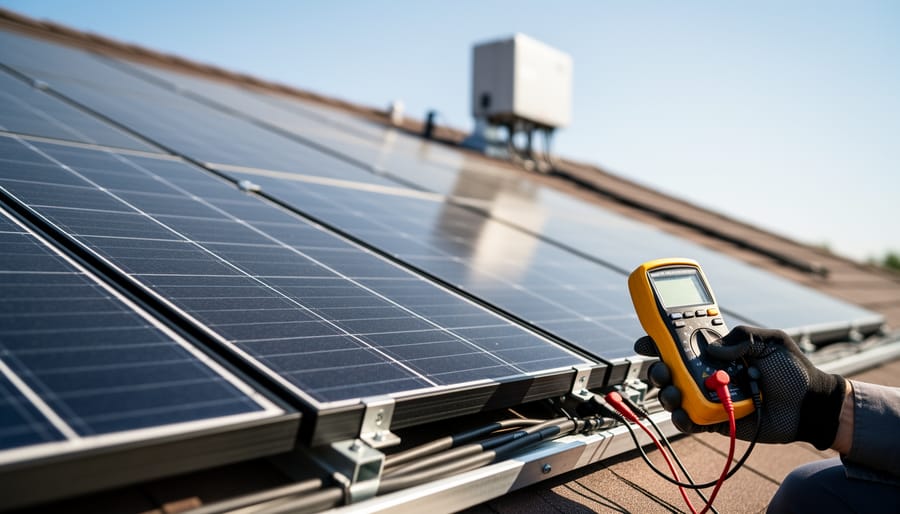
Set your multimeter to DC voltage and touch the probes to your combined positive and negative leads. You should see roughly the same voltage as a single panel, around 18-22V for typical 12V panels. Now switch to the amperage setting and test in full sunlight. Your reading should be close to double what one panel produces alone. If you see 5 amps from a single panel, expect about 10 amps from two in parallel.
Significantly lower readings? Check for loose connections, corroded terminals, or reversed polarity on one panel. It happens to everyone at least once.
A multimeter check scene helps readers connect the “how” of parallel wiring with real safety testing before trusting the system.
When Parallel Makes Sense (And When It Doesn’t)
Parallel connections really shine when you’re working with low-voltage battery systems, which describes most portable and camping setups. If you’re charging a 12V battery bank, connecting two 12V panels in parallel gives you exactly what you need: steady voltage with doubled amperage to fill those batteries faster. I’ve found this setup perfect for weekend camping trips where you want your power station topped off by early afternoon, not sunset.
Emergency power kits benefit hugely from parallel wiring too. When one panel gets shaded by a tree branch or covered in leaves during a storm, the other keeps working at full capacity. That redundancy matters when you actually need the power.
Pros
Maintains steady voltage while doubling current output, ideal for battery charging.
One shaded panel doesn’t kill your entire system’s production.
Simple to expand by adding more panels without voltage calculations.
Matches most portable battery systems and charge controllers directly.
Cons
Requires heavier gauge wire than series to handle the increased amperage safely.
Limited by charge controller’s maximum current rating rather than voltage.
Not efficient for long cable runs where voltage drop becomes an issue.
Won’t work if you need higher voltage for grid-tie inverters or specific equipment.
That said, parallel isn’t always the answer. If your panel specifications show higher voltage output (say, 24V or 48V panels) and you’re trying to charge a 12V battery, you’ll need a different approach entirely. Series connections make more sense when you’re dealing with long wire runs, since higher voltage means less current and reduced power loss over distance.
I’ve also learned that mixing connection types works for larger projects. A small RV rooftop might use series-parallel, where you wire pairs of panels in series first, then connect those pairs in parallel. But honestly, for most two-panel camping or emergency setups, straight parallel keeps things simple and effective.
The quality of your solar panel connectors matters more in parallel configurations since you’re handling higher current through each connection point. Bad connectors create resistance, which generates heat and wastes power you can’t afford to lose in a small system.
Before committing to parallel, think about your actual use case. Are you charging batteries under 24V? Will panels sometimes be partially shaded? Do you value simplicity over maximum efficiency? If you answered yes to these, parallel is probably your best friend. Just make sure to test your system properly once wired to confirm everything works as expected before heading into the backcountry.
Matching Panels: Does It Really Matter?
I get this question constantly: “Can I just grab whatever solar panels I have and wire them together?”
Short answer: You *can*, but you’ll get better results with matched panels.
Here’s what actually happens when you parallel mismatched panels. The system will only produce as much current as the weaker panel allows at any given voltage. If you connect a 100W panel with a 50W panel, you won’t get 150W, you’ll get something closer to 120W on a good day. The smaller panel becomes a bottleneck.
Voltage is where things get interesting. In parallel, the panels will settle at a common voltage somewhere between their individual maximum power point voltages. This means neither panel operates at peak efficiency. I tested this with a 12V/100W panel and a 12V/60W panel last summer. The voltage compromise cost me about 15% of the total theoretical output.
That said, I’ve absolutely mixed panels when building camping setups. When does it work? If the panels have similar voltage ratings (both 12V nominal or both 18V open circuit), you’ll lose some efficiency but the system will function. I once combined two different brand panels for a weekend trip, both rated around 12V, and charged my battery just fine.
What you absolutely must avoid: pairing panels with wildly different voltages, like a 12V with a 24V panel. The lower voltage panel will act like a resistor, potentially overheating.
My rule: Match panels when you’re building a permanent system or maximizing output matters. Mix panels for experimental projects or when you’re working with what you’ve got and understand you’re leaving some performance on the table.
Bypass Diodes vs Blocking Diodes (And Which One You Actually Need)
I mentioned blocking diodes in the mistakes list without explaining them, and a reader with an engineering background wrote in to point out that this isn’t much help if you’re trying to work out whether you need one. He’s right. Here’s the full picture.
Two completely different components get called “the diode,” and they do opposite jobs.
Bypass diodes are already in your panels
Look at the junction box on the back of almost any modern module and you’ll find two or three of them, each spanning a group of cells. They sit across the cell groups, not in line with your output wire, and in full sun they do nothing at all. Their moment comes when a branch or a vent pipe shades part of the panel. Without them, the shaded cells stop generating and start absorbing power from the healthy ones, which creates a hot spot that can cook the cell. The bypass diode gives the current a path around the shaded group instead. You don’t buy these or fit them. They’re already there.
Blocking diodes are the ones you might add
These go in series with each panel’s positive lead, and their job is to stop current running backwards into a panel. That happens in two situations: at night, when a battery would otherwise trickle back through the array, and in weak light, when a higher-voltage panel can push current into a lower-voltage one sitting next to it in parallel.
The night-time case is handled by any modern charge controller, which is why manufacturers largely stopped fitting blocking diodes. The parallel-mismatch case is the one that still catches people out, and it’s why they appear in the mistakes list below.
So when do you actually need one?
If your panels are properly matched, you don’t. If you’re paralleling panels with genuinely different voltages, fit one on each panel’s positive lead. The price is the diode’s own voltage drop: about 0.4 to 0.7V for a standard silicon diode, or around 0.2V for a Schottky. On a 12V system that difference matters, so use a Schottky.
One warning about testing for them
You can’t find out whether a panel has a blocking diode by probing it with a multimeter, even though it looks like you should be able to. A solar cell is itself a diode, and your panel is dozens of them in series, so in one direction your meter can’t muster the voltage to forward-bias the whole string. That takes around 20V on a 36-cell panel, against the two or three volts a multimeter provides. You’ll read infinity whether a blocking diode is fitted or not, because the cells dominate the reading. Check the datasheet, or open the junction box and look.
And before you assume your panels are mismatched at all, make sure you’re comparing like with like. Panel labels quote both a maximum-power voltage (Vmp) and an open-circuit voltage (Voc), and Voc is always the higher number. Comparing one panel’s Vmp against another panel’s Voc will make a well-matched pair look badly mismatched.
Real Examples from the Field
I’ve tested parallel connections in three different real-world scenarios, and each one taught me something valuable about making this configuration work.
My first serious parallel setup was a camping rig with two 100-watt panels feeding a 200Ah lithium battery. I mounted the panels on adjustable aluminum frames so I could angle them throughout the day. The goal was simple: charge my battery fast enough during daylight to run a portable fridge, lights, and phone charging overnight. This setup consistently delivered 8-10 amps in good sun, enough to top off the battery by mid-afternoon even after running the fridge all night. The big win? When I parked under trees with dappled shade, one panel kept producing while the other was partially covered. A single panel would’ve been useless in that situation.
The shed backup system was different. I needed reliable power for some tools and a small workbench light, but the shed roof had a vent pipe that cast shadows at certain times of day. Two 50-watt panels in parallel solved this perfectly. Even when the shadow hit one panel, the other kept things running. I learned the hard way here to pick a charge controller rated above my maximum possible current. My initial 10A controller couldn’t handle the peak output when both panels hit full sun simultaneously, and I had to upgrade to 15A.
The portable battery charger for weekend trips was my simplest build: two folding 60-watt panels charging a small power station. This taught me about wire management. My first attempt used wire that was too thin and too long. I was losing noticeable power to resistance. Shortening the cable run and upgrading to 10AWG wire made a measurable difference in charging speed.
The common thread? Parallel connections delivered exactly what I needed them to: resilience against shade and faster charging times. But they also demanded attention to details like proper wire sizing and correctly rated components. Start conservative, test everything, and scale up once you understand how your specific panels perform together.
Common Mistakes (I’ve Made Them So You Don’t Have To)
I’ll be honest: every mistake I’m about to describe? I’ve made it. Some of them twice because I’m stubborn and thought “that won’t happen to me again.” Spoiler: it did.
The reversed polarity incident happened on my first camping setup. I was rushing to get everything connected before sunset, didn’t double-check my positive and negative terminals, and wondered why my charge controller was flashing angry red lights. Nothing caught fire (thankfully), but I learned that modern charge controllers will protect you from this mistake exactly once before they give up on life. Always mark your wires clearly with red electrical tape for positive, black for negative, and verify with a multimeter before connecting anything to your battery or controller.
Wire gauge nearly cost me a weekend trip. I used some leftover 18-gauge wire I had lying around because “it’s only two panels, how much current could there be?” Turns out, two 100-watt panels in parallel push around 11 amps in full sun, and that thin wire got warm enough to make me nervous. Now I stick with 10-gauge wire for anything over 15 feet, 12-gauge for shorter runs. The few extra dollars aren’t worth a melted wire jacket in the middle of nowhere.
Here are the most common mistakes and their quick fixes:
Reversed polarity, mark wires clearly, verify with multimeter before final connection
Undersized wire gauge, use 10-gauge for runs over 15 feet, 12-gauge minimum for shorter distances
Skipping blocking diodes on mismatched panels, install one on each panel’s positive line when voltages differ
Poor weatherproofing at connections, wrap all MC4 connections with self-fusing silicone tape, even “waterproof” ones
Forgetting to secure loose wires, use zip ties every foot to prevent wind damage and chafing
The weatherproofing lesson came after a surprise rainstorm at the lake. I assumed MC4 connectors were completely waterproof. They’re water-resistant, which isn’t the same thing when you’re lying in a puddle for three days. My connections corroded and one panel stopped charging entirely. Now every connection gets wrapped with self-fusing silicone tape, and I elevate the junction point off the ground whenever possible.
Trust me, spending an extra ten minutes checking your work beats troubleshooting a dead system when you’re miles from the nearest hardware store.
Parallel connections really shine when you’re working with portable setups, camping rigs, or any small solar project where shade tolerance and steady voltage matter more than reaching high voltages. They’re forgiving, straightforward to wire, and genuinely useful for real-world conditions where panels don’t always get perfect sun.
If you’re just getting started, my advice is simple: begin with a small two-panel parallel setup. Test it somewhere safe, like your backyard or driveway, before heading out on that camping trip. Make sure you’ve got the right wire gauge for your amperage, double-check your connections, and verify everything with a multimeter before trusting it with your gear.
Planning a specific setup? Use the solar calculator tool here on Spheral Solar to figure out what configuration works best for your needs. And honestly, don’t hesitate to jump into the comments or our community forums with questions. We’ve all been beginners, we’ve all made the same mistakes, and sharing what we learn is what makes DIY solar genuinely accessible to everyone willing to try.
How useful was this post?
Click on a star to rate it!
Average rating 5 / 5. Vote count: 1
No votes so far! Be the first to rate this post.
We are sorry that this post was not useful for you!
Let us improve this post!
Tell us how we can improve this post?
charlesnoble
Here at Spheral Solar, I’m a hands-on solar power enthusiast, constantly exploring and experimenting with DIY solutions. I’m dedicated to sharing my discoveries, insights, and even the bumps I hit along the way, all in the pursuit of a more sustainable future.
How to Wire a 7-Way RV Plug: Step-by-Step Diagram… by Charlesnoble September 12, 2026 Wiring a 7-pin RV plug correctly connects your tow vehicle to your trailer’s lights, brakes, and auxiliary power in about 45 minutes with basic hand tools and careful attention to the color-coded wire standard. The diagram follows a specific layout mandated by the RV Industry Association: each pin controls a…
How to Connect SolarEdge to Ethernet for Seamless… by Charlesnoble July 9, 2026 Connecting your SolarEdge inverter to your home network via Ethernet cable takes about 15 minutes and gives you real-time access to your system’s performance data from any device with internet access. You’ll plug a standard Ethernet cable into the RJ45 port on your inverter (usually labeled “LAN” or “Ethernet”), run…
6 Best Solar Spot Lights of 2026, Tested and Reviewed by Charlesnoble August 8, 2026 After testing dozens of solar spotlights in real-world conditions throughout 2026, the AloftSun Solar Motion Sensor Outdoor Lights emerged as the top overall choice for most homeowners, thanks to its reliable performance and versatility across different landscape lighting scenarios. But picking the right solar spotlight depends entirely on what you’re…
How to Run Functional Performance Testing on Your… by Charlesnoble August 17, 2026 Functional performance testing measures whether your DIY solar system delivers the power output it’s designed to produce. You’ll check voltage, current, and total wattage under real-world conditions, then compare those numbers to your system’s nameplate ratings to calculate a Performance Ratio, the gold standard metric that tells you if everything’s…
How to Wire and Configure a Battery Inverter 3 Phase… by Charlesnoble September 16, 2026 Charging a battery bank with a 3-phase inverter requires connecting your inverter’s AC output to a compatible battery charger or hybrid inverter system that can convert the 3-phase power back to DC for storage. Most DIY solar setups achieve this by using a hybrid inverter that handles both solar input…
5 Sources of Electrical Energy Every Solar DIYer… by Charlesnoble July 1, 2026 Electricity powers our homes from five main sources: solar panels, wind turbines, hydroelectric generators, fossil fuel generators, and battery storage systems. If you’re building a reliable off-grid setup or backing up your solar array, understanding how these sources work together transforms a single-point-of-failure system into resilient, year-round power. I learned…
Subscribe for handpicked DIY projects, exclusive tips, and giveaways.
Nine times out of ten, an RV generator that won’t start has a stale fuel problem. If your generator hasn’t run in more than 30 days, degraded gasoline is likely gumming up the carburetor and preventing ignition. Before you panic or call for expensive roadside service, try this: turn on the generator’s fuel valve (if… Read more: RV Generator Troubleshooting: Common Problems and How to Fix Them
A 5kW solar system occupies between 250 and 350 square feet of roof or ground space and produces roughly 20 to 25 kilowatt-hours of electricity per day in most U.S. locations. That’s enough to power a typical three-bedroom home with moderate energy use, though your exact needs depend on your daily consumption patterns, climate zone,… Read more: How to Size a 5kW Solar System for Your Home or RV
Installing a home solar system yourself takes 2-4 weekends for an average 5kW setup, requires solid electrical knowledge and comfort working at heights, and can save you $5,000-$8,000 in labor costs if you tackle everything except the final utility interconnection. The process breaks down into five main phases: permitting and design, mounting the racking system,… Read more: Solar Power Installation Step by Step: Complete DIY Guide From Start to Finish