Power Bank vs. Portable Solar Power Station for Camping: Which Is Better for Your Trip?
Updated:
For most weekend campers, a 20,000mAh USB-C power bank is the right place to start, and a solar power bank only earns its spot if you’re out long enough that wall-charging stops being an option. Step up to a portable power station only when you need to run more than phones, headlamps and a small fan.
In the interest of transparency, we earn a commission on some purchases made through links on this site. As an Amazon Associate I earn from qualifying purchases.
Here’s the reason. A power bank is the lightest, simplest way to keep your devices alive, and a solar version like the BLAVOR Solar Power Bank 20000mAh adds a built-in panel that tops up the battery during the day, so it keeps charging your gear anytime, sun or no sun. A power station like the Jackery Explorer 300 Portable Power Station,292Wh trades that portability for much more stored energy, which matters once laptops, lights and bigger loads join the trip.
When we tested these side by side around the campsite, the gap in what each could realistically run was obvious within the first evening. The Anker Laptop Power Bank the EF ECOFLOW Rapid 20000mAh Power Bank and the Solar Power Bank 38800mAh all sit between “pocket gadget” and “mini generator,” which is why picking by milliamp-hours alone leads people astray.
The smarter move is to work out your actual daily draw first. Our watt-hour calculator turns mAh ratings into watt-hours so you can compare a power bank and a power station on equal footing. And if you’re still sorting out how to get electricity to your campsite in the first place, that guide covers the bigger picture.
Below, we compare both categories dimension by dimension, then walk through eight options so you can match the gear to your trip.
Key Takeaway: Phones and lights point to a power bank, while laptops, fridges and CPAP machines point to a portable power station. Whichever you pick, solar panels can top it up in the field, so you aren’t stuck when the battery runs low.
Power Bank vs. Power Station at a Glance: Which Off-Grid Setup Makes Sense?
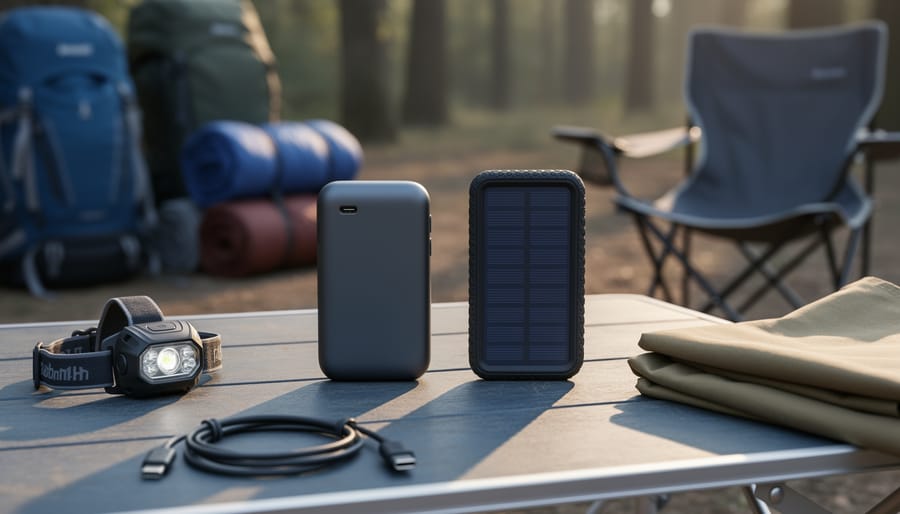
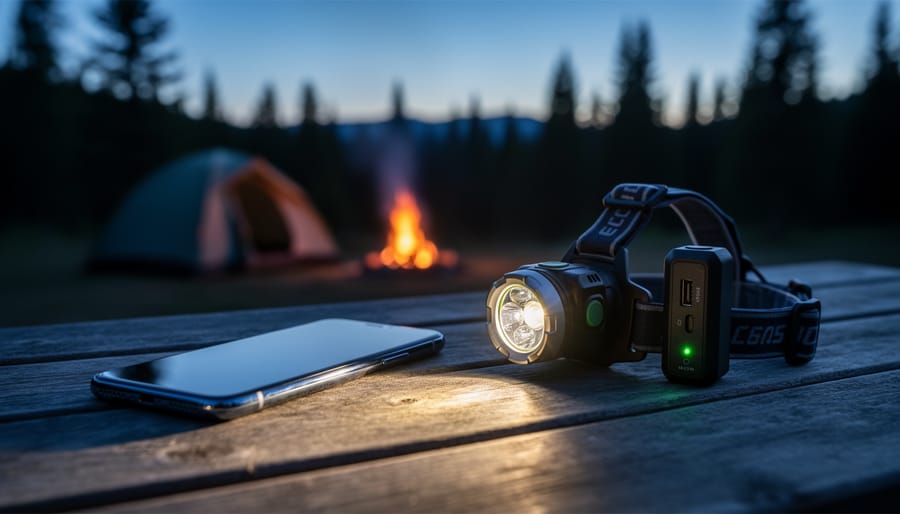
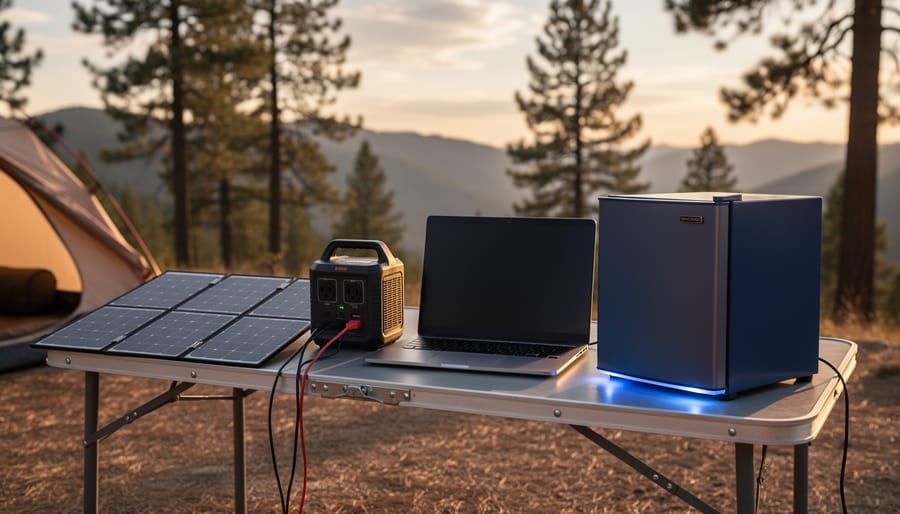
A phone and headlamp resting near a compact power bank at the campsite highlights why reliable charging matters after sunset.
The Quick Verdict by Camper Type
Not sure which setup fits your trip? Here’s the short version of what we’d tell a friend at the trailhead.
Day hikers should grab a compact power bank and keep the weight down. Weekend tent campers are best served by a 20,000mAh USB-C power bank, which is the best starting point for most campers in the US in 2026. Van lifers and overlanders, who run bigger loads for longer, should step up to a portable power station, the 288Wh class like the Anker Solix C300 DC being a sensible entry point.
Keep this quick split in mind as you read on. The detailed comparison below shows exactly why each recommendation lands where it does.
What Each Option Actually Is (And How Solar Fits In)
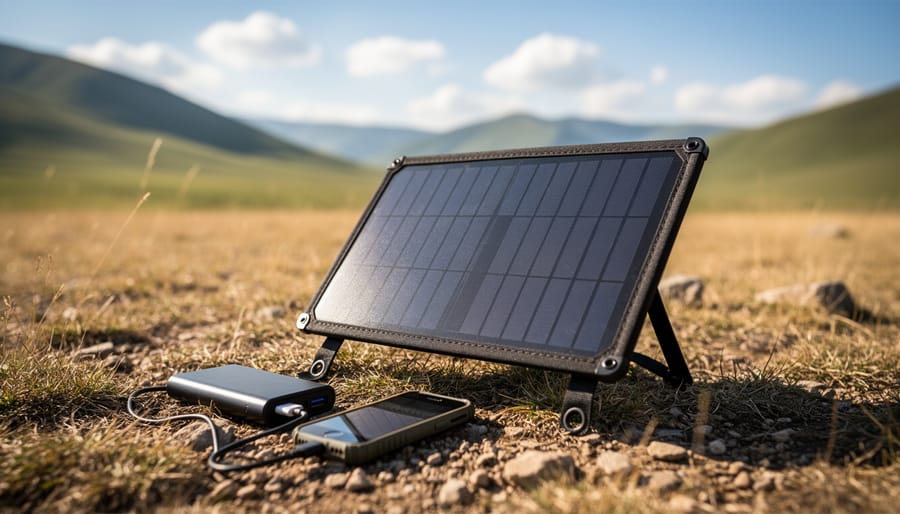
Sunlight on a small portable solar panel conveys how off-grid recharging can keep your power topped up in the field.
Converting mAh to Wh So You Can Compare Fairly
Power bank labels list milliamp-hours (mAh), but power stations list watt-hours (Wh). To compare them fairly, you need one common unit. The quick math: mAh × voltage ÷ 1,000 = Wh. Most power banks run on a 3.7V battery, so a 20,000mAh bank works out to roughly 74Wh (20,000 × 3.7 ÷ 1,000).
Now you can stack it against bigger gear. The Anker Solix C300 DC, for example, is listed at 288Wh, which is nearly four times that 20,000mAh bank. If you’d rather skip the arithmetic, our mAh to Wh conversion calculator does it for you. Then use our watt-hour calculator to add up what your phone, headlamp, and any other gear will draw over the whole trip.
Here’s the catch I learned the hard way: the number on the label isn’t the number you get. Converting battery voltage up to the 5V (or higher) that your devices need wastes some energy as heat, so real-world usable capacity lands noticeably below the label. When you size your setup, build in a cushion rather than planning to the exact watt-hour. A little extra capacity beats a dead phone on day three.
Dimension-by-Dimension: Capacity, Weight, Output, Solar Charging and Durability
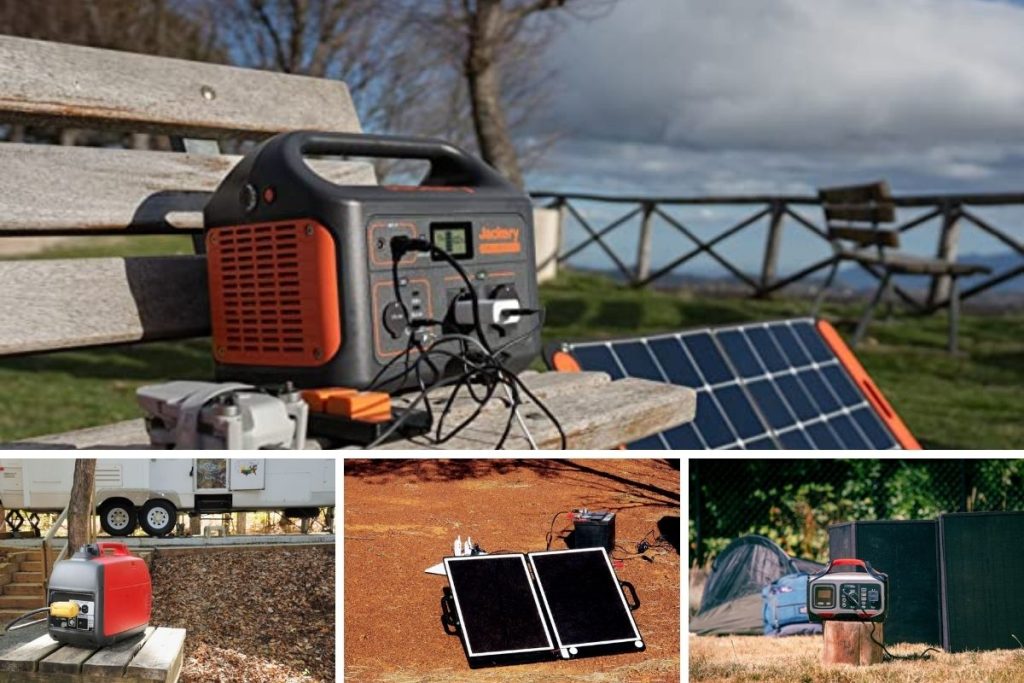
A visual metaphor using a measuring cup helps readers think in terms of capacity when comparing power banks and power stations.
When you line up a power bank against a portable power station, the differences show up in six places. Here’s how I think about each one.
Capacity and runtime. Capacity is simply how much energy the battery stores, and watt-hours (Wh) is the fairest way to compare. A 20,000mAh USB-C power bank is the best starting point for most campers in 2026, and it covers phones, a headlamp, and a camera for a weekend. A station like the Anker Solix C300 DC, at 288Wh, holds roughly three or four times that, which is what you need once a laptop or small appliance joins the trip. Our watt-hour calculator makes the math painless.
Weight and portability. This is where the two categories really split. A power bank slides into a jacket pocket. As a category illustration, the BLUETTI Elite 30 V2 packs 288Wh into about 9.5 lbs, while the Jackery Explorer 1000 v2 delivers 1,070Wh at 23.8 lbs. I once hauled a heavy station on a short overnight trip, convinced I’d want every spare watt. I used maybe a fifth of it and cursed every step back to the car. Match the battery to the trip, not to your worst-case fear.
Output and ports. Wattage tells you what a device can run at once, not how long. Power banks mostly offer USB-C and USB-A, enough for electronics. Stations add AC outlets, which matter for appliances. If you ever plan to go bigger, you might even install a power inverter to turn battery power into household-style outlets.
Charging versatility and solar reality. Stations recharge from a wall, a car, or panels. A solar power bank combines a built-in panel with a rechargeable battery; the panel tops up the battery during the day, and the battery charges your devices anytime, sun or no sun. Be honest about the limits, though. A small built-in panel is a trickle top-up, not a primary charger. For heavier loads, it’s worth reading about solar vs generators to see where each approach fits.
Durability and weather resistance. Pocket banks take knocks but fear rain. Bigger stations are sturdier, yet still not waterproof by default. Keep either one dry and shaded.
Here’s the quick checklist I run through before any trip:
Ports: USB-C for modern phones, plus AC if you’re running appliances.
Capacity: Add up your devices in Wh, then leave a cushion for conversion losses.
Weight: Ask whether you’ll carry it, or just load it into the car.
Solar compatibility: Check whether it has a built-in panel or accepts an external one.
Weather protection: Look for a rugged shell, and plan a dry spot for it anyway.
Work through that list honestly and the right category usually picks itself.
Solar Power Bank 38800mAh: Big Capacity, Built-In Panel Backup
Think of the Solar Power Bank 38800mAh as the “set it and forget it” option for people who hate hunting for an outlet. That big 38,800mAh capacity is roughly double what a standard 20,000mAh bank holds, so it gives you real breathing room on a multi-day trip. A couple of phones, a headlamp, a Bluetooth speaker, maybe a small fan: it can keep that whole pile of little gadgets going without you doing math every evening.
The built-in panel is where I want to set expectations. It’s a backup, not a power plant. On a sunny afternoon you can leave it on a rock or clip it to your pack, and it’ll nudge the internal battery up a bit. That’s handy if you’re stranded for an extra day or forgot to top it off before leaving. But a panel this small can’t realistically refill a battery this large in any reasonable time, so you should charge it fully at home first and treat the sun as a bonus.
The tradeoff is weight and bulk. All that capacity is physically heavier than a slim 10,000mAh bank, and you’ll notice it in a small daypack. For car camping or a basecamp weekend, that’s no problem. For ultralight backpacking, probably skip it.
On the ratings, it holds a 4.1 out of 5 from 10,051 customer ratings, which is solid for something at this size. It’s a good fit for families, group trips, and anyone who wants one big battery instead of juggling several small ones.
Jackery Explorer 300 Portable Power Station,292Wh: The Entry Point to Camp Appliances
If you’ve outgrown a pocket-sized power bank, the Jackery Explorer 300 Portable Power Station,292Wh is a sensible next step. It’s the kind of unit I’d point a weekend camper toward once the gear list grows beyond phones and a headlamp.
At 292Wh, it sits squarely in the 200Wh to 500Wh range that suits weekend and tent campers. That’s a real jump from a 20,000mAh power bank, and it’s enough headroom to charge a laptop, keep camp lights going, and run small appliances without watching the battery bar every hour. The trade-off is weight and bulk. You won’t forget you’re carrying it, so it fits car camping better than a long backpacking trip.
Solar is where it ties back to the bigger picture of powering camp appliances. You can pair it with an optional solar panel and top it up in the field, which stretches a weekend into something closer to a long weekend. I’d treat solar as a refill, though, not a guarantee. Cloud cover and tree shade change the math fast, and I can’t give you a solid input figure here, so plan your usage with some cushion.
Owners seem happy with it. It carries a 4.6 out of 5 rating from 11,379 customer ratings, which is a strong signal for a product at this tier.
Not sure whether 292Wh covers your trip? Add up your devices with the watt-hour calculator first, then decide whether a station or a power bank is the smarter buy.
BLAVOR Solar Power Bank 10,000mAh Portable Wireless Charger: The Reliable Week-Long Companion
The BLAVOR Solar Power Bank 10,000mAh Portable Wireless Charger is the one I’d hand to a friend who says, “I just need my phone to last the trip.” It earns solid marks from owners for reliability and week-long usage, which is exactly the job a light camper wants done.
What makes it handy at camp is the wireless charging. You set your phone on top and let it charge without hunting for a cable in a dark tent. That’s a small convenience, but it’s one I appreciate when I’m fumbling around with cold fingers at 6 a.m. It’s also pocket-sized, so it rides along on day hikes without you noticing it’s there.
Then there’s the solar part. Like any solar power bank, it pairs a built-in panel with a rechargeable battery. The panel tops up the battery during the day, and the battery charges your devices whenever you want, sun or no sun. Think of the panel as a trickle that stretches your supply, not a way to refill from empty. I’d keep a wall or USB charger in the plan for the real recharge and treat the sunshine as a bonus.
Shoppers seem to agree it’s a solid pick. It holds a 4.2 out of 5 rating from 48,028 customer ratings, which is a big pool of owners behind that number.
To be fair about the limits: 10,000mAh is a modest tank. It suits a phone, a headlamp, and maybe a watch or earbuds. If you’re bringing a laptop, a tablet you use heavily, or several people’s gadgets, size up to the 20,000mAh class or a power station. For solo campers and light users, though, this one hits a sweet spot.
Anker Laptop Power Bank: When You Need to Keep a Laptop Alive Off-Grid
If you camp with a laptop, a phone charger won’t cut it, and a full power station might be overkill. The Anker Laptop Power Bank sits right in that gap. It’s a 25,000mAh unit with 165W total output, which is enough muscle to keep a laptop going where most pocket banks would just stall out.
Who benefits most? Remote workers who want to answer a few emails from a lakeside site, photographers offloading and reviewing shots at the end of the day, and anyone who simply refuses to unplug completely. In our hands-on use, it felt like the sensible middle step: you get far more laptop-friendly power than a standard bank, without hauling the weight of a station built for fridges and CPAPs.
Customers back it up, too. It holds a 4.4 out of 5 rating from 13,314 customer ratings, which is a solid vote of confidence for a product people lean on for work.
One honest caveat: this one has no built-in solar panel. It won’t top itself up in the sun, so if you’re off-grid for several days, you’ll want to pair it with a separate solar setup to recharge it at camp. Think of it as your high-output reservoir, and the solar panel as the thing that keeps it full.
If you’re not sure how much laptop time you need, run your numbers through our watt-hour calculator before you buy.
EF ECOFLOW Rapid 20000mAh Power Bank: Fast Charging for Quick Camp Top-Ups
The EF ECOFLOW Rapid 20000mAh Power Bank is the closest match to what I’d tell most US campers to start with in 2026: a 20,000mAh USB-C power bank. It’s the kind of unit I’d toss in a day pack or leave in the cupholder of the car for quick camp top-ups.
What stood out when we handled it was how easy it is to live with. It has a built-in USB-C cable, so there’s one less cord to lose in the bottom of a stuff sack. It also has both USB-C and USB-A ports, so you can charge a phone and a headlamp at the same time. The digital display shows how much charge is left, which beats guessing from a row of blinking LEDs when you’re deciding whether to run your phone down before bedtime.
The fast-charging headline is 45W max. In practice that means topping up a modern phone or tablet quickly, rather than leaving it plugged in all night. That fits the camp routine: grab coffee, plug in, and your phone is in better shape before you head out for the day.
On the ratings, it’s 4.7 out of 5, but from only 75 customer ratings. That’s a small sample next to the bigger-name banks in this roundup, so I’d treat it as a promising sign rather than the final word.
One honest caveat: this is a plain battery bank with no built-in panel, so you’d need to recharge it at home or from the car. If you want to keep adding capacity off-grid, our guide to the best solar generators covers the next step up.
Anker Power Bank,10,000mAh 30W: The Lightweight Backpacking Pick
The Anker Power Bank, 10,000mAh 30W is the one I’d hand to anyone heading out for a day hike or an ultralight overnight. It’s a compact, pocketable battery, and it’s the kind of thing you forget is in your pack until you need it, which is exactly the point.
The 30W USB-C port is what makes it useful on the trail. That’s enough to charge a phone at a decent clip and top up smaller gear like a headlamp, GPS watch, or earbuds without waiting around. Because it’s a plain USB-C bank with no built-in panel, you’re not carrying extra bulk for a solar feature you’d mostly use as a trickle top-up anyway. In our hands-on use, it slides into a hip-belt pocket or the lid of a pack without anyone noticing the weight.
Buyers seem to agree. It holds a 4.5 out of 5 rating from 15,814 customer ratings, and it’s listed as in stock right now.
Now the honest part. 10,000mAh is a modest tank. It works for a day trip or a single night, but it gets tight fast if you’re running a phone with a lot of GPS tracking, shooting photos and video, or sharing the bank with a partner. Multiple nights without a recharge point? Size up. A 20,000mAh USB-C bank is the best starting point for most US campers in 2026, and it’s where I’d steer you once the trip stretches past a weekend.
For backpacking light and short on space, though, this one earns its spot.
BLAVOR Solar Power Bank 20000mAh: Solar Top-Ups Plus Wireless Charging
The BLAVOR Solar Power Bank 20000mAh sits right in the sweet spot we keep coming back to for weekend trips. A 20,000mAh battery is the size most campers in the US should start with in 2026, and this one adds two extras: a built-in solar panel and wireless charging for phones and Apple Watch.
In our hands-on look, the capacity is what makes it feel right for a weekend. It’s enough to keep a phone, a headlamp and a smartwatch topped up without rationing every percent. The wireless pad is a small luxury at camp. You set the phone down at night and skip the cable tangle in the dark. It also showed up as the number one pick in a video review, which lines up with how well-rounded it feels.
The solar piece works the way these designs do. The panel tops up the internal battery during the day, and then the battery charges your devices whether the sun is out or not. Think of it as a trickle that stretches your supply, not a main charger. I wouldn’t count on it to refill a drained bank in one afternoon, and I won’t pretend to quote a solar input number the listing doesn’t back up.
It holds a 4.3 out of 5 rating from 5,362 customer ratings, a healthy sample for a gadget like this. If you outgrow it and need to run bigger loads, a quiet generator can step in, and our look at a silent generator option covers where that tradeoff makes sense.
Daran Portable Power Station 89.6Wh LiFePO4 Battery 100W: A Mini Station Between Bank and Generator
The Daran Portable Power Station sits in an interesting spot. It’s bigger than any power bank on this list, but it’s nowhere near a full-size generator. Think of it as a mini station for campers who’ve outgrown USB ports but don’t need to haul 20 pounds of battery into the woods.
The headline feature is the AC outlet. A regular power bank only gives you USB-C and USB-A, so anything with a wall plug stays dead. An AC outlet lets you run small camp gear, like a laptop charger, a camera battery charger, or a small string of lights, without hunting for adapters. The listing also mentions PD fast charging, which keeps your phone and tablet topped up quickly.
You’ll see “LiFePO4” in the name. It’s short for lithium iron phosphate, a battery chemistry known for being stable and long-lasting. In plain terms, it’s built to handle plenty of recharge cycles, which matters if you plan to use it for years of weekend trips.
Now the honest part: 89.6Wh isn’t much. It will recharge phones and a laptop a few times, but it won’t power a camp fridge or a CPAP overnight. Compare that to the 288Wh class stations, and you’ll see why I call this a bridge product, not a full replacement for a larger setup.
A solar panel is optional, and sold separately, so you can stretch its life in the field. Buyers rate it 4.3 out of 5 from 1,008 customer ratings, which is a solid showing for a compact unit.
Who Should Choose Which: Matching Your Camping Style to the Right Setup
Power Bank vs. Power Station: Honest Pros and Cons
Neither option wins outright. It depends on what you’re plugging in, and how far you’re carrying it. Here’s how the tradeoffs shake out when we weigh a power bank against a portable power station for a camping trip.
Pros
A 20,000mAh USB-C power bank is light enough to forget in a jacket pocket, making it the best starting point for most US campers in 2026.
Power banks keep phones, headlamps, and small gadgets running with almost zero setup.
Power stations like the 288Wh Anker Solix C300 DC have the capacity to handle bigger loads such as laptops and small appliances.
A station can be recharged with a solar panel, so it keeps working through a longer off-grid stay.
Cons
Power banks have limited output, so they struggle with anything beyond personal electronics.
A solar power bank’s built-in panel only tops up the battery slowly, so it’s a backup, not a main charger.
Power stations are noticeably heavier and bulkier, which hurts on short trips or long carries.
A station’s solar recharging usually needs a separate panel, and that means more gear to pack and set up.
The solar piece is where expectations often outrun reality. A solar power bank combines a built-in panel with a rechargeable battery, and the panel tops up that battery during the day. Your devices then charge from the battery, sun or no sun. That’s handy insurance, but I’d never count on a small built-in panel to refill a big battery on its own.
So match the tool to the trip. If you’re mostly charging a phone and a headlamp, a power bank is plenty. Once appliances enter the picture, the extra weight of a station starts to make sense.
Power Bank for Camping FAQs
How big a power bank do I need for a weekend of camping?
For most campers, a 20,000mAh USB-C power bank is the best starting point in 2026. It covers phones, a headlamp, and a few small extras without much bulk. Add a laptop or a small fridge to the plan and you’re into portable power station territory.
Can a solar power bank fully recharge on its own in the sun?
Don’t count on it. The built-in panel tops up the internal battery during the day, but it works best as a backup, not your main charger. Plan to start each trip with the bank already full.
How many phone charges does a 20,000mAh power bank give?
It depends on your phone’s battery size and the losses that happen when energy is converted, so the label number is always optimistic. Think of it as a few full charges for a typical phone, then use the watt-hour calculator to get a closer estimate for your own devices.
Can I run a camping fridge or CPAP from a power bank?
Usually not a good fit. Those devices draw steady power for hours, and most power banks lack the AC outlet or capacity to keep up. A portable power station, like the 288Wh class we discussed earlier, is the safer pick, and you should check your device’s wattage first.
Is a power station worth it for tent camping?
Only if you’re bringing appliances. If it’s just phones and a light, a power bank keeps your pack lighter and your setup simpler.
Can I take a power bank on a plane after a camping trip?
Power banks generally belong in your carry-on, not checked luggage, since airlines restrict lithium batteries in the hold. Rules vary by airline and by battery size, so check with yours before you fly.
If one answer above sent you back to the sizing math, that’s normal. Everyone’s gear list looks a little different, and a quick pass through the calculator before you pack saves a lot of guesswork once you’re out at the campsite.
So here’s where we land, and it’s simpler than the spec sheets make it look. For most campers in 2026, start with a 20,000mAh USB-C power bank. It keeps your phone, headlamp, and small gear alive without adding much weight to your pack, and it’s the easiest way to stop worrying about that battery icon.
When appliances enter the picture, step up to a portable power station. A laptop, a small fridge, or a CPAP asks for more than a pocketable bank can give, and that’s where something like a 288Wh-class unit starts earning its space in the car. Solar is the piece that ties it together. Whether you’re running a bank or a station, a panel is how you keep it topped up in the field, so you’re not rationing power on day three.
I’ll give you the same advice I give myself before every trip: do the math first. Run your devices through the watt-hour calculator so you know what you actually need, not what the label promises. Then test the whole setup at home. Charge everything, run it for an evening, and see if it holds up. Finding a gap in your backyard beats finding it at a campsite with no signal.
Last thing: I’d love to see what you build. Whether it’s a minimalist bank-and-cable kit or a full solar-fed station setup, share it with the Spheral Solar community. Your setup might be exactly what another camper needs to see. Happy camping, and may your batteries always be full.
How useful was this post?
Click on a star to rate it!
Average rating 0 / 5. Vote count: 0
No votes so far! Be the first to rate this post.
We are sorry that this post was not useful for you!
Let us improve this post!
Tell us how we can improve this post?
charlesnoble
Here at Spheral Solar, I’m a hands-on solar power enthusiast, constantly exploring and experimenting with DIY solutions. I’m dedicated to sharing my discoveries, insights, and even the bumps I hit along the way, all in the pursuit of a more sustainable future.
11 Best Solar Generators for Your 2026 Camping Trip by Adeyomola June 22, 2021 Before buying a solar generator for your next camping trip, you should estimate how much power you need to run your appliances. Consider features like output power rating, charge controller type, weight, portability, charging rate, and battery type. In the interest of transparency, we earn a commission on some purchases…
Build Your Own Solar Generator Kit for Under $500… by Charlesnoble December 30, 2025 Gather four essential components—a 100-300 watt solar panel, a charge controller rated for your panel’s output, a deep-cycle battery (lithium or AGM), and a pure sine wave inverter matching your power needs—then connect them in sequence to create a functional solar generator for under $500. I built my first system…
Right-Sizing Your Solar Generator: Why Most People… by Charlesnoble December 9, 2025 Calculate your daily watt-hour consumption by listing every device you plan to power, multiplying each item’s wattage by the hours you’ll run it, then adding everything together. A laptop drawing 65 watts for 4 hours needs 260 watt-hours, while a mini-fridge at 60 watts running 8 hours requires 480 watt-hours.…
DIY Solar Generator – Complete Guide With Diagrams by Paul July 17, 2021 In the interest of transparency, we earn a commission on some purchases made through links on this site. Building a weatherproof DIY solar generator involves mounting and wiring a battery, charge controller, inverter, trickle charger, and fusing inside a weatherproof case. Then all the relevant input and output sockets are…
How Solar Energy Actually Works in Your Home (And… by Charlesnoble December 5, 2025 Capture sunlight with photovoltaic panels that convert solar radiation into direct current electricity through semiconductor technology. Position your panels at the optimal angle for your latitude—typically between 30 and 45 degrees in most locations—to maximize energy absorption throughout the day. Store excess electricity in deep-cycle lithium or lead-acid batteries, which…
Subscribe for handpicked DIY projects, exclusive tips, and giveaways.
For most weekend campers, a 20,000mAh USB-C power bank is the right place to start, and a solar power bank only earns its spot if you’re out long enough…
A 3 phase solar inverter is a device that converts the DC power from your solar panels into three-phase AC power: three alternating currents running in a…
In Alberta, certified operators for power and solar plants are licensed through ABSA, the province’s safety codes authority for pressure equipment, and the path runs through written exams that match a certificate class to the plant you want to run. Most hobbyists and homeowners never need one, since a rooftop array doesn’t call for a… Read more: How Alberta’s Power and Solar Plant Operators Get Certified Through ABSA Exams