Why 3-Phase Solar Inverters Are Game-Changers for Home Energy (Even If You’re Just Starting Out)
Updated:
Check your main electrical panel right now—if you see three thick power cables entering your home instead of two, you already have 3-phase power and might benefit from a 3-phase solar inverter. Most residential homes run on single-phase power, making 3-phase systems unnecessary for typical DIY solar setups, so understanding this distinction will save you thousands of dollars in equipment you don’t need.
A 3-phase solar inverter splits your solar power across three separate electrical currents instead of one, distributing energy more evenly throughout larger properties or homes with heavy machinery. I learned this the hard way when a neighbor spent $4,000 extra on a 3-phase system before discovering his workshop only needed single-phase power—a simple voltmeter test would have prevented that mistake.
The reality for most DIY solar enthusiasts is straightforward: if you’re powering standard household appliances, air conditioning, and electronics, single-phase inverters handle these loads perfectly well. Three-phase systems shine in specific scenarios—rural properties with large pumps, hobby farms running grain elevators, or workshops with industrial equipment that specifically requires 3-phase power.
This guide cuts through the confusion by helping you identify whether your situation genuinely calls for 3-phase technology, or if you’re being oversold on complexity you don’t need. We’ll walk through simple tests you can perform today, explain the real cost differences, and provide honest assessments of when 3-phase makes practical sense versus when it’s engineering overkill for your solar goals.
What Exactly Is a 3-Phase Solar Inverter? (And Why Should You Care)
The Simple Truth About Single-Phase vs. 3-Phase Power
Let me share something I learned during my first solar project: understanding single-phase versus 3-phase power isn’t nearly as complicated as it sounds. Think of it like water flowing through pipes. Single-phase power is like one steady stream delivering electricity to your home, while 3-phase power is like three separate streams working together, slightly out of sync with each other. This might sound like a subtle difference, but it matters quite a bit.
Here’s what you need to know right away: most residential homes in North America run on single-phase power. When you look at your main electrical panel, you’ll typically see 240 volts split across two “hot” wires. That’s single-phase, and it handles everything from your refrigerator to your air conditioner just fine for typical household loads.
So when does 3-phase become relevant? Generally, when you’re dealing with larger commercial properties, industrial facilities, or homes with exceptionally high power demands. I’m talking about properties running heavy machinery, large commercial HVAC systems, or multiple high-draw appliances simultaneously. If you’ve got a standard suburban home with typical appliances, you almost certainly have single-phase power, and that’s perfectly adequate for most residential solar installations.
The key takeaway here is simple: don’t assume you need 3-phase equipment just because it sounds more powerful or professional. Check your existing electrical setup first, which we’ll explore in the next section, and let your actual infrastructure guide your solar inverter choice.
How 3-Phase Inverters Actually Work
Let me walk you through how these systems actually convert sunshine into usable three-phase power for your home. When I first started exploring solar, I thought inverters were basically magic boxes, but they’re actually pretty clever pieces of engineering once you break them down.
Here’s the basic process: Your solar panels generate direct current (DC) electricity, which flows in one direction, like water through a pipe. Your home (especially if you have 3-phase power) needs alternating current (AC) that switches direction many times per second. A 3-phase inverter does this conversion and splits it into three separate waves of AC power.
Think of it like this: imagine three people jumping rope, but each person starts their jump at slightly different times, evenly spaced apart. That’s essentially what’s happening with the three power phases. The inverter uses electronic switches (called transistors) that turn on and off thousands of times per second, creating three synchronized but offset waves of electricity.
The inverter constantly monitors what your solar panels are producing and what your home needs. It adjusts the voltage and frequency to match your grid specifications exactly. Most importantly, it ensures all three phases stay balanced, delivering equal power across each phase. This balancing act is crucial because unbalanced phases can cause equipment problems and reduce efficiency.
The whole process happens continuously and automatically, managing everything from voltage regulation to safety shutoffs if the grid goes down.
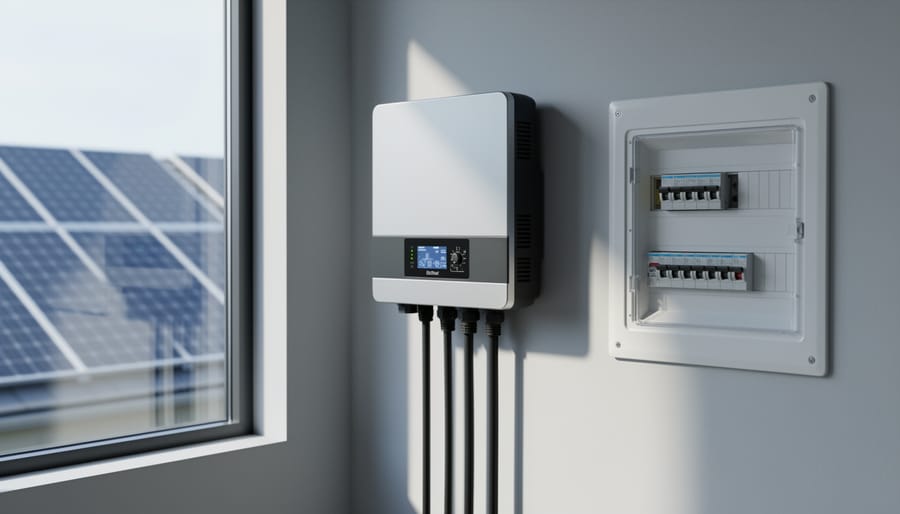
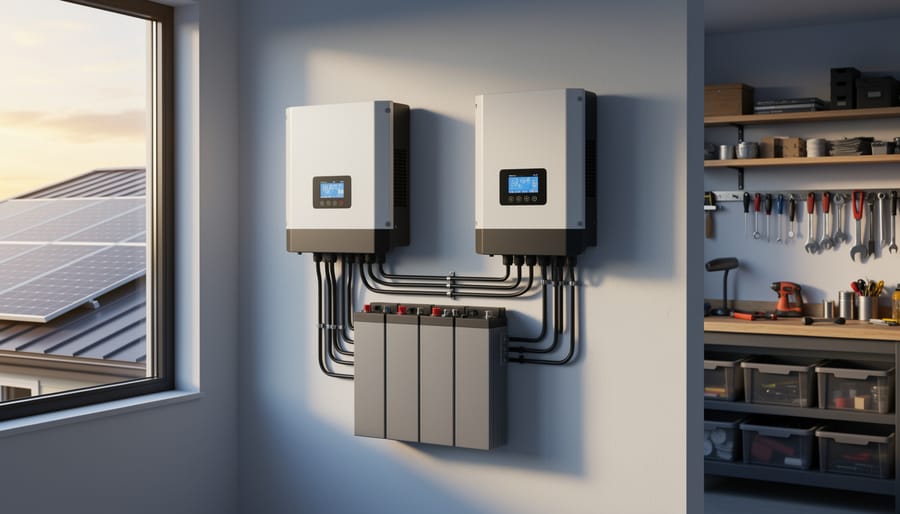
A three-phase solar inverter installation showing the characteristic three-phase connection points that distinguish it from single-phase models.
When Does a DIYer Actually Need a 3-Phase Inverter?
Checking Your Home’s Electrical Setup
Before investing in a 3-phase solar inverter, you’ll need to determine what type of electrical service your home actually has. Here’s how to figure it out without getting overwhelmed.
Start by locating your main electrical panel, usually found in the garage, basement, or on an exterior wall. Open the panel door and look for the main breaker at the top. In a typical single-phase residential setup, you’ll see one large double-pole breaker (often labeled 100A, 150A, or 200A). If you have 3-phase power, you’ll likely see three main breakers or a single large breaker with three poles instead of two.
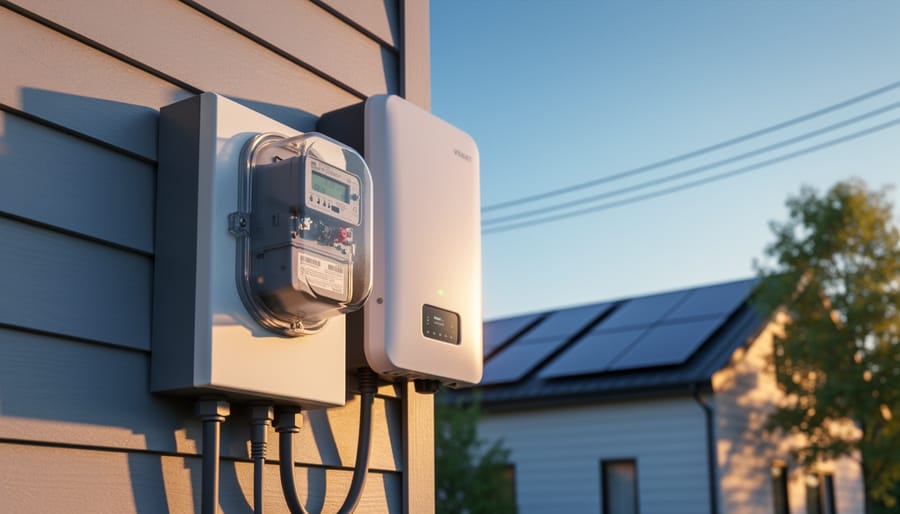
Next, check your utility meter outside. Single-phase meters are usually smaller boxes, while 3-phase meters tend to be larger with more visible connections. Still not sure? Look at the incoming power lines from the utility pole. Single-phase homes typically have two or three wires coming in, while 3-phase installations will have four or more.
I remember when my neighbor Charles was convinced he had 3-phase because his panel looked complex. Turns out, he just had a lot of circuits for his workshop equipment. The lesson? When in doubt, don’t guess.
If you’re uncertain after these checks, snap a few photos of your panel’s main breaker section and the utility meter, then call a licensed electrician. They can definitively identify your power configuration in minutes and advise whether upgrading to 3-phase makes sense for your solar goals. Safety first, especially when dealing with your home’s electrical infrastructure.
Understanding your home’s electrical panel configuration is the first step in determining whether three-phase power is available at your property.
Scenarios Where 3-Phase Makes Sense
Here’s the thing about 3-phase inverters: most homeowners will never need one. But if you’re running a serious workshop, planning a substantial off-grid setup, managing a farm, or setting up a commercial solar installation, 3-phase power might not just be helpful—it could be essential.
I learned this lesson the hard way when my neighbor Charles tried powering his woodworking shop with a standard single-phase system. He kept tripping breakers whenever he fired up his industrial table saw and planer simultaneously. After switching to a 3-phase setup, those power struggles disappeared completely.
Workshops with heavy machinery are prime candidates for 3-phase systems. If you’re running equipment like large compressors, CNC machines, or industrial welders, these tools often require or strongly prefer 3-phase power. They run more efficiently, start more smoothly, and deliver consistent performance compared to struggling on single-phase.
Large off-grid installations benefit enormously from 3-phase configurations. When you’re powering an entire property independently from the grid, balancing your electrical loads across three phases prevents bottlenecks and maximizes your solar investment. Think of it like having three highways instead of one—traffic flows much better.
Farm applications represent another sweet spot. Irrigation pumps, grain handling equipment, and climate control systems for livestock barns frequently run on 3-phase motors. These systems operate all day during peak seasons, so the improved efficiency of 3-phase power translates to real cost savings over time.
Commercial installations almost always warrant 3-phase consideration. Retail spaces, small manufacturing facilities, and office buildings typically have 3-phase service already installed. Matching your solar system with grid-tie inverters designed for 3-phase ensures seamless integration and optimal performance.
Workshops with heavy machinery and high power demands are ideal candidates for three-phase solar inverter systems.
The Real Benefits of 3-Phase Solar Inverters
Efficiency and Load Balancing Explained Simply
Think of a 3-phase system like having three delivery trucks instead of one. When you need to power multiple appliances at once, that single-phase system is like asking one truck to carry everything – it gets overloaded quickly. A 3-phase inverter divides the work among three separate electrical pathways, so each phase carries roughly a third of the total load.
Here’s what this means in practical terms: Let’s say you’re running your air conditioning, electric water heater, and workshop tools simultaneously. With single-phase power, all that demand hits one circuit, which can cause voltage drops, tripped breakers, or inefficient operation. With 3-phase, the load spreads naturally across the three phases, keeping everything running smoothly.
I learned this firsthand when helping a neighbor install solar for his woodworking shop. He kept tripping breakers when running his table saw and dust collector together. After switching to a 3-phase setup, both machines ran without issue, and his voltage remained stable.
This even distribution also means less wear on your system overall. Motors run cooler and more efficiently on 3-phase power, and you’ll experience fewer power quality issues. For most home solar setups, single-phase handles daily needs just fine. But if you’re consistently running heavy equipment or multiple high-draw appliances, 3-phase starts making real sense.
Long-Term Cost Considerations
Here’s the honest truth about 3-phase inverters and your wallet: they typically cost 30-50% more than single-phase systems, and that premium doesn’t always make sense for smaller homes.
I learned this lesson when my neighbor insisted on installing a 3-phase system for his modest 5kW setup. He spent an extra $2,000 upfront, yet his electricity savings remained identical to what a single-phase system would’ve delivered. That money could’ve bought more panels instead.
The math changes dramatically for larger installations. If you’re running a 10kW+ system with genuinely balanced 3-phase power needs, the higher efficiency and equipment protection can recoup that initial investment within 5-7 years through reduced electricity bills and lower maintenance costs. Commercial setups or homes with workshops, electric vehicle chargers, and heavy machinery often hit this sweet spot.
For most residential DIYers, though, single-phase systems deliver better value. Before committing to 3-phase, calculate your actual power usage across all three phases. If you’re primarily powering standard household appliances, air conditioning, and lighting, you’re likely looking at an unnecessary expense.
The breakeven point really depends on your specific electrical demands. Use online solar calculators to model both scenarios with your actual consumption data. Sometimes the simpler solution is the smarter investment.
Challenges and Trade-Offs You Need to Know About
Why 3-Phase Is Trickier for DIY Installation
I’ll be honest with you—when I first looked into 3-phase systems, I assumed the installation would be just like my single-phase setup, only bigger. Boy, was I wrong! Here’s what makes 3-phase installations considerably more complex.
First, the electrical requirements are significantly more demanding. You’re dealing with three separate power lines that must be perfectly balanced, not just one or two. A simple wiring mistake won’t just prevent your system from working—it can create serious safety hazards or damage expensive equipment.
Permitting becomes a much bigger hurdle too. Most jurisdictions require licensed electricians for 3-phase work, period. Your local utility company will likely need to inspect and approve the connection, which adds weeks or months to your timeline. Some areas won’t even allow homeowner-installed 3-phase systems under any circumstances.
The testing and commissioning process requires specialized equipment most DIYers don’t own. We’re talking about phase rotation testers, power quality analyzers, and commercial-grade multimeters—easily thousands of dollars in tools you’ll use once.
When it comes to troubleshooting inverter issues down the road, 3-phase systems require professional diagnostic skills that take years to develop.
Bottom line? Unless you’re a licensed electrician, this is where professional installation becomes non-negotiable for both safety and code compliance.
Professional installation and testing ensure three-phase inverter systems meet safety codes and perform optimally.
Equipment Costs and Availability
Let’s talk dollars and cents, because I know this is where the rubber meets the road for most DIY solar enthusiasts. Here’s my reality check after pricing dozens of systems: 3-phase inverters typically cost 30-50% more than comparable single-phase units. You’re looking at roughly $2,000-$5,000 for a quality residential 3-phase inverter versus $1,200-$3,500 for single-phase with similar capacity.
I learned this lesson when helping my neighbor source his system last year. We initially budgeted for single-phase pricing and had to recalibrate expectations quickly. The good news? The price premium reflects genuine engineering complexity, not just manufacturer markup.
For sourcing quality equipment, stick with established distributors like wholesale solar suppliers, specialized renewable energy retailers, or certified installers who can order commercial-grade equipment. I’ve had great experiences with companies that cater specifically to the DIY community while maintaining professional-grade inventory.
A word of caution: avoid mystery brands on general marketplaces. Your inverter is the heart of your system, and this isn’t where you want to gamble with budget options. Look for established manufacturers with strong warranties and local service networks. The slightly higher upfront cost pays dividends in reliability and support when you need it.
Choosing the Right 3-Phase Inverter for Your Project
Key Specs Decoded (Power Rating, Efficiency, and More)
When you’re shopping for a 3-phase inverter, the spec sheet can look like alphabet soup. Let me walk you through what actually matters.
Power rating comes first, typically shown in kilowatts (kW). This tells you how much solar energy your inverter can handle at once. For most homes, you’ll see ratings between 5kW and 15kW. Here’s my rule of thumb: match your inverter capacity to your solar array size, leaving about 10-15% headroom. If you’ve got 10kW of panels, look for an 11-12kW inverter.
Efficiency percentage is huge because even small differences add up over decades. Modern 3-phase inverters typically run 96-98% efficient. That 2% gap might sound tiny, but on a 10kW system over 25 years, it’s thousands of dollars in lost energy. Look for European efficiency ratings rather than peak efficiency, as they better reflect real-world performance.
Maximum input voltage tells you how many panels you can string together. Higher voltage capability means fewer strings and simpler wiring. Most residential units handle 600-1000V DC input.
Don’t overlook the IP rating for weather protection. IP65 means dust-tight and water-resistant, essential for outdoor installations.
Remember, inverter quality matters beyond just specs. Warranty length (typically 5-10 years) signals manufacturer confidence. For DIY installations under 10kW with straightforward single-phase power, you probably don’t need 3-phase complexity despite impressive specifications.
Brands and Models Worth Considering
When I first started exploring three-phase inverters, I was overwhelmed by the sheer number of manufacturers out there. Through conversations with fellow solar enthusiasts and hands-on experience, I’ve learned that certain brands consistently deliver reliable performance for DIY-friendly installations.
Fronius has earned respect in the solar community for producing inverters with excellent monitoring interfaces that help you understand your system’s performance. Their SnapINverter technology makes installation more straightforward, which matters when you’re working without a large installation crew. SMA Solar Technology, a German manufacturer, offers robust units known for their durability and comprehensive documentation—something I’ve found invaluable when troubleshooting.
For those considering quality inverter options, SolarEdge deserves mention for their optimizer-based systems that work well in situations where shading is a concern. Their monitoring platform is particularly user-friendly, letting you track performance from your phone.
Growatt and GoodWe represent more budget-conscious choices that still maintain solid reputations. I’ve seen several community members successfully install these in their workshops and small businesses. They may lack some advanced features of premium brands, but their straightforward setup and clear manuals make them approachable for determined DIYers.
Remember, the best inverter for your project depends on your specific power needs, available space, and comfort level with electrical systems. Don’t hesitate to reach out to manufacturer support—they’re often surprisingly helpful with technical questions, even for self-installers.
Alternatives If 3-Phase Isn’t Right for You
Here’s the thing I’ve learned after years of helping folks navigate solar decisions: bigger and more complex isn’t always better. If you’ve made it this far and you’re thinking, “Hmm, 3-phase sounds like overkill for my setup,” you’re probably right.
Most residential properties in North America run on single-phase power, and honestly, that’s perfectly fine for the majority of home solar installations. A quality single-phase inverter can handle systems up to 10-12 kW without breaking a sweat, which covers the energy needs of most households. If your home has a standard breaker panel and you’re not running industrial equipment, a single-phase setup will serve you well and save you considerable headache and expense.
For smaller systems or homes with shading challenges, microinverters might be better suited to your needs. I’ve seen these work wonders on roofs with dormers, chimneys, or partial shade from nearby trees. Each panel operates independently, so one shaded panel doesn’t drag down your whole system’s performance. Plus, they’re incredibly DIY-friendly since you’re working with standard household voltage instead of high-voltage DC strings.
Now, if you’ve got 3-phase power coming into your property but want to keep things simple, you have options. Some installers use phase conversion equipment, though I generally advise against this for residential setups due to efficiency losses. A simpler approach is connecting your solar system to just one phase of your service. Yes, you’ll create some phase imbalance, but for residential-scale systems, this rarely causes issues your utility will care about.
The key is matching your inverter choice to your actual needs, not your aspirations. I’ve watched too many enthusiastic DIYers overcomplicate their first solar project. Start with what fits your current electrical service and energy usage. You can always expand later as your confidence and budget grow. There’s genuine satisfaction in building a system that works perfectly for your situation, even if it’s not the most technically impressive option on paper.
Here’s the honest truth I’ve learned after years of tinkering with solar systems: just because something is more advanced doesn’t automatically make it the right choice for your project. I’ll never forget the time I almost convinced myself that I needed a 3-phase inverter for my workshop. I’d read about load balancing, higher efficiency, and commercial-grade performance. It sounded impressive. Then I actually measured my power needs and realized my single-phase setup was already handling everything perfectly fine. I would have spent thousands more for capabilities I’d never use.
Before you commit to a 3-phase solar inverter, take an honest inventory of your situation. Check your electrical panel. Calculate your actual power consumption, not what you think it might be someday. Talk to your utility company about what’s already running to your property. If you’re powering a typical home with standard appliances, a quality single-phase system will likely serve you better and save you money.
That said, if you genuinely have 3-phase equipment or your utility has already installed 3-phase service, then a 3-phase inverter makes perfect sense. The key is matching the technology to your real needs, not your aspirational ones.
I’d love to hear about your experiences. Have you made the jump to 3-phase, or are you sticking with single-phase? What factors influenced your decision? Share your story in the comments below and let’s learn from each other’s solar journeys.
How useful was this post?
Click on a star to rate it!
Average rating 0 / 5. Vote count: 0
No votes so far! Be the first to rate this post.
We are sorry that this post was not useful for you!
Let us improve this post!
Tell us how we can improve this post?
charlesnoble
Here at Spheral Solar, I’m a hands-on solar power enthusiast, constantly exploring and experimenting with DIY solutions. I’m dedicated to sharing my discoveries, insights, and even the bumps I hit along the way, all in the pursuit of a more sustainable future.
Size Your Off-Grid Solar Inverter Right the First… by Charlesnoble February 10, 2026 Calculate your total daily energy consumption by listing every device you’ll power, multiplying each device’s wattage by hours of daily use, then adding 20% for system losses. This single number becomes your foundation—underestimate it, and you’ll face frustrating power shortages; overestimate significantly, and you’ll waste thousands on oversized equipment. Identify…
Why Your RV Inverter Keeps Failing (And How to Fix It Fast) by Charlesnoble January 11, 2026 Check your battery connections first—loose or corroded terminals account for nearly 60% of inverter issues I’ve seen in my years working with RV solar systems. Remove both positive and negative cables, clean them with a wire brush and baking soda solution, then reconnect tightly. While you’re at it, use a…
Why Grid-Tie Solar Inverters Are Your Gateway to… by Charlesnoble December 4, 2025 Grid-tie solar inverters transform your solar panels’ DC electricity into AC power that feeds directly into your home’s electrical system and the utility grid, eliminating the need for expensive battery banks while letting you earn credits for excess power you generate. When your panels produce more electricity than you’re using,…
Why Your Home Solar System Fails During Power… by Charlesnoble March 8, 2026 Picture this: It’s 2 AM, a storm knocks out power in your neighborhood, and while your neighbors scramble for flashlights, your home stays lit, your refrigerator keeps running, and your family sleeps soundly. That’s the peace of mind a solar battery backup system delivers, and honestly, it’s one of the…
This Device Lets Your Solar System Talk to the Grid… by Charlesnoble February 2, 2026 Verify your utility’s specific anti-islanding requirements before purchasing any equipment—most power companies mandate IEEE 1547-compliant devices that automatically disconnect your solar system when the grid goes down, protecting line workers from unexpected backfeed. Contact your local utility interconnection department directly and request their technical specifications document, which lists approved devices…
Why Most RV Solar Setups Fail (And How to Build Yours Right) by Charlesnoble December 21, 2025 Calculate your daily power consumption by listing every device you’ll run in your RV—from the refrigerator drawing 40-60 amp-hours daily to your phone charger using just 5 amp-hours—then multiply by 1.3 to account for system losses and cloudy days. This single step prevents the most common mistake I see fellow…
Subscribe for handpicked DIY projects, exclusive tips, and giveaways.
Route your PV wires through UV-resistant conduit within 18 inches of leaving the solar array, securing it every 3 feet with proper clamps to prevent wind damage and code violations. This single step prevents 80% of the wire degradation issues I’ve seen in DIY solar installations over the past decade. Group your positive and negative… Read more: Why Your PV Wire Management Could Fail Inspection (And How to Fix It)
Understand that 6000 volts sounds terrifying but delivers surprisingly low amperage—typically around 120 milliamps for just 3/10,000th of a second per pulse. This combination creates an unforgettable shock that trains animals to avoid the fence without causing lasting harm. The voltage pushes current through thick fur and hide, while the minimal amperage and microsecond duration… Read more: Why 6000 Volts Won’t Kill Your Livestock (But Will Stop Predators Cold)
Check the maximum voltage and current ratings first—these determine whether your controller can actually handle your solar panel array without frying itself on the first sunny day. I learned this the hard way when my first DIY system shut down every afternoon because I’d paired 600 watts of panels with a controller rated for only… Read more: Why Your Solar Setup Needs Both a Charge Controller and Inverter (And How to Pick the Right Ones)