Why Most RV Solar Setups Fail (And How to Build Yours Right)
Updated:
Calculate your daily power consumption by listing every device you’ll run in your RV—from the refrigerator drawing 40-60 amp-hours daily to your phone charger using just 5 amp-hours—then multiply by 1.3 to account for system losses and cloudy days. This single step prevents the most common mistake I see fellow RV solar enthusiasts make: underestimating their needs and ending up with dead batteries halfway through a camping trip.
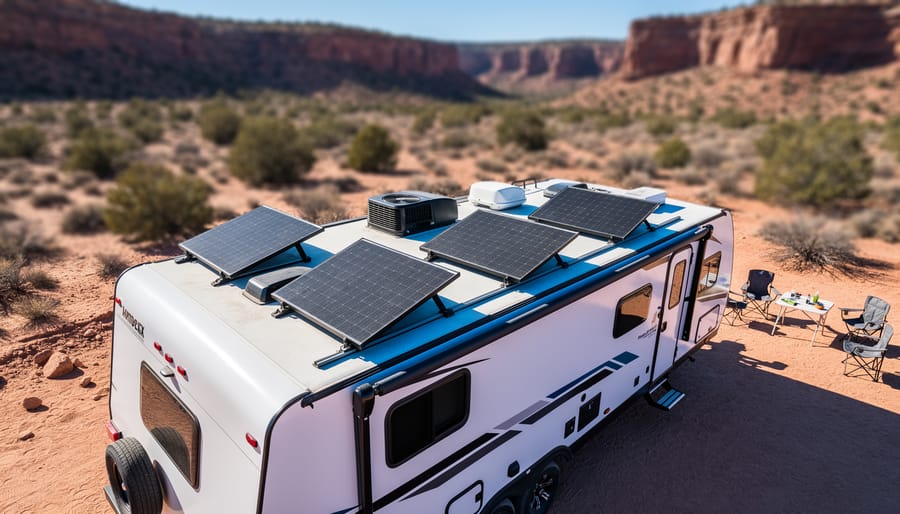
Mount your solar panels where shadows won’t touch them between 9 AM and 3 PM, even when your RV is parked at odd angles. I learned this the hard way during my first installation when a roof vent’s shadow cut my power production by 40 percent during peak sun hours. Use a flexible mounting system that allows slight adjustments, or better yet, opt for tiltable mounts that let you angle panels toward the sun as seasons change.
Size your battery bank to store at least two days of power consumption, giving you a buffer for cloudy weather without constantly running your generator. A 400-amp-hour lithium battery bank paired with 400-600 watts of solar panels works well for most full-time RVers running standard appliances, though your calculation from step one will give you the exact numbers for your situation.
Wire your system with appropriately sized cables—typically 10 AWG for short runs under 15 feet—and always use a charge controller rated 25 percent higher than your panel output to prevent equipment failure. The difference between a system that works flawlessly for years and one that frustrates you constantly often comes down to these fundamental sizing decisions made during the planning phase, not the quality of individual components.
Understanding Your RV’s Power Needs Before You Buy Anything
The 24-Hour Power Audit That Changes Everything
Before you start calculating solar panel wattage or comparing battery banks, you need to know exactly how much power you actually use. I learned this the hard way during my first RV solar setup when I overestimated my needs by nearly 50% and spent way more than necessary. Here’s the simple method that changed everything for me.
Grab a notebook or open a spreadsheet and spend one full day tracking every device you use in your RV. Create three columns: Appliance Name, Watts, and Hours Used Daily. The wattage is usually printed on a label somewhere on each device, or you can find it in the user manual. If you only see amps listed, multiply amps by 12 (your RV’s voltage) to get watts.
Walk through your RV and list everything that draws power. Don’t forget the hidden energy users like your water pump, furnace fan, phone chargers, and even USB ports. For that first day, be honest about your actual usage, not what you think you should use. If you watch TV for three hours, write down three hours.
Now comes the magic calculation. Multiply the watts by hours used for each item to get watt-hours. For example, a 60-watt laptop used for 4 hours equals 240 watt-hours. Add up all these numbers, and you’ve got your daily energy consumption in watt-hours.
This single number becomes the foundation of your entire solar setup, helping you size everything correctly from panels to batteries.
Conducting a thorough power audit helps determine your actual energy needs before purchasing solar components.
Peak Power vs. Average Power (Why This Matters)
When I first started planning my RV solar setup, I made a classic mistake: I calculated my power needs based on what my appliances consume during normal operation, completely forgetting about startup surges. That oversight nearly cost me a fried inverter and a lot of frustration.
Here’s the deal: most electrical devices draw two different amounts of power. Average power (also called continuous or running power) is what your microwave uses once it’s humming along, heating your leftovers. Peak power (or surge power) is the initial jolt needed to get that same microwave started, which can be two to three times higher than its running power.
Let me give you some real-world examples. Your RV air conditioner might run on 1,200 watts, but it needs a whopping 3,600 watts for those first few seconds when the compressor kicks in. A small microwave rated at 1,000 watts can demand 1,500 watts at startup. Even your coffee maker has a brief surge when you flip the switch.
Why does this matter for your solar setup? Your inverter needs to handle these peak demands without shutting down or tripping. If you size everything based only on average power, you’ll be sitting in a hot RV with a safety-tripped inverter, wondering what went wrong.
The solution is simple: when choosing your inverter, make sure its surge rating can handle your highest peak loads. Most quality inverters list both continuous and surge ratings, typically supporting peak loads for several seconds, which is exactly what you need.
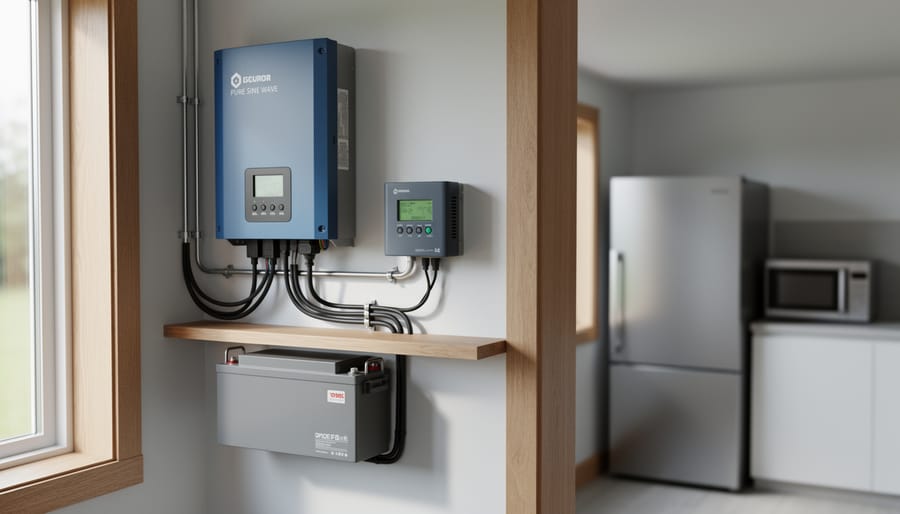
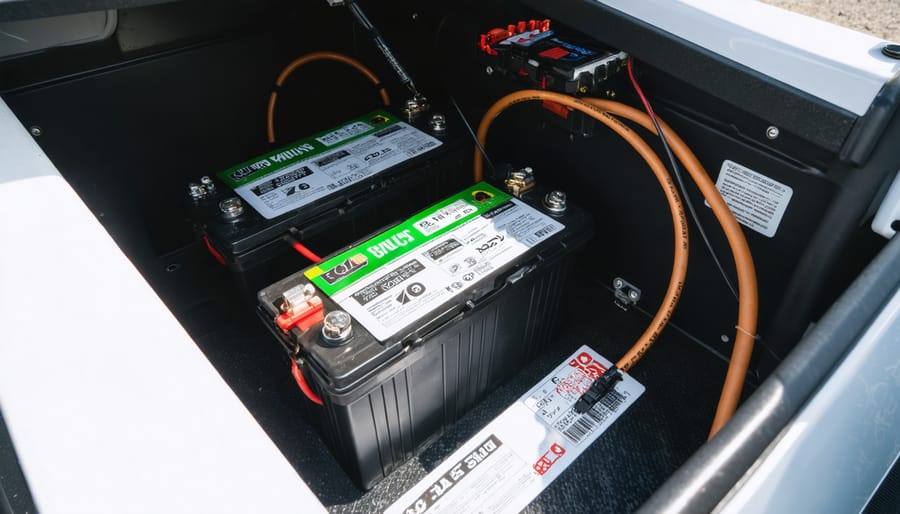
The four essential components of an RV solar system work together to capture, regulate, store, and convert solar energy.
The Four Core Components Every RV Solar System Needs
Solar Panels: Rigid vs. Flexible (And What Actually Works on the Road)
When you’re shopping for RV solar panels, you’ll quickly notice two main types: rigid and flexible. Each has its place, but understanding the real-world differences will save you money and frustration down the road.
Rigid panels are the traditional workhorses you see on most RVs. They’re built with aluminum frames and tempered glass, typically mounted on brackets above your roof. Charles started with three 100-watt rigid panels on his Class C motorhome back in 2019, and they’re still going strong today. The biggest advantage? Efficiency and durability. Rigid panels generally offer better performance per square foot and can last 25 years or more. They’re also easier to replace if something goes wrong since they use standard mounting hardware.
The downside is weight and installation complexity. Each panel weighs around 15-20 pounds, and you’ll need to drill holes in your roof for proper mounting. Charles spent an entire weekend installing his first setup, and he’ll tell you that proper sealing around those roof penetrations is critical to avoid leaks.
Flexible panels, on the other hand, are thin, lightweight, and can conform to curved surfaces. They’re popular for RVs with limited roof space or fiberglass tops where drilling isn’t ideal. You can often just stick them down with adhesive backing. Sounds perfect, right?
Here’s the reality check: flexible panels typically cost 30-50 percent more than rigid panels with the same wattage. They’re also less efficient and don’t handle heat as well. Charles experimented with two flexible panels on his teardrop trailer, and while installation took just an hour, they degraded noticeably after three summers. The adhesive failed in high heat, and the panels themselves showed reduced output.
For most full-time or frequent RVers, rigid panels offer better long-term value. Save flexible panels for specific situations like curved roofs or temporary setups where permanent mounting isn’t possible. Your wallet and your power output will thank you.
Charge Controllers: MPPT vs. PWM Explained in Plain English
Your charge controller sits between your solar panels and batteries, regulating the power flow. Think of it as a smart middleman that ensures your batteries charge safely and efficiently. There are two main types: PWM (Pulse Width Modulation) and MPPT (Maximum Power Point Tracking), and understanding the difference will save you money and headaches.
PWM controllers are the simpler, cheaper option. They work by pulling down the panel voltage to match your battery voltage. If your panels produce 18 volts but your battery is at 12 volts, the PWM controller essentially wastes that extra 6 volts. It’s like having a garden hose but only opening the tap partway. PWM controllers typically cost between $30-$150 and work fine for small systems under 200 watts where your panels and batteries are closely matched in voltage.
MPPT controllers are smarter and more efficient. They convert excess voltage into additional amperage, capturing up to 30% more power from your panels, especially in cold weather or low-light conditions. Instead of wasting that extra voltage, MPPT technology transforms it into usable charging current. Yes, they cost more—usually $150-$500—but here’s where it gets interesting.
I learned this lesson the hard way on my first RV setup. I went with PWM to save $150 upfront, then watched my batteries barely charge on cloudy days while my friend’s identical RV with MPPT kept chugging along. Within a year, I upgraded.
For most RVers with systems over 200 watts, MPPT pays for itself through increased efficiency and faster charging times. You’ll harvest more power from the same panels, especially during those less-than-perfect weather days when you need it most.
Battery Banks: Choosing Between Lithium and Lead-Acid
When I first started researching batteries for my RV solar setup, the price difference between lithium and lead-acid nearly gave me sticker shock. A 200Ah lithium battery runs around $800-1,200, while a comparable lead-acid setup costs just $200-400. But here’s what changed my mind: total cost of ownership tells a completely different story.
Let’s break down the real numbers. Lead-acid batteries typically last 300-500 charge cycles and shouldn’t be discharged below 50% capacity. That means your 200Ah battery realistically gives you 100Ah of usable power. Lithium batteries, on the other hand, handle 3,000-5,000 cycles and can safely discharge to 80-90%, giving you 160-180Ah of actual usable capacity from that same 200Ah rating.
Here’s the calculation that convinced me: If you replace lead-acid batteries every 3-4 years at $350 each, you’ll spend roughly $1,050-1,400 over 10 years. A lithium battery costing $1,000 should last that entire decade or longer. Plus, lithium weighs about one-third as much—a huge advantage when every pound counts in an RV. My 200Ah lithium bank weighs 55 pounds compared to 130 pounds for equivalent lead-acid.
The maintenance difference matters too. Lead-acid batteries need regular water top-ups (for flooded types), careful monitoring to prevent sulfation, and they hate sitting partially charged. I learned this the hard way when I killed a set of golf cart batteries by leaving my RV unused for two months. Lithium batteries require virtually zero maintenance and handle irregular usage patterns beautifully.
Temperature sensitivity is worth mentioning. Lead-acid performs poorly in cold weather but charges in any temperature. Lithium delivers consistent power in the cold but most can’t charge below freezing without a heating system. If you’re winter camping regularly, factor in batteries with built-in heating or budget for external heaters.
My honest recommendation? If you’re on a tight budget and camp occasionally, quality lead-acid batteries work fine. Consider 6-volt vs 12-volt batteries for your configuration. But if you’re a frequent traveler or full-timer like many folks in our community, lithium pays for itself through longevity, weight savings, and hassle-free operation. I made the switch three years ago and haven’t looked back.
Inverters: Sizing for Your Actual Needs
Choosing the right inverter can feel overwhelming, but I’ll walk you through what actually matters. When I first upgraded my RV’s solar system, I nearly made the classic mistake of buying way too much inverter—thinking bigger was always better.
First, let’s tackle the big question: pure sine wave vs modified. Pure sine wave inverters produce clean power that’s identical to what comes from the grid, making them safe for sensitive electronics like laptops, medical devices, and modern appliances with microprocessors. Modified sine wave inverters are cheaper but can cause issues—humming in audio equipment, shortened appliance lifespan, and sometimes outright failure with certain devices. For RV living, I always recommend pure sine wave. It’s worth the extra cost for peace of mind.
Now for sizing, here’s the practical approach. Calculate your highest simultaneous power draw, not your total system capacity. If you’ll never run your microwave and coffee maker at the same time, don’t size for both. Most RVers do well with 1000-2000 watts. A 3000-watt inverter sounds impressive, but it draws more phantom power when idle and costs significantly more.
The biggest mistake? Buying a massive inverter “just in case.” I’ve seen folks with 3000-watt inverters who realistically use 800 watts maximum. The second mistake is going too small and constantly tripping the overload protection. Use this simple rule: add up the wattage of everything you might run simultaneously, then add 20 percent buffer.
Check out our guide to the best pure sine wave inverters for specific recommendations based on your actual usage patterns, not theoretical maximums.
Sizing Your System: The Math Made Simple
Here’s the truth about sizing an RV solar system: it’s less complicated than you think, but it does require some honest math. I learned this the hard way during my first attempt, when I severely underestimated my needs and spent three cloudy days rationing power like I was on a spaceship.
Let’s walk through a real example together. Meet Sarah, who wants to power her 27-foot travel trailer for weekend trips. First, she lists her devices: a 12V refrigerator drawing 40 watts continuously, LED lights totaling 20 watts for 4 hours daily, a laptop at 65 watts for 3 hours, and her phone charger at 10 watts for 2 hours.
The calculation is straightforward. Multiply each device’s wattage by hours used: the fridge uses 960 watt-hours daily (40W × 24 hours), lights need 80 watt-hours (20W × 4 hours), the laptop requires 195 watt-hours (65W × 3 hours), and the phone uses 20 watt-hours (10W × 2 hours). Add these together, and Sarah’s daily consumption is 1,255 watt-hours, or about 1.3 kilowatt-hours.
Now comes the crucial part that most guides skip: adding buffer capacity. Solar systems aren’t 100 percent efficient. You’ll lose power through charge controllers (about 15 percent), battery charging inefficiencies (another 10 percent), and wire resistance. Plus, you need extra capacity for cloudy days when your panels produce less.
Here’s my rule of thumb: multiply your daily usage by 1.3 to account for system inefficiencies, then multiply by the number of days you want to run without sun. For Sarah, that’s 1,255 × 1.3 = 1,632 watt-hours per sunny day. If she wants two days of backup, her battery bank needs 3,264 watt-hours of storage.
For solar panels, divide your adjusted daily usage by average sun hours in your location. Most places get 4-5 peak sun hours. Sarah would need approximately 400 watts of panels (1,632 ÷ 4 = 408 watts).
Our calculator tool simplifies this entire process, automatically factoring in these buffers and giving you component recommendations. It takes about five minutes and saves hours of spreadsheet frustration.
Installing Your RV Solar Setup (Without Drilling Holes You’ll Regret)
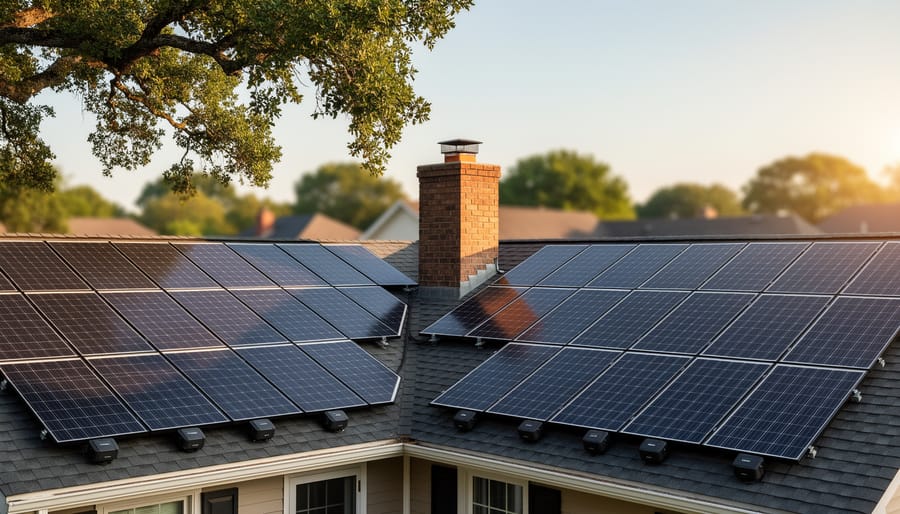
Mounting Panels on Your RV Roof the Right Way
Securing solar panels to your RV roof might seem intimidating, but with the right approach, you can do it confidently without damaging your rig. I learned this the hard way when I nearly cracked a panel on my first attempt by overtightening the bolts—patience is your friend here!
First, choose your mounting method. Z-brackets are the most popular because they’re affordable and create airflow beneath panels, which keeps them cooler and more efficient. Tilt mounts work great if you want adjustable angles, though they catch more wind while driving. For a low-profile look, flush mounts sit directly against the roof.
Before drilling anything, map out your panel placement. Leave at least two inches between panels and the roof edge for airflow. Position them to avoid roof vents, AC units, and areas that get shade from antennas or other obstructions. Trust me, even partial shade can significantly reduce output.
When it’s time to seal those mounting holes, use a high-quality dicor lap sealant or a similar product rated for RV roofs. Regular silicone won’t cut it—it breaks down under UV exposure and temperature fluctuations. Clean the mounting area thoroughly with isopropyl alcohol, apply sealant generously around bolt holes, and don’t skimp on the stuff. Water intrusion is your roof’s worst enemy.
Finally, hand-tighten bolts first, then give them just a quarter turn with a wrench. Over-tightening can crack panels or compress roof materials too much, creating future leak points. Check and reapply sealant annually during routine maintenance.
Proper mounting techniques and quality sealants prevent roof leaks while ensuring panels remain secure during travel.
Running Wires Safely (Wire Gauge Matters More Than You Think)
I learned about wire gauge the hard way during my first RV solar install. I figured thicker wires were just an upsell, so I went with what looked “good enough.” Within weeks, I noticed warm spots along my cables during charging—a clear sign something was wrong. Turns out, undersized wires don’t just waste energy through voltage drop; they can actually start fires.
Here’s what matters: the longer your wire run and the more current flowing through it, the thicker your wire needs to be. For most RV solar setups, you’ll use 10 AWG for runs under 15 feet between panels and charge controller, and 8 AWG or thicker for longer distances or higher currents. Always use a wire sizing calculator that factors in your system voltage, amperage, and distance. A 3% voltage drop is acceptable, but aim for 2% or less for maximum efficiency.
Fusing is non-negotiable. Install a fuse or breaker within 7 inches of your battery on the positive wire. This protects against short circuits that could turn your RV into a torch. Use marine-grade fuses rated slightly above your maximum expected current.
When routing wires through your RV, avoid sharp edges that could nick insulation over time. Use grommets when passing through walls, secure cables every 18 inches with proper clamps, and keep them away from heat sources like exhaust pipes. Run wires through existing chase ways when possible, and never just let them dangle loose where they might chafe or get crushed.
Connecting Everything: The Order That Prevents Sparks and Damage
Here’s the truth I learned the hard way: connection order matters just as much as having the right components. Think of it like lighting a gas stove—you want everything in place before you strike the match.
Start with your batteries completely disconnected from everything. Next, wire your charge controller to the batteries first, then connect your solar panels last. This prevents voltage spikes that can fry your controller. I once reversed this and watched a $200 controller spark out in seconds—not my proudest moment.
When adding an inverter, connect it directly to the batteries with proper fuses, making sure you’re properly grounding your inverter to your RV’s chassis. Use a multimeter to check voltage at each step before moving forward.
The golden rule: batteries first, controller second, panels last. And always, always install fuses or breakers between every major component. These aren’t optional—they’re your safety net. Test each connection with a gentle tug to ensure everything’s secure before powering up the system.
Real-World Performance: What to Expect When You’re Off-Grid
Let’s talk reality here, because solar living isn’t always sunshine and roses (though there’s definitely plenty of sunshine involved). Understanding what your system will actually deliver in real-world conditions helps you plan better and avoid frustration down the road.
Charles learned this lesson during his first winter in Montana. “I’d sized my system perfectly for summer camping,” he recalls, “but come December, my 400 watts of panels were producing maybe 120 watts on good days. I was running my generator way more than I’d planned.” The culprit? Shorter days, lower sun angles, and those gorgeous snow-covered mornings that kept his panels covered.
Here’s the thing: your solar panels won’t produce their rated wattage most of the time. That 100-watt panel? In ideal conditions with perfect sun angle and cool temperatures, you might see 100 watts. But realistically, expect 60-80 watts during peak hours on average days. Clouds, dust, heat, and angle all reduce output.
Seasonal variations matter tremendously. Summer camping in Arizona might give you 6-7 hours of usable sunlight daily. Winter in the Pacific Northwest? You might see 2-3 hours of weak production. This is why oversizing your system based on your worst-case scenario makes sense if you’re year-round travelers.
Location dramatically affects performance too. Desert environments offer incredible solar potential but panels get hot, which reduces efficiency. Heavily forested campgrounds provide shade and comfort but terrible solar production. Charles now checks sun exposure before committing to extended stays anywhere.
Temperature impacts are counterintuitive. Cold, sunny winter days can actually produce excellent power because solar panels are more efficient when cool. That blazing 105-degree summer afternoon? Your panels are losing 10-15 percent efficiency compared to their rated specs.
The good news? Once you understand these patterns, you adapt. Charles now carries portable panels he can angle perfectly and move into sun patches. He plans power-hungry activities for sunny days and goes minimal during cloudy stretches. Real-world solar living means staying flexible and learning your system’s personality through the seasons.
A properly sized solar system enables true off-grid freedom, allowing extended stays in remote locations without hookups.
Common Problems and How to Fix Them Before They Strand You
Nothing tests your patience quite like watching your solar panels soak up brilliant sunshine while your batteries refuse to charge. I learned this lesson the hard way during a desert camping trip when my system suddenly stopped producing power—and I was 50 miles from the nearest town. After some frantic troubleshooting, I discovered a loose wire connection that took five minutes to fix. That experience taught me that most RV solar problems have simple solutions if you know where to look.
Start with the obvious culprits. If your panels aren’t producing power, check for shade first—even a small shadow from a tree branch or RV antenna can dramatically reduce output. Clean your panels too, since dust and bird droppings create surprising power losses. Use a soft cloth and water, nothing abrasive.
When your charge controller shows low or zero input, examine all wire connections. Vibration from traveling loosens terminals over time. Tighten everything, especially the connections between panels and controller. Also inspect your MC4 connectors where panel wires join together—these can corrode in humid climates.
Battery issues often masquerade as solar problems. If batteries won’t hold a charge despite good panel output, test the battery voltage directly with a multimeter. A reading below 12 volts on a rested battery signals trouble. Check water levels if you have flooded lead-acid batteries, and look for corrosion on terminals. Sometimes the solution is just cleaning connections with a wire brush and applying terminal protector spray.
Inverter problems deserve special attention since they’re more complex. If your inverter won’t turn on or keeps shutting off, it might be overheating, overloaded, or experiencing low battery voltage. For detailed guidance on troubleshooting solar inverter problems, there are specific diagnostic steps you can follow.
Keep a basic toolkit handy: multimeter, wire strippers, crimpers, spare fuses, and extra MC4 connectors. These simple items have saved countless camping trips. Document your system’s normal voltage and amperage readings when everything works properly—this baseline makes diagnosing problems much easier later.
Remember, most RV solar issues stem from connections, not components. Before assuming equipment failure, systematically check every wire, terminal, and connector in your system. This methodical approach finds problems fast and keeps you powered up wherever your adventures take you.
Expanding Your System Later (Future-Proofing Your Investment)
When I first installed my RV solar system five years ago, I thought I was being smart by buying exactly what I needed. But six months later, I wanted to add more panels. The problem? I hadn’t left any room to grow. Learn from my mistake and plan ahead, even if you don’t expand right away.
The smartest investment you can make is buying a charge controller with extra capacity from the start. If you’re installing 400 watts of panels, consider a controller rated for 600 or even 800 watts. The price difference is usually minimal compared to replacing the entire unit later. The same goes for your inverter. If you need 1000 watts now, a 2000-watt inverter gives you breathing room without breaking the bank.
Battery systems are easier to expand if you plan correctly. When choosing your initial battery bank, stick with a technology and brand you can add to later. Mixing different battery types or ages creates problems, so buy batteries you know will still be available in a year or two. Lithium batteries with built-in battery management systems are particularly expansion-friendly since you can often add identical units in parallel without complicated rewiring.
Leave physical space for growth. Mount your charge controller and inverter where you can access connections easily. Run conduit or leave wire channels that can accommodate additional cables. I now keep a small diagram taped inside my electrical cabinet showing what capacity each component can handle, which saves me from second-guessing myself.
Generally, upgrade components when they limit your system’s potential. Replace them when they fail or become obsolete. Your future self will thank you for thinking ahead today.
Starting your RV solar journey might feel overwhelming at first, but remember that every experienced solar user began exactly where you are now. The key is breaking down the process into manageable steps and not rushing into purchases before you understand your actual needs.
I’ve seen countless RV owners transform their travel experience through solar power, and honestly, the planning phase is where you set yourself up for success. Take time to calculate your energy consumption, research quality components, and design a system that can grow with your needs. The upfront effort pays off in years of reliable, quiet power that lets you camp wherever your heart desires.
The Spheral Solar community is here to support you every step of the way. Whether you’re using our solar calculators to size your system, browsing component guides, or asking questions in the forums, you’re joining thousands of people who’ve successfully made the switch to solar. We’ve built these resources specifically to demystify the process and make solar accessible to everyone, regardless of technical background.
Remember, your RV solar setup isn’t just about panels and batteries. It represents freedom from noisy generators, expensive campground hookups, and the limitations of traditional RV power. You’re taking control of your energy future, reducing your environmental footprint, and opening up a whole new world of off-grid possibilities. That first morning you wake up to fully charged batteries powered entirely by sunshine makes every bit of planning worthwhile. Your energy independence awaits.
How useful was this post?
Click on a star to rate it!
Average rating 0 / 5. Vote count: 0
No votes so far! Be the first to rate this post.
We are sorry that this post was not useful for you!
Let us improve this post!
Tell us how we can improve this post?
charlesnoble
Here at Spheral Solar, I’m a hands-on solar power enthusiast, constantly exploring and experimenting with DIY solutions. I’m dedicated to sharing my discoveries, insights, and even the bumps I hit along the way, all in the pursuit of a more sustainable future.
Size Your Off-Grid Solar Inverter Right the First… by Charlesnoble February 10, 2026 Calculate your total daily energy consumption by listing every device you’ll power, multiplying each device’s wattage by hours of daily use, then adding 20% for system losses. This single number becomes your foundation—underestimate it, and you’ll face frustrating power shortages; overestimate significantly, and you’ll waste thousands on oversized equipment. Identify…
Why Your RV Inverter Keeps Failing (And How to Fix It Fast) by Charlesnoble January 11, 2026 Check your battery connections first—loose or corroded terminals account for nearly 60% of inverter issues I’ve seen in my years working with RV solar systems. Remove both positive and negative cables, clean them with a wire brush and baking soda solution, then reconnect tightly. While you’re at it, use a…
Why 6-Volt RV Batteries Beat 12-Volt for Your Solar Setup by Charlesnoble November 11, 2025 Choose 6-volt golf cart batteries when building your RV solar system if you prioritize longevity and consistent deep-cycle performance over initial simplicity. Wire two 6-volt batteries in series to create 12 volts with roughly double the amp-hour capacity of comparable single 12-volt batteries, giving you more usable power before reaching…
This Device Lets Your Solar System Talk to the Grid… by Charlesnoble February 2, 2026 Verify your utility’s specific anti-islanding requirements before purchasing any equipment—most power companies mandate IEEE 1547-compliant devices that automatically disconnect your solar system when the grid goes down, protecting line workers from unexpected backfeed. Contact your local utility interconnection department directly and request their technical specifications document, which lists approved devices…
Why Your Home Solar System Fails During Power… by Charlesnoble March 8, 2026 Picture this: It’s 2 AM, a storm knocks out power in your neighborhood, and while your neighbors scramble for flashlights, your home stays lit, your refrigerator keeps running, and your family sleeps soundly. That’s the peace of mind a solar battery backup system delivers, and honestly, it’s one of the…
Why 3-Phase Solar Inverters Are Game-Changers for… by Charlesnoble January 29, 2026 Check your main electrical panel right now—if you see three thick power cables entering your home instead of two, you already have 3-phase power and might benefit from a 3-phase solar inverter. Most residential homes run on single-phase power, making 3-phase systems unnecessary for typical DIY solar setups, so understanding…
Subscribe for handpicked DIY projects, exclusive tips, and giveaways.
Match your solar panels to microinverters or power optimizers based on your roof’s shading patterns—even partial shade from a chimney or tree during morning hours means module-level power electronics will recover 15-25% more energy than string inverters lose to the weakest panel. Install power optimizers when you’re working with mixed panel orientations across multiple roof… Read more: Why Smart Solar Modules Could Save Your DIY Array (Before It’s Too Late)
Measure your conduit run before purchasing materials by mapping the exact path from your solar array to the inverter and battery location, accounting for a 10% waste factor and additional length for bends. PVC electrical conduit remains the most cost-effective protective solution for DIY solar installations, but improper installation creates fire hazards, code violations, and… Read more: Why Your Solar Conduit Installation Could Start a Fire (And How to Do It Right)
Walk down to your nearest stream with a five-gallon bucket and a stopwatch. Fill that bucket and time how long it takes—this simple test reveals whether you have enough flowing water to power your off-grid home. If you can fill it in under 10 seconds from a source that drops at least 10 feet in… Read more: The Stream Behind Your House Could Power It (Here’s How Micro Hydro Works)