Why Your Pool Solar Heater Valve Position Changes Everything (And How to Get It Right)
Updated:
Set your three-way valve to point toward the roof when you want solar heating, typically between 10 AM and 4 PM on sunny days when your panels can effectively warm the water. Point it toward the bypass position during cloudy weather, at night, or when your pool has reached the desired temperature and you’re just circulating water. Check that your valve handle aligns perfectly with the pipe direction you want water to flow through – a common mistake I see is people leaving it at a 45-degree angle, which splits flow inefficiently and reduces heating performance.
Your valve position directly controls whether pool water travels up to your solar panels or bypasses them entirely, making it the single most important adjustment for maximizing your system’s efficiency. Most homeowners install solar heating to cut energy costs but then leave their valves in the wrong position for hours or even days, essentially running an expensive pump while gaining zero heat benefit.
Understanding when to switch positions saves you money on both heating and filtration costs. During peak sun hours, routing water through your panels can raise pool temperature by 5-10 degrees, but running that same water through panels on a cold, cloudy morning actually cools your pool down. The solution isn’t complicated – it just requires knowing three basic positions (solar, bypass, and sometimes winterize) and matching them to current weather conditions and your pool’s temperature goals. This guide walks you through exactly when to use each position, how to troubleshoot flow problems, and simple upgrades that can automate the entire process.
Understanding Your Solar Pool Heating System’s Valve Setup
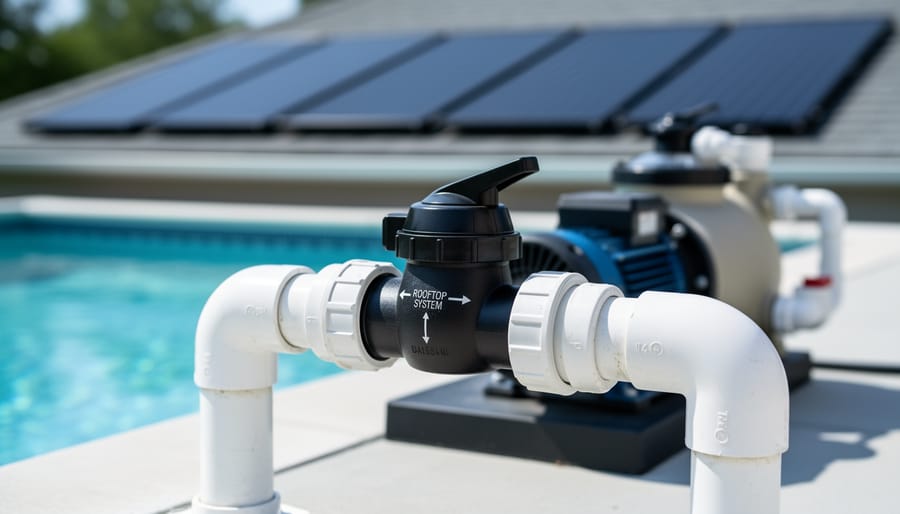
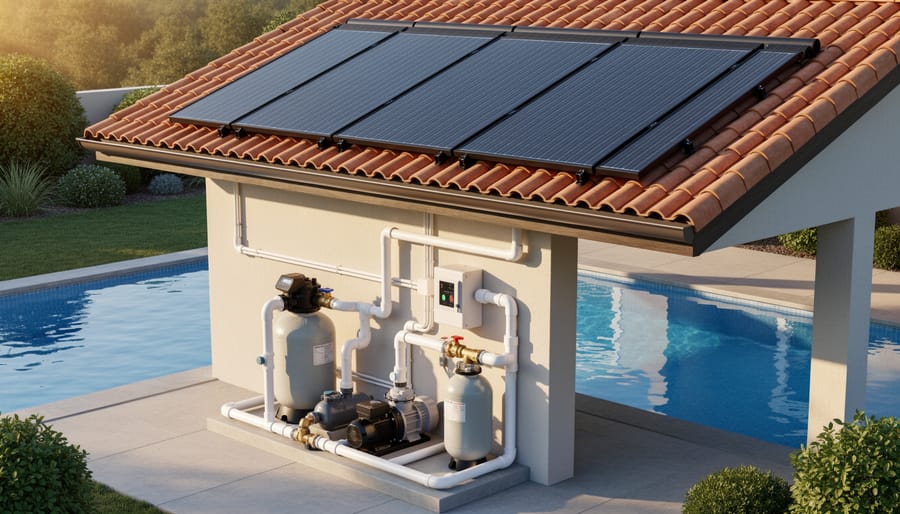
Three-way valves control water flow between your pool filter, solar panels, and bypass routes, making correct positioning essential for efficient heating.
The Three Main Valve Positions Explained
Understanding your three-way valve positions is simpler than you might think. Most solar pool heating systems use a valve with three distinct settings, and knowing when to use each one can make a huge difference in how efficiently your system operates.
The first position is full solar heating mode. In this setting, your pool water flows directly through the solar panels on your roof before returning to the pool. You’ll want to use this position during sunny days when your panels are hot and can effectively warm your water. I remember when I first set up my system, I was amazed at how quickly the temperature would climb on a clear afternoon with the valve in this position. If your solar panels are warmer than your pool water, this is your go-to setting.
The second position is bypass mode, which routes water around the solar panels entirely. Think of this as your nighttime or cloudy day setting. When your panels are cooler than your pool water, running water through them would actually cool down your pool, which defeats the purpose. I learned this the hard way during my first installation when I left the system running overnight and wondered why my pool felt colder in the morning. Bypass mode is also useful during those scorching summer days when your pool is already at your ideal temperature and you don’t want it getting any warmer.
The third position is pool filtration only, which is essentially your standard pool operation without solar involvement. This setting keeps your filtration system running while completely isolating the solar heating loop, perfect for maintenance or when the solar system needs servicing.
Manual vs. Automatic Valve Systems
When I first installed my solar pool heater, I faced a classic DIY dilemma: should I stick with simple manual valves or splurge on an automatic controller? After years of experience with both, I can tell you each approach has its place depending on your budget, technical comfort level, and how hands-on you want to be.
Manual three-way valves are the budget-friendly choice, typically costing between $30-$80 for quality brass models. They’re incredibly reliable with no electronics to fail, and they give you complete control over water flow. The downside? You need to physically adjust them based on weather conditions and pool temperature. On chilly mornings, you’ll walk outside to redirect flow, and on scoreboard-hot afternoons, you’ll do it again. For folks who enjoy being actively involved in their pool maintenance, this isn’t a burden, it’s part of the routine.
Automatic valve controllers, ranging from $200-$600 depending on features, take the guesswork out of the equation. These systems use temperature sensors to automatically divert water through your solar panels when heating is beneficial and bypass them when it’s not. Some even integrate with your dedicated solar pump for complete automation. The investment pays off in convenience and optimal efficiency, especially if you travel frequently or simply want a set-it-and-forget-it solution.
My recommendation for most DIYers? Start manual and upgrade later if needed. You’ll learn how your system responds to different conditions, making you a better solar pool owner regardless of which path you ultimately choose.
How to Position Your Valves for Maximum Solar Heating
Morning and Cool Weather Settings
During those chilly mornings or cool spring days when your pool feels more like a polar plunge, you’ll want every bit of solar heat you can capture. This is when I set my valves for maximum solar gain, and trust me, getting this right makes a huge difference.
Start by directing 100% of your pool water through the solar panels. If you have a three-way valve, turn it fully toward the solar panel position. For setups with multiple valves, close the bypass valve completely so all water takes the solar route. Think of it like choosing between a scenic mountain road and a tunnel – right now, you want that scenic route where the sun can warm things up.
Here’s something I learned the hard way: flow rate matters just as much as direction. When it’s cool outside, slow down your pump speed if you have a variable-speed model. Slower flow gives water more time to absorb heat in the panels, typically increasing temperature gain by 5-10 degrees. I aim for water spending about 15-20 seconds in the panels during cool weather.
One quick tip from my own backyard: check your panels around 10 AM. If they’re noticeably warmer than the air temperature, you’re in business. That’s your green light to keep the valves in full solar mode throughout the day.
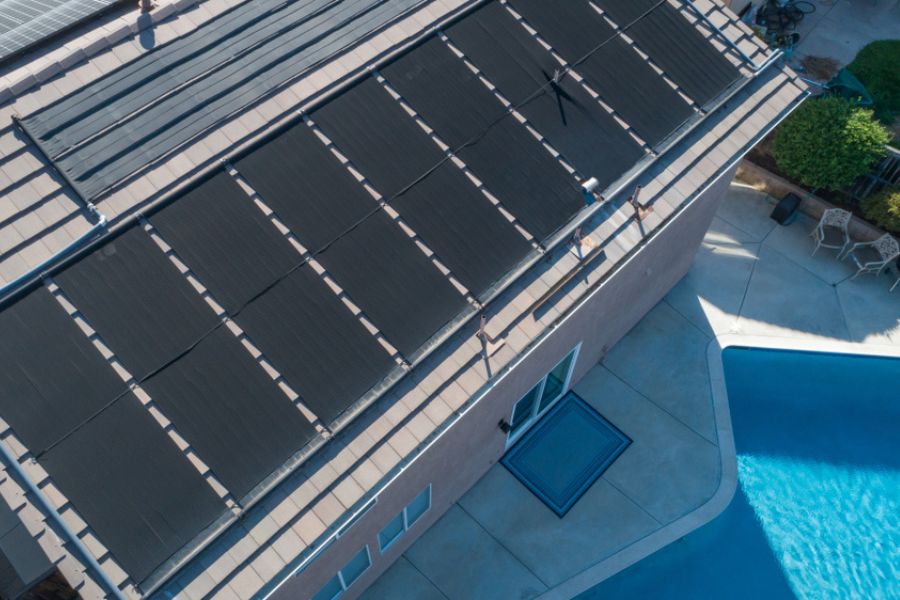
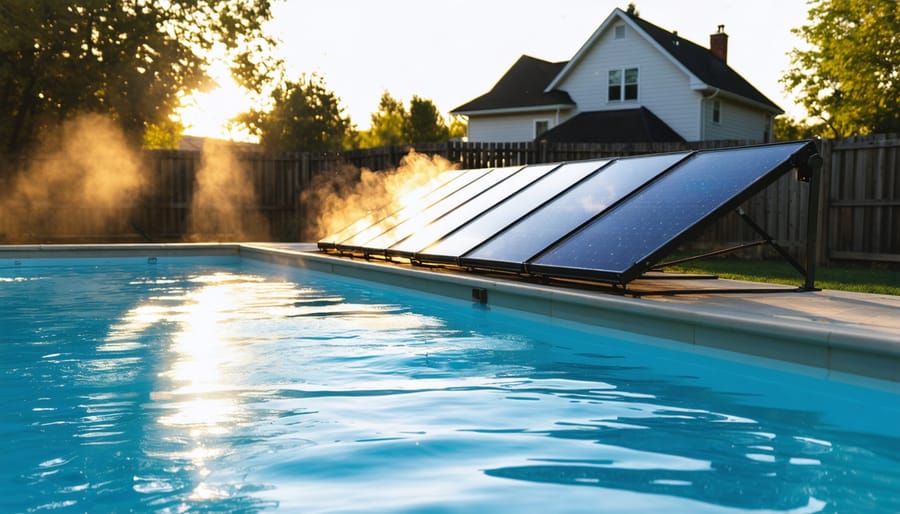
Solar panels actively heating pool water during peak sunshine hours demonstrate the system operating in full solar heating mode.
Hot Afternoon and Maintenance Mode
On scorching afternoons when your pool water creeps past 85°F, your solar panels can actually make things worse by adding even more heat. I learned this the hard way during my first summer with solar heating—nothing like an uncomfortably warm pool to teach you about bypass mode! When temperatures soar, simply switch your valve to bypass position, directing water straight back to the pool without passing through the collectors on your roof.
Most three-way valves have a middle position that’s perfect for this. You’re essentially giving your solar system a break while still maintaining circulation through your filter. Some pool owners worry about their panels sitting idle in the sun, but don’t stress—they’re designed to handle it. The water inside will heat up and expand slightly, which is completely normal.
During maintenance or when you’re winterizing your system, set your valve to allow some circulation through the panels every few weeks. This prevents stagnant water issues and keeps seals from drying out. Think of it like running your car occasionally during winter storage—a little movement goes a long way toward preventing problems. If you’re planning extended maintenance, consider the full bypass position to make repairs easier and safer.
Night and Off-Season Positions
Once the sun sets, your solar panels actually become heat thieves if you’re not careful. I learned this the hard way during my first solar pool installation when my pool lost 5 degrees overnight because I left the valves in the wrong position. Here’s what you need to know to protect your hard-earned heat.
At night, turn your valve to the “pool only” or “bypass” position. This prevents reverse thermosiphoning, which is when cooler water in your panels naturally flows back down into your warm pool, stealing heat you worked all day to collect. Think of it like leaving your front door open in winter. Some systems have check valves that prevent backflow automatically, but manual valves need your attention.
For off-season storage, especially in freezing climates, position valves to completely drain the solar panels. Set your three-way valve to direct flow away from panels, then open any drain plugs at the lowest points. I usually blow compressed air through my lines to remove lingering water, a trick an old pool technician taught me that prevents expensive freeze damage.
If you have an automated controller, it should handle nighttime valve positioning automatically. Still, double-check the settings before leaving for vacation or during your first few weeks to ensure everything functions properly.
Common Valve Position Mistakes That Kill Your Efficiency
Manual valve adjustments throughout the day allow pool owners to optimize heating performance based on weather conditions and temperature goals.
The Partial Flow Trap
I learned this lesson the hard way during my first season with solar pool heating. I thought I was being clever by setting my valve halfway open—giving me “the best of both worlds” with some heated water while keeping good flow through my filter. Turns out, I was just wasting sunshine.
Here’s what actually happens with partial valve positions: when you split the flow between your solar panels and the bypass, neither pathway gets optimal flow rate. Your solar collectors need sufficient water volume moving through them to actually pick up heat effectively. When you throttle back the flow with a partial setting, water sits in the panels longer but doesn’t circulate back to the pool fast enough. Meanwhile, the bypass water dilutes whatever warm water does return, so your pool temperature barely budges.
Think of it like trying to fill a bathtub with the drain half-open. You’re working against yourself.
The math is pretty straightforward: if you’re getting 50% flow through your panels, you might lose 60-70% of your potential heating because of reduced circulation efficiency. You’re better off running full solar flow for shorter periods than partial flow all day. Your system is designed for committed positions—either heating mode or standard circulation. Trying to compromise just compromises your results.
Forgetting the Night Bypass
I learned this lesson the hard way during my first season with solar pool heating. One beautiful summer evening, I left my valves in solar mode, thinking I’d get a head start on the next day’s heating. The next morning, I was shocked to find my pool had actually lost several degrees overnight!
Here’s what happens: during nighttime hours, your solar panels become heat radiators instead of heat collectors. Without sunlight, they’re essentially just large metal surfaces exposed to cool night air. When water circulates through them, it releases heat to the atmosphere rather than absorbing it.
The math is sobering. A typical residential solar panel array can lose between 5,000 to 15,000 BTUs per hour overnight, depending on your climate and panel surface area. Over an 8-hour night, that’s enough to drop a 15,000-gallon pool by 2-3 degrees Fahrenheit. In cooler climates or during shoulder seasons, the loss can be even more dramatic.
The fix is simple: always switch your valve to bypass mode before sunset. This routes water directly back to your pool, completely skipping the solar panels. Some pool owners set phone reminders for this task, while others install timers that automatically switch valve positions. Your future self (and your utility bill, if you’re running backup heating) will thank you for this small evening routine.
Ignoring Pressure and Flow Indicators
Your valve position directly impacts system pressure, and those gauges aren’t just there for decoration. When I first installed my solar pool heater, I ignored the pressure gauge for weeks until I noticed my panels weren’t heating efficiently. Turned out my valve position was creating too much back pressure.
Here’s what you need to know: when your valve directs water through the solar panels, you should see a pressure increase of 2-5 PSI on your gauge compared to the bypass position. If you’re seeing more than 8 PSI difference, that’s a red flag indicating a blockage or incorrect valve positioning. Too little pressure difference (under 1 PSI) usually means water is taking the easier bypass route instead of flowing through your panels.
Check your pressure gauge when switching between positions. The bypass position should show your baseline pool system pressure, typically 10-20 PSI. Solar position adds those extra few PSI. If readings seem off, don’t just adjust the valve randomly. First, check for debris in the panels, kinked lines, or air pockets. Your flow meter, if you have one, should show steady flow without wild fluctuations. Think of these indicators as your system’s vital signs, telling you when something needs attention before minor issues become expensive repairs.
DIY Valve Installation and Adjustment Tips
Tools and Parts You’ll Actually Need
Here’s the good news: you probably already have most of what you need in your garage. After testing dozens of pool setups over the years, I’ve found that the actual tool list is surprisingly short.
For basic valve operation, you’ll need absolutely nothing if you have manual three-way valves (the kind with the handles). Seriously, just your hands. If your valves are stiff, a pair of channel-lock pliers works wonders. I keep a $12 pair from the hardware store specifically for this, wrapped in an old towel to avoid scratching the valve body.
If you’re looking to upgrade to automated valves, I personally use Jandy three-way valves with actuators. They run about $150-200 for the valve-actuator combo, which sounds pricey until you realize you’ll save that in avoided service calls within a season. The cheaper $80 ball valves work fine too, but I’ve replaced three of those versus zero Jandys in my testing.
For troubleshooting, grab a simple infrared thermometer (around $20-30). Point it at pipes before and after valves to instantly see if water’s flowing where you think it is. This tool has saved me countless hours of head-scratching.
Budget-conscious? Start with what you have and upgrade only what breaks or genuinely frustrates you.
Basic plumbing tools and supplies make valve installation accessible for DIY pool owners without requiring specialized equipment.
Step-by-Step Valve Installation
Installing your three-way valve correctly makes the difference between a system that works beautifully and one that leaks or fails to heat properly. I learned this the hard way when my first installation sprung a leak during the maiden test run—water everywhere! Here’s how to avoid my mistakes.
Start by shutting off your pool pump and draining the section of pipe where you’ll install the valve. Position your three-way valve so the ports align with your existing plumbing. The valve body should have clear arrows indicating flow direction—these must point away from your pump toward your pool return. Most valves have three ports labeled: one for bypass, one for solar panels, and one common port that connects to your pump.
Before applying any glue, do a dry fit of all components. This saved me countless headaches over the years. Check that your valve handle can rotate freely without hitting nearby equipment or walls. Mark the pipe and fittings with a pencil so you can quickly align them when applying PVC cement.
When you’re ready to glue, work quickly but carefully. Apply primer to both the pipe and fitting, then cement. Push firmly and hold for 15 seconds. The common mistake? Not holding long enough, which causes joints to separate slightly and leak later.
For proper solar heater hookup, ensure your valve orientation matches your system design. Wait at least two hours before pressurizing the system—patience here prevents expensive do-overs.
Upgrading to Automated Valve Control
DIY Automatic Controllers vs. Commercial Options
When I first automated my pool solar system, I spent weeks debating whether to build my own controller or buy a commercial one. Let me share what I learned so you can make the best choice for your situation.
Building a DIY controller using an Arduino or Raspberry Pi typically costs between $50-150, depending on sensors and relays you choose. You’ll need temperature sensors for your pool and solar panels, a motorized valve or actuator, and some basic wiring skills. The beauty of this approach is complete customization. Want to integrate weather forecasts? Check cloud cover before opening valves? Log temperature data over months? You can do all that. I’ve seen community members create amazing systems that text them when the pool reaches their perfect temperature.
However, DIY requires time investment. Expect to spend 10-20 hours learning, building, and troubleshooting. You’ll also need basic programming knowledge, though plenty of open-source pool automation code exists online to get you started.
Commercial controllers range from $200-600 and work right out of the box. They’re designed specifically for pool solar systems, include warranties, and professional support. If troubleshooting circuit boards isn’t your idea of weekend fun, this route makes sense. The tradeoff is less flexibility and higher upfront costs.
My advice? If you enjoy tinkering and want maximum control, go DIY. If you prefer reliability and professional support, invest in commercial. There’s no wrong answer, only what fits your budget, skills, and patience level. Some folks even start commercial, then migrate to DIY once they understand their system better.
Temperature Sensors and Smart Positioning
Taking your system to the next level means letting it think for itself. I learned this after manually adjusting my valves for two seasons—there had to be a smarter way! Temperature sensors paired with motorized valves transform your setup into an automated powerhouse.
Here’s the basic concept: install one sensor at your solar collector’s outlet and another in your pool. When the collector is at least 5-8 degrees warmer than the pool water, a simple controller opens the valve to route water through the panels. When temperatures equalize or clouds roll in, it automatically bypasses the collectors.
You’ll need differential temperature controllers (around $50-150), waterproof temperature probes, and motorized ball valves. Popular DIY-friendly controllers include the ones used in hydronic heating systems—they work perfectly for solar pools.
The beauty? Your system optimizes itself. Morning sun heats the collectors, valves open automatically. Afternoon clouds appear, back to bypass mode. You’re maximizing every bit of free solar energy without checking temperatures or turning valves manually. Set it once, and enjoy perfectly warm pool water all season long.
Troubleshooting Your Valve System
Pool Not Heating Despite Sunny Weather
When your pool’s sitting in gorgeous sunshine but the water stays cold, it’s time to troubleshoot. I’ve been there myself, staring at my perfectly positioned panels on a blazing afternoon wondering where the warmth went!
Start with the basics: check that your valve is actually in solar heating mode. Sounds obvious, but it’s easy to accidentally bump it or forget to switch it back after maintenance. Next, feel the pipes coming from your solar panels. If they’re hot but your pool isn’t warming up, you’ve got flow issues.
Look for these common culprits: a dirty filter restricting water flow, air pockets trapped in your solar panels preventing circulation, or a pump that’s not strong enough to push water up to roof-mounted panels. Touch the return line coming back to your pool. It should feel noticeably warmer than the water leaving the pool.
Check your controller too. If it’s not sensing the right temperatures, it might not be calling for solar heating even when conditions are perfect. Sometimes the temperature sensor needs repositioning or cleaning to work properly.
Stuck or Leaking Valves
Even the best valves can develop issues over time. If your valve feels stuck or won’t turn smoothly, mineral deposits or debris might be the culprit. I learned this the hard way when my three-way valve seized up mid-season. First, try applying a silicone-based lubricant to the valve stem and working it back and forth gently. Never force a stuck valve, as this can crack the housing.
For leaking valves, check the O-rings first. These rubber seals wear out from sun exposure and chemical exposure. Replacing them is straightforward: turn off your pump, remove the valve handle, extract the old O-ring, and install a new one. Keep spare O-rings in your pool toolkit since they cost just a few dollars.
If lubrication and new O-rings don’t solve the problem, the valve body itself might be cracked or warped. In this case, replacement is your best option. Modern valves are more durable and easier to operate than older models, so upgrading often makes sense. When replacing, take photos before disconnecting anything to ensure proper reinstallation.
Optimizing Year-Round Performance
Creating Your Seasonal Valve Schedule
Creating a tracking system for your valve positions has been a game-changer in my own setup. I started by simply hanging a laminated chart near my pool equipment with three columns: date, outdoor temperature, and valve position. Each week during swimming season, I jot down quick notes about what’s working.
Here’s what to track: morning temperatures, afternoon highs, whether the pool felt too warm or too cold, and any adjustments you made. After a month or two, patterns emerge. You’ll notice that on days above 85 degrees, you might route 75% to solar, while cooler spring mornings need 100% solar heating.
I recommend creating seasonal presets. Label them simply: “Early Spring” (full solar), “Hot Summer” (mostly bypass), “Fall Extension” (back to full solar), and “Winter Off-Season” (drain mode). Take photos of your valve positions for each preset and save them on your phone.
The real magic happens when you combine your notes with local weather patterns. Within one season, you’ll instinctively know which position works best, saving energy and keeping your pool perfectly comfortable without constant adjustments.
Maintenance Checklist for Valve Longevity
Your valves work hard all season, so let’s keep them in top shape with some quick quarterly check-ups. I learned this the hard way after a seized valve cost me three days of heat during peak swimming season!
Every three months, manually turn each valve through its full range of motion, even your automated ones. This prevents mineral buildup from locking the mechanism. While you’re at it, wipe down the valve body with a damp cloth to remove debris and spider webs (yes, spiders love warm valve boxes).
Check for any drips or moisture around the valve stems. A few drops might seem minor, but they signal deteriorating seals that’ll fail when you need them most. Tighten the packing nut gently if you spot leaks, but don’t overdo it.
Lubricate manual valve handles with silicone spray twice yearly. This simple step extends valve life significantly and makes seasonal adjustments much easier. For automated valves, test the actuator by running it through several cycles and listening for unusual grinding sounds.
Keep a simple log on your phone noting the date and any observations. This helps you spot patterns before small issues become expensive repairs.
Here’s the truth: the difference between a lukewarm pool that nobody wants to swim in and that perfectly comfortable oasis you’ve been dreaming about often comes down to something as simple as valve positioning. Throughout this guide, we’ve explored how these humble devices control water flow, temperature, and system efficiency. Now it’s time to put that knowledge into action.
I remember when I first installed my solar pool heater, I was convinced there was some secret valve formula that experienced pool owners were keeping to themselves. Turns out, the real secret is experimentation. Your pool, your climate, and your solar setup are unique, so don’t be afraid to adjust those valves and observe what happens. Keep a simple log of positions and temperatures for a week, and you’ll quickly develop an intuition for what works best.
I’d love to hear about your experiences with valve positioning. What settings have worked for your setup? What challenges have you faced? Head over to the Spheral Solar community forums and share your story. Your insights might be exactly what another DIY pool owner needs to hear.
Before you dive in, make sure to check out our solar pool heating calculator tool. It’ll help you determine optimal flow rates and heating expectations based on your specific pool dimensions and local climate.
Remember, mastering your pool’s valve system isn’t rocket science. With a little patience and observation, you’ll be fine-tuning temperatures like a pro in no time.
How useful was this post?
Click on a star to rate it!
Average rating 0 / 5. Vote count: 0
No votes so far! Be the first to rate this post.
We are sorry that this post was not useful for you!
Let us improve this post!
Tell us how we can improve this post?
charlesnoble
Here at Spheral Solar, I’m a hands-on solar power enthusiast, constantly exploring and experimenting with DIY solutions. I’m dedicated to sharing my discoveries, insights, and even the bumps I hit along the way, all in the pursuit of a more sustainable future.
9 Best Solar Pool Heaters in 2023 by Adeyomola June 20, 2021 When buying solar pool heaters, people often give precedence to features like square footage, mounting type, water pressure limit, and the type of pool the solar pool heater is suitable for. But, in the end, the best solar pool heaters tip above the rest by offering superior temperature rise in…
Hook Up Your Solar Pool Heater the Right Way (Before… by Charlesnoble January 17, 2026 Position your solar collectors above pool water level whenever possible to enable gravity drainage when the system shuts off, preventing freeze damage and extending panel life. This single design choice eliminates the most common failure point in DIY solar pool heating installations. Study the three-zone valve configuration before purchasing components.…
DIY Solar Pool Heater – Beginner’s Guide With Diagrams by Paul June 27, 2021 Although you may think it’s a tall order, you can build a DIY solar pool heater using irrigation tubing and fittings, framing lumber, and basic tools and expertise, all in a weekend or less. And that’s not an exaggeration. You can build a functional and efficient solar pool heater using…
Pool Solar Panel Installation: Pro Installation or DIY? by Paul July 16, 2021 A DIY pool solar panel installation can save you almost half the cost of a pro installation, and before you doubt yourself, you CAN do it. Let’s get started with the basics. What Are Solar Panel Pool Heaters? A solar panel pool heater relies on pool water circulated through a…
9 Ways to Heat a Pool by Adeyomola July 24, 2021 Considering how popular they are, one might think that electric heat pump pool heaters, electric resistance heaters, and gas pool heaters are the only ways to heat a pool. However, one can heat a pool through many other means, including: Electric heat pump Electric resistance pool heater Gas pool heater…
Why Glazed Solar Pool Heaters Outperform Everything… by Charlesnoble November 25, 2025 Understand that glazed solar pool heaters are built with a glass or polycarbonate cover over dark absorber plates, creating an insulated greenhouse effect that captures and retains heat far more efficiently than unglazed alternatives. This design makes them capable of extending your swimming season by months, even in cooler climates…
Subscribe for handpicked DIY projects, exclusive tips, and giveaways.
Match your solar panels to microinverters or power optimizers based on your roof’s shading patterns—even partial shade from a chimney or tree during morning hours means module-level power electronics will recover 15-25% more energy than string inverters lose to the weakest panel. Install power optimizers when you’re working with mixed panel orientations across multiple roof… Read more: Why Smart Solar Modules Could Save Your DIY Array (Before It’s Too Late)
Measure your conduit run before purchasing materials by mapping the exact path from your solar array to the inverter and battery location, accounting for a 10% waste factor and additional length for bends. PVC electrical conduit remains the most cost-effective protective solution for DIY solar installations, but improper installation creates fire hazards, code violations, and… Read more: Why Your Solar Conduit Installation Could Start a Fire (And How to Do It Right)
Walk down to your nearest stream with a five-gallon bucket and a stopwatch. Fill that bucket and time how long it takes—this simple test reveals whether you have enough flowing water to power your off-grid home. If you can fill it in under 10 seconds from a source that drops at least 10 feet in… Read more: The Stream Behind Your House Could Power It (Here’s How Micro Hydro Works)