Why LFP Batteries Changed Everything About Solar Lighting (And How to Use Them Right)
Updated:
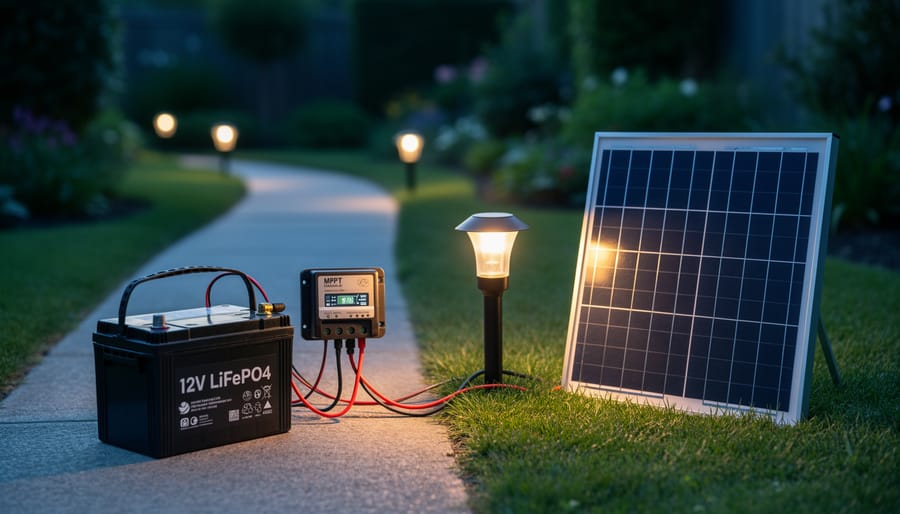
Match your LFP battery capacity to your actual lighting needs by calculating your nightly watt-hour consumption and multiplying by three—this gives you enough storage for cloudy stretches without overspending on unused capacity. A 20-watt LED running five hours nightly needs a 300Wh minimum battery, which translates to a 100Ah 12V LFP pack.
Choose LFP chemistry over traditional lead-acid because you’ll get 3,000-5,000 charge cycles instead of 300-500, meaning your battery investment lasts a decade rather than replacing it every two years. The math works out simple: spend $200 once versus $80 four times over the same period, plus you’re not hauling dead batteries to recycling centers.
Wire your solar charge controller to LFP-specific voltage settings—14.2V to 14.6V for bulk charging and 13.6V float voltage for 12V systems—because using lead-acid profiles will either undercharge your battery or trigger its built-in protection, shutting your lights off unexpectedly. Most modern MPPT controllers have preset LFP profiles you can select with a button press.
Size your solar panel at 20-25% of your battery’s amp-hour rating to maintain healthy charging without overwhelming the system. That 100Ah battery pairs perfectly with a 20-25 watt panel in most climates, giving you dependable performance without the complexity of oversized arrays.
I learned this the hard way after my first solar lamp project died within months because I assumed all batteries were interchangeable. Once I switched to properly matched LFP batteries with correct charging parameters, my pathway lights have run flawlessly through three winters without a single failure. The upfront learning curve pays off in systems that simply work.
What Makes LFP Batteries Different (In Plain English)
LFP stands for Lithium Iron Phosphate, but you don’t need to memorize that. What you need to know is that LFP batteries are a specific type of lithium battery that’s become incredibly popular for solar applications, and for good reason.
Think of battery chemistry like cooking recipes. Lead-acid batteries (the old-school ones in cars) use a heavy, toxic recipe that’s been around forever. They work, but they’re bulky, need maintenance, and wear out relatively quickly. Regular lithium batteries—the kind in your laptop or phone—use cobalt and other materials that pack a powerful punch but can be temperamental about temperature and safety.
LFP batteries use iron phosphate instead. I’ve been working with solar systems for years, and when I first switched from lead-acid to LFP for a garden lighting project, the difference was night and day. The batteries were lighter, charged faster, and just kept going.
Here’s what actually matters when choosing the right solar battery for your project: LFP batteries can handle around 3,000 to 5,000 charge cycles compared to maybe 300 to 500 for lead-acid. That means if you charge your battery daily, an LFP could last 8 to 15 years versus barely a year or two for lead-acid.
They also don’t mind sitting at partial charge. Lead-acid batteries hate that and will sulfate (basically get clogged up internally). With LFP, you can use whatever power you need without worrying about damaging the battery by not fully charging it every time.
Temperature tolerance is another big win. LFP batteries work reliably in both hot sheds and cold garages where other lithium batteries might shut down or, worse, become unsafe. They’re also inherently more stable—no thermal runaway issues like some lithium chemistries.
The practical result? You get consistent power, minimal babysitting, and batteries that actually last long enough to justify their upfront cost.
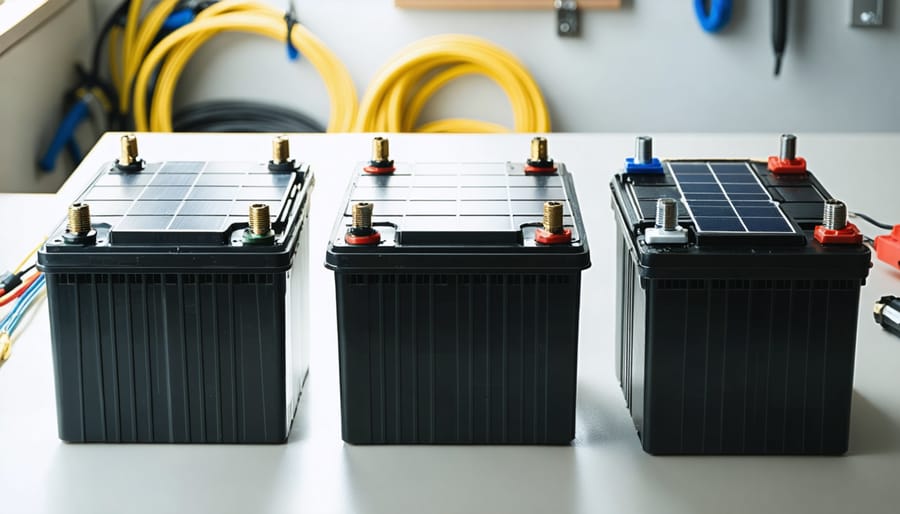
LFP batteries offer a modern alternative to traditional lead-acid batteries for solar lighting applications, with significant differences in size, weight, and performance characteristics.
The Real Benefits You’ll Actually Notice
They Last Forever (Well, Almost)
Here’s what really impressed me when I first switched to LFP batteries for my garden lighting setup: the cycle life numbers aren’t just marketing hype. These batteries are genuinely rated for 3,000 to 5,000+ charge-discharge cycles, and in real-world terms, that’s transformative for solar applications.
Let me break down what this means for your projects. If you’re running solar lights that cycle daily—charging during the day, discharging at night—you’re using one cycle per day. With a conservative 3,000-cycle lifespan, that’s over 8 years of reliable use. Push that to 5,000 cycles, and you’re looking at nearly 14 years. Compare this to traditional lead-acid batteries that typically give you 300-500 cycles (about 1-2 years), and the difference is staggering.
For weekend cabin setups or seasonal lighting that doesn’t cycle daily, the lifespan stretches even further. I installed LFP batteries in my mother’s holiday decorative solar lights three years ago, and they’re still performing like new—and those only run a few months each year.
The practical takeaway? While LFP batteries cost more upfront, you’re essentially buying one battery instead of replacing cheaper alternatives five to ten times over the same period. That’s fewer trips to the hardware store and less waste heading to landfills.
Temperature Tolerance That Actually Works
One of my favorite things about LFP batteries is how they just keep working when other batteries throw in the towel. I learned this the hard way during a winter camping trip in Montana where temperatures dropped to 15°F. My friend’s traditional lithium-ion setup shut down completely, but my LFP-powered solar lights kept running without missing a beat.
LFP batteries operate effectively in temperatures ranging from -4°F to 140°F (-20°C to 60°C), making them incredibly versatile for outdoor solar applications. Unlike other battery chemistries that lose significant capacity in cold weather, LFP batteries typically retain about 80% of their performance even when it’s freezing outside. On the flip side, they handle heat remarkably well too. I’ve installed LFP systems in Arizona where summer temperatures regularly exceed 110°F, and they continue performing reliably year after year.
The secret lies in their stable chemistry. While extreme cold does slow down charging (you’ll want to wait for temperatures above freezing for optimal charging), they can still discharge power effectively. For camping enthusiasts and off-grid applications, this temperature resilience means your solar lights will work when you need them most, regardless of the weather conditions you encounter.
Consistent Power Until the End
One of my favorite features of LFP batteries in my solar lights is their remarkably flat discharge curve. What does this mean in practical terms? Your lights stay at full brightness almost until the battery is completely drained. There’s no gradual dimming that tells you the power is running low—the lights just keep shining at their designed intensity.
I remember the first time I replaced my old lead-acid batteries with LFP in my pathway lights. With lead-acid, I’d gotten used to that sad, amber glow as the evening wore on. By checking the lead-acid battery performance curves, you’ll see voltage drops steadily throughout discharge, causing noticeable dimming.
LFP batteries behave completely differently. If you look at a LiFePO4 voltage chart, you’ll notice the voltage holds steady at around 3.2V per cell through most of the discharge cycle, only dropping quickly right at the end. For solar lighting, this means consistent, reliable illumination throughout the night—your lights perform exactly as designed until they turn off, rather than gradually fading into uselessness.
LFP batteries deliver consistent lighting performance throughout their discharge cycle, ensuring pathway lights maintain brightness until the battery is fully depleted.
Safety Features You Didn’t Know You Needed
When I first started experimenting with solar lighting systems, I’ll admit I didn’t give much thought to battery safety. I figured a battery was a battery, right? Then a friend had a lithium-ion battery overheat in his garage workshop, and suddenly safety became very real to me.
Here’s where LFP batteries truly shine. Unlike their lithium-ion cousins, LFP chemistry has exceptional thermal stability. What does that mean in plain English? These batteries are incredibly resistant to overheating and won’t experience thermal runaway—that dangerous chain reaction where a battery gets hotter and hotter until it potentially catches fire or explodes.
For solar lighting systems, this matters tremendously. Think about it: your solar lights sit outside in scorching summer heat, often unattended for weeks or months at a time. You’re not there monitoring them. LFP batteries handle these temperature extremes without breaking a sweat. They’re chemically stable even when punctured or damaged, which gives real peace of mind.
This inherent safety comes from the iron phosphate chemistry itself—it’s simply more stable than other lithium formulations. You won’t need elaborate cooling systems or constant monitoring. Install them, and they’ll quietly do their job without keeping you up at night worrying about fire hazards.
Sizing Your LFP Battery for Solar Lighting
The Simple Formula I Use Every Time
When I first started designing solar lighting systems, I made things way too complicated. After years of trial and error, I’ve settled on a formula that never lets me down. Here’s the straightforward calculation I use every single time:
Total Battery Capacity (Wh) = Daily Load (W) × Hours of Operation × Days of Autonomy ÷ 0.8
Let me break this down. Your daily load is the wattage of your lights. Hours of operation is how long they’ll run each night. Days of autonomy is how many cloudy days you want your system to survive without sunshine. That 0.8 at the end? It accounts for the fact that you shouldn’t drain LFP batteries completely, even though they handle deep discharge better than other types.
Here’s a real example from my backyard pathway lighting project. I had five LED lights at 3 watts each, running 6 hours per night, and I wanted 3 days of backup power.
My calculation looked like this: 15W (total lights) × 6 hours × 3 days ÷ 0.8 = 337.5Wh
I rounded up to a 400Wh LFP battery to give myself some breathing room. This simple buffer has saved me countless headaches during unexpected cloudy stretches.
The beauty of this formula is its flexibility. Adjust the autonomy days based on your local climate. Live somewhere sunny? Two days might suffice. Pacific Northwest in winter? Consider four or five days for peace of mind.
Common Solar Lighting Scenarios
Let me share some real-world scenarios I’ve encountered over the years that might match your own solar lighting projects. Understanding the right LFP battery size for your specific needs makes all the difference between a system that barely works and one that exceeds expectations.
For pathway lighting, you’re typically looking at small LED fixtures consuming 3-5 watts each. A 12V 20Ah LFP battery can comfortably power four to six pathway lights for 8-10 hours nightly, even with a couple of cloudy days thrown in. I installed exactly this setup along my own driveway three years ago, and it’s never let me down.
Shed or garage lighting requires more substantial capacity. Most folks want brighter illumination here, maybe 15-20 watts worth of LED strips or fixtures. A 12V 50Ah LFP battery paired with a 100-watt solar panel gives you plenty of working light for several hours each evening. During winter, you’ll still have enough reserve to get by on shorter solar collection days.
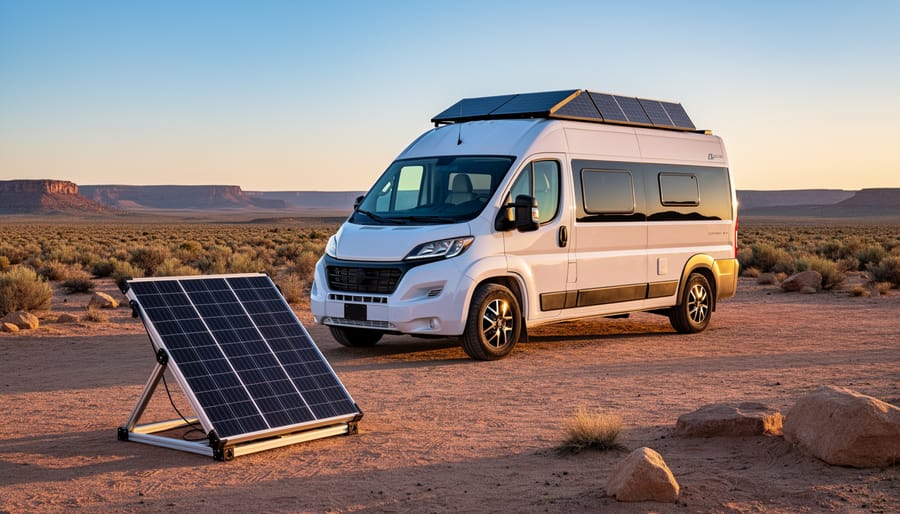
Camping setups are where LFP batteries really shine because of their lightweight design. A portable 12V 30Ah unit can run LED string lights, charge phones, and power a small fan for weekend trips. It’s roughly half the weight of equivalent lead-acid batteries, which your back will appreciate.
Security lighting with motion sensors needs reliable overnight power. Since these lights only activate when needed, a 12V 40Ah LFP battery works well for two to three 10-watt floodlights. The beauty here is that motion activation drastically reduces your actual power consumption compared to all-night operation.
The key takeaway? Match your battery capacity to actual runtime needs, not just the wattage rating on your lights.
Matching Your Solar Panel to Your LFP Battery
Voltage Requirements (Keep It Simple)
Understanding voltage matching is like making sure all your puzzle pieces fit together—it’s essential for a successful LFP battery solar setup.
Most solar systems run on three common voltages: 12V, 24V, or 48V. Your choice depends on your project size and power needs. Small setups like RV lights or garden lighting typically use 12V systems. Medium-sized applications often work best with 24V, while larger home systems benefit from 48V configurations, which handle more power efficiently with less current.
Here’s the key thing I learned the hard way during my first solar project: your solar panels don’t have to exactly match your battery voltage, but they do need to be higher. For example, to charge a 12V LFP battery, you’ll typically need panels rated around 18-22V. This ensures enough voltage overhead for the charge controller to properly regulate charging.
The magic happens in your charge controller, which takes whatever voltage your panels produce and converts it to the proper charging voltage for your LFP batteries. That’s why sizing solar panels for 12V batteries requires understanding this relationship.
LFP batteries are forgiving compared to other lithium types, but voltage mismatches can prevent charging altogether or reduce efficiency. Getting this right from the start saves frustration and ensures your investment performs as expected.
Why Your Charge Controller Matters More Than You Think
Here’s something I learned the hard way during my first LFP solar project: not all charge controllers understand how to properly charge these batteries. I watched my new LFP battery underperform for weeks before realizing my old charge controller was treating it like a traditional lead-acid battery.
LFP batteries need specific charging profiles with different voltage parameters than their lead-acid cousins. A compatible charge controller ensures your battery charges to its full capacity without damage. Think of it as speaking the right language—your controller needs to communicate properly with your LFP battery.
For solar lighting applications, you’ll encounter two main types: PWM (Pulse Width Modulation) and MPPT (Maximum Power Point Tracking). PWM controllers are budget-friendly and work fine for smaller systems where your solar panel voltage closely matches your battery voltage. MPPT controllers cost more but extract up to 30% more power from your panels, making them ideal for larger setups or when panel and battery voltages differ significantly.
The key takeaway? Always verify your charge controller explicitly supports LFP chemistry. Look for settings labeled “LiFePO4” or “Lithium Iron Phosphate” in the specifications. This simple check protects your investment and ensures your solar lighting system performs reliably for years to come.
Installation Tips That Save Headaches
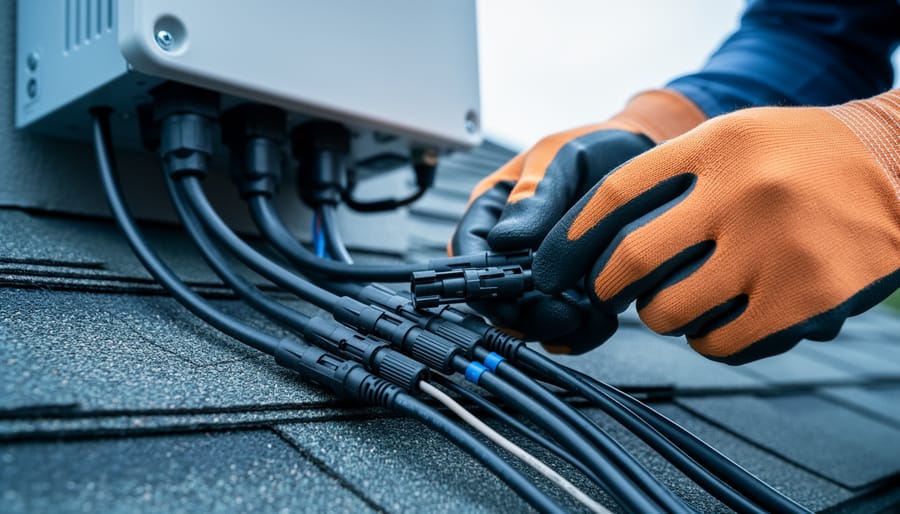
Proper wiring connections are essential for safe and efficient LFP battery installation in solar lighting systems.
Wiring It Right the First Time
Getting your LFP battery wired correctly from the start saves headaches down the road. I learned this the hard way when my first solar project flickered out after just two weeks because I undersized my cables!
Start with proper cable sizing. For most garden solar lights running on 12V LFP batteries, 14-gauge wire works great for runs under 10 feet. Going longer? Bump up to 12-gauge to prevent voltage drop. Think of cables like water pipes—too narrow and you choke the flow.
Fusing is your safety net. Always install an inline fuse rated at 125% of your maximum expected current between the battery and load. For a 5-amp system, use a 6-amp fuse. Place it as close to the battery positive terminal as possible.
Common mistakes to avoid: Never connect your solar panel directly to the battery without a charge controller—you’ll overcharge and damage those cells. Don’t mix old and new batteries in parallel. And please, double-check polarity before powering on. Red to positive, black to negative, every single time.
Use properly crimped ring terminals or quality connectors. Those twist-on wire nuts you have in your garage? Not for outdoor solar applications. Invest in weatherproof connectors designed for 12V systems, and your future self will thank you when everything still works perfectly next spring.
Where to Put Your Battery (And Where Not To)
Location matters more than you might think when it comes to your LFP battery’s performance and lifespan. I learned this the hard way when I first mounted a battery pack directly onto a metal fence post—summer sun turned it into a miniature oven, and performance dropped noticeably.
For outdoor solar lighting, aim to place your battery in a shaded, ventilated spot. Under eaves, inside weatherproof enclosures, or mounted on the north side of structures works wonderfully. While LFP batteries handle temperature swings better than other lithium chemistries, they still prefer staying between 32°F and 113°F for optimal performance.
Avoid direct sunlight, heat-radiating surfaces like metal siding, and low-lying areas where water might pool. Ground-level installations should include raised platforms to prevent flooding damage. If you’re mounting on walls, leave at least two inches of clearance behind the battery for air circulation.
Weatherproofing is essential. Use NEMA-rated enclosures (NEMA 3R minimum for outdoor use) with ventilation holes positioned to prevent rain entry while allowing heat escape. I’ve found that simple plastic project boxes with drilled vent holes and rubber grommets for wiring work perfectly for smaller setups without breaking the bank.
Keeping Your LFP Battery Happy for Years
Here’s the good news: LFP batteries are incredibly low-maintenance compared to older battery technologies. I learned this firsthand when I installed my first solar pathway lights five years ago. After dealing with lead-acid batteries that needed constant checking and topping off with distilled water, switching to LFP felt like a breath of fresh air. These batteries are basically the “set it and forget it” option of the solar world.
That said, a little attention goes a long way toward maximizing their already impressive lifespan. First, keep your battery compartment clean and dry. While LFP batteries themselves are resilient, their connections aren’t fans of corrosion. A quick visual check every few months ensures terminals stay clean and secure. If you spot any white or green buildup, a gentle wipe with a cloth dampened with vinegar usually does the trick.
Temperature matters, though LFP batteries handle extremes better than most. Ideally, keep them between 32°F and 113°F during operation. If you live in particularly harsh climates, consider insulating battery compartments or positioning lights where they’ll get some natural shade during scorching summer afternoons.
Avoid letting your batteries sit completely discharged for extended periods. If you’re storing solar lights seasonally, charge them to about 50-60% capacity first. This sweet spot keeps the battery chemistry stable during downtime.
Here’s the beautiful part: LFP batteries don’t require regular “equalization charges” or complicated maintenance cycles. They handle partial charging beautifully, meaning your solar panel can top them off throughout the day without any special programming. Just let your system do its thing, give it an occasional once-over, and your LFP battery should deliver reliable performance for a decade or more.
Real-World Cost Analysis (Is It Worth It?)
Let’s talk numbers, because I know that’s what many of you are wondering about. When I first considered switching to LFP batteries for my solar setup, I nearly fell off my chair looking at the price tags. But here’s the thing: the sticker shock doesn’t tell the whole story.
An LFP battery typically costs 2-3 times more upfront than a comparable lead-acid battery. For example, a 100Ah LFP battery runs around $300-500, while a similar capacity lead-acid battery might cost $150-200. Ouch, right? But let’s dig deeper into what really matters: the total cost of ownership.
Over a 10-year period, the math shifts dramatically. LFP batteries last 3,000-5,000 cycles compared to lead-acid’s 300-500 cycles. This means you’ll replace lead-acid batteries 6-10 times while your LFP battery is still going strong. Suddenly, that $300 LFP battery looks better than buying $150 batteries repeatedly, totaling $900-1,500 over the same period.
Factor in efficiency gains too. LFP batteries deliver 95% usable capacity versus 50% for lead-acid, meaning you need half the capacity to get the same performance. That $300 LFP effectively replaces a $300-400 lead-acid system when sized properly.
When does LFP make sense? If you’re building a serious off-grid system, powering essential equipment, or want a set-it-and-forget-it solution, absolutely invest in LFP. The reliability and longevity justify every penny. When comparing rechargeable batteries for solar lights, LFP stands out for permanent installations.
When might it be overkill? For simple pathway lights you barely use, seasonal decorations, or experimental projects where you’re still figuring things out, lead-acid might suffice. There’s no shame in starting small and upgrading later when you understand your actual needs. My first solar project used salvaged lead-acid batteries, and that hands-on learning was invaluable before I committed to premium LFP technology.
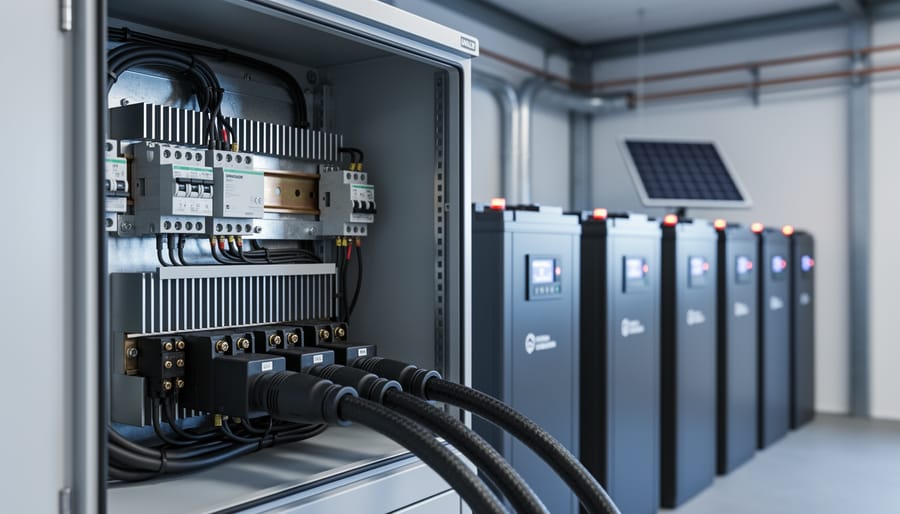
A complete solar lighting installation demonstrates how LFP batteries integrate seamlessly with panels and fixtures for reliable off-grid illumination.
LFP batteries truly transform solar lighting projects by delivering the longevity, consistency, and reliability that your outdoor spaces deserve. After years of working with various battery chemistries, I’ve seen firsthand how LFP technology eliminates the frustration of frequent replacements and unpredictable performance. These batteries simply work, season after season, giving you the confidence that your pathway lights, garden accents, or security lighting will perform when you need them most.
If you’re on the fence about making the switch, I encourage you to start small. Choose one solar lighting project—maybe those front walkway lights or a single garden feature—and upgrade it with an LFP battery system. You’ll quickly notice the difference in how consistently your lights perform, especially during those challenging winter months or extended cloudy periods. That real-world experience will tell you everything you need to know.
Ready to plan your project? Head over to Spheral Solar’s interactive calculators to determine exactly what battery capacity and solar panel size you’ll need for your specific application. Our community forums are also packed with fellow DIYers who’ve tackled similar projects and are eager to share their insights and troubleshooting tips.
Remember, every expert started as a beginner with a single project. By choosing LFP technology for your solar lighting, you’re not just installing batteries—you’re taking control of your energy independence, one light at a time. Your sustainable, self-powered lighting future starts now.
How useful was this post?
Click on a star to rate it!
Average rating 0 / 5. Vote count: 0
No votes so far! Be the first to rate this post.
We are sorry that this post was not useful for you!
Let us improve this post!
Tell us how we can improve this post?
charlesnoble
Here at Spheral Solar, I’m a hands-on solar power enthusiast, constantly exploring and experimenting with DIY solutions. I’m dedicated to sharing my discoveries, insights, and even the bumps I hit along the way, all in the pursuit of a more sustainable future.
Which Solar Battery Actually Lives Up to the Hype? by Charlesnoble November 8, 2025 Compare capacity ratings in amp-hours (Ah) and watt-hours (Wh) first—these numbers tell you exactly how much energy each battery stores and how long it’ll power your devices. Check the depth of discharge (DoD) percentage next, because a battery with 90% DoD gives you far more usable energy than one limited…
Why Your RV Solar System Isn’t Charging (And How to Fix It) by Charlesnoble May 6, 2026 Picture this: You’re parked at a stunning boondocking spot, miles from the nearest electrical hookup, and your RV batteries are draining fast. Your fridge starts warming, lights dim, and you’re left wondering if you’ll need to pack up and find a campground. I’ve been there, and it’s frustrating. RV solar…
Why a 7 kWh Battery Might Be Your Solar System’s Sweet Spot by Charlesnoble May 20, 2026 Match a 7 kWh battery to your actual energy usage by checking your utility bills for daily consumption patterns. If your household uses 20-30 kWh per day, this size covers roughly 4-6 hours of evening power or essential loads during an outage—perfect for keeping your refrigerator, internet, and a few…
How Solar Energy Actually Works in Your Home (And… by Charlesnoble December 5, 2025 Capture sunlight with photovoltaic panels that convert solar radiation into direct current electricity through semiconductor technology. Position your panels at the optimal angle for your latitude—typically between 30 and 45 degrees in most locations—to maximize energy absorption throughout the day. Store excess electricity in deep-cycle lithium or lead-acid batteries, which…
How Long Will a 100Ah Battery Run a TV by Charlesnoble November 6, 2023 A 100Ah battery’s ability to power a TV depends on the battery chemistry, the TV’s energy consumption, and losses through voltage conversion. The key is calculating the battery’s usable capacity and the TV’s hourly energy draw. In general, a 100Ah lithium battery can run an LED TV for 15-25 hours…
10 Best Rechargeable Batteries for Solar Lights by Nick April 23, 2021 Heads up: some links here are affiliate links, and purchases through them support the site. As an Amazon Associate I earn from qualifying purchases. While lithium-ion batteries have long been touted as the future of the solar battery world, some close rivals are giving them a run for their money.…
Subscribe for handpicked DIY projects, exclusive tips, and giveaways.
Charging a battery bank with a 3-phase inverter requires connecting your inverter’s AC output to a compatible battery charger or hybrid inverter system that can convert the 3-phase power back to DC for storage. Most DIY solar setups achieve this by using a hybrid inverter that handles both solar input and battery charging simultaneously, or… Read more: How to Wire and Configure a Battery Inverter 3 Phase System for Off-Grid Solar
Wiring a 7-pin RV plug correctly connects your tow vehicle to your trailer’s lights, brakes, and auxiliary power in about 45 minutes with basic hand tools and careful attention to the color-coded wire standard. The diagram follows a specific layout mandated by the RV Industry Association: each pin controls a distinct function, from left turn… Read more: How to Wire a 7-Way RV Plug: Step-by-Step Diagram and Setup Guide
Nine times out of ten, an E050 arc fault error on your solar inverter means a loose connection somewhere in your DC wiring. Before you panic or call an expensive technician, check every MC4 connector between your panels and inverter. A single connection that wasn’t snapped fully closed or has corroded from weather exposure will… Read more: Why Is My Solar Inverter Showing Arc Fault E050? Causes and How to Fix It