Why Your RV Solar System Isn’t Charging (And How to Fix It)
Updated:
Picture this: You’re parked at a stunning boondocking spot, miles from the nearest electrical hookup, and your RV batteries are draining fast. Your fridge starts warming, lights dim, and you’re left wondering if you’ll need to pack up and find a campground. I’ve been there, and it’s frustrating.
RV solar charging systems solve this exact problem by converting sunlight into reliable power that keeps your batteries topped off, whether you’re dry camping for a weekend or living full-time on the road. But here’s the thing—installing the wrong system or improperly sizing your setup can leave you in the same boat, just with expensive equipment collecting dust on your roof.
The good news? Getting solar right isn’t as complicated as the industry makes it seem. You don’t need to understand electrical engineering or spend thousands on oversized systems. What you do need is a clear understanding of your actual power consumption, the right components matched to your needs, and proper installation techniques that maximize charging efficiency.
Whether you’re researching your first solar setup, troubleshooting why your current system isn’t performing as expected, or planning an upgrade to support more power-hungry appliances, this guide walks you through everything from basic concepts to advanced optimization strategies. We’ll cut through the marketing hype and focus on practical, tested advice that actually works in real-world camping conditions. By the end, you’ll have the knowledge to design, install, or improve a solar system that delivers the freedom and reliability you’re looking for.
Understanding How RV Solar Charging Actually Works
The Four Essential Components
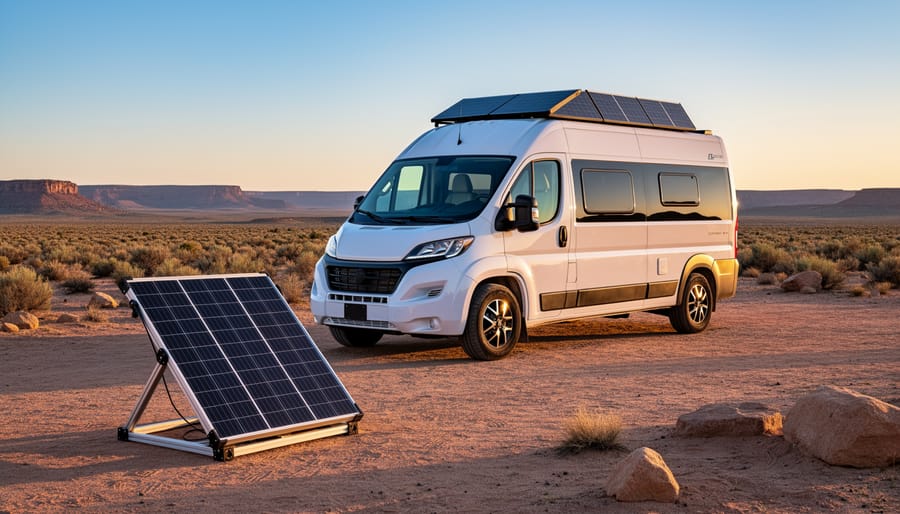
Think of your RV solar charging system like a small power plant on wheels. It has four main players working together to keep your batteries charged and your adventures rolling.
Solar panels are your energy harvesters. They sit on your roof, soaking up sunlight and converting it into DC electricity. I remember installing my first panels and feeling genuinely excited watching the power meter climb on a sunny morning. You’ll typically need between 200-400 watts for a basic setup, though your exact needs depend on your power consumption.
The charge controller acts as the traffic cop between your panels and batteries. Without it, those panels would overcharge your batteries faster than you can say “dead battery bank.” It regulates the voltage and current coming from your panels, ensuring your batteries charge safely and efficiently. There are two main types: PWM (cheaper, less efficient) and MPPT (pricier, significantly better performance).
Your battery bank is the storage unit, holding all that captured solar energy for when you need it, like running your fridge overnight or powering your laptop on a cloudy day. Deep-cycle batteries are essential here since they’re designed for regular charging and discharging, unlike your engine’s starter battery.
Finally, the inverter transforms that stored DC power into the AC electricity your household appliances expect. Unless you’re running only 12-volt devices, you’ll need one to power things like your coffee maker or laptop charger.
These four components work in harmony, creating a reliable off-grid power system that gives you the freedom to camp wherever adventure calls.
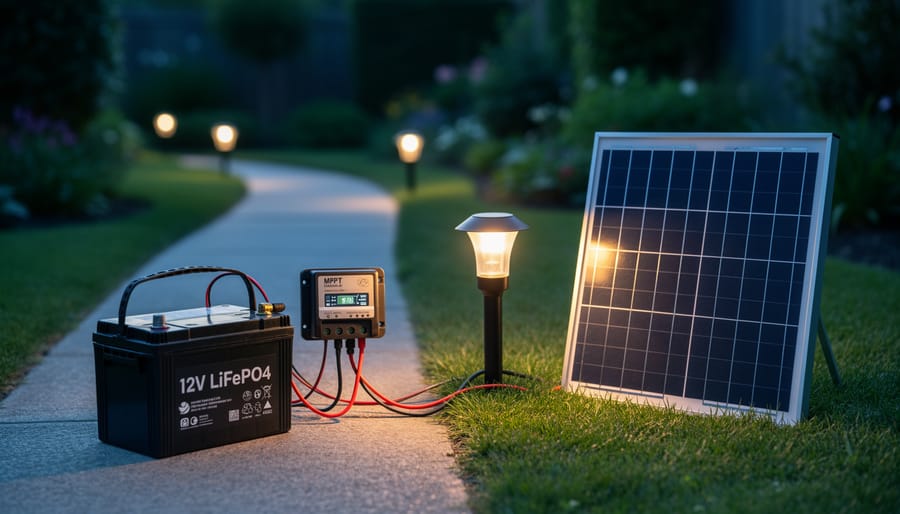
The four essential components of an RV solar charging system work together to convert sunlight into usable electricity for your batteries.
How Energy Flows From Sun to Battery
Think of your RV solar system like a water pipeline that fills your battery tank. It all starts when sunlight hits your solar panels. Those photons are like tiny packets of energy knocking on your panel’s door.
Here’s how it flows:
When sunlight strikes the solar cells, it energizes electrons inside the silicon material, creating direct current (DC) electricity. Picture this like rain falling on a roof and flowing into gutters. The electrons start moving in one direction, creating electrical current. Your panels typically generate between 18-22 volts, depending on conditions.
This raw power then travels through your wiring to the charge controller, which acts like a smart traffic cop. I learned this the hard way when I first started. I once tried connecting panels directly to my battery, and nearly cooked it. The charge controller prevents this disaster by regulating the voltage and current flowing into your battery.
The controller monitors your battery’s charge level and adjusts the incoming power accordingly. When your battery is low, it allows maximum current flow. As the battery fills up, it gradually reduces the charge rate, similar to how you slow down when filling a glass of water to avoid overflow.
Finally, the properly regulated electricity enters your battery, where it’s stored as chemical energy. Those electrons rearrange atoms inside the battery cells, ready to power your adventures whenever you need them. Simple as that.
Choosing the Right Solar Panels for Your RV Roof
Rigid vs. Flexible Panels: What Actually Matters
I’ve installed both types on various RVs, and here’s what I’ve learned: rigid panels are your workhorses. They’re more efficient per square foot, handle high temperatures better, and last 25-30 years. The downside? They’re heavy, bulky, and require solid roof mounting. I once tried fitting three rigid panels on a small Class B, and let’s just say the geometry didn’t cooperate.
Flexible panels shine when roof space is curved, irregular, or weight-sensitive. They’re perfect for older fiberglass RV roofs or mounting on curved surfaces. However, they run hotter because they sit flush against the roof, reducing efficiency by 10-15%. Their lifespan is typically 5-10 years versus rigid panels’ decades.
Here’s my practical take: use rigid panels as your primary power source if your roof can handle them. Go flexible for supplemental power, awkward spaces, or portable applications. I’ve seen RVers successfully combine both, placing rigid panels on flat sections and flexible ones on curved areas. Calculate your actual power needs first using a solar calculator, then let your roof’s reality guide your choice. Don’t sacrifice long-term efficiency just because flexible panels seem easier to install.
Rigid and flexible solar panels each offer distinct advantages for RV installations depending on roof type and mounting requirements.
How Much Solar Do You Really Need?
Here’s the honest truth: most RVers overestimate their power needs at first, then realize they need more panels later. I’ve been there myself! The key is finding that sweet spot based on how you actually use your rig.
Start with a simple energy audit. For a weekend warrior who camps Friday through Sunday with lights, a water pump, and phone charging, you’re looking at roughly 50-75 amp-hours per day. A 200-watt solar setup usually handles this beautifully. But if you’re a full-time boondocker running a refrigerator, laptop, and fans all day, you might burn through 150-200 amp-hours daily, requiring 400-600 watts of solar panels.
Here’s my quick calculation method: Add up the wattage of everything you run, multiply by hours used daily, then divide by your battery voltage. That gives you amp-hours consumed. Now multiply by 1.5 to account for cloudy days and inefficiencies. That’s your target solar output.
For example, if you need 100 amp-hours daily, aim for 150 amp-hours of solar generation, which translates to roughly 300 watts of panels in good sun conditions.
The beauty is you don’t have to guess. Spheral Solar’s solar system calculator does the math for you, factoring in your specific appliances and usage patterns. It takes the guesswork out of sizing your solar panels and helps prevent that sinking feeling when your batteries die at sunset.
Installation Considerations for RV Roofs
Mounting solar panels on your RV roof requires careful planning to protect your home-on-wheels. I learned this the hard way when Charles once told me about his friend who drilled straight through a support beam – not fun!
Start by mapping out existing roof fixtures like vents, air conditioners, and antennas. Use a stud finder to locate safe drilling spots, avoiding water lines and electrical wiring. For curved RV roofs, flexible panels work beautifully and conform to the surface without creating stress points.
When drilling mounting holes, always use high-quality sealant like Dicor or Sikaflex to prevent leaks. I recommend the “more is more” approach here – water damage is your worst enemy. For rubber roofs, use backing plates to distribute weight and prevent tearing.
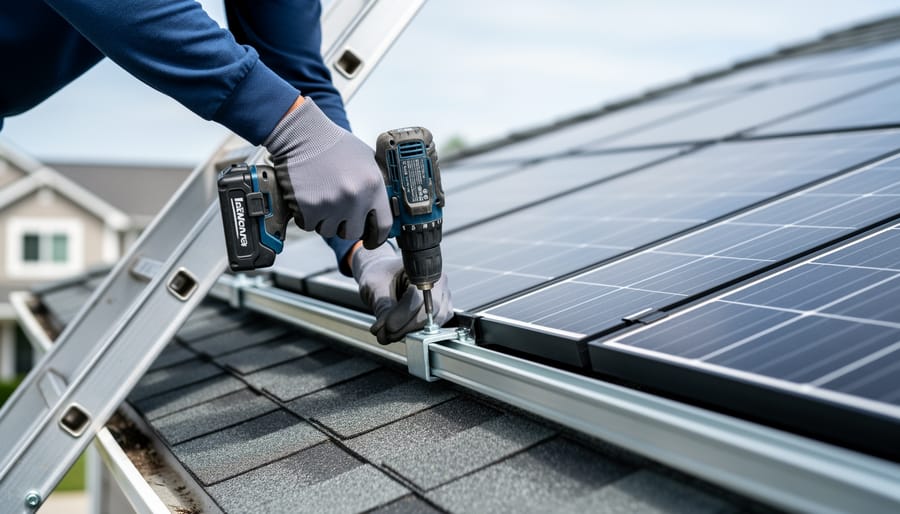
Consider removable mounting systems if you’re hesitant about permanent installation. These use existing ladder rack points or specialized clamps that require no drilling. They’re perfect for testing panel placement before committing to a permanent setup, and you can reposition them as your energy needs change.
Charge Controllers: The Brain of Your System
MPPT vs. PWM: Which One Your RV Needs
Here’s the truth about charge controllers: the choice between MPPT and PWM can mean the difference between harvesting every available ray of sunshine and leaving 20-30% of your solar potential on the table.
PWM (Pulse Width Modulation) controllers are the budget-friendly option, typically costing $30-100. They work by matching your panel voltage down to your battery voltage, which sounds simple because it is. I actually started with a PWM controller on my first RV setup, and for a basic 100-watt panel in summer conditions, it got the job done. But here’s where things get interesting.
MPPT (Maximum Power Point Tracking) controllers are smarter. They optimize the voltage-current relationship to extract maximum power from your panels, then convert it efficiently to charge your batteries. Yes, they cost more—usually $150-400—but the efficiency gains are real.
In real-world testing, MPPT controllers deliver 15-30% more power than PWM, with the biggest advantages in cold weather, early morning, late afternoon, and cloudy conditions. That’s exactly when RVers need charging most.
Here’s my recommendation: if you’re running 200 watts or less in warm climates with flooded lead-acid batteries, PWM works fine. But for 300+ watts, lithium batteries, or year-round travel, MPPT pays for itself within 1-2 years through improved charging performance. I upgraded after one frustrating winter, and the difference was immediately noticeable—my batteries reached full charge 2-3 hours earlier each day.
A properly installed charge controller regulates power flow from solar panels to batteries, protecting your system and maximizing charging efficiency.
Sizing Your Charge Controller Correctly
Getting the right-sized charge controller is easier than you might think. I remember when Charles first helped me size my RV system – I was worried about complicated math, but he showed me it comes down to one simple formula with a safety buffer built in.
Here’s the basic approach: multiply your total solar panel wattage by 1.25 to account for optimal conditions and give yourself a safety margin. Then divide by your battery bank voltage. For example, if you have 400 watts of solar panels and a 12-volt battery system, that’s 400 x 1.25 = 500, divided by 12 = about 42 amps. You’d want a controller rated for at least 40-50 amps.
Why the 1.25 multiplier? Solar panels can actually produce more than their rated wattage under perfect conditions – cool temperatures, ideal sun angle, crystal-clear skies. That extra 25% keeps your controller from getting overwhelmed on those gorgeous sunny days.
For PWM controllers, this calculation is pretty straightforward. With MPPT controllers, you’ll also want to check the maximum input voltage from your panels, especially if you’re wiring panels in series. Most quality MPPT controllers handle up to 100-150 volts, but always verify this matches your panel configuration.
Don’t forget future expansion either. If you think you might add more panels down the road, sizing up now saves you from buying a second controller later. Charles always says it’s cheaper to oversize slightly than to replace entirely.
Battery Bank Basics for RV Solar
Lithium vs. AGM: The Real Differences for Solar
When I first started researching RV solar systems, the battery debate felt overwhelming. Everyone had strong opinions, but here’s what actually matters for your solar setup.
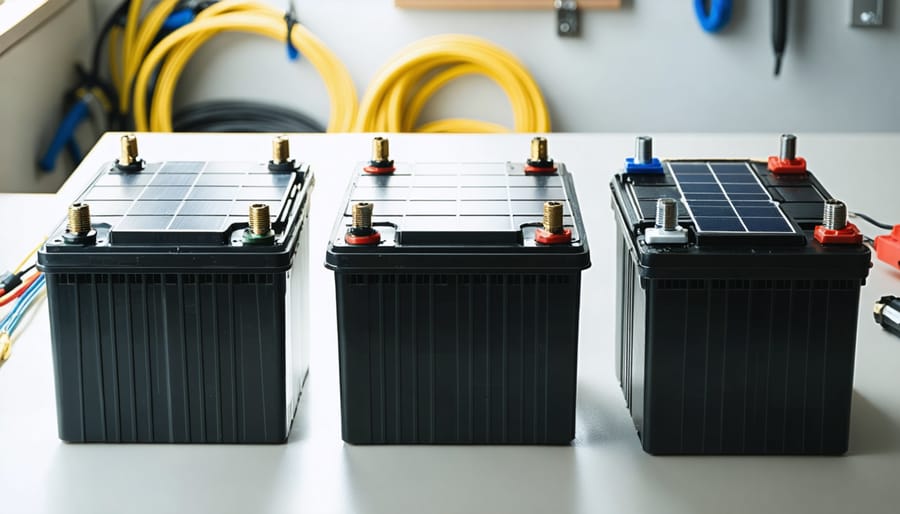
The biggest difference is how these batteries handle solar charging. Lithium batteries accept charge much faster than AGM, which means on partly cloudy days or shorter winter daylight hours, lithium captures more energy. I’ve watched my lithium bank fully recharge by noon, while my neighbor with AGM was still charging at sunset.
Depth of discharge is where lithium really shines. You can safely use 80-100% of a lithium battery’s capacity daily without harming it. AGM? You’re limited to about 50% if you want it to last. So that 200Ah AGM battery really gives you 100Ah of usable power, while a 100Ah lithium provides the same usable capacity at half the weight and size.
Lifespan tells the long-term story. Quality lithium batteries deliver 3,000-5,000 charge cycles, while AGM typically manages 400-800 cycles. Yes, lithium costs three times more upfront, but over ten years of RVing, the math actually favors lithium when you factor in replacements.
AGM isn’t obsolete though. If you’re weekend camping with modest power needs, rarely boondocking, or on a tight budget, AGM works fine. They’re also more forgiving in freezing temperatures.
Choosing the right battery depends on your actual camping style, not just specs. Consider how often you’ll use solar, your typical power consumption, and whether you plan to expand your system later.
How to Size Your Battery Bank
Sizing your battery bank doesn’t require advanced mathematics—just honest reflection about your power usage. Start by listing everything you’ll run daily: lights, water pump, refrigerator, phone chargers, and laptops. Check each device’s wattage (usually on a label) and estimate hours of use per day.
Here’s a real example from my first RV setup. I needed 40 watts for LED lights (4 hours), 120 watts for the fridge (running 8 hours total), 60 watts for laptop charging (3 hours), and 15 watts for phone charging (2 hours). That totaled about 670 watt-hours daily.
Now here’s the key: multiply your daily usage by two or three. Why? Because you shouldn’t drain batteries below 50 percent for longevity, and you need reserve capacity for cloudy days. My 670 watt-hours became 1,340-2,010 watt-hours of actual battery capacity needed.
For a 12-volt system, divide watt-hours by 12 to get amp-hours. My calculation showed I needed roughly 110-170 amp-hours of usable capacity, so I installed two 100Ah batteries.
Charles here—I learned this the hard way after undersizing my first bank. Don’t make my mistake of being optimistic about your power consumption. Add 20 percent more than you think you’ll need.
Common RV Solar Charging Problems and Quick Fixes
Why Your Batteries Aren’t Reaching Full Charge
If your RV batteries aren’t topping off like they should, you’re not alone. I’ve seen this frustration countless times, and the good news is that most causes have straightforward fixes.
Shading is the sneakiest culprit. Even a small shadow from a tree branch or vent can dramatically reduce your panel’s output. Charles once camped under what seemed like light tree cover, only to discover his panels were producing less than 30% of their rated capacity. The solution? Reposition your RV or invest in portable panels you can place in sunny spots.
Incorrect charge controller settings are another common issue. If your controller isn’t programmed for your specific battery type (AGM, lithium, flooded lead-acid), it won’t charge properly. Double-check your controller’s settings match your battery manufacturer’s recommendations.
Battery health matters too. Sulfated or aging batteries simply can’t accept a full charge anymore. Test your batteries with a multimeter and hydrometer to verify they’re still functioning correctly.
Finally, understanding what happens when batteries reach full charge helps you recognize whether you’re actually experiencing a problem or if your system is working as designed. Sometimes what looks like incomplete charging is just your controller protecting your batteries from overcharging.
Dealing with Inconsistent Charging Performance
Inconsistent charging can be frustrating, but the good news is that most issues have straightforward solutions. I remember chasing down a charging problem on my RV last summer, only to discover a loose MC4 connector hidden behind a panel—sometimes the fix is simpler than you think!
Start by checking all your connections. Corrosion, loose terminals, and dirty contacts can significantly reduce power transfer. Give everything a visual inspection and tighten any connections that seem loose. A little dielectric grease on your terminals can prevent future corrosion issues.
Next, look at environmental factors. Shading is the silent killer of solar performance—even a small shadow from a tree branch or roof vent can dramatically reduce output. Monitor your panels throughout the day to identify any shading patterns you might not have noticed during installation.
Temperature also plays a role. Panels actually perform less efficiently in extreme heat, which surprises many folks. If your system seems sluggish on scorching days, this might be normal behavior rather than a problem.
Finally, check your charge controller settings. Incorrect battery type settings can prevent proper charging cycles. Verify that your controller is programmed for your specific battery chemistry, whether that’s flooded lead-acid, AGM, or lithium.
When to Check Your Connections and Wiring
Make it a habit to visually inspect your RV solar system every month, especially before and after long trips. Look for loose wire connections at your panels, charge controller, and battery terminals—give each connection a gentle wiggle to check for movement. Charles learned this the hard way when a vibrating wire caused intermittent charging for weeks before he spotted it during a routine check.
Watch for these telltale signs of wiring trouble: discolored or melted insulation around connections, a burning smell near electrical components, or terminals that feel warm to the touch. Corroded connections appear white, green, or crusty around battery terminals and should be cleaned immediately. If you notice your system suddenly producing less power or your batteries aren’t fully charging, examine all visible wiring for damage, fraying, or exposed copper.
During inspections, also verify that wire nuts are tight and electrical tape hasn’t degraded from sun exposure. These simple five-minute checks can prevent major headaches down the road and keep your system running efficiently for years.
Setting Up Your First RV Solar System: A Step-by-Step Approach
Planning Your System Layout
Before you start drilling holes, let’s talk about mapping out your system. I learned this the hard way when I rushed my first installation and ended up relocating panels twice because I didn’t account for my AC unit’s shadow.
Start by measuring your usable roof space. Grab a tape measure and head up top, noting any vents, antennas, or air conditioners that cast shadows. Your panels need maximum sun exposure, especially during midday hours. I recommend taking photos from different angles and sketching a rough diagram.
Next, think about component placement strategically. Mount your charge controller as close to your batteries as possible to minimize voltage drop, ideally within 5-10 feet. The inverter should also live near the battery bank. I keep mine in an accessible spot for easy monitoring.
For wiring routes, plan the shortest, most protected path from panels to controller. Avoid running cables near heat sources or sharp edges. Use existing roof penetrations when possible, or plan new ones where you can properly seal against leaks. Mark everything on your diagram before making a single cut. Trust me, spending an extra hour planning saves days of frustration later.
The Installation Sequence That Works
Getting your installation order right saves hours of frustration. Trust me, I learned this the hard way when I had to remove my entire panel array because I forgot to run wiring through a particular access point first!
Start with planning your wire routes before touching a single component. Map out where cables will run from panels to charge controller, then to batteries, and finally to your battery monitor. This prevents the dreaded “I can’t reach that spot anymore” moment.
Next, mount your charge controller and battery monitor in your chosen location. These go up first because everything connects to them, and you’ll need clear access for wiring.
Then install your batteries and connect them to the charge controller. Double-check polarity here because reversing these wires can fry expensive equipment instantly.
After that, mount your solar panels on the roof. Run the cables down through your planned route to the charge controller. Many RVers use existing refrigerator vents or create new sealed entry points.
Finally, make your connections at the charge controller, working methodically through each terminal. Program your settings, and only then should you expose the panels to sunlight.
This sequence minimizes the chances you’ll need to undo completed work, keeping your project moving forward smoothly.
Testing and Commissioning Your System
Before you pack up and head out, spend an afternoon verifying your system works properly. Start by checking all connections are tight and there’s no exposed wiring. With your panels in full sunlight, your charge controller should display incoming watts. On a clear day, expect to see 75-85% of your panel’s rated capacity due to real-world conditions.
Watch your battery voltage climb as charging begins. For lithium battery voltage readings, you should see around 13.3-13.4V at rest, rising to 14.2-14.6V during bulk charging. Lead-acid batteries start around 12.6V and charge to about 14.4V.
I learned this the hard way when I first installed my system and panicked seeing lower-than-expected watts. Turns out, some cloud cover and panel angle made a huge difference.
Run a load test by turning on appliances and confirming your battery discharges normally. Finally, let the system complete a full charge cycle and verify it switches to float mode. This simple checkout prevents roadside troubleshooting later.
Maximizing Your RV Solar Performance on the Road
Parking and Positioning for Best Sun Exposure
When you’re boondocking without a solar tracking system, strategic parking becomes your secret weapon for maximizing charge. I learned this the hard way during my first trip to Arizona—I parked in what I thought was a perfect spot, only to watch my batteries barely budge because a nearby cliff shaded my panels after 2 PM.
Here’s what works: In summer months, park with your RV facing south if possible. Your rooftop panels will catch the sun’s arc across the sky from sunrise to sunset. In winter, the sun sits lower on the horizon, so southern exposure becomes even more critical. If you have portable panels, you’ve got more flexibility—simply reposition them every few hours to follow the sun.
Scout your campsite before committing. Walk around at different times if you can, noting where shadows fall. Trees, hills, and even other RVs can block precious sunlight. Morning sun is gold for battery recovery after overnight drain, so prioritize eastern exposure if you must choose.
Don’t forget the tilt angle. Even a simple adjustment using blocks or your RV’s leveling jacks can boost efficiency by 20-30%. Point your panels perpendicular to the sun’s rays—usually this means tilting toward the southern sky at an angle roughly matching your latitude.
Strategic campsite positioning maximizes solar exposure and charging performance while enjoying off-grid RV adventures.
Seasonal Adjustments and Expectations
Your RV solar system’s performance will vary dramatically throughout the year, and understanding these changes helps you plan better trips. During summer months, you’ll likely generate 20-30% more power than your system’s rated capacity thanks to longer daylight hours and optimal sun angles. I learned this during a July camping trip in Arizona when my 400-watt system consistently produced over 500 watts at peak hours.
Winter presents different challenges. Expect output to drop by 40-50% due to shorter days and lower sun angles. Snow coverage can temporarily halt production entirely, though panels usually warm enough to shed light snow naturally. The key is adjusting your energy consumption accordingly. In winter, I reduce my usage by running the furnace fan less frequently and relying more on propane for heating.
Spring and fall offer moderate production levels, typically 80-90% of summer output. These shoulder seasons are perfect for testing your system’s limits before extreme weather arrives.
My biggest tip? Track your daily production for a full year using a simple notebook or smartphone app. This creates realistic expectations and helps you plan future trips around your actual seasonal capacity rather than manufacturer specifications alone.
You’ve now got everything you need to transform your RV into a solar-powered adventure machine. Whether you’re just starting to research your first panel or you’re ready to expand an existing system, the beauty of RV solar is that you can start small and grow as your confidence builds.
I’ve been where you are. When I installed my first RV solar panel years ago, I was honestly terrified I’d fry something expensive or end up stranded with dead batteries. But that first morning when I woke up to fully charged batteries without running a noisy generator or searching for shore power? That feeling of independence changed everything about how I travel. Solar doesn’t just power your RV; it opens up campsites and experiences you never thought possible.
The path to solar independence doesn’t require an engineering degree or a massive upfront investment. Start with the basics, use the calculators and tools available to size your system correctly, and don’t be afraid to ask questions. The solar community is incredibly welcoming to newcomers.
Remember, every expert was once a beginner who decided to take that first step. Your journey toward energy independence starts with a single panel, a few connections, and the willingness to learn as you go.
We’d love to hear about your RV solar journey. Share your questions, successes, and lessons learned with the Spheral Solar community. Together, we’re making sustainable RV living accessible to everyone, one installation at a time. The open road is calling, and now you’ve got the power to answer.
How useful was this post?
Click on a star to rate it!
Average rating 0 / 5. Vote count: 0
No votes so far! Be the first to rate this post.
We are sorry that this post was not useful for you!
Let us improve this post!
Tell us how we can improve this post?
charlesnoble
Here at Spheral Solar, I’m a hands-on solar power enthusiast, constantly exploring and experimenting with DIY solutions. I’m dedicated to sharing my discoveries, insights, and even the bumps I hit along the way, all in the pursuit of a more sustainable future.
How Solar Energy Actually Works in Your Home (And… by Charlesnoble December 5, 2025 Capture sunlight with photovoltaic panels that convert solar radiation into direct current electricity through semiconductor technology. Position your panels at the optimal angle for your latitude—typically between 30 and 45 degrees in most locations—to maximize energy absorption throughout the day. Store excess electricity in deep-cycle lithium or lead-acid batteries, which…
Which Solar Battery Actually Lives Up to the Hype? by Charlesnoble November 8, 2025 Compare capacity ratings in amp-hours (Ah) and watt-hours (Wh) first—these numbers tell you exactly how much energy each battery stores and how long it’ll power your devices. Check the depth of discharge (DoD) percentage next, because a battery with 90% DoD gives you far more usable energy than one limited…
Why a 7 kWh Battery Might Be Your Solar System’s Sweet Spot by Charlesnoble May 20, 2026 Match a 7 kWh battery to your actual energy usage by checking your utility bills for daily consumption patterns. If your household uses 20-30 kWh per day, this size covers roughly 4-6 hours of evening power or essential loads during an outage—perfect for keeping your refrigerator, internet, and a few…
Why Your 8 Volt Battery Won’t Charge (And How to Fix… by Charlesnoble February 25, 2026 Match your charger voltage to your battery’s 8-volt requirement, or risk permanent damage to your battery bank. Most standard chargers output 6V or 12V, making them incompatible with the less common 8V configuration found in certain golf carts, floor scrubbers, and older solar setups. Use a dedicated 8-volt charger with…
Why LFP Batteries Changed Everything About Solar… by Charlesnoble April 3, 2026 Match your LFP battery capacity to your actual lighting needs by calculating your nightly watt-hour consumption and multiplying by three—this gives you enough storage for cloudy stretches without overspending on unused capacity. A 20-watt LED running five hours nightly needs a 300Wh minimum battery, which translates to a 100Ah 12V…
Why NiMH Batteries Keep Your Solar Lights Running… by Charlesnoble November 20, 2025 Choose rechargeable NiMH batteries rated between 600-1000mAh for most standard solar garden lights, matching the voltage of your original batteries—typically 1.2V AA or AAA sizes. These batteries outperform regular alkaline batteries because they handle the constant charge-discharge cycles that solar lights demand daily, lasting 2-3 years compared to just months…
Subscribe for handpicked DIY projects, exclusive tips, and giveaways.
Nine times out of ten, an RV generator that won’t start has a stale fuel problem. If your generator hasn’t run in more than 30 days, degraded gasoline is likely gumming up the carburetor and preventing ignition. Before you panic or call for expensive roadside service, try this: turn on the generator’s fuel valve (if… Read more: RV Generator Troubleshooting: Common Problems and How to Fix Them
A 5kW solar system occupies between 250 and 350 square feet of roof or ground space and produces roughly 20 to 25 kilowatt-hours of electricity per day in most U.S. locations. That’s enough to power a typical three-bedroom home with moderate energy use, though your exact needs depend on your daily consumption patterns, climate zone,… Read more: How to Size a 5kW Solar System for Your Home or RV
Installing a home solar system yourself takes 2-4 weekends for an average 5kW setup, requires solid electrical knowledge and comfort working at heights, and can save you $5,000-$8,000 in labor costs if you tackle everything except the final utility interconnection. The process breaks down into five main phases: permitting and design, mounting the racking system,… Read more: Solar Power Installation Step by Step: Complete DIY Guide From Start to Finish