Build a Solar-Powered Car That Actually Wins Your Science Fair
Updated:
Gather a small solar panel (1.5-6 volts), a lightweight toy car chassis or four bottle caps for wheels, a small DC motor, connecting wires, and a hot glue gun to create your science fair winner in an afternoon. Position the solar panel where it catches maximum sunlight—angled slightly toward the sky works best—and wire it directly to your motor using alligator clips or soldered connections, ensuring positive connects to positive and negative to negative. Test your car indoors first using a bright lamp to troubleshoot any connection issues before taking it outside, saving yourself frustration on presentation day.
The beauty of solar-powered car projects lies in their simplicity and visual impact. I remember when my neighbor’s daughter brought her first solar car to school—judges couldn’t resist watching it zip across the table powered by nothing but sunlight. This same principle powers solar-powered vehicles in the real world, making your project both educational and relevant to today’s renewable energy solutions.
Your car demonstrates photovoltaic conversion, where solar cells transform light energy into electrical current that spins the motor and moves the wheels. Most students stop at building, but winning projects go further by measuring speed at different light intensities, comparing panel angles, or testing various wheel sizes to optimize performance. Document everything with photos and create simple graphs showing how sunlight strength affects speed—judges love data.
Budget between five and twenty dollars for materials depending on whether you salvage parts from old toys or purchase new components. The entire build takes two to four hours, leaving plenty of time to practice your presentation and prepare answers about renewable energy, gear ratios, and how photovoltaic cells work. This hands-on project transforms abstract science concepts into something you can hold, modify, and race against classmates.
Why Solar-Powered Cars Make Perfect Science Fair Projects
Solar-powered car projects offer something truly special for science fairs, and I’ve seen firsthand why they consistently impress judges and spark genuine curiosity. When my nephew built his first solar car three years ago, I watched him transform from someone who barely knew what a photovoltaic cell was into a passionate advocate for renewable energy. That’s the magic of these projects.
What makes solar cars exceptional is their unique combination of multiple scientific disciplines in one visible, working demonstration. You’re not just explaining a concept on a poster board. You’re showcasing physics through motion and energy conversion, engineering through mechanical design, and environmental science through clean energy application. Judges love projects that cross traditional subject boundaries because they demonstrate deeper, more connected thinking.
The hands-on learning aspect cannot be overstated. Building a solar car means you’ll directly observe how sunlight converts to electrical energy, which then powers a motor to create mechanical motion. You’ll troubleshoot real problems like why your car won’t move or keeps veering left. These practical challenges teach problem-solving skills that no textbook can match. You’ll learn about circuits, gear ratios, weight distribution, and aerodynamics through direct experimentation rather than memorization.
From an educational standpoint, solar car projects perfectly demonstrate renewable energy principles that are increasingly relevant to our world. You’re not building yesterday’s technology. You’re working with the same fundamental principles powering electric vehicles and solar installations worldwide. This real-world connection makes your project meaningful beyond the classroom.
What really catches judges’ attention is the demonstration factor. While other students explain theoretical concepts, you can actually show energy conversion happening in real-time. Place your car under a light source, and everyone watches it spring to life. That immediate, visual proof of scientific principles at work creates memorable moments that scoring rubrics reward. Plus, you can conduct live experiments, testing variables like light intensity or surface angles, making your presentation interactive and engaging.
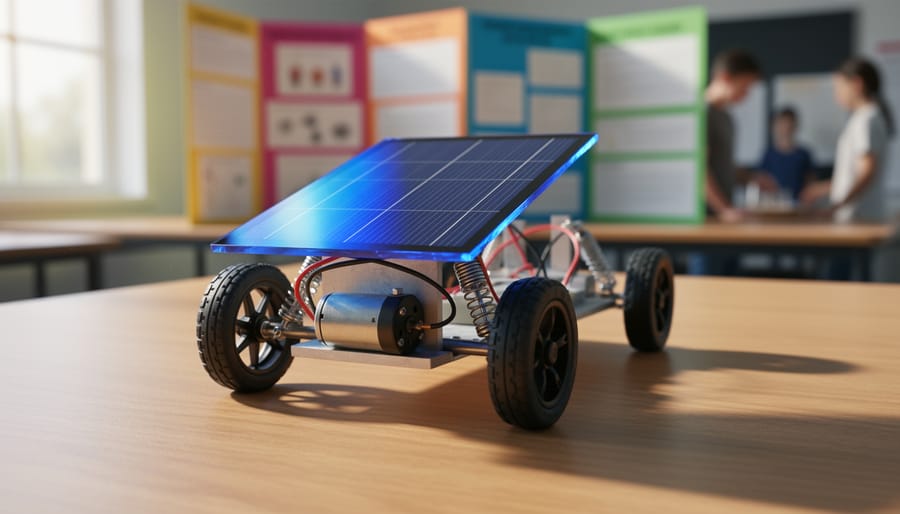
A well-constructed solar-powered car demonstrates the practical application of renewable energy principles in an engaging science fair project.
Understanding How Your Solar Car Will Work
The Solar Cell: Your Engine’s Power Source
Think of a solar cell as your model car’s miniature power plant. These remarkable devices, also called photovoltaic cells, transform sunlight directly into electrical energy through the photovoltaic effect. When light particles (photons) hit the cell’s surface, they knock electrons loose, creating an electrical current. It’s like a tiny waterfall of electricity flowing whenever the sun shines!
For your science fair project, understanding solar panel basics will help you choose the right cell. Most hobby solar cells produce between 0.5 and 6 volts, and for a small model car, you’ll typically want around 3-4 volts to get good speed without overwhelming your motor.
Here’s what really matters: voltage determines your car’s potential speed, while amperage (measured in milliamps for small cells) affects how much power you can actually deliver. I learned this the hard way on my first project when my nephew and I picked a high-voltage cell with very low amperage—our car barely crawled!
Look for cells rated at least 100-200 milliamps. The larger the cell’s surface area, generally the more current it produces. Most educational solar cells measuring 2×3 inches work perfectly for basic cars, providing enough juice to zip across your demonstration table and impress the judges.
The solar cell converts sunlight directly into electrical energy that powers the motor and drives your car forward.
The Motor and Wheels: Turning Electricity Into Motion
The electric motor is where the magic happens—it converts your solar panel’s electrical energy into the spinning motion that drives your car forward. For lightweight science fair projects, small DC (direct current) motors work perfectly because they’re simple, inexpensive, and match the power output of typical solar panels.
Here’s how they work: When electricity flows through the motor’s coil, it creates a magnetic field that pushes against permanent magnets inside. This pushing force causes the motor shaft to spin continuously. The faster the electricity flows (more voltage from your solar panel), the faster your wheels turn.
I remember Charles once telling me about his daughter’s first solar car—she chose a motor that was too powerful for her small panel, and the car barely moved. The key is matching your motor’s voltage rating to your solar panel. Most hobby solar panels produce 3-6 volts, so look for motors in that same range. You’ll often see these labeled as “toy motors” or “hobby motors” at electronics stores.
For the wheels, lightweight plastic wheels about 2-3 inches in diameter work best. They provide enough grip without adding weight that would slow your car down. Similar principles apply when powering small electronics with solar energy—matching components is essential for optimal performance.
The Chassis: Design Principles That Matter
Building a winning solar car starts with a smart chassis design. Think of it like creating a miniature race car that sips sunlight instead of gasoline. The three key principles you’ll want to focus on are weight distribution, aerodynamics, and friction reduction.
For weight distribution, place your solar panel and battery near the center of your chassis. I learned this the hard way when my first solar car kept tipping during turns because I mounted everything at the front. Balanced weight helps your car track straight and improves stability.
Aerodynamics might sound fancy, but it simply means making your car slice through air easily. Keep your design low and streamlined, avoiding tall or boxy shapes that create wind resistance. Even at slow speeds, a sleeker profile makes a noticeable difference.
Finally, minimize friction by ensuring wheels spin freely on their axles. A quick test: lift your car and spin the wheels. They should rotate smoothly for several seconds. Small details like straight axles and properly aligned wheels can mean the difference between a car that crawls and one that cruises confidently across the finish line.
What You’ll Need: Materials and Tools Shopping List
Getting your materials together is actually easier than you might think, and here’s some good news from my experience helping my daughter Emma with this exact project – you probably already have half of what you need at home! Let me break down everything into simple categories so you can tackle your shopping efficiently.
Essential Electronics (Budget: $15-25)
The heart of your car is a small solar panel, typically 1.5 to 3 volts. You can find these at hobby stores like Hobby Lobby or online at Amazon for around $5-8. I recommend the 2-volt panels for beginners. You’ll also need a small DC motor (about $3-5), which spins when electricity flows through it. Look for a 1.5-3 volt motor that matches your solar panel’s output. Grab some wire connectors or alligator clips ($2-3) to make connecting everything much easier.
Structural Materials (Budget: $5-10)
This is where recycling shines! Save money by using a cardboard box, foam board, or even a plastic water bottle as your car’s body. For wheels, raid your recycling bin for plastic bottle caps (free!) or purchase wooden wheels from craft stores ($3-4 for a pack). Lightweight wooden skewers or straws work perfectly as axles (under $2).
Assembly Supplies (Budget: $3-5)
Hot glue gun and glue sticks are your best friends here – they’re fast, strong, and forgiving for beginners. Alternatively, use craft glue or tape. You might need a few rubber bands for securing components.
Optional Upgrades
If you want to get fancy, consider adding a small capacitor ($2-3) to store energy for cloudy moments, or decorative materials like paint and stickers to make your presentation pop.
Total Project Cost: $25-45
Where to Shop: Local craft stores, hardware stores, or online retailers offer everything. Many teachers have classroom supplies you can borrow, so always ask! Salvaging materials from old toys or electronics can cut your costs in half while teaching valuable recycling lessons.
Gathering all necessary materials before beginning construction ensures a smooth building process and helps avoid mid-project delays.
Building Your Solar-Powered Car: Step-by-Step Instructions
Step 1: Preparing Your Chassis and Frame
The chassis is your car’s foundation, so let’s build something that’s both lightweight and strong enough to handle test runs. I remember when my nephew built his first solar car—he used a cardboard frame that looked great but crumpled after the third test drive. We learned our lesson!
Start with a sturdy cardboard piece, foam board, or thin balsa wood for your base. Cut a rectangle about 6-8 inches long and 3-4 inches wide. This gives you enough room for your motor, wheels, and solar panel without adding unnecessary weight. Think of it like packing for a trip—you only want what you absolutely need.
Here’s a handy tip: before cutting, trace your design lightly with pencil. Measure twice, cut once really applies here. Use sharp scissors or a craft knife with adult supervision for clean edges.
To keep your chassis rigid, consider adding small support struts underneath using popsicle sticks or wooden skewers. Just a couple crosspieces can dramatically increase strength without much weight penalty. Test your frame by gently pressing on it—it should resist flexing but not feel heavy in your hand.
For wheels, pre-made plastic wheels work great, but you can also repurpose bottle caps. The key is ensuring they spin freely on their axles, which we’ll tackle in the next step.
Step 2: Installing the Motor and Drivetrain
Now comes the fun part – bringing your solar car to life with movement! The motor is the heart of your drivetrain, so proper installation makes all the difference between a smooth racer and a car that barely crawls.
Start by securing your motor to the chassis using hot glue or small zip ties. Position it so the motor shaft points toward where your wheels will be. I learned this the hard way when my first solar car had the motor sideways – it looked great but went nowhere!
Next, attach your axle to the motor shaft. If you’re using a small hobby motor, you might need a rubber tube connector (like aquarium tubing) to join the motor shaft to a wooden dowel or metal axle. Push the tubing onto both pieces for a snug fit. This creates enough friction to transfer power without slipping.
For the wheels, drill a small hole through the center if they don’t already have one. Slide them onto your axle ends, leaving about a quarter-inch gap between the wheel and chassis. This prevents rubbing, which creates friction and slows you down. Secure wheels with a dab of hot glue on the axle end.
Test rotation by gently spinning the axle with your fingers. It should turn freely without wobbling. If there’s resistance, adjust wheel spacing or check that your axle sits level in its supports.
Step 3: Wiring Your Solar Panel to the Motor
Now comes the exciting part—connecting your solar panel to the motor! This is where your car truly comes to life. Before you start, here’s a quick safety reminder: solar panels generate electricity when exposed to light, so keep them covered or in shade until you’re ready to test.
First, identify the positive (red) and negative (black) wires on both your solar panel and motor. Polarity matters here! Connect the positive wire from your solar panel to the positive terminal on your motor, then connect the negative to negative. I remember Charles telling me about his daughter’s first solar car project—she accidentally reversed the wires and the car drove backward! While that’s not dangerous with these low-voltage components, you definitely want your car moving in the right direction for the fair.
For a simple connection, you can twist the wires together and secure them with electrical tape. If you want something more permanent, use wire connectors or a small breadboard. Think of it like this: you’re creating a complete circuit that lets electrons flow from the solar panel, through the motor (making it spin), and back to the panel.
Test your connection by placing the solar panel under bright light or sunshine. If everything’s wired correctly, your motor should start spinning immediately. If it doesn’t, double-check your wire connections and polarity.
Step 4: Mounting and Positioning Your Solar Panel
Now comes the fun part – getting your solar panel positioned just right! When I helped my nephew Charles with his first solar car, we learned this lesson the hard way: positioning matters more than you’d think.
Mount your solar panel on top of the car body using hot glue or double-sided tape. Here’s the key: angle it slightly toward where the sun will be during your demonstration. Most science fairs happen indoors under lights, so a flat position often works best. If you’re presenting outdoors, a 30-degree tilt captures more direct sunlight.
Keep the panel centered over the car’s body to maintain balance. An off-center panel creates drag and can make your car veer to one side. Charles initially mounted his panel too far forward, and his car did donuts instead of driving straight – funny, but not what the judges wanted to see!
Make sure the panel doesn’t hang over the edges too much, as this catches air and slows you down. Think streamlined, like a real race car. Test by gently pushing your car forward to ensure it rolls smoothly without tipping.
Step 5: Testing and Troubleshooting
Once you’ve assembled your solar car, it’s time for the moment of truth! Take your car outside on a sunny day and position the solar panel directly toward the sun. Give it a few seconds to charge up, then watch it go. If it works right away, congratulations! But don’t worry if it doesn’t move on the first try—that’s completely normal.
When I built my first solar car with my nephew, it just sat there stubbornly. We discovered the motor wires were reversed! Here are the most common issues and quick fixes:
If your car doesn’t move at all, first check that all wire connections are secure and touching metal-to-metal. A loose connection is the number one culprit. Next, verify your solar panel is getting direct sunlight—even shadows from your hand can dramatically reduce power. Test your motor separately by connecting it directly to the panel to confirm it works.
If the car moves backward, simply swap the two motor wires. If it’s sluggish, reduce weight by removing unnecessary materials or check that wheels spin freely without rubbing against the chassis. Make sure your axles are straight and smooth.
For presentation day, bring a backup flashlight or desk lamp. While natural sunlight works best, a bright LED lamp positioned close to the panel can demonstrate your car indoors if needed.
Testing your solar car under different light sources helps you understand how light intensity affects performance and provides valuable experimental data.
Making Your Project Stand Out to Judges
A great solar car project gets even better when you present it effectively. I remember my nephew’s first science fair – his car worked beautifully, but he missed the top prize because he couldn’t explain what made it special. Let’s make sure that doesn’t happen to you.
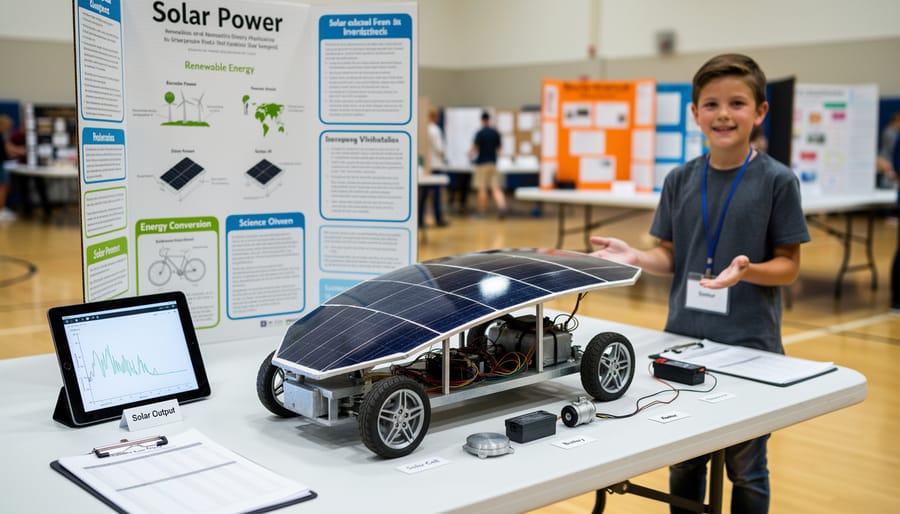
Start with a display board that tells your project’s story visually. Include large, clear photos of each build stage, from bare chassis to finished car. Create simple diagrams showing how sunlight converts to motion – judges love seeing that you understand the science, not just the assembly. Add a chart comparing your car’s performance under different lighting conditions. This shows you went beyond just building something cool.
Here’s where it gets interesting: run actual experiments. Test your car under various light sources – direct sunlight, cloudy conditions, indoor lighting, even flashlights at different distances. Record the speed and distance traveled in each scenario. Use a stopwatch and measuring tape to gather real data. Create a simple graph showing these results. This demonstrates the scientific method in action: hypothesis, testing, observation, and conclusion.
Document everything with photos and notes as you build. Judges appreciate seeing your problem-solving process. Did a wheel fall off during testing? Great! Show how you fixed it. These challenges make your project authentic and relatable.
Consider adding an interactive element to your display. Let judges adjust the solar panel angle or test the car themselves. This hands-on approach creates memorable experiences that stick with evaluators long after they’ve moved to the next project.
Finally, practice explaining your project in simple terms. You should confidently describe what you built, why it works, what you learned, and what surprised you most. Genuine enthusiasm combined with solid data creates winning combinations every time.
Experiments You Can Run With Your Solar Car
Now that you’ve built your solar car, it’s time for the fun part—experimenting! Testing different variables will not only strengthen your science fair presentation but also help you understand how solar energy really works. Let me share what worked when I helped my daughter with her project last year.
Start by testing light intensity. Move your car between indoor lighting, outdoor shade, and direct sunlight, timing how long it takes to travel a fixed distance (say, 10 feet). You’ll be amazed at the difference! Next, experiment with panel angles. Tilt your solar panel at 15-degree increments from flat to 90 degrees to find the sweet spot. Charles from our community discovered that a 45-degree angle worked best in his latitude during winter months.
Weight affects performance too. Add small washers or coins incrementally and measure speed changes. This demonstrates real-world challenges engineers face when designing electric vehicles. Try different surfaces—smooth tile, carpet, concrete, or wood—to see how friction impacts efficiency. For bonus points, test aerodynamic modifications by adding cardboard spoilers or streamlined shapes.
Documentation is crucial for your science fair success. Create a simple chart with columns for each variable, your measurements, and observations. Take photos or videos of each test. Include failed attempts too—scientists learn from those! Keep a lab notebook with dates, weather conditions, and any unexpected discoveries. This detailed record will impress judges and make creating your display board much easier. These hands-on experiments mirror real DIY solar projects that professionals undertake when optimizing renewable energy systems.
Common Mistakes and How to Avoid Them
Charles learned these lessons the hard way during his first solar car project with his daughter, and countless DIY enthusiasts have shared similar experiences. Let’s explore the most common pitfalls so you can skip straight to success.
Weight distribution is probably the biggest rookie mistake. Charles remembers watching his daughter’s first prototype veer off course constantly because they mounted the solar panel too far back. Keep your heaviest components, especially the panel, centered over the axles. A simple trick from the community: place your car on a ruler to find its balance point before gluing anything permanently.
Poor electrical connections will stop your project dead in its tracks. Loose wires or cold solder joints are frustrating because your car might work during testing but fail during presentation. Always tug gently on each connection after making it, and use electrical tape or heat shrink tubing to secure everything. One parent shared that their child’s car worked perfectly at home but failed at the fair because a wire popped loose in the car ride over.
Solar panel sizing matters more than you’d think. Many beginners grab the smallest, cheapest panel available, then wonder why their car barely moves. Your panel should provide at least 3-4 volts and enough current to match your motor’s needs. Check your motor’s specifications first, then choose accordingly.
Finally, friction is your enemy. Charles discovered that hot glue on axles creates drag that even the best solar panel can’t overcome. Use proper axle holders or drinking straw segments, and ensure wheels spin freely before final assembly.
Building your solar powered car is just the beginning of an exciting journey into renewable energy. The hands-on experience you’ve gained assembling solar cells, motors, and circuits creates a foundation that extends far beyond the science fair table. I remember when I built my first solar project decades ago—the thrill of seeing that initial movement powered entirely by sunlight never really fades, and it sparked a lifelong passion for clean energy.
Don’t be afraid to experiment with your design after the fair. Try different gear ratios, test various solar panel angles, or experiment with lighter materials to boost speed. Every modification teaches you something new about energy efficiency and engineering principles that apply to larger solar-powered vehicle projects and real-world applications like residential solar installations.
We’d love to see what you’ve created! Share photos of your solar car with the Spheral Solar community online. Your unique solutions and creative approaches might inspire the next generation of renewable energy enthusiasts. Who knows—today’s science fair project could spark tomorrow’s breakthrough in sustainable transportation.
How useful was this post?
Click on a star to rate it!
Average rating 0 / 5. Vote count: 0
No votes so far! Be the first to rate this post.
We are sorry that this post was not useful for you!
Let us improve this post!
Tell us how we can improve this post?
charlesnoble
Here at Spheral Solar, I’m a hands-on solar power enthusiast, constantly exploring and experimenting with DIY solutions. I’m dedicated to sharing my discoveries, insights, and even the bumps I hit along the way, all in the pursuit of a more sustainable future.
DIY Solar Generator – Complete Guide With Diagrams by Paul July 17, 2021 Building a weatherproof DIY solar generator involves mounting and wiring a battery, charge controller, inverter, trickle charger, and fusing inside a weatherproof case. Then all the relevant input and output sockets are wired and mounted on the outside of the case where they are easily accessible. What Exactly Are Solar…
How I Built a 48V Ebike Solar Charger That Works Anywhere by Charlesnoble January 14, 2026 Calculate your ebike’s battery capacity in watt-hours by multiplying 48 volts by your amp-hour rating—this determines the minimum solar panel wattage you’ll need. A standard 48V 14Ah ebike battery holds 672Wh, requiring at least a 200-watt solar panel for a full day’s charge in optimal sunlight conditions. Match your solar…
How to Build a Solar-powered Electric Fence (With Diagrams) by Paul November 1, 2021 Heads up: some links here are affiliate links, and purchases through them support the site. As an Amazon Associate I earn from qualifying purchases. You can build a permanent DIY, 3-acre solar-powered electric fence can with basic technical skills in under a week. And depending on whether you opt for…
How Does a Solar-Powered Drip Irrigation System Work by Paul September 13, 2021 Heads up: some links here are affiliate links, and purchases through them support the site. As an Amazon Associate I earn from qualifying purchases. Solar-powered drip irrigation can be installed in most gardens using a small solar system, readily available irrigation materials, and minimal tools. If you already have a…
Why 9 Volt Solar Panels Are Perfect for Your… by Charlesnoble March 9, 2026 Understand that 9 volt solar panels aren’t actually standardized products delivering exactly 9V—most small panels marketed this way produce anywhere from 6V to 12V depending on sunlight conditions, making them surprisingly versatile for charging batteries, running small electronics, or powering Arduino projects. Match your panel’s actual output voltage to your…
Build Your Perfect Van Solar Power System (Without… by Charlesnoble October 19, 2025 Transform your van into a self-sufficient mobile haven with a custom solar power system that delivers reliable, renewable energy wherever the road takes you. From weekend warriors to full-time nomads, installing solar panels on your van opens up endless possibilities for off-grid living while significantly reducing your environmental impact. Whether…
Subscribe for handpicked DIY projects, exclusive tips, and giveaways.
Charging a battery bank with a 3-phase inverter requires connecting your inverter’s AC output to a compatible battery charger or hybrid inverter system that can convert the 3-phase power back to DC for storage. Most DIY solar setups achieve this by using a hybrid inverter that handles both solar input and battery charging simultaneously, or… Read more: How to Wire and Configure a Battery Inverter 3 Phase System for Off-Grid Solar
Wiring a 7-pin RV plug correctly connects your tow vehicle to your trailer’s lights, brakes, and auxiliary power in about 45 minutes with basic hand tools and careful attention to the color-coded wire standard. The diagram follows a specific layout mandated by the RV Industry Association: each pin controls a distinct function, from left turn… Read more: How to Wire a 7-Way RV Plug: Step-by-Step Diagram and Setup Guide
Nine times out of ten, an E050 arc fault error on your solar inverter means a loose connection somewhere in your DC wiring. Before you panic or call an expensive technician, check every MC4 connector between your panels and inverter. A single connection that wasn’t snapped fully closed or has corroded from weather exposure will… Read more: Why Is My Solar Inverter Showing Arc Fault E050? Causes and How to Fix It