Why Your Solar Battery Dies Faster Than Expected (And How to Size It Right)
Updated:
Calculate your required solar battery capacity by multiplying your daily energy consumption in kilowatt-hours by the number of days of autonomy you want. If your home uses 30 kWh daily and you want three days of backup power, you need 90 kWh of usable storage capacity. Remember that most batteries shouldn’t discharge below 20-50% to preserve lifespan, so add 20-30% to your calculated total.
Check the battery specification sheet for three critical numbers: nominal capacity (total storage), usable capacity (what you can actually access), and depth of discharge percentage. A 10 kWh lithium battery with 90% depth of discharge gives you 9 kWh of usable power, while a 10 kWh lead-acid battery at 50% depth of discharge only delivers 5 kWh. This distinction matters more than any other specification when comparing options.
Match your battery chemistry to your actual usage patterns rather than chasing maximum capacity numbers. Lithium batteries excel for daily cycling in grid-tied systems with frequent shallow discharges, while quality lead-acid batteries still work well for off-grid setups with occasional deep draws. I learned this the hard way after oversizing my first battery bank based purely on capacity ratings without considering my actual energy rhythms throughout the week.
Monitor your system’s state of charge during typical use periods before expanding capacity. Many DIYers discover their batteries drain faster than expected not because they lack capacity, but because phantom loads, inverter inefficiencies, or miscalibrated charge controllers consume 15-25% more power than calculated. Address these efficiency losses first—adding more batteries to compensate for poor system design wastes money and space.
What Solar Battery Capacity Actually Means
Different solar battery types offer varying capacity ratings and real-world performance characteristics that affect your system planning.
The Numbers on Your Battery Explained
You’ve probably stared at a battery label and seen something like “12V 100Ah” and wondered what that actually means for your solar setup. Let me break it down in a way that finally makes sense.
The voltage (12V) tells you the electrical pressure, while the amp-hours (Ah) tell you the capacity—essentially how long the battery can deliver power. Think of voltage like water pressure in a hose, and amp-hours like the size of your water tank. A 100Ah battery can theoretically deliver 100 amps for one hour, or 10 amps for 10 hours, or 5 amps for 20 hours.
Here’s where it gets practical. To figure out how much actual energy you can use, you need to convert amp-hours to watt-hours. Just multiply the voltage by the amp-hours. So that 12V 100Ah battery contains 1,200 watt-hours (Wh) of stored energy.
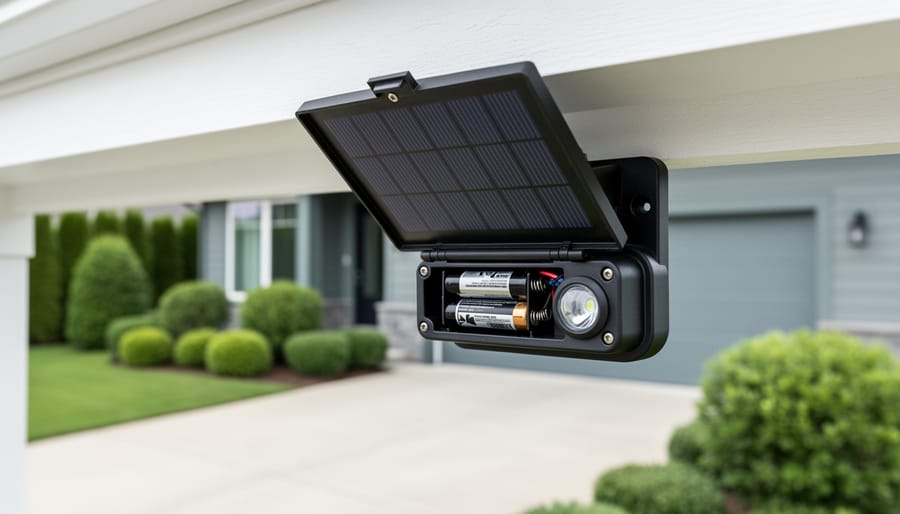
But here’s the catch—and this tripped me up on my first solar project—you can’t actually use all of that capacity. Lead-acid batteries should only be discharged to about 50% to maintain their lifespan, giving you just 600Wh of usable power. Lithium batteries are better, allowing you to safely use 80-90% of their nominal capacity.
So when you see those numbers on your battery, remember: the label shows nominal capacity, but your usable capacity depends entirely on the battery chemistry and how well you want to treat it.
Why 100Ah Doesn’t Mean 100Ah
Here’s something I learned the hard way during my first off-grid setup: that shiny new 100Ah battery sitting in your garage doesn’t actually give you 100Ah of usable power. Sounds like false advertising, right? Let me explain why this is actually about protecting your investment.
The key concept here is Depth of Discharge, or DoD. Think of it like your smartphone battery. You know how tech experts always say don’t let your phone drop to zero percent? The same principle applies to solar batteries, but it’s even more critical.
With traditional lead-acid batteries (including AGM and gel types), you should only use about 50% of the rated capacity. So that 100Ah battery? You’re really looking at 50Ah of usable power. Drain it below that regularly, and you’ll dramatically shorten its lifespan. I’ve seen folks replace batteries after just a year because they kept running them into the ground.
Lithium batteries change the game completely. Most lithium iron phosphate (LiFePO4) batteries allow 80-90% DoD, and some manufacturers even rate them for 100%. That same 100Ah rating suddenly gives you 80-90Ah of actual usable capacity. This is one reason lithium costs more upfront but often saves money long-term.
Understanding these differences is crucial when you’re doing battery power conversions and sizing your system. When someone tells you they have a 200Ah battery bank, your first question should be: lead-acid or lithium? Because the usable capacity could be anywhere from 100Ah to 180Ah depending on the chemistry. Always calculate your actual needs based on usable capacity, not the number printed on the label.
How Much Battery Capacity Do You Really Need?
The Simple Formula That Works
Here’s the good news: figuring out your solar battery capacity doesn’t require a degree in electrical engineering. I remember when I first started out, I was overwhelmed by all the technical specifications. Then a friend shared a simple formula that changed everything, and I’ve been using variations of it ever since.
The basic calculation starts with your daily energy consumption. Look at your electricity bill or use a power meter to track your usage for a few days. Let’s say your home uses 30 kilowatt-hours (kWh) per day. That’s your baseline number.
Next, decide how many days of backup power you want. Most people aim for 1-3 days of autonomy. If you want two days of backup, multiply your daily usage by two: 30 kWh x 2 = 60 kWh total capacity needed.
But here’s the catch: you shouldn’t drain batteries completely. Lead-acid batteries should only discharge to about 50%, while lithium batteries can safely go to 80-90%. So if you’re using lead-acid, divide your total by 0.5. For our example: 60 kWh ÷ 0.5 = 120 kWh of actual battery capacity needed.
For a more streamlined approach, try our battery capacity calculator. Just plug in your numbers, and it handles the depth of discharge calculations automatically while factoring in real-world efficiency losses.
One practical tip: round up rather than down. I learned this the hard way during my first winter when cloudy days lasted longer than expected. That extra 10-20% buffer has saved me countless headaches.
Testing battery capacity and voltage helps verify actual performance versus manufacturer specifications.
Days of Autonomy: Your Safety Buffer
Think of days of autonomy as your solar system’s rainy day fund. It’s the number of days your battery bank can keep your essentials running without any sun recharging the batteries. I learned this lesson the hard way during my first solar setup when three consecutive cloudy days left me scrambling for my backup generator at 2 AM.
For most residential applications, I recommend planning for 2-3 days of autonomy. This gives you breathing room during typical cloudy stretches without oversizing your battery bank unnecessarily. If you live in the Pacific Northwest where gray skies dominate winter months, consider bumping that to 3-4 days. Meanwhile, my friend in Arizona gets away with just 1-2 days since sunshine is practically guaranteed.
Here’s how to calculate it: multiply your daily energy consumption by your desired autonomy days. If you use 5 kWh daily and want 3 days of backup, you need 15 kWh of usable battery capacity. Remember to account for depth of discharge too—if you’re only comfortable using 80% of your battery capacity, divide that 15 kWh by 0.8, giving you an 18.75 kWh total battery bank.
Off-grid systems typically need 4-7 days of autonomy since you have no grid backup. Grid-tied systems with battery backup can get away with 1-2 days since the grid fills any gaps. Weekend cabin? One day might suffice if you’re only there intermittently.
Battery Types and Their Real-World Capacity
Lead-Acid: The Budget Option’s Hidden Costs
Let me be straight with you about lead-acid batteries: they’re the budget-friendly option that comes with some serious compromises. I learned this the hard way during my first off-grid cabin project when I thought I’d scored a deal on some golf cart batteries.
Lead-acid batteries come in two flavors: flooded (the kind you add water to) and sealed (often called AGM or gel). Both share a critical limitation that catches many DIYers off guard—you can only use about 50% of their rated capacity without drastically shortening their lifespan. That 200Ah battery? You’re really working with 100Ah of usable energy. Discharge them deeper than that regularly, and you’ll be replacing them in a couple of years instead of the promised five to seven.
Here’s the reality check: if you see a lead-acid battery bank advertised at $400 versus a lithium battery at $800, you’re not comparing apples to apples. That lead-acid setup needs to be twice as large to deliver the same usable capacity, putting you right back at similar pricing—sometimes even more expensive when you factor in the shorter lifespan.
So when do lead-acid batteries still make sense? Honestly, they’re ideal for very small systems where you’re just powering a few lights or a water pump, backup applications where they’ll rarely cycle, or situations where you already have the infrastructure and just need replacements. For serious daily-use solar setups, the hidden costs quickly outweigh the initial savings.
Lithium Batteries: Worth the Extra Money?
If you’re serious about maximizing your solar battery capacity, lithium batteries deserve a close look. While they cost roughly two to three times more upfront than lead-acid options, the real value becomes clear when you dig into the numbers.
The game-changer with lithium batteries is their depth of discharge. Remember how we mentioned lead-acid batteries should only be discharged to 50%? Lithium batteries can safely handle 80-100% DoD without damaging the cells. That means a 100Ah lithium battery gives you 80-100Ah of usable capacity, compared to just 50Ah from a similarly-sized lead-acid battery. Suddenly, that price difference doesn’t look quite so steep.
Beyond usable capacity, lithium batteries typically last 3,000 to 5,000 charge cycles compared to 300-500 for lead-acid batteries. If you’re cycling your batteries daily, that’s the difference between replacing them every year or two versus enjoying a decade or more of reliable service.
Charles made the switch to lithium in his van conversion project and hasn’t looked back. “I was initially shocked by the price tag on a 200Ah lithium battery,” he admits. “But after doing the math, I realized I’d need 400Ah of lead-acid capacity to get the same usable power. Plus, the weight savings in the van was incredible—lithium batteries weigh about half as much. I freed up almost 60 pounds, which matters when you’re trying to stay under weight limits.”
The maintenance factor is another bonus. Lithium batteries don’t require the regular water top-ups or equalization charging that flooded lead-acid batteries need, making them genuinely set-and-forget for most applications.
For weekend warriors or occasional users, lead-acid might still make sense. But if you’re building a system you’ll rely on daily, lithium batteries deliver better long-term value.
Common Mistakes That Kill Your Battery Capacity
Undersizing: The Most Expensive ‘Savings’
I learned this lesson the hard way during my first off-grid cabin project. I tried to save $200 by purchasing a smaller battery bank, thinking I’d just be more conservative with power usage. Within 18 months, those batteries were toast.
Here’s what happens when you undersize: your batteries constantly operate at deeper discharge levels than they’re designed for. Instead of cycling between 100% and 50% capacity (which is healthy), they’re regularly dropping to 20% or lower. Every deep cycle strips away capacity and shortens lifespan dramatically.
A battery rated for 3,000 cycles at 50% depth of discharge might only deliver 500 cycles if you’re routinely draining it to 80% depth. You’ll replace those “savings” batteries three to six times more often than properly sized ones. The math is brutal: that $800 battery bank becomes a $2,400+ expense over a decade, plus the hassle of replacement.
The sweet spot is sizing your battery bank so daily usage keeps you between 20-50% depth of discharge. Yes, it costs more upfront, but those batteries will actually reach their rated lifespan and save you money long-term. Think of proper sizing as an investment, not an expense.
Temperature’s Sneaky Effect on Capacity
Here’s something I learned the hard way during a winter camping trip with my solar setup: I woke up to find my battery bank showing only 60% of its usual capacity, even though it was fully charged the night before. Temperature, my friends, is one of battery capacity’s sneakiest enemies.
Cold weather hits batteries particularly hard. When temperatures drop below freezing, the chemical reactions inside slow down dramatically. A lead-acid battery can lose 20-30% of its capacity at 32°F, and up to 50% when it gets down to 0°F. Lithium batteries handle cold better but still suffer performance drops. The battery isn’t damaged—it’s just temporarily sluggish, like trying to pour cold honey.
Hot weather creates different problems. While batteries might seem to perform better initially in heat, temperatures above 80°F accelerate internal degradation and can permanently reduce lifespan. For every 15°F above 77°F, you can expect battery life to cut in half. That’s expensive math.
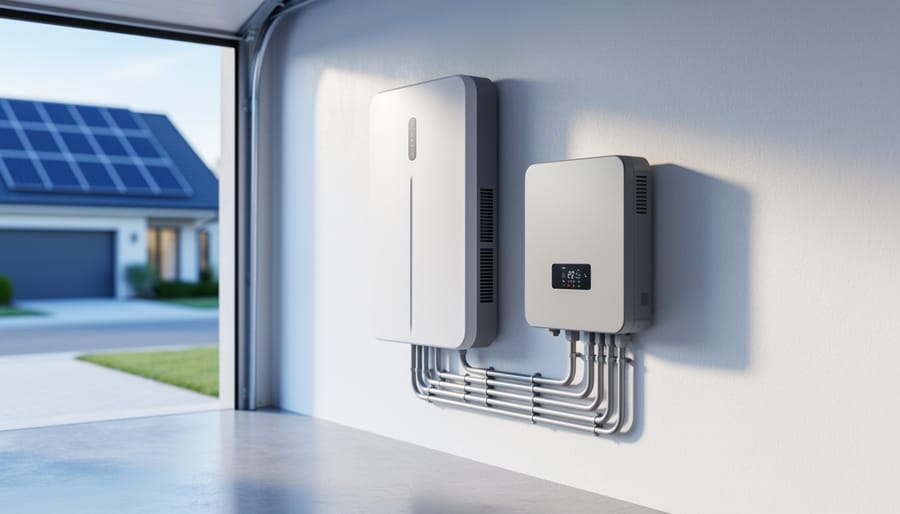
So what can you do? If possible, install batteries in climate-controlled spaces like basements or insulated garages. When that’s not feasible, insulated battery boxes work wonders. I’ve even seen DIYers use simple Styrofoam coolers for small setups. In extreme cold, some battery management systems include heating elements that kick in automatically. In hot climates, ensure adequate ventilation and shade. Remember, protecting your batteries from temperature extremes isn’t just about today’s performance—it’s about preserving your investment for years to come.
Proper battery protection from temperature extremes preserves capacity and extends system lifespan in outdoor installations.
Matching Battery Capacity to Your Solar Panel Array
A properly sized battery bank matched to your solar array ensures reliable energy storage and system efficiency.
The Sweet Spot Ratio
Finding the right balance between your solar panels and battery capacity doesn’t have to be complicated. Through years of tinkering with different setups, I’ve learned that the sweet spot usually falls within a fairly predictable range depending on your situation.
For sunny climates like Arizona or Southern California, a ratio of 1:1 to 1.5:1 (battery capacity in watt-hours to panel wattage) works beautifully for most off-grid applications. This means if you have 400 watts of solar panels, you’d want 400-600 watt-hours of battery storage. My neighbor Mike runs his camping trailer on exactly this setup, and he rarely runs out of power even after cloudy days.
In cloudier regions or for winter use, bump that ratio up to 2:1 or even 3:1. A friend in Seattle uses 800 watts of panels with 2,400 watt-hours of battery capacity for her greenhouse monitoring system, which handles those gray Pacific Northwest winters without issue.
Weekend warriors and occasional users can get away with smaller ratios around 0.75:1 since the batteries have time to fully recharge between uses. Daily users, especially those running critical equipment, should aim for the higher end.
Here’s a practical example: A 200-watt solar setup charging a 300 watt-hour battery bank provides enough power for LED lighting, phone charging, and a small fan in most climates. You can verify your specific charging needs using our charge time calculator to fine-tune these ratios for your exact situation.
Expanding Your Battery Capacity the Right Way
When You Can Add Batteries (And When You Shouldn’t)
Here’s the truth about battery expansion: it’s not always the right move, and knowing the difference can save you hundreds of dollars and a lot of frustration.
The golden rule is matching. If you’re adding batteries to an existing bank, they should ideally be the same brand, model, age, and capacity. Mixing a three-year-old battery with a brand new one is like pairing a marathon runner with someone just off the couch—the weaker battery will drag down the entire system and can actually damage your newer investment.
I learned this the hard way when I tried adding two new batteries to my aging setup. Within six months, the old batteries had pulled the new ones down to their degraded performance level. I ended up replacing everything anyway, spending more money than if I’d just started fresh.
Voltage matching is non-negotiable. When working with series vs parallel configurations, even a slight voltage mismatch creates imbalances that reduce capacity and lifespan. Use a multimeter to verify voltage before connecting anything.
Signs you should replace rather than expand include batteries older than three years, visible swelling or corrosion, capacity that’s dropped below 80 percent of original rating, or if you’re constantly equalizing to maintain performance. At that point, adding new batteries is throwing good money after bad.
If your existing bank is under two years old and performing well, expansion makes sense—just buy identical units and install them properly with balanced connections.
Getting your solar battery capacity right isn’t just about crunching numbers—it’s about creating a system that actually works for your life. I learned this the hard way during my first winter with solar, when I thought I’d sized everything perfectly until three cloudy days in a row left me scrambling. The math was correct, but I hadn’t accounted for real-world variability. That experience taught me that understanding capacity is the foundation of energy independence.
The good news? You now have the knowledge to avoid those rookie mistakes. You understand what amp-hours really mean, how to calculate your actual needs, and why oversizing by 20-30% isn’t wasteful—it’s smart planning. You’ve learned that the cheapest battery isn’t always the best value and that your usage patterns matter more than textbook calculations.
Now it’s your turn to put this into practice. Use the calculators we’ve provided to size your system properly. Start with one battery if you need to, monitor your results, and expand thoughtfully. Don’t be afraid to experiment—just document what works and what doesn’t.
Here’s what I love about this community: we learn from each other’s successes and mistakes. Share your solar journey in the comments below. What capacity did you choose? What surprised you? Your experience might be exactly what someone else needs to hear.
You’re not just installing batteries—you’re taking control of your energy future. That’s powerful, and you’ve got this.
How useful was this post?
Click on a star to rate it!
Average rating 0 / 5. Vote count: 0
No votes so far! Be the first to rate this post.
We are sorry that this post was not useful for you!
Let us improve this post!
Tell us how we can improve this post?
charlesnoble
Here at Spheral Solar, I’m a hands-on solar power enthusiast, constantly exploring and experimenting with DIY solutions. I’m dedicated to sharing my discoveries, insights, and even the bumps I hit along the way, all in the pursuit of a more sustainable future.
Stop Guessing Your Battery Power: The Conversion… by Charlesnoble October 28, 2025 Grab your battery specifications and check three numbers that matter: amp-hours (Ah) tells you total capacity like a fuel tank size, watt-hours (Wh) reveals actual energy storage accounting for voltage differences, and reserve capacity (RC) shows real-world runtime at a steady draw. These measurements aren’t interchangeable labels for the same…
How Much Power Does an 8kW Solar System Actually… by Charlesnoble March 24, 2026 An 8kW solar system typically generates between 24 and 40 kWh per day, depending on your location, season, and installation quality. That’s enough to power most average homes completely, but the reality is more nuanced than a single number can capture. I remember installing my first 8kW array in Arizona…
Calculate Your Solar Panel kWh Output Before You Buy… by Charlesnoble January 29, 2026 Grab your solar panel specs and electricity bill—you’re about to discover exactly how many kilowatt-hours your solar setup can generate and whether it’ll actually cover your energy needs. Most people dive into solar projects with enthusiasm but fuzzy math, leading to oversized systems that waste money or undersized ones that…
How Many kWh Does Your Solar System Actually Need?… by Charlesnoble November 29, 2025 Calculate your daily energy consumption by checking your utility bill for the monthly kilowatt-hour (kWh) usage, then divide by 30 to get your average daily number. This single figure becomes your North Star for sizing any solar system, whether you’re powering a full household, weekend cabin, or portable camping setup.…
How Batteries Actually Convert Energy (And Why It… by Charlesnoble April 27, 2026 A battery converts chemical energy stored within its cells into electrical energy that powers your devices—a fundamental transformation that makes everything from your smartphone to your off-grid solar setup possible. Understanding this energy conversion isn’t just academic knowledge; it’s the foundation for choosing the right batteries, calculating how long they’ll…
Why Joule Solar Energy Matters More Than Watts for… by Charlesnoble February 11, 2026 Picture this: You’re browsing solar panel specs and suddenly see energy output measured in joules, watt-hours, and kilowatt-hours all mixed together. Confusing, right? I’ve been there myself, standing in my garage with a handful of solar equipment brochures, wondering why some manufacturers use joules while others stick to watts. That…
Subscribe for handpicked DIY projects, exclusive tips, and giveaways.
Wiring a 7-pin RV plug correctly connects your tow vehicle to your trailer’s lights, brakes, and auxiliary power in about 45 minutes with basic hand tools and careful attention to the color-coded wire standard. The diagram follows a specific layout mandated by the RV Industry Association: each pin controls a distinct function, from left turn… Read more: How to Wire a 7-Way RV Plug: Step-by-Step Diagram and Setup Guide
Nine times out of ten, an E050 arc fault error on your solar inverter means a loose connection somewhere in your DC wiring. Before you panic or call an expensive technician, check every MC4 connector between your panels and inverter. A single connection that wasn’t snapped fully closed or has corroded from weather exposure will… Read more: Why Is My Solar Inverter Showing Arc Fault E050? Causes and How to Fix It
Most Defiant solar motion lights fail because the battery no longer holds a charge or the solar panel has accumulated enough grime to choke off charging completely. Before you assume your light is dead and start shopping for a replacement, pull off the panel cover and check the battery terminals for corrosion. That 30-second inspection… Read more: Why Is My Defiant Solar Motion Security Light Not Working? Causes and How to Fix It