Wire Your RV Tow Vehicle the Right Way (7-Pin Connector Explained)
Updated:
Identify the seven wires in your RV connector by their standard color codes: brown carries running lights, yellow handles left turn signal and brake, green manages right turn signal and brake, white serves as ground, blue powers electric brakes, black provides 12V battery charge, and red or purple connects auxiliary power for backup lights or accessories. Understanding these connections prevents the frustration of trailer lights that don’t work or, worse, create dangerous road situations when other drivers can’t see your signals.
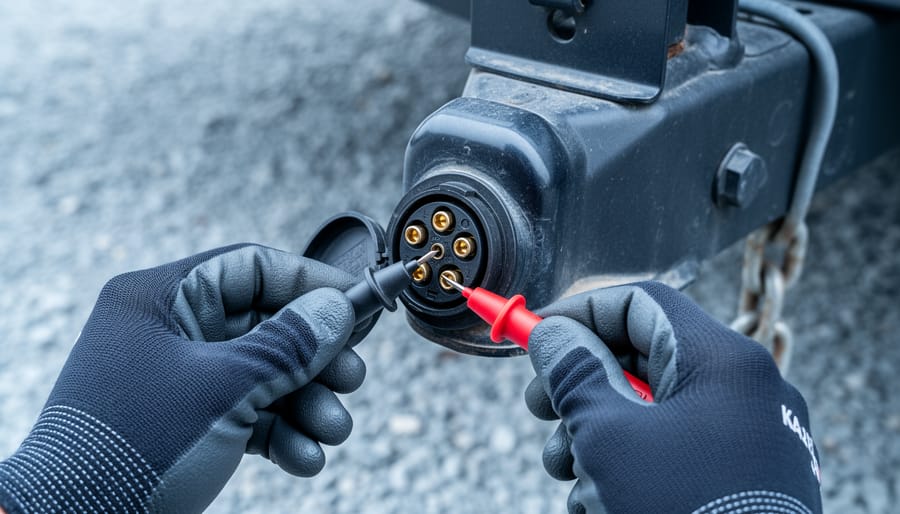
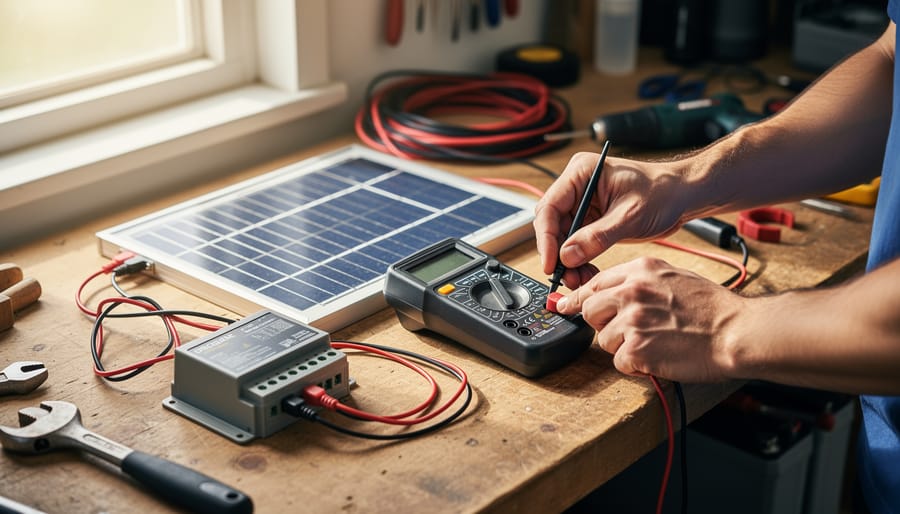
Trace each wire from your tow vehicle’s connector to your RV using a multimeter set to continuity mode, testing one circuit at a time with your vehicle’s lights activated. This hands-on approach taught me more in twenty minutes than hours of reading forums when I first wired my own setup. You’ll quickly discover whether you’re dealing with a simple loose connection or a more complex wiring issue that needs attention.
Match the pin numbers on your diagram to the actual connector, remembering that 7-way connectors follow a clock-face pattern with pin 1 at the 12 o’clock position. Most diagrams show the connector from the wire-entry side, so flip your mental image when looking at the plug-in side to avoid connecting wires backwards.
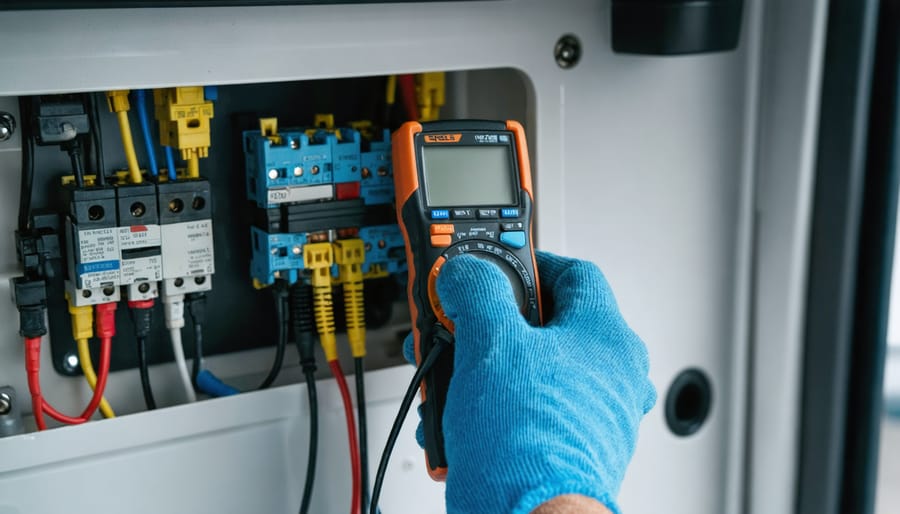
Check voltage at each pin with your test light or multimeter while someone operates the vehicle’s light switches, brake pedal, and turn signals. Real-world testing beats assumptions every time, especially since some manufacturers occasionally deviate from standard color codes or use different pin assignments for auxiliary functions.
Whether you’re installing a new connector, troubleshooting intermittent lighting problems, or upgrading your electrical system to support solar-powered accessories, mastering your 7-way wiring diagram gives you complete control over your RV’s electrical lifeline.
What Is a 7-Way RV Wiring Connector (And Why You Need It)
If you’ve ever wondered how your RV’s brake lights, turn signals, and other electrical systems communicate with your tow vehicle, the answer lies in that circular connector at the front of your trailer. That’s your 7-way RV wiring connector, and it’s essentially the electrical bridge between your vehicle and your home-on-wheels.
Think of the 7-way connector as a translator. Your truck or SUV sends electrical signals through this connector to control everything from your RV’s running lights to its electric brakes. Without it, you’d have no way to signal turns, illuminate your trailer at night, or safely stop your rig.
Here’s what makes the 7-way connector so useful: it handles seven different electrical functions through seven separate pins. These include your turn signals, brake lights, running lights, electric brakes, reverse lights, a 12-volt power supply for charging your RV’s battery, and a ground connection. That’s a lot of capability packed into one small component.
You might be wondering why RVs use a 7-way connector instead of the smaller 4-way connectors you see on utility trailers. The simple answer is that RVs need more functionality. A 4-way connector only handles basic lighting (turn signals, brake lights, and running lights). RVs, however, require electric brakes for safe stopping power and that battery charging capability to keep your onboard systems running while you travel.
I learned this the hard way during my first RV trip when I discovered my trailer battery was dead after a long drive. Turns out, one of my connector pins wasn’t making proper contact, so my battery never charged during transit. Once I understood how the 7-way system worked, troubleshooting became much simpler.
The 7-way connector has become the industry standard because it provides everything most RV owners need while remaining relatively simple to install and maintain. Whether you’re hooking up a travel trailer or a fifth wheel, you’ll almost certainly encounter this reliable workhorse of RV electrical systems.
The 7-way connector is the standard electrical interface between tow vehicles and RVs, featuring seven distinct pins for different functions.Each of the seven color-coded wires in an RV connector serves a specific function, from ground and lights to brake control and battery charging.
Understanding the 7 Wires: What Each One Does
Ground Wire (White)
The white wire serves as your ground connection, and it’s arguably one of the most important wires in your entire RV setup. Think of it as the safety net for your electrical system. When I first started tinkering with my RV’s electrical system, I’ll admit I underestimated the ground wire. That changed quickly when I experienced flickering lights and erratic brake signal behavior, all because of a poor ground connection.
Here’s what the ground wire does: it completes the electrical circuit by providing a return path for electricity back to the battery. Without a solid ground, your lights won’t work properly, and more importantly, you could face serious safety issues like electrical shocks or even fires.
The ground wire connects directly to the frame of both your tow vehicle and trailer, creating what electricians call a common ground. This means all your electrical components share the same reference point, ensuring they work harmoniously together.
When installing, make sure the white wire connects to bare metal on both ends. Remove any paint, rust, or debris where the connection point touches the frame. A clean, tight connection here prevents voltage drops and keeps your entire system running smoothly and safely.
Tail/Running Lights (Brown)
The brown wire handles your RV’s tail and running lights, which illuminate whenever your vehicle’s headlights are on. Think of these as the lights that make your RV visible to other drivers during evening trips or in low-light conditions. When you flip on your headlights, this wire carries a 12-volt signal from your tow vehicle to activate those marker lights running along the sides and rear of your RV.
I remember helping my neighbor troubleshoot his setup one evening, and we discovered his brown wire had a loose connection. Once we tightened it, his running lights worked perfectly. This connection is essential for safety and legal compliance in most states, so it’s worth testing before every trip to ensure your RV remains visible on the road.
Left Turn/Brake Signal (Yellow)
The yellow wire handles both left turn signals and brake lights for your trailer, which means it lights up when you’re either braking or signaling a left turn. When you tap your brake pedal, this wire receives power and illuminates the left brake light on your trailer. When you flip your turn signal, it receives that pulsing on-off signal that creates the blinking effect.
Here’s something I learned the hard way during my first RV hookup: if your left brake light stays solid when you signal a turn, there’s likely a wiring issue at the connector. The wire needs a clean connection at both the vehicle and trailer ends to properly distinguish between the steady brake signal and the pulsing turn signal. A quick inspection saved me from potential road hazards on my solar equipment delivery runs.
Right Turn/Brake Signal (Green)
The green wire in your 7-way connector handles double duty for your right side lights. When you flip your turn signal to merge right or tap your brake pedal, this same wire sends power to activate those lights on your trailer. Think of it as the communication line telling your trailer what’s happening on the right side of your tow vehicle.
I learned this the hard way when I first started towing. I had mixed up the green and yellow wires, so my right turn signal was flashing on the left side. A fellow camper at the RV park kindly pointed it out before I hit the road. Now I always remember: green for go right.
When testing this connection, have a helper press the brake pedal and then activate the right turn signal while you watch the trailer lights. Both should trigger the same lights to illuminate, which is exactly what you want for safe highway driving.
Electric Brakes (Blue)
The blue wire connects directly to your electric brake controller, and honestly, this is where safety becomes non-negotiable. If you’re towing anything over 1,000 pounds, which most travel trailers definitely are, you need functioning electric brakes to safely stop both your tow vehicle and trailer together.
Here’s how it works in simple terms: when you press your brake pedal, the controller sends an electric signal through this blue wire to activate the magnets inside your trailer’s drum brakes. Without this connection, you’re relying solely on your vehicle’s brakes to stop the combined weight of everything, which can lead to dangerous situations, especially on downhill grades or in emergency stops.
I learned this the hard way during my first RV trip when my brake controller wasn’t properly grounded. The trailer brakes were barely engaging, and let me tell you, that’s a white-knuckle experience you don’t want to repeat.
When wiring, make sure your brake controller is properly installed in your tow vehicle first, then run the blue wire from the controller to pin 5 on your 7-way connector. Always test your brake controller adjustment after connecting to ensure the trailer brakes engage smoothly and proportionally with your vehicle’s braking.
Reverse Lights (Purple)
The purple wire handles your reverse lights, and here’s where it gets practical for real-world towing. When you shift your tow vehicle into reverse, this connection automatically activates the backup lights on your RV or trailer. This isn’t just about being seen, though that’s certainly important when you’re maneuvering a large rig in tight campground spaces.
I remember helping my neighbor wire his travel trailer, and we initially overlooked this connection. The first time he tried backing into his driveway at dusk, he realized just how much those extra lights help illuminate what’s behind you. It’s especially valuable if you’re backing up to a solar panel setup at your campsite and need to see exactly where you’re positioning your trailer for optimal sun exposure throughout the day.
12V Hot/Battery Charge (Black/Red)
This is the wire that keeps your RV battery charged while you’re cruising down the highway, and it’s a game-changer for anyone running solar systems. The black or red 12V hot wire provides constant power from your tow vehicle’s battery directly to your RV’s battery, continuously topping it off during travel.
Here’s where things get interesting for solar enthusiasts. Charles recalls a conversation with a fellow RVer who thought solar panels meant they could skip this wire connection entirely. “Not quite,” he explained. “Your solar setup charges the battery when the sun’s out, but this wire charges it while you drive, especially helpful on cloudy days or long hauls.”
The beauty is how these systems complement each other. During daylight hours, your solar panels handle the charging duties. When you’re on the move, your tow vehicle takes over. Together, they ensure your battery bank stays healthy and ready.
If you’re integrating solar, understanding DC-to-DC charger sizing becomes important, as modern systems can optimize charging from both your vehicle and solar panels simultaneously, protecting your batteries from overcharging while maximizing efficiency.
Reading Your 7-Way Wiring Diagram: A Step-by-Step Walkthrough
Looking at a 7-way wiring diagram for the first time can feel like trying to decode a secret message, but I promise it’s much simpler than it appears. Let me walk you through it step-by-step so you can read these diagrams with confidence.
Most 7-way diagrams show a circular connector face with seven positions arranged around the perimeter. Think of it like a clock face. The diagram usually depicts what you’d see looking directly at the connector from the plug end. Each position will be numbered or labeled, typically starting from the top and moving clockwise.
The industry-standard color coding is your best friend here. Each wire in the 7-way system has a designated color that corresponds to its function. White is your ground wire, brown handles running lights, yellow connects to the left turn and brake signal, and green takes care of the right turn and brake. Blue is for your electric brakes, while red provides auxiliary power for charging your RV battery. Finally, black or purple (this varies by manufacturer) connects to the reverse lights.
When I first started working with RV wiring, I kept a color chart taped to my toolbox because honestly, who remembers all seven on the first try? There’s no shame in creating a cheat sheet.
You’ll notice symbols on the diagrams too. Lines represent wires, and where they connect you’ll see dots or junction points. A ground symbol looks like three descending horizontal lines, getting progressively shorter. Sometimes you’ll see wavy lines indicating resistance or a battery symbol showing power sources.
The key to reading any diagram is following one wire at a time. Start with the ground wire, trace its path through the diagram, and note where it connects. Then move to the next wire. Don’t try to understand everything at once.
Here’s a practical tip: print out your diagram and use highlighters to color-code each wire’s path. This transforms that confusing black-and-white drawing into something you can actually follow. I still do this for complex installations, and it saves hours of head-scratching.
Remember, these diagrams are standardized across most manufacturers, so once you learn to read one, you can read them all. Take your time, follow one wire at a time, and you’ll be troubleshooting like a pro before you know it.
Installing Your 7-Way Connector: What You Need to Know
Tools and Materials You’ll Need
Before you dive into your RV wiring project, let’s gather everything you’ll need to get the job done right. I learned this the hard way on my first attempt when I had to make three trips to the hardware store!
First up, you’ll need a 7-way connector kit, which includes both the plug and socket portions. Make sure to get a quality weatherproof version since these connections will face rain, road salt, and plenty of vibration. You’ll also want wire strippers and crimping tools to make secure connections that won’t come loose on bumpy roads.
Grab a multimeter or circuit tester next. This little device becomes your best friend for troubleshooting and verifying that each wire is doing its job properly. Don’t skip this one – it saves so much guesswork.
For the actual wiring, pick up marine-grade wire in the appropriate gauges. The brake and battery wires need thicker 10 or 12-gauge wire, while the lighting circuits can use 14 or 16-gauge. Marine-grade wire resists corrosion better than standard automotive wire, which matters when you’re dealing with moisture and weather exposure.
Finally, stock up on heat-shrink tubing, electrical tape, and zip ties for securing and protecting your connections. These simple items make the difference between a professional installation and one that causes headaches down the road.
Safety First: Disconnecting Your Battery
Before you touch a single wire, let’s talk about the most important step: disconnecting your battery. I learned this lesson the hard way years ago when a spark from a crossed wire singed my eyebrows and scared me half to death. Trust me, taking thirty seconds to disconnect your battery can save you from burns, damaged electronics, or worse.
Start by locating your RV’s battery compartment. You’ll want to disconnect the negative terminal first, which is usually marked with a minus sign and has a black cable. Use a wrench to loosen the clamp bolt, then carefully lift the cable away from the terminal. Tuck it aside so it can’t accidentally touch the post while you’re working.
Why the negative first? If your wrench accidentally touches metal while removing the positive terminal, you’ll create a dangerous short circuit. Removing the negative first breaks the circuit completely, making your workspace safe.
This simple step protects both you and your RV’s electrical system while you work on that 7-way connector.
Basic Installation Steps
Getting your 7-way connector wired up isn’t as intimidating as it might seem at first glance. I remember the first time I stared at those seven pins, feeling a bit overwhelmed, but once you understand the basic process, it’s actually pretty straightforward.
Start by gathering your tools: wire strippers, crimping tool, electrical tape, and a voltage tester. You’ll also want to have your vehicle’s specific wiring manual handy, since connection points can vary between makes and models. This general framework will guide you through the process, but those vehicle-specific details matter.
First, locate where you’ll mount the connector on your vehicle, typically near the rear bumper. Make sure it’s accessible but protected from road debris. Next, route your wires from the connector location to their respective power sources under the vehicle. Take your time here and secure the wiring away from hot exhaust components and moving parts.
The actual connection process follows a logical sequence: ground wire first, then the running lights, brake lights, turn signals, reverse lights, electric brakes, and finally the auxiliary power. Each connection should be tested individually as you go, rather than waiting until everything’s hooked up. Trust me, this saves hours of troubleshooting later.
Before you consider the job complete, apply dielectric grease to all connections to prevent corrosion, especially if you’re in wet or salty environments. Secure all wiring with zip ties and protective loom where needed. While this overview gives you the roadmap, always consult your vehicle’s specific guide for exact wire locations and any special requirements.
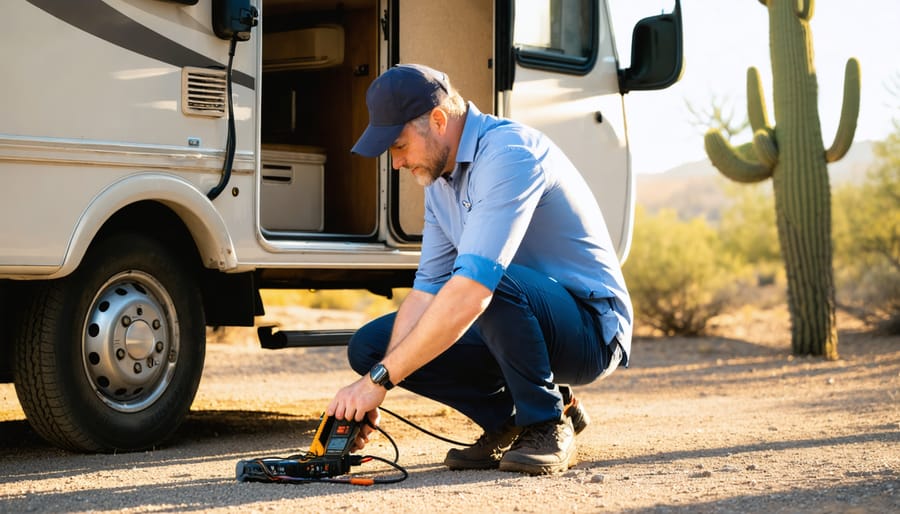
Proper installation and testing of 7-way RV wiring requires basic electrical tools and attention to safety procedures.
Troubleshooting Common 7-Way Wiring Problems
Even the most careful installations sometimes run into hiccups, and that’s completely normal. Let’s walk through the most common 7-way wiring problems you might encounter and how to solve them like a pro.
The number one issue? Intermittent connections or complete signal loss. This usually stems from corrosion or loose pins inside the connector. I learned this the hard way during my first RV trip with my family. We’d driven three hours when someone flagged us down because our trailer lights weren’t working. After pulling over and checking everything, I discovered the connector pins had worked themselves loose from vibration. Now I always do a quick wiggle test before hitting the road, and I’ve taught my kids to remind me if I forget.
Start your troubleshooting with a visual inspection. Disconnect both ends and look for green or white corrosion buildup, which blocks electrical flow. A wire brush or specialized contact cleaner works wonders here. Check that all pins are straight and making solid contact when plugged together.
Next, grab a multimeter and test each circuit individually. Set it to DC voltage and check against the color-coded functions we covered earlier. For the auxiliary power wire, you should see around 12 volts, though actual battery voltage levels may vary slightly. Running lights should show power when your vehicle lights are on, brake signals when you press the pedal, and so forth.
If one circuit isn’t working, trace that specific wire back on both the vehicle and trailer sides. Look for pinched wires, damaged insulation, or poor ground connections. Speaking of grounds, a bad ground causes more problems than any other single issue. Make sure your white ground wire connects to clean, bare metal on both your vehicle frame and trailer frame.
For persistent gremlins, consider replacing the entire connector. Sometimes corrosion penetrates so deeply that cleaning won’t fix it. Quality connectors with sealed designs prevent most future problems and are worth the investment for peace of mind on the road.
Properly functioning 7-way wiring ensures all safety lights work correctly while towing, keeping you visible and legal on the road.
How 7-Way Wiring Fits Into Your Solar-Powered RV Setup
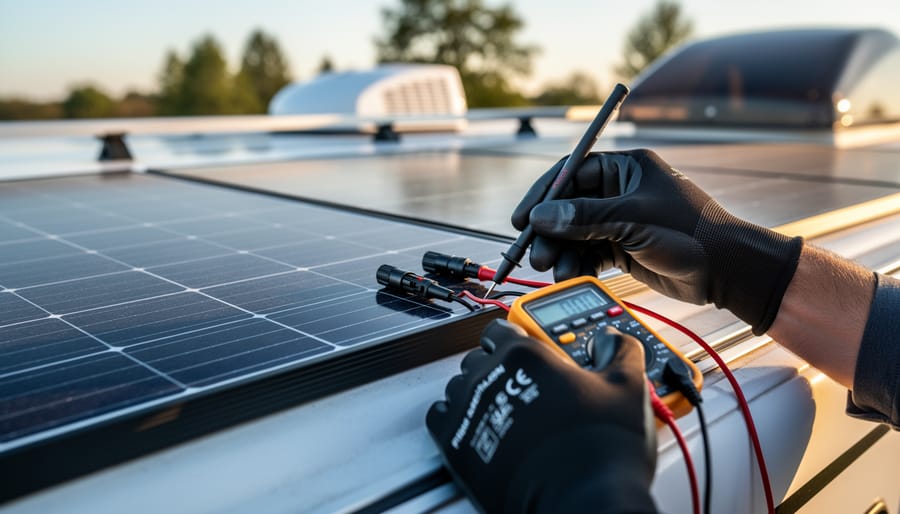
When you’re running a solar-powered RV, understanding how your 7-way wiring connects to your energy system becomes especially important. I learned this the hard way during my first solar installation when I couldn’t figure out why my trailer batteries weren’t charging properly while driving—turns out, I had overlooked how the charging wire plays a critical role in the whole setup.
The blue charging wire in your 7-way connector is designed to send 12V power from your tow vehicle’s alternator to your trailer’s battery bank. Here’s where things get interesting for solar enthusiasts: this wire works alongside your solar panels and charge controller, not against them. When you’re driving during the day, both your alternator and solar panels can charge your batteries simultaneously, giving you faster recharge times and more energy independence.
However, there’s a crucial consideration. Your charge controller manages power coming from your solar panels, protecting your batteries from overcharging. The 7-way charging wire bypasses this system, connecting directly to your battery bank. This means you need to ensure your tow vehicle’s charging system is compatible with your battery type, whether you’re using flooded lead-acid, AGM, or lithium batteries.
Think of your complete camper electrical system as having multiple charging sources. Solar panels handle daytime charging when you’re parked, a solar battery maintainer keeps things topped off during storage, and your 7-way connection provides charging while traveling. Proper wiring ensures these systems work together harmoniously.
One practical tip: consider adding a battery isolator or separator between your tow vehicle and trailer batteries. This prevents your RV from draining your truck’s battery and provides additional protection for your solar-charged battery bank.
You’ve got this! Understanding your 7-way RV wiring diagram might have seemed daunting at first, but with the knowledge you’ve gained here, you’re fully equipped to tackle the installation or troubleshooting with confidence. Remember the key safety points: always disconnect your power source before working, double-check each connection against your diagram, and test everything before hitting the road.
I’ve been there myself, sitting in my driveway with a tangle of wires, wondering if I’d ever figure it out. But once you understand that each colored wire has a specific job and follow the systematic approach we’ve outlined, it becomes surprisingly straightforward. You’re not just connecting wires; you’re ensuring safe travels for yourself and everyone else on the road.
If you’re powering your RV adventures with RV solar panels, don’t forget to check out our solar calculators to optimize your entire electrical setup. We’d love to hear about your wiring experiences in the comments below. What challenges did you face? What tips would you share with fellow RVers? Together, we’re building a community of capable, confident DIYers who aren’t afraid to take control of their own projects.
How useful was this post?
Click on a star to rate it!
Average rating 0 / 5. Vote count: 0
No votes so far! Be the first to rate this post.
We are sorry that this post was not useful for you!
Let us improve this post!
Tell us how we can improve this post?
charlesnoble
Here at Spheral Solar, I’m a hands-on solar power enthusiast, constantly exploring and experimenting with DIY solutions. I’m dedicated to sharing my discoveries, insights, and even the bumps I hit along the way, all in the pursuit of a more sustainable future.
Why Your RV Appliances Keep Tripping the Breaker… by Charlesnoble November 17, 2025 Turn off shore power and disconnect your battery bank before touching any wire in your RV—this single step prevents the most common DIY electrical accidents. Check your circuit breaker panel ratings against your actual appliance loads, because that microwave drawing 1500 watts on a 15-amp circuit is exactly why you’re…
Why Your Motorhome Electrical System Keeps Failing… by Charlesnoble November 18, 2025 Picture this: You’re three days into a dream cross-country trip when your lights flicker, the refrigerator stops cooling, and you’re left wondering whether to call for expensive roadside assistance or figure it out yourself. I’ve been there, and here’s what I wish someone had told me before my first electrical…
Why Your RV Solar Panels Aren’t Charging (And How to… by Charlesnoble November 30, 2025 Check your multimeter readings at each connection point along your solar charging path—from panels to charge controller to battery—to pinpoint exactly where voltage disappears. Most RV solar systems lose 10-30% of their potential power to voltage drop, but this invisible thief often goes undetected until you systematically measure and compare…
What Size DC-To-DC Charger Do I Need? by Charlesnoble August 21, 2023 The optimal size of a DC-to-DC charger depends on several factors, including the total auxiliary battery capacity, maximum charge rate, alternator output, and additional charging sources or loads. Accounting for these aspects and selecting a properly sized charger is crucial for maximizing charging efficiency. In this article, you’ll learn a…
Wire Your First Solar Panel Without Frying… by Charlesnoble April 29, 2026 Grab a multimeter and test your first solar panel connection right now—even if you’ve never touched electrical wiring before. Solar wiring isn’t the mysterious, dangerous territory most beginners imagine. It’s actually more forgiving than household AC wiring because you’re working with low-voltage DC power, typically 12 to 48 volts, which…
Why 48V is the Sweet Spot for Your RV Solar System by Charlesnoble May 20, 2026 Calculate your actual power consumption before jumping to 48V—most RVers overestimate their needs and waste money on unnecessary voltage conversions. Pull out your last month of camping data and add up the watt-hours your appliances actually use daily, not what you think you might need someday. If you’re consistently pulling…
Subscribe for handpicked DIY projects, exclusive tips, and giveaways.
Nine times out of ten, an RV generator that won’t start has a stale fuel problem. If your generator hasn’t run in more than 30 days, degraded gasoline is likely gumming up the carburetor and preventing ignition. Before you panic or call for expensive roadside service, try this: turn on the generator’s fuel valve (if… Read more: RV Generator Troubleshooting: Common Problems and How to Fix Them
A 5kW solar system occupies between 250 and 350 square feet of roof or ground space and produces roughly 20 to 25 kilowatt-hours of electricity per day in most U.S. locations. That’s enough to power a typical three-bedroom home with moderate energy use, though your exact needs depend on your daily consumption patterns, climate zone,… Read more: How to Size a 5kW Solar System for Your Home or RV
Installing a home solar system yourself takes 2-4 weekends for an average 5kW setup, requires solid electrical knowledge and comfort working at heights, and can save you $5,000-$8,000 in labor costs if you tackle everything except the final utility interconnection. The process breaks down into five main phases: permitting and design, mounting the racking system,… Read more: Solar Power Installation Step by Step: Complete DIY Guide From Start to Finish