6 Volt vs. 12 Volt vs. Lithium: Which Battery Setup Is Right for Your Solar System?
Updated:
A bank of 6 volt batteries is the right call for most off-grid cabins and full-time RV or van builds that want cheap, proven storage and don’t mind a little wiring, while 12 volt and lithium make more sense when space, weight, or simplicity matter most. The reason is straightforward. Two 6 volt batteries wired in series give you 12 volts, and the heavy-duty plates inside them are built for the deep, daily cycling a solar setup demands.
That’s the verdict from our hands-on use, and it holds up for a specific kind of reader. If you’re a DIYer who’s comfortable with a few cable runs, and you want a battery bank you can expand later without starting over, 6 volt is hard to ignore. If you’re a weekend camper who just wants to bolt in one battery and go, a single 12 volt unit (or lithium, if the budget stretches) will probably save you headaches.
Charles learned this the slow way on his first cabin build, when a tangle of mismatched 12 volt batteries taught him why wiring layout matters as much as the batteries themselves. We’ll save you that lesson.
Below, we compare 6 volt, 12 volt, and lithium side by side, break down the pros and cons, show you how to wire a series-parallel bank, and walk through sizing step by step. By the end, you’ll know whether 6 volt belongs in your system and exactly how to put it together.
Key Takeaway: 6 volt banks are rugged and budget-friendly, lithium wins on weight and lifespan, and 12 volt suits small, simple systems. Whatever you pick, size your bank first so you buy for your real needs.
6 Volt vs. 12 Volt vs. Lithium at a Glance
If you only have a minute, this table gives you the lay of the land. It compares general characteristics, not current prices or exact specs, since those shift by brand and retailer.
Setup
Wiring needed
Upkeep
Weight and cost
Best for
6V flooded lead-acid
Two in series for 12V, four for 24V
Regular watering, vented space
Heavy per battery, lowest entry cost
Cabins and budget off-grid banks
6V AGM
Same series wiring as flooded
Sealed, little hands-on care
Heavy, costs more than flooded
RVs and tight spaces
12V lead-acid
Single unit, simplest install
Varies by flooded or AGM type
Easier to lift, low cost for small banks
Small campers and starter systems
Lithium (LiFePO4)
Single unit or a few in parallel
Very low upkeep
Much lighter, highest upfront cost
Vans, full-timers, weight-sensitive builds
A few things jump out when you scan it. The 6 volt options ask a little more of you at the wiring stage, because you need matched pairs, but that extra step is what makes them so tough. Lithium flips the trade-off: it asks the most of your wallet upfront and the least of your back and your weekends. And a single 12 volt battery is the easiest way into solar, as long as your power needs stay modest.
Durability and long-term value are where the real differences show up, and we dig into those further down. For now, use the table as a quick filter, then read on for the reasoning behind each row.
What Each Battery Setup Actually Is
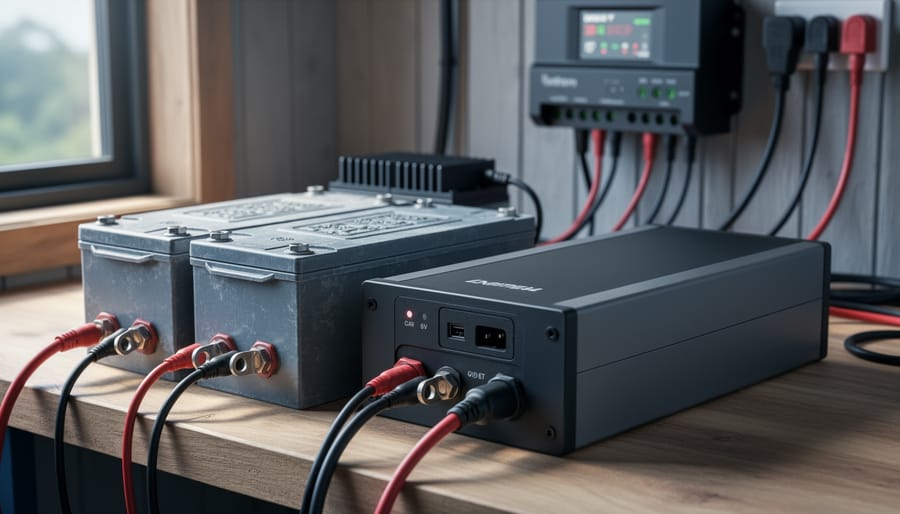
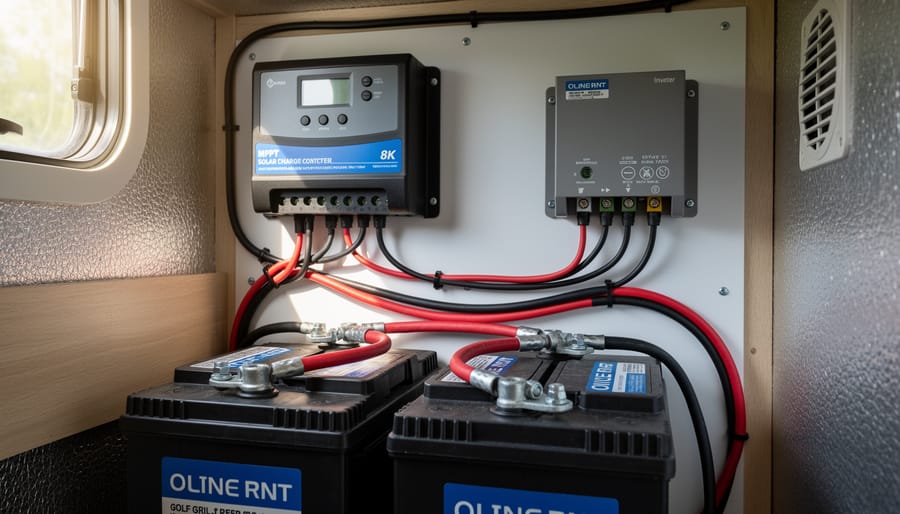
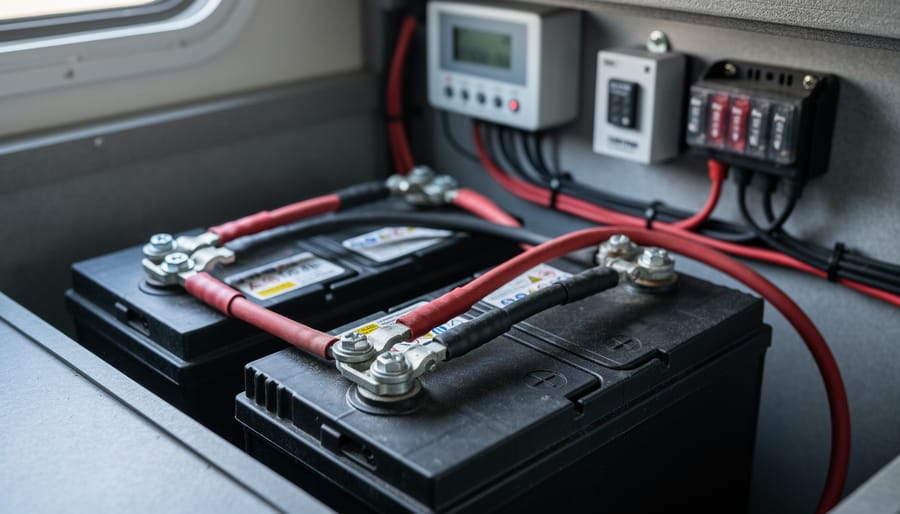
A pair of 6-volt golf-cart-style batteries wired together sits safely in a tidy off-grid compartment with solar gear nearby.
How a 6 Volt Battery Solar System Works
A 6 volt battery on its own doesn’t do much for a solar system, since most charge controllers and inverters expect 12, 24, or 48 volts. That’s why these batteries almost always come in pairs or sets. Wire two in series and the voltages add up to 12 volts. Wire four in series-parallel and you can build a 24 volt bank. The amp-hour rating stays the same as a single battery when you wire in series, so a pair of 225 amp-hour 6 volt batteries still gives you 225 amp-hours, just at 12 volts. Wiring in parallel does the opposite, stacking capacity while keeping voltage the same.
The reason people love them is the build. Golf-cart-style 6 volt batteries are deep-cycle designs, meaning they’re made to be drained and recharged again and again rather than delivering one big burst like a car starter battery. Their internal plates are thicker, and thicker plates hold up better to that daily cycling. I’ve found the weight is the giveaway: pick one up and you can tell there’s real lead inside.
Here’s a quick glossary of the terms you’ll run into:
Series wiring
Connecting the positive terminal of one battery to the negative of the next, which adds voltage while keeping amp-hours the same.
Parallel wiring
Connecting positive to positive and negative to negative, which adds amp-hours while keeping voltage the same.
Deep-cycle
A battery built to discharge deeply and recharge repeatedly, the opposite of a starter battery.
Depth of discharge
How much of a battery’s capacity you’ve used, so 50% means you’ve drained half of it.
Flooded vs. AGM
Flooded batteries use liquid electrolyte and need periodic watering, while AGM batteries hold it in glass mats and are sealed and low-maintenance.
Most 6 volt batteries come as either flooded or AGM. Flooded ones are usually cheaper and tolerate hard use, but they need watering and ventilation. AGM costs more yet skips the upkeep, and our breakdown of AGM vs flooded goes deeper on that trade-off. Once your bank is wired, a lead-acid voltage chart helps you read its state of charge from the resting voltage.
12 Volt Deep-Cycle and Lithium Options in Brief
A single 12 volt deep-cycle battery is the simplest way to start. You get one battery, one pair of cables, and a charge controller that connects straight to it. That’s why you’ll see them in weekend campers and small vans, where the loads are a few lights, a phone charger, and maybe a fridge. Flooded and AGM versions are common, and the same lead-acid habits apply: don’t drain them too deep, and keep them charged.
Lithium iron phosphate, often written LiFePO4, is the other 12 volt route. These batteries are much lighter, and they come with a built-in battery management system that protects the cells. In our experience, that low-fuss quality is what draws van builders and small cabin owners to them. You mount one, wire it up, and mostly forget about it.
Here’s the good news: both types plug into the same solar charge-controller setups you’d use with a 6 volt bank. You just need to set the controller’s charging profile to match the battery chemistry, since lithium wants different voltage settings than lead-acid.
6 Volt vs. 12 Volt vs. Lithium, Dimension by Dimension
Battery Chemistry and Lifespan
Chemistry decides how long a battery bank lasts, so it’s worth understanding before you buy anything. In our hands-on experience with all three types, the differences show up in two places: how many times you can cycle a battery, and how much of its rated capacity you can actually use.
Flooded lead-acid is the classic 6 volt golf-cart battery. It has liquid electrolyte and thick plates, and it handles regular deep discharges well if you look after it. The catch is usable capacity. To get a long life out of flooded batteries, you generally want to avoid draining them much past the halfway mark. Draw them down deeper, day after day, and the plates wear out faster. A bank that looks big on paper may only give you about half of that in practice.
AGM (absorbed glass mat) is also lead-acid, just sealed and maintenance-free. Its lifespan sits in the same general neighborhood as flooded batteries, and it responds to the same rule about shallow discharges. It costs a bit more for the convenience of not topping up water.
Lithium (LiFePO4) is a different animal. It typically offers many more charge cycles and lets you use a much larger share of the rated capacity before you risk shortening its life. It also holds a flatter voltage as it discharges, which is why a LiFePO4 voltage chart looks so different from a lead-acid one.
So what does that mean for real life? A lead-acid bank used daily, and discharged moderately, can serve you well for several years. Lithium, used the same way, can stretch considerably longer and gives you more usable energy from the same nameplate rating. Lead-acid wins on upfront affordability, while lithium wins when you divide cost by the useful years you get. Treat the cycle life numbers on any spec sheet as a comparison tool rather than a promise, since temperature, charging habits, and depth of discharge all shift the outcome.
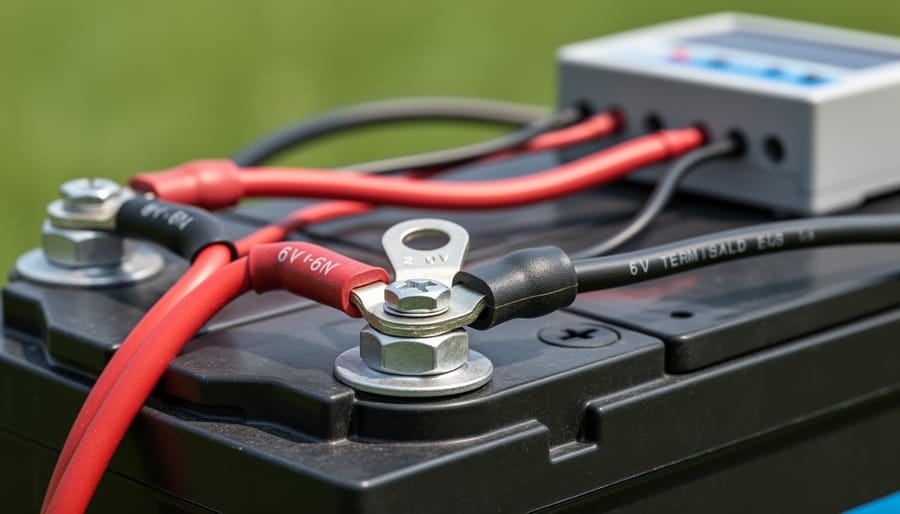
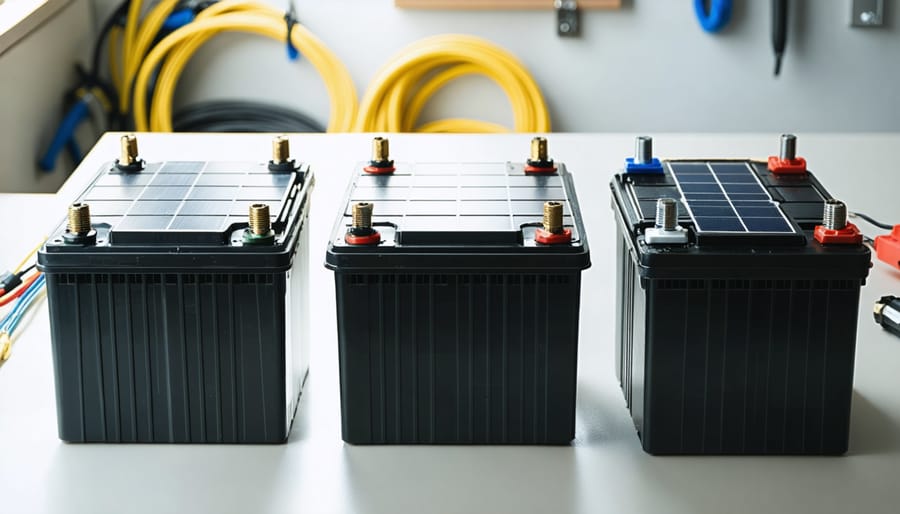
Up-close focus on a safe terminal connection, highlighting how careful wiring matters in a 6-volt battery solar setup.
Cost and Long-Term Value
A cheap bank isn’t always the cheap choice. A pair of 6 volt flooded batteries usually has one of the lowest entry prices you’ll find for a deep-cycle setup, which is exactly why so many first-time builders start there. In our testing and in the banks we’ve wired up over the years, that low upfront cost is real. What catches people off guard comes later.
Lead-acid chemistry, whether flooded or AGM, generally wears out sooner than lithium when you cycle it hard and regularly. You also can’t use as much of its capacity each day without shortening its life. Lithium costs more at the start, but it tends to last through many more cycles and gives you more usable energy from every amp-hour you pay for. So a lead-acid bank may need replacing while a lithium bank is still going strong, and that second purchase belongs in your math.
Here’s the habit I’d encourage. Don’t compare sticker prices. Compare cost per usable amp-hour over the life of the bank. Take what you pay, divide it by the capacity you can safely use each day, then think about how many years you realistically expect it to serve you.
A few things shift that math:
– How deeply you discharge the bank on a typical day
– How often you cycle it, such as weekend trips versus full-time living
– Whether you’ll keep up with maintenance on flooded cells
– How long you plan to keep the system before upgrading
For a weekend camper, a 6 volt bank can be the smart money choice. For daily off-grid living, the longer view often favors lithium.
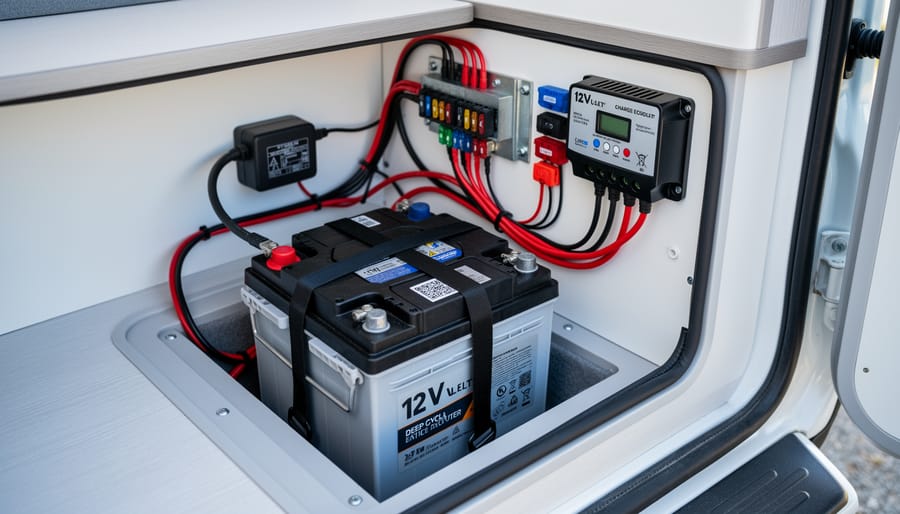
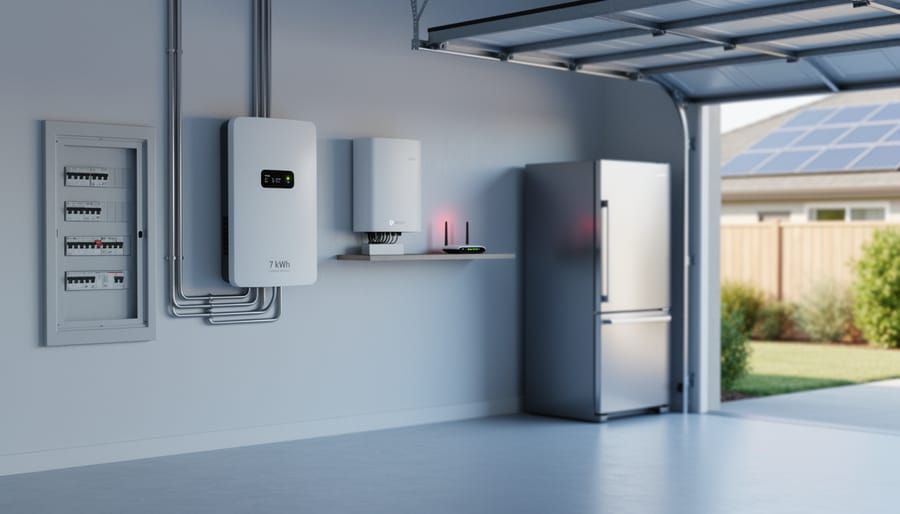
A small-setup battery space in an RV or van shows how 12-volt components fit into tighter installations.
Weight, Size and Portability for Camping and Vehicles
When you’re hauling a battery bank into a van or down to a campsite, weight and size matter more than any spec sheet. This is where 6 volt batteries earn their reputation, with a catch.
A single 6 volt golf-cart-style battery is heavy, but it’s a manageable one-person lift. You carry one, set it down, then go back for the next. Because the bank is built from separate pieces, you can wrestle each battery into a tight spot without needing a buddy or a hand truck. Two of them wired in series give you 12 volts, so the total weight adds up, but the load is split into chunks you can actually handle.
I learned this the hard way. The first time I loaded a bank into my van, I tried to muscle in a big 12 volt unit with an awkward grip and nearly threw out my back at the tailgate. Switching to a pair of 6 volts changed everything. I could carry one in each hand and slide them into the battery box without drama. They were still heavy, but I wasn’t gambling with my spine.
Lithium is the clear winner on weight. It’s far lighter for the same usable energy, which helps if you’re watching payload in a camper or van. A single 12 volt deep-cycle unit is the simplest to install: one battery, one set of cables, done.
My rule of thumb: if you’re not chasing every pound, 6 volts are easy to live with. If weight is your enemy, lithium is worth a serious look.
Maintenance, Safety and Ventilation
Maintenance is where the three setups really part ways. Flooded 6 volt batteries are the chore-heavy option, but the chores are simple, and a monthly check-in has kept my own bank happy for years.
Flooded batteries lose water as they charge, so you’ll top them up with distilled water, never tap water. They also vent hydrogen while charging, which is why they belong in a space with real airflow, never a sealed box. If you want the engineering behind it, this guide to hydrogen ventilation for batteries explains why moving air matters. Keep sparks and open flames well away from the bank.
Here’s a quick checklist for each type:
Flooded 6 volt: check electrolyte levels regularly, refill with distilled water, and keep the bank ventilated.
Flooded 6 volt: clean any white or blue corrosion off terminals and tighten every connection.
AGM: no watering needed, but still inspect terminals and avoid enclosing it somewhere that traps heat.
Lithium: no watering or venting chores, just keep connections tight and follow the maker’s temperature limits.
Temperature deserves a thought too. Heat shortens battery life, and cold slows lead-acid output and can stop lithium from charging at all, so check the manufacturer’s guidance for your climate.
Wear safety glasses and gloves around flooded batteries, use insulated tools, and take off rings or watches before touching terminals. None of this is intimidating once it becomes habit.
Wiring, Expansion and Modularity
Expansion is where the three setups really part ways, and it’s where I’ve made my own mistakes.
A 6 volt bank is built around pairs. Two in series give you 12 volts, four give you 24, and growing the bank usually means adding another matched string in parallel. That’s simple, but only if the new batteries match the old ones. Mixing a fresh battery with a tired one drags the whole string down. The weakest battery sets the pace, and an older one gets overworked while a newer one never fully charges. I learned that the hard way when I tried to stretch an aging bank with a single new battery. It never behaved. Add in sets of the same model, age and type, or plan to replace the whole bank at once.
Single 12 volt batteries are the easiest to add one at a time in parallel, though the same matching rule applies. Lithium is flexible too, but stick with the same brand and chemistry, and check the manufacturer’s limits on how many units can be paralleled.
Layout matters for upgrades. Series strings raise voltage, while parallel strings raise capacity. Too many parallel strings means more cable runs and more connections that can fail. Many DIYers settle on a higher system voltage so a bigger bank stays tidy.
Modularity is the idea behind it all: start small, grow in clean steps. CNET, for example, names the Generac PWRcell as its best modular home battery, a reminder that expandability is worth planning for. A DIY bank can borrow that thinking if you leave room, use thick cables and buy matched batteries from day one.
Backup Power and Real-World Performance
When the lights are on and the sun is out, nearly any battery bank looks fine. The real test comes when you’re running the microwave off an inverter, or when three gray days stack up in a row.
Heavy loads are where voltage matters most. Power is volts times amps, so a 2,000 watt load pulls roughly twice the current on a 12 volt system as it does on 24 volts. Higher current means thicker cables, bigger fuses, and more heat at every connection. In our hands-on experience, a small 12 volt setup handles a laptop, lights, and a fridge without drama, but add a coffee maker or power tool and the cabling gets chunky fast. Wiring four 6 volt batteries for 24 volts, or even 48 volts, keeps the cable runs manageable as the system grows.
Voltage also drives inverter choice. Inverters are built for a specific battery voltage, so decide your bank voltage first. Larger inverters generally pair better with 24 or 48 volt banks, while a small 12 volt inverter is fine for light use.
For cloudy-day stretches, usable capacity is what counts. Lithium lets you draw down deeper without much penalty, so a smaller lithium bank can carry you as far as a bigger lead-acid one. A 6 volt flooded or AGM bank needs more nameplate capacity to cover the same gap, but it handles surges well and keeps delivering.
Whole-home backup systems like the Tesla Powerwall 3 or Generac PWRcell are a different category, so check specs with the manufacturer. For a DIY bank, size it to your heaviest realistic load plus the days you want covered.
Pros and Cons of a 6 Volt Battery Bank
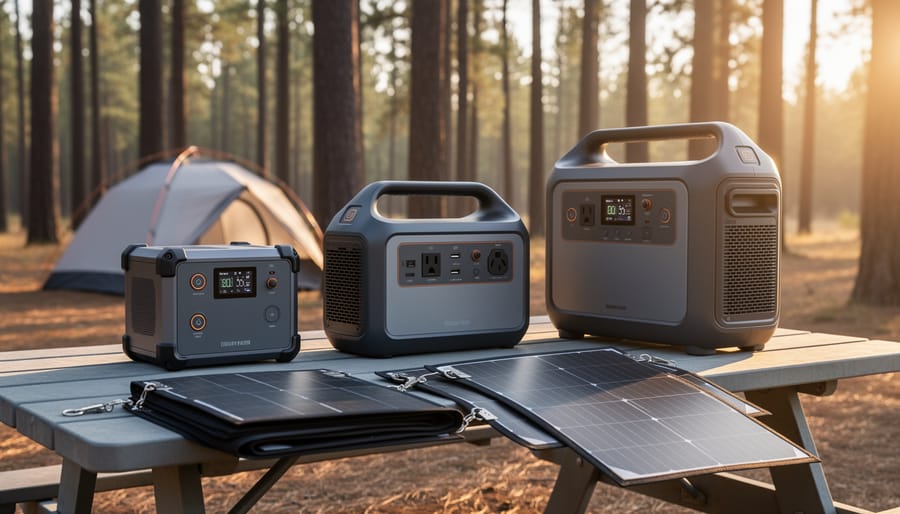
The weight and handling challenge of lead-acid batteries becomes clear during a real campsite load-in moment.
I’ve used a 6 volt bank in a few different builds, and my honest take is that it’s a great fit for some people and the wrong call for others. Here’s how the trade-offs stack up when you look at the 6 volt approach on its own.
Pros
The rugged deep-cycle design handles repeated daily discharge and recharge far better than a starting battery would.
Each battery is easier to lift and place on its own than one big 12 volt unit of the same capacity.
The entry cost is friendly for a first system, which matters when you’re still learning what you need.
You can build 12, 24 or 48 volt banks from the same type of battery as your system grows.
Cons
These batteries are heavy, which adds up fast in a van, trailer or boat.
Wiring in series, and then in parallel strings, means more cables and more places for a loose connection.
Flooded versions need regular watering and a ventilated spot, so they aren’t truly set-and-forget.
Expect a shorter service life than lithium, so you may be replacing the bank sooner.
The pattern I’ve noticed is that the strengths are all about toughness and simplicity of the parts, while the weaknesses are about the work and weight around them. If you have a fixed spot like a shed, cabin or garage, the weight and upkeep rarely bother anyone. If you’re building something mobile, the same traits can wear on you quickly.
None of this makes lithium or a single 12 volt battery the “better” choice across the board. They just trade different things. A 6 volt bank asks a bit more from you in setup and care, and in return it gives you a sturdy, flexible bank that’s easy to expand.
Where Ready-Made Home Batteries Fit In
If you’ve been reading about a DIY bank of 6 volt batteries, you’ll eventually bump into the other side of the Solar Battery Comparisons world: ready-made home batteries. These are whole-home products, built to back up a house and pair with a full rooftop array, so they’re a different category from the bank you wire up yourself in a van, cabin or camper. They’re worth a quick look mostly so you know where your project sits.
EnergySage reviewed dozens of home battery models quoted on its Marketplace for its 2026 roundup, and said six brands stood out: Tesla, FranklinWH, MidNite Solar, Sigenergy, Enphase, and SolarEdge. CNET took a category-by-category approach with these picks:
Battery
CNET recognition
Bluetti EP900 Home Battery Backup
Best pick for 2026
Tesla Powerwall 3
Best well-rounded
Enphase IQ Battery 5P
Best lower capacity
Generac PWRcell
Best modular
SolarEdge Home Battery
Best warranty
Notice what’s missing: specs and prices. Those change, and they vary by installer and region, so check directly with the manufacturer or a local installer before you plan around any of them.
For most weekend campers and cabin builders, none of these are the right tool. A 6 volt bank is the hands-on route, and the maintenance side is on you. If your setup ever shows a battery not charging problem, you’ll be the one troubleshooting it, which is part of the DIY deal.
Which Battery Setup Should You Choose?
Match Your Situation to a Battery Type
Here’s how I’d match the battery to the situation, based on what each type does well in real use. Weekend campers and van builders with a modest load are usually happiest with a single 12 volt deep-cycle or a small lithium battery, since weight and simple installation matter most. Off-grid cabin owners and RV full-timers tend to get the best value from a 6 volt golf-cart-style bank, because those thick-plated batteries handle daily cycling and are easy to move one at a time. If you’re on a tight budget with a first system, 6 volt flooded batteries keep the entry cost low, as long as you’re willing to check water levels now and then. And if you want a set-it-and-forget-it bank, lithium is hard to beat.
Here’s the short version:
Choose 6 volt if you want a tough, budget-friendly bank for a cabin or RV and don’t mind occasional watering and a bit of weight.
Choose 12 volt if your system is small, space is tight, and you want the simplest possible install.
Choose lithium if low weight, minimal upkeep, and a long service life matter more than a low sticker price.
None of these choices is wrong. The trick is being honest about how you’ll actually use the system. A bank that suits a cabin you visit every weekend can be overkill for a van you only take out a few times a season. I’ve seen people overbuild on day one and then spend the next year wishing they’d put that money toward more panels instead.
Size Your Bank Before You Buy
Sizing a bank is easier than it sounds, and it’s worth doing before you spend a dime. Here’s the walkthrough I use.
Start with daily energy use. List everything you’ll run, note each device’s watts, and estimate hours per day. Multiply watts by hours to get watt-hours, then add them up. Don’t forget the inverter itself, which sips power even when nothing’s plugged in.
Add days of autonomy. This is how many cloudy days you want to ride out without recharging. A weekend camper might plan for one day, while an off-grid cabin owner often wants two or three. Multiply your daily total by that number.
Account for usable depth of discharge. You can’t drain a lead-acid bank to zero without shortening its life, so only part of the rated capacity is actually available. Lithium generally lets you use more of its rated capacity than flooded or AGM batteries do. Divide your needed watt-hours by the usable fraction for your chemistry to find the total capacity to buy.
Turn it into a bank. Divide that watt-hour figure by your system voltage (12, 24 or 48 volts) to get amp-hours. Then see how many 6 volt batteries it takes: two in series for 12 volts, four for 24 volts, and so on, adding more strings in parallel if you need extra capacity.
Doing this by hand is a great way to learn, but you don’t have to. Try our power system calculator along with the battery bank calculators here on Spheral Solar to run your own numbers, then compare a few scenarios before you buy.
6 Volt Battery Solar System FAQs
Still have questions? These come up more than any others when readers are planning a 6 volt bank.
Can I run a solar system on 6 volt batteries?
Yes. Wire them in series (or series-parallel strings) to reach 12 or 24 volts, then connect the bank to your charge controller and inverter as you would any other battery bank.
How many 6 volt batteries do I need for 12 or 24 volts?
Two in series make 12 volts, and four in series make 24 volts. For more capacity, add identical parallel strings of the same voltage.
Are 6 volt batteries better than 12 volt?
Often, for a bigger bank, because they’re built tougher for deep cycling and are easier to handle one at a time. For the tiniest setups, a single 12 volt unit is simpler.
Can I mix 6 volt and 12 volt batteries?
Not in the same string. Mismatched voltage, capacity, or age makes the weaker battery drag down the rest, so keep every battery in a bank identical.
How long do 6 volt deep-cycle batteries last?
It depends on the type, how deeply you discharge them, how well they’re charged, and how you maintain them. Gentle use and proper care stretch their life, while regular deep drains and neglect shorten it.
If you’re still on the fence, the best next move is to run your own numbers. Matching bank size to your real daily energy use will settle most of these questions faster than any rule of thumb.
So here’s where we land. For most DIY cabins, campers and budget off-grid builds, a pair of 6 volt batteries wired in series is a rugged, wallet-friendly way to get started. Lithium earns its keep when weight and lifespan matter most, and a single 12 volt battery is perfectly fine for small, simple setups.
The best battery isn’t the fanciest one on the shelf. It’s the one that fits your budget, your space and the way you’ll actually use your power. Before you buy anything, run your numbers with the solar system and battery bank calculators here on Spheral Solar, then browse our related guides when you’re ready for the next step.
And please, keep building. Every bank I’ve wired taught me something new, and I’d love to hear how yours turns out. Share your projects, your wins and even your head-scratchers with the community, because that’s how we all get better at this together.
How useful was this post?
Click on a star to rate it!
Average rating 0 / 5. Vote count: 0
No votes so far! Be the first to rate this post.
We are sorry that this post was not useful for you!
Let us improve this post!
Tell us how we can improve this post?
charlesnoble
Here at Spheral Solar, I’m a hands-on solar power enthusiast, constantly exploring and experimenting with DIY solutions. I’m dedicated to sharing my discoveries, insights, and even the bumps I hit along the way, all in the pursuit of a more sustainable future.
Why 6 Volt Batteries Might Be Your Solar System’s… by Charlesnoble February 20, 2026 Connect 6-volt batteries in series pairs to create 12-volt banks that deliver superior amp-hour capacity and longer lifespan than single 12-volt alternatives. This wiring configuration doubles your voltage while maintaining the individual battery capacity, giving you more usable power for off-grid applications. Most RV and camping solar setups benefit from…
How Solar Energy Actually Works in Your Home (And… by Charlesnoble December 5, 2025 Capture sunlight with photovoltaic panels that convert solar radiation into direct current electricity through semiconductor technology. Position your panels at the optimal angle for your latitude—typically between 30 and 45 degrees in most locations—to maximize energy absorption throughout the day. Store excess electricity in deep-cycle lithium or lead-acid batteries, which…
Which Solar Battery Actually Lives Up to the Hype? by Charlesnoble November 8, 2025 Compare capacity ratings in amp-hours (Ah) and watt-hours (Wh) first—these numbers tell you exactly how much energy each battery stores and how long it’ll power your devices. Check the depth of discharge (DoD) percentage next, because a battery with 90% DoD gives you far more usable energy than one limited…
Why Your RV Solar System Isn’t Charging (And How to Fix It) by Charlesnoble May 6, 2026 Picture this: You’re parked at a stunning boondocking spot, miles from the nearest electrical hookup, and your RV batteries are draining fast. Your fridge starts warming, lights dim, and you’re left wondering if you’ll need to pack up and find a campground. I’ve been there, and it’s frustrating. RV solar…
Why a 7 kWh Battery Might Be Your Solar System’s Sweet Spot by Charlesnoble May 20, 2026 Match a 7 kWh battery to your actual energy usage by checking your utility bills for daily consumption patterns. If your household uses 20-30 kWh per day, this size covers roughly 4-6 hours of evening power or essential loads during an outage—perfect for keeping your refrigerator, internet, and a few…
Subscribe for handpicked DIY projects, exclusive tips, and giveaways.
The DJI Power 2000 is our top pick for most people shopping for a portable solar generator in 2026, because it gets you back to full power fast without…
For most weekend campers, a 20,000mAh USB-C power bank is the right place to start, and a solar power bank only earns its spot if you’re out long enough…