How Solar Power Slashed My Farm Cold Storage Bills by 80%
Updated:
Size your solar array by calculating your cold storage’s continuous power draw and multiplying by 24 hours, then add 30% for system losses and cloudy days. A typical 10×12 walk-in cooler running at 38°F draws roughly 2-3 kWh daily in moderate climates, requiring a 600-900 watt solar setup with adequate battery storage for overnight operation.
Calculate your battery bank by determining how many days of autonomy you need without sun—most growers target 2-3 days minimum. Take your daily kWh usage, multiply by your desired backup days, then divide by your battery’s depth of discharge rating (usually 50% for lead-acid, 80% for lithium). That 10×12 cooler would need approximately 12-18 kWh of usable battery capacity.
Start with the highest-efficiency cooling equipment you can afford because every watt saved at the load reduces your entire solar investment proportionally. Modern variable-speed compressors use 40-60% less energy than standard units, and proper insulation—at least R-25 for walls, R-35 for ceilings—cuts power consumption dramatically before you spend a dollar on panels.
I learned this the expensive way on my own farm setup. I initially oversized my solar array trying to compensate for a poorly insulated cooler and an inefficient compressor. After upgrading the insulation and switching to a variable-speed unit, my power requirements dropped by half, leaving me with excess capacity I could have avoided purchasing.
The economics work best for off-grid operations or locations with expensive utility rates above 15 cents per kWh. Grid-tied systems with net metering offer simpler solutions but require utility cooperation, while fully off-grid setups demand careful load management and realistic expectations about system limitations during extended cloudy periods.
Why Growers Cold Storage Eats Your Profits (And Your Peace of Mind)
I learned this lesson the hard way during my first harvest season running a small community garden cooperative. We’d had an incredible year – bumper crops of berries, leafy greens, and root vegetables. But when the power bills started rolling in from our rented cold storage unit, I watched three months of careful planning dissolve into red ink. The refrigeration units ran constantly, and wouldn’t you know it, peak electricity rates kicked in right when we needed storage most.
Here’s the reality most small-to-medium growers face: cold storage isn’t optional. Without it, your beautiful harvest spoils within days, sometimes hours. But conventional cold storage operates on a brutal economic model that punishes farmers precisely when they’re most vulnerable – at harvest time.
The electricity consumption of commercial refrigeration is staggering. A typical walk-in cooler runs 8-12 hours daily, drawing 2-5 kilowatts per hour depending on size and efficiency. Multiply that by seasonal peak rates (often 30-50% higher during summer months when you’re storing produce), and you’re looking at hundreds or thousands of dollars monthly just to keep things cold.
For farmers already operating on thin margins, this creates an impossible squeeze. You can’t skip cold storage without losing product to spoilage. You can’t absorb the electricity costs without sacrificing profitability. And you certainly can’t control when utility companies decide to raise rates.
This dependency strips away your autonomy. You’re locked into whatever the power company charges, whenever they choose to charge it. It’s the same frustration that drives DIY enthusiasts to explore solar-powered greenhouses and other renewable solutions – that desire to take control back, to stop hemorrhaging money to systems designed to benefit everyone except the actual producer.
The good news? There’s a better way forward.
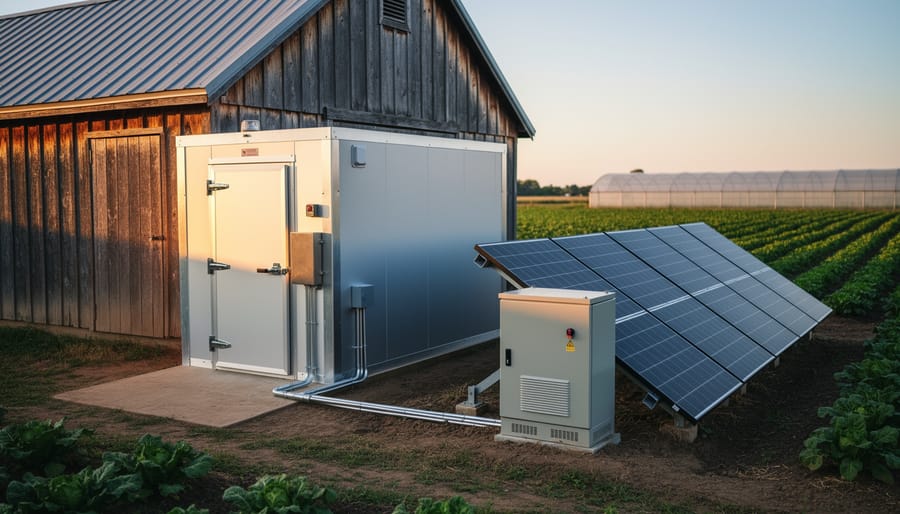
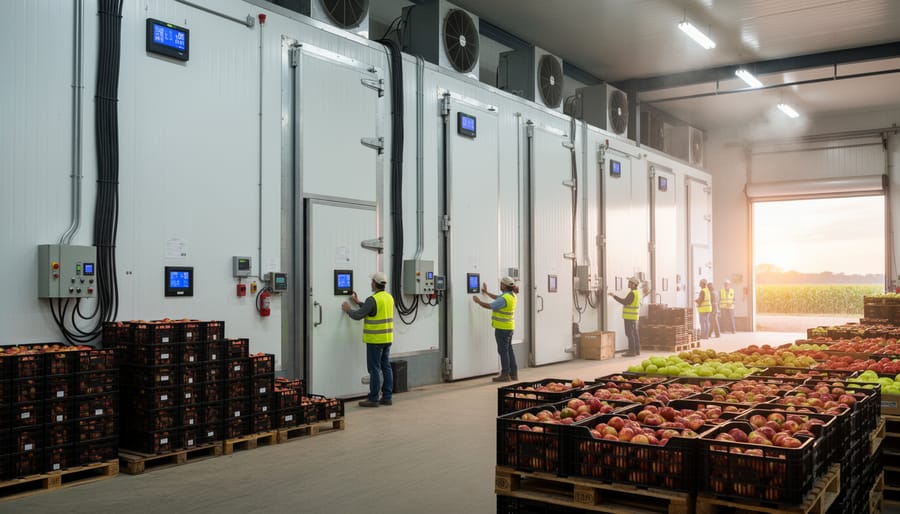
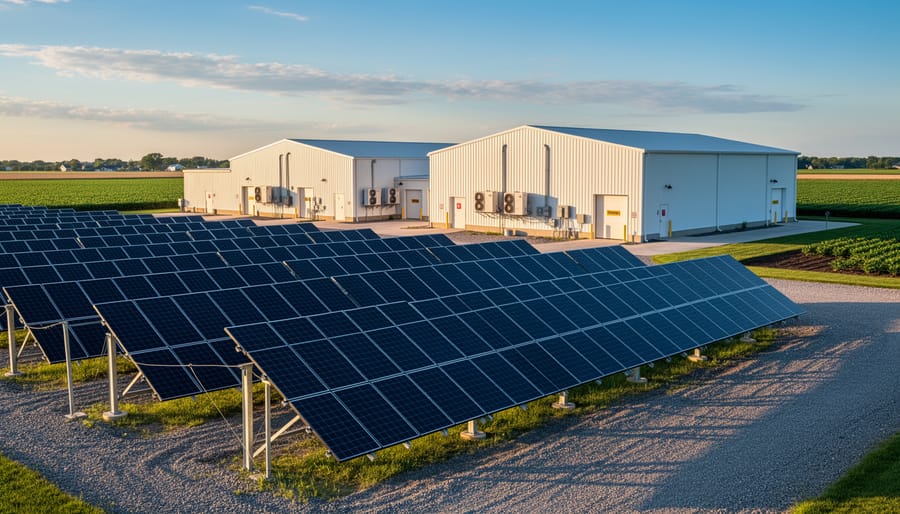
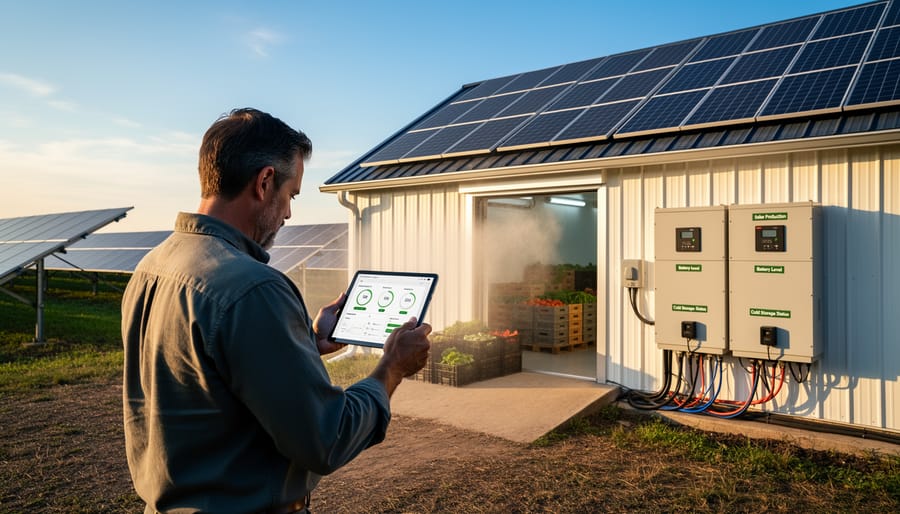
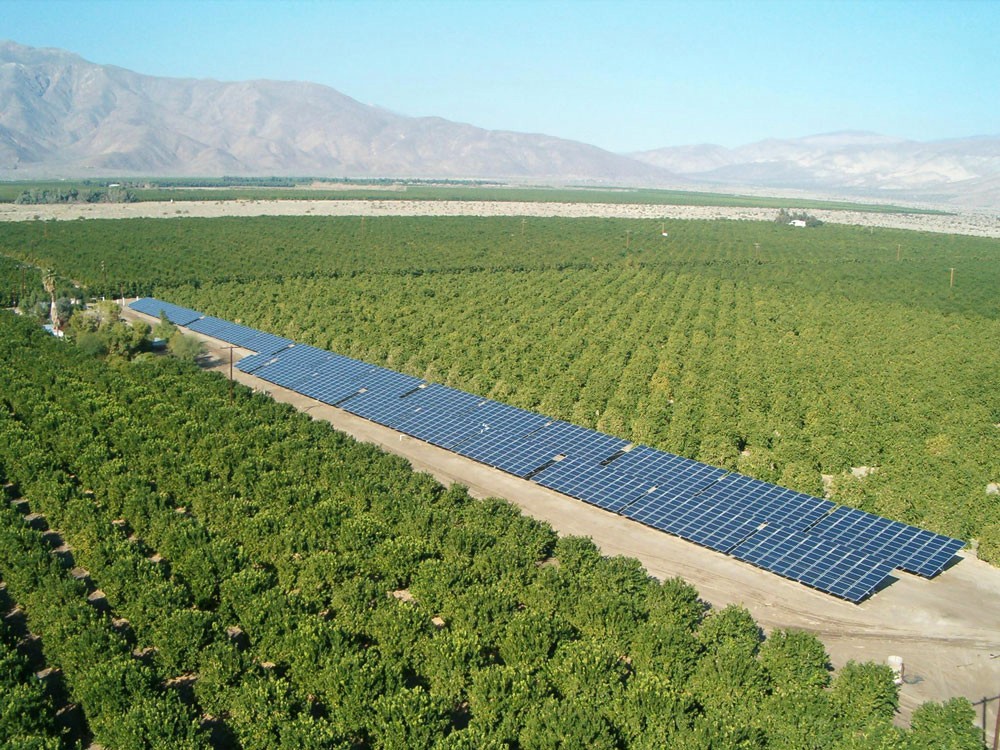
Conventional cold storage refrigeration units consume massive amounts of electricity, particularly during peak harvest season when farmers can least afford high energy bills.A properly sized solar array positioned near cold storage infrastructure provides reliable renewable power for continuous refrigeration throughout the growing season.
The Solar-Powered Cold Storage Setup That Actually Works
Sizing Your Solar Array for Refrigeration Loads
Let me walk you through calculating your solar needs for cold storage—it’s simpler than you might think once you break it down into manageable steps.
Start by identifying your refrigeration unit’s power consumption. Check the nameplate on your compressor for its wattage and voltage. A typical walk-in cooler for small-scale growers might draw 1,500-3,000 watts when the compressor runs. Here’s the thing though: compressors don’t run continuously. They cycle on and off to maintain temperature, usually running about 8-12 hours per day depending on ambient temperature and how often you open the door.
Understanding thermal mass is crucial for accurate calculations. A fully stocked cold storage room holds temperature much better than an empty one. Those crates of produce act like thermal batteries, keeping things cool even during compressor off-cycles. I learned this the hard way when Charles and I first set up our system—we initially oversized everything because we calculated for an empty room. Start conservative and expand if needed.
Here’s your calculation formula: multiply your compressor wattage by estimated daily run hours, then add 20-25% for inverter efficiency losses and startup surge. For example, a 2,000-watt compressor running 10 hours daily needs 20,000 watt-hours (20 kWh), plus buffer = roughly 25 kWh total daily production needed.
The process of sizing solar panels follows similar principles across applications. Divide your daily energy needs by your location’s peak sun hours (typically 4-6 hours). Using our example: 25,000 watt-hours ÷ 5 sun hours = 5,000 watts of solar panels needed.
Battery storage deserves special attention for refrigeration. You’ll want at least two days of backup capacity for cloudy weather. That means our example needs roughly 50 kWh of battery storage.
Spheral Solar offers helpful calculators that simplify these calculations, accounting for regional solar variations and seasonal adjustments. These tools remove much of the guesswork, especially when you’re just starting out.
Battery Bank Essentials for 24/7 Cooling
When I first started helping growers design solar-powered cold storage, I learned pretty quickly that this isn’t like running your house lights. Your cold storage absolutely cannot tolerate power gaps, even for a few hours. Lose power overnight, and you could wake up to thousands of dollars of spoiled produce. That’s why battery storage isn’t optional here, it’s the backbone of your entire system.
The key question is sizing your battery bank correctly. You need enough capacity to run your cooling equipment through the night, plus a safety buffer for cloudy days when your panels aren’t producing at full capacity. Start by calculating your overnight power consumption. If your refrigeration unit draws 500 watts and runs 12 hours per night, that’s 6 kilowatt-hours (kWh) minimum. But here’s where most folks trip up: never design for the minimum. I always recommend building in at least a 50 percent safety margin, so you’d want 9 kWh of usable storage for this example. Add another day’s worth if you’re in a frequently overcast region.
Now let’s talk battery chemistry. Lithium batteries cost more upfront, typically two to three times the price of lead-acid, but they’re game-changers for cold storage applications. They offer deeper discharge cycles without damage, meaning you can actually use 80-90 percent of their rated capacity. Lead-acid batteries should only be discharged to about 50 percent if you want them to last. Lithium also handles partial charging better, which matters when you’re dealing with inconsistent solar production.
For real-world planning, I worked with a berry grower who needed to keep a 10×10 walk-in cooler running. We calculated 15 kWh of lithium storage gave him comfortable overnight operation plus cushion for two partly cloudy days. He went with lead-acid to save money initially but ended up replacing them after three years. Sometimes paying more upfront actually saves you money and headaches down the road.
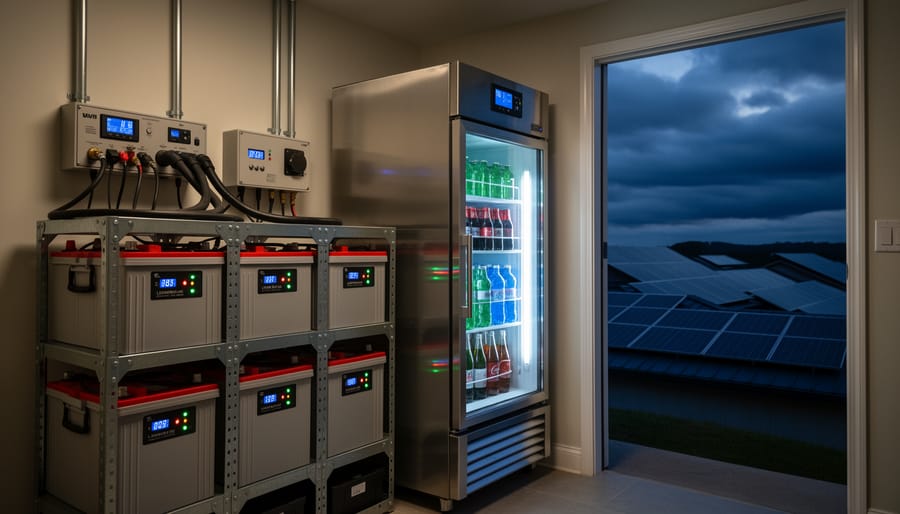
A robust battery bank ensures uninterrupted cooling power during nighttime hours and cloudy days when solar production drops but refrigeration demands remain constant.
Choosing the Right Refrigeration Equipment
Your refrigeration equipment choice is probably the single biggest factor determining your solar system size and cost. I learned this the hard way when I first helped my neighbor set up cold storage for her vegetable farm. We initially looked at a standard AC-powered walk-in cooler, but the startup surge from the compressor would have required an enormous battery bank and inverter.
Here’s what makes the difference: DC-powered cooling units are inherently more efficient for solar applications because they eliminate the conversion losses from DC to AC power. You’re looking at roughly 15-20% better efficiency right off the bat. For a small chest freezer conversion, this could mean the difference between a 400-watt solar array and a 600-watt one.
Compressor technology matters too. Variable-speed compressors use significantly less energy than traditional single-speed models because they adjust their output based on actual cooling needs rather than cycling on and off. Think of it like cruise control for your cooler.
Insulation is where many growers try to cut costs and end up paying for it in electricity bills. For walk-in coolers, aim for R-25 minimum in walls and R-30 in ceilings. Repurposed chest freezers already have excellent insulation, which is why they’re popular for DIY conversions.
The reality check: A poorly insulated 8×10 walk-in might need a 3kW solar array, while a well-insulated unit with DC cooling could run on 1.5kW. That’s potentially $2,000-3,000 in system cost savings.
Real-World Solar Cold Storage Configurations for Different Farm Scales
Let me walk you through three real-world setups I’ve seen work beautifully for different growers. These aren’t theoretical designs—these are actual configurations folks are using right now to keep their harvests fresh.
The Farmers Market Setup: Small-Scale Chest Freezer
Picture this: you’re selling at weekend markets and need to keep greens crisp and berries cool. A friend of mine, Sarah, runs exactly this kind of operation with a 7-cubic-foot chest freezer converted to a cooler.
Her system uses two 200-watt solar panels (around 400 watts total), a basic 40-amp charge controller, and four 100Ah AGM batteries wired for 12 volts. The chest freezer gets modified with an external thermostat set to hold 38-40°F instead of freezing temps. Total investment? Roughly 1,200 to 1,500 dollars including the freezer.
What makes this work is efficiency. Chest-style units hold cold incredibly well because you’re not opening a door that dumps all the cool air out. Sarah’s system runs purely on solar from April through October in Zone 6, and she only needs to supplement with grid power during cloudy winter weeks. She stores about 15-20 flats of greens and several lugs of berries without issue.
The Small Orchard Build: Medium-Scale Walk-In
When you’re dealing with bushels instead of baskets, you need more space. A small orchard operation I consulted for installed a 6×8 foot walk-in cooler powered by a more substantial solar array.
This setup requires four 400-watt panels (1,600 watts total), a 60-amp MPPT charge controller, and eight 200Ah lithium batteries configured for 24 volts. The walk-in cooler itself uses a CoolBot controller paired with a standard air conditioner—a clever hack that turns a regular AC unit into refrigeration.
The numbers here get bigger: expect 8,000 to 12,000 dollars all-in, including the insulated cooler structure. But for an operation storing 50-100 bushels of apples or stone fruit, the payback period is typically 4-6 years compared to grid power costs. During peak season, this system handles the daily harvest from about three acres of mixed fruit.
The Budget-Conscious Start: Repurposed Refrigerator
Not everyone can drop thousands upfront. The absolute minimal viable setup uses a used apartment-size refrigerator, one or two 100-watt panels, a 20-amp charge controller, and two 100Ah batteries.
Total cost? You can pull this off for 400 to 600 dollars if you shop used equipment carefully. I started with something similar before scaling up. It won’t run 24/7 year-round in all climates, but it’ll keep a few days’ harvest fresh during growing season—perfect for backyard market gardeners testing the waters.
The key limitation here is run-time. You’re looking at maybe 12-16 hours of cooling per sunny day, so you’ll need to be strategic about when you harvest and how you manage the load.
Installation Insights: What I Wish I’d Known Before Building Mine
Looking back at my cold storage build, I’d tell anyone starting this journey: location matters way more than I initially thought. I placed my solar array based purely on sun exposure, which meant running 75 feet of cable back to the storage unit. That distance cost me nearly $200 in thicker gauge wire to minimize voltage drop, plus I had to upsize my charge controller to compensate for the losses. If I could do it over, I’d find a compromise spot that balances decent solar access with proximity to the load. Even sacrificing 10% of peak sun hours would’ve been worth cutting that cable run in half.
The battery bank temperature issue caught me completely off-guard. My first summer running the system, I noticed capacity dropping dramatically. Turns out, lead-acid batteries sitting in a metal shed in 95-degree heat don’t perform anywhere near their rated specs. I ended up building an insulated battery box with ventilation fans powered by a small panel. That simple fix recovered about 30% of my usable capacity. If you’re in a hot climate, budget for thermal management from day one.
Here’s a mistake that cost me actual money: I bought a cheap PWM charge controller to save $150. Within three months, I realized I was leaving about 20% of my solar production on the table compared to an MPPT controller. When you’re powering refrigeration that runs 24/7, that inefficiency adds up fast. I eventually upgraded, but I should’ve invested in quality control equipment from the start.
Wiring was another learning curve. I didn’t account for the startup surge when the compressor kicks on. My first breaker kept tripping until I upsized it and added a soft-start capacitor. Similar to challenges you might face with a solar-powered drip system, understanding your actual power demands versus rated specs makes all the difference.
The biggest lesson? Oversize your battery bank by at least 25% beyond calculations. Cold storage units cycle on and off, and those startup draws hit your batteries harder than steady loads. Having that buffer means longer battery life and fewer anxious moments during cloudy stretches. Trust me, the extra upfront cost beats replacing batteries early or losing a harvest to a warm cooler.
Managing Your System Through the Seasons
Your solar cold storage system isn’t a set-it-and-forget-it solution. It needs attention throughout the year, though honestly less than you might think. Let me walk you through what I’ve learned managing mine through all four seasons.
During harvest season, you’ll likely push your system to its limits. I remember my first autumn with the setup, watching those batteries drain faster than expected as I crammed in bushels of apples. The key is planning ahead. If you know a big harvest week is coming, pre-cool your storage space a few degrees extra on sunny days beforehand. This thermal banking gives you buffer room when production peaks.
Winter presents the opposite challenge. Shorter days and lower sun angles mean reduced solar production right when you need consistent cooling. This is where battery capacity really matters. Monitor your state of charge daily during winter months. I use a simple smartphone app connected to my charge controller that sends me alerts if levels drop below 40 percent.
For extended cloudy periods, having a backup plan is essential. I keep a small gas generator on standby, though I’ve only needed it twice in three years. Some growers I know use grid-tie systems as automatic backup, which eliminates the worry entirely.
Basic maintenance keeps everything running smoothly. Clean your solar panels monthly during dusty seasons, check battery water levels if you’re using flooded lead-acid types, and inspect all connections quarterly for corrosion. These simple tasks take maybe an hour every few months but prevent expensive failures.
Track your system’s performance with a basic log. Note daily battery voltages, temperatures, and weather conditions. After a full year, you’ll spot patterns that help you optimize for year two.
Regular monitoring of solar production and battery levels helps farmers optimize their cold storage systems and prevent costly produce losses from power interruptions.
Taking the leap into solar-powered cold storage for your growing operation isn’t just about going green—it’s about taking control of one of your biggest ongoing expenses. Yes, the upfront investment requires careful planning and honest number-crunching, but the long-term payoff in energy independence and predictable costs can transform how your farm operates.
I’ve walked this path myself, and I can tell you that calculating your specific needs is the essential first step. Use the interactive calculators available on this site to get a clear picture of your actual power requirements, system size, and realistic payback timeline. Don’t guess—measure your current usage, factor in your climate zone, and build your system around real data.
The beauty of solar cold storage is that it scales with you. Start small if you need to, maybe with a single cooling unit powered by a modest array, then expand as your operation grows. The same principles that work for cold storage apply to other farm systems too, like solar water pumping, creating an interconnected web of energy independence.
The farmers and growers who’ve made this switch consistently report the same benefit: peace of mind. No more anxiety when electricity rates spike. No more vulnerability to grid outages during harvest season.
Have you already started your solar journey, or are you still calculating? Share your experiences or questions in the comments—this community thrives when we learn from each other’s real-world results.
How useful was this post?
Click on a star to rate it!
Average rating 0 / 5. Vote count: 0
No votes so far! Be the first to rate this post.
We are sorry that this post was not useful for you!
Let us improve this post!
Tell us how we can improve this post?
charlesnoble
Here at Spheral Solar, I’m a hands-on solar power enthusiast, constantly exploring and experimenting with DIY solutions. I’m dedicated to sharing my discoveries, insights, and even the bumps I hit along the way, all in the pursuit of a more sustainable future.
How Solar-Powered Greenhouses Slash Your Growing… by Charlesnoble November 13, 2025 Picture this: It’s mid-July, your tomatoes are thriving, but your electricity bill just jumped $80 because your greenhouse exhaust fans have been running nonstop. I’ve been there. Three summers ago, I watched my monthly power costs climb while knowing the sun beating down on my 12×16 greenhouse could be doing…
Solar Water Pumps That Bring Your Garden Features to… by Charlesnoble January 13, 2026 Match your pump’s wattage to your solar panel capacity by calculating total daily runtime hours multiplied by pump watts, then add 30% for cloudy days and battery charging losses. A typical 10-watt fountain pump running 8 hours daily needs a minimum 20-watt panel and 12-volt, 7-amp-hour battery to maintain consistent…
5 Best Solar Powered Water Pump for Irrigation in… by Adeyomola June 18, 2021 A high-capacity solar panel is not all that defines the best solar water pumps. Factors like flow rate, head lift, pump efficiency, and power source flexibility add to the total quality a solar-powered water pump for irrigation will offer. Then the ease of maintenance and resistance to corrosion will determine…
Set Your Garden Watering on Autopilot (Even When the… by Charlesnoble February 23, 2026 Picture this: You’re enjoying a relaxing weekend morning when you suddenly remember—you forgot to water the garden yesterday. Again. That sinking feeling is all too familiar for busy homeowners and gardening enthusiasts alike. But what if your irrigation system could run itself, powered entirely by the sun, without trenching for…
How Does a Solar-Powered Drip Irrigation System Work by Paul September 13, 2021 Solar-powered drip irrigation can be installed in most gardens using a small solar system, readily available irrigation materials, and minimal tools. If you already have a home solar system, it can be tapped into without installing a dedicated system. And the installation of an average drip irrigation system is well…
What Size Solar Panel for Well Pump: Comprehensive… by Charlesnoble August 2, 2023 The size of the solar panel system required to power a well pump depends on several factors, including the pump’s horsepower rating and daily energy needs. As a rule of thumb, approximately five solar panels are often needed to run a 1 hp solar pump. Following this comprehensive sizing guide,…
Subscribe for handpicked DIY projects, exclusive tips, and giveaways.
Measure your wire gauge and count of six conductors before selecting conduit—most residential solar installations running six AWG 10 wires require 1-inch conduit, while six AWG 6 wires need 1.5-inch conduit, and six AWG 2/0 wires demand 2.5-inch conduit minimum. Calculate fill capacity using the 40% rule for three or more conductors, which means your… Read more: Why Your 6-Wire Solar Setup Needs the Right Conduit (Before You Regret It)
Calculate your home’s solar potential by checking your annual electricity bills and measuring your available south-facing roof space—Florida homes typically need 20-30 panels to offset 100% of energy usage. Contact your utility provider to understand net metering policies, as companies like Duke Energy, FPL, and Tampa Electric have different buyback rates that directly impact your… Read more: Why Florida Homeowners Are Going Solar (And How You Can Too)
Working with solar and battery systems puts you face-to-face with one of electricity’s most dangerous hazards: arc flash events that can reach temperatures of 35,000°F in milliseconds. If you’re installing your own solar array or energy storage system, understanding NFPA 70E arc flash PPE requirements isn’t just about compliance—it’s about making sure you walk away… Read more: Why Your DIY Solar Project Needs Arc Flash Protection (Before You Get Hurt)