Solar Water Pumps That Bring Your Garden Features to Life (Without the Power Bill)
Updated:
Match your pump’s wattage to your solar panel capacity by calculating total daily runtime hours multiplied by pump watts, then add 30% for cloudy days and battery charging losses. A typical 10-watt fountain pump running 8 hours daily needs a minimum 20-watt panel and 12-volt, 7-amp-hour battery to maintain consistent operation through variable sunlight conditions.
Position panels within 15 feet of your water feature using 14-gauge wire to minimize voltage drop, which kills pump performance faster than undersized panels. I learned this the hard way when my first pond fountain barely trickled by afternoon because I used cheap 18-gauge extension cord over 25 feet, losing nearly 40% of my power before it reached the pump.
Select pumps with maximum lift height ratings that exceed your feature’s requirements by at least 20%. A waterfall measuring 3 feet tall needs a pump rated for 4-foot lift minimum, since solar panels rarely deliver peak wattage throughout the day, causing flow rates to fluctuate as cloud cover changes or morning and evening sun angles reduce panel efficiency.
Install battery backup systems between your panel and pump to maintain steady water flow during passing clouds and extend operating hours into early evening when your outdoor space gets the most use. Direct solar-to-pump connections work only in consistently sunny climates with modest performance expectations, while battery buffers smooth out the natural variations in solar power generation.
The real beauty of solar water features is eliminating trenching for electrical lines and monthly energy costs, but success requires honest assessment of your site’s sun exposure and realistic expectations about performance. Your fountain will not run identically at noon versus 7 PM, and that is perfectly acceptable once you understand the relationship between available sunlight and water flow dynamics.
Why Solar Pumps Are Perfect for Water Features
Solar-powered water features eliminate the need for electrical wiring while providing natural operation that peaks when the sun shines brightest.
The Economics That Actually Make Sense
Let me share something I discovered after installing my first solar fountain pump three years ago: the numbers surprised me more than the fountain itself.
A decent solar pump kit for a small fountain typically runs between $50-150, while comparable grid-powered systems cost $30-80 for the pump plus installation expenses that can easily add another $200-500 if you need an electrician to run outdoor wiring. Right there, you’re already competitive on upfront costs if your water feature isn’t near an existing outlet.
Here’s where it gets interesting. That grid-powered pump drawing 50 watts running 8 hours daily costs roughly $15-25 annually in electricity, depending on your local rates. Sounds cheap, right? But solar pumps have zero operating costs. Your payback period for the slightly higher initial investment is typically 2-3 years, and quality solar pumps last 5-10 years with minimal maintenance.
I’ve seen hobbyists in our community save even more by starting with solar. One member avoided a $600 electrician bill by placing his pond where the sun was best rather than near the house. Another upgraded from a 5-watt to 20-watt panel for $40 more upfront, gaining enough flow for a modest waterfall without touching his electric bill.
The real economics favor solar when you factor in installation flexibility. No trenching, no permits, no electrician scheduling. For weekend warriors like us, that time savings alone makes the math work beautifully.
Installation Freedom
One of the biggest advantages I’ve discovered with solar pumps is the incredible placement freedom they offer. When I installed my first solar-powered fountain, I remember the relief of not having to worry about extension cords, buried conduit, or hiring an electrician. You simply place your feature wherever it looks best and where the sun shines.
This freedom transforms your options. Want a birdbath at the far corner of your property? A bubbling rock fountain tucked into your garden beds? A pond in that sunny spot 50 feet from your house? With solar pumps, it’s all possible without trenching cables across your yard or dealing with outdoor electrical boxes.
I’ve seen fellow DIYers take their solar pumps to campsites, creating peaceful water sounds at their RV setup. Others have installed features at remote cabins where grid power would cost thousands to extend. The portability is genuinely liberating—you can even move your water feature seasonally to follow the best sun exposure or adjust your landscape design.
The only real consideration is ensuring your solar panel gets adequate sunlight, either by positioning it directly or using the extension cable that comes with most kits. Beyond that, you’re free to create the water feature you’ve always imagined, wherever inspiration strikes.
Understanding Solar Water Pump Components
The Solar Panel
Your solar panel is the heart of your water feature system, converting sunlight into the electrical energy that runs your pump. Most small fountains work well with 5-10 watt panels, while larger pond pumps may need 20-50 watts or more. Charles learned this the hard way when his first 5-watt panel couldn’t power his ambitious three-tier fountain. “I had a trickle when I wanted a cascade,” he jokes. The key is matching panel capacity to your pump’s requirements, which is where sizing solar panels correctly becomes essential.
Placement matters tremendously. Your panel should face south if you’re in the Northern Hemisphere, angled to catch maximum sun throughout the day. Even partial shade from a tree branch can reduce output by 50% or more. Charles recommends the “shadow test”—observe your planned location at different times of day to ensure it stays sunny. Most solar pump kits include a cable between panel and pump, giving you flexibility to position the panel on a sunny spot while keeping your water feature wherever looks best. Remember, panels work in cloudy weather too, just at reduced capacity.
The Pump Itself
Choosing the right pump makes all the difference between a quietly gurgling fountain and a disappointing dribble. Let me walk you through the key decisions.
First up: submersible versus surface pumps. Submersible pumps sit underwater in your feature, making them nearly silent and protected from the elements. They’re perfect for fountains and ponds where the pump can hide beneath the surface. Surface pumps stay dry on land, which makes maintenance easier but requires weatherproof housing. I’ve used both, and honestly, for most water features under 6 feet tall, submersible wins for simplicity.
Now, DC versus AC pumps. DC pumps run directly from your solar panels (with a charge controller), which means simpler wiring and better efficiency. AC pumps need an inverter to convert DC solar power to AC, adding cost and a bit of energy loss. For water features, I always recommend DC pumps. They’re designed for solar systems and work beautifully with battery backup. While researching pumps, you might also want to explore solar well pump options if you’re drawing water from a deeper source.
Two critical specs you’ll see: flow rate (gallons per hour) and head height (maximum vertical lift). A 100 GPH pump creates gentle movement for small fountains, while 500+ GPH generates impressive waterfalls. Head height matters because pumps lose power lifting water upward. A pump rated for 6-foot head height might only deliver half its flow rate at that maximum height.
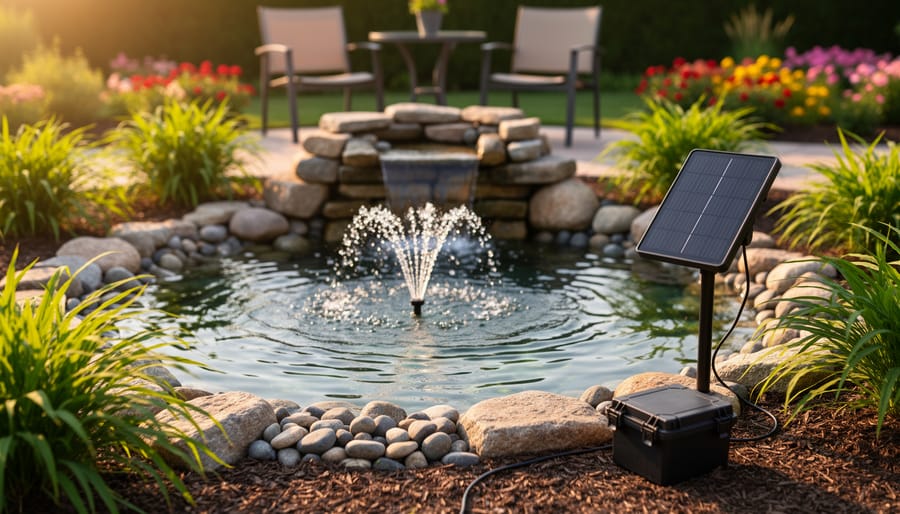
Submersible pumps sit directly in the water feature, making them ideal for ponds and fountains where the pump can remain hidden.
Optional Battery Storage
Most solar fountain pumps work great during sunshine hours, but what if you want your water feature bubbling during evening gatherings? That’s where battery storage comes in. Here’s my take after years of experimentation: if you only care about daytime operation, skip the battery and save money. The pump simply runs when the sun shines, which honestly covers most garden enjoyment hours.
For evening operation, you’ll need a battery between your solar panel and pump. Simple sizing: multiply your pump’s wattage by the hours you want it running after sunset, then add 25% buffer. A 10-watt pump running 4 evening hours needs roughly 50 watt-hours of battery capacity.
The trade-off? Battery systems cost more upfront and require occasional battery replacement every 3-5 years. Direct solar systems are simpler, cheaper, and nearly maintenance-free. I usually recommend starting with direct solar, then adding battery storage later if you find yourself missing that evening water sound.
Matching Your Pump to Your Water Feature
Small Fountains and Birdbaths
For small fountains and birdbaths, you’re looking at the most beginner-friendly solar pump projects out there. These compact features typically need just 5-10 watts of power, making them incredibly affordable and easy to set up.
I remember installing my first solar birdbath pump on a Saturday morning, and by lunchtime, I was watching birds splash around. Most units come as complete kits with integrated solar panels, eliminating the guesswork. Popular options include the Ankway Solar Fountain (7W) and Lewisia Solar Birdbath Pump (5W), both under $30.
The beauty of these small pumps is their portability. You can move them around your yard to find the perfect sunny spot without worrying about extension cords or electrical outlets. They’ll cycle water through 12-18 inch fountains or create gentle bubbling effects in birdbaths up to 20 inches wide.
One practical tip: Clean your pump’s filter weekly during peak use. Bird feathers and debris can reduce flow within days. Also, consider adding a small battery backup unit if you want evening operation, though most basic models only run in direct sunlight.
Medium Ponds and Waterfalls
Now we’re getting into the sweet spot for most backyard water features! Medium ponds and cascading waterfalls typically need solar pumps in the 20-50 watt range. I remember when my neighbor installed a three-tiered waterfall—she initially underestimated the power needed and ended up with a disappointing trickle instead of the flowing cascade she’d imagined.
For ponds around 500-1500 gallons with fountains or waterfalls up to 3-4 feet high, you’ll want at least a 30-watt pump. Multi-tiered systems require extra consideration because water loses momentum as it cascades down, so you need sufficient pressure at the top tier to create that satisfying flow all the way down.
Here’s what makes this range tricky: you’ll need a solar panel around 50-80 watts (remember that 25-30 percent overhead we talked about?) and a battery backup becomes pretty essential. Unlike small fountains that can pause when clouds roll in, larger ponds need consistent water circulation for fish health and algae control. Plan for at least 6-8 hours of daily runtime, which means either a robust battery system or positioning your panel for maximum sun exposure throughout the day.
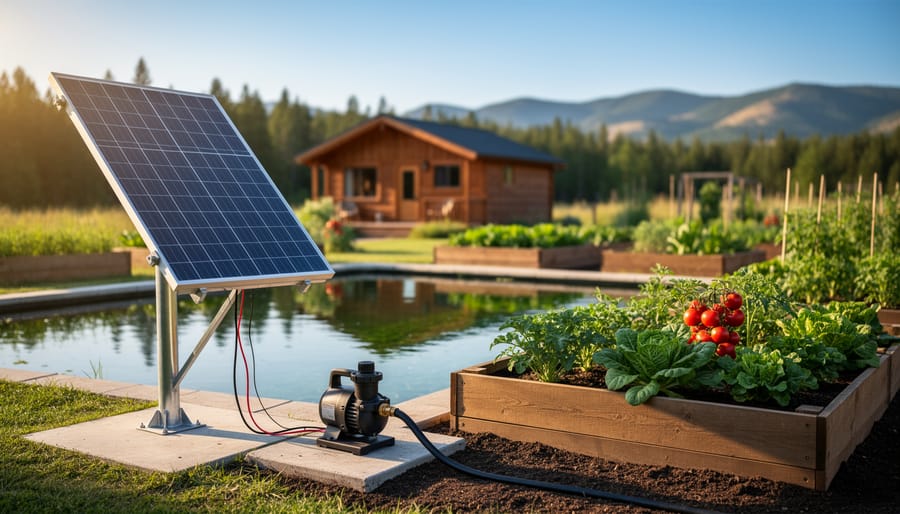
Medium-sized pond installations benefit from solar pumps in the 20-50W range, providing adequate flow for waterfalls and filtration.
Large Ponds and Elaborate Features
When I tackled my neighbor’s 3,000-gallon koi pond project, I quickly learned that bigger doesn’t always mean better with solar. For large ponds and elaborate multi-tier fountains, you’ll need serious power, often 100+ watts of solar panels. Here’s the reality check: a single solar pump may not cut it for features requiring high flow rates or significant vertical lift.
Consider using multiple smaller solar water pumps instead of one massive unit. This approach gives you redundancy and better distribution across complex features. Position separate panels to capture sunlight throughout the day, ensuring at least one pump keeps water circulating even during cloudy spells.
For ponds exceeding 2,000 gallons or waterfalls higher than 6 feet, be honest about solar limitations. You might need battery backup systems or hybrid solar-electric setups to maintain consistent performance. Calculate your total daily water circulation needs using our online calculator, then add 30 percent capacity as a safety buffer. Remember, oversized solar arrays perform better during marginal conditions than barely-adequate ones struggling on overcast days.
Charles’s Step-by-Step Setup Process
Site Assessment and Planning
Before you buy a single component, let’s talk about positioning. I learned this the hard way when I installed my first solar fountain—placing the panel in a spot that looked great got me only three hours of pump operation daily because a nearby tree cast afternoon shade.
Start by observing your intended water feature location throughout the day. You need at least 4-6 hours of direct sunlight for reliable operation, with peak performance from south-facing exposure (or north-facing if you’re in the Southern Hemisphere). Walk around your yard at different times and note where shadows fall. That decorative tree might be sabotaging your solar plans.
For the solar panel itself, you’ve got options. Ground-mounted panels offer flexibility in positioning—you can place them up to 15 feet away from your feature using extension cables. This lets you optimize both aesthetics and sun exposure separately. Just remember: longer cable runs mean slightly reduced efficiency, so keep it reasonable.
Consider the visual balance too. Your water feature should be the star, not the solar panel. Many hobbyists disguise panels among rocks or plants, or angle them away from primary viewing spots. Think about cable routing early—nobody wants visible wires crossing pathways or garden beds. Burying cables in conduit keeps things tidy and protects against accidental damage from garden tools.
Physical Installation
Now for the fun part—putting it all together! I still remember my first solar fountain installation; I was so excited that I nearly forgot to check the waterproofing twice. Learn from my enthusiasm and take your time with these steps.
Start by positioning your solar panel in the sunniest spot you identified earlier. Most panels come with ground stakes or mounting brackets. If you’re using stakes, push them firmly into the soil at an angle that maximizes sun exposure—typically facing south in the Northern Hemisphere. For permanent installations, consider mounting the panel on a nearby structure using the provided hardware, ensuring it won’t be shaded as trees grow or seasons change.
Next, place your pump in the water feature. Submerge it fully according to the manufacturer’s depth recommendations, usually at least six inches deep. Position it away from the bottom to prevent sediment from clogging the intake. Many hobbyists use flat stones or bricks to create a stable platform that keeps the pump elevated.
Here’s where waterproofing becomes critical: examine all electrical connections carefully. If your system has a connection point between the panel and pump, wrap it generously with self-fusing silicone tape or use waterproof junction boxes. Never assume “water-resistant” means waterproof—I’ve seen too many systems fail because someone skipped this step.
Connect the pump to the solar panel, following the color-coded wiring (typically red to positive, black to negative). If your system includes a battery or controller, connect these components in sequence as shown in your instruction manual. Before calling it complete, test everything in full sunlight to ensure proper operation.
Testing and Adjustments
Before turning on your solar pump for the first time, run through this quick checklist. Make sure your solar panel is positioned in direct sunlight with no shadows, all connections are secure and waterproof, and your pump intake is clear of debris. Check that your water reservoir has adequate depth—most pumps need at least 2-3 inches to function properly.
When I installed my first solar fountain, it sputtered and stopped within minutes. The culprit? A clogged intake filter from pond sediment. This is actually the most common issue you’ll face. Simply remove the filter cage and rinse it thoroughly every few weeks. If your pump seems weak or intermittent, check your solar panel angle—even a 15-degree adjustment can make a surprising difference in power output.
For fine-tuning water flow, most solar pumps include adjustable flow restrictors or multiple fountain head options. Start with the lowest setting and gradually increase until you achieve your desired effect. Remember that cloudy days will naturally reduce flow, so optimize for typical conditions rather than peak sunshine. If you’re getting inconsistent performance, consider adding a small battery backup system to smooth out the variations throughout the day.
Real-World Performance: What to Expect
Cloudy Days and Winter Months
Let’s be honest—cloudy days and winter months can feel like your solar water feature’s nemesis. I remember the first winter after installing my pond fountain, watching it sputter to life only during that precious two-hour midday window. It was a bit disappointing, but it taught me some valuable workarounds.
When sunlight drops, so does your pump’s performance. On overcast days, you might see 10-30% of normal output, and during winter’s shorter days, even less. But don’t worry—you’ve got options to keep things flowing.
The simplest solution is embracing the natural rhythm. Many pond owners let their features rest during winter, which actually benefits fish and ecosystems. If you need continuous operation, consider adding a battery backup system. A small 12V battery can store excess energy from sunny days and keep your pump running through cloudy stretches.
Another creative approach is positioning reflective surfaces near your panels to maximize whatever light is available. White stones or light-colored surfaces around your feature can bounce additional light onto panels.
For those committed to year-round operation, hybrid systems that switch to grid power during low-sun periods offer reliable backup. It’s not purely solar, but it keeps your feature running while maintaining that eco-friendly focus most of the time.
Maintenance Rhythm
Here’s the honest truth from my own backyard experience: solar water pumps need surprisingly little fussing over, but the maintenance you do matters. I’ve found that spending about 15 minutes every couple of weeks keeps everything running smoothly.
Your main task is keeping those solar panels clean. Dusty panels can lose 25% of their efficiency, so I just spray mine down with the garden hose or wipe them with a soft cloth. While you’re at it, check the pump intake for leaves, algae, or debris that can restrict flow. If your pump starts sounding labored or flow weakens, nine times out of ten it’s just a clogged intake.
Seasonal considerations make a difference too. In fall, I clear leaves more frequently and sometimes add a mesh cover over my pond to reduce debris. Come winter, if you live where things freeze solid, you’ll want to pull the pump and store it indoors. Snow on panels isn’t usually a problem—it typically slides right off—but brush away heavy accumulation if your fountain isn’t running.
As for longevity, quality solar pumps typically last five to seven years with proper care, while good panels can keep producing for 25 years or more. That’s a pretty solid return on your investment.
Regular cleaning of solar panels ensures optimal performance and maximizes water flow throughout the season.
Beyond the Backyard: Creative Applications
Here’s something I love about solar water pumps—they’re not just for backyard ponds. Last summer, I helped my neighbor set up a small solar pump at his hunting cabin, and it completely transformed how he thinks about off-grid living.
If you’re into camping or RV adventures, a compact solar pump can keep fresh water circulating in your portable pet bowls or create a mini wash station. I’ve seen clever campers use 5-watt pumps with small solar panels to run filtration systems for drinking water—no batteries needed during daylight hours. The setup packs flat and weighs almost nothing.
Remote cabin owners have endless possibilities. A friend installed a modest solar pump system to move water from a nearby creek to a storage tank uphill. It runs automatically whenever the sun’s out, filling his gravity-fed system without any intervention. Similar principles apply to solar irrigation systems for remote gardens.
Livestock watering is probably the most practical application I’ve encountered. Ranchers with distant pastures use solar pumps to keep troughs filled from ponds or wells. The animals always have fresh water, and there’s no need to run electrical lines across acres of land. The remote water pumping approach saves both money and maintenance headaches.
Even emergency preparedness folks have discovered these pumps. During power outages, a pre-installed solar pump keeps water moving in rain barrels or emergency storage tanks.
The beauty is scalability—start with a simple 10-watt setup for basic circulation, then expand as your needs grow. The DIY community continues finding creative applications I never imagined, proving that solar water pumps work anywhere the sun shines.
Common Mistakes to Avoid
After years of working with our community members on their solar water feature projects, I’ve noticed several patterns in what can go wrong. Let me share the most common pitfalls I’ve seen—and yes, I’ve made some of these mistakes myself!
The biggest mistake? Undersizing your solar panels. I learned this the hard way when I set up my first pond fountain. I calculated the pump’s wattage requirement but forgot to account for cloudy days and the sun’s angle throughout the seasons. The result? A fountain that worked beautifully in July but barely trickled by October. A good rule of thumb is to add 25-30% to your calculated panel wattage needs. Your future self will thank you during those overcast spring days.
Pump placement is another area where many folks stumble. Placing your pump too close to the surface means it’ll struggle during low water periods, while burying it too deep in debris-filled pond bottoms leads to clogged intakes. I’ve found that suspending pumps in a mesh basket about 6-8 inches below the water surface works wonders for most backyard features.
Water quality matters more than you’d think. Algae, mineral deposits, and debris don’t just affect your feature’s appearance—they’re pump killers. Community member Sarah learned this when her beautiful koi pond fountain died after just three months. The culprit? Calcium buildup from hard water that seized the impeller. Regular cleaning every 4-6 weeks prevents most issues.
Finally, let’s talk expectations. Your solar fountain won’t run 24/7 like a grid-powered system. It won’t operate at full power on cloudy days. That’s not a flaw—it’s simply how solar works. Understanding these limitations from the start prevents disappointment and helps you design a system that truly fits your needs.
So there you have it—everything you need to know to bring your water feature dreams to life using the power of the sun. I know it might feel overwhelming at first, looking at all these components and calculations, but here’s my advice: start small. Choose one simple project, maybe a modest fountain or a small pond pump, and learn as you go.
When I installed my first solar pump years ago, I made plenty of mistakes—bought the wrong connector, underestimated my panel needs, you name it. But each mistake taught me something valuable, and now those lessons help me guide others in the Spheral Solar community. You’ll have your own learning moments too, and that’s perfectly okay.
If you’re unsure about sizing your system, take advantage of the calculator tools available through Spheral Solar. They’ll help you match your pump requirements to the right solar panel capacity, taking the guesswork out of your project planning. It’s much easier than doing all the math by hand, believe me.
The beauty of solar power is that it puts you in control. You’re not just building a water feature—you’re creating something sustainable that runs on free energy from the sun. That’s genuinely empowering, and it’s something you can feel good about every time you hear that water flowing.
I’d love to hear how your project turns out. What challenges did you face? What creative solutions did you discover? Share your experiences with our community—your insights might be exactly what inspires someone else to take their first step into solar-powered water features.
How useful was this post?
Click on a star to rate it!
Average rating 0 / 5. Vote count: 0
No votes so far! Be the first to rate this post.
We are sorry that this post was not useful for you!
Let us improve this post!
Tell us how we can improve this post?
charlesnoble
Here at Spheral Solar, I’m a hands-on solar power enthusiast, constantly exploring and experimenting with DIY solutions. I’m dedicated to sharing my discoveries, insights, and even the bumps I hit along the way, all in the pursuit of a more sustainable future.
Why Your Next Outdoor Water Pump Should Run on Sunshine by Charlesnoble March 12, 2026 Picture this: You’re standing in your garden on a sunny afternoon, watching crystal-clear water flow effortlessly from your well to your vegetable beds—no extension cords snaking across the lawn, no monthly electricity bills, and no guilt about your carbon footprint. That’s the promise of solar powered outdoor water pumps, and…
How Solar-Powered Greenhouses Slash Your Growing… by Charlesnoble November 13, 2025 Picture this: It’s mid-July, your tomatoes are thriving, but your electricity bill just jumped $80 because your greenhouse exhaust fans have been running nonstop. I’ve been there. Three summers ago, I watched my monthly power costs climb while knowing the sun beating down on my 12×16 greenhouse could be doing…
How Solar Power Slashed My Farm Cold Storage Bills by 80% by Charlesnoble February 6, 2026 Size your solar array by calculating your cold storage’s continuous power draw and multiplying by 24 hours, then add 30% for system losses and cloudy days. A typical 10×12 walk-in cooler running at 38°F draws roughly 2-3 kWh daily in moderate climates, requiring a 600-900 watt solar setup with adequate…
Solar Driveway Lights That Actually Work (No… by Charlesnoble December 5, 2025 Picture this: You’re pulling into your driveway after dark, and instead of fumbling for a flashlight or navigating by memory, your path is illuminated by a gentle row of lights that cost you absolutely nothing to operate. No electrician bills, no trenching through your yard, and no spike in your…
Set Your Garden Watering on Autopilot (Even When the… by Charlesnoble February 23, 2026 Picture this: You’re enjoying a relaxing weekend morning when you suddenly remember—you forgot to water the garden yesterday. Again. That sinking feeling is all too familiar for busy homeowners and gardening enthusiasts alike. But what if your irrigation system could run itself, powered entirely by the sun, without trenching for…
How Does a Solar-Powered Drip Irrigation System Work by Paul September 13, 2021 Solar-powered drip irrigation can be installed in most gardens using a small solar system, readily available irrigation materials, and minimal tools. If you already have a home solar system, it can be tapped into without installing a dedicated system. And the installation of an average drip irrigation system is well…
Subscribe for handpicked DIY projects, exclusive tips, and giveaways.
Route your PV wires through UV-resistant conduit within 18 inches of leaving the solar array, securing it every 3 feet with proper clamps to prevent wind damage and code violations. This single step prevents 80% of the wire degradation issues I’ve seen in DIY solar installations over the past decade. Group your positive and negative… Read more: Why Your PV Wire Management Could Fail Inspection (And How to Fix It)
Understand that 6000 volts sounds terrifying but delivers surprisingly low amperage—typically around 120 milliamps for just 3/10,000th of a second per pulse. This combination creates an unforgettable shock that trains animals to avoid the fence without causing lasting harm. The voltage pushes current through thick fur and hide, while the minimal amperage and microsecond duration… Read more: Why 6000 Volts Won’t Kill Your Livestock (But Will Stop Predators Cold)
Check the maximum voltage and current ratings first—these determine whether your controller can actually handle your solar panel array without frying itself on the first sunny day. I learned this the hard way when my first DIY system shut down every afternoon because I’d paired 600 watts of panels with a controller rated for only… Read more: Why Your Solar Setup Needs Both a Charge Controller and Inverter (And How to Pick the Right Ones)