Stop Tripping Your Solar System: Size Your 3-Phase Breaker Right the First Time
Updated:
Calculate your three-phase breaker size by multiplying your load’s full-load current by 1.25, then selecting the next standard breaker rating above that value. For a 40-amp three-phase motor, you’d calculate 40 × 1.25 = 50 amps, meaning you need a 50-amp breaker minimum.
Verify your voltage system first—208V, 240V, 480V, or 600V systems each require different approaches. A 10kW load at 208V three-phase draws 27.8 amps, but that same load at 480V only pulls 12 amps, dramatically changing your breaker requirements. I learned this the hard way on my first commercial solar installation when I sized breakers for 240V but the facility ran 208V—everything had to be recalculated.
Account for continuous loads by applying the 125% safety factor mandated by electrical code. If your solar inverter outputs 30 amps continuously, you’re legally required to size for 37.5 amps, which means installing a 40-amp breaker. This isn’t optional padding—it prevents nuisance tripping and potential fire hazards from sustained current flow.
Cross-reference wire gauge with breaker size because sizing fuses and breakers means nothing if your conductors can’t handle the current. A 60-amp breaker demands 6 AWG copper minimum for most installations, while 8 AWG copper maxes out at 40 amps under standard conditions.
Understanding these fundamentals transforms three-phase calculations from intimidating math into straightforward problem-solving. Whether you’re wiring a solar array’s AC disconnect, protecting a well pump, or connecting workshop equipment, the same principles apply. The calculator below automates these calculations while teaching you the underlying logic—because knowing why the numbers work matters just as much as getting the right answer for your specific project.
Why 3-Phase Circuit Breakers Matter in Solar Installations
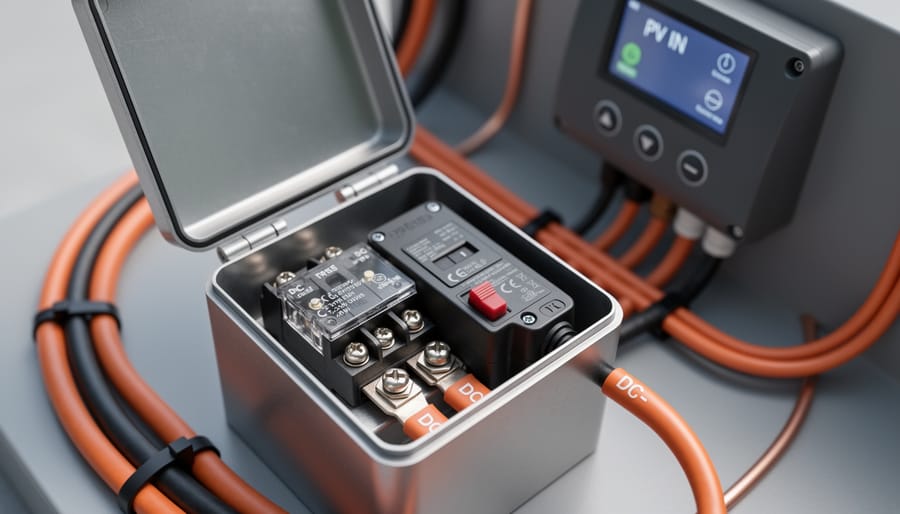
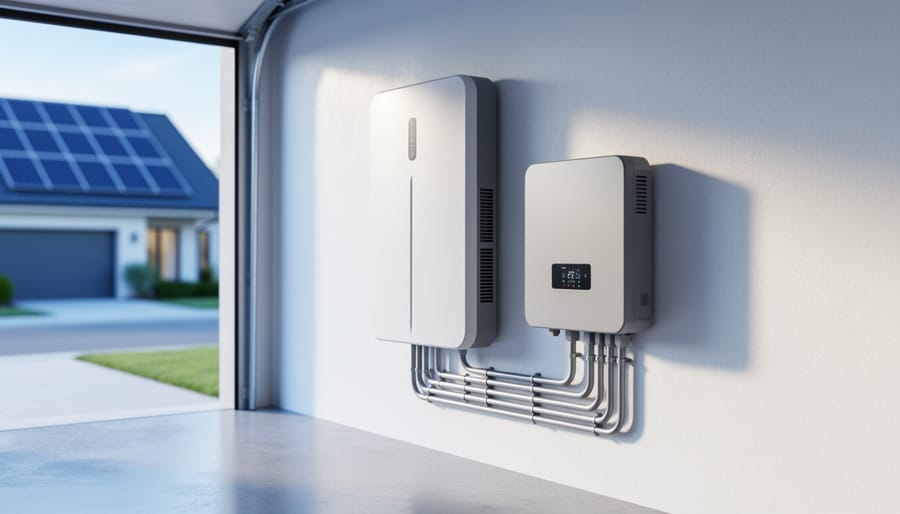
Three-phase circuit breakers are essential components in larger solar installations, providing protection for high-power systems.
When Your Solar Project Needs 3-Phase Protection
You might be wondering when exactly you’d need to step up from standard single-phase protection to three-phase circuit breakers in your solar setup. Let me share what I’ve learned from the DIY solar community and my own experiences.
If you’re planning a larger home system that pushes beyond 10-12 kW, you’re entering three-phase territory. I remember when my neighbor Charles expanded his initial rooftop array to power not just his home but also his electric vehicle charging station and home battery system. His electrical panel was already three-phase (common in larger homes), and properly sizing those breakers became essential for safe operation.
Workshop solar setups are another perfect example. Maybe you have a detached garage or workshop with serious power tools – table saws, welders, air compressors. When you wire your solar panels to offset that heavy equipment usage, three-phase breakers distribute the load evenly and prevent circuit overloads.
RV park owners in our community have also found three-phase systems invaluable. When you’re supplying power to multiple RV hookups simultaneously, balanced three-phase distribution keeps everything running smoothly without tripping breakers every time someone runs their air conditioner.
Small commercial installations round out the list. Coffee shops, small retail stores, or farm operations often have three-phase service already installed. Adding solar means you’ll need properly sized three-phase breakers to integrate your renewable energy safely into the existing electrical infrastructure.
The key is matching your breaker protection to your actual electrical service and load requirements, not oversizing or undersizing based on guesswork.
The Basics: What You Need to Know Before Sizing
Understanding Load Current vs. Breaker Rating
Here’s something I learned the hard way during my first solar shed project: your breaker needs to be bigger than the current your equipment draws. Sounds obvious, right? But there’s a crucial safety rule that trips up a lot of DIYers.
Think of it like this: if your three-phase solar inverter draws 50 amps of continuous current, you can’t just slap a 50-amp breaker on it and call it done. The National Electrical Code requires what’s called the 80% rule for continuous loads. A continuous load is anything that runs for three hours or more, which definitely includes solar equipment that operates all day.
Here’s the simple math: your breaker should only be loaded to 80% of its rated capacity for continuous use. So if your equipment draws 50 amps, you need to divide 50 by 0.8, which gives you 62.5 amps. That means you’d need a 70-amp breaker (the next standard size up).
This rule exists because breakers generate heat when current flows through them. Running a breaker at full capacity continuously can cause it to heat up excessively and trip prematurely, or worse, degrade over time without you noticing.
The relationship is straightforward: calculate your actual load current, multiply it by 1.25 (which is the same as dividing by 0.8), and then round up to the next available breaker size. This gives you the proper safety margin while keeping your solar system running smoothly and reliably for years to come.
Voltage Considerations for 3-Phase Systems
Understanding three-phase voltage is crucial for sizing your breaker correctly, and I’ll be honest—when I first started working with three-phase systems, this part confused me more than anything else. Let me break it down in a way that actually makes sense.
In North America, you’ll typically encounter three common three-phase voltages: 208V, 240V, and 480V. Each has its place in solar installations, and the voltage directly impacts your breaker sizing calculations. Here’s why: higher voltage means lower current for the same amount of power. Think of it like water flowing through pipes—higher pressure (voltage) means you need less volume (current) to deliver the same energy.
For residential solar projects, 208V is most common in multi-unit buildings, while 240V shows up in some commercial settings. Industrial solar arrays often use 480V systems. When you calculate your system voltage, you’ll notice that a 10kW inverter on a 208V system draws about 28 amps, but the same inverter on a 480V system only draws 12 amps. This difference dramatically affects which breaker size you’ll need.
The key takeaway? Always confirm your system voltage before plugging numbers into any calculator—it’s the foundation of everything else.
Power Factor and Why It Matters
Here’s something I learned the hard way during my first solar installation: not all watts are created equal. When I sized my first three-phase breaker, I calculated everything based on the inverter’s rated power and wondered why electricians kept mentioning this mysterious “power factor” number. Turns out, it matters quite a bit.
Power factor is essentially a measure of how efficiently electrical power converts into useful work. It’s expressed as a number between 0 and 1 (or sometimes as a percentage). A power factor of 1.0 means perfect efficiency—every watt of electrical power becomes useful work. Most solar inverters operate at a power factor between 0.95 and 1.0, which is pretty excellent. But some loads, especially motors and older equipment, can have power factors as low as 0.7.
Why does this matter for breaker sizing? Because breakers are sized based on current, not just power. If your power factor is low, you’ll draw more current to produce the same amount of useful power. This means you might need a larger breaker than you’d initially calculated. Most modern solar inverters publish their power factor specs in the datasheet—always check this before finalizing your breaker selection to avoid undersizing and potential safety issues.
How to Calculate Your 3-Phase Circuit Breaker Size
The Formula Broken Down (No Math Degree Required)
Let me share something that clicked for me during my first solar installation. I stared at that formula—I = P / (√3 × V × PF)—and honestly, my eyes glazed over. But here’s the good news: it’s way less intimidating than it looks, and understanding it could save you from an expensive (or dangerous) mistake.
Let’s break it down piece by piece.
I is the current in amps. This is the number you’re solving for—it tells you how many amps your circuit will draw, which determines what size breaker you need.
P stands for power in watts. This is how much electricity your equipment uses. If you’re hooking up a three-phase inverter rated at 15,000 watts, that’s your P value. Sometimes you’ll need to convert watts to amps for different applications, which is exactly what this formula does.
V is your voltage. For three-phase systems, this is typically 208V, 240V, or 480V depending on your setup. Check your equipment specifications—getting this wrong throws everything off.
PF is the power factor, usually between 0.8 and 1.0. Most modern inverters run close to 1.0 (or unity), meaning they’re pretty efficient. When in doubt, check your equipment manual or use 0.95 as a safe estimate.
That weird √3 symbol? It equals 1.732, and it’s there because three-phase power works differently than single-phase. Think of it as the mathematical adjustment that accounts for how three-phase systems distribute power across three separate conductors.
When I finally understood these components, electrical unit conversions became less mysterious. You’re simply translating your system’s power needs into a language your breaker understands.
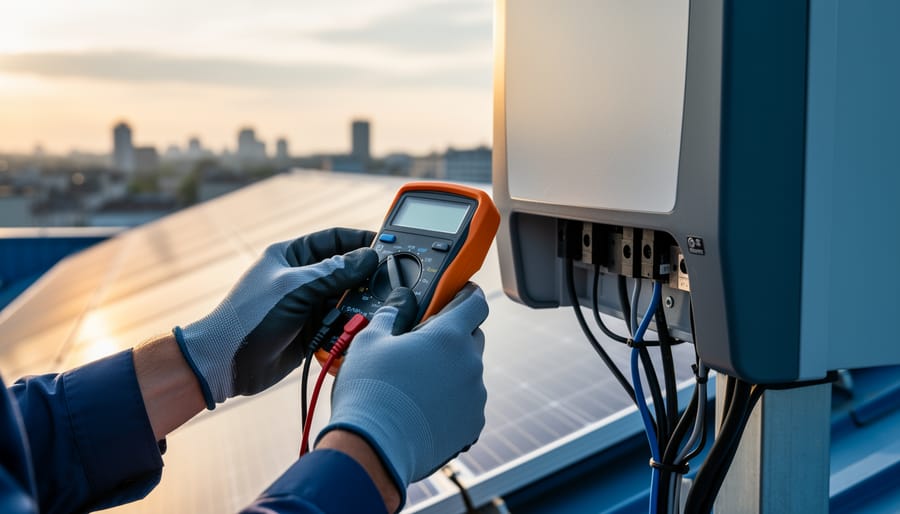
Accurate current measurement is the foundation of proper circuit breaker sizing for solar systems.
Working Through a Real Solar System Example
Let me share a real example from a system I helped size last summer. My neighbor was installing a 15kW three-phase solar array, and we sat down together to figure out the right breaker size. Here’s exactly how we worked through it.
First, we gathered the critical information. His inverter specs showed it would output 15,000 watts at 208 volts three-phase. We grabbed those numbers straight from the manufacturer’s datasheet, which is always your best starting point.
Next, we calculated the continuous current. Using our formula, we divided 15,000 watts by 208 volts, then divided by 1.732 (that square root of 3 for three-phase systems). This gave us about 41.6 amps of actual operating current.
Here’s where the safety margin comes in. The National Electrical Code requires breakers to be sized at 125% of continuous loads. So we multiplied 41.6 amps by 1.25, which gave us 52 amps minimum breaker size.
Now, breakers don’t come in every possible size. Looking at standard options, we had to choose between a 50-amp and 60-amp breaker. Even though 50 amps seemed close, it was actually below our 52-amp requirement. We went with the 60-amp breaker, which provided the proper safety margin without being oversized.
The whole process took about ten minutes once we had the inverter specs in hand. Having the formula and understanding each step made what seemed complicated actually pretty straightforward.
Applying Safety Margins and Code Requirements
Here’s something I learned the hard way during my first solar installation: calculating the exact load isn’t enough. The National Electrical Code requires us to add safety margins to protect both the circuit and the people using it. Think of it like wearing a helmet when biking—you hope you never need it, but you’ll be grateful it’s there.
The NEC requires that breakers handling continuous loads (anything running for three hours or more, like your solar inverter) be sized at 125% of the actual load. So if your three-phase system draws 40 amps continuously, you’d calculate 40 × 1.25 = 50 amps minimum breaker size. This prevents the breaker from heating up and nuisance tripping.
Temperature also matters more than most DIYers realize. If you’re installing breakers in a hot attic or outdoor enclosure where temperatures exceed 86°F, you’ll need to apply derating factors. Check the breaker manufacturer’s specs—typically you might need to reduce the breaker’s capacity by 10-20% in high-heat environments.
Don’t forget conductor ampacity ratings too. Your wire must handle the load just as much as the breaker. The NEC provides tables showing ampacity based on wire gauge, insulation type, and ambient temperature. Always match your wire size to support the breaker rating, not just the load.
Using Our 3-Phase Circuit Breaker Sizing Calculator
What Information You’ll Need to Gather
Before you dive into the calculator, let’s talk about what numbers you’ll actually need. I learned this the hard way on my first solar project when I had to make three trips back to check my inverter specs because I hadn’t written everything down!
Start with your solar inverter documentation. You’ll need the maximum continuous output current, which is usually listed in amps. Don’t confuse this with the peak or surge current—we’re looking for the steady-state number. Also grab the voltage rating, typically 208V or 480V for three-phase systems.
Next, check your load equipment. If you’re powering specific machinery or appliances, note their total amp draw. This helps you account for everything downstream from the breaker.
From your system design, you’ll want the wire gauge you’re planning to use and the ambient temperature where the breaker will be installed. Temperature matters more than you’d think—a breaker in a hot attic behaves differently than one in a climate-controlled garage.
Finally, jot down any derating factors. Are you bundling multiple circuits together? Is there conduit involved? These details affect your final calculations and ensure your breaker properly protects your investment without nuisance tripping.
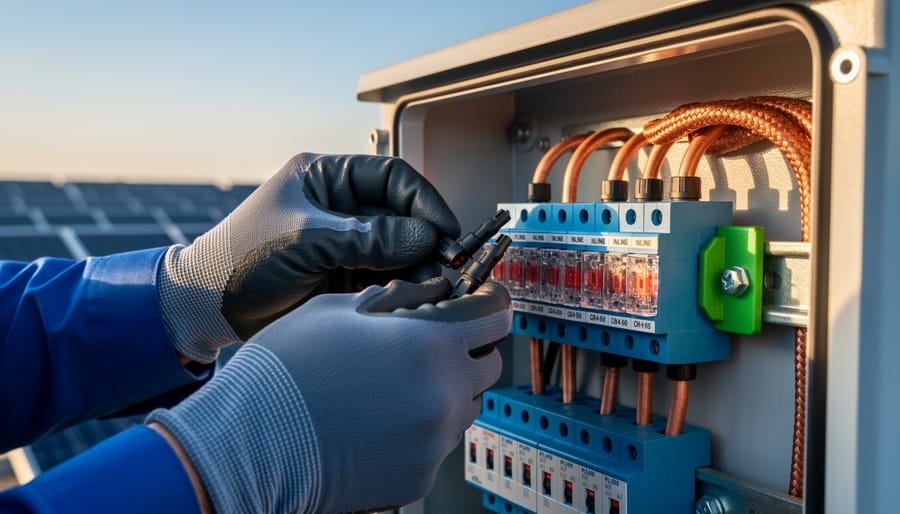
Gathering accurate specifications from your solar equipment is essential before calculating breaker sizes.
Step-by-Step: Using the Calculator
Let me walk you through using our three-phase circuit breaker sizing calculator—it’s easier than you might think! I remember the first time I sized a breaker for my workshop solar setup, second-guessing every number. This tool takes that anxiety away.
Start by entering your load’s power in kilowatts. For example, if you’re powering a 7.5 kW three-phase solar inverter, type “7.5” in the power field. Next, select your system voltage from the dropdown—common options include 208V, 240V, 380V, or 480V. Most residential three-phase systems in North America use 208V or 240V.
Now here’s where it gets interesting: input your power factor. If you’re unsure, 0.8 is a safe estimate for most motor loads and inverters, though many modern inverters run closer to 0.95. The calculator instantly displays your load current and recommends the appropriate breaker size, accounting for the standard 125% safety margin required by electrical codes.
The results screen shows both the calculated current and the next standard breaker size up. For instance, if your load draws 23 amps, the calculator might recommend a 30-amp breaker. You’ll also see a helpful breakdown explaining why that particular size was chosen, giving you confidence in your selection before making any purchases.
Understanding Your Results
Once your calculator gives you a result, you’ll typically see a recommended amperage like 28.7A or 43.2A. Here’s the thing—you can’t buy a 28.7A breaker at your local supplier! Breakers come in standard sizes: 15A, 20A, 25A, 30A, 40A, 50A, and so on.
Always round up to the next available standard size. If your calculation shows 28.7A, you’d select a 30A breaker. If it shows 43.2A, go with a 50A breaker. Never round down—that’s asking for nuisance trips or worse.
I learned this the hard way on my first solar installation when I tried to “make do” with what I had in my garage. The breaker kept tripping on sunny days when my system was producing peak power. After upgrading to the proper size, everything ran smoothly.
Most quality calculators will show both your calculated minimum and suggest the standard breaker size for you. Double-check that the breaker’s voltage rating matches your system—a 480V three-phase system needs a breaker rated for at least that voltage.
Common Mistakes DIYers Make (And How to Avoid Them)
Oversizing: When Bigger Isn’t Better
Here’s a mistake I learned the hard way during my first solar shed project: I thought installing a bigger breaker would give me “headroom” for future expansion. Turns out, oversizing is one of the most dangerous errors you can make.
Think of a circuit breaker as your electrical system’s emergency brake. If you size it too large, it won’t trip when your wires start overheating. Your wire might be rated for 20 amps, but if you install a 40-amp breaker, that wire could overheat and potentially cause a fire before the breaker ever trips to protect it.
The breaker’s job is to protect the wire, not just the equipment. When you oversize, you’re essentially disabling that protection. It’s like putting a seatbelt around your waist but leaving it so loose it won’t catch you in an accident.
This is especially critical in solar installations where wiring runs through attics, walls, or outdoor conduit. You won’t see the warning signs of overheating until it’s too late. Always match your breaker to your wire’s ampacity rating, not to what you think you might need someday.
Undersizing: The Nuisance Trip Problem
I learned this lesson the hard way during my first solar installation. I sized my breaker based purely on the inverter’s rated output—seemed logical, right? What I didn’t account for were those brief surge currents when the system starts up each morning or when clouds suddenly part and production spikes. Within two weeks, I was resetting that breaker almost daily. It drove me absolutely nuts.
Here’s what happens when you undersize: your breaker trips during perfectly normal operation, not because something’s wrong, but because you’ve left zero wiggle room. Solar inverters, especially, can produce momentary inrush currents that exceed their rated capacity by 20-30 percent. If your breaker is sized right at the edge, these normal surges will trip it every time.
The frustration goes beyond just flipping a switch. Frequent nuisance trips can wear down your breaker over time, and if your panel is outdoors or in a hard-to-reach location, you’ll be making those walks of shame regularly. Plus, every trip means your solar production stops, costing you energy and potentially shortening equipment life.
The solution? Build in appropriate headroom when sizing. That extra margin isn’t waste—it’s insurance against the real-world behavior of your system.
Forgetting About Environmental Factors
Here’s something I learned the hard way during a solar installation in Arizona: environmental factors can completely change your breaker calculations. Your perfectly sized breaker might become undersized simply because of where you install it.
Temperature is the big one. Circuit breakers are rated for 40°C (104°F), but if you’re mounting your panel in a hot attic or outdoor enclosure in summer, ambient temperatures can hit 50°C or higher. Heat reduces a breaker’s current-carrying capacity, so you’ll need to apply derating factors—typically reducing the breaker’s rating by 10-20% in high-heat environments. Check the manufacturer’s derating charts for your specific situation.
Altitude matters too, though many DIYers don’t realize it. Above 6,000 feet, thinner air provides less cooling, requiring further derating of about 3% per 1,000 feet above that threshold.
Enclosure location is equally important. Direct sunlight on a metal enclosure can add 10-20°C to internal temperatures. Whenever possible, choose shaded locations with good ventilation. If you’re working on a rooftop solar project, consider these factors early in your planning—moving an electrical panel after installation is nobody’s idea of fun.
Selecting the Right Breaker Type for Your Solar Setup
Thermal-Magnetic vs. Electronic Trip Breakers
When choosing a circuit breaker for your three-phase solar system, you’ll encounter two main types: thermal-magnetic and electronic trip breakers. Understanding the difference can save you money and headaches down the road.
Thermal-magnetic breakers are the traditional workhorses. They use a bimetallic strip that bends when heated by excessive current, plus an electromagnet for instant response to short circuits. These are generally less expensive, highly reliable, and perfect for most residential solar installations. I’ve used them in probably 90% of my home projects because they’re straightforward and don’t require programming.
Electronic trip breakers, on the other hand, use microprocessors to monitor current flow. They offer precise trip settings, adjustable response times, and better accuracy across varying temperatures. The downside? They cost significantly more and can be overkill for simple residential setups.
For most DIY solar enthusiasts, thermal-magnetic breakers strike the right balance. They’re cost-effective, widely available, and provide adequate protection for typical home installations. Save the electronic models for commercial projects or situations where you need precise trip customization. Just ensure whichever type you choose is rated for DC applications if protecting the solar array side, as standard AC-only breakers won’t safely interrupt DC current.
Special Considerations for Solar Inverters
Solar inverters are unique creatures in the electrical world, and I learned this the hard way during my first three-phase installation. I assumed any breaker of the right amperage would work—big mistake! Solar inverters require specific breaker types because they generate backfed power, meaning electricity flows from your panels back through the breaker toward the grid, opposite to normal current flow.
Most inverter manufacturers specify breakers that are rated for backfeed applications and can handle DC fault conditions. Check your inverter’s datasheet carefully—you’ll usually find a section labeled “Protection Requirements” or “Recommended Breakers.” Some inverters need breakers with specific interrupt ratings (measured in kA) to safely handle fault currents, while others require particular trip curves to avoid nuisance tripping.
Three-phase solar inverters often specify breakers certified to certain standards like UL 489 or IEC 60947. Don’t skip this detail! Using the wrong breaker type can void warranties and create safety hazards. When using a sizing calculator, always cross-reference the result with your specific inverter’s documentation. The manufacturer knows their equipment best, and their specifications aren’t suggestions—they’re requirements for safe, reliable operation. When in doubt, reach out to the manufacturer’s technical support team before making your final selection.
Safety First: When to Call a Professional
Look, I’ll be straight with you—calculators and guides like this one are fantastic learning tools, but they have limits. I learned this lesson the hard way back in 2014 when I was upgrading my workshop’s electrical system. I’d done all my calculations perfectly, triple-checked everything, but when the inspector showed up, he pointed out local code requirements I hadn’t even known existed. That moment taught me something valuable: knowing when to call in a pro isn’t admitting defeat—it’s being smart.
Here’s my honest take on when you should absolutely pick up the phone and call a licensed electrician:
If you’re doing any new installation or modification to your main electrical panel, that’s professional territory. Playing around inside your service panel isn’t just risky—it’s potentially deadly, and most jurisdictions require permitted work by licensed professionals for exactly this reason.
When your project involves connecting to the grid or upgrading service capacity, you need someone with the proper credentials. These scenarios involve coordination with your utility company, permits, and inspections that only licensed electricians can properly navigate.
If you’re feeling uncertain or second-guessing your calculations, trust that instinct. A consultation with an electrician might cost a few hundred dollars, but it’s dramatically cheaper than fixing a fire-damaged home or replacing expensive solar equipment.
Working with three-phase power in industrial or commercial settings? That’s another clear situation for professional help. The stakes are higher, the systems more complex, and the margin for error much smaller.
Remember, using these calculators to understand your system and have informed conversations with electricians is incredibly valuable. You’ll ask better questions, understand their recommendations, and potentially save money by doing the preliminary planning yourself. There’s zero shame in bringing in expertise when the situation calls for it.
Properly sized circuit protection ensures your solar installation operates safely and reliably for years to come.
Getting your three-phase circuit breaker sizing right isn’t just about passing inspection or following code requirements—it’s about protecting your investment and keeping your solar system running safely for decades to come. I remember when I first tackled my own solar installation, I spent hours double-checking my breaker calculations because I knew that one mistake could mean a fire hazard or system failure down the road. That diligence paid off, and I want the same confidence for you.
Now that you’ve worked through the calculator and understand the fundamentals—load calculations, voltage considerations, temperature derating, and safety margins—you’re equipped to size breakers with real confidence. The calculator takes the guesswork out of the math, but your understanding of the principles behind it ensures you’re making informed decisions rather than just plugging in numbers.
Don’t hesitate to use this tool for every three-phase application in your solar project, whether it’s your main inverter connection, battery bank protection, or charge controller circuits. And here’s where I’d love to hear from you: what challenges have you faced with circuit breaker sizing? Have you discovered any helpful tips or learned lessons the hard way? Share your experiences in our community forums—your insights could be exactly what another DIYer needs to hear.
Remember, proper circuit protection is the foundation of every reliable, safe solar system. You’ve got this, and you’ve got a whole community backing you up.
How useful was this post?
Click on a star to rate it!
Average rating 0 / 5. Vote count: 0
No votes so far! Be the first to rate this post.
We are sorry that this post was not useful for you!
Let us improve this post!
Tell us how we can improve this post?
charlesnoble
Here at Spheral Solar, I’m a hands-on solar power enthusiast, constantly exploring and experimenting with DIY solutions. I’m dedicated to sharing my discoveries, insights, and even the bumps I hit along the way, all in the pursuit of a more sustainable future.
How to Size Low Voltage Circuit Protection for Your… by Charlesnoble September 26, 2026 Low voltage circuit protection in DIY solar systems boils down to matching the right fuse or breaker to your wire size and expected current, not to the capacity of your battery bank or inverter. Most fires and equipment failures happen when people oversize protection devices, thinking bigger is safer, when…
Wire Your Solar Panels Wrong and Watch Your… by Charlesnoble December 22, 2025 Match your wire gauge to your system’s amperage before making a single connection—undersized wire creates dangerous heat buildup and wastes the energy you worked hard to capture. For most residential 12V systems running under 30 amps, 10 AWG copper wire handles the load safely, but calculate your specific needs using…
How to Size a 5kW Solar System for Your Home or RV by Charlesnoble October 18, 2026 A 5kW solar system occupies between 250 and 350 square feet of roof or ground space and produces roughly 20 to 25 kilowatt-hours of electricity per day in most U.S. locations. That’s enough to power a typical three-bedroom home with moderate energy use, though your exact needs depend on your…
Stop Burning Out Your Solar Gear: Why Electrical… by Charlesnoble February 22, 2026 Grab your multimeter and calculator—understanding electrical conversions transforms confusing numbers into actionable data for your solar setup. When I first started working with solar panels, I’d stare at spec sheets showing watts, amps, and volts, completely baffled about which numbers actually mattered for sizing my components. That confusion nearly led…
Why Your Solar Battery Dies Faster Than Expected… by Charlesnoble May 12, 2026 Calculate your required solar battery capacity by multiplying your daily energy consumption in kilowatt-hours by the number of days of autonomy you want. If your home uses 30 kWh daily and you want three days of backup power, you need 90 kWh of usable storage capacity. Remember that most batteries…
How Much Power Does an 8kW Solar System Actually… by Charlesnoble March 24, 2026 An 8kW solar system typically generates between 24 and 40 kWh per day, depending on your location, season, and installation quality. That’s enough to power most average homes completely, but the reality is more nuanced than a single number can capture. I remember installing my first 8kW array in Arizona…
Subscribe for handpicked DIY projects, exclusive tips, and giveaways.
Nine times out of ten, an RV generator that won’t start has a stale fuel problem. If your generator hasn’t run in more than 30 days, degraded gasoline is likely gumming up the carburetor and preventing ignition. Before you panic or call for expensive roadside service, try this: turn on the generator’s fuel valve (if… Read more: RV Generator Troubleshooting: Common Problems and How to Fix Them
A 5kW solar system occupies between 250 and 350 square feet of roof or ground space and produces roughly 20 to 25 kilowatt-hours of electricity per day in most U.S. locations. That’s enough to power a typical three-bedroom home with moderate energy use, though your exact needs depend on your daily consumption patterns, climate zone,… Read more: How to Size a 5kW Solar System for Your Home or RV
Installing a home solar system yourself takes 2-4 weekends for an average 5kW setup, requires solid electrical knowledge and comfort working at heights, and can save you $5,000-$8,000 in labor costs if you tackle everything except the final utility interconnection. The process breaks down into five main phases: permitting and design, mounting the racking system,… Read more: Solar Power Installation Step by Step: Complete DIY Guide From Start to Finish