Why Your 9 Volt Battery Dies So Fast (And What It Means for Solar)
Updated:
Grab any 9-volt battery from your drawer and flip it over—you’ll rarely find capacity listed in milliamp-hours (mAh), yet this hidden specification determines whether your smoke detector dies at 2 AM or your guitar pedal cuts out mid-solo. Most alkaline 9V batteries hold between 400-600 mAh, while rechargeable versions typically store 150-300 mAh, numbers that seem small until you realize they’re powering critical safety devices in millions of homes right now.
Understanding battery capacity transforms how you approach every energy project, from choosing the right backup power for weekend camping trips to designing your first solar charging system. I learned this the hard way when my early solar experiments failed because I treated all 9-volt batteries as equals—they’re not. A cheap carbon-zinc 9V might deliver barely 200 mAh, while premium lithium versions can exceed 1,200 mAh, making capacity knowledge essential for anyone serious about reliable off-grid power.
The capacity rating tells you exactly how much current a battery can deliver over time. A 500 mAh 9-volt battery theoretically provides 500 milliamps for one hour, or 50 milliamps for ten hours, though real-world performance varies based on discharge rates and temperature. This same principle scales up to the deep-cycle batteries in solar installations, making 9V batteries the perfect classroom for learning energy storage fundamentals without the complexity or cost of larger systems.
What 9 Volt Battery Capacity Actually Means
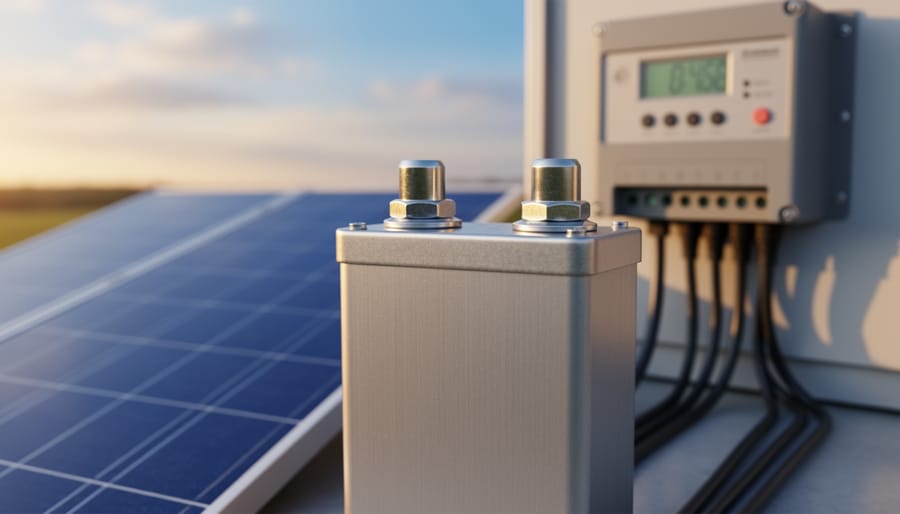
9-volt batteries serve specific niches in solar projects, particularly for small sensors and backup power applications.
The Numbers Behind Your 9V
Let me break down what you’ll actually get from different 9V batteries, because the numbers matter when you’re powering your projects.
A standard alkaline 9V battery typically holds between 400-600 mAh of capacity. I learned this the hard way when I first started building small solar monitoring systems and wondered why my backup batteries didn’t last as long as I’d calculated. Meanwhile, rechargeable NiMH 9V batteries usually range from 150-300 mAh, which sounds like less, but they’re reusable hundreds of times.
Here’s what that means in practice: if you’re running a simple LED circuit that draws 20 mA, an alkaline 9V could theoretically power it for 20-30 hours. A smoke detector pulling about 30 mA might run for several months because it’s mostly in standby mode. For your solar projects, understanding these numbers helps you size backup systems correctly.
The capacity also depends on how you use the battery. Heavy current draws drain them faster than the rating suggests, while light loads often exceed expectations. When comparing different battery chemistries for solar applications, it helps to convert mAh to Wh for accurate energy calculations across your system.
Why 9V Batteries Are Different
Here’s something that surprised me when I first cracked open a 9V battery during one of my early solar experiments—it’s not actually a single battery at all! Inside that familiar rectangular case, you’ll find six tiny 1.5V cells stacked together. Each cell is about the size of a AAAA battery (yes, that’s a real size), working together to deliver the 9 volts we expect.
This internal construction is exactly why 9V batteries have notably lower capacity compared to their larger cousins like AA or D cells. While a standard AA alkaline battery might offer 2,000-3,000 mAh, a 9V alkaline typically provides only 400-600 mAh. The math is straightforward—cramming six separate cells into that compact space leaves less room for the chemical materials that store energy.
For solar applications, this matters more than you might think. Those smaller internal cells drain faster under load, which means your solar panel needs to work harder to keep a 9V battery topped up. I learned this the hard way with my first solar-powered weather station. Understanding this relationship between physical size, internal construction, and actual capacity helps you choose the right battery size for your project from the start, saving both time and frustration down the road.
Inside a 9-volt battery, six individual 1.5-volt cells are stacked in series, explaining both its voltage and limited capacity compared to larger batteries.
How Battery Capacity Works in Solar Systems
From 9V to Deep Cycle: The Capacity Connection
I’ll be honest with you—when I first started tinkering with solar systems, the whole amp-hour thing confused me. But here’s what clicked: a 9V battery is actually the perfect teaching tool because it’s something we’ve all held in our hands, and the principles scale up beautifully.
Think of capacity (measured in milliamp-hours or mAh for small batteries, amp-hours for bigger ones) as your battery’s fuel tank. That 9V battery in your smoke detector? It typically holds about 500-600 mAh. Now, when you move up to a 12V deep cycle battery for solar, you’re looking at 50-200 amp-hours—same concept, just a much bigger tank.
Here’s where it gets practical. Depth of discharge (DoD) matters at every scale. Just like you shouldn’t drain your 9V completely (it’ll never perform the same), you shouldn’t drain your solar batteries past 50% for lead-acid or 80% for lithium. This principle applies whether you’re powering a guitar pedal or running your off-grid cabin.
The math works the same way too. Understanding battery power conversions helps you calculate runtime: divide your battery’s capacity by your device’s draw. A 500 mAh 9V powering a 50 mA device gives you 10 hours. A 100 Ah solar battery powering a 10 amp load? Same 10 hours. Once you grasp this with a simple 9V, scaling up to 12V, 24V, or even 48V solar systems becomes way less intimidating.
Personal Story: My First Solar Capacity Mistake
I learned this lesson the hard way back when I was building my first solar-powered weather station. I’d calculated everything perfectly—or so I thought. I knew I needed a 9V battery as backup power, and I grabbed whatever was cheapest at the hardware store. What I didn’t realize was that not all 9V batteries are created equal. The alkaline battery I chose had a capacity of only about 400mAh, while a lithium version would have given me over 1200mAh.
Three days into my project, the battery died during a cloudy stretch. My weather station went dark, and I lost valuable data I’d been collecting. That’s when I discovered the hard truth: voltage tells you the pressure, but capacity tells you how long the party lasts. I’d focused solely on matching the voltage requirement without considering runtime needs.
Since then, I always calculate my actual power consumption and match it to battery capacity with a healthy safety margin. That early mistake taught me to respect the mAh rating as much as the voltage itself.
Where 9 Volt Batteries Fit in Solar Projects
Small Solar Sensors and Monitoring
I’ve learned from experience that monitoring is often the unsung hero of a solar setup. During my first garden solar project, I installed moisture sensors without backup power – and quickly discovered they’d go dark every time clouds rolled in for a few days. That’s where 9V batteries really shine as a safety net.
Think of a 9V battery as your monitoring system’s insurance policy. Most temperature sensors and moisture monitors draw incredibly small amounts of power – often just 5-10 milliamps when actively measuring. With a typical 9V alkaline battery offering around 500-600 mAh capacity, you’re looking at 50-100 hours of continuous operation, or several months if your sensors only wake up periodically to take readings.
Here’s a practical example: A soil moisture sensor checking conditions every 30 minutes might only need power for 30 seconds each time. That means your 9V battery could last an entire growing season as backup power, stepping in whenever your solar panel can’t keep up.
The beauty of this approach is simplicity. You can connect a 9V battery in parallel with your solar charging circuit using basic diode protection, creating a seamless failover system. Your sensors stay online through cloudy spells, nighttime, or unexpected shade without any complicated electronics. It’s an affordable, reliable solution that gives peace of mind to any solar monitoring setup.
Emergency and Camping Applications
When you’re heading out for a camping trip or preparing emergency backup systems, 9V batteries paired with small solar panels create surprisingly effective power solutions. I learned this firsthand during a weekend camping trip when my solar-charged 9V setup kept our LED lantern running for three consecutive nights without missing a beat.
For emergency preparedness, a compact 5-10 watt solar panel can maintain charged 9V batteries that power critical devices like portable smoke detectors in off-grid cabins or backup radio systems. Given that most 9V alkaline batteries hold around 500-600 mAh, while rechargeable NiMH versions offer 200-300 mAh, you’ll want to calculate your device’s current draw to estimate runtime. A typical LED camping light drawing 20mA could run for 25 hours on a single alkaline 9V, making it perfect for weekend adventures.
The beauty of solar-charged 9V systems is their simplicity. You don’t need complex charge controllers for basic setups, just ensure your solar panel output matches your rechargeable battery specifications. Keep a couple of charged 9V batteries in your emergency kit, rotate them every six months, and pair them with a small solar panel for indefinite backup power. This approach gives you peace of mind knowing essential devices will work when you need them most, whether you’re miles into the wilderness or dealing with a power outage at home.
When NOT to Use 9V Batteries
Let me be honest with you: 9V batteries are rarely the right choice for solar projects. I learned this the hard way when I tried powering a small outdoor sensor system with them. The problem? Their limited capacity (usually 400-600 mAh) means they drain quickly, and constantly replacing them defeats the whole purpose of sustainable solar energy.
For most solar applications, rechargeable battery packs like 18650 lithium cells or even AA rechargeable batteries offer much better value and capacity. They’re designed for repeated charge cycles, which is exactly what solar systems do daily. Plus, 9V batteries are expensive per watt-hour of storage compared to other options.
The only time I’d recommend 9V batteries for solar is in temporary prototyping or testing circuits before committing to a permanent battery solution. They’re convenient for breadboard experiments, but that’s about it. If you’re building something meant to last, invest in proper rechargeable battery banks from the start. Your wallet and the environment will thank you.
Rechargeable 9V Options for Solar Charging
NiMH vs Lithium 9V: What Works Best
When I first started exploring rechargeable 9V batteries for my solar projects, I was amazed at how different NiMH and lithium options perform. Let me break down what I’ve learned through hands-on experience.
NiMH (Nickel-Metal Hydride) batteries typically offer capacities between 200-280 mAh. They’re the workhorses of the rechargeable world, affordable and widely available. I’ve used them in smoke detectors and guitar pedals with great success. However, they do have a quirk: they self-discharge fairly quickly, losing about 20-30% of their charge per month just sitting on the shelf. They also require specific NiMH chargers and take several hours to fully charge.
Lithium rechargeable 9V batteries, on the other hand, are the premium option. With capacities reaching up to 500 mAh, they pack nearly double the energy of NiMH alternatives. They hold their charge much longer when not in use and typically charge faster through USB ports. The downside? They cost significantly more upfront.
For small solar applications, lithium batteries pair beautifully with compact solar panels because their higher capacity means longer runtime between charges. If you’re planning a solar charging setup, our solar charge time calculator can help you determine how long it’ll take to recharge either type based on your panel size.
My recommendation: Choose NiMH for budget-conscious projects with frequent use, and lithium for applications where reliability and longer intervals between charges matter most.
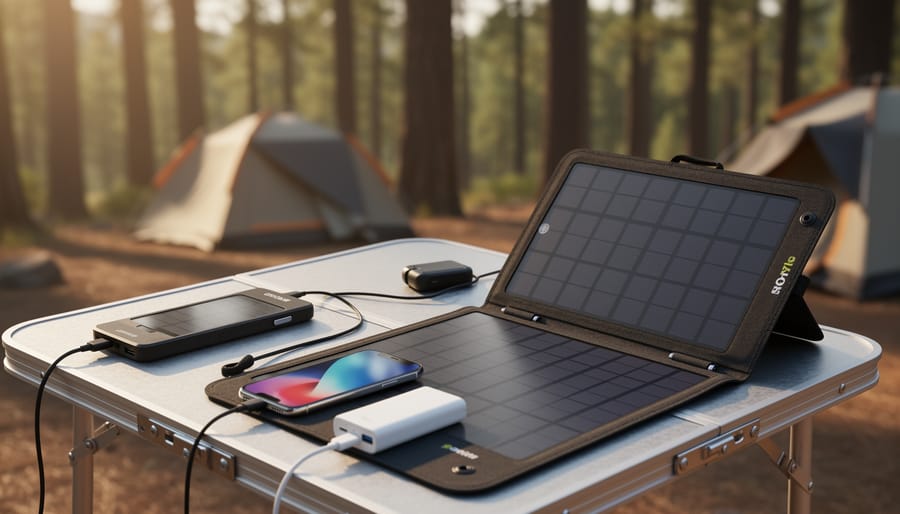
Rechargeable 9-volt batteries paired with small solar panels provide practical backup power for camping and off-grid applications.
Setting Up a Simple 9V Solar Charger
Building your own 9V solar charger is easier than you might think! I remember my first attempt—Charles here—charging a simple 9V battery for a smoke detector, and the satisfaction was incredible. Here’s how to get started safely.
You’ll need three basic components: a small solar panel (12V rated works perfectly), a charge controller designed for 9V rechargeable batteries, and of course, rechargeable 9V batteries (NiMH are best for solar applications). The panel should provide at least 200-300mA output for reasonable charging speeds.
Connect your solar panel to the charge controller first—never connect directly to the battery, as overcharging can cause damage or even safety hazards. The controller regulates voltage and prevents overcharging, which is essential for battery longevity. Then connect your 9V battery to the controller’s output terminals, observing correct polarity.
For safety, always work in a well-ventilated area and check all connections before exposing your setup to sunlight. You can calculate charging time based on your panel output and battery capacity. Start with this simple setup, and you’ll soon understand the fundamentals that apply to larger solar projects!
Calculating Your Battery Needs: From 9V to Full Systems
The Simple Capacity Formula
Let me share a story that helped me finally understand battery capacity. I was working on a small solar garden light project and kept running into a frustrating problem—my 9V batteries would die way faster than expected. That’s when I discovered the simple formula that changed everything.
Here’s the basic capacity formula: Runtime (hours) = Battery Capacity (mAh) ÷ Device Current Draw (mA)
Let’s walk through a real example. Say you have a typical 9V alkaline battery rated at 500 mAh, and you want to power an LED circuit that draws 20 mA. Using our formula: 500 mAh ÷ 20 mA = 25 hours of runtime. Pretty straightforward, right?
Now, if you’re working with a device that draws 50 mA instead, the same battery would only last 10 hours (500 ÷ 50 = 10). This is exactly why knowing your device’s current draw is critical before choosing a battery.
You can flip this formula around too. If you need your project to run for a specific time, multiply the required runtime by your device’s current draw to find the minimum capacity you need. Want 40 hours from that 20 mA LED? You’ll need at least 800 mAh of capacity (40 × 20 = 800).
This same principle applies whether you’re sizing a 9V battery for a smoke detector or calculating solar panel requirements for a home system. The numbers get bigger, but the math stays simple and incredibly useful.
Using Our Battery Calculator
When I first started working with solar projects, I wish I’d had access to tools that made sizing batteries less of a guessing game. That’s exactly why we developed our interactive battery capacity calculator at Spheral Solar. This free tool takes the complexity out of determining how much battery capacity you need for your specific project, whether you’re working with 9V batteries for small electronics or planning a larger solar installation.
Simply input your device’s power requirements and desired runtime, and the calculator does the math for you. It’s designed to help you understand the relationship between capacity, voltage, and actual performance, giving you confidence in your battery choices without needing an engineering degree to figure it out.
Understanding the capacity of a simple 9-volt battery might seem like a small step, but it’s actually the foundation for designing successful solar energy systems of any size. Just like we learned that a typical 9V battery holds around 400-600 mAh, the same principles of capacity, voltage, and runtime apply whether you’re powering a smoke detector or running an entire off-grid cabin. The beauty of starting with something as familiar as a 9-volt battery is that it removes the intimidation factor from renewable energy.
I remember when I first started tinkering with solar projects, I felt overwhelmed by all the technical specifications and calculations. But once I understood how battery capacity worked using everyday batteries, everything else clicked into place. That’s the approach I encourage you to take: start small, experiment with basic setups, and gradually scale up as your confidence grows.
Maybe your first project is a simple solar-powered phone charger using small batteries, or perhaps a garden light system. Whatever you choose, the capacity calculations we’ve covered here will serve you well. Don’t be afraid to make mistakes along the way because that’s where the real learning happens.
Now it’s your turn to put this knowledge into action. I’d love to hear about your solar projects, whether you’re just getting started or you’ve been experimenting for years. Share your experiences, questions, and even your failures in the comments below. Building a community of solar enthusiasts helps everyone learn faster and achieve better results together.
How useful was this post?
Click on a star to rate it!
Average rating 0 / 5. Vote count: 0
No votes so far! Be the first to rate this post.
We are sorry that this post was not useful for you!
Let us improve this post!
Tell us how we can improve this post?
charlesnoble
Here at Spheral Solar, I’m a hands-on solar power enthusiast, constantly exploring and experimenting with DIY solutions. I’m dedicated to sharing my discoveries, insights, and even the bumps I hit along the way, all in the pursuit of a more sustainable future.
Wire Your Solar Panels Wrong and Watch Your… by Charlesnoble December 22, 2025 Match your wire gauge to your system’s amperage before making a single connection—undersized wire creates dangerous heat buildup and wastes the energy you worked hard to capture. For most residential 12V systems running under 30 amps, 10 AWG copper wire handles the load safely, but calculate your specific needs using…
Stop Guessing Your Battery Power: The Conversion… by Charlesnoble October 28, 2025 Grab your battery specifications and check three numbers that matter: amp-hours (Ah) tells you total capacity like a fuel tank size, watt-hours (Wh) reveals actual energy storage accounting for voltage differences, and reserve capacity (RC) shows real-world runtime at a steady draw. These measurements aren’t interchangeable labels for the same…
Calculate Your Solar Panel kWh Output Before You Buy… by Charlesnoble January 29, 2026 Grab your solar panel specs and electricity bill—you’re about to discover exactly how many kilowatt-hours your solar setup can generate and whether it’ll actually cover your energy needs. Most people dive into solar projects with enthusiasm but fuzzy math, leading to oversized systems that waste money or undersized ones that…
Stop Tripping Your Solar System: Size Your 3-Phase… by Charlesnoble April 19, 2026 Calculate your three-phase breaker size by multiplying your load’s full-load current by 1.25, then selecting the next standard breaker rating above that value. For a 40-amp three-phase motor, you’d calculate 40 × 1.25 = 50 amps, meaning you need a 50-amp breaker minimum. Verify your voltage system first—208V, 240V, 480V,…
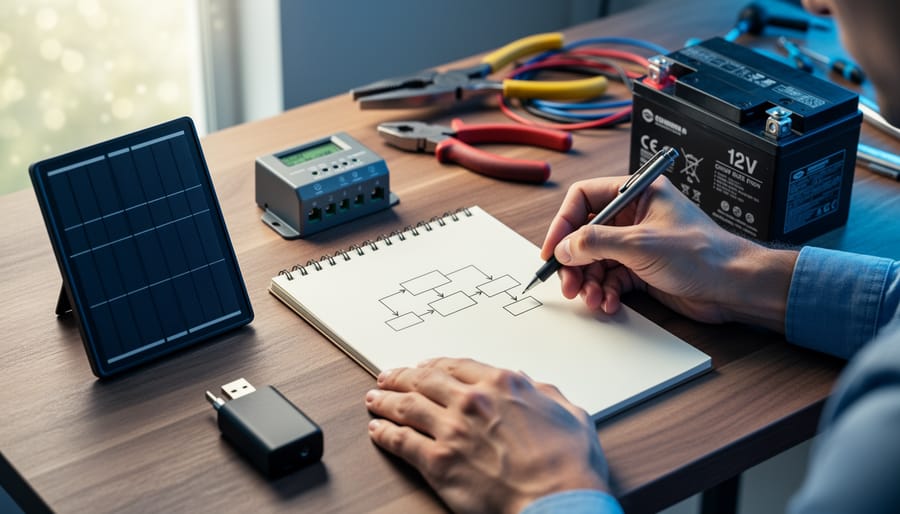
Why Your Solar System Needs an Energy Conversion… by Charlesnoble April 15, 2026 Sketch your solar system’s energy flow on paper before buying a single component—start with the sun at top, draw arrows through your solar panel, charge controller, battery, and finally to your devices, labeling each conversion point with estimated percentages of energy loss. This simple visual reveals exactly where your power…
How Batteries Actually Convert Energy (And Why It… by Charlesnoble April 27, 2026 A battery converts chemical energy stored within its cells into electrical energy that powers your devices—a fundamental transformation that makes everything from your smartphone to your off-grid solar setup possible. Understanding this energy conversion isn’t just academic knowledge; it’s the foundation for choosing the right batteries, calculating how long they’ll…
Subscribe for handpicked DIY projects, exclusive tips, and giveaways.
After testing dozens of solar chargers across camping trips, power outages, and backyard experiments, we found the X-Dragon 20W delivers the most reliable charging performance for phones and tablets, while the Goal Zero Nomad 50W steps up when you need to power larger devices or handle extended emergencies. If you’re planning weekend hikes, assembling an… Read more: 7 Best Solar Powered USB Chargers of 2026, Tested and Reviewed
There is something special about a mature tree. Decades of growth, shade that actually cools the house, branches that the kids climbed, a root system that has quietly held the yard together through every storm. So when circumstances force a move, whether it is a home renovation, a new driveway, or a construction project that… Read more: How to Move a Mature Tree Without Killing It: The Complete Relocation Guide
A mass energy conversion calculator lets you determine how much energy is locked inside any amount of matter using Einstein’s famous equation E=mc². Whether you’re working on a physics assignment or simply curious about the enormous energy potential in everyday objects, the calculation itself takes just seconds once you understand the formula’s three components: energy… Read more: How to Use a Mass Energy Conversion Calculator (Step-by-Step Guide)