Why Your Farm Needs Solar Water Pumping That Follows the Sun
Updated:
Picture this: Your crops are wilting under the afternoon sun while your water pump sits idle because electricity costs spike during peak hours. Or worse, you’re in a remote field with no grid connection at all. I faced this exact frustration on my cousin’s farm three summers ago, watching perfectly good irrigation equipment gather dust because the power bill made pumping water almost as expensive as the crops themselves.
Solar-powered water pumping with automatic sun tracking changes everything. Instead of fixed panels that lose efficiency as the sun moves across the sky, tracking systems pivot throughout the day to maintain optimal angles, boosting energy capture by 25-40% compared to stationary setups. That extra power means more water pumped per dollar spent on equipment, faster fill times for storage tanks, and the ability to run pumps even during cloudy conditions when every watt counts.
The beauty of these systems lies in their self-sufficiency. Once installed, they operate independently without monthly utility bills, diesel fuel runs, or complicated maintenance schedules. The pump runs when the sun shines and water is needed most, then rests at night when irrigation typically stops anyway. For farmers working marginal land, remote pastures, or off-grid homesteads, this alignment of power availability with actual water demand creates remarkable efficiency.
But here’s the honest truth: adding auto-tracking complexity isn’t right for everyone. You’ll pay 30-50% more upfront than fixed panels, and the mechanical components require occasional attention. Whether that investment makes sense depends on your specific situation, which is exactly what we’ll explore together. Let’s break down how these systems actually work and help you decide if tracking technology deserves a place on your land.
What Makes Auto-Tracking Different From Regular Solar Pumps
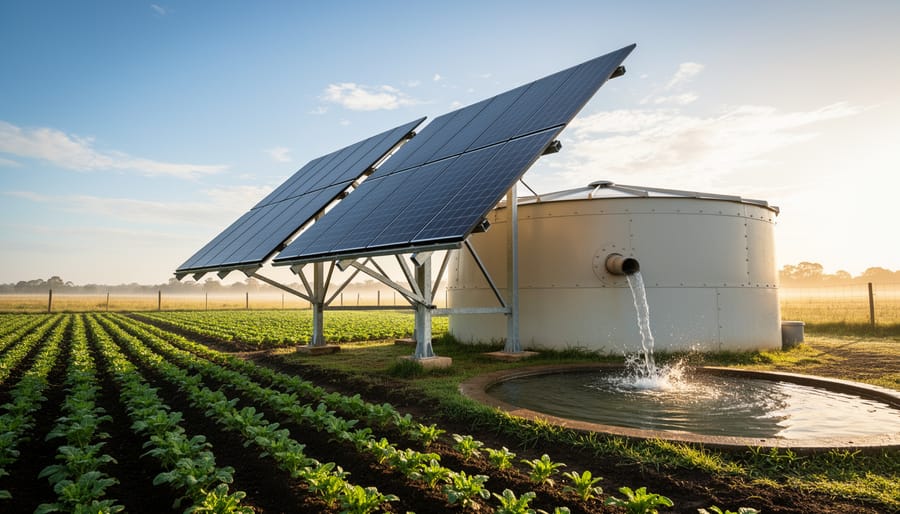
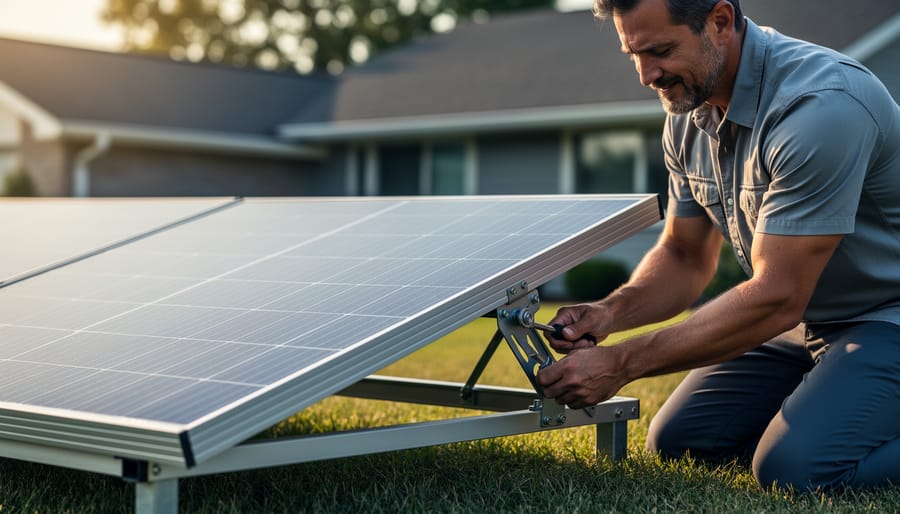
Solar tracking systems actively follow the sun’s movement throughout the day, maximizing energy collection for water pumping applications.
The Real-World Efficiency Gains You Can Expect
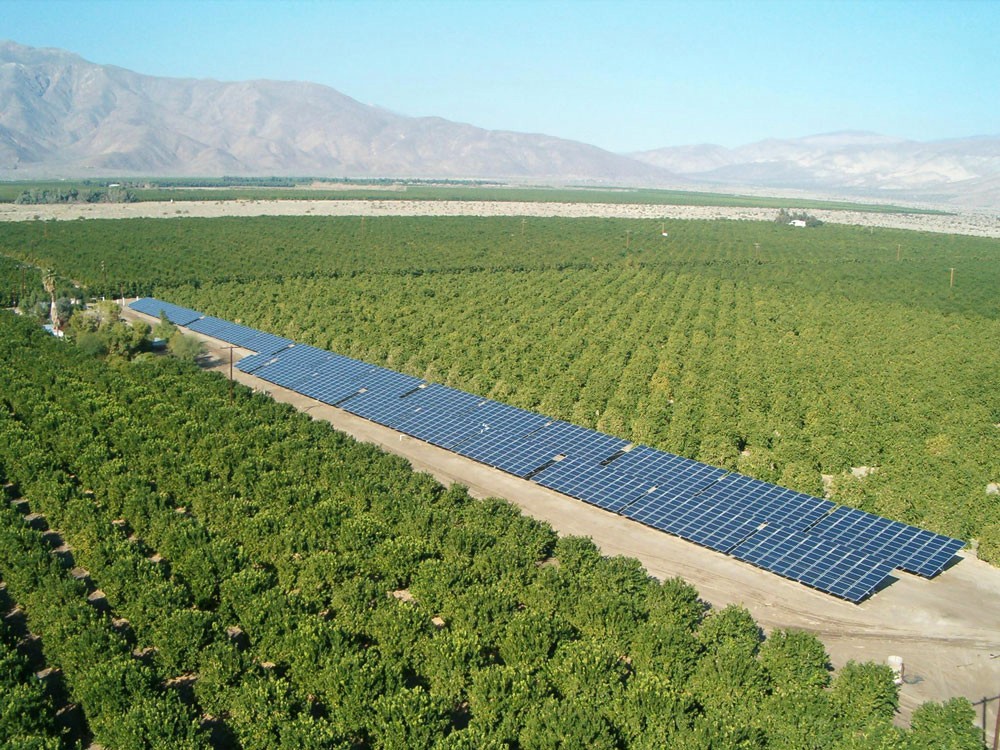
Let me share something I learned from a farmer friend in Arizona who upgraded to auto-tracking last year. His numbers tell the real story: during peak summer months, he pumped an average of 32% more water compared to his fixed-panel setup. That translated to an extra 2,400 gallons daily for his vegetable operation.
Research consistently shows tracking systems deliver 20-40% efficiency gains, but here’s what that actually means for you. In early morning and late afternoon, when fixed panels barely produce power, tracking panels follow the sun’s angle and keep pumping at near-peak capacity. If you’re running drip irrigation or filling livestock tanks, those extra hours matter tremendously.
However, tracking isn’t always the smart choice. If you live near the equator where the sun passes nearly overhead most of the year, you might only see 15-20% improvements. Similarly, if your water needs are modest or you already have oversized fixed panels meeting your demands, the added complexity and cost don’t make practical sense.
The sweet spot? Mid-latitude farms (between 30-50 degrees) with consistent daily watering needs. Spring and fall deliver the biggest tracking advantages when sun angles change dramatically throughout the day. One homesteader in Colorado told me his tracking system essentially eliminated the “shoulder season” performance dips he experienced with fixed panels.
Consider your maintenance tolerance too. Tracking systems have moving parts requiring occasional attention. If you’re the hands-on type who enjoys tinkering and optimization, you’ll appreciate maximizing every solar dollar. But if you prefer set-it-and-forget-it reliability, slightly oversizing a fixed system might serve you better. Calculate whether that 25-35% average gain justifies the investment for your specific situation before committing.
How Solar Auto-Tracking Systems Actually Work
The tracking mechanism uses motors and actuators to adjust panel position, following the sun’s path for optimal energy capture.
Light Sensors vs. Time-Based Tracking
When I started experimenting with auto-tracking systems, I quickly discovered there are two main approaches: light sensors and time-based tracking. Each has its strengths, and choosing the right one really depends on your situation and comfort level with technology.
Light sensors use photoresistors or photodiodes to detect where the sun is brightest. The system continuously compares readings from sensors positioned at different angles and moves the panel toward the strongest light. This sounds perfect in theory, and it does work well in consistently sunny climates. However, I learned the hard way that clouds can confuse these systems. On partly cloudy days, my early prototype would sometimes chase shadows or get stuck oscillating back and forth as clouds passed overhead.
Time-based tracking takes a different approach. It uses a simple clock and predetermined calculations to move the panel based on the sun’s predictable path across the sky. You program in your latitude, and the system follows a schedule. It’s remarkably reliable because clouds don’t affect it, and there are fewer sensors to fail or get dirty.
For DIY builders, I honestly recommend starting with time-based tracking. It’s simpler to build, requires fewer components, and dirt or dust won’t throw off your readings. You can use an inexpensive Arduino or similar microcontroller with a real-time clock module. Light sensors can be finicky and need regular cleaning, especially in agricultural environments where dust and debris are constant challenges. Plus, the difference in energy capture between the two methods is minimal in real-world conditions.
The Components You’ll Need
Let me walk you through what you’ll actually need to get your auto-tracking solar water pump running. I learned this the hard way after my first attempt left me with mismatched parts and a lot of head-scratching.
Your solar panels are the heart of the system. For a typical agricultural pump moving 500-1000 gallons per hour, you’re looking at 300-600 watts of panels. Expect to spend $200-$400 here. This is one area where I recommend buying quality panels with good warranties. Cheap panels degrade faster, and when you’re counting on water for crops or livestock, reliability matters.
The water pump itself depends on your depth and volume needs. Submersible DC pumps work great for wells, while surface pumps handle shallow water sources. Budget $150-$500 depending on specs. You can save money buying reconditioned pumps if you’re handy with basic maintenance.
For the tracking system, you’ll need a solar tracker controller (the brains), linear actuators or motors (the muscle), and sensors to follow the sun. The controller runs $50-$150, while actuators cost $40-$100 each. You’ll need at least two for dual-axis tracking. Here’s where DIYers can really save money. I’ve seen folks build controllers using Arduino boards for under $30, though you’ll invest time learning the programming.
The mounting hardware and frame can be scrounged or fabricated if you’re resourceful. New materials run $100-$200, but I’ve built solid systems using repurposed metal posts and salvaged materials for half that.
Total budget? Expect $600-$1400 for a complete system, with the lower end achievable if you’re willing to DIY the tracking components and get creative with mounting.
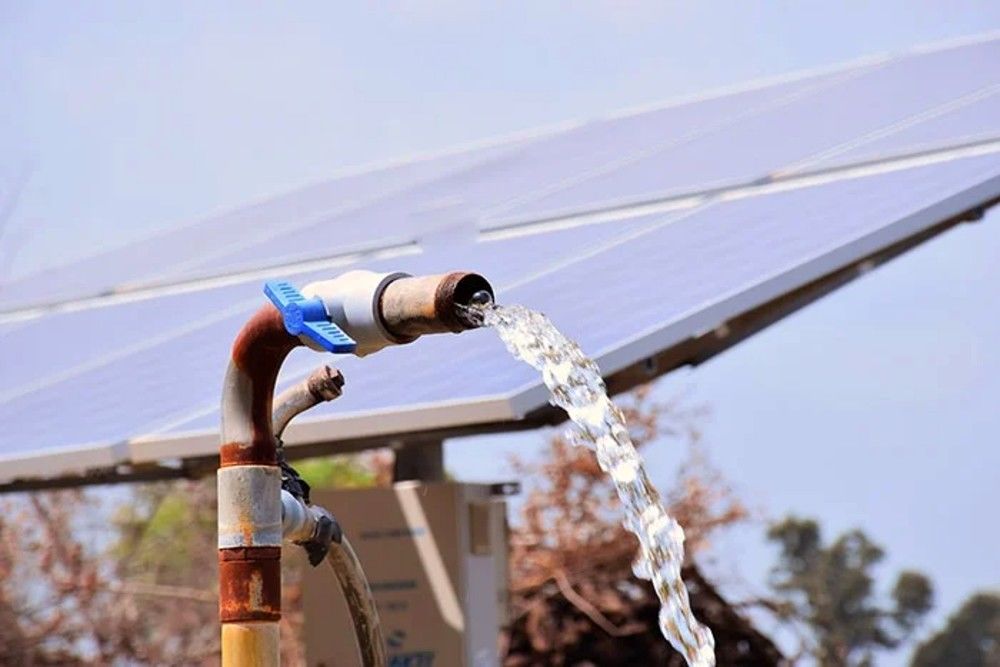
Key components for a solar tracking water pump system include the pump, solar panels, tracking controller, and mounting hardware.
Sizing Your System for Your Actual Water Needs
Pump Head, Flow Rate, and What They Mean for Your Setup
When I first started looking at water pumps for my homestead garden, I got lost in spec sheets filled with numbers that meant nothing to me. Let me break down the two most important ones in plain English.
Pump head is essentially how high your pump can push water vertically, measured in feet or meters. Think of it like this: if your water source is 20 feet below ground and your garden is another 10 feet uphill from there, you need at least 30 feet of head. But here’s what the spec sheets don’t always tell you clearly—you should add another 20-30% as a safety buffer because friction in pipes and bends reduces the effective head.
Flow rate tells you how much water moves through your system per minute or hour, usually shown as gallons per minute (GPM) or liters per hour. To picture this, a typical bathtub holds about 40-50 gallons. A pump rated at 5 GPM would fill that tub in roughly 10 minutes. For agricultural use, calculate how much water your crops need daily, then work backward to figure out the flow rate you need based on how many hours of good sunlight you’ll get.
Here’s my quick rule of thumb from experience: most small agricultural setups (under one acre of vegetables) do fine with 3-5 GPM and 30-50 feet of head. Larger operations or those with significant elevation changes need to crunch the numbers more carefully using online calculators designed for irrigation systems.
Building Your Own vs. Buying a Complete System
DIY Auto-Tracking: What You’re Really Getting Into
Let me be honest with you: building an auto-tracking system isn’t a weekend project. Charles learned this the hard way when his first attempt at motorized tracking ended with a panel pointed stubbornly at the ground for three days straight. “I thought I could skip the limit switches to save money,” he recalls. “Big mistake. My tracker went full circle and nearly ripped the wiring out.”
Here’s what you’re actually signing up for. First, the tools. Beyond basic solar installation equipment, you’ll need a decent multimeter, wire strippers, and ideally a drill press for mounting the tracking mechanism. Charles spent about $200 on tools he didn’t already own, not counting the tracker components themselves.
The complexity hits hardest during calibration. Your tracking system needs to know where it is, where the sun is, and how to get there without overshooting. Dual-axis trackers are particularly finicky because you’re managing two motors that need to work in harmony. Charles’s advice? Start with single-axis tracking if you’re new to this. You’ll capture 70-80% of the tracking benefit with half the headaches.
Common pitfalls include underestimating wind loads (your moving panel becomes a sail), using inadequate foundations (concrete is your friend), and neglecting weatherproofing on electrical connections. One thunderstorm taught Charles that “water-resistant” doesn’t mean waterproof.
Budget realistic timelines too. Charles’s first complete system took three weekends plus numerous evenings troubleshooting. His second build? Just two days, because he knew what to expect.
The learning curve is steep, but manageable if you approach it methodically and don’t rush the planning phase.
Installation Considerations That Matter
Maintenance and What Actually Goes Wrong
Let’s be honest: these systems aren’t “set and forget,” but they’re not maintenance nightmares either. I learned this the hard way when my tracking motor stopped mid-rotation during peak growing season. The culprit? Dust buildup on the sensor.
Your solar panels need cleaning every 4-6 weeks, more often in dusty agricultural areas. Bird droppings and pollen can cut efficiency by 20-30%. A simple rinse with water usually does the trick, but avoid harsh chemicals that might damage panel coatings.
The tracking mechanism is where most problems happen. Gears and motors exposed to weather accumulate grit, which causes premature wear. Plan on lubricating moving parts every three months and checking for loose bolts. The light sensors that guide tracking can get covered in debris or spider webs, causing erratic movement. A quick wipe-down monthly prevents this.
Pump failures typically stem from dry-running when water levels drop unexpectedly. Installing a float switch prevents this entirely. Check it quarterly to ensure it’s functioning. Electrical connections corrode over time, especially in humid environments. Coat them with dielectric grease and inspect them twice yearly.
Battery systems (if you’re using them) need voltage checks every month. Batteries usually last 3-5 years before replacement becomes necessary.
The tracking controller occasionally needs recalibration, particularly after storms or if someone bumps the system. Most modern controllers make this a 10-minute job with clear instructions.
Budget 2-3 hours monthly for thorough maintenance. It’s less work than maintaining a gas generator, and you’ll catch small issues before they become expensive repairs.
Real-World Applications Beyond Traditional Farming
While traditional agriculture remains the primary focus, I’ve discovered that auto-tracking solar pumping systems open up fascinating possibilities for anyone needing reliable water access beyond conventional farms. Let me share some creative applications that might surprise you.
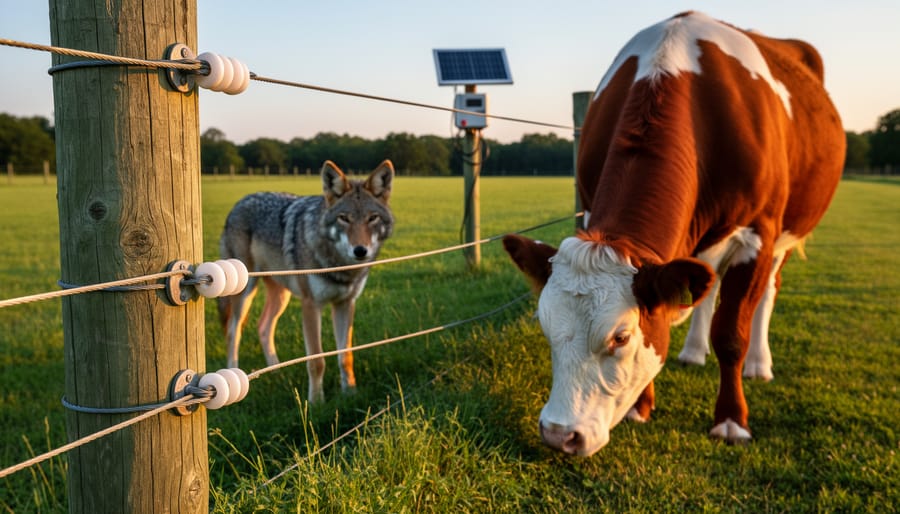
Remote livestock operations benefit tremendously from these systems. If you’re managing cattle, sheep, or horses across sprawling acreage without grid access, a tracked solar pump can deliver water to distant pastures or troughs. The auto-tracking feature ensures consistent performance even during shorter winter days when animals still need their full water supply. Pair this with solar electric fencing, and you’ve got a completely off-grid livestock management solution.
Off-grid homesteaders are finding these systems perfect for establishing water independence. Whether you’re drawing from a well, spring, or creek, the tracking capability maximizes your daily water harvest for household use, laundry, and bathing. One fellow DIYer I know in Colorado installed a tracked system that outperforms his neighbor’s fixed panels by nearly 35 percent during critical summer months.
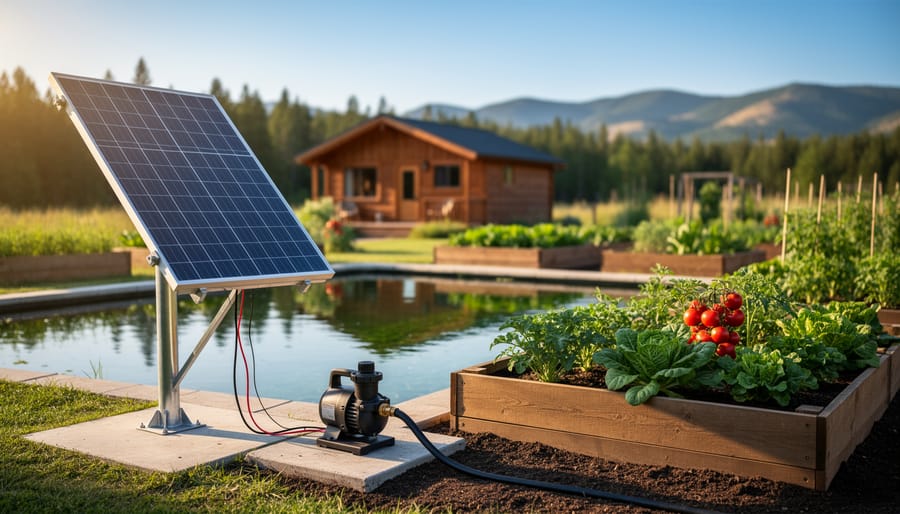
Garden enthusiasts are scaling down the technology for impressive backyard applications. Combined with solar drip irrigation systems, these pumps can transform hobby gardens into productive food sources. The efficiency gains from tracking mean smaller, more affordable panel arrays that still deliver adequate pressure for solar irrigation pumps.
Camping properties and recreational land also benefit from seasonal water access without trenching power lines. Emergency preparedness advocates are installing these as backup water systems that operate independently during grid failures. The versatility really shines when you realize that reliable water access solves countless challenges across diverse situations.
Solar tracking systems excel in remote livestock watering applications where grid power is unavailable and maximum water output is needed.
When I first started exploring solar water pumping years ago, I never imagined how accessible this technology would become. Today, you have the power to build a system that not only reduces your energy bills but gives you true independence from the grid. That’s what this journey is really about—taking control of your water supply with clean, renewable energy.
Is auto-tracking worth the added complexity? For many applications, absolutely. If you’re pumping significant volumes daily or operating in areas with less-than-ideal sun angles, that 25-40% efficiency boost translates to real dollars saved and more water pumped. You’ll recoup the additional investment faster than you might think.
But here’s my honest advice: start by understanding your specific needs. Use our sizing calculators to figure out your daily water requirements, your location’s solar potential, and what pump capacity you actually need. Don’t overbuild or get seduced by fancy features you won’t use. Match the technology to your application.
The future of DIY solar water solutions is bright, and it’s being built by people like you—backyard tinkerers, curious homesteaders, and practical problem-solvers. Join our community forums, share your questions, and learn from others who’ve walked this path. Whether you start with a simple fixed-panel system or dive straight into auto-tracking, you’re making a choice that benefits both your wallet and our planet.
Take that first step today. Calculate, plan, and build your energy independence, one solar panel at a time.
How useful was this post?
Click on a star to rate it!
Average rating 0 / 5. Vote count: 0
No votes so far! Be the first to rate this post.
We are sorry that this post was not useful for you!
Let us improve this post!
Tell us how we can improve this post?
charlesnoble
Here at Spheral Solar, I’m a hands-on solar power enthusiast, constantly exploring and experimenting with DIY solutions. I’m dedicated to sharing my discoveries, insights, and even the bumps I hit along the way, all in the pursuit of a more sustainable future.
How Does a Solar-Powered Drip Irrigation System Work by Paul September 13, 2021 Solar-powered drip irrigation can be installed in most gardens using a small solar system, readily available irrigation materials, and minimal tools. If you already have a home solar system, it can be tapped into without installing a dedicated system. And the installation of an average drip irrigation system is well…
5 Best Solar Powered Water Pump for Irrigation in… by Adeyomola June 18, 2021 A high-capacity solar panel is not all that defines the best solar water pumps. Factors like flow rate, head lift, pump efficiency, and power source flexibility add to the total quality a solar-powered water pump for irrigation will offer. Then the ease of maintenance and resistance to corrosion will determine…
Why Your Next Outdoor Water Pump Should Run on Sunshine by Charlesnoble March 12, 2026 Picture this: You’re standing in your garden on a sunny afternoon, watching crystal-clear water flow effortlessly from your well to your vegetable beds—no extension cords snaking across the lawn, no monthly electricity bills, and no guilt about your carbon footprint. That’s the promise of solar powered outdoor water pumps, and…
Solar Water Pumps That Bring Your Garden Features to… by Charlesnoble January 13, 2026 Match your pump’s wattage to your solar panel capacity by calculating total daily runtime hours multiplied by pump watts, then add 30% for cloudy days and battery charging losses. A typical 10-watt fountain pump running 8 hours daily needs a minimum 20-watt panel and 12-volt, 7-amp-hour battery to maintain consistent…
7 Best Solar Well Pump Reviews by Charlesnoble August 11, 2023 The best solar well pumps come with efficient systems and durable bodies and are easy to install. But when it comes to it, the best of the best is a solar pump with a high flow rate and high lift. It is only right that the best solar-powered water pumps…
How Solar-Powered Greenhouses Slash Your Growing… by Charlesnoble November 13, 2025 Picture this: It’s mid-July, your tomatoes are thriving, but your electricity bill just jumped $80 because your greenhouse exhaust fans have been running nonstop. I’ve been there. Three summers ago, I watched my monthly power costs climb while knowing the sun beating down on my 12×16 greenhouse could be doing…
Subscribe for handpicked DIY projects, exclusive tips, and giveaways.
Position your solar panels at an angle equal to your latitude for year-round performance, or adjust seasonally by adding 15 degrees in winter and subtracting 15 degrees in summer to capture maximum sunlight during each season’s sun path. Use a simple angle finder app on your smartphone against the back of your panel to verify… Read more: The Right Tilt Angle Can Boost Your Solar Panel Output by 30% (Here’s How to Find It)
Route your PV wires through UV-resistant conduit within 18 inches of leaving the solar array, securing it every 3 feet with proper clamps to prevent wind damage and code violations. This single step prevents 80% of the wire degradation issues I’ve seen in DIY solar installations over the past decade. Group your positive and negative… Read more: Why Your PV Wire Management Could Fail Inspection (And How to Fix It)
Understand that 6000 volts sounds terrifying but delivers surprisingly low amperage—typically around 120 milliamps for just 3/10,000th of a second per pulse. This combination creates an unforgettable shock that trains animals to avoid the fence without causing lasting harm. The voltage pushes current through thick fur and hide, while the minimal amperage and microsecond duration… Read more: Why 6000 Volts Won’t Kill Your Livestock (But Will Stop Predators Cold)